
By Michael Nielsen, Publisher | 15+ Years in Diesel Repair & Fleet Operations
Last Updated: September 2026
⏱ Estimated reading time: 15 minutes
CAN bus diagnostics for heavy-duty trucks has become essential knowledge for fleet managers and diesel technicians working with today's electronically integrated commercial vehicles. When Controller Area Network communication fails, the entire vehicle operation suffers — unexpected downtime, reduced fuel efficiency, and safety concerns that put drivers and cargo at risk. Understanding how to identify, diagnose, and resolve these network communication errors separates skilled technicians from those left guessing at problems.
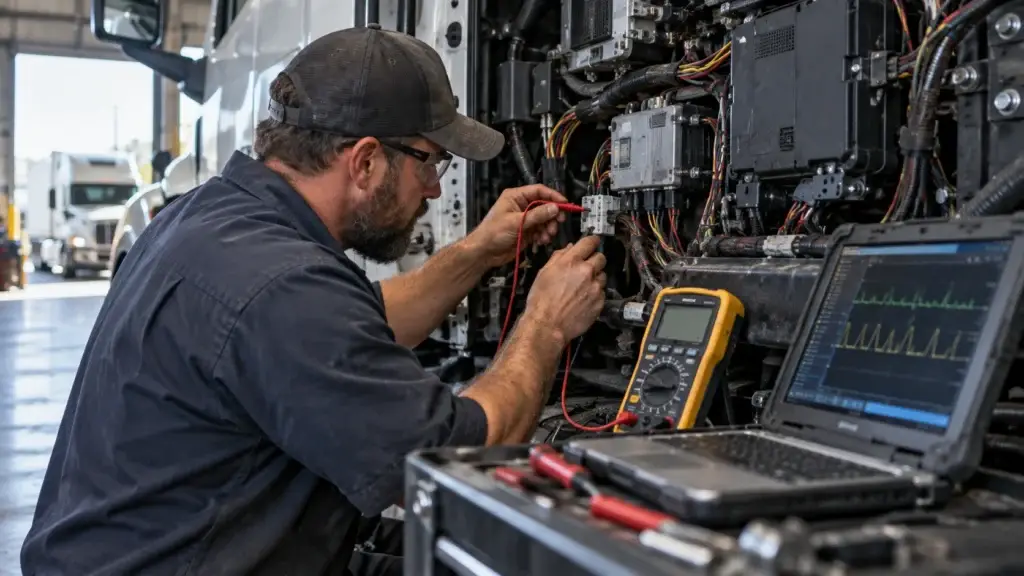
Modern commercial trucks rely on sophisticated electronic networks connecting engine controllers, transmission modules, brake systems, and emission controls, coordinating hundreds of operations every second under extreme temperatures, constant vibration, and moisture exposure. This guide focuses on the physical-layer troubleshooting and repair work that separates a real diagnosis from a guess — voltage and resistance testing, oscilloscope waveform analysis, wire repair, and the preventive maintenance habits that keep network failures from happening in the first place.
Michael Nielsen's take on the distinction, after 15+ years around diesel shops: reading a fault code tells you what the ECM already knows, but physical-layer testing is what tells you why the network is actually failing.
Key Takeaways
- ✓CAN bus networks connect 20-30 ECUs in a heavy-duty truck, enabling real-time data sharing between engine, transmission, brakes, and emissions systems.
- ✓Wiring and connection failures cause most network problems. Vibration-induced wire breaks at rigid connection points and connector corrosion account for the bulk of real-world CAN bus failures.
- ✓Termination resistance is the fastest health check. A network measuring 60 ohms with power off has both 120-ohm terminators intact — anything else points to a specific, identifiable fault.
- ✓Proper diagnosis requires the right tools — professional scan tools, a high-impedance digital multimeter, and an oscilloscope to verify both protocol-level and physical-layer network health.
- ✓Systematic network segmentation testing isolates faulty components without swapping parts on a guess — disconnect, measure, and narrow the search methodically.
In This Guide
- Understanding CAN Bus Systems in Commercial Vehicles
- Common CAN Bus Network Issues in Heavy-Duty Trucks
- Recognizing Symptoms of CAN Bus Network Failures
- Essential Diagnostic Tools and Equipment
- Step-by-Step CAN Bus Diagnostic Procedures
- Advanced Troubleshooting Techniques
- Repairing and Resolving Network Problems
- Preventive Maintenance Strategies for CAN Bus Systems
- Frequently Asked Questions
Understanding CAN Bus Systems in Commercial Vehicles
CAN bus diagnostics starts with the Controller Area Network itself — a robust vehicle bus standard, developed by Robert Bosch GmbH in the 1980s, that lets microcontrollers and devices communicate without a host computer. Today's commercial trucks typically manage 20 to 30 electronic control units simultaneously through this network. Every device connects to a common data bus rather than point-to-point wiring, broadcasting messages that all other nodes receive, with a priority system where lower identifier numbers get faster bus access.
The SAE J1939 protocol governs most heavy-duty communications on top of that CAN foundation, organizing data into Parameter Group Numbers and identifying faults through Suspect Parameter Numbers and Failure Mode Identifiers — for example, "SPN 94, FMI 1" points directly to fuel delivery pressure failing low.
HDJ's J1939 protocol guide covers that message structure, PGN/SPN breakdown, and OEM diagnostic software (Cummins INSITE, Detroit DDDL, Cat ET) in full depth — this guide instead focuses on what happens below the protocol layer, in the physical wiring and hardware that actually carries those messages.
Two twisted-pair wires — CAN-High and CAN-Low — carry every message as a differential voltage signal, with termination resistors at each end of the bus preventing the signal reflections that corrupt data. Heavy-duty applications typically shield these cables against electrical noise from alternators and other high-current devices. Without proper 120-ohm termination at both ends, reflected signals create the interference that shows up as intermittent communication errors — which is exactly why termination resistance is the first thing to check on any CAN bus complaint.
Common CAN Bus Network Issues in Heavy-Duty Trucks
Commercial vehicles face CAN bus challenges passenger cars rarely see, thanks to extreme operating conditions and constant vibration. Road debris impacts, temperature swings from -40°F to 150°F, chemical exposure from road treatments, and relentless vibration combine to create a genuinely hostile environment for delicate electronic communications.
Wiring faults are the most common source of network failures. Road debris can penetrate protective conduits and sever wires, while constant flexing at connection points fatigues conductors until they break. This happens most often at rigid connection points where harnesses transition from flexible cable to fixed connectors — engine mounting areas see particularly severe vibration, and the breaks that result often create intermittent faults that appear and disappear as the vehicle moves.
Watch four connection points especially closely: seven-way trailer connectors exposed to weather and mechanical stress, engine compartment connections cycling through extreme heat, chassis harness routing points vulnerable to abrasion, and ECU connector terminals susceptible to fretting corrosion from vibration-driven micro-movement.
Termination Resistance Problems
Proper CAN bus operation requires exactly two 120-ohm termination resistors at opposite ends of the network backbone — measured across CAN-High and CAN-Low with the network unpowered, a healthy network reads approximately 60 ohms. Deviations from that value point directly to specific failure modes.
| Measured Resistance | Condition Indicated | Network Impact |
|---|---|---|
| 60 ohms (±5 ohms) | Correct termination present | Normal operation expected |
| 120 ohms | One terminator missing or failed | Increased error rates, intermittent failures |
| Below 50 ohms | Additional termination present | Signal amplitude reduction, failures |
| Infinite resistance | Both terminators missing or open circuit | Severe reflections, network inoperative |
ECU Malfunctions and Bus-Off States
ECU failures disrupt communication when a module loses the ability to transmit or receive correctly, stemming from internal hardware failure, corrupted firmware, or power supply problems in the CAN transceiver circuitry. A single failing ECU can impact the entire network by generating invalid messages or monopolizing bandwidth. The protocol defines three error states based on accumulated errors: error-active modules detect and signal errors while continuing normal operation, error-passive units have exceeded thresholds and limit their signaling, and bus-off forces an ECU to fully disconnect after severe repeated errors.
Recognizing Symptoms of CAN Bus Network Failures
When multiple unrelated warning lights illuminate at once — check engine, ABS, transmission fault — that pattern strongly suggests a network-level issue rather than independent component failures, since the affected ECUs simply can't communicate with the instrument cluster. Modern trucks also display specific messages like "Communication Error," "Network Fault," or "Lost Communication with Engine Control Module." Warnings that disappear on an ignition cycle suggest an intermittent connection problem; persistent warnings usually mean more serious physical-layer damage.
Intermittent problems are the hardest to chase — cruise control disengaging without input, gauge readings fluctuating, an engine unexpectedly entering limp mode. Temperature swings often trigger these: a connector working fine cold may fail once engine heat causes thermal expansion. Document exact conditions when a problem occurs — vehicle speed, engine temperature, ambient conditions, active systems — since that documentation is what turns an unreproducible complaint into a diagnosable one.
Subtle performance changes often precede full failure: delayed system responses, unusual shift patterns, or fuel consumption drift as the engine ECU loses accurate real-time data from other systems. Telematics platforms provide an early warning too — intermittent disconnections or reporting gaps in the fleet portal can show up weeks before a driver notices anything.
Essential Diagnostic Tools and Equipment
Professional diagnostic equipment for heavy-duty applications differs meaningfully from consumer-grade automotive tools, and the investment pays for itself through faster diagnostics and less downtime. A heavy-duty scanner understanding the J1939 protocol structure — not a generic OBD-II reader — is the primary interface for reading fault codes, viewing live data, and running active tests.
HDJ's full evaluation of Noregon JPRO covers what a multi-brand professional platform costs and whether it fits a mixed-brand shop, while engine-specific tools like Cummins INSITE, Detroit DDDL, and Caterpillar ET provide deeper access to proprietary parameters on their respective platforms.
A digital multimeter handles physical-layer measurements — look for high impedance (at least 10 megohms) so the meter doesn't load sensitive circuits. With the network operational, CAN-High should read 2.5-3.5 volts relative to ground at idle, and CAN-Low 1.5-2.5 volts. An oscilloscope goes further, revealing waveform shape and timing that a multimeter simply can't show — configure it with a 10-volt-per-division vertical scale and 100-microsecond-per-division time base, and expect clean, square transitions without excessive ringing or slow rise times on a healthy network.
Dedicated CAN bus analyzers go beyond scan tools, capturing and decoding traffic in real time — individual messages with their identifiers, data bytes, and timestamps. Long-term logging is invaluable for intermittent problems, recording hours of traffic and triggering captures on specific conditions, while error-frame detection surfaces protocol-level problems invisible to a standard scan tool.
Step-by-Step CAN Bus Diagnostic Procedures
A logical sequence — from visual inspection to signal analysis — keeps diagnostics efficient and avoids swapping parts on a guess. Start by documenting every active warning light and symptom, then inspect the entire harness for chafing, cuts, burns, or pinched wires, paying special attention to frame pass-throughs and areas near moving components. Check every connector for corrosion, bent pins, or looseness; trailer connections and glad-hand areas deserve extra scrutiny since they see the most mechanical stress from coupling and uncoupling.
Connect a professional scan tool and establish communication with every ECU — modern trucks can carry more than a dozen modules, each needing individual interrogation. Retrieve both active and inactive fault codes from each one; active codes indicate current problems, inactive codes show history.
HDJ's SPN and FMI fault code guide walks through interpreting exactly what you find, but the code that specifically flags network trouble is SPN 639, FMI 2 — "J1939 Data Link, Data Erratic, Intermittent, or Incorrect" — which points directly at the CAN bus itself rather than any single component.
Digital multimeter testing comes next: access CAN-High at pin 6 and CAN-Low at pin 14 of the diagnostic connector, referencing to ground at pin 4 or 5. Idle voltage should read approximately 2.5 volts on both lines when no messages are transmitting. Resistance measurements require the system fully powered down — 60 ohms across CAN-High and CAN-Low confirms both terminators are functioning; readings above that suggest a missing or damaged terminator, while lower readings point to a short or unintended extra termination.
Oscilloscope testing catches signal-integrity problems a multimeter can't. Connect channel one to CAN-High and channel two to CAN-Low with a solid chassis or DLC ground reference — transitions between dominant and recessive states should look clean and sharp, and the two waveforms should mirror each other with equal but opposite voltage swings. Asymmetry between the lines points to a circuit imbalance degrading noise immunity; document abnormal waveforms with screenshots to compare after the repair.
Advanced Troubleshooting Techniques
When conventional steps can't isolate a persistent problem, systematic network segmentation testing pinpoints which portion of a complex system — powertrain CAN, body CAN, chassis CAN — contains the fault. Start by mapping every ECU and its physical connection, then disconnect strategically: begin with external connections like trailer harnesses and auxiliary equipment, check termination resistance after each disconnection, test functionality, and progressively narrow the search by subdividing faulty segments. When disconnecting a specific ECU resolves the problem, that module or its wiring becomes the primary suspect.
Testing individual ECUs starts with the basics: measure supply voltage at the connector (typically 12-24V depending on the system) and confirm ground connections show less than 0.1V drop under load. Diagnostic software reveals per-ECU error counters — watch for modules with rapidly climbing counts. Testing a suspect module on a known-good vehicle or bench confirms whether it has actually failed internally; a module that works fine in isolation but fails on the truck points to wiring or environmental problems, not the ECU itself.
Short-circuit diagnosis relies on resistance measurements with power disconnected: CAN-High to ground and CAN-Low to ground should both read in the megohms — anything below 1,000 ohms suggests a short to ground. CAN-High to CAN-Low should read approximately 60 ohms with both terminators connected; near-zero resistance means a direct short between the signal lines.
When a short shows up, disconnect segments systematically until it disappears. Open-circuit faults show as infinite resistance on lines that should show continuity — pair the electrical test with a visual check for damaged insulation, corrosion, and abraded wires contacting metal.
Repairing and Resolving Network Problems
Once diagnostics identify the root cause, quality repair technique matters as much as the diagnosis itself. CAN bus wire repair has to preserve the network's electrical characteristics — use replacement cable matching the original 120-ohm characteristic impedance and the correct twist rate (usually 13-16 twists per foot), since the twisted-pair design exists specifically to cancel electromagnetic interference.
Avoid splicing in high-flex areas near articulation points — repairs there fail far more often than repairs in stationary locations. Complete harness replacement is the better call when damage is extensive or the affected location makes a proper splice impractical. Always follow OEM-specific repair procedures to protect warranty coverage.
Connector maintenance addresses one of the most frequent causes of network problems: inspect visually for green or white corrosion deposits, clean with proper electrical contact cleaner (not a general-purpose solvent that leaves residue), and apply dielectric grease after cleaning and straightening pins. Test retention force — pins that feel loose or need excessive force to remove indicate worn retention features and should be replaced regardless of visible condition. Seven-way trailer connectors specifically warrant inspection every 10,000-15,000 miles in severe-duty applications.
When an ECU has failed beyond repair, verify the part number carefully — similar-looking units can carry different firmware or calibration, and most modern ECUs need programming or configuration after installation rather than simple plug-and-play replacement. That typically means VIN programming, parameter configuration, calibration file installation, and security authentication; some manufacturers restrict certain functions to dealer networks while others allow independent shop access through subscription services. If the replacement work overlaps with performance calibration, HDJ's ECM reprogramming guide covers what legitimate calibration work should and shouldn't touch.

Preventive Maintenance Strategies for CAN Bus Systems
A comprehensive preventive maintenance program is what keeps a network failure from becoming a roadside breakdown. During the CVSA's 2025 International Roadcheck, inspectors placed 18.1% of the 56,178 commercial vehicles inspected out of service — brakes, tires, and lighting topped the list of causes, a reminder that the defects inspectors catch most often are also the ones a structured inspection program catches first.
18.1%
Vehicle out-of-service rate during CVSA's 2025 International Roadcheck — 10,148 of 56,178 commercial vehicles inspected across the U.S., Canada, and Mexico were placed out of service.
HDJ's predictive maintenance ROI guide covers the broader cost case for catching electrical and mechanical issues before they become roadside events — heavydutyjournal.com's fleet-technology coverage applies the same standard across every maintenance category, not just CAN bus networks.
Daily pre-trip inspections are the first line of defense — drivers should visually check exposed wiring and trailer connectors for damage or looseness. Monthly inspections should connect a scan tool to verify every ECU communicates cleanly with no stored fault codes. Quarterly testing establishes baseline voltage and termination-resistance measurements to compare against future readings, and a full fault-code history review catches intermittent problems even when no warning light has appeared. Annual comprehensive testing should add oscilloscope signal analysis and bus-load review under typical operating conditions.
Route cables away from heat sources like exhaust components and turbochargers, and secure harnesses every 12-18 inches to limit movement. Apply dielectric grease to exposed connectors — trailer connections especially — and verify firewall and floor grommets remain sealed.
49 CFR Part 396 requires motor carriers to systematically inspect, repair, and maintain every commercial motor vehicle under their control, electrical systems included — keep ECU firmware current too, since manufacturers regularly resolve communication bugs through software updates rather than hardware changes, and document every version installed so future troubleshooting can rule firmware in or out quickly.
Frequently Asked Questions
What causes CAN bus communication errors in heavy-duty trucks?
Most stem from physical-layer problems: damaged wiring, corroded connectors, incorrect termination resistance, or a failing ECU. Vibration-induced wire breaks at rigid connection points are the single most common cause — see the Common Network Issues section above for the specific connection points to check first.
How do I measure CAN bus termination resistance correctly?
Power the network down completely, then measure resistance between CAN-High (pin 6) and CAN-Low (pin 14) at the diagnostic connector. Roughly 60 ohms means both terminators are healthy — see the resistance table above for what other readings indicate.
What scan tools work best for CAN bus diagnostics on heavy-duty vehicles?
Professional J1939-capable scanners like Noregon JPRO cover multi-brand diagnostics, while engine-specific tools (Cummins INSITE, Detroit DDDL, Cat ET) offer deeper OEM access. Dedicated CAN bus analyzers add protocol-level traffic capture for the toughest intermittent cases.
How can I tell if a CAN bus problem is network-wide or module-specific?
Multiple unrelated warning lights firing at once usually signals a network-wide issue. If disconnecting one module restores normal function, that module or its wiring is the problem — the Advanced Troubleshooting section above covers the full segmentation-testing sequence.
What preventive maintenance intervals prevent CAN bus failures?
Daily visual checks, monthly scan-tool verification, quarterly baseline voltage/resistance testing, and annual oscilloscope analysis. Trailer connectors in severe-duty use need inspection every 10,000-15,000 miles — see the Preventive Maintenance section above for the full tiered schedule.
Professional diagnostic practice is the foundation of successful heavy-duty maintenance, and the investment in proper training, quality tools, and systematic troubleshooting pays for itself in reduced downtime and accurate repairs. As commercial vehicle electronics keep growing more complex, the technicians who master physical-layer CAN bus diagnostics — not just code lookup — become the ones a fleet can't afford to lose.
Found This CAN Bus Guide Helpful?
Share it with your maintenance team and fellow fleet professionals — the troubleshooting techniques here can save hours of diagnostic time and prevent a costly roadside breakdown.