By Michael Nielsen, Editor & Publisher | 15+ Years in Diesel Repair
Last Updated: January 2026
📖 Estimated reading time: 22 minutes
Fleet managers and equipment operators face a critical decision in 2025: how to balance maintenance budgets without sacrificing performance. Remanufactured diesel parts offer a compelling solution, delivering substantial savings while meeting rigorous industry standards—typically 30-50% less than new OEM equivalents with comparable reliability and warranty protection.
The global market for restored automotive components is projected to reach $68-78 billion in 2025, growing at approximately 6-8% annually through the next decade. This expansion reflects a fundamental shift in how professionals approach equipment maintenance and cost management, driven by stricter emissions regulations, extended vehicle lifespans, and increasing adoption of circular economy practices.
Modern diesel component restoration has evolved dramatically. Professional remanufacturers now deliver products that match or exceed original manufacturer specifications through advanced machining, comprehensive testing, and rigorous quality controls. Fleet operators across trucking, construction, agriculture, marine, and industrial sectors are discovering that quality rebuilt diesel components provide exceptional long-term value.
This comprehensive guide examines everything you need to know about remanufactured diesel parts: industry quality standards and certifications, detailed cost comparisons by component type, performance reliability metrics, warranty coverage analysis, and total ownership calculations. Smart component choices extend beyond initial purchase price to encompass long-term value creation and environmental sustainability.
Key Takeaways
- Cost savings: Restored components cost 30-50% less than new OEM equivalents while delivering comparable performance and 75-90% of new component lifespan
- Market growth: The global automotive remanufacturing market is valued at $60-78 billion in 2025 with 6-8% annual growth projected through 2030
- Quality assurance: ISO 9001 certified facilities and APRA member remanufacturers achieve field failure rates of 2-4%, comparable to new OEM parts
- Total cost of ownership: Including warranty protection, installation costs, and expected service life delivers superior long-term value versus rebuild or used alternatives
- Environmental impact: Remanufacturing reduces carbon emissions by 80-85% and conserves 85% of raw materials compared to new production
- Warranty coverage: Quality remanufacturers offer 12-36 month warranties with comprehensive coverage matching new component protection
Understanding the Remanufactured Diesel Parts Market in 2025
As diesel engines power the backbone of American commerce—from Class 8 long-haul trucks to agricultural equipment and construction machinery—the demand for cost-effective, quality replacement components continues to surge. The diesel parts remanufacturing sector has reached a significant milestone, with industry research projecting the global automotive remanufacturing market at $65-78 billion in 2025, growing at 6-10% compound annual growth rates through 2030.
Market data reveals the breadth of remanufacturing activity across critical diesel systems. Engine components account for approximately 30 million units annually, while transmission remanufacturing reaches 25 million units. Starting systems and alternators each represent approximately 40 million remanufactured units annually. These volumes demonstrate growing recognition among fleet operators that professionally restored components deliver genuine value.
Several converging factors drive this market expansion. Stricter EPA emissions regulations increase the complexity and cost of new replacement parts, making remanufactured alternatives more attractive. Extended vehicle lifespans—now averaging 12.5 years in the U.S.—generate sustained demand for quality replacement components. Meanwhile, technological advancements enable successful restoration of increasingly sophisticated diesel systems, including common rail fuel injection and advanced emissions control equipment.
Defining Remanufactured Diesel Components
A remanufactured diesel part is a component that has undergone systematic restoration to “like-new” condition through comprehensive industrial processes. This restoration follows rigorous standards that distinguish professional remanufacturing from simple repair work or component cleaning—a critical distinction that directly impacts reliability and warranty protection.
A genuinely remanufactured diesel part progresses through six essential stages. First, complete disassembly breaks down the component to individual elements for thorough evaluation. Second, industrial-grade cleaning removes all contaminants, carbon deposits, and residual fluids using specialized equipment and chemical processes.
Third, precision inspection employs calibrated measuring instruments and diagnostic tools to assess each element against OEM specifications. Fourth, replacement of worn components substitutes new parts for any elements falling outside acceptable tolerance ranges. Fifth, reassembly to OEM specifications reconstructs the component using proper torque values, clearances, and assembly sequences.
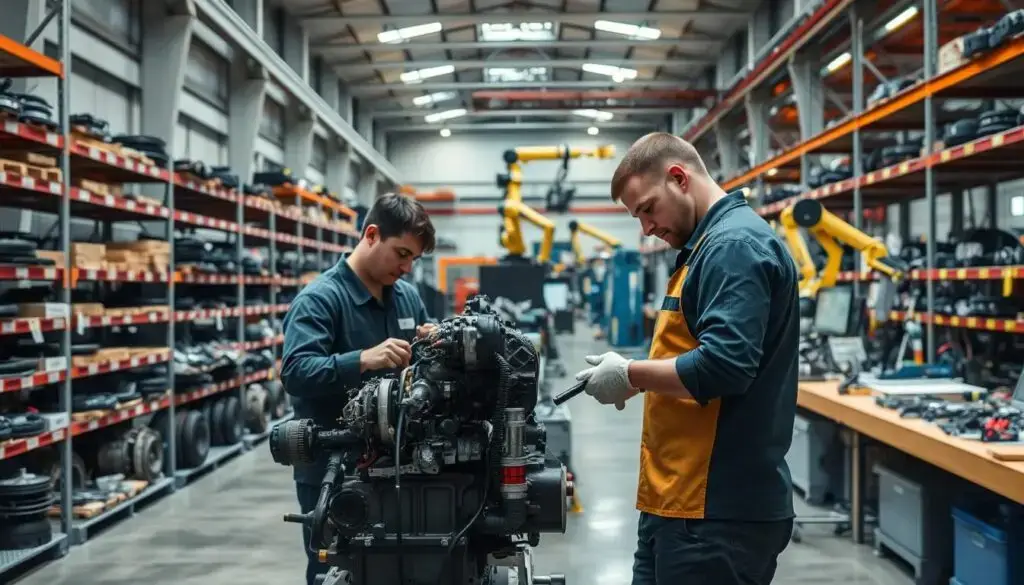
The final stage involves comprehensive testing that validates performance across all operational parameters. Quality remanufacturers invest in dynamometer testing, pressure testing, flow testing, and electronic diagnostic verification to ensure each component meets or exceeds original performance standards. This systematic approach differentiates professional remanufacturing from less rigorous alternatives.
80-85%
Energy savings achieved through remanufacturing compared to new part production — EPA resource conservation data
The environmental benefits of this approach extend beyond simple waste reduction. Remanufacturing conserves raw materials, reduces energy consumption by 80% compared to new part production, and diverts millions of components from landfills annually. These sustainability advantages align with corporate environmental goals while delivering economic value through cost savings of 30-50% compared to new parts.
Key Differences: Remanufactured vs. Rebuilt vs. Used Parts
Understanding the distinctions between remanufactured, rebuilt, and used diesel parts proves essential for making informed purchasing decisions. The terminology confusion in the marketplace often leads buyers to unknowingly accept inferior components when they believe they’re purchasing quality remanufactured parts. Each category represents a fundamentally different approach to component restoration with dramatically different quality outcomes.
| Characteristic | Remanufactured | Rebuilt | Used |
|---|---|---|---|
| Process Scope | Complete disassembly, inspection, and restoration to OEM specifications | Repair of specific failed components only | Removed from salvaged equipment with minimal refurbishment |
| Component Replacement | All worn parts replaced with new components meeting specifications | Only obviously failed parts replaced | No component replacement performed |
| Testing Protocol | Comprehensive performance testing across all operational parameters | Basic functional testing of repaired area | Visual inspection only or no testing |
| Quality Standards | ISO 9001, APRA certification, documented quality controls | Variable standards depending on rebuilder capabilities | No standardized requirements |
| Warranty Coverage | 12-36 months with comprehensive coverage | 90 days to 12 months with limited coverage | 30-90 days or no warranty |
Rebuilt components address immediate failures but leave untested wear patterns that may cause premature failure. The rebuilding process typically focuses on the specific problem that caused the original failure—replacing a damaged gear, for instance—without evaluating the condition of bearings, seals, or other wear items. This targeted repair approach costs less initially but carries higher risk of unexpected breakdowns.
Used parts represent the highest risk category. These components come from salvaged equipment with unknown operating history, maintenance practices, and remaining service life. While pricing appears attractive, used parts lack any restoration work, carry minimal or no warranty protection, and may fail shortly after installation—creating costly downtime that far exceeds any initial savings.
The Professional Remanufacturing Process
The professional remanufacturing process begins long before any restoration work occurs—it starts with rigorous core evaluation. Quality facilities employ certified technicians who assess incoming cores using detailed inspection criteria. Components exhibiting structural damage, cracks in housings, excessive wear beyond specification limits, or evidence of catastrophic failure are immediately rejected as unsuitable for restoration.
Accepted cores enter a systematic workflow designed to restore components to precise tolerances. State-of-the-art diagnostic equipment identifies wear patterns and performance deficiencies that may not be visible to the naked eye. Advanced facilities utilize computerized measuring systems providing micron-level accuracy, ultrasonic testing equipment detecting internal cracks, magnetic particle inspection revealing stress fractures, flow bench testing validating fuel delivery performance, and electronic diagnostic platforms interfacing with control modules.
Precision machining capabilities form the technical foundation of quality remanufacturing. CNC machining centers restore worn bearing surfaces, valve seats, and mating surfaces to exact OEM dimensions. Specialized honing equipment re-establishes proper cylinder bore geometry and surface finish. Grinding operations return crankshafts and camshafts to specified tolerances.
The assembly phase requires meticulous attention to detail. Certified technicians follow documented procedures specifying torque values, assembly sequences, clearance measurements, and quality checkpoints. Each critical measurement is recorded, creating a permanent quality record for the remanufactured component that provides traceability throughout the component’s service life.
Final testing validates that restoration work has successfully returned the component to proper function. Leading remanufacturers like JASPER Engines run every diesel engine through live dynamometer testing that subjects engines and transmissions to load conditions simulating real-world operation. This comprehensive quality control process explains why professional remanufacturing delivers reliability comparable to new parts while providing substantial cost savings.
Industry Quality Standards and Certification Requirements
Established certification requirements and quality management systems distinguish professional remanufacturers from less capable operations. These standards provide measurable benchmarks that protect buyers from substandard products while ensuring consistent performance across the industry. Understanding the certification landscape helps fleet managers and technicians identify suppliers who maintain rigorous quality controls throughout the restoration process.

ISO 9001 and Automotive Quality Management Systems
ISO 9001 certification establishes the foundational framework for quality standards in professional remanufacturing facilities. This internationally recognized standard requires documented processes for quality control, continuous improvement, and customer satisfaction. Facilities must demonstrate systematic approaches to identifying defects, correcting problems, and preventing recurrence.
The ISO 9001 framework demands comprehensive documentation at every production stage. Remanufacturers must maintain detailed records of core acquisition, inspection results, machining operations, component replacements, and final testing. This traceability ensures accountability and enables rapid problem identification when quality issues arise.
Automotive-specific quality specifications build upon the ISO 9001 foundation with additional requirements specific to vehicle components. These enhanced standards address precision manufacturing tolerances, statistical process control, and failure mode analysis unique to diesel engine parts. Advanced facilities implement real-time monitoring systems that track dimensional accuracy and performance parameters throughout production.
APRA Certification Standards
The Automotive Parts Remanufacturers Association (APRA) provides industry-specific standards that address the unique challenges of diesel component restoration. APRA certification requirements establish best practices for core evaluation, cleaning procedures, inspection protocols, and testing methodologies. These standards reflect decades of collective industry experience and technical expertise from approximately 1,000 member companies worldwide.
APRA member facilities commit to transparent business practices and warranty standards that protect end users. The association promotes remanufacturing as a sustainable alternative to new parts production while maintaining quality standards that match original equipment performance. Membership requires adherence to a code of conduct that emphasizes honesty in marketing claims and warranty fulfillment.
Industry data shows that APRA-certified remanufacturers maintain significantly lower warranty claim rates compared to uncertified operations. This performance difference reflects the rigorous standards that certified facilities must maintain to retain their credentials. Buyers should prioritize suppliers with current APRA certification when sourcing critical diesel components.
OEM Specification Compliance and Third-Party Testing
Professional remanufacturers maintain detailed specifications that match or exceed original equipment manufacturer standards for dimensional tolerances and performance parameters. OEM specification compliance represents the technical benchmark that separates quality remanufacturing from basic rebuilding. These specifications cover material properties, surface finishes, clearances, and operational characteristics.
Validation processes verify that remanufactured components meet OEM standards through comprehensive testing and measurement. Professional facilities invest in precision measurement equipment including coordinate measuring machines, surface roughness testers, and hardness analyzers. This equipment enables verification of critical dimensions to tolerances measured in microns.
Independent testing laboratories provide objective verification of remanufacturer quality claims through standardized protocols. Third-party testing eliminates the bias inherent in manufacturer self-certification. Accredited laboratories conduct performance testing, durability validation, emissions compliance verification, and safety assessments using calibrated equipment and documented procedures. This layered approach to quality assurance provides multiple verification points throughout the remanufacturing process.
Critical Quality Control Measures for Diesel Components
Rigorous inspection, precise machining, and thorough testing form the foundation of quality diesel component remanufacturing. These quality control measures determine whether a rebuilt part will deliver reliable service or fail prematurely in the field. Professional remanufacturers invest in specialized equipment, trained personnel, and documented procedures that ensure every component meets exacting standards before reaching customers.
Core Evaluation and Initial Assessment
Professional rebuilding starts with proper core evaluation standards that determine whether a used component qualifies for remanufacturing. Trained inspectors examine incoming cores for catastrophic damage, excessive wear, and structural integrity issues that would prevent economical restoration. Components failing this initial assessment are rejected and directed to recycling rather than compromising product quality.
The inspection process follows documented protocols covering specific failure modes for each component type. Cracked housings, broken mounting points, and fractured internal components automatically disqualify cores from further processing. Inspectors also assess wear patterns that indicate whether damage extends beyond acceptable repair limits.
Cylinder bore scoring, bearing journal damage, and valve seat erosion represent common wear conditions requiring evaluation. Measurement tools verify whether remaining material allows machining back to specification or if wear has progressed too far. Quality remanufacturers establish clear acceptance criteria based on OEM specifications and industry standards—understanding that questionable cores lead to field failures and warranty claims.
Precision Machining and Component Testing
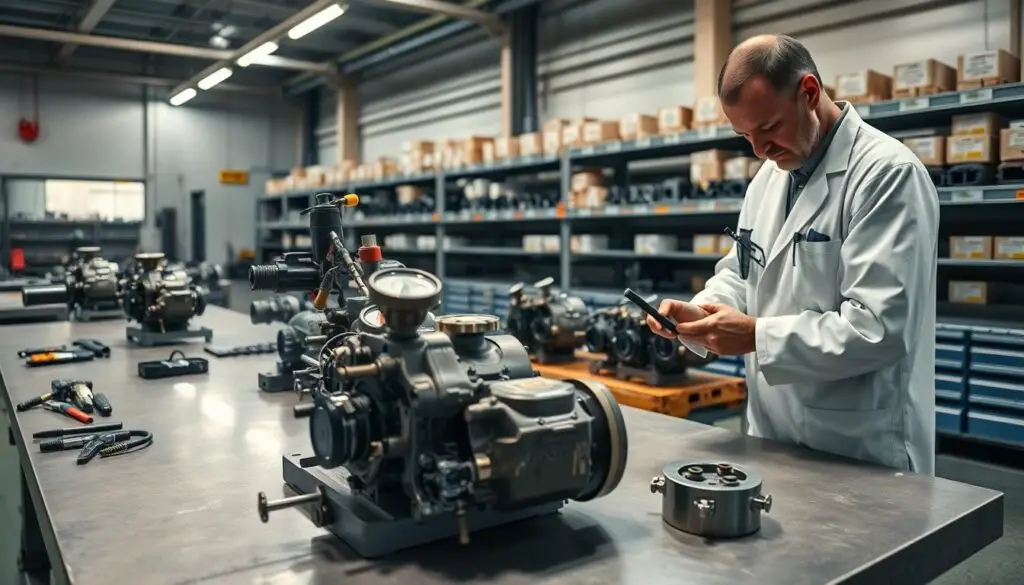
Dimensional restoration through precision machining returns worn components to OEM specifications with micron-level accuracy. Modern CNC machining centers perform cylinder boring, honing, grinding, and surface finishing operations that achieve tolerances typically ranging from 0.0001 to 0.001 inches. This precision ensures proper clearances, sealing surfaces, and bearing fits critical to component performance.
Coordinate measuring machines (CMM) verify dimensional accuracy throughout the restoration process. These computerized systems probe critical surfaces and compare measurements against CAD models or specification drawings. Any deviation outside tolerance limits triggers corrective machining or component rejection.
Comprehensive component testing represents the final quality gate before remanufactured parts reach customers. Multi-stage testing validates that restored components meet performance specifications under conditions simulating actual service. Professional facilities employ specialized test equipment designed for specific component types—transmission test stands simulate operational loads, engine dynamometers measure power output and emissions, and starter test benches verify electrical performance under various load conditions.
⚠️ Safety Warning
Always verify remanufacturer credentials before purchasing critical components. Substandard rebuilt parts can cause sudden failures in high-pressure fuel systems, turbochargers operating at extreme temperatures, and emission control systems—potentially resulting in roadside breakdowns, equipment damage, or injury.
Cost Analysis: Remanufactured vs. New Diesel Parts
The economics of remanufactured diesel parts extend far beyond simple price comparisons, encompassing total lifecycle costs and operational considerations. Financial decision-making for diesel component replacement requires quantitative evaluation of purchase prices, installation expenses, warranty coverage, and expected performance duration. Proper value analysis incorporates both immediate budget impact and long-term operational reliability to determine true cost-effectiveness.
Industry data consistently demonstrates that remanufactured diesel parts cost approximately 30-50% less than new OEM equivalents across most component categories. This substantial price differential creates immediate budget relief for fleet operators and equipment owners facing unexpected repairs. However, comprehensive financial evaluation must extend beyond initial purchase price to capture the complete economic picture.
Direct Purchase Price Comparisons by Component Type
Understanding component-specific pricing structures enables accurate budget forecasting and informed procurement decisions. Cost differentials vary significantly across diesel part categories based on complexity, remanufacturing difficulty, and market availability.
Diesel Fuel Injectors: Individual injector replacement typically costs $500-$1,200 per unit including parts and labor for remanufactured components, compared to $750-$1,800 for new OEM injectors—delivering savings of 30-40%. Complete injector set replacement for 6-8 cylinder engines ranges from $3,000-$6,000 for remanufactured sets versus $4,500-$9,000 for new components. Heavy-duty applications in Volvo, Mack, and Freightliner trucks typically require higher-grade injectors costing $600-$1,000 each remanufactured.
Turbochargers: Light-duty diesel turbochargers cost $800-$1,500 remanufactured compared to $1,500-$2,800 new, representing savings of approximately 40-45%. Heavy-duty and variable geometry turbochargers used in commercial trucking applications range from $1,200-$2,500 remanufactured versus $2,200-$4,500 new. VGT units with electronic actuators typically deliver 35-42% savings compared to new replacements.
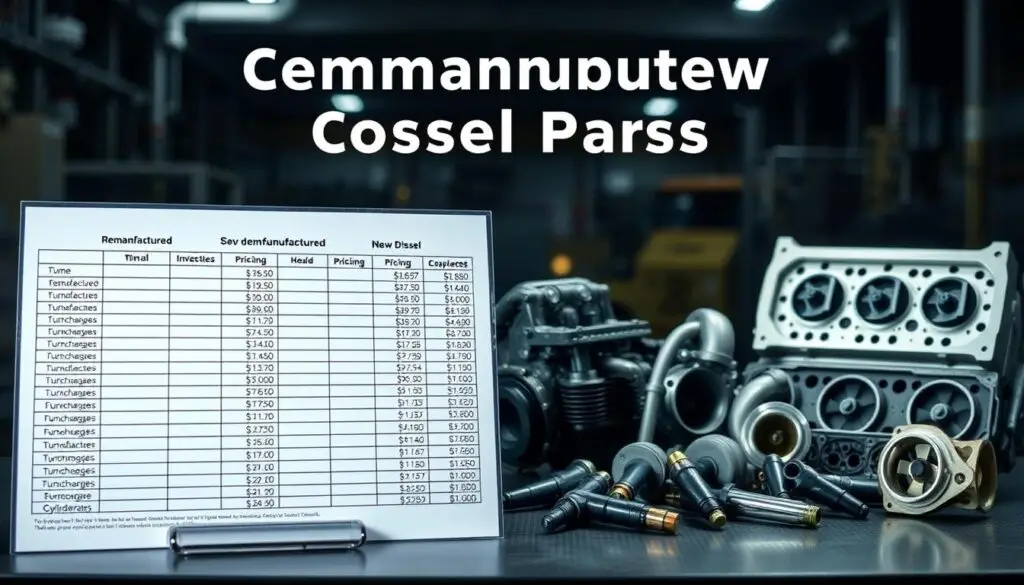
Engine Assemblies: Remanufactured diesel engine long blocks range from $3,500-$15,000 depending on displacement and application specifications. Comparable new engines cost $7,000-$30,000, creating potential savings of 40-50%. Popular configurations for Cummins ISX engines run $8,500-$12,000 remanufactured compared to $18,000-$25,000 new. Detroit DD15 remanufactured long blocks typically cost $10,000-$14,000 versus $22,000-$30,000 new.
High-Pressure Fuel Pumps: Common rail high-pressure pumps require precision remanufacturing to maintain proper fuel delivery specifications. Remanufactured units cost $800-$2,000 depending on flow capacity and pressure ratings, compared to $1,500-$3,500 for new pumps—representing typical savings of 35-45% while maintaining pressure specifications of 25,000-30,000 PSI required for modern diesel injection systems.
| Component Type | Remanufactured Price | New OEM Price | Typical Savings |
|---|---|---|---|
| Diesel Fuel Injectors (per unit) | $500 – $1,200 | $750 – $1,800 | 30% – 40% |
| Turbochargers (heavy-duty) | $1,200 – $2,500 | $2,200 – $4,500 | 35% – 45% |
| Engine Long Blocks | $3,500 – $15,000 | $7,000 – $30,000 | 40% – 50% |
| High-Pressure Fuel Pumps | $800 – $2,000 | $1,500 – $3,500 | 35% – 45% |
| EGR Valves/Coolers | $400 – $1,200 | $800 – $2,000 | 40% – 50% |
Total Cost of Ownership Analysis
Comprehensive total cost of ownership analysis extends beyond initial purchase price to encompass multiple financial factors affecting long-term value. Installation labor costs typically range from $200-$800 depending on component complexity and accessibility. Expected service life for quality remanufactured components typically delivers 75-90% of new component lifespan, translating to 150,000-250,000 miles for major components like fuel injection systems and turbochargers.
Warranty coverage significantly impacts total ownership costs by protecting against premature failure. Quality remanufactured parts typically include 12-36 month warranties with mileage limits of 100,000-150,000 miles. This warranty value should be quantified at approximately 8-12% of purchase price when calculating true cost-effectiveness.
Availability and lead times create substantial financial implications beyond purchase price. Remanufactured parts typically ship within 1-3 business days from established suppliers, while new OEM components often require 1-4 weeks for delivery. This availability advantage reduces downtime costs and enables faster equipment return to service—potentially saving $500-$2,000 daily in lost productivity for commercial applications.
Understanding Core Charges and Exchange Programs
Core charges represent refundable deposits applied to remanufactured component purchases, incentivizing return of failed parts for remanufacturing. Typical core charges range from $200-$1,500 depending on component complexity and remanufacturing value. Diesel injectors carry core charges of $50-$150 per unit, turbochargers $200-$600, fuel pumps $150-$400, and complete engines $800-$1,500.
Exchange programs operate on direct swap basis, eliminating separate core charge transactions. Customers receive remanufactured components immediately while surrendering failed cores simultaneously. This streamlines procurement and cash flow management by avoiding temporary capital tied up in core deposits. Core return requirements typically mandate intact housings, minimal physical damage, and matching part numbers to qualify for full refund.
Core return timeframes establish deadlines for shipping cores to suppliers after receiving remanufactured components. Standard policies allow 30-90 days for core returns, with core charges becoming permanent if deadlines are missed. Extended return periods may incur administrative fees or reduced refund percentages.
The HDJ Perspective
After 15+ years working with fleets across the trucking industry, the pattern is clear: operations that systematically evaluate remanufactured components—rather than defaulting to either new OEM or cheapest-available options—consistently achieve lower total maintenance costs. The key isn’t choosing remanufactured for everything, but understanding which components offer the best value proposition for your specific duty cycle. Critical high-stress components like fuel injectors and turbochargers often deliver the best remanufactured value, while electronic modules may warrant new-part investment depending on your fleet’s diagnostic capabilities.
Performance Reliability and Warranty Coverage
Warranty coverage analysis provides critical insights into manufacturer confidence and long-term component reliability for diesel applications. The strength of warranty protection directly reflects the quality control measures and testing protocols employed during the remanufacturing process. Fleet operators and maintenance professionals rely on comprehensive warranty terms to assess financial risk and operational dependability.
Standard Warranty Terms for Remanufactured Components
Professional remanufacturers offer warranty coverage that varies significantly based on component complexity and application intensity. Quality rebuilt components often include substantial warranties that reflect confidence in rebuilding processes. Basic warranty programs typically provide 12 months of unlimited mileage coverage for standard commercial applications, while premium facilities extend protection to 24-36 months or 100,000+ miles.
Warranty duration varies considerably across different diesel component categories. Fuel injection systems typically carry 12-24 months coverage reflecting precision machining requirements. Turbochargers receive 18-36 months protection for high-temperature applications. Complete engines often include 24-36 months coverage with mileage limitations, while transmission assemblies may receive 24-48 months reflecting mechanical complexity.
Professional remanufacturers stand behind their work with meaningful warranty coverage that reflects confidence in their restoration processes. Coverage terms specify exclusions for improper installation, inadequate maintenance, or operation beyond design parameters. Understanding these limitations prevents disputes during claim processing.
Field Failure Rates and Expected Service Life
Industry studies demonstrate that certified remanufactured diesel parts achieve reliability metrics comparable to new components. Leading remanufacturers report field failure rates of 2-4% for premium remanufactured components within the first year of service. This compares favorably against 1-2% failure rates for new OEM parts during equivalent operating periods.
Professionally remanufactured diesel components typically deliver 75-90% of new component lifespan under comparable operating conditions. Remanufactured fuel injectors average 120,000-180,000 miles compared to 150,000-200,000 miles for new components. Turbochargers reach 150,000-250,000 miles versus 200,000-300,000 for new units. Complete remanufactured engines typically achieve 250,000-500,000 miles compared to 350,000-600,000 for new engines.
Service interval planning should account for these durability differences when developing maintenance schedules. Fleet managers balance component cost against replacement frequency to optimize total operational expenses. The economic advantage of remanufactured parts often outweighs minor differences in ultimate service life.
Performance Testing Compared to OEM Parts
Comprehensive performance testing validates remanufactured component capability to meet original equipment specifications. Professional remanufacturers employ dynamometer testing, flow bench analysis, and computerized diagnostic verification. These quality control measures ensure that restored components deliver OEM-equivalent performance characteristics.
Fuel delivery precision testing confirms that remanufactured injectors maintain spray patterns within factory specifications. Turbocharger boost pressure measurements verify proper compressor and turbine efficiency across the operational range. Compression ratio testing validates engine cylinder integrity and sealing effectiveness.
Emissions performance represents a critical validation metric for modern diesel components. Remanufactured parts must demonstrate compliance with EPA heavy-duty engine and vehicle emissions standards and OEM emissions specifications. Testing protocols measure particulate matter, nitrogen oxides, and hydrocarbon emissions under controlled conditions.
Free Professional Fleet Tools
Cost calculators, fault code lookup, maintenance planners, and more—built for owner-operators, fleet managers, and diesel techs. No signup required.
Most Common Remanufactured Diesel Parts and Applications
Certain diesel engine components dominate the remanufacturing market due to their high replacement costs, critical performance roles, and proven restoration success rates. Understanding which parts offer the best candidates for remanufactured alternatives helps fleet managers make informed purchasing decisions that balance quality with operational budgets.
Diesel Fuel Injection System Components
Fuel injection systems represent the highest-volume category for diesel component restoration. These precision assemblies operate under extreme conditions demanding micron-level manufacturing tolerances. Modern diesel engines rely on sophisticated injection technology where components deliver fuel at pressures exceeding 30,000 PSI—5-10 times higher than gasoline counterparts—creating significant wear over operational lifecycles.
Common rail technology features centralized high-pressure fuel rails feeding individual electronically-controlled injectors operating at 25,000-35,000 PSI. Remanufacturing common rail injectors requires sophisticated testing equipment capable of validating spray pattern geometry and fuel atomization quality. The restoration process includes replacement of internal nozzles, solenoid valves, and sealing components.
Unit injectors combine pumping and injection functions within single integrated assemblies, extensively utilized by Detroit Diesel, Caterpillar, and Cummins engines. The complexity of unit injectors makes them excellent candidates for professional remanufacturing rather than field repair. Internal components including plungers, barrels, and check valves require precise machining tolerances achievable only with specialized equipment.
Turbochargers and Emission Control Components
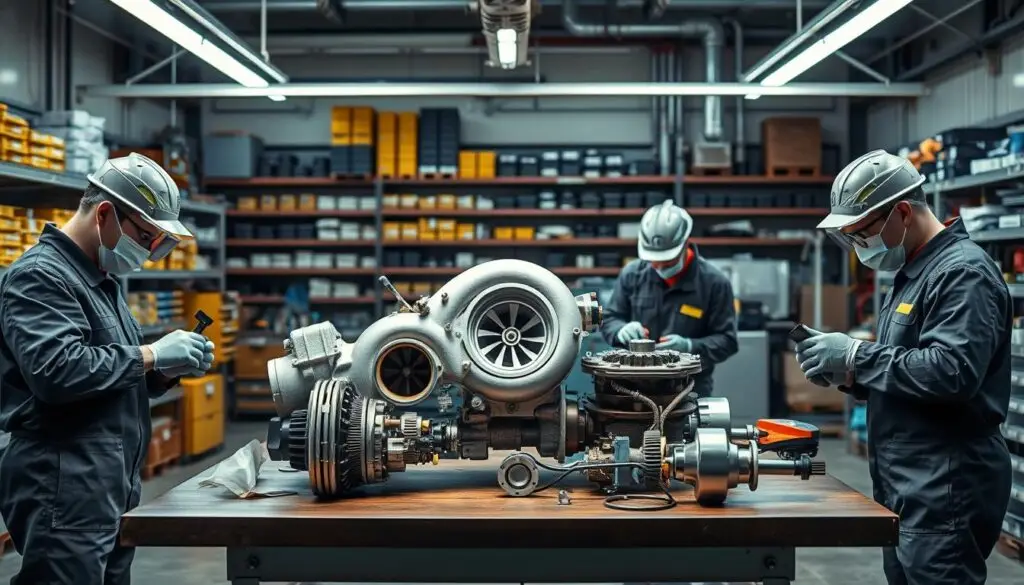
Turbocharger remanufacturing represents a substantial market segment driven by high new-part costs ranging from $1,500-$4,500 per unit. These forced induction devices increase engine power density by compressing intake air, allowing more fuel combustion within the same displacement. The extreme operating temperatures and rotational speeds create wear patterns that eventually require restoration.
Variable geometry turbochargers add complexity through adjustable vane mechanisms that optimize boost pressure across engine speed ranges. Remanufacturing these advanced units requires specialized calibration equipment for actuator testing. The electronic or pneumatic actuators controlling vane position must respond accurately to engine control signals, requiring validation testing throughout the operating range.
Emission control systems face increasing regulatory scrutiny, driving growth in DPF remanufacturing and related component restoration. Diesel particulate filters capture soot particles from exhaust gases, accumulating deposits that eventually require cleaning or replacement. The high cost of new DPF assemblies creates strong economic incentives for professional remanufacturing through specialized thermal and chemical cleaning processes.
Starting, Charging, and Electronic Systems
Diesel starting systems represent high-volume remanufacturing categories with mature restoration processes. Starters and alternators collectively account for 80 million remanufactured units annually. These electrical components experience predictable wear patterns that respond well to standardized restoration procedures, delivering reliable performance at significant cost savings.
ECU remanufacturing requires specialized capabilities that differ significantly from mechanical component restoration. Electronic control modules contain complex circuit boards with microprocessors, memory chips, and interface circuits controlling fuel injection timing, emission system operation, and numerous engine parameters. Professional remanufacturers maintain extensive databases of calibration files, ensuring proper software installation for each application while addressing security features requiring specialized equipment.
Buyer’s Guide: Selecting Quality Remanufactured Diesel Parts
The difference between quality remanufactured diesel parts and substandard alternatives often comes down to careful evaluation of supplier credentials and manufacturing processes. Fleet managers who invest time in vetting suppliers upfront avoid costly failures, extended downtime, and warranty disputes that plague those chasing the lowest price.
Evaluating Remanufacturer Reputation and Credentials
Remanufacturer reputation provides the foundation for supplier selection decisions impacting fleet reliability and maintenance costs. Companies with established track records demonstrate staying power in a competitive industry where quality shortcuts eventually lead to business failure. Operations with 10+ years in business have survived economic cycles and maintained customer relationships through consistent quality delivery.
Research company history through multiple channels to build a complete picture of capabilities and reliability. Customer reviews on industry forums, testimonials from fleet operators in similar applications, and references from equipment dealers reveal real-world performance beyond marketing claims. Professional remanufacturers willingly provide contact information for current customers operating comparable equipment.
Industry certifications and memberships signal commitment to quality standards and continuous improvement. ISO 9001 certification requires documented quality management systems with regular third-party audits. APRA membership indicates adherence to industry best practices and ethical business standards. Facility tours provide invaluable insights into remanufacturing capabilities—clean, organized facilities with documented procedures indicate systematic quality control throughout the restoration process.
Analyzing Warranty Terms and Documentation Requirements
Warranty evaluation requires scrutiny beyond simple duration statements to understand actual coverage and claim processes. Premium remanufacturers offer warranties ranging from 24-36 months with fewer restrictions, reflecting confidence in their restoration processes. Budget suppliers often limit coverage to 12 months with numerous exclusions shifting risk to buyers.
Coverage exclusions require careful attention to understand what circumstances void warranty protection. Common exclusions include consequential damages, improper installation, inadequate maintenance, and operation outside specified parameters. Professional remanufacturers clearly document exclusions rather than using vague language that creates disputes during claims.
Pro-rata versus full replacement terms significantly impact warranty value for components that fail late in the coverage period. Full replacement warranties provide new remanufactured components regardless of when failure occurs during the warranty period. Pro-rata warranties reduce coverage based on time or mileage used, requiring buyers to pay an increasing percentage of replacement costs.
Key Recommendation
Before purchasing remanufactured diesel components, request copies of current ISO 9001 certification documents, APRA membership verification, and component-specific test reports. Verify credentials directly with issuing organizations—reputable remanufacturers welcome this verification and provide documentation promptly.
Red Flags and Warning Signs to Avoid
Red flags during supplier evaluation indicate quality shortcuts, inadequate processes, or business practices that increase risk of premature failures. Extremely low pricing often signals compromises in materials, testing, or quality control that result in higher total costs through failures and downtime.
Reluctance to provide facility tours or detailed process explanations suggests operations lacking confidence in their capabilities. Absence of quality certifications or specialized testing equipment indicates reliance on basic cleaning and reassembly rather than comprehensive restoration. Pricing significantly below market averages—60% or more below established suppliers—suggests shortcuts in materials, testing, or quality control.
Poor communication and unresponsive customer service during the sales process typically worsen after purchase when warranty support is needed. Suppliers who fail to return calls promptly, answer technical questions thoroughly, or provide requested documentation demonstrate service levels that frustrate buyers during critical downtime situations.
Environmental Benefits and Sustainability Impact
As corporate sustainability mandates intensify, remanufactured diesel parts offer quantifiable environmental benefits that align ecological responsibility with operational efficiency. Fleet operators, equipment managers, and procurement specialists now evaluate suppliers not just on price and quality, but on their contributions to corporate environmental goals and circular economy principles.
Carbon Emissions and Energy Reduction
The carbon emissions reduction achieved through remanufacturing diesel components significantly outperforms new parts production across virtually all component categories. Comprehensive lifecycle assessments demonstrate that remanufacturing diesel engines reduces carbon emissions by 80-85% compared to manufacturing new engines. This dramatic reduction stems from eliminating energy-intensive processes including mining, ore smelting, metal casting, and primary manufacturing operations.
Specific component categories deliver impressive carbon savings. Remanufactured fuel injectors reduce carbon emissions by 75-80% versus new production. Turbochargers achieve 70-75% reductions, while starter motors and alternators typically deliver 65-70% carbon savings. These reductions translate to meaningful environmental impact at scale—a fleet operating 100 Class 8 trucks replacing engines with remanufactured units rather than new engines prevents approximately 400-500 metric tons of CO2 emissions annually.
Raw Material Conservation and Circular Economy
Raw material conservation constitutes a fundamental advantage of diesel component remanufacturing. Restoring a diesel engine to service conserves approximately 2,500 pounds of iron ore, 1,400 pounds of coal, and 120 pounds of limestone that would otherwise be consumed in new engine production. These savings multiply across thousands of remanufactured units annually, preserving finite natural resources while reducing mining environmental impacts.
Remanufacturing processes typically consume 85-90% less energy than new parts manufacturing. Water usage also decreases substantially—new engine production consumes 8,000-12,000 gallons per unit for cooling, washing, and processing operations, while remanufacturing reduces water consumption by 70-80%.
Remanufacturing exemplifies circular economy principles by extending product lifecycles and keeping valuable materials in productive use rather than landfills. The process diverts an estimated 15-20 million tons of materials annually from North American waste streams. A single diesel engine block may be remanufactured 3-5 times during its useful life, dramatically extending material utility while delivering cost savings to fleet operators.
Industry-Specific Applications and Requirements
Different industries demand specialized remanufactured diesel parts that meet unique operational requirements and performance standards. Understanding these industry-specific applications helps buyers select components engineered for their particular needs.
Heavy-Duty Over-the-Road Trucking
Class 8 trucks represent the largest market for heavy-duty trucking diesel parts nationwide. Fleets operating Volvo, Mack, Freightliner, Kenworth, Peterbilt, and International models accumulate 100,000-150,000 miles annually, creating substantial demand for replacement components. High mileage accelerates wear on fuel systems, turbochargers, and starting systems.
Downtime costs trucking operations between $500-$1,000 daily in lost revenue per vehicle. Fleet managers prioritize rapid parts availability to minimize these losses. Remanufactured components typically ship within 1-3 days compared to 1-4 weeks for new OEM parts, making them strategically valuable for time-sensitive repairs.
Construction, Agricultural, and Marine Applications
Construction equipment remanufacturing addresses extreme operating conditions that accelerate component degradation. Caterpillar, Komatsu, Volvo CE, and John Deere diesel engines power equipment exposed to dust, vibration, extended idle periods, and heavy loads. Off-highway equipment typically follows mid-life rebuild cycles, with operators installing remanufactured engines and components during comprehensive overhauls that extend equipment service life 10-15 years beyond original specifications.
Agricultural diesel components serve operators balancing seasonal cash flow with reliability demands. Farmers face critical planting and harvesting windows when equipment downtime directly impacts crop yields and revenue. Remanufactured parts offer cost-effective maintenance solutions that preserve capital while providing budget flexibility to maintain complete fleets.
Marine diesel remanufacturing serves commercial fishing vessels, tugboats, and workboats operating in corrosive saltwater environments. These applications demand components meeting stringent corrosion resistance and vibration tolerance specifications. Professional marine remanufacturers apply enhanced protective coatings and upgraded seals, with validation testing simulating marine operating environments including temperature extremes and constant vibration.
Frequently Asked Questions
What is the difference between remanufactured and rebuilt diesel parts?
Remanufactured diesel parts undergo complete disassembly, cleaning, inspection, and restoration to OEM specifications with all worn components replaced using new parts. Rebuilt parts only address specific failed components while leaving other wear patterns untested. This fundamental difference means remanufactured parts typically carry 12-36 month warranties comparable to new parts, while rebuilt parts often have limited 90-day to 12-month coverage. The remanufacturing process includes comprehensive testing across all operational parameters—dynamometer testing, pressure testing, flow validation—whereas rebuilding focuses only on the repaired area. For fleet operations where reliability directly impacts revenue, the additional quality assurance of remanufactured components often justifies the modest cost premium over rebuilt alternatives.
How much can I save by choosing remanufactured diesel parts over new OEM parts?
Remanufactured diesel parts typically cost 30-50% less than new OEM equivalents while delivering comparable performance and reliability. Fuel injectors offer savings of 30-40%, with remanufactured units costing $500-$1,200 versus $750-$1,800 for new OEM injectors. Turbochargers deliver 35-45% savings at $1,200-$2,500 compared to $2,200-$4,500 new. Complete engine long blocks represent the largest absolute savings, with remanufactured units costing $3,500-$15,000 versus $7,000-$30,000 for new engines—a 40-50% reduction. These savings scale significantly for fleet operations requiring multiple component replacements, with additional value from faster availability reducing costly downtime.
How long do remanufactured diesel parts last compared to new components?
Professionally remanufactured diesel components typically deliver 75-90% of new component lifespan under comparable operating conditions and proper maintenance. Remanufactured fuel injectors average 120,000-180,000 miles compared to 150,000-200,000 for new units. Turbochargers reach 150,000-250,000 miles versus 200,000-300,000 for new components. Complete remanufactured engines typically achieve 250,000-500,000 miles compared to 350,000-600,000 for new engines. Quality remanufacturers report field failure rates of 2-4% in the first year of service, comparable to the 1-2% rate for new OEM parts. The economic advantage of 30-50% cost savings often outweighs minor differences in ultimate service life.
What certifications should I look for when buying remanufactured diesel parts?
Look for ISO 9001 certification demonstrating documented quality management systems with regular third-party audits. APRA (Automotive Parts Remanufacturers Association) membership indicates adherence to industry best practices, ethical business standards, and warranty commitments. Request documentation showing OEM specification compliance—detailed specifications for dimensional tolerances, material properties, and performance parameters. Professional remanufacturers also provide component-specific test reports including flow rate measurements, pressure test results, and dimensional verification. Facilities should demonstrate advanced testing equipment including dynamometers, flow benches, and pressure testing capabilities. Verify credentials directly with issuing organizations rather than relying solely on supplier claims.
What are the environmental benefits of choosing remanufactured diesel parts?
Remanufacturing diesel engines reduces carbon emissions by 80-85% compared to manufacturing new engines by eliminating energy-intensive mining, smelting, and primary manufacturing processes. The process conserves approximately 85% of raw materials—a single diesel engine restoration saves approximately 2,500 pounds of iron ore, 1,400 pounds of coal, and 120 pounds of limestone. Remanufacturing uses 80% less energy and 70-80% less water than new production. A diesel engine block can be remanufactured 3-5 times during its useful life, extending material utility while diverting millions of tons from landfills annually. These sustainability benefits align with corporate environmental goals while delivering 30-50% cost savings.
How do core charges work for remanufactured diesel parts?
Core charges are refundable deposits applied to remanufactured component purchases, incentivizing return of failed parts for future remanufacturing. Typical charges range from $200-$1,500 depending on component complexity and material value. Diesel injectors carry $50-$150 per unit, turbochargers $200-$600, fuel pumps $150-$400, and complete engines $800-$1,500. Most suppliers require core return within 30-90 days to maintain full refund eligibility. Cores must have intact housings and minimal physical damage to qualify for full refund—cracked housings, missing components, or excessive corrosion may result in partial refunds of 25-75%. Exchange programs eliminate separate core charge transactions by accepting failed cores at the time of remanufactured component delivery.
Making Smart Component Decisions for Your Fleet
The remanufactured diesel parts market stands at $60-78 billion in 2025, with projected growth of 6-8% annually through 2030. This expansion reflects growing recognition of the genuine value proposition among fleet operators seeking both cost efficiency and operational reliability without compromising on quality or performance.
Quality-certified remanufactured diesel parts deliver 30-50% savings compared to new components while providing 75-90% of new component lifespan. This value extends beyond purchase price to encompass comprehensive warranty coverage, documented testing protocols, and proven performance metrics. Fleet managers who evaluate suppliers based on ISO 9001 certification, APRA standards, and transparent quality processes achieve optimal results.
The environmental benefits—80-85% carbon emission reduction while conserving raw materials and energy—align corporate sustainability goals with practical cost management. This creates measurable value across multiple performance indicators while supporting circular economy objectives increasingly important to fleet customers and regulatory compliance.
A successful diesel maintenance strategy requires systematic supplier evaluation. Verify certifications, review warranty terms, examine testing documentation, and assess customer references. These steps protect operational continuity while maximizing total cost of ownership benefits. Fleet operators who partner with professional remanufacturers secure competitive advantages through reduced maintenance costs, minimized downtime, and enhanced equipment longevity.
Share This Guide With Your Team
Help fleet managers and diesel technicians make informed decisions on remanufactured components. Share this comprehensive guide with colleagues who need practical, actionable guidance.