By Michael Nielsen, Editor & Publisher | 15+ Years in Diesel Repair
Last Updated: December 2025
Modern commercial trucks rely on sophisticated multiplexing networks that have replaced thousands of individual wires with digital communication systems. When these networks fail, technicians face diagnostic challenges unlike anything in traditional electrical troubleshooting. A single communication error can disable lighting, instrument clusters, and safety systems simultaneously—making systematic truck multiplexing systems troubleshooting essential for every fleet maintenance operation.
Today’s Class 8 trucks contain 40 to 60 electronic control units communicating across 3 to 5 separate CAN networks. This complexity creates both opportunity and challenge: systematic diagnostic approaches can reduce repair time by 60%, but only when technicians understand how these networks function and fail. This guide provides the diagnostic framework, manufacturer-specific insights, and practical techniques needed to troubleshoot multiplexing systems efficiently.
Key Takeaways
- Network-wide symptoms: Multiple unrelated fault codes appearing simultaneously typically indicate a network communication problem rather than individual component failures.
- Critical measurements: CAN bus voltage should measure 3.5V (High) and 1.5V (Low) with key on; termination resistance should measure 60 ohms between CAN High and Low with power disconnected.
- Systematic approach: Proper diagnostic procedures can reduce troubleshooting time by 60% compared to random component replacement.
- OEM software required: Generic scan tools cannot access proprietary fault codes, perform module programming, or complete advanced diagnostics—manufacturer-specific software is essential.
- Safety protocols: Modern hybrid and electric commercial vehicles carry up to 800V DC, requiring strict high-voltage safety procedures and ESD protection when handling modules.
Understanding Commercial Truck Multiplexing Technology
Multiplexing allows multiple electronic modules to share information over a common data bus rather than requiring dedicated wiring between each component. A typical Class 8 truck would require over 2,000 separate conductors using conventional point-to-point wiring. Multiplexing reduces this complexity by 60 to 70 percent—instead of dedicated circuits, modules connect to a shared network backbone where the engine controller sends operating data to the transmission, instrument cluster, and diagnostic system simultaneously over a single wire pair.
The SAE J1939 protocol became the industry standard for heavy-duty vehicles in North America. This specification defines how modules format messages, assign priorities, and handle errors. J1939 operates at either 250 kilobits per second or 500 kbps depending on the network segment, enabling real-time coordination between critical safety systems including engine management, transmission control, and ABS.
Older trucks may still use legacy J1708 and J1587 protocols operating at much slower 9,600 baud rates. These systems could report fault codes but handled limited data compared to modern CAN-based networks. Technicians working on mixed fleets must understand all three protocols to diagnose problems across different vehicle model years.
Core Network Components
Electronic control units serve as specialized computers distributed throughout the vehicle. Each ECU manages specific functions while continuously sharing data with other modules. Body control modules handle non-powertrain functions like lighting, HVAC, and driver interface operations. The engine control module manages fuel injection timing, turbocharger boost, emissions system operation, and engine protection strategies.
Gateway modules serve as translators between different network segments or protocols. These controllers allow legacy J1708 devices to communicate with modern J1939 networks and isolate network segments to prevent faults in one area from affecting the entire system. Understanding the physical network topology—typically a linear bus configuration—helps technicians trace wiring and locate connection points during troubleshooting.
CAN bus termination plays a critical role in network reliability. Each end of the network backbone requires a 120-ohm termination resistor to prevent signal reflections that interfere with data transmission. A correctly terminated network shows approximately 60 ohms total resistance between CAN High and CAN Low—the parallel combination of two 120-ohm resistors.
Recognizing Multiplexing System Failures
Network communication failures create unique diagnostic challenges because damage to a single wire or module can disable seemingly unrelated functions across the entire vehicle. Unlike traditional wiring where each circuit operates independently, multiplexed systems share common communication pathways that make fault isolation more difficult.
Bus errors occur when network communication degrades or fails completely, preventing modules from exchanging critical operational data. These errors manifest as erratic system behavior, missing functionality, or complete system shutdowns. The network continues attempting communication, but corrupted or missing messages prevent normal operation.
Characteristic symptoms that indicate network problems include:
- Multiple fault codes appearing simultaneously across different systems
- Intermittent loss of gauge cluster information or warning lamp function
- Communication timeout errors in diagnostic scan tool data
- Complete loss of specific vehicle functions with no physical damage to related components
- Fault codes that clear temporarily but return during vehicle operation
Bus-Off Conditions and Message Timing Failures
A bus-off condition represents a protective mechanism where a module detects excessive communication errors and removes itself from the network. This self-isolation prevents a malfunctioning module from disrupting communication for other network participants. When the error counter reaches a predetermined threshold, the module stops transmitting messages and waits for network conditions to improve. This creates diagnostic challenges because the problem module becomes invisible to scan tools.
Time-critical messages must arrive within specific windows to maintain system synchronization. Message timing failures occur when network congestion, signal degradation, or processing delays cause messages to arrive late or out of sequence. A delayed message from the engine controller might cause the transmission to shift at the wrong moment or affect stability control responses.
60%
Reduction in diagnostic time when using systematic network troubleshooting approaches versus random component replacement — TMC industry benchmark
Common Physical Causes of Network Failures
Wiring harness damage presents particularly challenging diagnostic scenarios. A single damaged wire carrying CAN bus signals might cause the instrument cluster, body controller, and lighting systems to malfunction together. Physical damage occurs through abrasion from vibration, heat exposure from exhaust components, chemical contamination from road salt or hydraulic fluid, and rodent damage in hidden locations.
Poor ground connections create voltage reference differences between modules that prevent accurate signal interpretation. When one module grounds at 0.2 volts and another at 0.5 volts, their perception of signal levels differs enough to cause communication faults. Ground-related problems typically worsen under load conditions—cranking the engine draws heavy current through ground paths, temporarily raising ground potential at some modules.
Essential Diagnostic Tools and Equipment
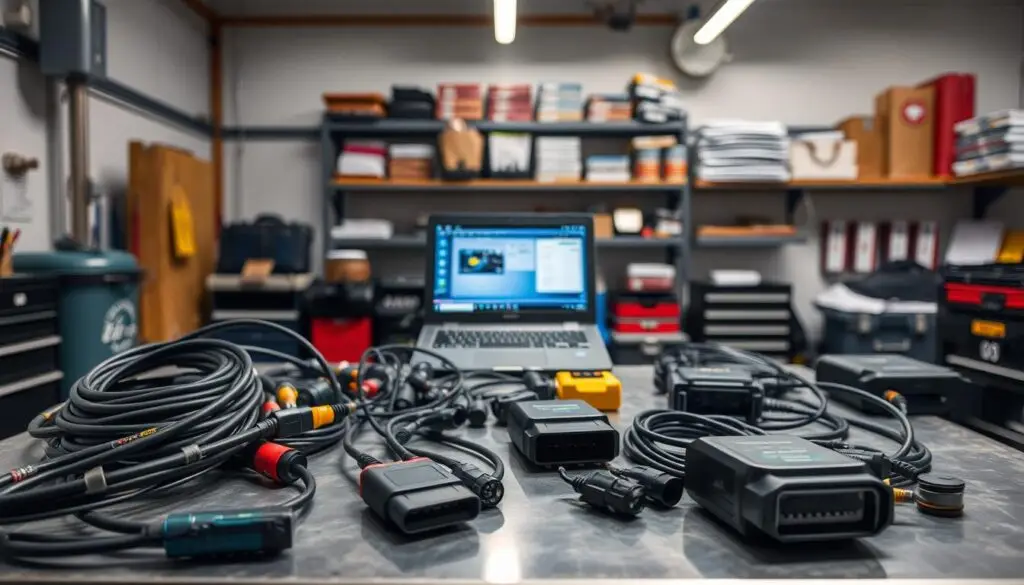
Professional shops servicing commercial vehicles must invest in both hardware and software solutions to diagnose sophisticated multiplexing systems effectively. Without proper diagnostic tools, technicians face significant challenges when troubleshooting network communication issues or programming electronic control modules.
Manufacturer-Specific Diagnostic Software
OEM diagnostic software platforms provide access to proprietary functions that generic scan tools cannot reach. These packages allow complete system diagnostics, parameter configuration, and module programming. Many advanced repair procedures require these platforms as the only approved method.
Cummins Insite serves as the official diagnostic platform for all Cummins engine systems. This software enables technicians to read and clear fault codes, view live engine parameters, perform cylinder cutout tests, and calibrate fuel injectors. Detroit Diesel Diagnostic Link (DDDL) provides comprehensive diagnostics for Detroit engines and integrates with Freightliner and Western Star vehicle systems for complete coverage. Paccar Davie handles engine calibrations, chassis programming, and body builder configurations for Peterbilt and Kenworth trucks. International’s Diamond Logic Builder allows system configuration and custom control logic programming.
| Equipment Category | Key Specifications | Primary Functions |
|---|---|---|
| Digital Multimeter | 0-1000V, high impedance, min/max recording | Voltage, resistance, continuity testing |
| Automotive Oscilloscope | 4-channel, DC-20MHz, automotive triggers | Signal quality analysis, waveform capture |
| Heavy-Duty Scan Tool | J1939, J1587, proprietary protocols | Code reading, live data, bidirectional tests |
| CAN Bus Analyzer | J1939 message decoding, error frame detection | Network traffic analysis, bus loading measurement |
Multimeters and Oscilloscopes for Network Testing
Automotive-grade digital multimeters with high impedance inputs are essential for voltage measurements without loading sensitive circuits. Professional multimeters should include min/max recording functions to capture intermittent voltage fluctuations during vehicle operation.
Oscilloscope diagnostics provide critical insights into network signal quality that multimeters cannot reveal. Four-channel automotive oscilloscopes allow simultaneous viewing of CAN High, CAN Low, and differential signals for complete network analysis. Proper CAN bus signals should show 2.5V nominal voltage with 3.5V and 1.5V differential levels during active communication. Signal rise times, reflections, and distortions visible on oscilloscope displays indicate termination problems or wiring damage.
Step-by-Step Troubleshooting Process
Successful multiplexing diagnostics depend on systematic procedures that guide technicians from symptom identification to verified repair. A structured troubleshooting process eliminates guesswork and prevents the costly mistake of replacing functional components.
Initial System Assessment and Fault Code Retrieval
Begin with a thorough conversation with the vehicle operator. Ask specific questions about when the problem occurs, how often it happens, what conditions trigger it, and whether any recent changes were made to the vehicle. This information provides valuable clues that direct the diagnostic approach.
Connect diagnostic software and establish communication with all vehicle modules—not just the engine control module. Network problems frequently generate codes in multiple modules throughout the vehicle, including the body control module, transmission controller, and ABS system. Document all fault codes from every accessible module before clearing any codes or performing repairs.
Understanding the difference between active and inactive fault codes is essential. Active codes indicate problems currently present during the diagnostic session. Inactive or historical codes represent faults that occurred previously but are not currently active—these codes provide diagnostic value by showing intermittent problems or conditions that led to the current failure.
The J1939 protocol uses Fault Mode Identifiers (FMI) to specify exactly what type of failure occurred. Key FMI codes include:
- FMI 3: Voltage above normal or shorted high—check for wiring shorts to power
- FMI 4: Voltage below normal or shorted low—check for shorts to ground or open circuits
- FMI 5: Current below normal or open circuit
- FMI 9: Abnormal update rate—critical for diagnosing communication issues
- FMI 12: Bad intelligent device or component
Network Communication Testing Procedures
After completing fault code retrieval, verify the physical health of the communication network. Begin by checking basic communication status in your diagnostic software and noting which modules respond and which remain silent. A pattern of multiple non-communicating modules often indicates a network problem rather than individual module failures.
With the ignition key on and modules active, measure voltage at the diagnostic connector using a digital multimeter:
- CAN High to ground: Should measure approximately 3.5 volts
- CAN Low to ground: Should measure approximately 1.5 volts
- Differential voltage: Should toggle around 2.0 volts during active communication
With the ignition key off and no module activity, both CAN High and CAN Low lines should rest at approximately 2.5 volts if termination resistors are properly installed.
Verify proper termination resistance by disconnecting vehicle battery power, then measuring resistance between CAN High and CAN Low terminals. A correctly terminated network shows 60 ohms total. Higher readings indicate a missing or damaged termination resistor; lower readings suggest additional unintended resistors or a short circuit.
Stay Current on Fleet Electrical Diagnostics
As multiplexing technology continues advancing, staying informed on diagnostic techniques and manufacturer updates is critical for fleet maintenance success.
Isolating Faulty Modules and Circuits
When network problems persist after verifying proper voltage and resistance, use a divide-and-conquer approach to isolate the faulty module or circuit section. Disconnect modules one at a time while monitoring network communication status. When you disconnect the problematic module, communication should restore to the remaining modules on the network.
Use diagnostic software to monitor which modules actively transmit messages. A module that appears connected but sends corrupted data can disrupt the entire system. Compare the list of communicating modules against the vehicle’s network architecture diagram to identify missing participants.
Perform voltage drop testing on both power supply and ground circuits. Connect your multimeter positive lead to the power source and negative lead to the module power input. With the circuit under load, voltage drop should measure less than 0.1 volts per connection point. Higher voltage drops indicate resistance from corrosion, loose terminals, or undersized wiring.
Manufacturer-Specific Multiplexing Architectures
While all modern trucks rely on similar communication protocols, each major OEM has developed proprietary implementations that extend beyond standard J1939 frameworks. Understanding these unique architectures is critical for effective troubleshooting and repair work.
Freightliner and Detroit Diesel Integration
Freightliner multiplexing architecture utilizes multiple CAN bus segments operating simultaneously. The powertrain network handles engine and transmission communications at 250 kbps, while a separate body network manages lighting, HVAC, and accessory controls at 125 kbps. Detroit Diesel integration occurs through the DDEC system, communicating bidirectionally with chassis modules through gateway controllers.
Diagnostic access requires brand-specific software tools. Detroit Diesel Diagnostic Link addresses all engine-related functions while Freightliner ServiceLink provides chassis system diagnostics and body control module programming. Common module locations include the Bulkhead Control Module behind the instrument panel and the Chassis Control Module near the battery box.
Paccar Systems in Peterbilt and Kenworth
Paccar systems implement multiplexing through a segmented architecture that separates critical vehicle functions. The Paccar MX engine integrates with chassis networks through dedicated gateway modules. Communication occurs on a high-speed powertrain CAN bus at 500 kbps, with chassis functions running on a separate network.
Diagnostics require Paccar Davie software for comprehensive system access. The Chassis Control Module serves as the primary body controller, managing lighting circuits, power distribution, and accessory controls. Body builder integration provisions make Paccar systems particularly flexible for specialty applications.
International Diamond Logic and Mack/Volvo Networks
International’s Diamond Logic system employs a hierarchical module structure with the Body Controller as the central hub. Multiple Smart Switch modules connect to the Body Controller through twisted-pair CAN networks, supporting up to 256 programmable inputs and outputs. Diamond Logic Builder software allows technicians to modify input/output assignments and create custom control logic.
Mack and Volvo trucks share common technology through Volvo Group ownership, with network topology typically including separate CAN buses for powertrain, chassis, and body systems. Diagnostic access requires Volvo Tech Tool (PTT) or Mack-specific versions. Network configurations emphasize reliability through redundant communication pathways, with critical safety systems maintaining independent connections that bypass gateway modules.
The HDJ Perspective
The rapid evolution of commercial vehicle electronics presents both challenges and opportunities for fleet maintenance operations. While network complexity has increased dramatically, the fundamental diagnostic principles remain consistent—systematic approaches, proper tools, and continuous training determine success. Fleets that invest in technician development and manufacturer-specific diagnostic capabilities will find multiplexing technology improves maintenance efficiency rather than complicating it. The key is treating network diagnostics as a core competency rather than an occasional specialty.
Advanced Techniques for Intermittent Faults
Many multiplexing problems don’t occur consistently, making them difficult to diagnose using traditional shop-based testing methods. Intermittent faults appear unpredictably or only under specific operating conditions that may not be present when the truck sits in the repair bay.
Data Logging and Snapshot Analysis
Data logging captures network communication and parameter information over extended periods, recording events that occur during normal vehicle operation. Set up trigger conditions to begin recording when specific fault codes activate or when parameters exceed threshold values—for example, logging can start automatically when bus voltage drops below 12 volts or when communication errors reach a certain frequency.
Snapshot analysis captures operating conditions at the exact moment faults occur, including vehicle speed, engine RPM, coolant temperature, electrical system loads, and network traffic levels. Compare multiple snapshots to identify patterns or common conditions associated with fault occurrences.
Environmental Testing Methods
Reproducing intermittent faults often requires recreating the physical conditions that trigger problems. Conduct diagnostic road tests with diagnostic software connected and real-time monitoring active. Safety requires that a passenger operates the diagnostic laptop while the driver focuses entirely on vehicle operation.
Temperature cycling tests can reveal temperature-sensitive component failures. Heat cycling procedures involve using heat guns on suspect modules or circuit areas while monitoring for fault occurrence—raise component temperatures gradually to 150-180°F maximum. Cold spray testing applies electronic component cooling spray to suspect areas, potentially revealing problems that disappear at normal operating temperatures.
Signal Integrity Analysis
Advanced oscilloscope techniques reveal signal quality problems that degrade network reliability without causing complete communication failure. Measure signal characteristics against known-good references: rise and fall times should show sharp vertical transitions completing in less than 200 nanoseconds, and clean CAN bus signals should show square waves without overshoot or ringing.
Voltage level verification confirms proper network electrical characteristics. Deviations from standard CAN High (3.5V) and CAN Low (1.5V) levels indicate problems with transceiver circuits or power supply issues. Capture intermittent glitches using single-shot mode to identify brief disturbances, or enable persistence mode to display signal variations over time.
Repair Procedures and Best Practices
Effective repair of multiplexing systems requires more than just swapping parts—it demands methodical procedures and quality verification at every step. Every repair should begin with proper documentation of original settings and configurations.
Module Replacement and Programming
Simply installing a new electronic control unit rarely completes a successful module replacement. Most modern truck modules arrive blank or with default settings that won’t match the specific vehicle configuration. Verify the replacement module matches the failed unit’s part number and hardware revision before installation.
Connect diagnostic software and establish communication with the new module. Navigate to programming or configuration menus specific to that module type. Common configuration parameters include axle ratio specifications, tire circumference measurements, engine power ratings, transmission type and gear ratios, body configuration details, and customer preference settings.
Vehicle identification number programming serves as a security feature that prevents module theft. Most powertrain and body control modules store the VIN and won’t function properly until programmed with the correct 17-character code. Calibration files represent the most complex aspect of ECU programming—identify the correct calibration by cross-referencing the engine serial number, emission label, and vehicle application.
The calibration flash process typically takes 15-30 minutes. Maintain stable battery voltage throughout the procedure using a battery maintainer. Never disconnect power or diagnostic connections during programming—interrupting the flash can brick the module.
Wiring Repair and Splice Techniques
Professional wiring repair maintains the electrical characteristics that multiplexed networks require for reliable communication. CAN bus networks use twisted pair wiring where the two conductors cancel electromagnetic interference through a balanced differential signal. Repairs must maintain this twisting right up to the splice point—untwisting wires during repair destroys this balance and makes the network vulnerable to electrical noise.
Use appropriate crimp splices rated for automotive environments, solder crimped connections for maximum reliability, and cover with adhesive-lined heat shrink tubing. Maintain the proper twist rate (typically 40-50 twists per meter) when repairing longer sections. For shielded twisted pair cables, the shield typically connects to chassis ground at one end only—this single-point grounding prevents ground loops that can introduce interference.
Post-Repair Verification
Thorough post-repair testing confirms that repairs actually solved the problem. Clear all fault codes from every module in the vehicle, then cycle the ignition key off and back on. Monitor for immediate fault code return—if codes reappear within seconds, the repair didn’t address the root cause.
Perform network communication tests verifying proper voltage levels and checking for error frames. Conduct a thorough road test under conditions that previously triggered the fault. Monitor the vehicle over several key cycles and instruct the driver to return if problems reoccur.
Preventive Maintenance for Multiplexing Systems
A proactive approach to multiplexing system care reduces unexpected downtime and costly repairs. The frequency of inspections depends heavily on operating conditions—monthly for severe service vehicles, quarterly for normal highway trucks.
Monthly inspections should cover visual examination of wiring harnesses in vulnerable areas near exhaust components, suspension mounting points, and areas exposed to road debris. Connector inspection is critical: look for signs of corrosion, looseness, or damage, and verify that connector seals remain intact. Module mounting security deserves attention since vibration gradually loosens mounting bolts, stressing electrical connectors.
Check for available software updates during each preventive maintenance service. Most manufacturers release updates several times per year that often fix bugs causing intermittent failures or communication errors. Schedule software updates during planned downtime rather than waiting for failures to occur.
Environmental protection measures significantly extend system lifespan. Ensure all connector seals remain intact, apply dielectric grease to connector interfaces, and verify that electronic control module enclosures remain properly sealed. Keep battery terminals clean and protected, and maintain chassis ground connections free from corrosion.
Safety Protocols for Electrical System Work
Electrical work on truck multiplexing systems presents serious hazards including electrocution, arc flash events, and chemical exposure. Modern hybrid and electric commercial vehicles can carry voltages up to 800V DC, requiring strict safety protocols. Technicians must wear safety glasses, insulated gloves rated for the voltage level, non-conductive footwear, and flame-resistant clothing.
Battery disconnect procedures form the foundation of electrical safety. Turn off all electrical loads, turn the ignition key off, and wait 5-10 minutes for modules to enter sleep mode properly. Disconnect the negative battery cable first to prevent short circuits, then disconnect positive cables. Apply lockout and tagout devices to prevent reconnection during service.
Electrostatic discharge can damage sensitive semiconductor components through voltage spikes of thousands of volts. Wear an ESD wrist strap connected to vehicle chassis, maintain continuous contact throughout module handling, and use ESD-safe work surfaces. Handle modules only by their edges—never touch connector pins or circuit boards directly. Keep modules in protective packaging until immediately before installation.
Share Your Multiplexing Diagnostic Expertise
Heavy Duty Journal welcomes contributions from fleet maintenance professionals and diesel technicians with hands-on experience troubleshooting modern vehicle networks.
Frequently Asked Questions
What is multiplexing in commercial trucks and why is it necessary?
Multiplexing is a communication method that allows multiple electronic control modules to share information over a common data bus rather than requiring dedicated wiring between each component. Modern trucks use multiplexing because conventional point-to-point wiring would require over 2,000 individual wires, creating excessive weight, complexity, and potential failure points. Multiplexing reduces wiring by 60-70 percent while enabling advanced features like remote diagnostics and predictive maintenance that would be impossible with conventional systems.
What should CAN bus voltage measurements be on a properly functioning system?
On a functioning CAN bus system with key on and modules active, measure approximately 3.5 volts between CAN High and ground, approximately 1.5 volts between CAN Low and ground, and a differential voltage of approximately 2.0 volts between CAN High and CAN Low. With the key off and power disconnected, both lines should rest at approximately 2.5 volts if termination resistors are properly installed. Termination resistance between CAN High and CAN Low should measure 60 ohms—representing two 120-ohm termination resistors in parallel.
Can generic diagnostic tools replace manufacturer-specific OEM software?
No. While quality generic J1939 scan tools can read standard fault codes and monitor many parameters, they cannot access proprietary fault codes, perform module programming and configuration, conduct manufacturer-specific diagnostic tests, or properly configure parameters after module replacement. Professional repair facilities need both generic tools for initial assessment and OEM software for complete diagnosis and repair of specific truck brands.
How do I identify which module is causing network communication problems?
Use a systematic divide-and-conquer approach. Connect diagnostic software to identify which modules are communicating and which are silent. Disconnect modules one at a time (with power off, following proper battery disconnect procedures) and retest network communication after each disconnection. When you disconnect the problem module, communication should restore to remaining modules. Pay attention to whether removing a specific module eliminates error frames visible on diagnostic software or oscilloscopes.
What causes multiple unrelated systems to fail simultaneously?
Multiple simultaneous failures of unrelated systems strongly suggest a network communication problem rather than individual component failures. Check for communication fault codes (FMI 9 for abnormal update rate, codes indicating lost communication). Perform network testing including CAN bus voltage levels and termination resistance. Inspect the main network backbone wiring for abraded insulation, corroded connections, or physical damage. True component failures typically affect individual systems, while network problems cause multiple simultaneous failures.
Do replacement electronic control modules require programming?
Yes. Most replacement modules arrive blank or with default settings. They require VIN programming, parameter configuration (axle ratios, tire sizes, engine ratings, transmission types), and often calibration file installation. Use manufacturer diagnostic software to perform these programming steps after installation. Never disconnect power during the flash programming process—this can permanently damage the module and require replacement.
Building Multiplexing Diagnostic Expertise
Truck electrical systems have evolved beyond traditional wiring methods, and multiplexing diagnostics require a systematic approach that combines technical knowledge with practical experience. Technicians who invest in understanding network communication principles gain significant advantages in today’s commercial vehicle environment.
The economic benefits of professional troubleshooting expertise are substantial. Proper diagnostic procedures reduce costly parts replacement approaches, and systematic methods can cut diagnostic time by more than half. Building competence in multiplexing maintenance starts with foundational concepts—understanding how modules communicate, recognizing common failure patterns, and using manufacturer-specific diagnostic software correctly.
The Technology & Maintenance Council (TMC) and ASE certification programs offer resources for technicians developing network diagnostic skills. Modern commercial vehicles depend entirely on these systems, creating opportunities for technicians who develop specialized expertise. The complexity ensures that skilled professionals remain valuable assets—the best time to develop these capabilities is now, as technology continues advancing across all commercial truck platforms.
Help Other Fleet Professionals Master Network Diagnostics
If you found this guide valuable, share it with colleagues who could benefit from systematic multiplexing troubleshooting techniques.