Fleet managers face a critical decision that impacts every mile their trucks travel: choosing between leaf spring and air ride suspension systems. This choice affects driver retention, maintenance budgets, cargo protection, and overall operational efficiency. With suspension systems representing a significant capital investment, making the wrong choice costs money every single day your fleet operates.
Both suspension technologies serve two fundamental purposes in commercial trucking. They support the combined weight of the truck and cargo while distributing loads evenly across axles. They also absorb road impacts to protect cargo and reduce component wear. However, these systems achieve these goals through vastly different mechanical approaches.
The data speaks clearly: over 70% of modern dry freight trailers, refrigerated units, and flatbeds now utilize air ride suspension, according to industry analysis from the Technology & Maintenance Council (TMC). Yet leaf springs continue dominating construction, intermodal, and heavy-haul segments where their mechanical simplicity proves invaluable. Understanding why different fleets choose different systems helps you make the right decision for your specific operation.
Last Updated: November 2025
Key Takeaways
- Cost Analysis: Leaf springs cost $800-$1,500 per axle versus $2,500-$4,000 for air ride, but lifecycle costs depend on application
- Performance Metrics: Air ride reduces cargo damage claims by 30-40% while leaf springs last 10+ years versus 7-10 for air bags
- Application Fit: Construction and heavy-haul favor leaf springs; long-haul and fragile cargo operations benefit from air ride
- Maintenance Reality: Leaf springs require simpler maintenance at $150-$250 annually versus $300-$450 for air systems
- Driver Impact: Fleets report 12-18% better driver retention with air ride due to superior comfort and reduced fatigue
Understanding Commercial Fleet Suspension Fundamentals
Every commercial vehicle suspension system must perform two critical functions that directly impact fleet safety and profitability. The system bears the combined weight of truck and cargo while ensuring even distribution across all axles. Simultaneously, it absorbs constant road impacts to protect vital components and cargo from damage.
These dual responsibilities create a complex engineering challenge. The suspension must remain rigid enough to support 80,000-pound gross vehicle weights while maintaining sufficient flexibility to cushion impacts. This balance determines how effectively your trucks operate across varying load conditions and road surfaces.
According to 49 CFR 393.207 suspension requirements, commercial vehicles must maintain proper suspension function with no cracked, broken, or missing components. Federal regulations mandate that leaf springs remain intact and properly positioned, while air suspensions must maintain pressure without leaking more than 3 psi in five minutes. This safety impact extends beyond regulatory compliance to affect insurance premiums and liability exposure.
Modern suspension engineering has evolved significantly from early commercial trucking designs. Today’s systems incorporate advanced materials, precise manufacturing tolerances, and sophisticated load management capabilities. Understanding these technological advances helps fleet managers evaluate options beyond simple cost comparisons.
Leaf Spring Suspension: Proven Mechanical Simplicity
Leaf spring suspension technology has served commercial trucking for over a century, evolving from horse-drawn carriages to modern 18-wheelers. This longevity stems from the system’s fundamental reliability and straightforward mechanical operation. Steel or composite strips, shaped like an archer’s bow and stacked in graduated lengths, flex to absorb road impacts while supporting heavy loads.
The physics behind leaf spring operation involves converting kinetic energy from road impacts into elastic deformation across the spring pack. Each leaf maintains specific curvature allowing independent flexing while distributing force throughout the entire assembly. This graduated flexibility creates progressive spring rates that naturally stiffen as compression increases, providing stable support across varying load conditions.
Fleet maintenance professionals consistently praise leaf springs for their predictable service requirements. Mike Richardson, ASE Master Technician with 25 years of fleet experience, notes: “You can diagnose most leaf spring issues with a visual inspection and basic hand tools. That simplicity saves hours of diagnostic time compared to electronic systems.”
Modern Leaf Spring Configurations
Traditional multi-leaf designs stack two or three leaves of varying lengths, with the longest “master leaf” containing rolled eyes for hanger mounting. This staggered arrangement ensures progressive load sharing as weight increases. When trailers operate at capacity, all leaves engage to distribute stress across multiple contact points.
Parabolic leaf springs represent significant advancement in spring technology. These designs use tapered-thickness profiles varying from thick centers to thin ends, achieving superior load distribution with reduced weight. By eliminating inter-leaf friction through fewer contact surfaces, parabolic springs deliver notably smoother ride quality while maintaining mechanical simplicity.
Composite leaf springs, manufactured from glass fiber-reinforced plastics, offer 50-75 pounds weight savings per axle compared to steel assemblies. These advanced materials resist corrosion and fatigue while providing consistent performance across temperature extremes. SAE International research demonstrates composite springs achieve 3-5 times longer fatigue life than traditional steel designs.
Air Ride Suspension: Dynamic Load Management Technology
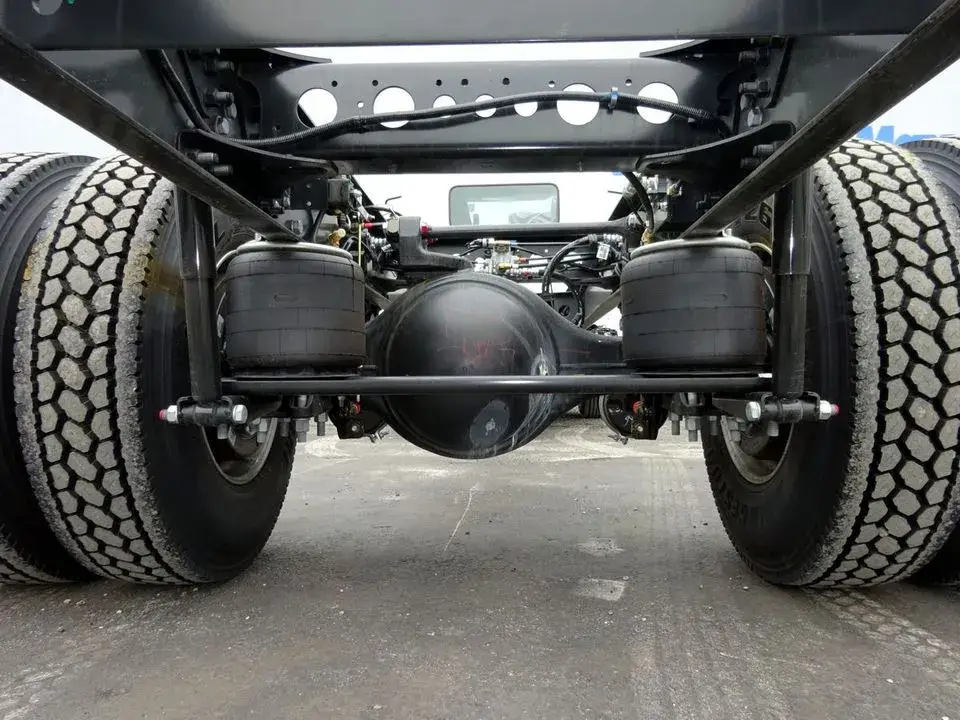
Air suspension systems transform load management through pressurized rubber bellows that automatically adjust to changing conditions. This pneumatic technology replaces fixed-rate metal springs with adaptive components that maintain optimal ride height regardless of cargo weight. The system leverages existing truck air compressors, integrating seamlessly with air brake infrastructure.
Electronic height sensors continuously monitor vehicle stance, triggering automatic pressure adjustments when load changes occur. This real-time adaptation maintains consistent ride quality whether hauling 10,000 or 50,000 pounds. The Technology & Maintenance Council reports that properly maintained air suspension reduces whole-body vibration exposure by 35-40% compared to leaf springs.
The widespread adoption of air ride technology reflects measurable operational benefits. Insurance carriers increasingly recognize reduced cargo damage claims, with some offering premium discounts for air-equipped fleets. Major shippers, particularly in electronics and pharmaceutical sectors, mandate air ride suspension for temperature-sensitive or fragile cargo protection.
Air Suspension Component Architecture
Modern air springs utilize multi-ply rubber construction reinforced with high-tensile steel or synthetic cords. These components withstand millions of compression cycles while maintaining structural integrity. Leading manufacturers like Hendrickson and Firestone engineer air springs for specific weight ratings and operational profiles.
Control systems represent the technological heart of air suspension. Integrated electronic modules process sensor inputs to maintain predetermined ride heights within 0.25 inches tolerance. Advanced systems incorporate predictive algorithms that anticipate load shifts during cornering or braking, preemptively adjusting pressure for enhanced stability.
Emergency backup systems prevent complete suspension failure if air supply is compromised. Mechanical bump stops engage before suspension bottoms out, allowing limited operation to reach service facilities. Some configurations include auxiliary air reservoirs providing temporary suspension function during compressor failures.
Stay Ahead of Industry Trends
Get expert insights, equipment reviews, and operational strategies delivered weekly.
Performance Comparison: Leaf Spring vs Air Ride Metrics
Direct performance comparison reveals distinct operational characteristics affecting daily fleet operations. Load capacity, ride quality, and adaptability differences significantly impact total cost of ownership beyond initial purchase prices. Understanding these performance variations helps match suspension technology to specific operational requirements.
Load Handling and Weight Distribution
Leaf springs perform optimally between 30,000 and 45,000 pounds, providing predictable support within this range. However, performance degrades significantly outside these parameters. Empty or lightly loaded trucks experience harsh, bouncing rides that increase driver fatigue and accelerate component wear.
Air suspension maintains consistent performance across the entire legal weight spectrum through automatic pressure modulation. The system’s load-leveling capability ensures proper weight distribution regardless of cargo placement, reducing uneven tire wear patterns. According to CVSA’s brake safety campaigns, brake-related violations comprise the largest percentage of all out-of-service violations during roadside inspections, with improperly maintained brake systems significantly affecting stopping distance and vehicle safety.
Testing by the National Institute for Occupational Safety and Health (NIOSH) demonstrates air suspension reduces vertical acceleration forces by 40-50% compared to leaf springs under identical load conditions. This vibration reduction translates directly to decreased cargo damage claims and extended vehicle component life.
| Performance Factor | Leaf Spring | Air Ride | Impact on Operations |
|---|---|---|---|
| Optimal Load Range | 30,000-45,000 lbs fixed | 10,000-50,000+ lbs adaptive | Air accommodates variable loads |
| Empty Ride Quality | Harsh and jarring | Smooth and controlled | Driver comfort affects retention |
| Vibration Transmission | High transfer to cargo | 40-50% reduction | Cargo damage prevention |
| Height Adjustability | Fixed by load weight | Manual/automatic control | Dock compatibility improvement |
Total Cost of Ownership Analysis
Comprehensive financial analysis extends beyond initial purchase prices to encompass maintenance, operational efficiency, and revenue opportunities. While leaf springs offer lower entry costs, air ride systems may deliver superior returns through reduced damage claims and driver retention benefits.
Initial Investment and Installation
Current market pricing positions leaf spring systems at $800-$1,500 per axle for new installations, with retrofit projects averaging $1,200-$2,000 including labor. Volume purchases exceeding ten units typically secure 8-15% discounts, further improving the value proposition for budget-conscious operations.
Air ride installations command $2,500-$4,000 per axle on new equipment, representing a $500-$1,000 premium per trailer. This differential has compressed dramatically from historical spreads exceeding $1,500 during the 1990s. Retrofit conversions cost $3,500-$5,500 per axle due to frame modifications and additional labor requirements.
Industry data shows the air ride premium has compressed dramatically over recent decades. According to fleet leasing analysis, the premium dropped from $1,500 on a $12,000-$15,000 dry van in the early 1990s to just $500-$1,000 today, depending on quantity purchased and optional features. This narrowing gap makes air suspension accessible to mid-sized fleets previously excluded by capital constraints.
Lifecycle Operating Expenses
Annual maintenance costs average $150-$250 for leaf spring systems, primarily covering bushing replacements and torque adjustments. Major component replacement occurs every 7-10 years at $800-$1,200 per axle. The mechanical simplicity enables most repairs at general service facilities without specialized training.
Air suspension maintenance runs $300-$450 annually, including air line inspections, valve servicing, and electronic diagnostics. Air bag replacement every 5-8 years costs $400-$700 per bag, while compressor rebuilds add $500-$800 every 4-6 years. However, reduced wear on other vehicle components often offsets these direct costs.
Insurance data from the American Transportation Research Institute reveals fleets with air ride equipment experience 30-40% fewer cargo damage claims. For operations handling high-value freight, this reduction can save thousands annually in deductibles and premium adjustments. Additionally, driver retention improvements of 12-18% with air ride translate to $3,000-$5,000 savings per driver in recruitment and training costs.
Maintenance Requirements and Service Life Expectations
Preventive maintenance programs significantly extend suspension system life regardless of technology choice. However, the complexity and frequency of required service varies considerably between leaf spring and air ride configurations. Understanding these differences helps fleet managers allocate resources effectively and minimize unexpected failures.
Leaf Spring Maintenance Protocols
Industry standards established by the Technology & Maintenance Council recommend leaf spring inspections every 12 months or 25,000 miles. These primarily visual examinations check for cracks, deformation, and leaf separation. Technicians verify U-bolt torque specifications, as vibration-induced loosening represents a common failure mode.
Common wear points include spring eye bushings subjected to constant articulation, center bolts experiencing metal fatigue, and permanent spring deformation from overloading. Proper maintenance extends service life beyond 10 years, though harsh environments accelerate deterioration. Northern fleets combat corrosion through regular washing and protective coatings.
Air Suspension Service Requirements
Air systems demand more comprehensive maintenance addressing multiple components. Essential tasks include air bag inspection for abrasions or punctures, pneumatic line integrity verification, valve functionality testing, and height sensor calibration. According to the Technology & Maintenance Council’s RP 643A guidelines, suspension U-bolt lock nuts should be retorqued after the first 1,000 miles, at first A-service, and annually for highway service or every 25,000 miles in severe-service applications.
Component failure typically occurs at predictable intervals. Air bags last 7-10 years depending on environmental exposure and load cycles. Electronic sensors may fail from corrosion or vibration damage after 5-7 years. Compressor wear accelerates in dusty conditions, requiring more frequent filter changes and internal component inspection.
Advanced diagnostic capabilities streamline troubleshooting for properly equipped facilities. Electronic control modules store fault codes identifying specific component failures, reducing diagnostic time. However, this sophistication requires technician training investments not necessary for leaf spring maintenance.
Application-Specific Performance Considerations
Matching suspension technology to operational requirements optimizes performance and value. Different applications stress suspension systems uniquely, favoring specific characteristics over others. Fleet managers should evaluate typical routes, cargo types, and operational priorities when selecting suspension systems.
Long-Haul Highway Operations
Interstate trucking operations overwhelmingly favor air ride suspension for compelling operational reasons. Driver comfort during thousand-mile trips reduces fatigue-related safety incidents and improves retention. Major carriers report air ride as a critical recruitment tool in today’s competitive driver market.
The National Highway Traffic Safety Administration’s Fatigue Management Program identifies whole-body vibration as a significant fatigue contributor. Air suspension’s 40% vibration reduction meaningfully impacts driver alertness during extended operation periods. This safety improvement influences insurance underwriting and CSA scoring.
Construction and Off-Road Applications
Harsh jobsite conditions favor leaf spring durability over air ride sophistication. Construction vehicles encounter debris, impacts, and environmental extremes that damage vulnerable pneumatic components. The mechanical simplicity of leaf springs ensures continued operation despite abuse that would sideline air systems.
Field service capabilities matter critically in remote locations. Leaf spring repairs require basic tools and general mechanical knowledge available at most locations. Air suspension diagnostics and repairs demand specialized equipment rarely available at construction sites, potentially causing extended downtime.
Urban Delivery and Distribution
City operations present mixed suspension requirements. Frequent dock interactions benefit from air ride’s height adjustment capability, eliminating dock plates and expediting loading. However, constant cycling between stops increases maintenance demands on pneumatic components.
Less-than-truckload carriers traditionally specify leaf springs for standardization and simplicity. The consistent moderate loads typical of LTL operations fall within leaf spring’s optimal performance range. Additionally, terminal maintenance facilities can efficiently service large fleets with uniform suspension specifications.
Share Your Expertise
Join Heavy Duty Journal as a guest author and reach thousands of industry decision-makers.
Making the Right Suspension Choice for Your Fleet
The optimal suspension selection emerges from careful analysis of your specific operational requirements rather than following industry trends. Both leaf spring and air ride technologies deliver reliable service when properly matched to application demands. Consider how each system’s characteristics align with your fleet’s daily reality.
When Leaf Springs Make Sense
Leaf spring suspension excels in operations prioritizing mechanical simplicity, durability, and cost control. Construction fleets operating in harsh environments benefit from the robust design resistant to impact damage. Companies with limited maintenance resources appreciate straightforward service requirements without specialized diagnostic equipment.
Budget-constrained operations find leaf springs attractive for minimizing capital investment while maintaining acceptable performance. The 10+ year service life with minimal maintenance provides predictable lifecycle costs. Fleets consistently hauling near-capacity loads within the 30,000-45,000 pound range maximize leaf spring value.
Regional carriers with established routes and predictable cargo weights successfully utilize leaf springs without compromising service quality. When driver comfort takes secondary priority to reliability and cost-effectiveness, leaf springs deliver appropriate performance at minimal expense.
When Air Ride Delivers Value
Air suspension justifies its premium for operations prioritizing driver satisfaction, cargo protection, and operational flexibility. Long-haul fleets recognize air ride as essential for driver recruitment and retention in competitive markets. The comfort advantage during extended trips measurably impacts safety and job satisfaction.
Operations handling fragile or high-value cargo require air suspension’s superior vibration dampening. Many shippers mandate air ride equipment for sensitive products, making this technology necessary for accessing premium freight markets. The ability to command higher rates for specialized service offsets increased equipment costs.
Fleets with variable load profiles benefit from air suspension’s automatic adjustment capabilities. Whether hauling partial loads or maximum capacity, the system maintains optimal performance characteristics. This versatility proves valuable for operations serving diverse customer requirements.
Critical Decision Factors
Several key considerations should guide your suspension selection beyond basic operational requirements. Fleet size impacts total capital requirements, with larger operations better positioned to absorb air ride premiums. Smaller fleets may prioritize minimizing initial investment despite potential long-term benefits.
Geographic operating areas influence suspension durability requirements. Northern fleets combat corrosion from road salt, while southern operations face heat-related rubber degradation. Urban environments stress components differently than rural routes, affecting maintenance intervals and failure modes.
Customer requirements may dictate equipment specifications regardless of other factors. Securing contracts with major shippers often requires specific suspension types. Evaluate whether equipment investments enable access to higher-margin business opportunities.
Consider mixed-fleet strategies matching suspension types to specific vehicle missions. Specify leaf springs for dedicated construction vehicles while equipping long-haul units with air ride. This targeted approach optimizes investment by aligning technology with operational demands.
Conclusion
The suspension system decision significantly impacts fleet operational efficiency, maintenance costs, and driver satisfaction. Leaf spring technology delivers proven reliability, mechanical simplicity, and cost-effectiveness for operations prioritizing durability and budget control. These systems excel in construction applications, consistent heavy-haul operations, and fleets with limited maintenance resources.
Air ride suspension justifies higher initial investment through superior ride quality, automatic load adaptation, and cargo protection capabilities. Long-haul operations, variable-load applications, and premium freight services benefit from air suspension’s advanced performance characteristics. The technology has become increasingly accessible as price premiums compress and operational benefits multiply.
Neither system claims universal superiority across all applications. Your optimal choice depends on honest evaluation of operational requirements, budget constraints, and business objectives. Consider total lifecycle costs including maintenance, driver retention, and revenue opportunities rather than focusing solely on purchase prices.
Fleet managers should analyze specific route profiles, cargo characteristics, and maintenance capabilities when making suspension decisions. Consult with suspension specialists familiar with your industry segment. Review warranty terms and component availability for your operating regions.
The detailed analysis presented here equips you to make informed suspension selections aligned with operational realities. Whether choosing traditional leaf springs or modern air ride systems, match the technology to your fleet’s specific mission. This strategic approach to suspension selection optimizes performance and delivers measurable returns throughout your equipment’s service life.
Frequently Asked Questions
What is the main cost difference between leaf spring and air ride suspension?
Leaf spring systems cost $800-$1,500 per axle for new installations, while air ride runs $2,500-$4,000 per axle. The air ride premium has compressed to just $500-$1,000 per trailer, representing only 3-5% of total trailer cost. However, lifecycle costs must include maintenance expenses: leaf springs average $150-$250 annually versus $300-$450 for air systems. Air ride may offset higher costs through 30-40% fewer cargo damage claims and 12-18% better driver retention rates.
Which suspension system lasts longer?
Leaf springs typically last 10+ years with proper maintenance and appropriate loading. Air bags require replacement every 7-10 years due to rubber deterioration from environmental exposure. However, the overall air suspension framework remains functional with component replacements. Both systems’ actual lifespan varies significantly based on operating conditions, maintenance quality, and load patterns. Northern fleets face corrosion challenges with steel springs, while extreme temperatures affect air bag longevity.
Do shippers require specific suspension types?
Many major shippers mandate air ride suspension, particularly for electronics, pharmaceuticals, and temperature-sensitive cargo. Premium freight contracts often specify air ride equipment as a qualification requirement. Fleet managers should survey target customers’ equipment requirements before making suspension decisions. Having air ride capability enables access to higher-margin freight opportunities that offset equipment premiums. Some insurance carriers also offer reduced premiums for air-equipped fleets based on lower damage claim frequencies.
How does suspension choice affect driver retention?
Fleets report 12-18% improved driver retention with air ride suspension due to significantly reduced fatigue and enhanced comfort. The harsh, bouncing ride of empty leaf spring trucks causes physical stress during long hauls. In competitive driver markets, air ride equipment becomes a critical recruitment and retention tool. Major carriers consistently cite suspension type as a key differentiator when attracting experienced drivers. The $3,000-$5,000 annual savings per driver in reduced turnover costs often justifies air ride investment.
Are leaf springs better for construction applications?
Yes, leaf springs excel in construction environments due to mechanical simplicity and damage resistance. Jobsites present hazards including debris, impacts, and harsh conditions that can puncture air bags or damage pneumatic components. Leaf springs’ robust steel construction withstands abuse that would sideline air systems. Additionally, field repairs require only basic tools available at most locations, while air suspension demands specialized diagnostic equipment rarely found at construction sites.
Which suspension handles variable loads better?
Air ride suspension significantly outperforms leaf springs for variable load applications. The system automatically adjusts pressure to maintain optimal ride height whether hauling 10,000 or 50,000 pounds. Leaf springs operate best within a narrow 30,000-45,000 pound range, delivering harsh rides when empty and potentially sagging under maximum loads. For fleets with diverse cargo weights or frequent empty miles, air ride’s adaptability provides consistent performance and superior driver comfort across all load conditions.
Share This With Your Heavy-Duty Network
Help fleet managers and diesel technicians discover valuable insights by sharing this article.