By Michael Nielsen, Editor & Publisher | 15+ Years in Diesel Repair
Last Updated: December 2024
📖 Estimated reading time: 20 minutes
Hydraulic oil analysis transforms fleet maintenance from reactive repairs to predictive care—catching pump wear, contamination, and fluid degradation before they strand trucks or sideline equipment. For fleet managers running hydraulic-dependent systems on trucks, trailers, and vocational equipment, regular fluid testing provides an early warning system that protects expensive components and prevents costly roadside breakdowns.
The average hydraulic pump replacement runs $3,000 to $8,000 including downtime, while a complete hydraulic system failure on a refuse truck or concrete mixer can exceed $15,000 in emergency repairs. Oil analysis programs typically cost $25 to $75 per sample—a fraction of a single avoided failure. This guide covers everything fleet maintenance teams need to implement effective hydraulic oil analysis, from understanding contamination types to building a sampling program that delivers measurable ROI.
Key Takeaways
- Early detection: Oil analysis identifies pump wear, contamination, and degradation 200-500 hours before visible symptoms appear.
- ROI potential: Programs typically return $3-$10 for every dollar invested through avoided failures and extended component life.
- Contamination control: Particulates, water, and air cause 75-80% of hydraulic system failures—all detectable through analysis.
- Sampling consistency: Taking samples from the same location at regular intervals enables trend analysis that reveals developing problems.
- Fleet applications: Hydraulic systems on dump bodies, refuse compactors, PTOs, and liftgates all benefit from condition monitoring.
- Baseline establishment: Initial samples with new oil create equipment-specific reference points for accurate future comparisons.
Understanding Hydraulic Systems in Commercial Trucking
Hydraulic systems convert fluid pressure into mechanical force, powering critical operations across commercial truck fleets. Unlike consumer vehicles, heavy-duty trucks rely on hydraulic power for revenue-generating work—dump bodies, refuse compactors, concrete mixers, liftgates, and auxiliary equipment that keeps freight moving and job sites productive.
The fluid serves dual roles: transmitting power through the system while lubricating pumps, cylinders, and valves. This combination of functions makes fluid condition critical to system performance. Degraded oil loses its ability to protect precision components, while contaminated fluid acts like sandpaper inside expensive pumps and valves.
Common Fleet Applications
Fleet managers encounter hydraulic systems across multiple equipment types. Dump trucks depend on hydraulic cylinders for body operation, with pump-over-tank (POT) systems common in construction applications. Refuse trucks use complex hydraulic circuits powering compactors, automated side loaders, and container handling arms—often running 8-12 hours daily in demanding conditions.
Tractor-trailers equipped with hydraulic liftgates rely on power units that may sit dormant for days, then cycle repeatedly during delivery routes. Concrete mixers use hydraulic motors for drum rotation, operating in high-heat environments that accelerate fluid degradation. Vocational equipment including aerial lifts, cranes, and service bodies all depend on hydraulic power for their primary functions.
Why Fleet Hydraulics Fail
Hydraulic failures create immediate operational problems that extend beyond simple repair costs. A refuse truck sidelined during collection routes disrupts schedules, potentially triggering municipal contract penalties. A dump truck unable to raise its body at a job site holds up crews and equipment. Emergency hydraulic repairs frequently run three to five times the cost of planned maintenance due to expedited parts, overtime labor, and towing expenses.
Most hydraulic failures trace back to three root causes: particulate contamination, water infiltration, and fluid degradation. All three are detectable through oil analysis long before systems fail—making regular testing one of the most effective predictive maintenance tools available to fleet operations.
What Is Hydraulic Oil Analysis?
Hydraulic oil analysis is a diagnostic technique that examines fluid samples to assess system health, identify contamination, and detect component wear before failures occur. Laboratories test physical properties (viscosity, color), chemical composition (oxidation, additive levels), and contamination levels (particles, water, metals) to create a comprehensive picture of hydraulic system condition.
The process works because hydraulic fluid accumulates evidence of everything happening inside the system. Wear metals from degrading pumps appear as specific elements—iron from gears, copper from bearings, chromium from cylinder rods. Contamination shows up as particle counts and ISO cleanliness codes. Degradation reveals itself through viscosity changes and acid number increases.
Key Parameters Tested
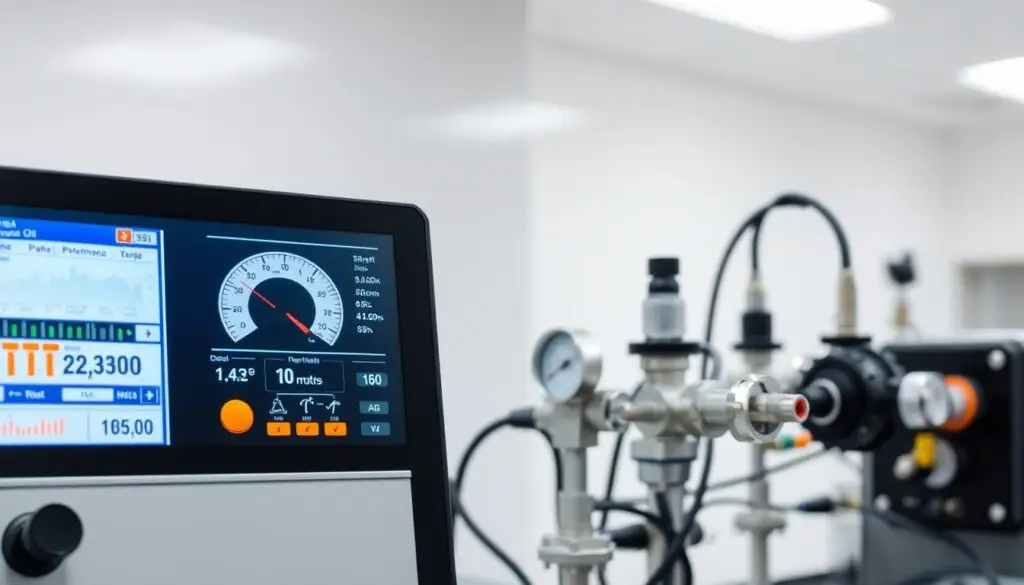
Standard hydraulic oil analysis examines multiple parameters that together reveal system health:
Viscosity: Measures fluid thickness at standardized temperatures (typically 40°C and 100°C). Changes indicate oxidation, contamination, or thermal breakdown. Oil that thickens resists flow, reducing system efficiency. Oil that thins loses its ability to maintain protective films between moving parts.
Particle Count and ISO Codes: Quantifies contamination using the ISO 4406 cleanliness standard, which reports particles at 4, 6, and 14 micron sizes. Different components require different cleanliness levels—servo valves demand ISO 16/14/11 or better, while standard cylinders tolerate ISO 18/16/13.
Water Content: Identifies moisture contamination that destroys lubrication effectiveness and accelerates corrosion. Results report as saturation percentage or parts per million depending on concentration severity.
Wear Metals: Spectroscopic testing identifies and quantifies specific metals indicating component wear. Iron suggests pump or cylinder degradation; copper points to bearing wear; chromium indicates piston rod or plating damage.
Total Acid Number (TAN): Reveals oxidation levels—fresh oil has low TAN values that increase as fluid ages. Rapid TAN increases signal excessive heat exposure or contamination problems.
Predictive vs. Preventive Approaches
Traditional preventive maintenance changes oil and filters at fixed intervals regardless of actual condition. A fleet might change hydraulic oil every 2,000 hours based on manufacturer recommendations—sometimes too early, wasting good fluid, and sometimes too late, after damage has begun.
Predictive maintenance uses oil analysis data to determine optimal intervention timing. Testing reveals actual fluid condition, enabling maintenance when indicators show it’s necessary rather than on arbitrary schedules. This condition-based approach typically extends drain intervals by 25-50% while catching developing problems between scheduled services.
| Approach | Decision Basis | Cost Efficiency | Failure Prevention |
|---|---|---|---|
| Preventive | Fixed time/hour intervals | Moderate—may change fluid early | Schedule-based protection |
| Predictive | Actual fluid condition data | High—intervention when needed | Data-driven early detection |
Contamination: The Primary Cause of Hydraulic Failures
Industry research consistently shows that 75-80% of hydraulic system failures trace back to contamination. Understanding contamination sources and effects helps fleet managers implement effective prevention and detection strategies.
Particulate Contamination
Solid particles enter hydraulic systems from external and internal sources. External contamination infiltrates through damaged seals, worn breather caps, and improperly secured fill ports. Job site dust poses constant threats to equipment operating in construction, refuse collection, and agricultural environments.
Internal generation creates equally serious problems. Pumps, cylinders, and valves produce microscopic wear particles during normal operation. These particles circulate and damage additional components, creating a self-reinforcing destruction cycle. Maintenance activities also introduce contaminants—oil changes, filter replacements, and component repairs can inadvertently contaminate clean systems if proper procedures aren’t followed.
⚠️ Safety Warning
New hydraulic oil directly from suppliers often contains unacceptable particle levels. Filter new fluid through a 10-micron filter before adding to systems to prevent introducing contamination during oil changes.
Water Contamination Effects
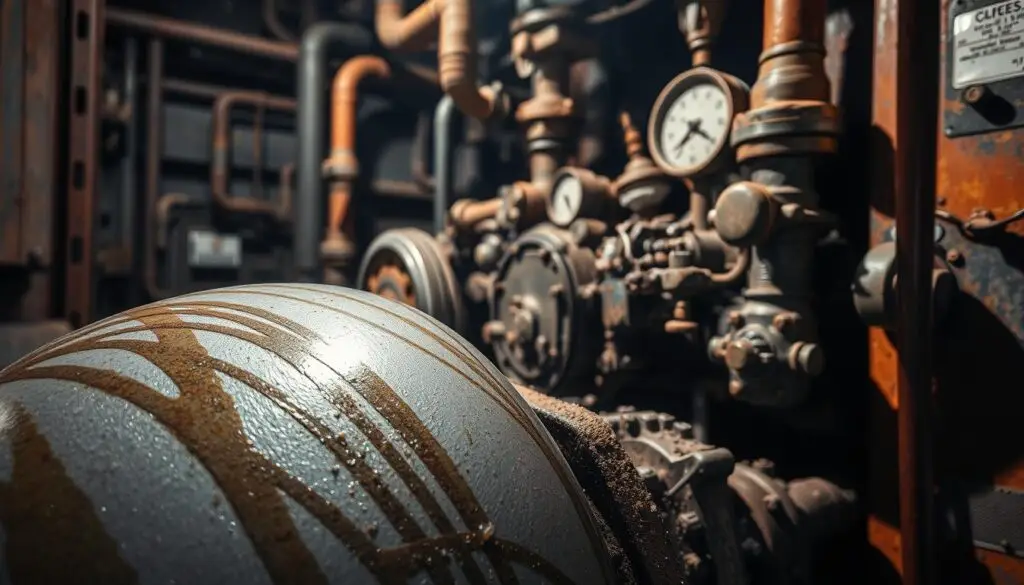
Water destroys hydraulic fluid performance through multiple pathways. Moisture enters systems when temperature fluctuations cause condensation inside reservoirs—common in equipment that operates in varying weather conditions or sits overnight. Leaking heat exchangers, damaged cylinder seals, and pressure washing without proper protection all introduce water directly.
Even small amounts of water dramatically reduce lubrication effectiveness. Water displaces oil films from metal surfaces, allowing metal-to-metal contact that accelerates wear exponentially. Water also promotes oxidation, depletes protective additives, and supports bacterial growth that creates acidic byproducts corroding internal components.
Dissolved water remains invisible until saturation levels exceed capacity. Emulsified water creates a milky appearance indicating serious contamination requiring immediate attention. Free water separates and settles at reservoir bottoms where it accelerates corrosion of system components.
Air Contamination and Cavitation
Air contamination manifests in two forms: aeration and cavitation. Aeration occurs when air mixes with hydraulic fluid, creating foam that reduces the system’s ability to transmit power efficiently. Low fluid levels, suction leaks, and improper reservoir design all contribute to aeration problems.
Cavitation develops when pressure drops cause dissolved air to form bubbles that collapse violently against component surfaces. The resulting shock waves erode metal and create pitting damage on pump rotors and valve bodies. Symptoms include increased noise, vibration, and erratic system operation. The debris generated adds to particulate contamination levels, compounding system damage.
| Contamination Type | Primary Sources | Detection Methods |
|---|---|---|
| Particulates | External ingression, component wear, maintenance introduction | Particle counting, ISO codes, ferrography |
| Water | Condensation, cooler leaks, seal damage | Karl Fischer test, crackle test, visual inspection |
| Air | Cavitation, suction leaks, low fluid levels | Visual observation, acoustic monitoring |
| Chemical | Wrong fluids, process chemicals, cleaning solvents | FTIR spectroscopy, viscosity analysis |
Recognizing Oil Degradation Warning Signs
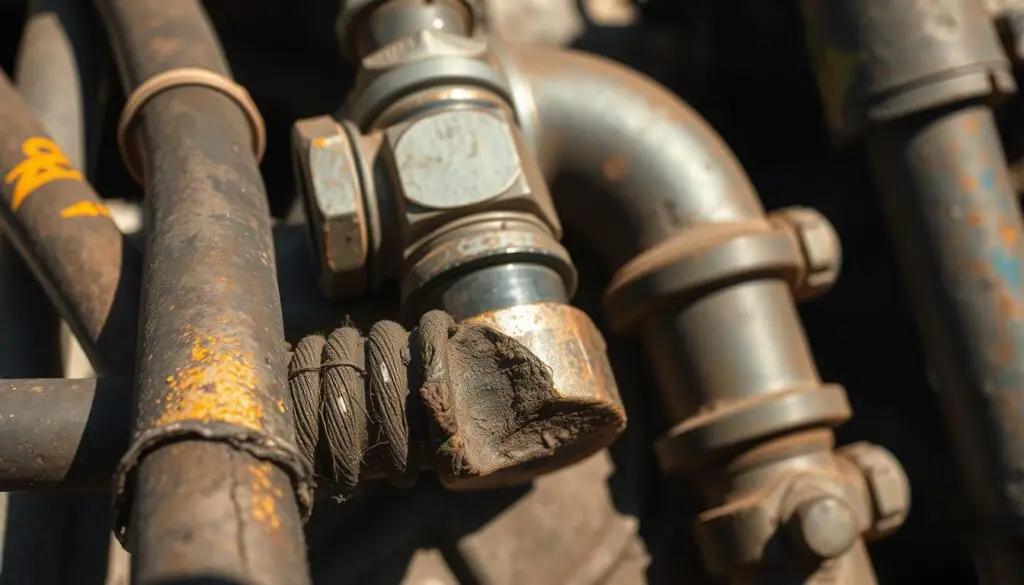
Hydraulic oil degrades through chemical and physical processes that compromise equipment protection. Recognizing warning signs helps maintenance teams identify problems before catastrophic failures occur.
Oxidation and Thermal Breakdown
Oxidation represents the most common form of hydraulic fluid degradation. When oil combines with oxygen—accelerated by heat, metal catalysts, and existing contamination—it produces acids, sludge, and varnish deposits that damage sensitive components throughout the system.
Temperature dramatically affects oxidation rates. According to the Arrhenius rate rule for lubricants, oxidation speed roughly doubles for every 18°F (10°C) increase in operating temperature. Equipment running consistently above recommended temperatures consumes fluid life rapidly.
Observable symptoms of degradation include darkened fluid color, burnt odor, elevated operating temperatures, and sluggish system response. Dump trucks may exhibit jerky body operation; refuse compactors may cycle slower than normal. These symptoms indicate degradation has already progressed significantly—oil analysis catches the problem earlier through chemical markers.
Additive Depletion
Hydraulic oils contain carefully formulated additive packages providing essential protection: anti-wear agents, antioxidants, rust inhibitors, and foam suppressants. Each component serves specific functions that deteriorate with use and contamination exposure.
As additives deplete, the base oil loses critical defensive properties. Anti-wear agents that protect pump surfaces diminish. Antioxidants that slow fluid breakdown become exhausted. Foam suppressants that maintain system efficiency lose effectiveness. Without adequate additive protection, equipment faces dramatically shortened service life—often evident in accelerated wear metal trends on sequential oil analysis reports.
Stay Ahead of Hydraulic System Problems
Heavy Duty Journal delivers practical maintenance insights, industry updates, and expert guidance for fleet managers and diesel technicians. Get actionable content that helps you reduce downtime and control costs.
Laboratory Testing Methods
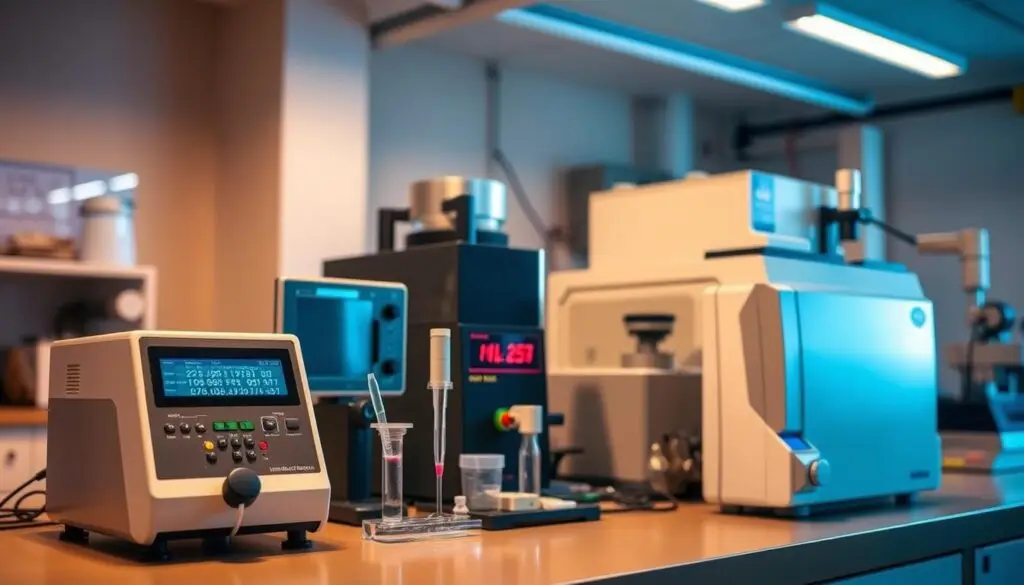
Modern oil analysis laboratories use multiple analytical techniques to examine hydraulic fluid from different perspectives. Understanding these methods helps fleet managers interpret reports and communicate effectively with lab partners.
Spectroscopic Analysis
Inductively Coupled Plasma (ICP) spectroscopy atomizes oil samples at temperatures exceeding 10,000°F, measuring light emissions from different elements to identify and quantify metals with precision down to parts per million. This sensitivity makes ICP essential for detecting early-stage component wear.
Specific elements indicate wear from particular components. Iron typically comes from gears, cylinders, and pump components. Copper signals bearing and bushing wear. Chromium often originates from piston rods and chrome-plated surfaces. Tracking these wear metals over time reveals deterioration patterns long before visible damage occurs.
Fourier Transform Infrared (FTIR) spectroscopy examines molecular-level chemical changes. This method identifies oxidation, nitration, additive depletion, and contamination from incompatible fluids. FTIR creates a chemical fingerprint of oil condition, revealing degradation before performance problems become apparent.
Particle Counting and Ferrography
Automatic particle counters use light-blocking or light-scattering principles to count and classify particles suspended in oil samples. These instruments generate ISO cleanliness codes and particle distribution data within minutes, showing whether filtration systems effectively remove contaminants.
Analytical ferrography magnetically separates ferrous wear particles for microscopic examination, determining particle size, shape, and wear mode. This technique distinguishes between normal rubbing wear and severe cutting or fatigue wear requiring immediate attention. Large metallic particles indicate aggressive wear conditions that demand investigation.
| Testing Method | Primary Detection | Key Applications |
|---|---|---|
| ICP Spectroscopy | Elemental metals (1-1000 ppm) | Wear trend analysis, component identification |
| FTIR Analysis | Chemical compounds | Oxidation, additive depletion, contamination |
| Particle Counting | Particle size distribution | Cleanliness codes, filtration effectiveness |
| Ferrography | Wear particle morphology | Wear mode classification, severity assessment |
Best Practices for Hydraulic Oil Sampling
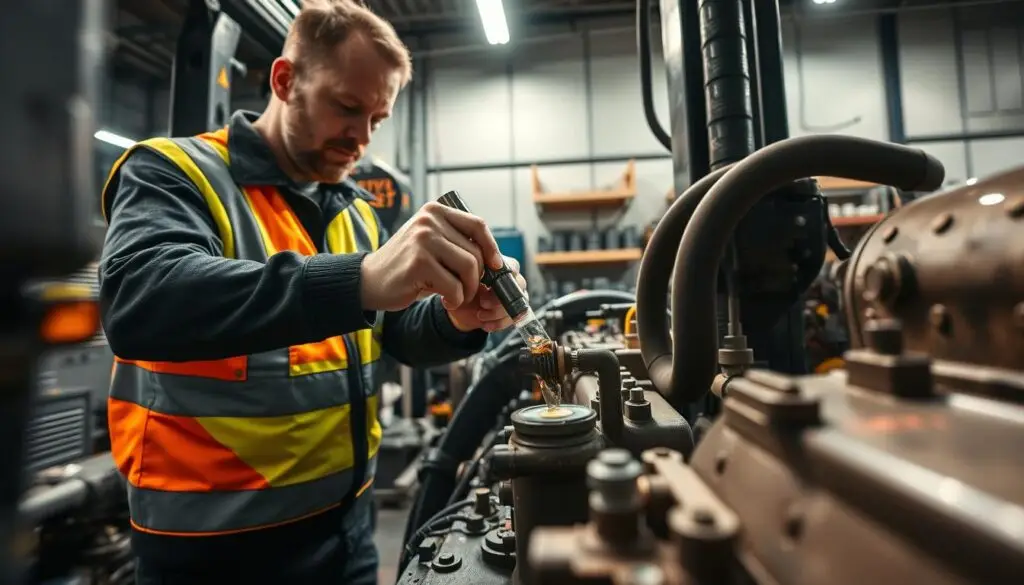
Sample quality directly determines analysis accuracy. Contaminated or improperly collected samples produce misleading results that lead to incorrect maintenance decisions. Following established procedures ensures samples truly represent system condition.
Equipment and Preparation
Proper sample collection requires dedicated equipment to maintain sample integrity. Essential supplies include laboratory-supplied sample bottles with proper labeling and sealing, dedicated sampling valves or ports, vacuum pumps or sampling tubes, cleaning materials, and personal protective equipment.
Never reuse containers from previous samples—residual contamination compromises results. Most oil analysis laboratories supply pre-cleaned bottles as part of their testing packages. Store sampling equipment in clean, protected locations to prevent contamination before use.
⚠️ Safety Warning
Hydraulic systems operate under high pressure and elevated temperatures. Never loosen fittings or access sampling points on pressurized systems. Allow equipment to cool and release pressure before sampling. Wear appropriate PPE including safety glasses and gloves.
Sampling Location and Timing
Location significantly impacts sample representativeness. The best practice draws fluid from return lines after components but before filtration occurs—this captures wear debris and contamination that filters would remove. Avoid sampling from reservoir bottoms where settled debris concentrates, or from stagnant lines that don’t reflect circulating fluid condition.
Sample while equipment operates at normal temperature. Cold fluid or shutdown conditions provide misleading results that don’t reflect actual system performance. For fleet equipment with intermittent hydraulic use (liftgates, dump bodies), operate the system through several cycles before sampling to ensure fluid has circulated.
Consistency matters more than perfection. Sample from the same location every time to enable meaningful trend analysis. Variations in sampling points create apparent changes that reflect location differences rather than actual condition changes.
Contamination Prevention During Collection
Preventing sample contamination starts before drawing fluid. Clean the area around sampling points thoroughly—a single grain of job site dust can skew particle count results. Flush an adequate quantity of oil through sampling lines or valves before capturing the specimen to ensure you collect representative fluid rather than stagnant oil.
According to oil sampling best practices, if using vacuum pumps for collection, use new tubing for every sample point. This critical step prevents cross-contamination between different equipment samples. Clean tools and containers reduce risk of introducing foreign materials into analysis.
Documentation Requirements
Accurate records transform individual samples into valuable trend data. Document essential information at collection time:
- Equipment identification with unique asset numbers
- Sampling date, time, and technician
- Operating hours or service time since last oil change
- Oil type and grade currently in system
- Recent maintenance activities or repairs
- Any operational abnormalities observed
Send samples to the laboratory promptly after collection. Don’t hold samples for extended periods, as fluid properties can change during storage. Most laboratories recommend shipping within 48-72 hours of collection for optimal accuracy.
The HDJ Perspective
In our experience working with fleet maintenance operations, the biggest barrier to successful oil analysis programs isn’t cost or complexity—it’s consistency. Fleets that treat sampling as an optional task when technicians have time never build the trend data that makes analysis valuable. The operations seeing real ROI from oil analysis have made it part of their PM process: every service, same location, same procedures, same documentation. That consistency transforms individual data points into actionable intelligence that catches problems before they become roadside failures.
Interpreting Oil Analysis Reports
The numbers on an oil analysis report tell a story about equipment condition—but extracting actionable intelligence requires understanding what each measurement means and how parameters relate to specific problems.
Establishing Baseline Values
Initial sampling during operation with clean, new oil establishes critical reference points for identifying future abnormalities. These baseline readings capture normal operating characteristics for specific equipment under actual working conditions. Generic “normal” values published in manuals often prove unreliable because baselines vary by equipment type, operating environment, and oil formulation.
Establish accurate baselines by sampling new equipment or freshly serviced systems multiple times during the first 50-100 operating hours. This creates a reliable foundation for future comparisons—when subsequent samples show elevated iron at 45 ppm, knowing your baseline was 15 ppm signals a developing problem, while the same reading on equipment that normally runs 40 ppm indicates normal operation.
Trend Analysis Over Time
Single-point analysis provides limited value. Trend analysis—plotting parameters over time—reveals the gradual changes that signal developing problems long before absolute values reach dangerous levels. A steady increase in iron particles indicates progressive pump wear even when current levels remain within acceptable ranges.
Effective trending requires consistent sampling intervals, proper documentation, and regular data review. Many fleet maintenance teams plot key parameters on simple graphs that make patterns visually obvious. A flat line suddenly trending upward demands investigation even if values remain “normal” by generic standards.
200-500 hours
Typical advance warning oil analysis provides before hydraulic component failures—enough time to schedule repairs during planned maintenance rather than emergency breakdowns.
Understanding Alert Thresholds
Laboratories establish alert and critical thresholds based on equipment type, manufacturer specifications, and industry standards. Understanding these levels enables appropriate responses to different severity findings.
Normal: All parameters within baseline ranges. Continue routine sampling schedule.
Caution: One or more parameters showing upward trends. Increase sampling frequency and investigate potential causes within 1-2 weeks.
Alert: Parameters approaching or exceeding limits. Schedule maintenance inspection and prepare corrective action within 3-5 days.
Critical: Parameters at or above critical thresholds. Equipment shutdown and immediate repair required within 24 hours.
Develop clear protocols defining responsibilities and actions for each threshold level. This structured approach ensures warning signs receive appropriate attention before minor issues escalate into major failures.
Share Your Hydraulic Maintenance Expertise
Have you implemented oil analysis programs in your fleet operation? HDJ welcomes contributions from fleet managers, technicians, and maintenance professionals who can share real-world insights with our industry audience.
Common Problems Detected Through Oil Analysis
Oil analysis connects laboratory findings to specific equipment problems. Understanding these correlations helps maintenance teams respond appropriately when reports flag abnormalities.
Pump Wear and Cavitation
Pump deterioration manifests through elevated iron, aluminum, and bronze levels depending on pump construction. Particle morphology reveals whether degradation results from normal abrasion or cavitation damage—cavitation creates jagged, irregular particles while also producing characteristic noise and vibration symptoms.
Rising wear metals combined with increased system noise typically indicate pump problems requiring investigation. Flow rate monitoring combined with particle analysis provides the clearest diagnostic picture for pump-related issues.
Cylinder and Seal Problems
Cylinder wear appears as elevated chromium and iron from rod and bore surfaces. Seal degradation introduces elastomer particles detectable through infrared spectroscopy testing. Internal leakage from damaged seals often permits moisture ingression, creating secondary contamination issues visible in water content results.
For fleet equipment, cylinder problems often correlate with operating conditions. Dump bodies experiencing frequent cycling in dusty environments show different wear patterns than liftgates with intermittent use in clean conditions. Understanding these operational contexts improves diagnostic accuracy.
Filtration System Failures
Filter bypass events appear as sudden particle count increases despite scheduled filter changes. Monitoring ISO cleanliness levels reveals when filters reach capacity or experience media degradation. Filter fibers appearing in oil samples indicate breakdown of filtration materials that may be contaminating the system rather than protecting it.
Filtration system failures allow contamination to circulate freely throughout hydraulic circuits. Regular analysis identifies these conditions before they cause extensive damage. The combination of particle counting and system pressure monitoring provides comprehensive filtration health assessment.
Building Your Oil Analysis Program
Successful programs require systematic implementation aligned with fleet operations and maintenance capabilities. Starting small with critical equipment and expanding based on results typically outperforms attempting comprehensive coverage immediately.
Defining Scope and Objectives
Begin by identifying which equipment warrants monitoring. Prioritize based on criticality, repair costs, and failure history. A refuse fleet might start with packer body hydraulics where failures create immediate route disruptions. A construction operation might focus on excavator main pumps where replacements exceed $10,000.
Establish clear objectives: reducing unplanned downtime by a defined percentage, extending drain intervals, or catching problems before critical failures. These goals guide program design and provide metrics for measuring success.
Selecting Laboratory Partners
Laboratory selection significantly impacts program success. Evaluate candidates on analytical capabilities, turnaround time, reporting quality, and technical support availability. Many commercial laboratories offer fleet programs with volume pricing and dedicated account support.
Consider industry expertise—laboratories experienced with heavy equipment hydraulics understand normal parameters for your applications. Consistent use of the same facility maintains trend reliability across sampling cycles. Look for laboratories offering online portals for report access and trend visualization tools.
Major providers serving fleet hydraulic applications include Polaris Laboratories, Bureau Veritas, and OEM-affiliated testing services through companies like Caterpillar and Cummins that extend to hydraulic systems.
Training and Integration
Effective programs require trained technicians who understand sampling procedures and recognize when results demand action. Most laboratories offer training resources covering sampling techniques, contamination avoidance, and report interpretation.
Integrate analysis results into existing maintenance management systems. Abnormal findings should generate work orders automatically, while trending data informs preventive maintenance schedules. According to the SAE JA1011 reliability-centered maintenance standard, condition monitoring data should directly influence maintenance task selection and intervals.
Fleet management software increasingly incorporates oil analysis data alongside telematics, inspection records, and repair history. This integration enables comprehensive equipment health assessment that considers multiple data sources for maintenance decisions.
Measuring Return on Investment
Quantifying program benefits helps justify continued investment and identifies opportunities for expansion. Track specific metrics that demonstrate financial value.
Avoided Failure Costs
Document each problem detected through oil analysis and estimate avoided repair costs. When analysis reveals elevated copper indicating bearing wear, and subsequent inspection confirms the finding before catastrophic failure, calculate what emergency repair would have cost versus planned intervention.
Include indirect costs: tow charges, lost productivity, overtime labor, expedited parts shipping, and customer impact. Emergency hydraulic failures frequently cost three to five times more than planned repairs due to these factors.
Extended Fluid and Component Life
Condition-based oil changes based on analysis results often extend drain intervals significantly versus time-based schedules. Track actual drain intervals achieved versus previous practices to calculate fluid cost savings and reduced maintenance labor.
Component life extension occurs when analysis catches abnormal wear before it cascades into catastrophic failure. A pump showing elevated wear metals might need repair at $2,000, while the same pump failing completely requires $6,000 replacement plus associated damage to valves and cylinders contaminated by debris.
Program ROI Calculation
Sum annual program costs including sampling supplies, laboratory fees, technician time for sampling and report review, and software expenses. Compare against documented savings from avoided failures, extended component life, and reduced downtime.
Most comprehensive programs achieve benefit-to-cost ratios exceeding 3:1, with well-implemented programs often reaching 5:1 or higher. Even modest programs typically demonstrate positive ROI within 12-18 months as trend data accumulates and catches developing problems.
$3-$10 returned
For every dollar invested in comprehensive oil analysis programs, according to fleet maintenance industry benchmarks from the Technology & Maintenance Council.
Frequently Asked Questions
How often should fleet hydraulic systems be sampled?
Sampling frequency depends on equipment criticality and operating intensity. Critical systems like refuse truck compactors or concrete mixer hydraulics benefit from monthly sampling due to severe duty cycles. Standard fleet hydraulics typically require quarterly analysis. Liftgates and intermittent-use systems may need only semi-annual testing. Start with more frequent sampling to establish baselines, then adjust intervals based on results stability and equipment importance to operations.
What does an elevated iron reading indicate in hydraulic oil analysis?
Elevated iron typically indicates wear from steel components including gears, cylinders, pumps, and valve bodies. Context matters: compare current readings against established baselines and previous trends rather than generic limits. A sudden increase from 20 ppm to 60 ppm demands investigation even if 60 ppm falls within “normal” ranges. Rising iron combined with increased particle counts suggests accelerating wear requiring prompt attention before more extensive damage occurs.
Can oil analysis extend hydraulic fluid drain intervals?
Yes, condition-based maintenance using oil analysis commonly extends drain intervals by 25-50% compared to time-based schedules. Analysis confirms whether fluid remains serviceable regardless of calendar time or operating hours. However, extension depends on maintaining acceptable contamination levels, adequate additive packages, and stable viscosity. Never extend intervals without analysis confirmation—fluid degradation rates vary significantly based on operating conditions, temperature exposure, and contamination control.
What is the typical cost for hydraulic oil analysis testing?
Standard hydraulic oil analysis packages range from $25 to $75 per sample depending on test parameters included. Basic panels covering viscosity, water content, wear metals, and particle counts fall toward the lower end. Comprehensive packages adding ferrography, advanced spectroscopy, and specialized contamination testing cost more. Many laboratories offer fleet volume pricing that reduces per-sample costs. Compare total program costs against a single avoided hydraulic failure to understand the value proposition.
How do ISO cleanliness codes work for hydraulic systems?
ISO 4406 cleanliness codes report contamination using three numbers representing particle counts at 4, 6, and 14 micron sizes per milliliter of fluid. Each number corresponds to a range—lower numbers indicate cleaner fluid. For example, ISO 18/16/13 means particle counts fall within specific ranges at each size. Different components require different cleanliness levels; servo valves typically need ISO 16/14/11 or better, while standard cylinders tolerate ISO 18/16/13. Target cleanliness codes should be established based on system component sensitivity.
Implementing Hydraulic Oil Analysis in Your Fleet
Hydraulic oil analysis delivers measurable value for fleet operations running hydraulic-dependent equipment. By catching contamination, wear patterns, and fluid degradation before they cause failures, testing programs transform maintenance from reactive emergency response to proactive planned intervention.
Start with your most critical equipment where hydraulic failures create the greatest operational and financial impact. Establish consistent sampling procedures, build baseline data, and track trends over time. The investment in systematic oil analysis typically returns three to ten dollars for every dollar spent through avoided failures, extended component life, and reduced unplanned downtime.
Fleet managers who implement these programs position their operations for improved reliability and controlled maintenance costs—turning hydraulic system care from a reactive headache into a predictable, manageable process.
Share This Guide With Your Team
Know fleet managers or maintenance professionals who could benefit from implementing hydraulic oil analysis? Share this guide to help them protect their equipment investments.