By Michael Nielsen, Editor & Publisher | 15+ Years in Diesel Repair
Last Updated: December 2025
📖 Estimated reading time: 42 minutes
Commercial vehicle operators face a persistent challenge during roadside inspections: brake-related violations account for 23% of all DOT citations, making them the single largest category of inspection failures. For fleet managers and owner-operators, this isn’t just a regulatory headache—it directly impacts CSA scores, insurance premiums, and vehicle uptime.
The solution lies in systematic air brake system maintenance programs that deliver measurable results. Industry data shows fleets implementing preventive brake maintenance achieve 98% vehicle uptime compared to just 89% for reactive approaches, while reducing DOT brake violations by 60%. This comprehensive guide walks you through proven inspection schedules, component maintenance procedures, and documentation practices that transform your approach from reactive repairs to data-driven prevention.
Key Takeaways
- Systematic preventive programs cut regulatory violations by 60% through scheduled inspections and proper documentation
- Proactive fleets achieve 98% uptime versus 89% for reactive maintenance approaches—a 9-point advantage
- Brake violations carry up to 10 CSA severity points with 3x time-weighted multipliers for recent citations
- Preventive maintenance costs $0.12 per mile compared to $0.22 per mile for reactive repairs—a 45% reduction
- Emergency repairs drop by 83% with proper programs (from 12 incidents to 2 per vehicle annually)
- ROI turns positive within 6-12 months, delivering $3-5 return for every dollar invested
The Critical Impact of Air Brake Failures on Fleet Operations
Fleet managers face mounting challenges when air brake violations compromise their operations, triggering a cascade of regulatory and financial consequences. The impact extends beyond immediate safety concerns, affecting compliance records, insurance costs, and overall operational efficiency. Understanding these interconnected effects helps carriers develop strategies to protect their business from preventable setbacks.
Air brake system deficiencies represent one of the most significant vulnerabilities in commercial vehicle operations. Each violation creates a documented record that influences regulatory oversight and business costs for years. The data reveals patterns that separate successful fleets from those struggling with recurring compliance issues.
DOT Violation Statistics and Out-of-Service Rates
Brake system violations account for 23% of all DOT violations, making them the leading cause of inspection failures across the United States. This statistic underscores the critical attention inspectors place on brake performance during roadside checks. Fleet operators cannot afford to overlook this high-risk area.
Out-of-service violations represent the most severe category of brake deficiencies. When inspectors identify critical brake problems, they immediately prohibit the vehicle from continuing operation until repairs are completed. These orders disrupt delivery schedules and strand drivers far from maintenance facilities.
The Federal Motor Carrier Safety Administration tracks brake-related citations across multiple categories under 49 CFR Part 396, which governs inspection, repair, and maintenance requirements. Vehicle maintenance violations constitute the largest section of FMCSR regulations, reflecting the complexity of commercial vehicle systems.
Roadside inspection data shows that brake deficiencies trigger enforcement actions more frequently than any other mechanical system. The concentration of violations in this area demonstrates both the rigorous inspection standards and the common maintenance oversights that plague commercial fleets.

How Brake Violations Affect CSA Scores and Insurance Premiums
The Compliance, Safety, Accountability program assigns point values to every violation discovered during inspections. These CSA scores create a public safety rating that affects carrier operations in multiple ways. Understanding the point system helps fleet managers grasp the true cost of brake violations.
Brake violations carry severity weights ranging from 1 to 10 points depending on the nature and seriousness of the deficiency. The most critical violation—”Brakes Out of Service” under regulation 396.3A1BOS—receives the maximum 10 CSA points when 20% or more service brakes are defective. This single violation can significantly damage a carrier’s safety profile.
Time weight multipliers compound the impact of recent violations. The CSA system applies multipliers of 1x to 3x based on how recently the violation occurred. Violations under six months old receive a 3x multiplier, potentially generating 30 total points from a single serious brake violation.
30 CSA Points
Maximum impact from a single recent Brakes Out of Service violation with 3x time-weight multiplier
Additional brake-related violations include inoperative brake lamps (393.9BRKLAMP) at 6 CSA points, clamp or Roto-chamber brakes out of adjustment (393.47d) at 6 points, and brake hose and tubing issues (393.45 series) at 6 points.
Insurance companies monitor CSA scores when calculating premium rates for commercial fleets. Higher scores indicate greater risk exposure, leading insurers to increase premiums or reduce coverage options. Some carriers with poor safety ratings face difficulty obtaining affordable insurance at all.
| Violation Type | Regulation Code | Base CSA Points | Maximum Points (with 3x) |
|---|---|---|---|
| Brakes Out of Service | 396.3A1BOS | 10 | 30 |
| Inoperative Brake Lamps | 393.9BRKLAMP | 6 | 18 |
| Brakes Out of Adjustment | 393.47(d) | 6 | 18 |
| Brake Hose/Tubing Issues | 393.45 series | 6 | 18 |
The 60% Reduction: Data from Proactive Maintenance Programs
Fleet data demonstrates compelling evidence that systematic maintenance programs deliver measurable results. Carriers implementing proactive air brake maintenance achieve 98.5% vehicle uptime compared to just 89.2% for fleets using reactive repair approaches. This 9.3 percentage point difference translates to significant operational advantages.
The financial impact proves equally impressive. Proactive maintenance programs cost an average of $0.12 per mile, while reactive maintenance approaches cost $0.22 per mile. This represents a 45% cost reduction through preventive strategies alone.
Fleets implementing comprehensive maintenance programs report a 60% reduction in brake violations during DOT inspections. This dramatic improvement stems from systematic inspection schedules, standardized procedures, and predictive maintenance technologies. The reduction directly improves CSA scores and reduces insurance premiums.
Beyond violation reduction, these programs minimize unexpected breakdowns that strand drivers and delay shipments. Scheduled maintenance windows replace emergency repairs, allowing better resource allocation. Fleet managers can plan maintenance activities around operational demands rather than responding to crises.
Understanding Air Brake System Components and Functions
Understanding brake system components is the foundation of effective maintenance and DOT compliance. Air brake systems use compressed air as the energy source to apply braking force, unlike hydraulic systems found in lighter vehicles. This fundamental difference creates unique maintenance requirements and potential failure points.
The system operates through a network of interconnected components that must function in harmony. Each component plays a specific role in converting air pressure into stopping power. When one element fails, the entire system’s reliability becomes compromised.
How Compressors and Governors Control System Pressure
The air compressor serves as the heart of any air brake system. It generates pressurized air by drawing in atmospheric air and compressing it to 120-140 PSI for commercial vehicle applications. Most compressors are engine-driven through belts or gears, operating whenever the engine runs.
The governor controls when the compressor cycles on and off based on system pressure. When air pressure drops to the cut-in point (typically 100-105 PSI), the governor signals the compressor to resume building pressure. Once pressure reaches the cut-out point (usually 120-135 PSI), the governor unloads the compressor to prevent over-pressurization.
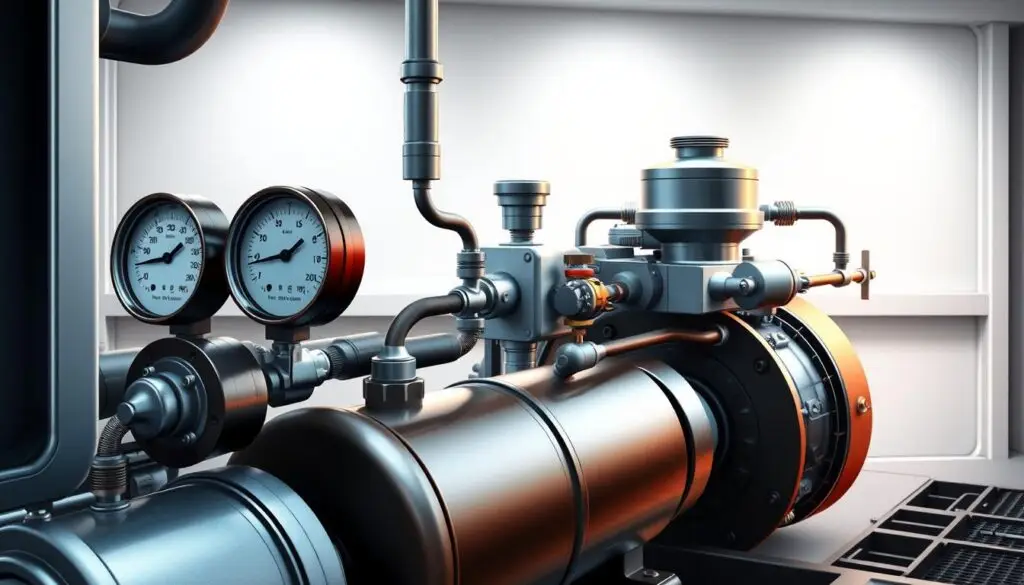
Air compressor maintenance requires monitoring these pressure settings during inspections. Incorrect cut-in or cut-out pressures indicate governor malfunction or adjustment needs. Technicians should also check for excessive oil consumption, which signals worn piston rings or cylinder walls.
Moisture Removal Through Air Dryers and Storage Reservoirs
Air dryers remove moisture and contaminants before compressed air enters the brake system. When air compresses, water vapor condenses into liquid that can freeze in cold weather or cause corrosion year-round. The air dryer uses a desiccant cartridge to absorb this moisture through chemical action.
The desiccant material has a limited capacity and requires regular replacement based on operating conditions. Most manufacturers recommend replacement every 24-36 months or according to mileage intervals. Saturated desiccant allows moisture to pass through, defeating the dryer’s purpose.
Reservoir tanks store dried compressed air for brake applications. Primary and secondary reservoirs create redundancy in the system. The primary reservoir typically supplies air to rear brakes, while the secondary feeds front brakes and accessories. These components require periodic draining to remove accumulated moisture and oil.
Converting Air Pressure Into Mechanical Braking Force
Brake chambers convert air pressure into the physical motion needed to apply brakes. These diaphragm-type chambers contain a flexible rubber diaphragm that moves a pushrod when air pressure enters. The pushrod connects to a slack adjuster, which rotates the brake camshaft.
Slack adjusters maintain proper clearance between brake shoes and drums. Automatic slack adjusters adjust themselves during normal brake application and release cycles. Manual slack adjusters require periodic adjustment by technicians to compensate for brake lining wear.
Brake chamber inspection focuses on pushrod stroke measurement. Excessive stroke indicates out-of-adjustment brakes—the most common DOT violation. Proper stroke length varies by chamber size and type, but typically ranges from 1.5 to 2 inches for standard chambers.
⚠️ Safety Warning
Spring brake chambers contain powerful springs under compression. Never attempt to disassemble a spring brake chamber without proper caging tools and training. Uncontrolled spring release can cause severe injury or death.
Emergency Protection Through Safety Valves and Check Valves
Safety valves protect the air brake system from catastrophic failures. One-way check valves prevent air from flowing backward between reservoirs. This design ensures that if one circuit develops a major leak, the other circuits retain pressure for emergency stopping.
Pressure protection valves guard against total system air loss to accessories. These valves close automatically when reservoir pressure drops below 70-80 PSI, preserving remaining air for brake applications. Without these valves, air leaks in auxiliary systems could deplete braking capacity.
Spring brake chambers provide parking and emergency braking functions. These chambers contain powerful springs held in compression by air pressure. When air pressure releases or drops below 60 PSI, the springs apply the brakes mechanically. This fail-safe design ensures vehicles can stop even with complete air system failure.
Most Common DOT Air Brake Violations and Their Causes
Understanding the most frequent air brake violations helps fleet managers target their maintenance efforts effectively. According to CVSA’s 2024 Brake Safety Week results, brake-related violations continue to comprise the largest percentage of all out-of-service violations cited during roadside inspections. The “Brakes Out of Service” violation carries a maximum 10-point severity weight when defective brakes equal or exceed 20% of service brakes.
Brakes Out of Adjustment: The Leading Violation
Brake adjustment issues consistently rank as the most common reason commercial vehicles receive out-of-service orders. Improper slack adjuster adjustment directly affects stopping distance and compromises safety margins on every trip. This violation occurs when brake components move beyond acceptable limits during application.
Inspectors identify adjustment problems through visual inspection and physical measurement. The brake adjustment directly correlates to the distance between brake shoes and drums. When this gap exceeds specifications, the vehicle cannot generate sufficient stopping force.
Measuring Pushrod Travel Standards
Federal inspectors use specific pushrod travel measurement criteria to determine brake adjustment compliance. The measurement process involves applying air pressure between 90-100 PSI and measuring how far the pushrod extends from the brake chamber. Maximum allowable stroke varies by chamber type and size.
Type 30 long-stroke chambers typically allow 2.5 inches of travel. Standard Type 20 chambers have a 2.0-inch limit. Smaller Type 16 chambers restrict pushrod travel to 1.75 inches maximum. Inspectors mark the pushrod at the brake chamber face before applying pressure, then measure the distance the mark traveled from its original position.
| Chamber Type | Size (Sq. In.) | Max Pushrod Stroke | Clamp Type Limit |
|---|---|---|---|
| Type 16 | 16 | 1.75 inches | 1.50 inches |
| Type 20 | 20 | 1.75 inches | 1.50 inches |
| Type 24 | 24 | 1.75 inches | 1.50 inches |
| Type 30 (Standard) | 30 | 2.00 inches | 1.75 inches |
| Type 30 (Long Stroke) | 30 | 2.50 inches | 2.25 inches |
Automatic vs. Manual Slack Adjuster Issues
Automatic slack adjusters represent the most common cause of brake adjustment violations. These devices should maintain proper brake-to-drum clearance without manual intervention. When automatic slack adjusters fail, technicians sometimes make a critical error by manually adjusting them.
Manual slack adjuster adjustment on automatic systems damages the self-adjusting mechanism. This practice creates a temporary fix that masks the underlying problem. The adjustment typically lasts only a few days before the brakes fall out of adjustment again. Proper procedure requires replacing failed automatic slack adjusters rather than manually adjusting them.
Air Leaks Exceeding FMCSA Limits
Air system leakage represents another frequent category of DOT brake violations during commercial vehicle inspections. FMCSA regulations specify maximum acceptable leak rates for both static and applied conditions. Exceeding these limits compromises system pressure and brake effectiveness.
Static leakage tests measure air loss with brakes released after building system pressure to governor cut-out. The acceptable rate allows 2 PSI loss in one minute for single vehicles. Combination vehicles may lose up to 3 PSI per minute. Applied leakage testing occurs with full brake application at 90-100 PSI, allowing 3-4 PSI loss per minute.
Contaminated or Moisture-Laden Air Systems
Contamination in air brake systems creates multiple failure modes that lead to DOT violations. Moisture enters through atmospheric air during compressor intake cycles. Oil contamination occurs when compressor seals fail and lubricant enters the air supply.
Water accumulation freezes in cold weather and blocks air passages. This condition prevents proper brake application or release. Frozen air lines and valves represent immediate safety hazards warranting out-of-service orders. Regular air dryer maintenance prevents most contamination-related violations.
Essential Air Brake System Maintenance Schedule
Fleet managers who implement structured maintenance intervals catch 85% of brake problems before they become costly violations. A well-designed brake maintenance schedule transforms routine inspections from mere compliance tasks into strategic operations that protect both safety and profitability. Research shows that systematic inspection programs reduce maintenance costs by 40% while achieving uptime rates exceeding 98%.
Daily Pre-Trip Inspection Checklist
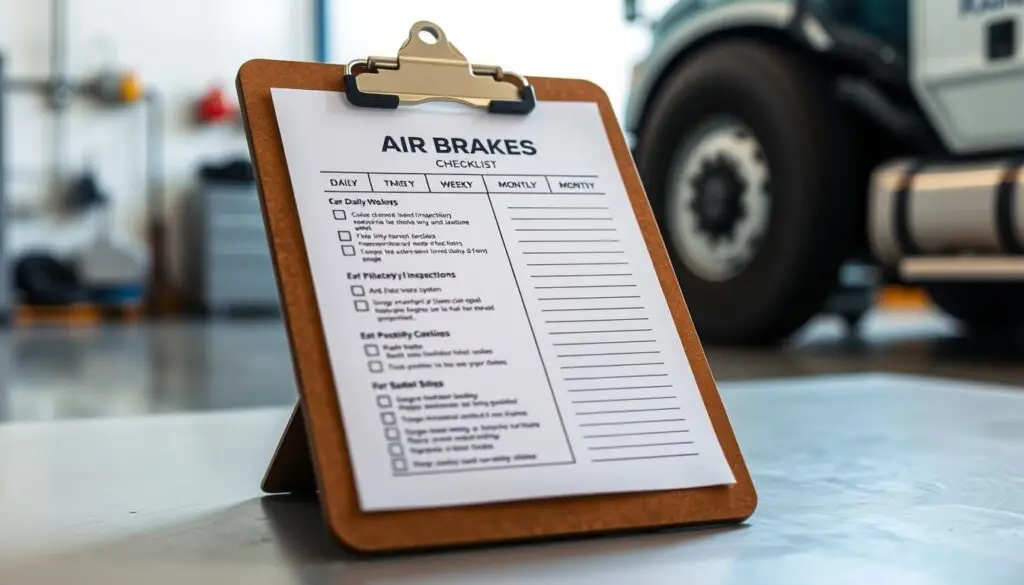
Federal Motor Carrier Safety Regulations mandate pre-trip inspections for all commercial vehicles before operation. Drivers must perform these checks systematically, documenting any defects that affect safe operation. The air brake inspection component represents the most critical safety verification in this daily routine.
A thorough daily brake check identifies developing problems before they escalate into roadside failures. Drivers should examine visible brake components for obvious damage, missing parts, or disconnected air lines. Air system pressure readings provide immediate insight into compressor performance and system integrity.
Seven-Step Air Brake Check Procedure
The standard seven-step testing sequence ensures comprehensive system verification during pre-trip inspections. This procedure systematically evaluates every critical brake function from air generation through final application:
Step one measures air pressure build-up time from approximately 85 PSI to governor cut-out. Excessive build times indicate compressor wear or system leaks requiring immediate attention.
Step two tests the low air pressure warning device by reducing system pressure with the engine off. The audible and visual warnings must activate at or above 60 PSI as mandated by federal regulations.
Step three verifies that spring brakes automatically engage between 20-40 PSI. This emergency fail-safe must function properly to prevent runaway vehicles during air system failures.
Step four evaluates service brake application by applying firm pedal pressure while the vehicle is in gear against the brakes. The vehicle should not move, and the pedal should remain firm without fading.
Step five measures air pressure drop rates with brakes applied. Make several full brake applications and observe pressure gauge drop. Excessive loss indicates leaks requiring repair.
Step six tests parking brake holding ability by releasing the service brakes while keeping the parking brake engaged. The vehicle must remain stationary on level ground.
Step seven conducts a walk-around inspection of all visible brake components, air lines, and mounting hardware. Look for leaks, damage, or any component showing wear or deterioration.
Weekly Maintenance Tasks and Visual Inspections
Intermediate-level inspections performed by qualified maintenance personnel complement daily driver checks. Weekly brake maintenance tasks dive deeper into component condition assessment and system performance evaluation.
Maintenance technicians should conduct thorough visual examinations of all brake assemblies, slack adjusters, and air chambers. Look for signs of binding, corrosion, or physical damage that drivers might miss during quick pre-trip inspections. Air line routing and condition deserve special attention during weekly reviews.
Stay Current on Fleet Compliance Requirements
DOT regulations and inspection criteria update annually. Get the latest brake maintenance requirements, CVSA out-of-service criteria changes, and fleet compliance strategies delivered to your inbox.
Monthly Service Requirements
Monthly intervals provide opportunities for more intensive preventive brake maintenance during regular vehicle servicing. These comprehensive inspections catch problems that develop gradually between weekly checks.
Technicians should perform complete brake system evaluations including measurement of all pushrod strokes, air pressure testing under load conditions, and functional testing of all valves and control devices. Compare measurements against manufacturer specifications and previous readings.
Air Tank Draining and Moisture Inspection
Moisture contamination represents one of the most common causes of air brake system failures. Water accumulates naturally as compressed air cools in reservoir tanks, creating conditions for corrosion and freeze-ups.
Drain all air tanks completely during monthly service intervals. Open each drain valve fully and allow air to purge until only dry air exits. Excessive liquid discharge or visible oil contamination signals serious problems requiring investigation. The expelled material provides diagnostic information about system health.
Belt and Hose Condition Assessment
Air compressor drive belts require proper tension to maintain adequate air generation. Loose belts slip under load, reducing compressor output and extending pressure build times beyond acceptable limits. Check belt tension using manufacturer-specified procedures and replace belts showing cracking, glazing, or fraying.
Air lines and hoses deteriorate from age, heat, and environmental exposure. Inspect every visible section for cracks, abrasion, or weather checking. Pay special attention to flex points where movement causes accelerated wear.
Quarterly and Annual Comprehensive Inspections
Federal regulations mandate annual inspections for all commercial motor vehicles under 49 CFR 396.17. These comprehensive examinations align perfectly with quarterly preventive brake maintenance programs that provide thorough system evaluation.
Quarterly inspections should include complete disassembly of at least one brake assembly per axle for detailed component inspection. Measure lining thickness, drum diameter, and all clearances against service limits. Document findings with detailed measurements and photographs.
Performance testing during comprehensive inspections reveals degradation that gradual wear masks. Measure actual stopping distances, brake balance across axles, and air system recovery rates under simulated load conditions. Compare results against baseline data to identify trending issues.
Air Compressor Maintenance and Performance Testing
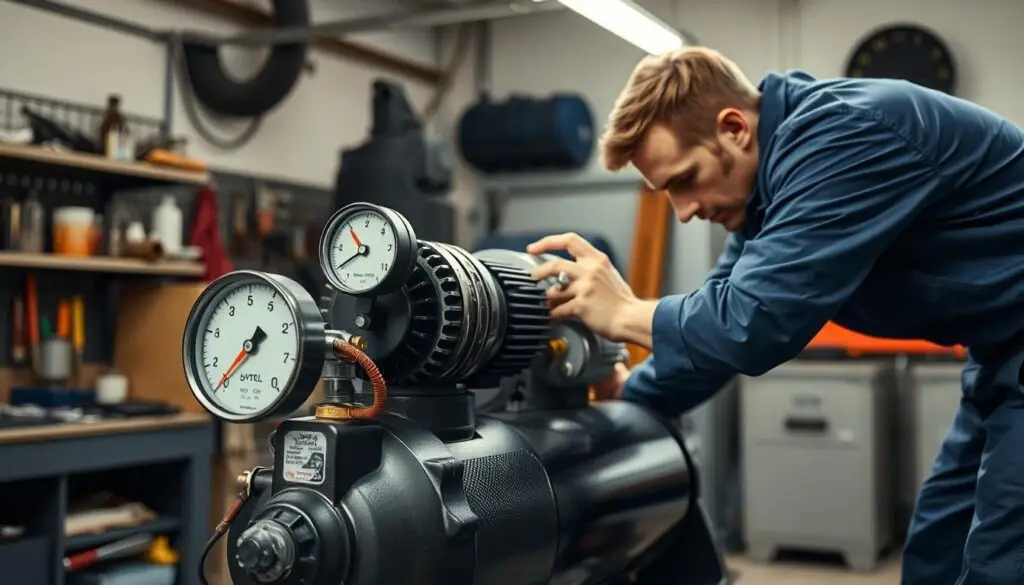
Understanding air compressor performance metrics separates effective maintenance programs from reactive failures. The air compressor generates all pneumatic energy that powers your brake system, making it the most critical component in your fleet’s safety infrastructure. When air compressor maintenance fails, the consequences cascade throughout the entire brake system.
Monitoring Cut-In and Cut-Out Pressure Settings
The governor controls when your air compressor cycles on and off to maintain system pressure within operational limits. Monitoring these compressor pressure settings reveals potential problems with the governor, compressor wear, or system leaks. Your dash-mounted air pressure gauge provides real-time data for evaluating governor performance during normal vehicle operation.
Proper Pressure Range Specifications
Commercial vehicle air brake systems operate within specific pressure parameters established by manufacturers and FMCSA regulations. The cut-in pressure typically ranges from 100 to 110 PSI, while cut-out pressure should reach 120 to 140 PSI. This pressure differential ensures adequate air supply for multiple brake applications while preventing excessive compressor operation.
| Pressure Parameter | Standard Range | Optimal Setting | Action Required |
|---|---|---|---|
| Cut-In Pressure | 100-110 PSI | 105 PSI | Governor adjustment if outside range |
| Cut-Out Pressure | 120-140 PSI | 125-130 PSI | Governor calibration needed |
| Build-Up Time | 85-100 PSI in 45 sec | 90 PSI in 30 sec | Compressor service required |
| Operating Spread | 20-30 PSI difference | 25 PSI difference | Prevents excessive cycling |
Governor Adjustment Procedures
Governor adjustment requires specific tools and safety precautions when working with high-pressure pneumatic systems. Always relieve system pressure completely before attempting any adjustment. Locate the adjustment screw on the governor body, typically secured with a locknut to prevent drift.
Testing governor settings involves bringing the system to full pressure and observing cut-out point accuracy. Turn the adjustment screw clockwise to increase cut-out pressure, counterclockwise to decrease. Make small adjustments of one-quarter turn, then cycle the system to verify results.
Identifying Oil Contamination and Leakage
Oil presence in your air system signals serious compressor problems that require immediate attention. Contamination occurs when worn piston rings, excessive oil levels, or improper lubricant viscosity allow oil to enter the compression chamber. This oil travels downstream, coating brake chambers, valves, and air lines while degrading rubber components.
Visual inspection reveals oil contamination through several indicators. Check discharged air from reservoir drain valves for oil residue or sheen. Examine brake chambers and air line connections for oil coating that attracts dirt. Worn piston rings represent the most common oil contamination source.
Compressor Rebuild Intervals and Warning Signs
Air compressor rebuild or replacement becomes necessary when wear exceeds acceptable performance parameters. Most commercial vehicle compressors require major service between 300,000 and 500,000 miles, depending on duty cycle and maintenance quality.
Monitor these key indicators that signal approaching compressor failure: excessive oil consumption without visible external leaks, slow pressure build-up times exceeding 45 seconds to reach 100 PSI, abnormal operating noise including knocking or grinding sounds, excessive heat generation beyond normal operating temperature, and frequent short-cycling even after repairing system leaks.
Air Dryer Service and Moisture Prevention Strategies
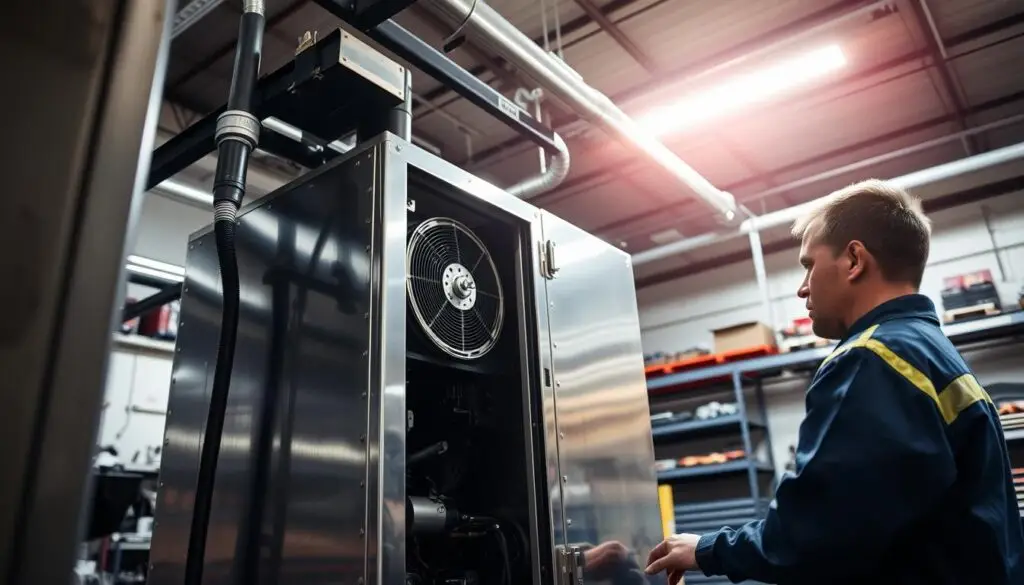
Water contamination causes more air brake problems than all other factors combined, making moisture prevention the cornerstone of system reliability. Moisture infiltration leads to corrosion, winter freeze-ups, valve malfunctions, and accelerated wear throughout the brake system. The air dryer stands as the primary defense mechanism.
Air Dryer Cartridge Replacement Intervals
Desiccant cartridges have a finite capacity to absorb moisture before reaching saturation. Most manufacturers recommend replacement annually or every 100,000 miles, whichever milestone arrives first. Operating conditions significantly affect how quickly cartridges reach the end of their service life.
Vehicles operating in humid climates or making frequent short trips experience faster desiccant saturation. The compressor cycles more often during stop-and-go driving, introducing moisture with each compression cycle. Long-haul operations in dry climates typically extend cartridge life beyond minimum recommendations.
The cost-benefit analysis for desiccant cartridge replacement shows remarkable returns. A replacement cartridge costs between $50 and $150 depending on the system. That modest investment prevents thousands of dollars in downstream component damage from moisture contamination.
Purge Valve Function Testing and Troubleshooting
The purge valve performs a critical function in moisture prevention by expelling collected water and regenerating the desiccant material. This component opens periodically to discharge accumulated moisture through a controlled air burst. Normal purge valve operation produces a distinctive sound when the air dryer cycles—a brief, forceful air discharge lasting two to four seconds.
Recognizing Purge Valve Failures
Purge valve failures manifest in three distinct patterns. Failure to purge represents the most serious problem, resulting in rapid desiccant saturation. Continuous purging wastes compressed air and depletes desiccant material prematurely. Insufficient purge duration leaves water in the system and prevents full desiccant regeneration.
Watch for these warning signs: water droplets or ice forming around the purge valve outlet, oil contamination visible in discharged air, weak or inconsistent air discharge pressure, delayed purge activation after compressor unloading, and multiple short purge bursts instead of one complete cycle.
Heater Element Operation in Cold Climates
Cold weather introduces a specific failure mode that the heater element prevents. Moisture collected in the purge valve can freeze when temperatures drop below 32°F, blocking the discharge passage. A frozen purge valve cannot expel moisture, leading to rapid desiccant saturation and system contamination.
Verify heater operation using a multimeter to check electrical continuity and resistance. Most heater elements show resistance between 10 and 30 ohms when functioning properly. Infinite resistance indicates a broken heating element requiring replacement. Check the heater circuit fuse, electrical connections, and wiring harness for common causes of heater malfunction.
The HDJ Perspective
After 15 years covering commercial vehicle maintenance, we’ve seen fleets struggle with the same brake system failures repeatedly—not because they lack technical knowledge, but because they lack systematic processes. The most successful operations we’ve profiled share one trait: they treat brake maintenance as a strategic investment rather than a regulatory burden. The 60% violation reduction and 45% cost savings documented in this guide aren’t theoretical—they’re achievable for any fleet willing to implement structured inspection schedules and hold their team accountable to documented procedures. Start with daily pre-trip compliance, build toward weekly visual inspections, and you’ll see measurable improvement within 90 days.
Brake Chamber and Slack Adjuster Inspection Protocols
Among all air brake system inspections, verifying proper brake adjustment through pushrod stroke measurement carries the highest importance for DOT compliance. Brake adjustment violations represent the leading cause of brake-related citations during roadside inspections, with the “Brakes Out of Service” violation carrying 10 CSA severity points.
Step-by-Step Pushrod Stroke Measurement
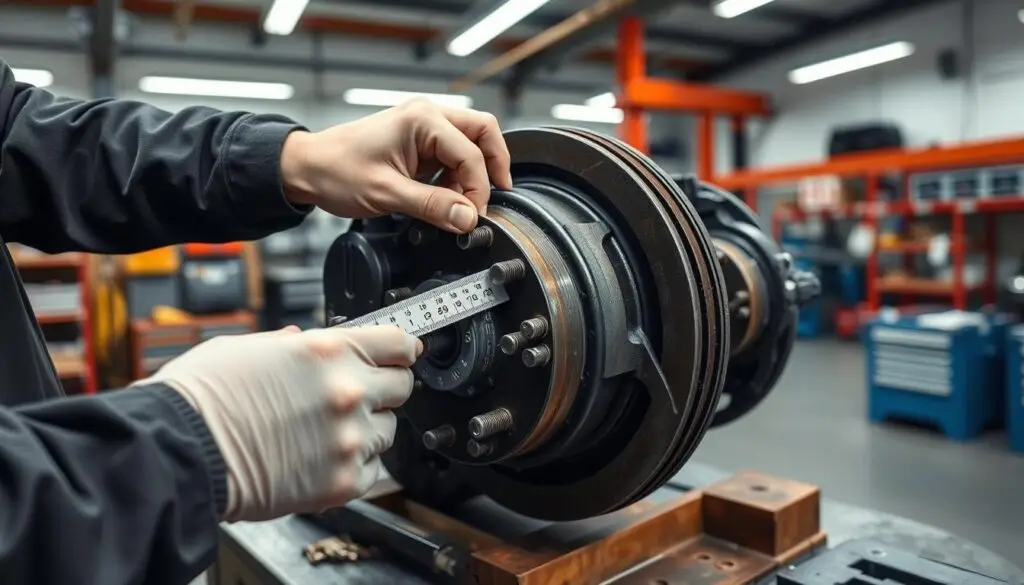
Accurate pushrod travel measurement forms the foundation of brake adjustment verification. This inspection must be performed with proper air pressure between 90-100 PSI and parking brakes fully released. Position yourself where you can clearly observe the pushrod and brake chamber while someone applies and releases the service brakes.
Applying the Applied Stroke Method
The applied stroke method provides the industry standard for measuring pushrod travel. Start by using chalk, a marker, or tape to mark the pushrod at a fixed reference point—typically where the pushrod exits the brake chamber housing. Make this mark clearly visible and precisely positioned for accurate measurement.
With the brakes fully released, measure and record the exact position of your reference mark. Have an assistant apply the service brakes to full working pressure (approximately 90-100 PSI) while you observe the pushrod movement. Measure the distance the pushrod extends from its release position to its fully applied position.
Record this measurement in inches to at least two decimal places. Repeat the measurement at least twice to confirm consistency. Document the brake position (left front, right rear, etc.) and chamber size for each measurement. These records become critical evidence of compliance during DOT inspections and audits.
Automatic Slack Adjuster Testing and Evaluation
Automatic slack adjusters should maintain proper brake adjustment automatically during normal operation. Testing their function requires understanding both their operational principles and regulatory requirements. The evaluation process begins with pushrod travel measurement, followed by additional steps to verify the adjusting mechanism functions properly.
One-Time Manual Adjustment Rule
Federal regulations and manufacturer specifications establish a critical principle: automatic slack adjusters should never require manual adjustment during normal operation. If pushrod stroke exceeds limits on a brake equipped with automatic slack adjusters, manual adjustment to bring the stroke back within specification is permitted one time only as a diagnostic procedure.
After manual adjustment, perform several full brake applications (typically 10-20 cycles) and re-measure the stroke. If stroke returns to within specification and remains there across multiple applications, the automatic adjuster is functioning properly. However, if stroke measurements increase again after the test applications, the automatic slack adjuster has failed and requires immediate replacement—not repeated manual adjustment.
Brake Chamber Inspection for Damage and Leaks
Beyond measuring pushrod stroke, comprehensive brake chamber inspection identifies structural damage and air leaks that compromise system performance. Begin visual inspection by examining the brake chamber housing for cracks, dents, or deformation. Check the mounting bracket and bolts for proper torque, damage, or wear.
Air leak detection requires soap solution testing around all chamber connections, seams, and the pushrod seal. Mix liquid dish soap with water and apply to suspect areas while maintaining system pressure at 90-100 PSI. Bubbles indicate leaks requiring immediate attention.
Spring Brake Chamber and Parking Brake Checks
Spring brake chambers combine service brake and parking/emergency brake functions in a single unit. Test spring brake hold function by fully applying the parking brake and attempting to move the vehicle. The spring brakes should hold the vehicle firmly on a grade.
Spring brakes must apply automatically when air pressure drops below safe levels (typically 20-45 PSI). Test this safety function by slowly draining air pressure while monitoring when spring brakes engage. Early or late engagement indicates valve problems requiring immediate attention.
Share Your Brake Maintenance Expertise
Fleet maintenance managers and diesel technicians with proven track records of reducing brake violations—we want to hear your strategies. Contribute to Heavy Duty Journal and help the industry improve compliance outcomes.
Air Line, Fitting, and Valve Leak Detection Methods
Even minor air leaks can compromise brake performance and trigger costly violations during DOT inspections. Brake system leakage reduces available pressure for brake applications and forces the air compressor to work harder, accelerating wear and shortening compressor life across your entire fleet.
Soap Solution Testing Technique
The soap solution method provides the most practical and reliable approach for leak detection in pressurized air brake systems. Mix liquid dish soap with water at approximately one part soap to four parts water. Apply this solution generously to fittings, connections, and components while the system maintains operating pressure.
Leaks reveal themselves through bubble formation at problem areas. Start your inspection at the air compressor and work systematically toward the brake chambers. This methodical approach ensures you examine every potential leak point in the system.
Acceptable Leak Rates Under FMCSA Regulations
Federal regulations establish specific maximum leak rates for commercial vehicle air brake systems. These FMCSA leak rates apply to both static conditions with brakes released and applied conditions with brakes engaged.
Static Leakage Test Procedures
Begin the static test by charging the system to maximum pressure until the governor cuts out. Mark the starting pressure reading on the gauge. Wait for the air compressor to cut out completely and allow pressure to stabilize. Release the spring brakes, wait exactly two minutes while monitoring the pressure gauge, and measure total pressure drop.
Maximum allowable static leak rates typically range from 2 to 3 PSI per minute depending on system size. Combination vehicles receive higher allowable rates than single vehicles due to their larger air systems and additional connections.
Applied Leakage Test Requirements
The applied leakage test imposes more stringent standards because it evaluates the system under operational conditions. Charge the system to governor cut-out pressure, make a full service brake application of approximately 90 to 100 PSI, and hold for one minute. Maximum allowable applied leak rates measure 3 to 4 PSI per minute for single vehicles and 4 to 6 PSI for combination vehicles.
Common Leak Locations and Quick Repair Solutions
Systematic inspections reveal that certain locations develop leaks more frequently than others. Push-to-connect fittings at brake chambers and valves top the list of problem areas. Relay valve exhaust ports frequently develop leaks due to contamination or seal deterioration. Quick-release valve seals wear over time from constant air cycling. Tractor-trailer glad hand connections leak when seals crack or when dirt prevents proper seating.
Tightening loose fittings often resolves leaks at connection points without parts replacement. Replace damaged or cut air lines as soon as you discover them. Swap out leaking glad hand seals between inspection intervals to maintain system integrity.
Implementing a Preventive Air Brake Maintenance Program
Systematic preventive maintenance programs separate high-performing fleets from average operations by transforming air brake maintenance from reactive responses into strategic fleet compliance initiatives. Fleet maintenance data reveals that proactive programs achieve 98.5% vehicle uptime compared to just 89.2% for reactive approaches—along with that 45% cost reduction from $0.22 to $0.12 per mile.
Beyond cost savings, preventive brake maintenance programs prevent 85% of breakdowns before they occur. Emergency repairs drop from 12 per vehicle annually to just 2 per vehicle—an 83% reduction that eliminates roadside failures and DOT violations.
Creating Maintenance Schedules Based on Vehicle Usage
Generic manufacturer maintenance schedules rarely match the specific demands of your fleet operations. Customized intervals based on actual usage patterns optimize both component life and fleet compliance while avoiding unnecessary service costs.
Vehicle duty cycles significantly impact component wear rates. Long-haul operations with continuous highway driving create different maintenance requirements than regional routes with frequent stops. Local delivery vehicles making 50-100 stops daily experience brake system stress that demands more aggressive inspection schedules.
Operating environment factors directly influence maintenance intervals: mountainous terrain increases brake usage and air system demand, extreme climates stress air dryers in humid conditions and challenge heating elements in cold weather, urban environments with stop-and-go traffic accelerate brake adjustment drift, and off-road or construction operations expose components to contamination and damage.
Standardizing Inspection Procedures Across Your Fleet
Consistency determines program success when multiple technicians perform inspections across different shifts and facilities. Written standard operating procedures eliminate ambiguity about inspection requirements. Document each step with clear acceptance criteria and photo examples showing both acceptable conditions and defects requiring correction.
Vehicle-specific inspection checklists account for configuration differences within your fleet. Different brake chamber sizes, slack adjuster types, and air system layouts require customized inspection approaches. Inspector training and certification programs verify that technicians understand procedures and apply them correctly.
Using Predictive Maintenance Technology and Telematics
Modern technology enables proactive intervention before component failures create violations or breakdowns. The Bendix technical support resources and similar OEM programs help fleets implement predictive maintenance tools that identify developing problems through data analysis rather than waiting for visual inspection to reveal obvious defects.
Telematics systems monitor air brake performance parameters in real-time during vehicle operation. These systems track pressure levels, compressor activity, and system response characteristics that reveal deteriorating conditions. Data logging creates historical baselines that highlight deviations from normal performance patterns.
Parts Inventory Management for Critical Components
Having critical brake components available when needed prevents extended downtime that compounds maintenance costs. High-failure components require stock inventory based on fleet size and historical replacement rates. Brake chambers, slack adjusters, air dryer cartridges, and common air valves should be readily available.
Minimum stock levels should cover at least 30 days of typical usage plus safety stock for high-impact items. Automated reorder systems trigger parts purchases before inventory depletion. The cost-benefit analysis clearly favors maintaining adequate inventory—properly implemented preventive maintenance programs show positive ROI within 6-12 months and return $3-5 for every dollar invested.
Documentation Requirements for DOT Compliance
DOT compliance documentation requirements go beyond simply performing maintenance—they demand detailed records that demonstrate your commitment to safety. Even the most thorough air brake maintenance program can result in violations if your paperwork doesn’t meet federal standards.
Mandatory Maintenance Records and Retention Periods
Federal regulations specify exactly which records fleet operators must maintain. Inspection records must document all periodic inspections performed on each vehicle. Maintenance work orders should detail every repair and service completed. Parts replacement records track component lifecycles and warranty information.
Maintenance record retention periods vary depending on document type. Most routine maintenance documentation must be kept for at least one year. Annual inspection records require retention for 14 months from the inspection date. These records must be readily available during DOT compliance reviews or roadside inspections.
Driver Vehicle Inspection Report Procedures
DVIR procedures form the foundation of daily vehicle safety verification. Drivers must complete post-trip inspection reports noting any defects or deficiencies that affect safe operation. Carriers must review and sign these reports before the vehicle returns to service.
Operating a commercial motor vehicle without proof of periodic inspection carries 6 CSA points under violation 396.17(c). Effective DVIR procedures include specific identification of affected components and systems, clear descriptions that provide actionable information to mechanics, notation of when problems were first observed, and assessment of whether issues affect safe operation.
Annual Inspection Documentation Requirements
Annual inspections demand comprehensive documentation that proves compliance with inspection standards. Records must include inspector identification and qualification credentials, inspection date and location, complete vehicle identification, and detailed listings of inspected components with any defects noted.
Vehicles must display current inspection decals showing the inspection date and inspector information. These decals provide visible proof of compliance during roadside inspections. Missing or expired decals result in immediate violations regardless of actual vehicle condition.
Training and Certification for Air Brake Maintenance Personnel
Even the best equipment and procedures cannot compensate for inadequately trained maintenance personnel. Your air brake maintenance program’s success depends entirely on the competency of technicians who perform inspections and repairs. Fleet managers must establish clear qualification standards for anyone working on air brake systems.
Essential Qualifications for Brake System Inspectors
Effective brake inspector certification programs must cover five core competency areas. First, technicians need comprehensive understanding of air brake system operation and component functions. Second, inspectors must know FMCSR brake regulations and inspection standards thoroughly. Third, accurate brake adjustment measurement represents a critical skill requiring hands-on practice.
Fourth, proficiency in leak detection and pressure testing procedures ensures compliance with FMCSA regulations. Finally, competency in diagnosing and repairing common brake system problems separates qualified inspectors from basic mechanics.
Industry-Recognized Certification Programs
ASE certification provides the most widely recognized validation of technician competency in commercial vehicle maintenance. The ASE T4 certification focuses specifically on brake systems, covering hydraulic and air brake operation, diagnosis, and repair. ASE T2 certification for diesel engines includes air compressor service and troubleshooting, while T8 Preventive Maintenance Inspection certification covers comprehensive vehicle inspection procedures.
While federal regulations don’t mandate ASE certification for commercial vehicle work, it represents industry best practice for establishing baseline competency. Certification delivers multiple benefits: standardized competency benchmarks across maintenance teams, structured learning pathways, demonstration of commitment to qualified personnel during DOT audits, and potential insurance premium reductions.
Staying Current with Regulatory Changes
Yesterday’s training doesn’t guarantee compliance with today’s standards. FMCSR regulations evolve, enforcement interpretations change, and industry best practices advance. Subscribe to FMCSA communications and industry publications that track regulatory changes. The Commercial Vehicle Safety Alliance publishes enforcement guidance that clarifies inspection standards.
Attend periodic training updates and webinars on regulation changes. Designate one team member as the regulatory compliance coordinator to monitor updates and disseminate relevant information to maintenance personnel.
Cost-Benefit Analysis of Proactive Air Brake Maintenance
Understanding the true economics of air brake maintenance requires looking beyond upfront costs to total ownership expenses. Comprehensive maintenance cost analysis reveals that fleets implementing systematic programs consistently generate $25,000 to $50,000 in annual savings per vehicle.
Average Annual Preventive Maintenance Costs Per Vehicle
Establishing a systematic air brake maintenance program requires specific investments that vary based on fleet size and vehicle utilization. Comprehensive preventive brake maintenance typically costs $800 to $1,500 per vehicle annually, covering scheduled inspection labor, parts replacement on preventive schedules, testing equipment, training, and documentation systems.
Top-performing fleets with systematic programs spend only 8 to 12 percent of operating budgets on maintenance. In contrast, average fleets without structured programs spend 15 to 20 percent—potential savings of 40 percent or more through better planning and execution.
DOT Fine Structures and Out-of-Service Order Expenses
The financial consequences of brake system violations extend far beyond simple citation fines. Individual violation fines typically range from $100 to over $1,000, with severe or repeated violations potentially reaching several thousand dollars per citation.
Downtime and Lost Revenue Calculations
Indirect costs from violations often exceed direct fines by substantial margins. Lost revenue while vehicles sit out of service typically ranges from $500 to $2,000 per day depending on vehicle utilization and route profitability. Expedited repair costs add significant expense when repairs must be performed immediately at roadside locations.
A single out-of-service order typically costs $2,000 to $5,000 in total impact—far exceeding the direct citation penalty. These calculations don’t include intangible costs like reputation damage or lost customer confidence.
Long-Term Savings from Reduced Component Failures
Preventive maintenance delivers cumulative financial benefits that grow more substantial over time. Components last longer, failures decrease, and replacement timing becomes predictable rather than chaotic. Fleets with systematic preventive programs typically achieve 30 percent longer component service life compared to reactive approaches, along with 40 percent lower annual maintenance costs despite higher investment in scheduled service.
Insurance Premium Reductions with Improved Safety Records
Insurance costs represent a frequently overlooked area where preventive maintenance delivers measurable financial returns. Carriers review CSA scores and violation histories carefully when setting premiums. Fleets with excellent safety records receive substantially lower premium quotes—potentially thousands of dollars annually per vehicle. Maintaining clean DOT inspection records and low CSA scores can reduce insurance costs by 15 to 30 percent.
Frequently Asked Questions
How often should air brake systems be inspected for DOT compliance?
Federal regulations under 49 CFR 396.17 require annual periodic inspections for all commercial motor vehicles, but effective compliance programs include daily pre-trip driver inspections, weekly visual inspections by maintenance personnel, and monthly comprehensive system evaluations. The most successful fleets implement quarterly pushrod stroke measurements and component assessments to catch issues before they become violations. Daily checks focus on pressure readings and obvious damage, while monthly inspections should include air tank draining, leak testing, and brake adjustment verification.
What is the maximum allowable pushrod stroke for air brake chambers?
Maximum pushrod stroke limits vary by brake chamber type and size. Type 30 long-stroke chambers allow up to 2.5 inches of travel, standard Type 30 chambers permit 2.0 inches, Type 20 and 24 chambers allow 1.75 inches, and smaller Type 16 chambers restrict travel to 1.75 inches. Clamp-type brake adjusters have slightly lower limits. Exceeding these specifications during applied stroke measurement results in out-of-adjustment citations. Always verify the specific chamber type stamped on the housing before comparing measurements against federal standards.
Can automatic slack adjusters be manually adjusted when out of specification?
Automatic slack adjusters should be manually adjusted only one time as a diagnostic procedure when found out of specification. After adjustment, perform 10-20 full brake application cycles and re-measure the pushrod stroke. If stroke remains within limits, the adjuster is functioning properly. However, if the brakes fall out of adjustment again after testing, the automatic slack adjuster has failed and must be replaced—not repeatedly adjusted. Manual adjustment of automatic slack adjusters is a common maintenance error that masks underlying component failure and leads to recurring violations.
How much air pressure loss is acceptable during leak testing?
FMCSA regulations specify different leak rate limits for static and applied conditions. For static testing with brakes released, single vehicles may lose up to 2 PSI per minute, while combination vehicles allow 3 PSI per minute. During applied leakage testing with brakes engaged at 90-100 PSI, single vehicles cannot exceed 3-4 PSI loss per minute, and combination units are limited to 4-6 PSI per minute. Any leak creating an audible hiss typically exceeds acceptable limits and requires immediate repair before the vehicle returns to service.
How long should air dryer desiccant cartridges last before replacement?
Most manufacturers recommend desiccant cartridge replacement annually or every 100,000 miles, whichever comes first. However, operating conditions significantly affect cartridge life. Vehicles in humid climates or those making frequent short trips with more compressor cycling may require replacement every 75,000 miles. Long-haul operations in dry climates often extend beyond 125,000 miles. Inspect expelled material during monthly tank draining—excessive moisture discharge indicates the desiccant may be saturated and require earlier replacement. Oil-contaminated cartridges must be replaced immediately regardless of mileage.
Building a Sustainable Brake Maintenance Program
Systematic air brake system maintenance delivers measurable results that directly impact your operation’s safety record and financial performance. Fleets implementing comprehensive brake maintenance programs achieve a 60% reduction in DOT violations while preventing 85% of brake-related breakdowns. The financial case is equally compelling: preventive programs cost 45% less per mile than reactive approaches while achieving 98% vehicle uptime.
The path forward requires commitment to structured inspection schedules, proper documentation, and qualified personnel. Start by assessing your current practices against the standards outlined in this guide. Identify gaps in daily inspections, component maintenance, or documentation procedures. Prioritize improvements based on your violation history and fleet risk profile. Train personnel on proper inspection techniques and adjustment procedures.
The investment in preventive brake maintenance pays for itself within 6-12 months, then continues delivering $3-5 return for every dollar invested. More importantly, it protects drivers, cargo, and the motoring public from the consequences of brake system failures. That’s the kind of return that makes air brake maintenance one of the highest-value investments available to fleet operators.
Share This Guide With Your Team
Fleet managers, maintenance supervisors, and diesel technicians across your organization can benefit from these brake maintenance best practices. Share this resource to help improve compliance outcomes fleet-wide.