By Michael Nielsen, Editor & Publisher | 15+ Years in Diesel Repair
Last Updated: December 2025
📖 Estimated reading time: 18 minutes
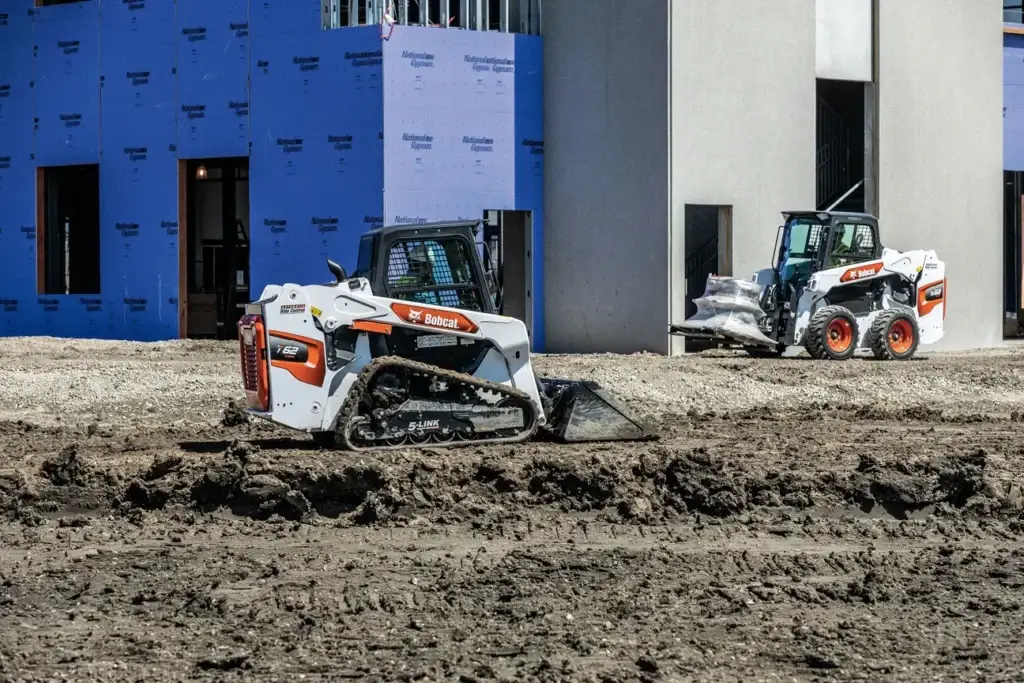
Choosing the right compact loader for your operation directly impacts jobsite productivity and profitability. The compact track loader vs skid steer debate comes down to one fundamental question: what terrain will your machine work on most often? Tracked machines dominate soft ground, slopes, and turf-sensitive applications, while wheeled skid steers excel on hard surfaces where speed and maneuverability matter most.
Fleet managers and contractors face this decision regularly as compact loaders now represent over 70% of new equipment sales in this category, according to Association of Equipment Manufacturers industry data. The choice isn’t simply about preference—it’s about matching equipment capabilities to actual working conditions. A tracked machine stuck on a project without soft ground wastes fuel and maintenance dollars. A wheeled machine spinning in mud wastes hours and frustrates operators.
This guide breaks down the practical differences between these two machine types. You’ll learn the ground pressure specifications, maintenance cost realities, and application-specific advantages that determine which loader delivers the best return for your fleet. We’ll cover everything from undercarriage wear patterns to real-world fuel consumption differences, giving you the data needed to make an informed equipment selection.
Key Takeaways
- Ground pressure determines capability: Compact track loaders operate at 4-6 PSI compared to 35-45 PSI for skid steers, making CTLs essential for soft ground and turf protection.
- Speed advantage on hard surfaces: Skid steers reach 10-12 mph versus 6-8 mph for track loaders, translating to faster cycle times on concrete, asphalt, and compacted material.
- Total cost difference: Track loaders cost 20-30% more upfront and require $4,000-$10,000 track replacements compared to $800-$2,400 for tire sets, but quality tracks last 3-5 times longer.
- Slope stability: CTLs safely operate on inclines up to 30 degrees compared to 15-20 degrees for wheeled machines, with lower centers of gravity reducing rollover risk.
- Market dominance: Compact track loaders now account for approximately 78% of sales in this equipment category due to all-terrain versatility.
Understanding Skid Steer Loader Fundamentals
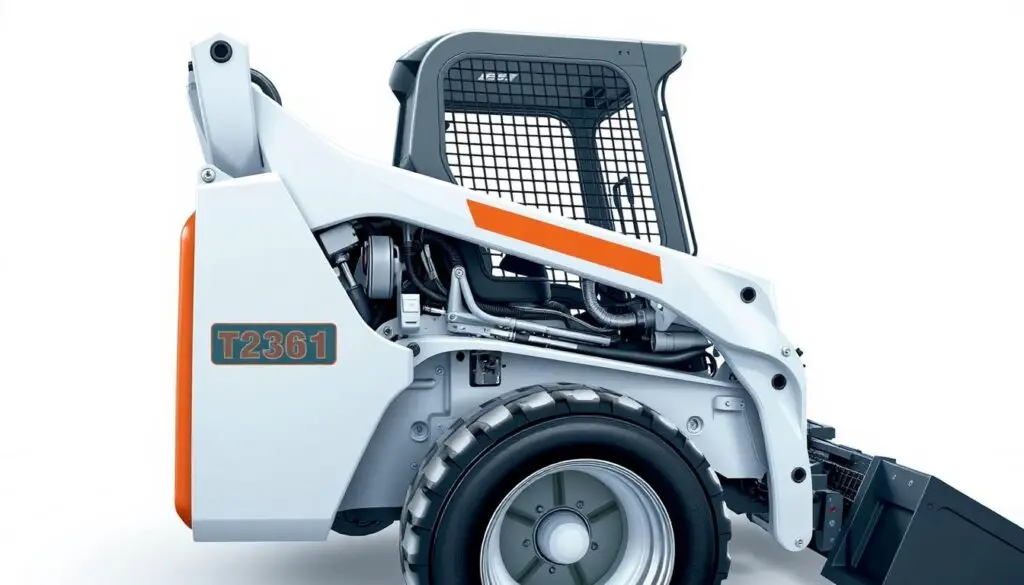
The skid steer loader earned its name from its distinctive steering mechanism. Rather than pivoting wheels like conventional equipment, these machines control direction by varying the speed of wheels on each side independently. When one set of wheels spins faster than the other, the slower wheels drag across the ground surface, causing the machine to pivot around its center point.
This design enables zero-radius turning—the ability to rotate completely within the machine’s own footprint. Operators can work in spaces barely larger than the loader itself, making skid steers invaluable for warehouse operations, tight urban construction sites, and indoor renovation projects. The hydraulic joystick controls allow precise positioning that larger equipment simply cannot match.
Frame Size Classifications and Capacity Ratings
Manufacturers build skid steers in three primary frame classifications, each designed for specific capacity requirements and horsepower needs. Modern equipment incorporates enhanced operator safety features including John Deere’s operator protection systems and improved visibility designs. Rated operating capacity (ROC) follows SAE J818 standards, which specify that ROC equals 50% of tipping load for wheeled machines and 35% for tracked loaders. Understanding these categories helps match equipment to application demands.
| Frame Size | Rated Operating Capacity | Horsepower Range | Typical Applications |
|---|---|---|---|
| Small Frame | 1,500-1,750 lbs | ~50 HP | Landscaping, light material handling |
| Medium Frame | 1,750-2,200 lbs | 50-70 HP | General construction, commercial work |
| Large Frame | 2,200+ lbs | 70+ HP | Heavy construction, demolition, earthmoving |
The quick-attach mounting system shared across most manufacturers transforms a single skid steer into dozens of specialized machines. Operators switch between buckets, pallet forks, augers, grapples, and snow removal attachments in minutes, as detailed in Caterpillar’s skid steer attachment specifications. This versatility often justifies the equipment investment for operations requiring multiple task capabilities without purchasing separate machines for each function.
Skid Steer Operating Characteristics
Four pneumatic tires mounted on fixed axles distribute the machine’s weight across relatively small contact patches. A typical 8,000-pound skid steer concentrates approximately 2,000 pounds per tire onto footprints measuring just 15-20 square inches each. This creates ground pressures ranging from 35-45 PSI, depending on tire size and machine weight.
The higher ground pressure serves specific purposes. On hard surfaces like concrete and asphalt, concentrated weight provides better traction than distributed force. Snow removal operations benefit from this characteristic as tires sink into snow pack rather than floating across the surface. Some compaction applications actually require the higher ground pressure that wheeled machines provide.
Travel speeds reach 10-12 mph on most models, significantly faster than tracked alternatives. This speed advantage compounds over full work shifts when machines frequently travel between loading and dumping locations. For operations centered on paved surfaces with scattered work zones, the mobility premium translates directly to productivity gains.
Compact Track Loader Design and Capabilities
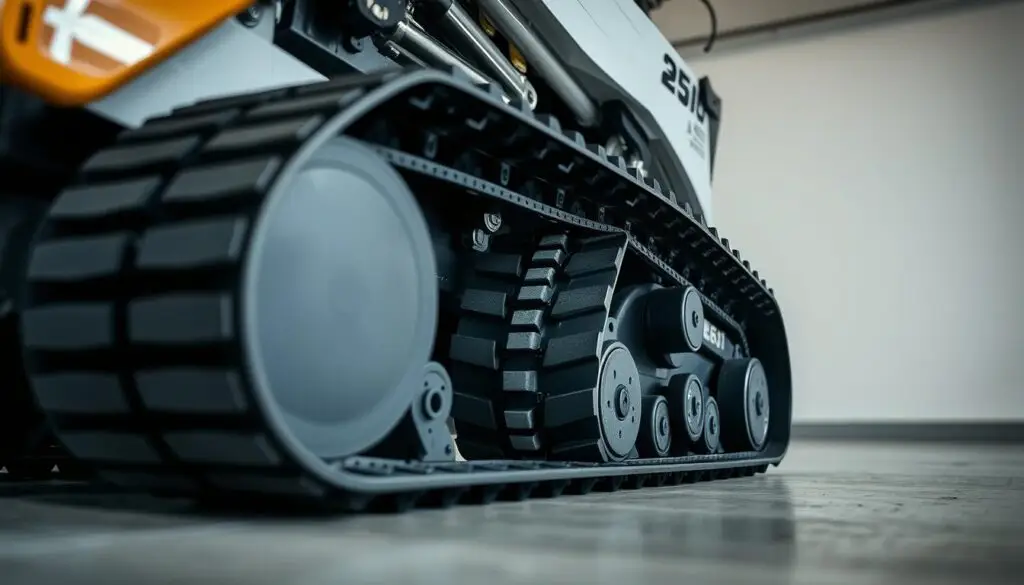
The compact track loader replaces wheels with continuous rubber tracks wrapped around a suspended undercarriage system. According to Bobcat’s compact track loader specifications, steel-reinforced rubber belts feature aggressive tread patterns molded into the track surface, providing durability against tears while maintaining flexibility around rollers, idlers, and drive sprockets.
Track systems typically measure 12-18 inches wide, creating a substantial footprint that spreads machine weight across a much larger surface area than four individual tires could achieve. The continuous ground contact fundamentally changes how these machines interact with terrain, enabling operation in conditions that would immediately immobilize wheeled equipment.
Suspended Undercarriage Engineering
Multiple roller wheels positioned along each track’s length maintain constant ground contact while absorbing terrain irregularities. This suspended design allows tracks to conform to uneven surfaces while keeping the machine frame level and stable. Operators experience significantly less jarring and vibration compared to wheeled machines traversing rough ground.
The track system distributes identical machine weight across areas often 8-10 times larger than tire contact patches. An 8,000-pound compact track loader exerts ground pressure of just 4-6 PSI, representing an 85% reduction compared to a similarly-sized skid steer. This dramatic pressure decrease prevents sinking in soft conditions and minimizes surface disturbance on turf.
Turning mechanics differ from skid steers due to track system design. While CTLs can perform counter-rotation turns similar to wheeled machines, manufacturers recommend maintaining forward motion during direction changes. Sharp pivoting causes excessive wear and can throw material into the undercarriage cavity, packing track grooves and accelerating component deterioration.
Track System Components and Wear Points
Understanding CTL undercarriage components helps predict maintenance requirements and total ownership costs. Each track assembly contains sealed roller bearings, reinforced track guides, adjustable tensioning systems, and hardened drive sprockets—all subject to wear during operation.
- Drive sprockets: Hardened teeth transfer power from the hydraulic motors to the track system, wearing gradually under normal use
- Idler wheels: Front-mounted wheels guide track travel and maintain proper tension
- Roller assemblies: Multiple sealed rollers support track weight and absorb ground impacts
- Tensioning mechanism: Adjustable system compensates for rubber stretch and component wear
- Track guides: Reinforced components prevent derailment during operation
Track lifespan varies considerably based on operating conditions. Contractors can expect 800-1,600 hours of service under normal conditions, with abrasive materials like gravel, rough concrete work, and excessive hard-surface turning accelerating wear substantially. Operators working in mild conditions with diligent maintenance sometimes achieve 2,000 hours or more from quality track assemblies.
Ground Pressure: The Defining Difference
Ground pressure determines where each machine type can actually work. This single specification creates the most significant operational distinction between compact track loaders and skid steers, dictating terrain capability, surface damage potential, and application suitability.
Physics of Weight Distribution
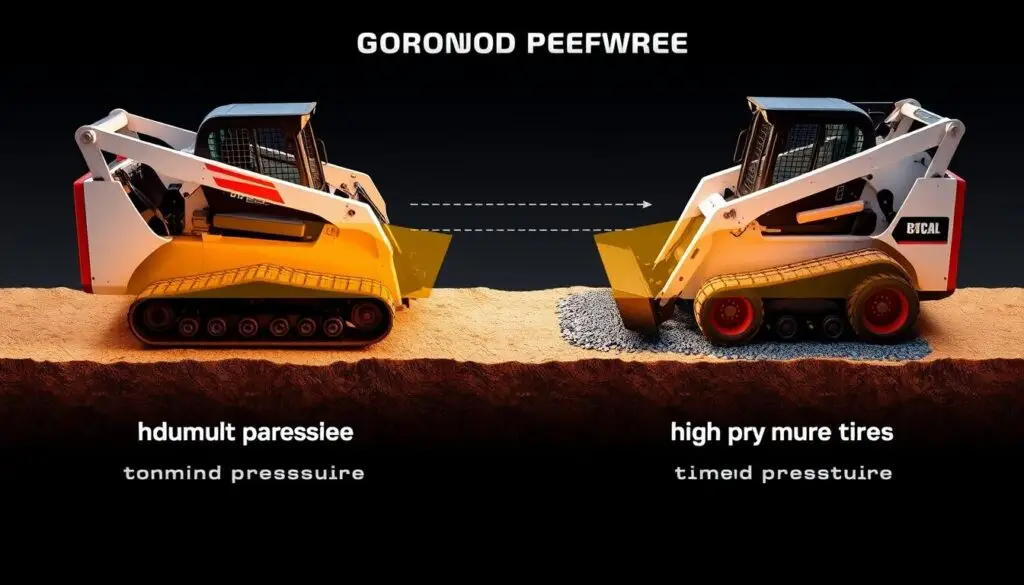
Skid steer loaders concentrate their entire operating weight through four relatively small tire contact patches. Each 15-20 square inch footprint bears roughly one-quarter of total machine weight, creating ground pressures of 35-45 PSI depending on equipment size and tire selection. This concentration compacts soil aggressively, creates ruts in anything softer than packed dirt, and leaves visible marks on sensitive surfaces.
Compact track loaders distribute identical weight across continuous track surfaces measuring 400-600 square inches per side. The mathematics work dramatically in favor of tracked machines: spreading force across 8-10 times more area reduces ground pressure to 4-6 PSI. This 85% reduction transforms equipment capability in challenging conditions.
4-6 PSI vs 35-45 PSI
Ground pressure difference between compact track loaders and skid steers—an 85% reduction that enables CTL operation on soft ground, wet conditions, and turf-sensitive surfaces
Soft Ground and Wet Conditions Performance
Compact track loaders function like snowshoes, spreading weight to create flotation that prevents sinking. The continuous track maintains forward momentum even when individual sections encounter soft spots. Muddy conditions, wet soil, loose sand, and fresh snow present serious challenges for wheeled equipment but pose minimal problems for tracked machines.
Wetland restoration projects, beach construction, winter operations, and work following heavy rainfall favor tracked machines. The continuous ground contact provides consistent traction that keeps projects moving while wheeled equipment sits immobilized or creates unacceptable surface damage. Once skid steer tires begin spinning without forward movement, extraction becomes time-consuming and delays compound.
Material characteristics influence soft ground performance. Clay-based soils become extremely slippery when wet, creating traction challenges for both machine types—though tracks still maintain an advantage through greater surface contact. Sandy conditions prove particularly difficult for skid steers, as tires dig downward rather than providing forward movement.
Slope Stability and Safety Considerations
Compact track loaders maintain superior stability on inclines through three design advantages: lower center of gravity, longer effective wheelbase, and continuous ground contact throughout the track length. These characteristics allow CTLs to safely operate on slopes up to 25-30 degrees in many conditions, compared to 15-20 degree limits for wheeled machines.
The lower center of gravity results from track system positioning closer to ground level compared to tire-mounted machines. This geometric advantage reduces tipping risk during cross-slope operation or when working on uneven grades. The extended track footprint distributes weight more evenly across elevation changes, with self-leveling characteristics that help maintain stability as the machine encounters bumps and depressions.
⚠️ Equipment Safety Warning
Always consult manufacturer specifications for maximum slope operation angles. According to OSHA 29 CFR 1926.602, equipment operators must receive proper training on safe operating procedures including slope limitations. NIOSH Alert 2011-128 documents significant fatalities involving compact loaders from rollover incidents and pinning between lift arms and frame—never exceed rated operating angles or bypass safety interlocks.
Traction and Pushing Power Comparison
The fundamental contact difference between wheels and tracks creates measurable performance gaps in material moving applications. When equipment must push against resistance—dozing soil, backfilling trenches, or loading heavy materials—traction determines productivity.
Surface Condition Impact on Grip
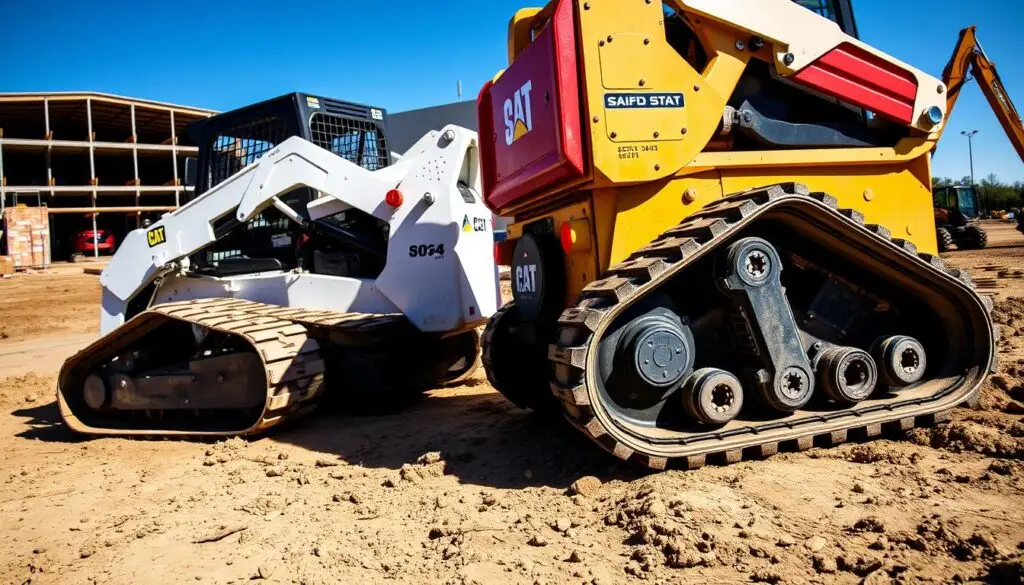
On dry, hard surfaces, both machine types achieve adequate grip for most operations. The performance gap emerges when conditions deteriorate—wet concrete, mud, loose soil, snow, and ice all create scenarios where tire-equipped machines struggle while tracked loaders maintain consistent traction.
Skid steer tires concentrate tractive force on four small contact patches. When these patches encounter slippery surfaces, they break traction and spin without generating forward motion. Compact track loaders maintain continuous ground contact through their track systems, with aggressive tread patterns continuously biting into surfaces. Even when individual track sections encounter slippery spots, remaining contact areas continue providing traction.
| Surface Condition | Skid Steer Performance | Compact Track Loader | Advantage |
|---|---|---|---|
| Dry hard surfaces | Excellent | Excellent | Equal performance |
| Wet concrete/asphalt | Good to fair | Excellent | CTL 15-20% better |
| Mud and soft soil | Fair to poor | Very good | CTL 30-40% better |
| Snow and ice | Poor | Good to very good | CTL 40-50% better |
| Loose sand/gravel | Fair | Very good | CTL 25-35% better |
Effective Pushing Force in Real Conditions
Compact track loaders typically deliver 15-30% more effective pushing force than comparable skid steers due to superior traction combined with optimized weight distribution. The continuous track contact prevents power loss from wheel spin when pushing against high-resistance materials.
Material moving efficiency improves significantly with enhanced grip. Operators maintain consistent forward pressure when dozing soil, gravel, or debris without experiencing frustrating slippage. This sustained force application reduces cycle times and fuel consumption per cubic yard moved—metrics that matter for high-volume earthmoving operations.
The weight distribution advantage gives compact track loaders higher practical lifting capacity in field conditions. While rated capacities depend on machine size and configuration, CTLs work closer to maximum capacity safely, particularly on uneven ground. Stability allows full power application without tipping concerns that force skid steer operators to work conservatively.
Speed and Maneuverability Analysis
Travel speed and turning capability significantly impact daily productivity and project efficiency. These characteristics determine how quickly machines move between work zones, how effectively they operate in confined spaces, and how surface conditions affect cycle times.
Maximum Travel Speed Differences
Skid steer loaders achieve maximum travel speeds of 10-12 mph, while compact track loaders typically reach 6-8 mph. This 40-50% speed advantage for wheeled machines translates directly into productivity gains on projects requiring frequent repositioning across hard surfaces.
Loading operations with trucks positioned at a distance from excavation areas benefit from faster transit times. Projects covering large areas with scattered work zones see improved cycle times with quicker-moving equipment. However, rough terrain forces both machine types to reduce speed for operator comfort and equipment protection, narrowing the gap in real-world conditions.
Turning Radius and Space Requirements
Skid steer loaders demonstrate superior agility in confined environments through zero-radius turning capability. These machines spin within their own footprint without requiring additional maneuvering space—essential for interior demolition, narrow alleyways, warehouse operations, and any application where clearance limits movement.
Compact track loaders require approximately 2-3 times more area to complete 180-degree turns compared to skid steers. The track system prevents true zero-radius pivoting, though fixed axles allow counter-rotation turns when necessary. Operators executing tight turns with track loaders should use three-point turning techniques to minimize track wear.
The turning radius disadvantage matters less in open areas where space isn’t constrained. Large grading sites, agricultural operations, and extensive earthmoving projects minimize the agility difference, allowing CTL advantages in traction and stability to dominate equipment selection decisions.
Stay Current on Fleet Equipment Decisions
Heavy Duty Journal delivers practical equipment analysis and fleet management insights to help you make informed purchasing and rental decisions. Get weekly updates on maintenance best practices, cost-saving strategies, and industry trends.
Operating Cost Breakdown and Total Ownership
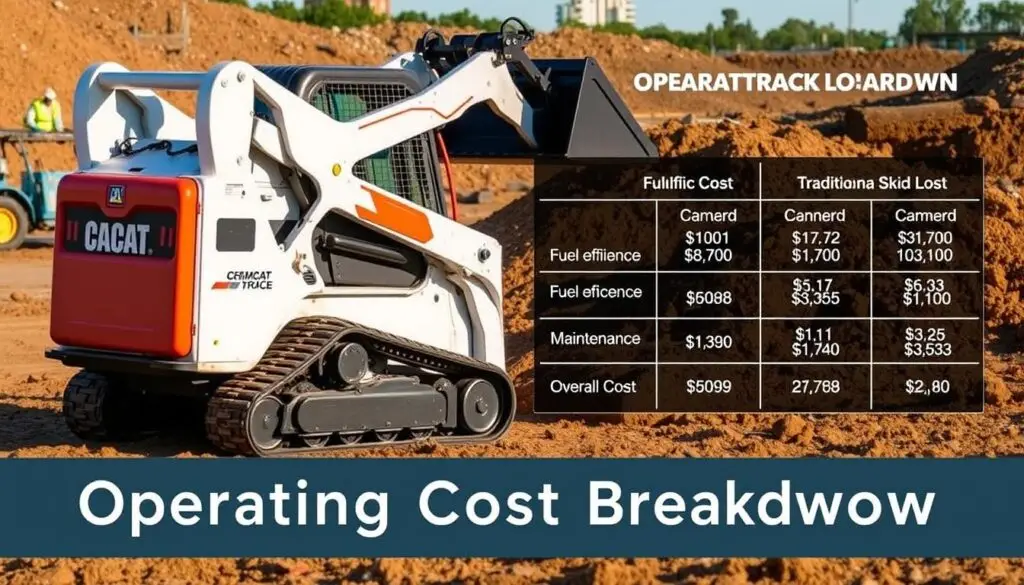
Equipment decisions extend far beyond purchase price. Operating costs accumulate throughout the machine’s service life, encompassing fuel consumption, maintenance requirements, and major component replacements. Smart fleet managers evaluate both immediate capital requirements and long-term financial obligations before committing to either machine type.
Purchase Price and Initial Investment
Skid steer loaders consistently command lower acquisition costs than compact track loaders with comparable specifications. The price difference typically ranges from 20-30% less for wheeled machines, stemming from simpler undercarriage design and less expensive components. Track systems incorporate complex engineering with sealed bearings, roller assemblies, and sophisticated tensioning mechanisms that add manufacturing cost.
Current market pricing positions small-frame skid steers in the $35,000-$50,000 range, with medium-frame units from $45,000-$65,000 and large-frame models reaching $70,000 or higher. Comparable compact track loaders add the manufacturer premium, placing similar-capacity tracked machines $10,000-$25,000 higher depending on size class and options.
Fuel Consumption Realities
Compact track loaders typically consume 10-20% more fuel than comparable skid steers during standard operations. Greater overall weight, higher rolling resistance from rubber tracks, and more powerful engines required to move heavier machines all contribute to increased consumption.
However, fuel efficiency calculations require context beyond simple hourly consumption rates. In applications where CTL traction advantages eliminate wheel spin and reduce the need for multiple passes, overall fuel consumption per task may favor tracked machines. A skid steer spinning wheels in mud wastes considerable fuel without accomplishing productive work.
Hard surface operations consistently favor skid steers for fuel economy. On concrete, asphalt, or well-compacted gravel, wheeled machines travel faster while consuming less fuel per hour. Contractors working primarily on prepared surfaces see meaningful annual fuel savings.
Maintenance Requirements and Component Costs
Maintenance intensity differs dramatically between machine types, representing one of the most significant operational cost differences. Skid steers require straightforward tire maintenance that most operators handle in-house without specialized training or equipment.
| Cost Category | Skid Steer Loader | Compact Track Loader | Difference |
|---|---|---|---|
| Tire/Track Replacement | $800-$2,400 per set | $4,000-$10,000 per pair | 3-5x higher for CTL |
| Component Lifespan | 1,200-2,500 hours (tires) | 800-2,000 hours (tracks) | Quality tracks can last 3-5x longer |
| Daily Maintenance Time | 5-10 minutes | 20-30 minutes | 2-3x more for CTL |
| Annual Fuel Cost (est.) | $4,500-$6,500 | $5,000-$7,500 | 10-20% higher for CTL |
Tire replacement on skid steers costs $200-$600 per tire depending on size and quality, with complete sets running $800-$2,400. Skilled operators replace all four tires in one to two hours using basic equipment. Track replacement requires specialized tools, technical expertise, and typically dealer involvement—costing $4,000-$10,000 for the pair plus labor.
Daily track maintenance demands more attention than tire care. Debris removal, tension adjustment, and undercarriage cleaning prevent premature wear but consume 20-30 minutes per day compared to 5-10 minutes for tire pressure checks. Over time, this maintenance investment protects expensive components and extends track life significantly.
Best Applications for Each Machine Type
Matching equipment capabilities to specific applications maximizes productivity and minimizes operational frustrations. Each machine type excels in particular scenarios based on its inherent design advantages.
When Skid Steers Excel
Wheeled loaders deliver optimal performance on hard, paved surfaces where their speed and maneuverability advantages shine. Concrete, asphalt, and compacted aggregate provide ideal operating conditions—tires achieve excellent traction without causing surface damage while machines move quickly between work points.
Indoor operations strongly favor skid steers for several reasons. Compact dimensions pass through standard doorways, while wheels protect finished floors that tracks might damage. Propane and electric-powered models eliminate exhaust concerns for warehouse and manufacturing facility work. Zero-radius turning navigates congested interiors efficiently.
Time-sensitive material handling benefits from faster travel speeds. Snow removal operations, high-volume loading, and projects with widely scattered work zones see productivity gains from the 40-50% speed advantage. Municipal snow contractors and commercial property maintenance operations often maintain skid steers specifically for these applications.
When Compact Track Loaders Dominate
Soft ground, wet conditions, and turf protection requirements demand tracked equipment. Wetland restoration, construction in poorly drained areas, beach projects, and winter operations all favor CTL capabilities. Attempting wheeled equipment in such conditions typically results in equipment immobilization and project delays.
Landscaping professionals increasingly specify track loaders for turf-sensitive work. Golf course construction, sports field installation, and residential landscaping on established lawns benefit from reduced ground pressure that preserves grass roots and prevents depressions requiring restoration.
Slope operations and hillside construction require the enhanced stability that tracked undercarriages provide. Lower centers of gravity, extended wheelbases, and continuous ground contact enable safe operation on inclines that present rollover risks for wheeled machines. Land clearing, erosion control, and mountain access projects often mandate tracked equipment.
The HDJ Perspective
After fifteen years observing fleet equipment decisions across diverse operations, one pattern emerges consistently: the right loader for your operation depends almost entirely on your primary terrain conditions. The 78% market shift toward compact track loaders reflects broader industry recognition that all-terrain capability provides better value for most contractors than hard-surface speed optimization. However, operations centered on paved surfaces, indoor work, or requiring maximum maneuverability still see better returns from skid steers. The mistake isn’t choosing either machine type—it’s selecting equipment without honestly assessing where that machine will actually work.
Making the Equipment Selection Decision
A systematic approach to equipment selection prevents costly mismatches between machine capabilities and actual working conditions. The decision framework begins with honest terrain assessment and extends through financial analysis of total ownership costs.
Terrain Assessment Methodology
Start by cataloging where your machine will operate most frequently. Document primary surface types across typical projects: concrete, asphalt, compacted gravel, bare dirt, mud, grass, sand. Estimate the percentage of operating time on each surface type over a typical year, including seasonal variations.
If 70% or more of operation occurs on hard, level surfaces, skid steers deliver optimal performance and cost-effectiveness. When 50% or more of work involves soft ground, slopes, or turf protection requirements, compact track loaders justify their higher investment through capability advantages that wheeled machines simply cannot match.
Space constraints deserve careful analysis. Measure typical working areas, access routes, and maneuvering clearances. Operations in extremely confined spaces—indoor projects, narrow residential access, congested urban sites—may require wheeled machines regardless of other considerations.
Financial Decision Framework
Calculate total cost of ownership over a realistic operating period rather than focusing solely on purchase price. A comprehensive analysis spanning five years or 5,000 operating hours reveals the true financial impact of each equipment choice.
Include acquisition cost, annual fuel consumption, scheduled maintenance, unscheduled repairs, and major component replacements. Over typical ownership periods, skid steers cost 25-35% less to own and operate than comparable CTLs—a substantial difference that makes wheeled machines attractive for suitable applications.
However, this cost advantage evaporates when equipment cannot perform effectively. A skid steer stuck in mud wastes expensive labor hours. Surface damage requiring restoration adds unexpected costs. Equipment unable to safely access work areas becomes a liability regardless of purchase price savings. The cheaper machine that cannot do the work becomes the most expensive choice.
Rental vs. Purchase Considerations
Short-duration projects under 200 hours often favor rental economics over ownership. Rental arrangements shift major maintenance burdens to equipment owners while providing access to appropriately matched equipment for specific project conditions.
General contractors handling diverse project types benefit from maintaining skid steers as a fleet foundation while supplementing with track loader rentals for challenging conditions. This approach optimizes both capability and cost across varied work requirements. Specialized contractors whose projects consistently demand tracked capabilities justify CTL ownership despite higher costs.
Share Your Compact Loader Experience
Fleet managers and equipment operators bring valuable real-world perspective on compact loader selection. If you’ve learned lessons about matching equipment to applications or want to share maintenance insights from your operation, Heavy Duty Journal welcomes industry expertise.
Maintenance Best Practices for Each Type
Proper maintenance extends equipment life and protects the significant investment represented by either machine type. The nature and intensity of maintenance requirements differ substantially between wheeled and tracked loaders.
Skid Steer Tire Care
Daily visual inspections check for cuts, punctures, and abnormal wear patterns. These quick walkaround evaluations prevent small problems from becoming major failures. Air pressure monitoring represents the most critical maintenance task—proper inflation ensures even weight distribution and maximizes tire lifespan.
Check tire pressure weekly to prevent uneven wear. Underinflated tires wear rapidly on sidewalls while overinflated tires deteriorate prematurely in center tread areas. Most skid steer tires operate between 30-50 PSI depending on tire size and load requirements.
Tire rotation every 500-800 hours distributes wear evenly across all positions. The skidding action during turns accelerates tread wear compared to conventional wheeled equipment, making rotation particularly valuable for extending overall tire investment.
Compact Track Loader Undercarriage Maintenance
Track systems demand more intensive daily attention than tires. Debris removal stands as the most important daily task—mud, soil, vegetation, and construction materials accumulate between track lugs and around rollers, acting like grinding compound that accelerates component wear.
Clean undercarriages thoroughly at shift end to prevent debris hardening overnight. Pressure washers remove packed material effectively. This daily time investment extends track life by hundreds of hours and protects expensive suspension components.
Track tension requires weekly verification at minimum. Tracks naturally loosen during operation as rubber stretches and components settle. Check tension by measuring sag at the midpoint between rollers according to manufacturer specifications. Loose tracks cause excessive wear and risk derailment; overtightened tracks stress bearings and motors.
The suspended undercarriage requires regular lubrication of roller bearings, idler bearings, and pivot points according to maintenance schedules. Neglecting these lubrication points causes bearing failures requiring expensive repairs and extended downtime.
Frequently Asked Questions
What ground pressure difference exists between compact track loaders and skid steers?
Compact track loaders operate at 4-6 PSI ground pressure while skid steers exert 35-45 PSI—an 85% reduction for tracked machines. This fundamental difference determines terrain capability. The lower pressure allows CTLs to work on soft ground, wet conditions, and turf without sinking or causing surface damage. Higher skid steer pressure provides better traction on hard surfaces and some compaction capability but limits operation in challenging conditions.
How much more expensive are compact track loaders to own and operate?
Compact track loaders typically cost 20-30% more to purchase than comparable skid steers. Operating costs run 25-35% higher over typical ownership periods due to track replacement costs of $4,000-$10,000 compared to $800-$2,400 for tire sets, plus 10-20% higher fuel consumption and more intensive maintenance requirements. However, quality tracks from reputable manufacturers often last 3-5 times longer than standard tires, partially offsetting the cost difference for operations requiring tracked capabilities.
Which machine type offers better stability on slopes?
Compact track loaders provide significantly better slope stability, safely operating on inclines up to 25-30 degrees compared to 15-20 degrees for skid steers. Three design factors create this advantage: lower center of gravity from track positioning, longer effective wheelbase from continuous ground contact, and superior traction preventing slippage during direction changes on hillsides. For hillside construction, slope stabilization, or any application involving significant grades, tracked equipment reduces rollover risk substantially.
Can skid steers use the same attachments as compact track loaders?
Yes, most skid steers and compact track loaders share compatible quick-attach mounting systems, allowing the same buckets, forks, augers, grapples, and specialized attachments to work with either machine type. This compatibility means attachment investments transfer between machine types if fleet needs change. However, operators should verify attachment weight ratings match the specific loader’s rated operating capacity, and the enhanced stability of CTLs may allow them to safely use heavier attachments at full lift height.
Why have compact track loaders become more popular than skid steers?
Industry data shows CTLs now account for approximately 78% of sales in this equipment category, reversing historical dominance by wheeled machines, according to Equipment World market analysis. The shift reflects contractor recognition that all-terrain versatility provides better value than hard-surface speed optimization for most applications. CTLs work effectively on prepared surfaces while also handling challenging conditions that would sideline skid steers. The productivity insurance of avoiding stuck equipment and project delays justifies higher ownership costs for diverse operations.
Choosing the Right Compact Loader for Your Operation
The compact track loader vs skid steer decision ultimately comes down to matching equipment strengths with actual working conditions. Neither machine type delivers universal superiority—each represents an optimized solution for specific applications that align with its inherent design characteristics.
Skid steers excel on hard surfaces, in confined spaces, and when travel speed directly impacts productivity. Their lower acquisition and operating costs make them financially attractive for operations centered on paved areas, indoor work, or applications requiring maximum maneuverability. Compact track loaders dominate on soft ground, slopes, and turf-sensitive projects where their flotation, stability, and traction capabilities prove essential.
Honest terrain assessment determines the right choice. Calculate total ownership costs rather than focusing on purchase price alone. Consider rental options for occasional specialized requirements. The right loader for your fleet maximizes productivity on the projects you actually perform—not theoretical applications or worst-case scenarios. Match equipment to reality, and both machine types deliver exceptional value for their intended purposes.
Help Fellow Fleet Managers Make Better Decisions
This equipment comparison provides practical guidance for contractor and fleet manager equipment decisions. If you found this analysis useful, share it with colleagues facing similar compact loader selections.