By Michael Nielsen, Publisher | 15+ Years in Diesel Repair
Last Updated: September 2026
⏱ Estimated reading time: 15+ minutes
Heavy equipment financing solutions differ enormously in approval speed, underwriting model, and how well they actually fit a fleet's cash flow — and the difference between a good fit and a bad one shows up months later in a payment schedule that either matches your revenue or fights it.
A fleet manager or owner-operator evaluating a truck, trailer, excavator, or tractor purchase faces a genuinely crowded field: a traditional bank, an SBA-backed program, a manufacturer's captive finance arm, and a growing set of independent equipment-specific lenders all compete for the same deal, each with a different qualification bar and a different idea of what "fast" means.
Michael Nielsen and Heavy Duty Journal's editorial team built this guide around the actual evaluation criteria that separate a financing solution worth signing from one worth walking away from — underwriting speed, asset-backed structure, term flexibility, and how the decision interacts with a Section 179 tax deadline. Throughout, we use Thirty3 Capital, an equipment-specific lender serving agriculture, construction, and transportation, as a real-world illustration of what a well-structured modern program looks like in practice.
Key Takeaways
- ✓Asset-backed underwriting speeds approval: a lender that secures the loan against the equipment itself can approve and fund faster than a traditional bank evaluating a business purely on credit history.
- ✓Compare at least two or three sources for the same equipment — down payment, term length, and total cost vary meaningfully between a bank, an SBA lender, and an independent equipment finance company.
- ✓Section 179 timing matters as much as the rate: equipment must be delivered, registered, and placed in service by December 31 to qualify for the current tax year's deduction — not just ordered or paid for.
- ✓A loan and a true lease get taxed differently: a loan or a $1 buyout lease generally qualifies for Section 179, while a fair-market-value lease typically doesn't, since the business never takes ownership.
- ✓Budget for the repair, not just the payment: a financing payment is predictable; a major repair usually isn't, and skipping a maintenance reserve alongside the loan is one of the most common budgeting mistakes.
In This Guide
- The Heavy Equipment Financing Market Right Now
- Why Underwriting Model Is the First Thing to Evaluate in Heavy Equipment Financing Solutions
- Approval Speed and the One-Page Application Trend
- A Real-World Example: How a Modern Equipment Lender Structures a Deal
- Loan vs. Lease: Which Structure Actually Fits
- Section 179 and the Tax Timing That Trips Up Buyers
- Red Flags and Questions to Ask Before You Sign
- A Practical Evaluation Checklist
- Frequently Asked Questions
The Heavy Equipment Financing Market Right Now
Per Global Market Insights, the global construction equipment finance market was valued at roughly $99.8 billion in 2025 and is projected to reach $104.1 billion in 2026, growing at a 6.8% compound annual rate through 2035 — with the U.S. segment alone generating about $20.9 billion in 2025. Other research firms publish notably different figures depending on how they scope the market, so treat the growth direction as the reliable signal and a specific dollar figure as something to verify against the current report before citing it elsewhere.
What's driving that growth is straightforward: equipment costs keep climbing, and preserving working capital has become standard practice rather than a fallback for most fleets and owner-operators. As operating costs continue to climb across the industry, financing a truck, trailer, or piece of heavy machinery rather than paying cash lets a business keep cash available for fuel, payroll, and the unplanned repair that inevitably shows up mid-quarter. HDJ's fleet equipment financing fundamentals guide covers the basic loan-vs-lease mechanics if you're starting from scratch.
The Field of Lenders Has Genuinely Diversified
Fleet equipment financing isn't a single product — it's a set of tools, from bank term loans to SBA-backed programs to independent equipment loans and leases, each suited to different credit profiles, timelines, and equipment types. A traditional bank still offers the lowest rate for a borrower with strong credit and patience for a longer underwriting process.
An SBA 7(a) or 504 loan can offer favorable terms but typically requires strong credit, a detailed business plan, and a 60-90 day approval window. An independent equipment-specific lender occupies the middle ground most fleets actually operate in: faster than a bank, more specialized than a general small-business lender, and built around the equipment itself as collateral rather than years of financial history.
Why Underwriting Model Is the First Thing to Evaluate in Heavy Equipment Financing Solutions
Before comparing a rate or a monthly payment on a heavy equipment financing solution, the single most useful question to ask a lender is how they underwrite the loan. This one distinction predicts almost everything else about the experience — how fast you'll get an answer, how much documentation you'll need to produce, and whether a newer business or a thinner credit file disqualifies you outright.
Asset-Backed vs. Credit-Based Underwriting
Equipment-specific lenders differ from a traditional bank in one important way: they underwrite against the equipment itself, which tends to make approval faster and more attainable for a newer operator or a business with a shorter credit history than a conventional small business loan would require. A traditional bank, by contrast, evaluates the borrower's overall financial history first and treats the equipment as secondary collateral — a process that takes longer but can produce a better rate for a borrower who already has an established banking relationship and strong financials.
| Lender Type | Underwriting Basis | Typical Approval Window |
|---|---|---|
| Traditional Bank | Overall credit history, financial statements | Several weeks |
| SBA-Backed Program | Credit, business plan, government guarantee criteria | 60-90 days |
| Independent Equipment Lender | The equipment itself, plus business cash flow | Same-day to a few business days |
| Manufacturer Captive Finance | Credit tier, tied to a specific equipment brand | Varies by program |
Why This Matters More for New and Growing Operations
A newer owner-operator or a fleet in a growth phase often has a thinner credit file than the years-in-business a traditional bank wants to see, even when the business itself is healthy and generating solid cash flow. An asset-backed lender's core advantage is treating the equipment's own resale value as the primary security — which is exactly why a construction, agriculture, or transportation business without a decade of banking history can still secure competitive terms once the underwriting model shifts away from credit history alone.
Approval Speed and the One-Page Application Trend
A meaningful shift among equipment-specific lenders over the past several years has been the move toward a single-page application in place of the extensive documentation package a bank or SBA program still requires. This isn't just a convenience feature — it reflects the underwriting model itself: a lender that's primarily securing the loan against the equipment needs less financial-history documentation upfront than one evaluating years of tax returns and financial statements.
What "Same-Day Approval" Actually Means
A same-day or 24-hour approval claim is worth asking a specific question about: does that timeline cover the credit decision only, or does it include funding and equipment delivery as well? A fast credit decision is genuinely useful for a business that needs to move on a deal, but the equipment still has to be delivered, registered, and — if a Section 179 deduction is part of the plan — placed in service before a tax deadline matters.
Financing approval, delivery, and registration for a truck or piece of heavy machinery can easily take four to eight weeks depending on the lender and manufacturer backlog, even when the credit decision itself came back in a day.
A Real-World Example: How a Modern Equipment Lender Structures a Deal
Thirty3 Capital, a lender offering heavy construction equipment financing alongside programs for agriculture and transportation, illustrates several of the structural features worth looking for when evaluating a financing solution against the criteria above.
Application Structure and Approval Timeline
The lender uses a single-page application for financing up to $600,000, with credit decisions typically delivered within 24 hours. That structure matches the asset-backed underwriting pattern described above — a streamlined application paired with a faster decision, rather than the multi-week documentation review a bank or SBA program would require for a comparable loan amount.
Coverage Across New and Used Equipment
The program covers both equipment loans and equipment leases for new and used machinery, spanning trailers and trucks for transportation operations, loaders and excavators for construction, and tractors and irrigation systems for agriculture.
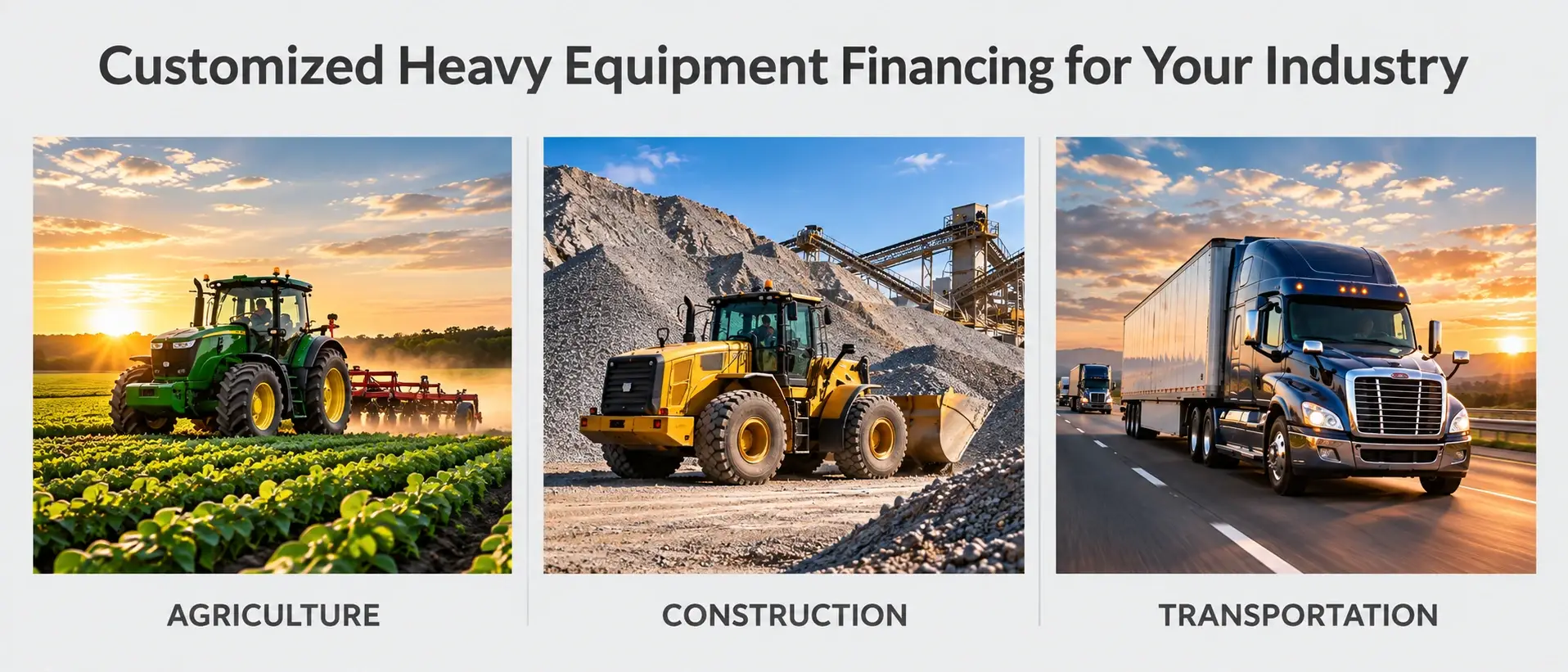
Financing used equipment through a specialized lender is a meaningful option worth evaluating separately — a quality used asset in construction, agriculture, or trucking retains strong market value, and a lender comfortable underwriting used equipment specifically can open financing paths a captive finance program tied to only new inventory won't offer. HDJ's heavy equipment auction bidding guide covers financing pre-approval for a related used-equipment acquisition path.
Industry Affiliations Worth Checking For
Thirty3 Capital is a member of the Equipment Leasing and Finance Association (ELFA), the industry's primary trade association, along with the American Association of Commercial Finance Brokers and the National Trailer Dealers Association. Membership in a recognized industry association isn't a guarantee of quality on its own, but it's a reasonable data point to check for when comparing a lender you haven't worked with before — particularly for a newer or less-established program without an extensive public track record yet.
Loan vs. Lease: Which Structure Actually Fits
Financing arrangements generally fall into two categories: loans, where the borrower owns the equipment and builds equity from the first payment, and leases, where a company pays for the use of equipment over a fixed term with an option to purchase, renew, or return it at the end. The right structure depends on cash flow, tax strategy, and how long the equipment will stay in service. HDJ's leasing vs. owning guide for new owner-operators and total-cost-of-ownership comparison both cover this decision in more depth for a truck purchase specifically.
When a Loan Makes More Sense
A loan tends to fit better for equipment with a long useful life and a strong resale value — a well-maintained truck, tractor, or piece of construction machinery that a fleet plans to run for many years and eventually sell rather than replace on a fixed cycle. Building equity from the first payment matters most when the plan is genuinely long-term ownership.
When a Lease Makes More Sense
A lease tends to fit better when equipment technology evolves quickly, when a fleet wants a predictable payment without residual-value risk, or when cash flow flexibility matters more than eventual ownership. A fleet running a fixed replacement cycle — swapping trailers every few years, for example — often finds a lease structure aligns more naturally with how the equipment actually gets used than a loan built around long-term ownership would.
Section 179 and the Tax Timing That Trips Up Buyers
Per IRS Publication 946, the Section 179 deduction lets a business deduct the full purchase price of qualifying equipment in the year it's placed in service, rather than spreading the deduction across several years of depreciation.
For tax years beginning in 2025, the maximum deduction is $2,500,000, with a phase-out beginning once total qualifying purchases exceed $4,000,000 — figures that continue adjusting for inflation each year, so it's worth confirming the exact current-year number directly with the IRS or a tax professional rather than relying on a number quoted in an older article, including this one.
The Financing Structure Changes Whether the Deduction Applies
Because the Section 179 deduction applies to property a business owns for tax purposes, a loan or a $1 buyout lease typically qualifies for the deduction, while a true fair-market-value lease generally does not, since the business never takes ownership of the asset. This is one of the more consequential details in the loan-vs-lease decision above — the tax treatment isn't a footnote, it's a real factor that should inform which structure a lender helps you set up in the first place.
Placed in Service, Not Just Ordered
Fleets planning to use the Section 179 deduction for the current tax year need the equipment placed in service — delivered, registered, and ready to operate — by December 31, not just ordered or paid for. This is exactly where approval speed and delivery timeline intersect: a fast credit decision in November doesn't help if the equipment itself doesn't arrive and get registered until February. HDJ's owner-operator tax deductions guide covers the broader Section 179 and depreciation strategy in more depth.
Red Flags and Questions to Ask Before You Sign
A heavy equipment financing decision made under time pressure is where most of the expensive mistakes happen. A few specific questions, asked before signing rather than after, catch most of the common problems.
Ask for the Total Cost, Not Just the Monthly Payment
A monthly payment can be structured lower through a longer term, a balloon payment, or a residual assumption that shifts cost to the back end of the agreement. Request the full APR, every fee, the prepayment terms, and the total amount repaid over the life of the loan or lease before comparing offers — a lower monthly number is not the same thing as a lower total cost.
Confirm Whether the Approval Timeline Includes Funding
As covered above, a same-day credit decision and same-day funding are two different claims. Ask directly what happens between approval and the equipment actually being available to use.
Not Comparing at Least Two or Three Sources
Down payment requirements, term length, and total cost can vary meaningfully between a bank, an SBA lender, and an independent equipment finance company for the exact same piece of equipment. A single quote, taken at face value under deadline pressure, is the single most common way a fleet ends up in a financing structure that doesn't fit.
Skipping the Maintenance Reserve
A truck or excavator payment is predictable; a major repair usually isn't, and a fleet that budgets only for the financing payment can get caught short. Build a maintenance reserve into the same budgeting exercise that determines what monthly payment you can actually afford — not as an afterthought once the financing is already signed.
A Practical Evaluation Checklist
Pulling the criteria above into a single practical sequence, here is how to evaluate a heavy equipment financing solution step by step: first, identify the underwriting model (asset-backed, credit-based, or SBA-guaranteed) and confirm it matches your business's actual profile — a newer operation with a thin credit file benefits more from an asset-backed lender than from a bank that primarily reads years of tax returns.
Second, get a real timeline for both the credit decision and the full funding-to-delivery process, especially if a Section 179 deadline is part of the plan. Third, decide on loan vs. lease based on how long you'll actually keep the equipment and how the tax treatment lines up with your business's current tax position — a decision worth making before shopping lenders, not after receiving an offer.
Fourth, request the total cost breakdown from every lender you're comparing, not just the advertised monthly payment. Fifth, check for industry association membership and a genuine track record with businesses in your specific vertical — agriculture, construction, and transportation each have different equipment cycles and seasonal cash flow patterns that a specialized lender understands better than a generalist one.
Frequently Asked Questions
What's the difference between asset-backed and credit-based equipment financing?
Asset-backed financing secures the loan primarily against the equipment's own value, enabling faster approval for newer businesses or thinner credit files. Credit-based lending — the traditional bank model — evaluates years of financial history first and treats the equipment as secondary collateral, typically producing better rates but a much slower approval process.
How fast can heavy equipment financing actually be approved?
Independent equipment-specific lenders commonly offer same-day to 24-hour credit decisions using a streamlined application. That covers the credit decision only — actual funding, delivery, and registration typically add four to eight weeks depending on the lender and equipment availability, which matters most when a tax deadline is part of the plan.
Does financed equipment still qualify for the Section 179 deduction?
Yes, for a loan or a $1 buyout lease — the equipment counts as owned for tax purposes even while payments continue. A true fair-market-value lease generally doesn't qualify, since ownership never transfers. The equipment must also be placed in service by December 31 of the tax year the deduction is claimed.
Can I finance used heavy equipment, not just new?
Yes. Most equipment-specific lenders finance used equipment across construction, agriculture, and transportation, since a well-maintained used asset in these industries retains strong resale value. Used equipment financing is common precisely because it offers substantial cost savings over new while still qualifying for the same financing structures.
Should I choose a loan or a lease for heavy equipment?
It depends on how long you'll keep the equipment and your tax position. A loan fits long-life assets you plan to own and eventually sell, building equity from the first payment. A lease fits equipment that changes quickly or when predictable payments without residual-value risk matter more than ownership — common on a fixed trailer or truck replacement cycle.
The Bottom Line
Evaluating a heavy equipment financing solution comes down to matching the underwriting model, approval timeline, and loan-vs-lease structure to how your business actually operates — the same discipline Michael Nielsen and Heavy Duty Journal's editorial team hold every guide on heavydutyjournal.com to. A fast approval and a simple application solve a real problem, but they're only part of the evaluation; the total cost, the tax treatment, and the fit between financing structure and actual equipment use matter just as much.
Compare at least two or three sources for the same equipment before committing, confirm the full timeline from approval to delivery — especially against a Section 179 deadline — and budget for the maintenance reserve alongside the payment itself. The right financing solution is the one that fits your business's actual cash flow and equipment cycle, not simply the one with the fastest yes.
Share This Guide With Your Network
Know a fleet manager or owner-operator evaluating equipment financing options? Share this guide to help them ask the right questions before they sign.