
By Michael Nielsen, Editor & Publisher | 15+ Years in Diesel Repair
Last Updated: January 2026
📖 Estimated reading time: 27 minutes
Shop labor guide software has become the operational backbone of profitable heavy-duty repair facilities, transforming how diesel shops estimate repairs, manage technician productivity, and maintain competitive pricing. For fleet maintenance managers and independent shop owners servicing Class 4-8 commercial vehicles, the right labor estimation platform can mean the difference between consistent profitability and chronic margin erosion.
The commercial vehicle repair industry has undergone a fundamental shift over the past decade. What once relied on paper manuals, technician memory, and educated guesswork now demands precision through advanced digital platforms. Modern truck repair software integrates comprehensive labor time databases with diagnostic tools, inventory systems, and compliance tracking—creating unified workflows that eliminate the costly inefficiencies of manual estimation.
This guide examines how heavy duty labor guides transform shop operations, evaluates leading platforms serving the diesel repair market, and provides actionable frameworks for selection, implementation, and ROI measurement. Whether you’re considering your first digital estimation system or evaluating an upgrade from existing tools, you’ll find the practical insights needed to make an informed technology investment.
Key Takeaways
- Revenue Recovery: Most shops discover 15-30% undercharging on major repairs when comparing manual estimates against standardized labor databases, representing tens of thousands in recoverable annual revenue.
- Estimation Speed: Digital platforms reduce estimate preparation time from 35-50 minutes to 8-15 minutes per job, dramatically improving quote-to-approval conversion rates.
- Technician Utilization: Shops using integrated labor guide systems achieve 85-95% technician utilization compared to 65-75% with manual methods.
- Platform Selection: Choose based on vehicle coverage depth, integration capabilities with existing systems, and subscription versus perpetual licensing models.
- Implementation Success: Phased rollouts spanning 6-8 weeks with dedicated pilot groups consistently outperform rapid full deployments.
- ROI Timeline: Most shops achieve positive return on investment within 3-6 months through combined labor recovery and efficiency gains.
The Critical Role of Digital Labor Guides in Heavy-Duty Repair Operations
Accurate labor time estimation separates profitable repair operations from those struggling to maintain margins. The heavy-duty repair industry has reached a critical juncture where traditional estimation methods no longer support sustainable business models. Shop owners who continue relying on manual processes face declining profitability and increased customer disputes that damage long-term relationships.
Digital labor guides provide the foundation for consistent pricing, transparent customer communications, and predictable revenue streams. These systems transform how shops approach every repair order from initial quote through final invoicing. The transition from manual to digital estimation represents one of the most impactful operational changes a heavy-duty shop can implement.
Why Manual Labor Estimating No Longer Works for Modern Shops
Traditional estimation methods depend heavily on individual technician experience and memory. This approach creates significant variability between estimators, leading to inconsistent pricing across similar jobs. One service advisor might quote four hours for a transmission repair while another estimates six hours for the identical service on the same vehicle model.
The time required to create manual estimates drains productivity from service departments. Advisors spend valuable minutes or even hours researching labor times, calling technicians for input, and recalculating totals. This inefficiency delays customer responses and reduces the number of quotes a shop can process daily.
Manual systems offer no mechanism for tracking historical performance or identifying patterns. Shops cannot determine whether their labor time estimates align with actual completion times. Without this data, continuous improvement becomes impossible, and the feedback loop essential for operational optimization simply doesn’t exist.
Customer expectations have evolved alongside technology advancements in other industries. Modern fleet managers expect detailed, professional estimates delivered quickly through digital channels. They’re accustomed to instant pricing in other business transactions and view slow quote responses as indicators of operational inefficiency.
The Financial Impact of Inaccurate Labor Time Calculations
Even minor estimation errors compound dramatically across hundreds of annual repair orders. Consider a shop completing 500 jobs per year with an average underestimate of just one hour per job. At the national average shop rate of approximately $134 per hour, this single-hour error represents $67,000 in lost annual revenue.
The financial architecture of successful heavy-duty repair operations depends on precise labor cost management. Top-performing shops target a specific profit mix on repair orders: approximately 20% from labor, 25% from parts markup, 30% allocated to overhead, and 25% representing net profit. On an $800 repair order, this translates to $160 in labor profit, $200 from parts, $240 for overhead, and $200 in net profit.
When labor profit drops below 17% or overhead exceeds 35% of total revenue, shops enter dangerous financial territory. These imbalances signal systematic pricing problems that threaten long-term viability. Many shop owners discover too late that years of undercharging have created unsustainable business models requiring difficult corrections.
| Estimation Method | Average Time Per Quote | Accuracy Rate | Annual Revenue Impact |
|---|---|---|---|
| Manual Memory-Based | 18-25 minutes | 68-72% | -$45,000 to -$78,000 |
| Technician Consultation | 12-18 minutes | 75-80% | -$28,000 to -$42,000 |
| Digital Labor Guide | 4-7 minutes | 92-96% | +$35,000 to +$58,000 |
| ✓ Integrated Shop Management | 2-4 minutes | 94-98% | +$52,000 to +$85,000 |
Technician productivity metrics reveal another dimension of the profitability challenge. Industry benchmarks indicate technicians should achieve at least 85% billable time per shift. When inaccurate estimates lead to jobs taking longer than quoted, technicians spend unbilled hours completing work. This destroys the efficiency ratio and reduces overall shop capacity for revenue-generating repairs.
Quantifying Revenue Recovery from Undercharged Labor
Implementation of accurate labor guides immediately reveals previously unbilled work. Most shops discover they’ve been undercharging by 15-30% on major repairs when they compare manual estimates against standardized labor time databases. This discovery represents both a painful realization and a tremendous opportunity for margin improvement.
Data-driven pricing based on actual shop performance captures labor hours that previously went unbilled. Many shops find certain repair categories consistently exceed estimated times. Transmission rebuilds quoted at eight hours might average 9.5 hours of actual work. Electrical diagnostics estimated at two hours often require three or more hours to complete properly.
Establishing consistent rate structures through repair estimate software improves both profitability and customer transparency. Customers appreciate detailed estimates that break down labor operations with associated time allocations. This transparency reduces disputes and increases approval rates, as customers understand exactly what they’re purchasing.
Essential Features of Shop Labor Guide Software Systems
The effectiveness of any shop management software depends entirely on its core feature set and how well those capabilities align with the operational realities of commercial vehicle maintenance. Professional-grade platforms deliver comprehensive toolsets that extend far beyond simple time lookups. These systems integrate multiple functional areas into unified workflows that connect estimation, pricing, approval, and work order execution.
Comprehensive Labor Time Databases for Class 4-8 Vehicles
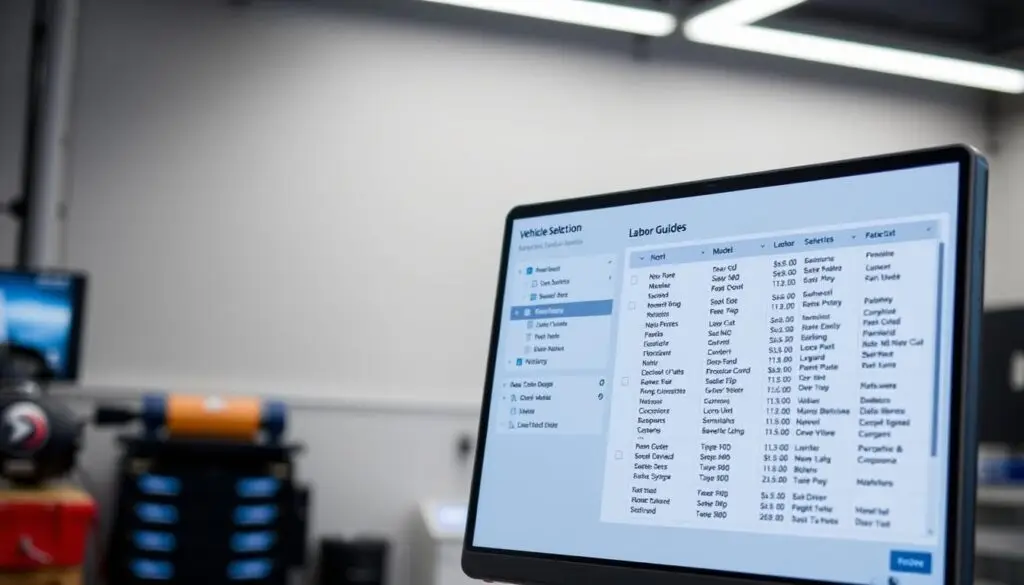
The foundation of any effective labor guide database lies in the breadth and accuracy of its vehicle coverage. Heavy-duty applications demand specialized data that accounts for the significant differences between medium-duty delivery trucks and Class 8 over-the-road tractors. Quality databases include manufacturer-specific repair procedures that reflect the actual complexity of each job.
Component variations create substantial differences in repair times even within the same vehicle class. A transmission replacement on a Freightliner Cascadia differs significantly from the same operation on a Kenworth T680. Professional databases capture these nuances through detailed labor times that factor in access challenges, component weight, and specialized tool requirements.
Model-year differences add another layer of complexity to accurate labor estimating. Newer vehicles incorporate advanced emissions systems, electronic controls, and integrated diagnostics that older models lack. These technological advances often increase repair complexity and require additional diagnostic time that generic estimates fail to capture.
Beyond standard truck components, comprehensive systems include specialized equipment categories. Refrigeration units, hydraulic liftgates, and auxiliary power systems require their own labor time libraries. Shops servicing vocational trucks need databases that cover dump bodies, cranes, and other specialized equipment installations.
Dynamic Pricing Tools and Rate Adjustment Capabilities
Flexible pricing structures separate sophisticated platforms from basic calculators. Modern shops serve diverse customer segments that require different rate structures. Fleet accounts typically negotiate discounted labor rates, while retail customers pay standard pricing. Warranty work often follows manufacturer-specified rates that differ from both retail and fleet pricing.
Dynamic pricing capabilities allow shops to maintain multiple rate schedules within a single system. Service advisors select the appropriate rate structure based on customer type without manual calculations. This automation eliminates pricing errors and ensures consistent application of negotiated rates across all estimates and invoices.
Job complexity modifiers provide additional pricing flexibility for unusual circumstances. Rush jobs, after-hours service, and field repairs justify premium rates that standard labor times don’t reflect. Quality systems let shops apply percentage multipliers or fixed surcharges to base labor rates for these special situations.
Digital Estimate Creation and Customer Approval Workflows
Modern estimate generation extends beyond printed documents to comprehensive digital workflows. Professional platforms create detailed estimates that include labor breakdowns, parts pricing, and total cost projections. These digital estimates present information clearly while maintaining professional formatting that builds customer confidence.
Photo attachment capabilities strengthen estimate justification and reduce approval friction. Service advisors capture images of damaged components, fluid contamination, or wear conditions directly from mobile devices. These visual elements attach automatically to digital estimates, providing customers clear evidence of needed repairs.
Electronic approval processes accelerate the quote-to-authorization cycle dramatically. Customers receive estimates via email or text message with embedded approval links. Single-click authorization eliminates phone tag and paper-based approval delays. Automated follow-up systems send reminders to customers who haven’t responded within specified timeframes.
How Heavy-Duty Shops Benefit from Automated Labor Estimating
Modern diesel repair software fundamentally changes the economics of heavy-duty shop operations through systematic labor management. Heavy-duty repair facilities face constant pressure to deliver accurate estimates quickly while maintaining profitability across diverse repair scenarios. Automated labor estimating systems address these challenges by integrating all repair and maintenance processes into a single digital platform.
The transformation extends beyond simple time savings. Shops using these systems eliminate manual data entry errors and gain automated calculations that ensure consistent accuracy across every estimate. This technological foundation creates measurable improvements in repair shop efficiency that directly impact the bottom line.
Eliminating Guesswork and Reducing Estimate Disputes
The most persistent challenge in heavy-duty repair operations involves justifying labor charges to customers who question pricing. Manual estimating creates a problematic dynamic where service advisors defend numbers that appear arbitrary or inflated. This scenario damages customer relationships and creates unnecessary friction in the sales process.
Automated systems solve this problem through standardized labor times based on verified industry data. Every labor rate calculation references documented performance standards rather than individual opinions. Service advisors present estimates backed by objective benchmarks that customers can understand and accept.
The impact on dispute resolution proves substantial. Shops report significant reductions in pricing complaints when they can show customers exactly how labor times were determined. The software provides transparent documentation that explains why a particular job requires specific hours, removing the perception of guesswork from the equation.
Accelerating Quote-to-Approval Turnaround Time
Speed matters intensely in the competitive commercial truck repair market. Fleet managers and owner-operators routinely contact multiple shops seeking the best combination of price and availability. The facility that delivers a professional, detailed estimate first often wins the job regardless of minor price differences.
Manual estimating creates a critical disadvantage in this race. Service advisors spend extended periods researching labor times, calculating totals, and formatting presentable quotes. During this delay, competitors using commercial truck repair software generate comprehensive estimates in minutes and capture price-sensitive customers.
Automated systems compress the entire quoting process into a streamlined workflow. Service advisors enter basic vehicle information and select required repairs from comprehensive databases. The software instantly retrieves appropriate labor times, applies shop-specific rates, and produces professional estimates ready for customer review.
40-60%
Reduction in estimate preparation time when transitioning from manual to automated labor guide systems
Standardizing Labor Rates Across Multiple Technicians
Internal pricing consistency represents a hidden challenge that undermines profitability in many heavy-duty operations. Different technicians and service advisors naturally develop varying approaches to estimating the same repairs. This inconsistency creates serious problems that erode shop performance over time.
Without standardized systems, identical repairs receive dramatically different price quotes depending on who creates the estimate. Some advisors quote conservatively to improve closing rates, inadvertently leaving money on the table. Others overestimate to build cushion, potentially losing jobs to competitors with more accurate pricing.
Commercial truck repair software eliminates this variability through uniform labor rate calculation methodologies. Every estimate for a specific repair uses identical time standards and pricing formulas. Whether the shop owner, lead technician, or newest service advisor creates the quote, customers receive consistent pricing.
| Estimating Method | Average Quote Time | Pricing Consistency | Technician Utilization |
|---|---|---|---|
| Manual Calculation | 45-90 minutes | Variable (±25%) | 65-75% |
| Spreadsheet Templates | 20-35 minutes | Moderate (±15%) | 70-80% |
| Automated Software | 5-10 minutes | Standardized (±5%) | 85-95% |
| ✓ Integrated Platform | 3-7 minutes | Uniform (±2%) | 90-98% |
Selecting the Right Shop Labor Guide Software
Before committing to any heavy duty labor guide platform, successful shop managers conduct thorough due diligence across multiple critical evaluation criteria. The software marketplace offers dozens of competing solutions, each claiming superior features and capabilities. Making an informed decision requires systematically assessing how well each candidate aligns with your shop’s operational requirements, budget constraints, and growth trajectory.

Evaluating Vehicle Coverage and Data Accuracy
The foundation of any effective labor guide database starts with comprehensive vehicle coverage that matches your service portfolio. Not all systems provide equal depth across different manufacturers, model years, and equipment types. A platform might excel at conventional Class 8 tractors while offering minimal coverage for specialty vocational trucks or older equipment your shop regularly services.
Request detailed coverage reports from vendors before making commitments. These reports should specify exactly which makes, models, and years receive full labor time data versus generic estimates. Shops specializing in particular manufacturers need verified OEM data sources rather than aggregated industry averages that may not reflect actual repair complexity.
Data accuracy directly impacts your bottom line. Investigate how frequently the vendor updates labor times to reflect technical service bulletins, engineering changes, and emerging repair procedures. Premium systems receive monthly or even weekly updates, while budget platforms might refresh annually.
Understanding Subscription vs. Perpetual Licensing
Software pricing structures vary dramatically across providers, making direct comparisons challenging without calculating total cost of ownership over realistic time horizons. The heavy-duty repair software market has largely transitioned from perpetual licensing to subscription-based models, though hybrid options still exist.
Subscription platforms typically charge monthly or annual fees per user, with costs ranging from $30-$100 monthly for basic cloud-based systems. More sophisticated platforms with integrated shop management capabilities command $150-$300 per user monthly. These fees usually include automatic updates, cloud hosting, and basic support.
| Pricing Model | Typical Cost Range | Primary Advantages | Potential Drawbacks |
|---|---|---|---|
| Monthly Subscription | $30-$100/user | Low initial investment, regular updates | Ongoing expenses, vendor dependency |
| Annual Subscription | $500-$2,000/user | Cost savings vs. monthly, budget predictability | Upfront commitment, contract lock-in |
| Perpetual License | $2,000-$8,000 one-time | Long-term efficiency, data ownership | High initial cost, separate update fees |
| Hybrid Model | $1,000 + $20-$40/month | Balanced investment, core features owned | Complex pricing, potential limitations |
Calculate total three-year and five-year costs for realistic comparison. A $50 monthly subscription totals $3,000 over five years per user, while a $2,500 perpetual license with $300 annual maintenance reaches $4,000. Factor in implementation costs, training expenses, and integration fees that vendors sometimes exclude from advertised pricing.
Examining User Support and Training Resources
Even the most intuitive labor guide database requires proper implementation support and ongoing training to deliver maximum value. Vendor support quality varies enormously, ranging from comprehensive white-glove onboarding to minimal self-service documentation.
Investigate the vendor’s implementation methodology before signing contracts. Premium providers assign dedicated implementation specialists who conduct needs assessment, configure the system for your specific operations, migrate historical data, and provide hands-on training. Budget vendors might offer only webinar training and email support.
Reference checks with current users reveal insights that sales presentations never disclose. Request contact information for shops similar to yours in size, service mix, and geographic region. Ask these references specific questions about implementation challenges, support responsiveness, system reliability, and whether they would make the same purchase decision again.
Top Software Platforms for Heavy-Duty Shops in 2025
Several leading software providers have emerged as essential partners for diesel repair shops seeking to modernize their labor estimation and workflow management processes. These platforms combine comprehensive labor time databases with advanced features that address the unique challenges of heavy-duty repair operations.

Mitchell 1 TruckSeries
Mitchell 1 has established itself as a trusted name in commercial vehicle repair information through its TruckSeries platform. This truck repair software delivers extensive coverage for Class 4-8 vehicles, including medium and heavy-duty trucks from all major manufacturers. The platform’s labor time database draws from decades of industry data collection and real-world repair documentation.
TruckSeries integrates seamlessly with parts catalogs from major suppliers, enabling shops to create complete estimates that include both labor and parts pricing. Multi-location dealerships and larger independent shops particularly benefit from Mitchell 1’s enterprise-level features supporting standardized labor rates across multiple facilities.
Fullbay Complete Shop Management
Fullbay has revolutionized how independent diesel repair facilities manage their operations through cloud-based technology designed specifically for heavy-duty applications. This diesel repair software eliminates the late-night paperwork that traditionally burdens shop owners and service advisors.
The platform provides complete visibility into shop operations from service order creation through final invoicing. Fullbay’s integration with MOTOR provides access to the world’s largest parts cross-reference database, current labor times, detailed wiring diagrams, and step-by-step service guides for commercial vehicles.
Cloud-based architecture with encrypted security ensures data protection while enabling access from any device with internet connectivity. Mobile service operations find particular value in Fullbay’s accessible-anywhere design, allowing technicians working on roadside repairs to access labor guides and create estimates directly from tablets or smartphones.
MOTOR Heavy Truck Labor Guide
MOTOR has built its reputation on maintaining the industry’s most extensive parts interchange database. The platform’s heavy duty labor guide capabilities complement this parts expertise with comprehensive labor time information for commercial vehicles. Shops that prioritize parts identification alongside labor estimation benefit from MOTOR’s integrated approach.
Diesel Laptops Repair Solutions
Diesel Laptops offers a unique ecosystem that combines diagnostic hardware, technical training resources, and repair management software. The platform’s diagnostic tools connect directly with vehicle systems, enabling technicians to identify issues quickly and accurately. Extensive training resources help technicians develop skills on new vehicle technologies and repair techniques.
Platform Comparison Overview
| Platform | Primary Strength | Ideal Shop Type | Key Integration |
|---|---|---|---|
| Mitchell 1 TruckSeries | Technical data depth | Dealerships, large independents | Major parts catalogs |
| Fullbay | Cloud-based complete management | Independent shops, mobile services | MOTOR, accounting platforms |
| MOTOR | Parts cross-reference database | Parts-focused operations | Aftermarket suppliers |
| Diesel Laptops | Diagnostic + training ecosystem | Diagnostic-focused facilities | Diagnostic hardware |
The HDJ Perspective
The shop labor guide software market has matured significantly over the past five years, with cloud-based platforms now dominating new implementations. From our conversations with shop owners across the country, we consistently hear that the integration capabilities matter more than the labor database itself—most major platforms offer adequate coverage for standard repairs. Where shops struggle is connecting their estimation tools with existing accounting systems, parts suppliers, and customer communication workflows. Before evaluating specific vendors, document your current tech stack and identify which integrations are truly essential versus nice-to-have. That clarity will narrow your options far more effectively than feature-by-feature comparisons.
Integration Architecture for Seamless Operations
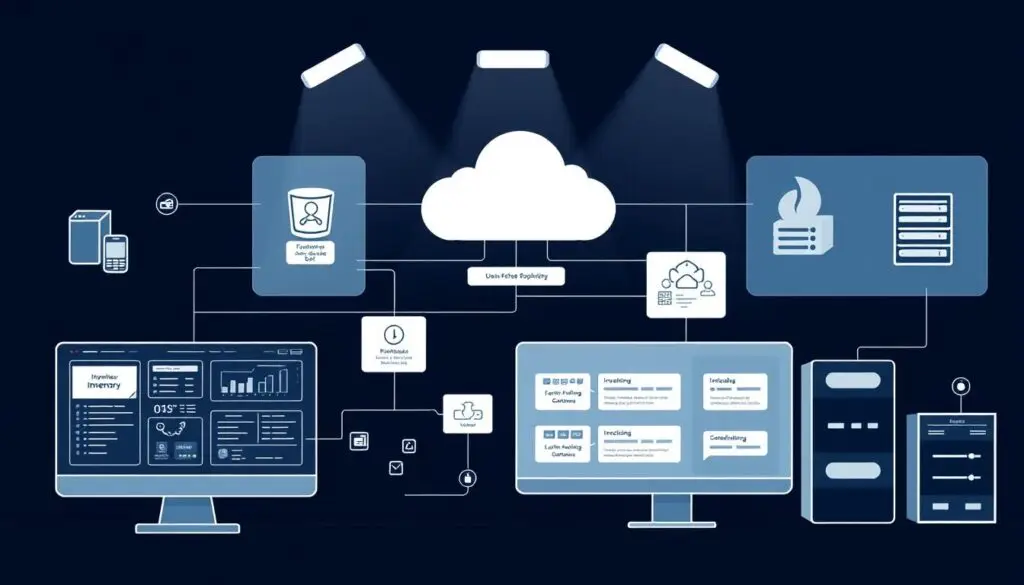
Integration architecture transforms isolated software tools into a unified operational ecosystem for heavy-duty shops. The ability to connect your labor guide database with other critical business systems determines whether your shop runs smoothly or struggles with disconnected information silos.
Connecting Labor Guides with Shop Management Software
The foundation of efficient workflow automation begins with connecting your labor guide database to comprehensive shop management software. This integration eliminates the frustrating need to enter the same information multiple times across different platforms. When a service advisor creates an estimate using labor time data, that information should flow automatically into work orders, scheduling systems, and final invoices.
Native integrations built into all-in-one platforms provide the most seamless experience. Best-of-breed solutions require API connections that link specialized labor databases with separate commercial truck repair software. These connections ensure consistency between initial quotes and completed job documentation.
Synchronizing Accounting Platforms and Payment Processing
Financial visibility improves dramatically when shop management software connects seamlessly with accounting platforms. Integrations with QuickBooks, Xero, Sage, and similar systems eliminate manual export-import processes that consume valuable administrative time. Invoice data, payment information, and job costing details transfer automatically into financial records.
This synchronization provides real-time financial visibility that helps shop owners make informed business decisions. Instead of waiting until month-end to understand profitability, integrated systems deliver up-to-the-minute reporting on revenue, expenses, and margins.
API Capabilities and Third-Party Support
Open API architecture provides flexibility for shops with specialized requirements or unique industry workflows. Application programming interfaces allow custom integrations that extend beyond standard platform capabilities. Commercial truck repair software with robust API support can connect to virtually any business system.
Telematics platform integration represents a powerful example of API capabilities in action. When diagnostic codes from connected vehicles flow directly into the labor guide database, service advisors can generate accurate repair estimates before trucks even arrive at the shop. This proactive approach reduces vehicle downtime and improves customer satisfaction.
Free Professional Fleet Tools
Cost calculators, fault code lookup, maintenance planners, and more—built for owner-operators, fleet managers, and diesel techs. No signup required.
Strategic Implementation for Maximum Team Adoption
Moving to digital labor estimating demands more than purchasing software—it requires a comprehensive implementation strategy that prioritizes team adoption and operational continuity. The difference between shops that thrive with new technology and those that struggle comes down to execution.

Building a Phased Rollout Plan
The phased approach avoids the “big bang” mistake that disrupts operations and frustrates staff. Start with a carefully selected pilot group of two to three service advisors and four to five technicians who demonstrate openness to change. This core team tests the system under real conditions while providing feedback that shapes broader deployment.
Your pilot phase should run for three to four weeks minimum. This timeframe allows users to move beyond initial learning curves and encounter the full range of repair scenarios your shop handles. During this period, maintain your existing estimation methods as a backup to ensure business continuity.
Phase two expands to the next group of users, typically adding another shift or department. Stagger this expansion by two to three weeks after pilot completion. Complete rollout to all staff should occur only after refining processes based on early-stage feedback. This timeline typically extends six to eight weeks from initial pilot launch to full deployment.
Training Service Advisors and Technicians
Training represents the make-or-break factor in software adoption. One-time classroom sessions fail because people learn technology through hands-on repetition, not passive observation. Your training program should emphasize practical application over feature demonstrations.
Service advisors need focused training on creating accurate estimates quickly using the labor guide database. They must learn how to adjust standard times for vehicle condition, customize labor operations for specialty services, and present estimates confidently to customers.
Technician training takes a different approach because technician productivity tools must enhance rather than interrupt their workflow. Focus on mobile access so they can view job details, reference wiring diagrams, and track time without leaving the bay. Emphasize how accurate time tracking protects their compensation, especially in shops using flat-rate or performance-based pay structures.
Establishing Performance Benchmarks
Clear metrics transform implementation from a hopeful investment into measurable business improvement. Define your baseline performance before deployment so you can quantify gains accurately. Track these indicators weekly during rollout and monthly thereafter.
Estimate creation time serves as an immediate efficiency indicator. Measure how long service advisors spend building quotes before and after adoption. Successful implementations typically reduce estimate preparation time by 40 to 60 percent within the first month.
Estimate-to-approval conversion rates reveal whether faster quoting translates to closed business. Track what percentage of estimates result in approved work orders. Improvements here indicate that advisors present pricing more confidently and customers perceive greater professionalism.
Calculating Return on Investment and Cost Savings
Heavy-duty shop owners need concrete data to justify software investments, and labor guide systems deliver measurable financial improvements across multiple operational areas. Understanding the quantifiable benefits allows shop managers to make informed decisions and set realistic expectations.
Measuring Time Savings in Estimate Preparation
Service advisors in shops without automated systems typically spend 35-50 minutes preparing each comprehensive estimate for heavy-duty repairs. This process involves manually looking up labor times, calling parts suppliers for pricing, calculating totals, and formatting presentable quotes.
Modern labor cost management software reduces this timeline dramatically through integrated databases and automated calculations. Shops implementing these solutions report average estimate preparation times dropping to 8-15 minutes per job. The time differential creates immediate capacity improvements.
Consider a shop generating 50 estimates weekly with traditional methods averaging 45 minutes each. That represents 37.5 hours of service advisor time weekly dedicated solely to estimate creation. Implementing automated systems that reduce estimate time to 12 minutes reclaims 27.5 productive hours each week—nearly three-quarters of a full-time position without additional payroll expense.
Quantifying Revenue Recovery from Undercharged Labor
Many heavy-duty shops unknowingly leave substantial revenue on the table through inconsistent labor rate calculation practices. Historical pricing based on outdated estimates, technician memory, or competitive pressure often results in undercharging for complex repairs.
Financial modeling demonstrates the significant impact of small per-job improvements. A shop completing 100 repair orders monthly that recovers just $18 per order through accurate labor pricing generates $21,600 in additional annual revenue. This revenue requires no additional capacity, equipment investment, or marketing expense.
$21,600+
Potential annual revenue recovery for shops completing 100 monthly repairs with accurate labor pricing—based on $18/job average improvement
Reducing Comebacks Through Accuracy
The often-overlooked cost savings from reduced comebacks represent substantial value in ROI calculations. Inaccurate estimates that fail to account for all required procedures create situations where technicians skip steps, rush work, or compromise quality to meet artificially low labor allocations.
Industry data shows comeback rates between 8-12% in shops using manual estimation methods. Modern repair shop efficiency systems reduce this rate to 3-5% through standardized, accurate labor allocations. A shop completing 1,200 annual repairs with a 10% comeback rate experiences 120 redo situations yearly. Reducing that rate to 4% eliminates 72 incidents. At an average cost of $350 per comeback, this improvement generates $25,200 in annual savings.
Technology Innovations Transforming Labor Guides
Technology breakthroughs are pushing shop labor guide software into a new era of precision and accessibility, powered by machine learning algorithms and real-time data networks. Forward-thinking heavy-duty shops that adopt these innovations gain substantial competitive advantages through faster estimating, improved accuracy, and enhanced customer service capabilities.
Artificial Intelligence for Predictive Labor Adjustments
Artificial intelligence represents the most significant advancement in digital labor guides, transforming static databases into learning systems that adapt to real-world conditions. Machine learning algorithms analyze thousands of completed repairs to identify patterns and refine labor time predictions based on specific vehicle characteristics and shop performance data.
AI-enhanced shop labor guide software examines variables that traditional systems ignore, including vehicle age, accumulated mileage, operating environment, and previous repair history. The technology recognizes that a brake job on a ten-year-old Class 8 truck with 800,000 miles differs substantially from the same repair on a two-year-old vehicle with 150,000 miles.
Cloud-Based Platforms Enabling Mobile Estimating
Cloud architecture has revolutionized accessibility for commercial truck repair software, eliminating the limitations of desktop-bound systems. Service advisors and mobile technicians now create professional estimates on-site at customer locations using tablets or smartphones, dramatically accelerating the quote-to-approval process.
Mobile estimating capabilities provide immediate access to complete vehicle service history from any location with internet connectivity. Technicians working on roadside repairs or conducting fleet inspections generate accurate labor quotes without returning to the shop office.
Telematics Integration for Automated Diagnostics
Telematics integration connects digital labor guides directly with vehicle diagnostic systems and fleet management platforms, enabling automated estimate generation based on fault codes and sensor data. This technology bridges the gap between problem identification and repair quotation, streamlining the entire service workflow.
Advanced commercial truck repair software receives diagnostic trouble codes wirelessly from vehicles equipped with telematics systems, automatically generating preliminary labor estimates before the truck arrives at the shop. Service advisors review recommended repairs with supporting labor times, creating detailed quotes that customers approve remotely through digital platforms.
Navigating Common Implementation Challenges
Every shop implementing labor guide technology faces predictable challenges that require strategic communication and operational adjustments. Understanding these obstacles before deployment allows managers to create proactive solutions rather than reactive fixes.
Addressing Technician Concerns About Standardized Times
Experienced mechanics often view standardized times as challenges to their expertise or threats to their earnings. Technicians working under flat-rate compensation structures worry that diesel repair software will reduce their income by setting unrealistic time standards.
The reality contradicts these fears when shops implement properly calibrated systems. Labor guides actually protect technician compensation by establishing consistent, defensible standards that justify charges when customers question invoices. Documentation eliminates disputes about whether work was actually performed.
Involving lead technicians in the calibration process gives them ownership of setting shop-specific standards. This participatory approach transforms potential opponents into implementation champions. When experienced mechanics contribute their expertise to labor rate calculation adjustments, they validate the system rather than resist it.
⚠️ Implementation Warning
Never implement labor guide software without first establishing baseline metrics for your current estimation accuracy and technician utilization rates. Without this data, you cannot demonstrate ROI or identify where the new system creates the most value for your operation.
Creating Solutions for Specialty and Custom Work
Standard databases cover common maintenance and repair operations but cannot anticipate every situation. Custom fabrication, prototype repairs, unusual equipment modifications, and emergency field repairs fall outside typical labor time estimation parameters. These situations require flexible approaches within structured systems.
Creating custom labor operations transforms specialty work into repeatable, estimable services. Most diesel repair software platforms allow shops to build proprietary operation codes with shop-specific time standards. After completing three to five similar jobs, shops have sufficient data to establish reliable time standards. This proprietary knowledge base becomes a competitive advantage.
Educating Customers About Professional Labor Pricing
Customer resistance to labor charges represents the most frequent objection service advisors encounter. Many fleet managers and owner-operators lack understanding of what professional labor rate calculation includes. They compare hourly rates without considering efficiency, equipment investment, or outcome quality.
Effective communication distinguishes between labor time and labor cost. A four-hour repair at $135 per hour from a well-equipped professional shop often delivers better value than a six-hour repair at $95 per hour from an underequipped competitor. The professional shop completes the job faster, with better quality, and provides warranty protection.
Frequently Asked Questions
What is shop labor guide software and why do heavy-duty repair shops need it?
Shop labor guide software provides standardized labor time databases and automated estimation tools specifically designed for commercial vehicle repair operations. Heavy-duty shops need this technology because manual estimation methods create significant pricing inconsistencies, typically resulting in 15-30% undercharging on complex repairs. These platforms deliver accurate labor times for Class 4-8 vehicles, eliminate estimation guesswork, and integrate with shop management systems to streamline workflows from quote to invoice. The investment typically pays for itself within months through recovered revenue from properly charged labor and improved technician utilization rates that approach 85-95% compared to 65-75% with manual methods.
How much does shop labor guide software cost for commercial truck repair shops?
Shop labor guide software pricing varies considerably by platform type and included features. Cloud-based subscription systems typically range from $30-$100 per user monthly for basic labor guide access, while comprehensive shop management platforms with integrated labor databases command $150-$300 per user monthly. Some vendors still offer perpetual license options at $2,000-$8,000 one-time cost, plus annual maintenance fees typically running $300-$500. Calculate total cost of ownership over three to five years for accurate comparison, and factor in implementation costs, training expenses, and integration fees that vendors sometimes exclude from advertised pricing.
Which shop labor guide software platforms are best for diesel repair operations?
Leading platforms for diesel repair shops include Mitchell 1 TruckSeries for comprehensive technical data and multi-location support, Fullbay for cloud-based complete shop management with MOTOR integration, MOTOR Heavy Truck for industry-leading parts cross-reference alongside labor data, and Diesel Laptops for diagnostic integration and technician training resources. Selection depends on shop size, service mix, existing technology stack, and integration requirements. Most vendors offer trial periods or demonstrations—take advantage of these opportunities to evaluate how each platform handles your specific vehicle mix and workflow requirements before committing.
How do I calculate ROI on shop labor guide software for my fleet maintenance operation?
Calculate ROI by measuring three impact areas: time savings from faster estimation (typically 40-60% reduction in quote preparation time), revenue recovery from properly priced labor (most shops discover 15-30% undercharging on complex repairs), and cost avoidance through reduced comebacks (modern systems cut comeback rates from 8-12% to 3-5%). A shop completing 100 monthly repairs recovering just $18 per job generates $21,600 in additional annual revenue. Add time savings value—recovering 27 hours weekly of service advisor time at $40/hour represents another $56,000 annually. Factor in subscription costs and implementation expenses against these gains for accurate ROI projection.
Can shop labor guide software integrate with my existing shop management and accounting systems?
Most modern shop labor guide platforms offer extensive integration capabilities. Cloud-based systems typically connect with major accounting platforms including QuickBooks, Xero, and Sage for automated invoicing and financial reporting. Parts catalog integrations enable real-time inventory verification and pricing during estimate creation. API capabilities allow custom connections to telematics systems, fleet management platforms, and specialized industry tools. Before selecting a platform, verify specific integration support for your existing systems and evaluate native versus third-party connector options. Some integrations require additional subscription fees or technical implementation assistance.
How long does it take to implement shop labor guide software in a heavy-duty repair facility?
Full implementation typically spans 6-8 weeks using a phased approach that maximizes adoption and minimizes operational disruption. Begin with a 3-4 week pilot phase involving 2-3 service advisors and 4-5 technicians testing the system under real conditions while providing feedback. Phase two expands to additional users over 2-3 weeks, with pilot group members serving as peer mentors. Complete rollout follows after refining processes based on early feedback. Training requirements vary by platform complexity, but plan for 8-16 hours of initial training per user plus ongoing support during the first month of full deployment. Rushing implementation consistently produces lower adoption rates and reduced ROI.
Making Labor Guide Software Work for Your Shop
The transition to shop labor guide software represents a fundamental business transformation for heavy-duty repair operations. Shops that embrace digital estimation systems position themselves for sustained competitive advantage in a market where precision and speed determine profitability.
Successful adoption requires more than purchasing a subscription. Shops must invest in proper training, develop calibration processes that align estimates with actual performance, and commit to leveraging analytics capabilities. The right heavy duty labor guide eliminates estimation guesswork while accelerating quote-to-approval cycles that directly impact cash flow.
The financial benefits extend beyond time savings. Shops recover revenue from previously undercharged labor, reduce estimation disputes, and improve technician productivity through standardized processes. These gains compound over time as teams become proficient with the system and continuous calibration refines accuracy.
Evaluate your current estimation process against the capabilities outlined throughout this guide. Calculate the cost of manual methods and estimation inaccuracy. Research platforms that match your operation size and specialization. Develop an implementation plan that transforms labor estimation from an administrative burden into a strategic asset driving growth throughout 2025 and beyond.
Share This Guide With Your Team
If this comprehensive guide helped you understand shop labor guide software options, share it with fellow shop owners, fleet managers, and industry colleagues who are evaluating their technology investments.


