
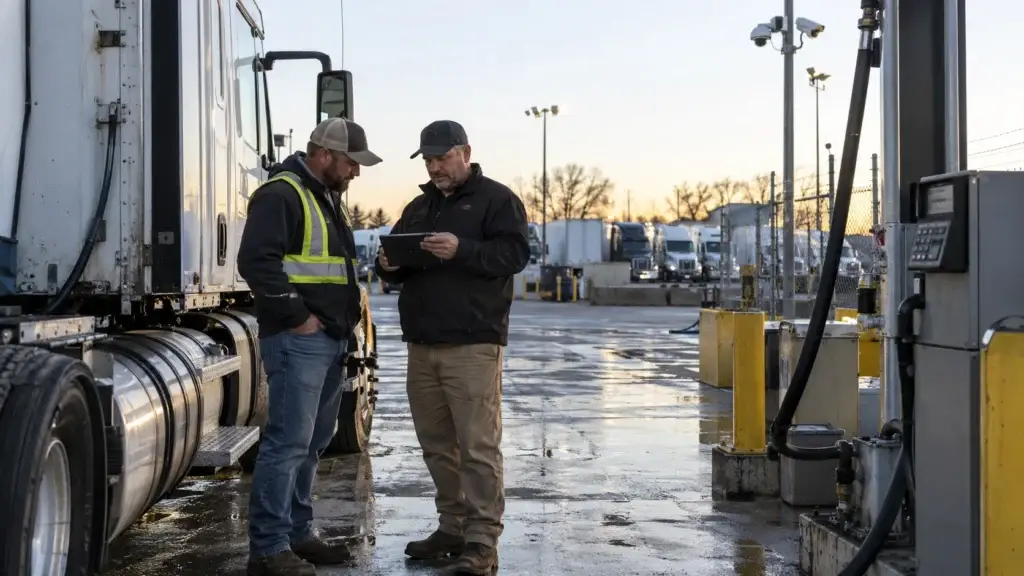
fleet fuel theft prevention

8 Essential Strategies for Commercial Fuel Theft Protection in Fleet Operations

Table of Contents
    Add a header to begin generating the table of contents

    Commercial transportation companies lose 16-19% of their diesel resources annually to unauthorized access and fraud. These losses strike at a vulnerable point: fuel represents approximately 40% of total operating expenses for most fleet operators.

    The financial damage extends far beyond the stolen diesel itself. Fleet fuel theft prevention requires a multi-layered approach combining technology, physical security, and operational policies.

    Companies implementing comprehensive monitoring systems, locking fuel caps, GPS tracking, and strict fuel card controls report 20-30% cost reductions while recovering lost profit margins. The most effective strategies address vulnerabilities at every operational level—from tank security to daily reconciliation procedures.

    Many fleet managers discover these losses only during detailed audits. By that time, profit margins have already taken a significant hit. Hidden costs accumulate through administrative burdens, insurance complications, vehicle downtime, and damaged customer relationships when service commitments fall short.

    Last Updated: October 2025

    Key Takeaways

    • Annual Losses: Industry sources report 16-19% of fuel budgets lost to theft and fraud across commercial transportation operations
    • Financial Impact: Fuel comprises 40% of operating expenses, with hidden costs often tripling the value of stolen diesel
    • Detection Timeline: Most companies discover losses only during audits, meaning damage accumulates undetected for months
    • Technology ROI: 47% of fleet managers achieve positive returns within 11 months of implementing comprehensive monitoring systems
    • Cost Recovery: Companies report 20-30% fuel cost reductions through integrated prevention strategies
    • Comprehensive Approach: Eight proven strategies address vulnerabilities at every operational level

    commercial fleet manager reviewing fuel monitoring dashboard for theft prevention

    The Financial Impact of Fuel Theft on Fleet Operations

    The true cost of fuel theft remains hidden in plain sight across American fleet operations, silently eroding profits through both direct losses and operational disruptions. Understanding these impacts is the first step toward implementing effective protection strategies that safeguard your bottom line.

    Fuel represents a staggering portion of fleet budgets. According to industry research, fuel costs account for approximately 40% of total fleet operating expenditure. When theft occurs within this already substantial expense category, the financial consequences multiply rapidly across the organization.

    Understanding the Scope of Diesel Theft in America

    Diesel theft isn’t an isolated incident problem affecting only a few unlucky operations. Annual losses from fuel theft and fraud range between 16-19% globally, with American fleets experiencing similar or higher rates depending on industry sector and geographic location. These losses often remain undetected until detailed audits reveal the discrepancies.

    To put these statistics in perspective, consider a mid-sized fleet spending $500,000 annually on fuel. At the conservative end of the theft range, this operation loses $80,000 to $95,000 yearly to preventable theft.

    That represents the equivalent of two full-time driver salaries, three replacement vehicles, or significant technology investments—all disappearing into fuel theft instead of supporting business growth.

    According to the American Transportation Research Institute, fleet operational expenses climbed significantly in recent years, with fuel driving most of this increase. When theft compounds already rising fuel costs, the pressure on operational budgets becomes unsustainable for many operations.

    Fuel theft occurs through multiple channels:

    • Employee siphoning for personal vehicles or resale, typically occurring overnight or at unsecured locations
    • Fraudulent fuel card transactions at non-business locations, including purchases for personal vehicles or cash-back schemes
    • Drivers selling fuel to third parties, either transferring diesel directly or allowing unauthorized refueling
    • External theft from unsecured parking facilities, where criminals target parked vehicles with accessible fuel tanks
    • Collusion between drivers and fuel station attendants, manipulating transaction records to hide theft

    Hidden Costs Beyond Stolen Fuel

    The direct cost of stolen diesel represents only the visible portion of fuel theft’s financial impact. Fleet managers must account for numerous hidden expenses that amplify the damage and complicate recovery efforts.

    Administrative time spent investigating discrepancies diverts management attention from productive activities. When fuel reports show unexplained variances, operations managers, accountants, and sometimes legal teams spend hours reviewing transaction records, interviewing personnel, and reconciling data.

    Insurance premium increases following theft incidents create ongoing financial obligations. Repeated claims signal risk management failures to insurers, triggering higher rates that persist for years. Some operations face policy cancellations or coverage restrictions that limit protection options.

    Vehicle downtime occurs when fuel shortages prevent scheduled routes. A truck that runs out of diesel due to unreported theft cannot complete deliveries, generating cascading problems throughout the operation. Emergency fuel delivery, towing services, and rescheduling logistics all carry direct costs.

    Customer relationship damage from missed deliveries threatens long-term business stability. When fuel theft causes late arrivals or incomplete routes, customers experience service failures that erode trust and confidence.

    Cost CategoryDirect ImpactHidden CostsTotal Damage
    Stolen Fuel Value$1,000$0$1,000
    Investigation & Administration$0$450$450
    Vehicle Recovery$0$325$325
    Lost Revenue from Downtime$0$800$800
    Customer Service Recovery$0$500$500
    Total Per Incident$1,000$2,075$3,075

    This analysis reveals that each fuel theft incident costs three times the value of stolen diesel when accounting for cascading operational impacts.

    This analysis demonstrates that each fuel theft incident costs three times the value of stolen diesel when accounting for cascading operational impacts. For fleets experiencing multiple theft incidents monthly, these hidden costs accumulate into six-figure annual losses that directly threaten profitability.

    The opportunity cost of capital tied up replacing stolen fuel deserves particular attention. Money spent repurchasing stolen diesel cannot fund equipment upgrades, technology investments, or business expansion. This represents perhaps the most insidious hidden cost—the unrealized potential for growth that fuel theft prevents.

    Advanced Fuel Monitoring Systems

    Installing comprehensive fuel tracking systems transforms how fleet operations detect and prevent unauthorized fuel removal. These technological solutions create a digital chain of custody for every gallon of diesel, making theft immediately visible to fleet managers.

    Companies implementing comprehensive fuel monitoring technology report 20-30% reduced fuel costs due to better visibility and control. Modern fuel monitoring systems serve as the foundation for all other theft prevention strategies.

    They provide the data intelligence needed to identify patterns, investigate discrepancies, and hold drivers accountable. Without accurate fuel measurement, fleet managers operate blind to one of their largest operating expenses.

    Continuous Fuel Level Measurement

    Modern fuel sensors installed directly in vehicle tanks provide continuous, accurate measurement of fuel levels throughout every shift. Today’s ultrasonic and capacitive sensors deliver precision measurements regardless of tank shape, vehicle angle, or fuel sloshing during transport.

    Real-time tracking systems transmit fuel level data wirelessly to central management platforms every few minutes. This creates an unbroken record of fuel status before, during, and after every trip. Fleet managers gain complete visibility into fuel levels without requiring drivers to manually record readings.

    The technology captures fuel additions during refueling events with timestamp accuracy. When compared against fuel card transaction data, managers can verify that purchased fuel actually entered the tank. This dual verification system is essential for detecting theft and eliminates opportunities for fraudulent purchase schemes.

    Intelligent Anomaly Detection Alerts

    Automated alert systems analyze fuel consumption patterns using intelligent algorithms that learn normal operating parameters for each vehicle. When fuel levels drop without corresponding engine operation, the system generates immediate notifications to fleet managers.

    Telematics fuel monitoring systems identify unusual patterns that human review might miss. The software adjusts expected consumption rates based on route difficulty, load weight, weather conditions, and historical performance. Deviations from these calculated norms trigger investigation protocols.

    Alert thresholds can be customized based on fleet-specific risk profiles. Some operations set sensitive triggers for any unexplained fuel drop exceeding five gallons. Others focus on percentage-based changes or consumption rate anomalies.

    real-time fuel monitoring system dashboard displaying theft alerts and consumption analytics

    Modern fuel monitoring dashboards provide real-time alerts when anomalies are detected, enabling immediate investigation.

    Seamless Platform Integration

    Modern tracking systems integrate seamlessly with existing telematics platforms, GPS tracking, maintenance management software, and fuel card systems. This connectivity eliminates data silos and creates a comprehensive operational view.

    Integration reveals discrepancies between fuel purchased and fuel added to tanks. When a driver swipes a fuel card for 50 gallons but sensors detect only 30 gallons entering the tank, the system flags the transaction for investigation. This cross-verification is impossible without integrated systems working together.

    The telematics approach provides comprehensive vehicle diagnostics beyond theft prevention. Engine performance data, idling time, harsh acceleration events, and maintenance alerts all feed into the same platform.

    System FeatureTechnology TypePrimary Benefit
    Ultrasonic Tank SensorsHardware installationAccurate measurement within 1% precision
    Wireless Data TransmissionCellular connectivityReal-time data without manual recording
    Anomaly Detection AlgorithmsCloud-based analyticsAutomatic alerts for suspicious drops
    Fuel Card IntegrationAPI connectionCross-verification of purchases

    GPS Tracking and Geofencing Solutions

    Implementing GPS tracking and geofencing solutions creates an intelligent defense network that identifies suspicious patterns before fuel losses accumulate. These systems provide continuous visibility into vehicle movements, fueling locations, and driver behavior patterns that might indicate theft.

    Modern GPS fleet tracking reduces fuel costs significantly through improved visibility and operational control. Real-time tracking enables dynamic route adjustments, traffic avoidance, and efficient dispatching that minimizes empty miles and idle time.

    Beyond operational efficiency, these systems create accountability frameworks that deter theft while documenting vehicle activity for investigation purposes.

    Real-Time Location Visibility and Accountability

    Continuous vehicle location monitoring establishes a comprehensive record of where each fleet asset travels throughout the day and overnight. GPS systems capture precise coordinates at regular intervals, creating digital breadcrumbs that verify driver activities and vehicle whereabouts.

    The real power emerges when you combine location data with fuel transaction records. Fleet managers can instantly verify whether a vehicle was actually present at the fueling station when a fuel card transaction occurred.

    If a driver claims to have fueled at a specific location but GPS data shows the vehicle never visited that site, you’ve identified clear evidence of fraud. Vehicle location monitoring also reveals unauthorized personal use of company vehicles during off-hours.

    When trucks make unexplained trips to residential areas or remain at locations unrelated to business operations, you’re witnessing indirect fuel theft.

    GPS tracking dashboard displaying real-time vehicle locations and geofence boundaries

    GPS tracking systems provide real-time vehicle location data that can be cross-referenced with fuel card transactions to detect fraud.

    Virtual Boundaries for Authorized Operations

    Geofencing technology allows fleet managers to establish virtual perimeters around approved locations such as terminals, customer sites, and authorized fuel stations. These digital boundaries trigger automatic alerts when vehicles enter or exit designated zones.

    You can designate approved fueling locations and receive immediate alerts when drivers fuel elsewhere. This capability enables prompt investigation of potential fraud scenarios, including kickback schemes where drivers receive personal compensation for directing company business to specific stations.

    The most advanced systems take geofencing protection further through automated transaction controls. According to Coast’s fuel card platform, telematics integrations add an extra layer of security by automatically blocking purchases if a company vehicle isn’t near the fueling station.

    This technology eliminates the most common form of fuel card fraud. Implementation requires strategic planning to balance security with operational flexibility:

    • Define realistic boundary sizes that account for GPS accuracy limitations and parking lot dimensions
    • Establish time-based rules that flag after-hours fueling at locations that should only see daytime activity
    • Create exception protocols for legitimate emergency situations or route changes
    • Monitor geofence violations through dashboards that prioritize high-risk alerts

    Route Adherence and Unexpected Stop Analysis

    GPS systems identify when vehicles stop at unexpected locations or deviate from assigned routes without authorization. These unscheduled stops may indicate fuel siphoning to personal vehicles, fuel sales to unauthorized third parties, or other theft scenarios.

    Route deviation detection works by comparing actual vehicle paths against planned routes or historical patterns. When a truck takes an unexplained detour that adds mileage without corresponding delivery records, investigation is warranted.

    Pay particular attention to stops near residential areas, competing businesses, or construction sites where diesel fuel might be sold illicitly. Drivers engaged in fuel theft often establish regular patterns, stopping at the same unauthorized locations repeatedly.

    Research from the National Association of Fleet Administrators shows that 47% of fleet managers achieve positive ROI within 11 months when implementing comprehensive fleet management technology. Theft prevention contributes substantially to these returns alongside reduced fuel consumption and improved route efficiency.

    Stay Ahead of Industry Trends

    Get expert insights, equipment reviews, and operational strategies delivered to your inbox weekly.

    Subscribe to Our Newsletter

    Telematics and Engine Diagnostics Data

    Engine diagnostics and telematics data provide fleet managers with forensic-level visibility into fuel consumption patterns that distinguish legitimate usage from theft. These sophisticated systems record and analyze every mile driven and every gallon burned, creating comprehensive digital profiles of vehicle performance.

    Modern telematics platforms enable monitoring of routing efficiency, identification of excessive idling, detection of speeding and aggressive driving behaviors, and recognition of misuse or unauthorized vehicle use.

    When combined with fuel sensors and GPS tracking, these systems form an interconnected web of data that makes fuel theft exponentially more difficult to conceal.

    Leading fleets that implemented structured telematics programs achieved remarkable operational improvements. These organizations documented a 79% reduction in hard acceleration events, a 40% decrease in hard braking incidents, and a 20% reduction in unnecessary idling.

    telematics dashboard showing fuel consumption analysis and engine diagnostics

    Telematics platforms provide comprehensive engine diagnostics that help distinguish between mechanical issues and fuel theft.

    Establishing Baseline Performance Through Data Analysis

    Fuel consumption analysis begins with establishing accurate baseline profiles for each vehicle based on multiple operational parameters. These profiles account for route type, load weight, driving conditions, weather patterns, and individual driver behavior.

    Once baseline metrics are established, telematics systems identify anomalies that suggest potential fuel theft. Consumption rates that suddenly increase without corresponding changes in operational parameters trigger immediate investigation.

    Vehicles that consistently underperform efficiency expectations compared to similar units warrant closer scrutiny. The sophistication of modern fleet management platforms distinguishes between legitimate efficiency variations and suspicious patterns.

    Weather conditions, traffic congestion, and cargo weight all affect consumption legitimately. Engine diagnostics separate these operational factors from unexplained fuel losses that indicate theft.

    Correlating Idle Time With Actual Consumption

    Excessive idling often serves as a cover story for fuel theft. Drivers may claim high fuel consumption results from extended idle periods, but telematics data either confirms or refutes these claims with precise measurements.

    Idle fuel consumption varies significantly by vehicle type and engine size. According to U.S. Department of Energy research, light-duty vehicles with 2.0-liter gasoline engines idle at approximately 0.16 gallons per hour.

    Medium-duty diesel trucks weighing 19,700-26,000 pounds consume approximately 0.84 gallons per hour during idle periods. When reported fuel use exceeds what documented idle time and driving time should consume, theft becomes the probable explanation.

    Telematics platforms calculate expected consumption based on recorded engine hours, idle time, and distance traveled. Engine diagnostics also reveal performance issues that legitimately increase fuel consumption.

    Clogged filters, faulty injectors, worn engine components, and transmission problems all affect efficiency. By identifying these mechanical issues, telematics helps fleet managers distinguish between equipment problems requiring maintenance and deliberate fuel theft.

    Tracking Miles-Per-Gallon Ratios for Theft Detection

    Mileage-to-fuel ratio monitoring creates objective metrics that are difficult for thieves to manipulate. Telematics systems precisely track miles driven and correlate this data with fuel consumed, generating miles-per-gallon calculations for every trip, driver, and vehicle.

    Significant deviations from expected MPG ratios flag potential theft for immediate investigation. A vehicle that consistently achieves 7.5 MPG but suddenly drops to 5.2 MPG without changes in load, route, or driving conditions indicates probable fuel removal.

    Fuel consumption measurements from tank sensors create an objective theft detection mechanism. Thieves cannot easily alter electronic odometer data or sensor readings without triggering system alerts.

    Comparative analysis across similar vehicles enhances detection accuracy. When one truck in a homogeneous fleet consistently underperforms its counterparts operating under identical conditions, investigation typically reveals either mechanical problems or theft.

    Locking Fuel Caps and Anti-Siphoning Devices

    The battle against fuel theft begins at the tank itself, where commercial-grade security devices create physical obstacles that force thieves to move on to easier targets. Physical fuel security measures represent the foundational layer of protection that every fleet needs, regardless of sophistication in digital monitoring systems.

    Standard automotive fuel caps provide virtually no protection against determined thieves. A basic cap can be removed in seconds using simple hand tools or even bare hands in many cases. Fleet managers who rely on factory-installed caps leave their diesel supplies completely vulnerable.

    Hardened Security Cap Solutions

    Commercial-grade locking fuel caps feature hardened steel construction designed to resist cutting, prying, and impact attacks. These specialized caps incorporate pick-resistant cylinder locks that cannot be defeated with standard lock-picking tools.

    The tamper-evident designs reveal unauthorized access attempts through visible damage or displacement. Fleet managers should specify caps with unique key codes for each vehicle or implement fleet-wide keying systems.

    Unique keying prevents one compromised key from granting access to the entire fleet. Fleet-wide systems allow authorized personnel to refuel any vehicle while maintaining strict access control.

    The investment in quality locking fuel caps remains minimal compared to potential losses. Quality commercial caps typically cost between $30 and $100 per vehicle. A single prevented theft event easily justifies this expense.

    commercial-grade locking fuel cap and anti-siphoning valve installed on fleet vehicle

    Commercial-grade locking fuel caps and internal anti-siphoning devices form the first line of defense against physical fuel theft.

    Consumer-grade locking caps sold at automotive retailers lack the durability and security features required for commercial fleet applications. Fleet-specific products incorporate reinforced mounting systems, weather-resistant seals, and construction designed for daily use in demanding environments.

    Internal Tank Protection Systems

    Modern thieves have adapted to external cap security by inserting flexible hoses directly into fuel tanks, bypassing locking caps entirely. Anti-siphoning devices install inside the fuel tank filler neck to prevent this common theft method.

    These devices feature check-valve designs that allow fuel to flow inward during legitimate refueling while physically blocking hoses from reaching the tank’s fuel supply. Ball-and-spring mechanisms represent the most effective anti-siphoning technology currently available.

    When a siphoning hose enters the filler neck, the ball closes against the spring-loaded valve, creating an impenetrable barrier. Legitimate fuel nozzles apply sufficient pressure to open the valve during refueling, but thin siphoning tubes cannot generate the required force.

    Protection guards shield the entire fuel tank area from external attacks. These metal enclosures surround fuel tanks, making it extremely difficult for thieves to access tanks even if they defeat cap security. Guards prove particularly valuable for vehicles parked in unsecured areas overnight.

    Comprehensive Access Point Protection

    Fuel systems contain multiple potential theft entry points beyond the primary filler neck. Drain plugs, fuel line connections, and secondary fill ports each represent vulnerabilities that require individual security measures.

    Tank security demands protecting every access point with appropriate locks, guards, or permanent closures for unused openings. Some fleets install locking access panels that enclose entire fuel system areas.

    These secondary barriers create additional security layers that significantly increase the difficulty of unauthorized fuel access. Welding unused fuel system openings permanently eliminates certain vulnerabilities.

    Many commercial vehicles include drain plugs or auxiliary fill ports that serve no operational purpose for specific applications.

    Security DeviceProtection MethodCost Range
    Commercial Locking CapsHardened steel with pick-resistant locks$30-$100
    Anti-Siphoning ValvesInternal check-valve blocks hose insertion$50-$150
    Tank Protection GuardsMetal enclosure shields tank area$200-$500
    Locking Access PanelsSecondary barrier around fuel system$300-$700

    Fuel Card Programs with Strict Transaction Controls

    Modern fuel card programs deliver dual benefits: administrative efficiency and powerful fraud prevention through transaction-level controls. These specialized payment systems replace cash transactions and personal credit card reimbursements with centralized spending management.

    Fleet fuel cards create detailed audit trails for every gallon purchased while eliminating opportunities for unauthorized fuel transactions. Companies implementing comprehensive fuel transaction controls report significant cost reductions alongside simplified accounting processes.

    The right fuel card system transforms fuel from an unmanageable expense into a controllable cost center with measurable accountability.

    fleet fuel card management dashboard showing transaction controls and fraud prevention

    Modern fuel card systems provide real-time transaction controls that prevent unauthorized purchases before they occur.

    Driver-Specific Fuel Card Assignment

    Issuing individual cards to specific drivers creates personal accountability for every fuel transaction. Unlike shared cards that make fraud investigation difficult, driver-specific assignments immediately identify who made each purchase, when, where, and for what amount.

    This assignment system should link directly to driver employment records for seamless management. Cards must be immediately deactivated when drivers leave the company to prevent unauthorized post-employment purchases.

    Driver-specific fleet fuel cards enable performance tracking that identifies efficiency patterns. Fleet managers can see which drivers consistently achieve better fuel economy and which exhibit suspicious purchasing behaviors.

    Attempting to save money by sharing cards among multiple drivers actually increases theft risk exponentially. Shared cards eliminate the personal accountability that prevents fraud and make investigating discrepancies nearly impossible.

    Purchase Limits and Fueling Restrictions

    Modern fuel transaction controls offer sophisticated restrictions that prevent unauthorized purchases before they occur. Fleet managers can establish maximum transaction amounts that prevent drivers from purchasing more fuel than their assigned vehicle’s tank capacity.

    When a driver attempts to purchase 40 gallons for a vehicle with a 30-gallon tank, this represents a common fraud indicator. The driver may be filling personal vehicles on company accounts or selling fuel for cash.

    Leading systems enable comprehensive control configurations:

    • Time-of-day restrictions prevent purchases during off-duty hours when vehicles should be parked at terminals
    • Geographic restrictions limit purchases to regions where vehicles are authorized to operate
    • Product restrictions prevent drivers from purchasing non-fuel items or limit them to approved maintenance products
    • Fuel grade restrictions flag transactions when drivers select premium fuel for vehicles requiring regular grade
    • Odometer reading requirements enable automatic calculation of miles-per-gallon at each transaction

    These controls can be customized by vehicle, driver, department, or location. Fleet managers create specific rules that match operational requirements while maximizing fraud prevention effectiveness.

    Telematics integrations add another security layer by automatically blocking purchases if the company vehicle isn’t physically near the fueling station. This prevents drivers from using fleet cards for personal vehicle fueling.

    Real-Time Transaction Verification and Reconciliation

    Modern fleet fuel cards provide immediate transaction notifications that enable fleet managers to identify suspicious purchases within minutes. This represents a dramatic improvement over discovering fraud weeks later during monthly reconciliation processes.

    Real-time verification using telematics integration automatically confirms the assigned vehicle was physically present at the purchase location. The system blocks fraudulent transactions before they complete when GPS data shows the vehicle was actually miles away from the reported fueling station.

    Automated reconciliation compares three critical data points:

    1. Fuel purchased (from card transaction data)
    2. Fuel added to tanks (from monitoring systems)
    3. Fuel consumed (from telematics and engine diagnostics)

    Discrepancies between these measurements immediately flag potential theft for investigation. This triangulation approach catches fraud that might slip through single-source monitoring.

    Integration with accounting software like QuickBooks Online eliminates manual data entry and creates comprehensive audit trails. Transaction data flows directly into financial systems without administrative overhead.

    Research shows that 20-30% of fleets report reduced fuel costs after implementing comprehensive fuel card and management systems. Fraud prevention represents a substantial portion of these savings.

    Comprehensive Fleet Fuel Management Policies

    Every successful fleet fuel theft prevention program requires more than hardware—it demands written policies, structured training, and organizational commitment. Technology investments deliver measurable results, but they cannot replace the human element in comprehensive fleet fuel management.

    Verbal expectations about fuel use create confusion and enable violations. Written documentation establishes the foundation for prevention success that technology alone cannot achieve.

    Written Policies and Enforcement Procedures

    Comprehensive fuel theft policies must be documented in writing rather than communicated through verbal instructions. Fleet managers who rely on informal expectations discover that ambiguity creates opportunities for theft and makes enforcement legally problematic.

    Effective policy documents should include specific elements:

    • Clear statement that company fuel is exclusively for business use
    • Detailed vehicle inspection procedures before and after shifts
    • Mandatory fueling protocols including transaction documentation requirements
    • Fuel card use restrictions specifying authorized purchase types and locations
    • Consequences for policy violations ranging from warnings to termination

    These policies must be provided to all drivers during onboarding, reviewed annually, and acknowledged through signed documentation. The signature creates clear accountability and provides legal protection for both the company and employees.

    Enforcement procedures require consistent application across all drivers regardless of seniority or performance history. Selective enforcement undermines policy effectiveness and creates discrimination risks.

    “Clear policies and consistent enforcement create organizational cultures where theft becomes unthinkable rather than simply risky.”

    — Fleet Management Best Practices Guide

    Driver Training and Accountability Programs

    Written policies remain ineffective until transformed into operational practices through comprehensive training. Employee training programs must explain not only what the policies require but why fuel theft prevention matters to everyone in the organization.

    fleet manager conducting driver training session on fuel theft prevention policies

    Regular driver training sessions reinforce fuel theft prevention policies and build a culture of accountability.

    Effective training programs cover four critical areas. First, they explain the business impact of fuel theft on profitability and employment stability. Second, they demonstrate how monitoring systems work, creating transparency that reduces suspicion.

    Third, they detail expected behaviors including proper fueling procedures and card usage protocols. Fourth, they clarify consequences of violations using real examples when appropriate.

    Training should occur during initial onboarding and be refreshed annually. Updates are necessary whenever policies change or new monitoring technologies are implemented.

    Structured eco-driving training delivers immediate fuel efficiency improvements of 13.6% while simultaneously reducing theft opportunities. Leading fleets achieved a 79% reduction in hard acceleration events, 40% decrease in hard braking, and 20% reduction in unnecessary idling through comprehensive programs.

    Driver scorecards tracking fuel efficiency, idle time, and adherence to fueling protocols create performance visibility. Recognition programs rewarding top performers encourage positive behaviors.

    Confidential Reporting Systems for Suspected Theft

    Co-workers often discover fuel theft before management detects unusual patterns in monitoring data. Establishing confidential reporting mechanisms enables honest employees to report suspected violations without fear of retaliation.

    Anonymous hotlines, secure web forms, or designated reporting managers provide accessibility. The reporting channels must be easy to use and available outside normal business hours.

    Absolute confidentiality protection is non-negotiable. If reporters’ identities are disclosed, the reporting system will fail immediately and the company may face legal liability for retaliation.

    Investigations based solely on anonymous reports without supporting data create wrongful accusation risks. The combination of confidential reports and technological verification provides the strongest foundation for enforcement actions.

    Regular Fuel Audits and Inventory Reconciliation

    Without consistent fuel reconciliation procedures, fleet managers discover theft months after it occurs—when losses have compounded and evidence has disappeared. Monthly or quarterly audits reveal problems too late, after patterns become established.

    Daily reconciliation creates immediate accountability that catches discrepancies on day one rather than day ninety. Industry data reveals that annual losses from fuel theft and fraud range between 16-19% globally, with these costs often discovered only during detailed audits.

    These staggering figures demonstrate why regular fuel audit procedures function as essential detective controls.

    Daily Fuel Consumption Reconciliation Methods

    Effective daily reconciliation compares three critical data sources that should match within small tolerances. First, fuel purchased comes from card transaction data showing gallons bought and locations.

    Second, fuel added to vehicles comes from tank monitoring systems recording actual tank level changes. Third, fuel consumed comes from telematics engine data measuring actual usage.

    These three numbers should align within measurement precision limits, typically 2-3%. Significant discrepancies indicate theft, system malfunctions, or data errors requiring immediate investigation.

    Modern fuel inventory management systems automate this comparison process. They flag variances exceeding predetermined thresholds and alert fleet managers to review specific transactions.

    The methodology calculates expected fuel consumption based on multiple factors. These include miles driven, vehicle type, load characteristics, and route conditions.

    According to industry benchmarks, truckers spend approximately $0.55 per mile on fuel. Vehicles consistently showing higher-than-expected consumption require investigation.

    The variance might indicate theft, but it could also reveal mechanical issues like fuel system leaks or engine problems.

    Variance Investigation and Root Cause Analysis

    Not every variance indicates theft. System timing differences, measurement errors, and mechanical issues create legitimate discrepancies that effective variance analysis must distinguish from actual theft.

    Structured investigation protocols follow a systematic approach. First, confirm the variance through multiple data sources to eliminate false positives. Second, review related transactions and operational records for context.

    Third, interview involved personnel when appropriate, using non-accusatory questioning. Fourth, examine physical evidence including vehicle inspection and fuel cap condition.

    Fifth, determine root cause before taking corrective action to ensure the response addresses the actual problem rather than symptoms. Root cause variance analysis categorizes discrepancies into four primary types.

    Theft requires disciplinary action up to termination and possibly law enforcement involvement. Mechanical problems require maintenance interventions. System errors require technical corrections. Process gaps require procedure updates.

    Reconciliation FrequencyDetection TimelineAverage Loss
    Daily1-2 days$50-$200
    Weekly7-14 days$350-$1,400
    Monthly30-60 days$1,500-$6,000
    Quarterly90-180 days$4,500-$18,000

    Documentation Standards and Audit Trails

    Fuel inventory management without comprehensive documentation is fuel mismanagement. Every fuel-related transaction, variance investigation, policy violation, and corrective action requires documentation with specific details.

    Essential documentation elements include dates and times of incidents, personnel involved, findings from investigations, and actions taken. This comprehensive record-keeping creates the accountability framework that deters theft while supporting legitimate disciplinary actions.

    Modern integrated systems create automatic audit trails showing critical information. These digital records capture who accessed what information when, what changes were made to system settings, and what transactions triggered automated alerts.

    Documentation serves multiple essential purposes. First, it supports theft investigations and disciplinary actions by providing evidence of patterns. Second, it provides evidence for law enforcement if theft warrants criminal prosecution.

    Third, it demonstrates regulatory compliance with tax and environmental requirements. Fourth, documentation enables financial audits and accurate reporting that satisfy accounting standards.

    Fifth, it identifies improvement opportunities through trend analysis that reveals operational inefficiencies beyond theft.

    Secure Parking Facilities and Overnight Storage

    Where you park your fleet vehicles overnight can be the difference between consistent fuel costs and escalating theft losses. Vehicles sitting in unsecured areas face significantly higher fuel theft risks during non-operational hours.

    Physical security at storage locations provides the final defensive layer in your comprehensive theft prevention strategy. While technology monitors fuel during operations, secure facilities protect assets when vehicles are most vulnerable.

    Controlled Access Parking with Entry Restrictions

    Parking vehicles in uncontrolled areas creates immediate security vulnerabilities. Public streets, customer locations, and unsecured lots expose your fleet to theft during extended periods.

    Dedicated controlled access facilities dramatically reduce this risk by limiting who can approach vehicles after hours. Access control systems vary based on facility size and budget requirements.

    Smaller operations might implement perimeter fencing with locked gates. Larger fleets benefit from automated gate systems requiring credentials such as key cards, fobs, or PIN codes.

    Security guard staffing at entry points provides additional protection for high-value fleets. Visitor management protocols requiring authorization for non-employee access strengthen security further.

    Establish policies requiring vehicles to return to secure facilities when not in operational use. Allow exceptions only for approved circumstances with documented justification.

    High-Definition Surveillance Camera Coverage

    Comprehensive video surveillance serves dual purposes as both theft deterrent and investigation tool. Camera systems must provide complete parking area coverage with no blind spots where thieves could work unobserved.

    Modern high-definition cameras with night vision capabilities deliver clear images regardless of lighting conditions. This technology enables identification of individuals and vehicle license plates during investigations.

    Surveillance systems should record continuously rather than motion-activated to create complete timeline documentation. Storage capacity requirements depend on investigation timelines.

    Retain footage for minimum 30 days, preferably 90 days, since theft discoveries may not occur immediately. Remote viewing capabilities enable fleet managers to monitor facilities in real-time from any location.

    Visible cameras deter opportunistic theft effectively. Consider positioning concealed cameras strategically to capture sophisticated thieves who attempt to avoid obvious surveillance.

    Perimeter Security and Lighting Requirements

    Physical barriers and visibility complement access control and video surveillance for complete protection. Perimeter fencing creates the first defensive barrier against unauthorized access.

    Height, material, and design choices depend on your security requirements and threat environment. Chain-link fencing provides basic security for low-risk environments.

    Anti-climb designs with additional height offer enhanced protection for facilities in high-crime areas. Lighting eliminates the darkness that thieves exploit to work undetected.

    Coverage should ensure all parking areas, fuel storage locations, and perimeter fencing remain well-lit during non-operational hours. Modern LED lighting provides excellent visibility at minimal operating cost.

    Motion-activated lighting in secondary areas provides additional deterrent effects while conserving energy. Design lighting to eliminate shadows and dark corners without creating light pollution.

    Additional security measures strengthen perimeter protection:

    • Security patrols for larger facilities with multiple entry points
    • Alarm systems detecting unauthorized entry attempts
    • Clear signage warning of surveillance and prosecution
    • Regular inspections of fencing and gate integrity
    • Landscaping management preventing concealment opportunities

    Secure parking facilities represent the final defensive layer in comprehensive fuel theft prevention. Technology and policies control theft during operations, while physical security protects assets during non-operational periods.

    Investment in facility security pays dividends beyond fuel theft prevention. Enhanced security reduces insurance premiums, protects vehicle condition, and demonstrates professional fleet management standards.

    Share Your Expertise

    Join Heavy Duty Journal as a guest author and reach thousands of industry decision-makers.

    Become a Guest Author

    Protecting Your Fleet’s Bottom Line

    Fleet managers face a critical decision point. Fuel represents approximately 40% of operating expenses, with annual theft and fraud claiming 16-19% of fuel budgets globally.

    The eight strategies outlined provide a roadmap for commercial fuel theft protection that addresses vulnerabilities at every level. Successful implementation requires an integrated approach.

    Technology delivers visibility through monitoring systems and GPS tracking. Physical security creates barriers with locking caps and anti-siphoning devices. Fuel card programs establish transaction controls.

    Policies and training build accountability cultures. Regular audits ensure systems function as designed.

    Start with a baseline assessment of current losses and system gaps. Implement quick wins first: fuel cards with strict controls, commercial-grade locking caps, and basic monitoring.

    Companies using this comprehensive security strategy report 20-30% fleet cost reduction through improved visibility and control. The return on investment speaks clearly.

    47% of fleet managers achieve positive ROI within 11 months when implementing comprehensive fleet management technology. With operational expenses climbing significantly in recent years, prevention systems pay for themselves quickly.

    Take action within 90 days. Conduct an immediate fuel spending audit. Deploy at least three prevention strategies. Establish regular review cycles for continuous improvement.

    Fleet fuel theft prevention protects profit margins and competitive positioning. Managers who treat this as strategic priority will consistently outperform those who accept theft losses as unavoidable operating costs.

    Share This Article

    Share this post with your network and help other industry professionals stay informed.

    Leave a Comment

    Your email address will not be published. Required fields are marked *

    Sponsored

    Emergency Breakdown?

    Find Certified Repair Shops Near You

    24/7 Mobile Service
    Verified Facilities
    Nationwide Coverage
    Find Repair Shops Now →

    Trusted by thousands of fleet operators