By Michael Nielsen, Editor & Publisher | 15+ Years in Diesel Repair
Last Updated: February 2026
📖 Estimated reading time: 21 minutes
Female diesel technology instructors are reshaping technical education across the United States, challenging decades of exclusion in one of the most male-dominated skilled trades. With fewer than 5% of heavy-duty truck technicians being women—a figure that has barely moved in decades—these educators are doing more than filling classroom vacancies. They’re proving that technical excellence has no gender requirement, mentoring the next generation of diesel technicians, and helping an industry facing severe workforce shortages tap into an overlooked talent pool.
The ASE Education Foundation’s 2025 Instructor Training Conference in St. Louis spotlighted this shift, dedicating sessions to inclusive education strategies and recognizing instructors committed to diversifying the trade. From community college programs to secondary vocational schools, women are stepping into instructional roles that were virtually nonexistent a generation ago.
This guide examines the rising presence of female diesel technology instructors, the qualifications required to enter the field, their measurable impact on students, and the career opportunities available for women considering this rewarding path. Whether you’re a technician exploring a teaching career, a program administrator building a diverse faculty, or a student seeking mentorship, understanding this shift matters for the future of diesel technology education.
Key Takeaways
- Critical workforce gap: Fewer than 5% of heavy-duty truck technicians are women, and that figure has remained stagnant for decades despite growing industry labor shortages.
- Instructor shortage creates opportunity: Technical education programs nationwide struggle to find qualified diesel instructors, with some turning students away due to staffing gaps.
- Representation drives enrollment: Programs with female instructors report higher female student enrollment and retention, expanding the future technician pipeline.
- Qualifications are rigorous and gender-neutral: ASE certifications, industry experience (4-7+ years), and CTE teaching credentials form the pathway for all aspiring diesel educators.
- Industry recognition is growing: The ASE Education Foundation now dedicates conference sessions to inclusive education and recognizes diverse instructional excellence.
- Career rewards extend beyond salary: Teaching positions offer benefits packages, academic schedules, mentoring fulfillment, and structured advancement paths rarely found in shop environments.
Breaking Barriers: Women in Diesel Technology Education
For generations, diesel service bays and technical training classrooms remained nearly exclusively male spaces. Vocational schools in the mid-20th century openly marketed diesel programs only to male students. Recruitment materials featured only men. Facilities were designed without consideration for diverse populations. Women who attempted to enter these programs faced discouragement from counselors and administrators who steered them toward secretarial work or nursing instead.
The few women who persisted encountered classrooms where they were the sole female presence, creating isolation that many couldn’t sustain. Physical barriers reinforced the message—restrooms, changing areas, and safety equipment were designed exclusively for male bodies. Even as other industries diversified their workforces, diesel technology lagged behind.
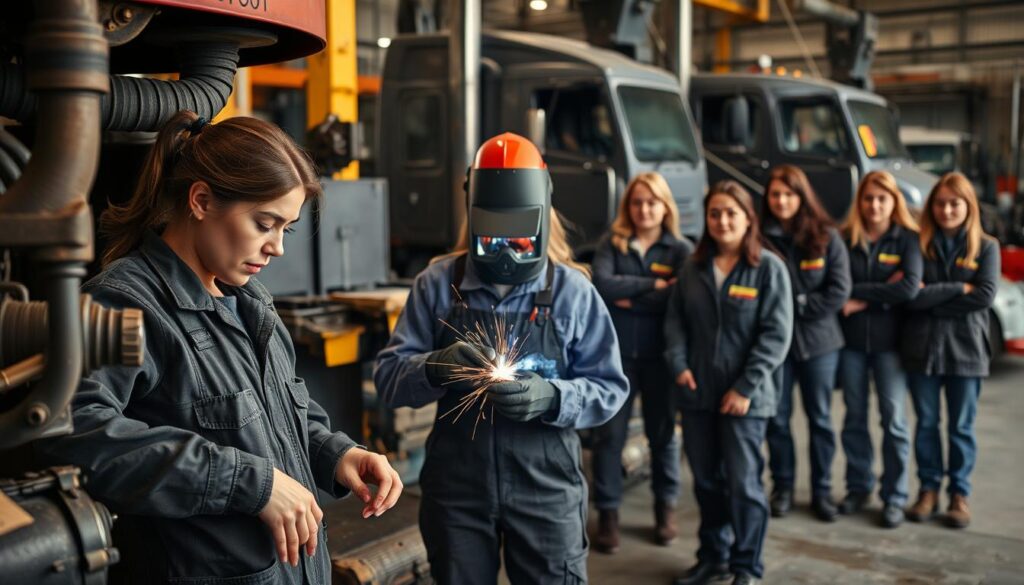
Today, measurable changes are emerging in technical education demographics. Community colleges report increased female enrollment in diesel technology programs, though numbers remain modest. Some institutions have seen enrollment of women in skilled trades programs double or triple from previous baselines. The ASE Education Foundation’s 2025 conference addressed creating inclusive learning environments head-on, with sessions covering unconscious bias, classroom dynamics, and recruitment strategies designed to welcome all students.
Progressive institutions are also addressing the practical barriers that excluded women for decades. Modern training centers include appropriate changing areas and restrooms for all students. Tool selections now include options sized for different body types. Safety equipment comes in ranges that fit diverse populations properly. These aren’t just accommodations—they’re basic professional standards that should have existed all along.
Less than 5%
Percentage of heavy-duty truck technicians who are women — a figure that has not changed significantly in decades. Source: HDT Talks Trucking
Why Representation Changes Everything
Research consistently demonstrates that students persist in fields where they see professionals who share their identity. A young woman considering diesel technology is far more likely to complete training when she has a female instructor modeling success in that career. The visual evidence of a woman expertly diagnosing engine problems or teaching advanced diagnostic procedures demolishes assumptions about gender limitations in technical work.
The business case for diversity strengthens as the skilled trades face acute workforce shortages. According to the Bureau of Labor Statistics’ occupational outlook for diesel service technicians, demand for qualified diesel technicians continues to grow, with approximately 26,500 openings projected annually. The industry simply cannot afford to exclude half the population from potential careers when it already struggles to fill positions.
Industry leaders increasingly recognize that technical training diversity creates competitive advantages beyond filling seats. Service facilities with diverse technician teams report higher customer satisfaction ratings. Different perspectives lead to innovative diagnostic approaches. And as more women enter diesel technology education—both as students and instructors—they create networks and support systems that help sustain careers that might otherwise be abandoned due to isolation.
The Rising Presence of Female Diesel Instructors
A quiet revolution is underway in diesel technology classrooms. While comprehensive national data on female diesel instructor numbers remains limited, observable trends point to steady increases in female representation across instructional roles. Industry conferences now feature more women sharing expertise and teaching methodologies. The retirement wave of predominantly male instructors from previous generations creates hiring opportunities that institutions are increasingly filling with diverse candidates.
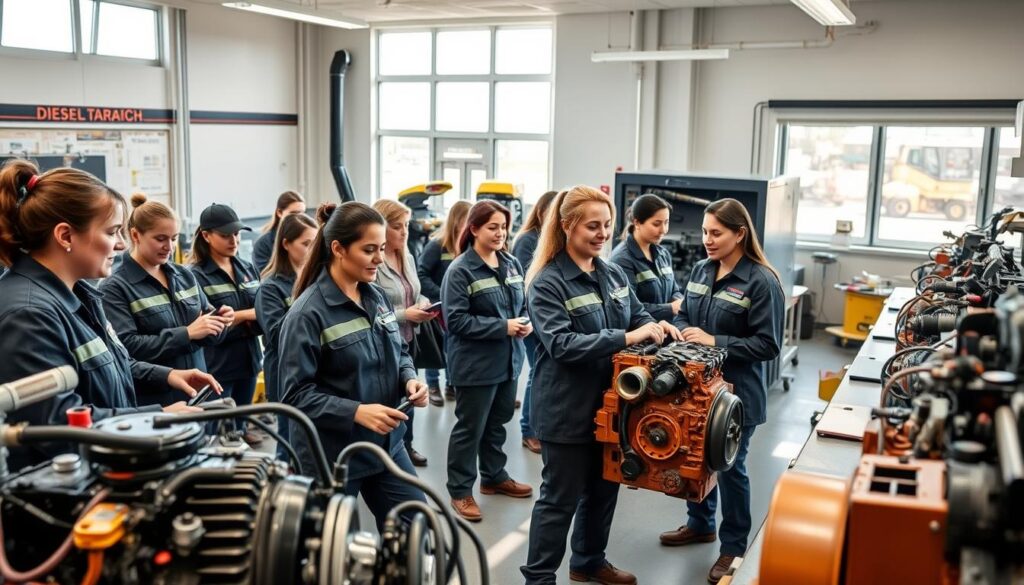
The ASE Education Foundation has begun tracking diversity metrics within accredited programs to better understand instructor demographics. Programs affiliated with professional organizations report heightened awareness about equity in technical education, translating into deliberate recruitment efforts and supportive workplace policies. Young technicians like Kaitlynn Aikin, a 20-year-old diesel technician featured on HDT Talks Trucking for her work at a major freight carrier, represent the pipeline of future instructors entering the field.
Geographic Distribution and Leading Programs
The 2025 ASE Instructor Training Conference drew educators from diesel technology programs nationwide, with attendees representing institutions from Illinois, Utah, Kansas, Michigan, and beyond. Certain regions have proven particularly successful in retaining female instructors. States with robust community college diesel programs and strong technical school systems lead in diversity initiatives, with the Midwest and Mountain West regions showing notable concentrations of programs with female leadership in technical departments.
Several institutional types have emerged as leaders in diversifying diesel technology faculty. Community colleges with comprehensive support systems, four-year universities integrating diversity goals into automotive and diesel programs, technical colleges prioritizing inclusive hiring, and secondary vocational programs building diverse instructional teams all share common characteristics: administrative commitment, mentorship programs, and ongoing professional development opportunities.
| Institution Type | Diversity Initiatives | Key Success Factors |
|---|---|---|
| Community Colleges | Faculty mentorship, flexible scheduling, professional development grants | Strong industry partnerships, ASE accreditation, retention programs |
| Four-Year Universities | Diversity recruitment, inclusive curriculum development, industry partnerships | Degree pathways (associate + bachelor’s), high job placement rates |
| Technical Colleges | Targeted hiring practices, leadership training, conference support | Hands-on focus, employer connections, smaller class sizes |
| Secondary Vocational Programs | Early career pathways, student mentorship, female role model visibility | Pipeline development, community engagement, dual enrollment options |
These programs maintain ASE accreditation while actively working to increase female representation among faculty. Many have implemented specific initiatives beyond general hiring policies, including mentorship matching programs connecting new female instructors with experienced educators and professional development funds specifically supporting conference attendance.
Educational Pathways and Diesel Instructor Qualifications
Aspiring diesel technology instructors must navigate a comprehensive qualification process that blends technical certifications, real-world experience, and teaching abilities. The standards are rigorous and gender-neutral—the same credentials that make a male instructor effective are exactly what female instructors bring to the classroom.
Technical Certifications and Degrees
The foundation begins with formal technical education. Most institutions require instructors to hold at least an associate degree in diesel technology, automotive technology, or a closely related mechanical field. Some colleges prefer candidates with bachelor’s degrees, particularly for leadership positions within technical programs.
Beyond degrees, ASE certification in the Medium/Heavy Truck (T-Series) forms the cornerstone of instructor credibility. Relevant certifications include Diesel Engines (T2), Drive Train (T3), Brakes (T4), Electrical/Electronic Systems (T6), Preventive Maintenance Inspection (T8), and Gasoline Engines (T1). Many institutions require instructors to achieve Master Technician status, demonstrating comprehensive knowledge across multiple vehicle systems.
Ken Kunz, the ASE Education Foundation’s 2025 Instructor of the Year, exemplifies this standard as an ASE Certified Master Technician with 35 years in automotive education. Manufacturer-specific certifications from companies like Ford, Freightliner, Volvo, or Caterpillar add another layer of expertise that instructors bring directly into their teaching.
Industry Experience Requirements
Technical certifications alone don’t make an effective instructor. Most community colleges and vocational schools require candidates to have worked as diesel technicians for a minimum of 4-7 years before considering them for teaching positions. This hands-on experience provides the practical knowledge students need most—real diagnostic scenarios, troubleshooting strategies, and workplace insights that no textbook can replicate.
Richard Cox of Fort Hays Tech North Central illustrates this pathway. After graduating in 1992, he worked in the trade for approximately 20 years with General Motors and other companies before transitioning to education 13 years ago. Diverse industry experience across dealership service departments, independent repair facilities, fleet maintenance operations, and heavy equipment service strengthens an instructor’s ability to prepare students for various career paths.
Teaching Credentials and Continuing Education
Technical expertise must combine with pedagogical skills. Most states require vocational instructors to obtain Career and Technical Education (CTE) credentials involving coursework in teaching methodology, classroom management, and assessment techniques. Some states allow instructors to begin teaching with provisional licenses while completing credential requirements, recognizing that experienced technicians bring irreplaceable value even as they develop formal teaching skills.
Continuing education keeps instructors current with rapidly evolving vehicle systems. Annual ASE Instructor Training Conferences, manufacturer update training, technology-specific workshops on hybrid systems and advanced diagnostics, and online courses covering new equipment are all part of the ongoing professional development landscape. The ASE Education Foundation’s truck program accreditation standards require programs to meet specific benchmarks for instructor qualifications, ensuring consistent quality across institutions.
| Qualification | Minimum Requirement | Preferred Credentials | Maintenance |
|---|---|---|---|
| Education | Associate degree in diesel technology | Bachelor’s degree with technical concentration | Continuing education units annually |
| Certifications | ASE certification in 3+ diesel areas | ASE Master Technician + manufacturer certs | Recertification every 5 years |
| Experience | 4-7 years as practicing diesel technician | 10+ years with diverse employer types | Summer industry work to maintain currency |
| Teaching | State CTE teaching license or provisional | Full CTE license with methodology training | Professional development per state requirements |
Teaching Methods That Inspire the Next Generation
The most effective diesel technology instructors understand that learning happens through experience, repetition, and carefully structured guidance. Female instructors bring fresh perspectives to traditional training approaches, creating dynamic learning environments where every student can thrive. Richard Cox captures the essence of effective teaching: “I just love seeing students learn something—learn a career. When students don’t know something and then that lightbulb moment hits.”
Hands-On Training as the Foundation
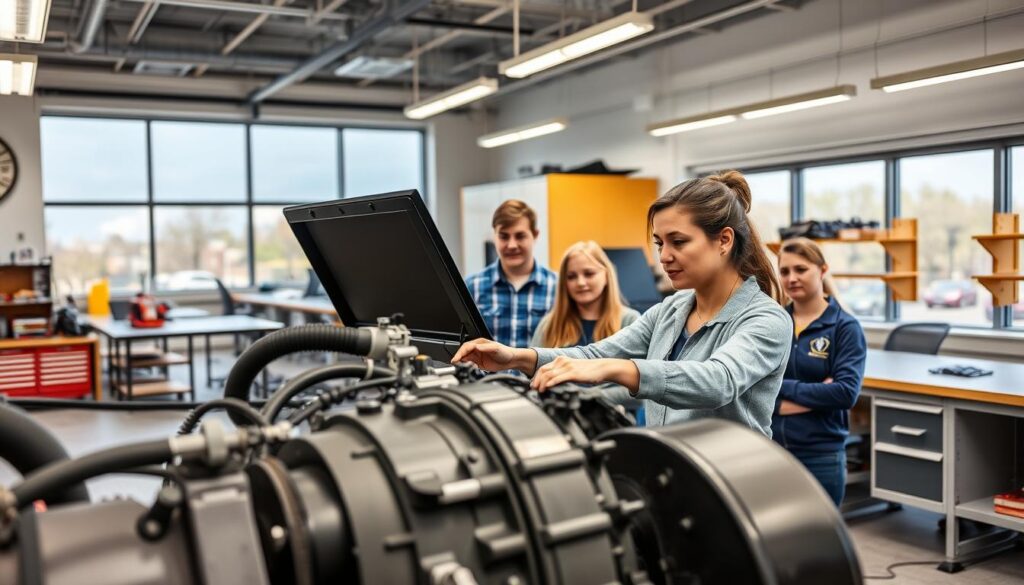
Hands-on diesel training forms the backbone of every effective technical education program. Students must physically engage with diesel engines, transmissions, brake systems, and electrical components to develop genuine competency. Effective training begins with instructor demonstrations followed by supervised student practice, allowing learners to observe proper techniques before attempting them independently.
Team-based repair projects simulate real shop environments where technicians collaborate to solve problems. Students rotate through different lab stations, gaining exposure to diverse systems and specialized tools. Instructors work directly alongside students during hands-on activities, modeling professional diagnostic approaches—creating the “lightbulb moments” that transform understanding from theoretical to practical.
Bridging Theory and Practice
Successful diesel lab instruction seamlessly connects classroom learning with practical application. Instructors introduce theoretical concepts like diesel engine operating principles, electrical theory, and hydraulic systems in traditional classroom settings, then immediately reinforce that knowledge through relevant hands-on lab activities.
Case studies and diagnostic scenarios using real service bulletins and manufacturer technical documents prepare students for the diagnostic challenges they’ll face professionally. Modern educational technology enhances this integration. TaskMentor software, presented at the ASE conference, manages electronic task sheets covering over 500 ASE automotive repair tasks across 12 programs, allowing instructors to track individual student progress across hundreds of specific skills.
This systematic approach contributes to impressive outcomes. Programs with strong theory-to-practice integration report job placement rates as high as 99%, demonstrating the effectiveness of comprehensive instructional approaches.
Adapting to Diverse Learning Styles
Contemporary technical education must accommodate students with vastly different backgrounds, learning preferences, and educational experiences. Effective instructors provide multiple representations of every important concept—combining verbal explanations with schematic diagrams, physical demonstrations, and video resources. This multi-modal approach ensures all students can access content in formats that match their strengths.
Alternative assessment methods extend beyond traditional written tests to include practical demonstrations, oral explanations, and portfolio-based evaluations. Female instructors often demonstrate particular sensitivity to different learning needs, creating inclusive environments where every student receives appropriate support. Caid Kroeger at Weber State University exemplifies this philosophy by emphasizing that students “should be collectively smarter than all of us.”
Integrating Advanced Diagnostic Technology
Diagnostic technology training has become increasingly critical as diesel systems incorporate sophisticated electronic controls. Computerized diagnostic scanners, electronic service information systems, and manufacturer-specific software platforms are now standard teaching tools. Students gain experience with the same digital systems they’ll encounter in professional shops.
The challenge lies in keeping pace with rapid technological change. Electronic engine controls, advanced driver assistance systems, alternative fuel technologies, and telematics constantly evolve. The American Trucking Associations’ industry data underscores how rapidly fleet technology is advancing, making continuous instructor development essential. Quality instructors teach students to become adaptable, continuous learners rather than technicians with static knowledge—a mindset that serves graduates throughout careers spanning decades of technological evolution.
Impact on Female Students Entering the Diesel Field
Beyond technical instruction, female diesel technology educators serve as catalysts for cultural change. The presence of accomplished women teaching complex mechanical systems sends a powerful message that challenges outdated stereotypes about who belongs in the trades. Programs with female leadership often report measurable differences in student diversity, retention rates, and post-graduation success among women technicians.
Mentorship That Goes Beyond Technical Skills
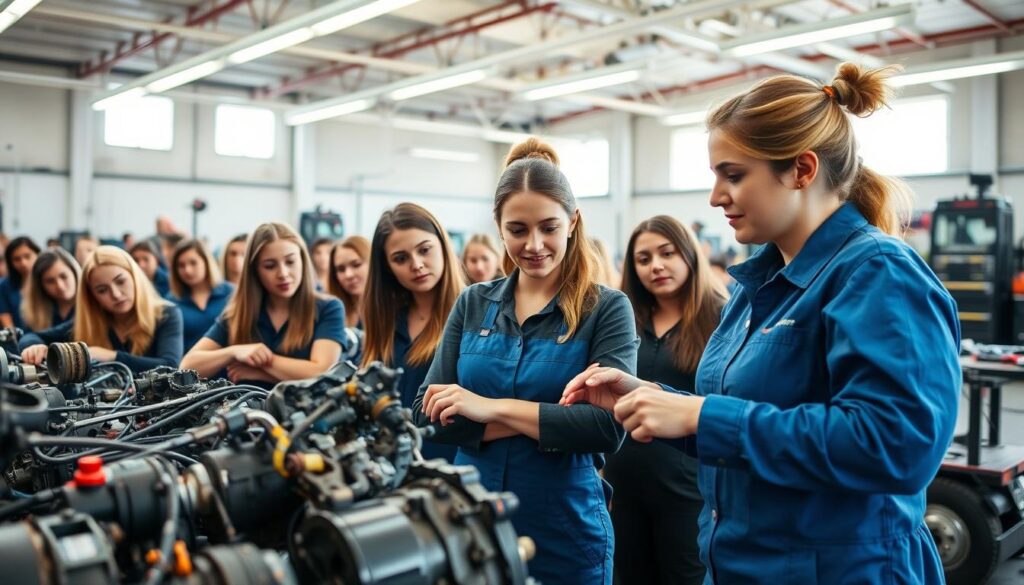
The principle of “you can’t be what you can’t see” explains why representation matters so profoundly in technical education. When a young woman walks into a diesel lab and observes a female instructor expertly diagnosing engine problems, something fundamental shifts in her perception of career possibilities. Kaitlynn Aikin, a 20-year-old diesel technician featured on HDT Talks Trucking, represents the next generation benefiting from increased visibility of women in the field—the podcast specifically highlighted how she is challenging stereotypes.
Effective mentorship extends well beyond casual advice. Female instructors provide one-on-one advising addressing individual student goals, share personal career journeys including obstacles overcome, connect students with industry contacts for employment opportunities, provide encouragement during difficult coursework, and advocate for students through professional introductions and recommendations.
Caid Kroeger captures the deeper purpose of teaching: wanting students to achieve their dreams and being part of their legacy. This philosophy creates lasting relationships that support students through education and into professional careers.
“The way we measure the success of our career is by the success of our students.”
— Ken Kunz, ASE Education Foundation 2025 Instructor of the Year
Building Technical Confidence
Building women technician confidence represents one of the most significant contributions female instructors make. Many women enter diesel technology programs having internalized societal messages questioning their mechanical aptitude. The phenomenon of imposter syndrome disproportionately affects women in male-dominated fields, causing self-doubt despite evidence of competence.
Seeing competent female instructors successfully troubleshoot sophisticated engine management systems or operate heavy equipment helps combat this self-doubt. Female instructors accelerate confidence development through specific strategies: starting with achievable tasks that build momentum, providing technical feedback focused on skill development rather than inherent ability, creating showcase opportunities for students to demonstrate expertise, and directly addressing stereotypes through discussion and evidence.
These approaches create learning environments where students can make mistakes, ask questions, and develop mastery without fear of judgment. Students graduate not only with technical skills but with the self-assurance to apply those skills confidently in professional settings where they may still be in the minority.
Creating Inclusive Diesel Programs
Creating inclusive diesel programs requires intentional cultural development beyond diverse hiring alone. Female instructors often champion policies and practices that make labs and classrooms welcoming for all students. Zero-tolerance policies for discriminatory behavior ensure everyone can focus on learning. Diverse representation in teaching examples, case studies, and visual materials normalizes inclusion throughout the curriculum.
The U.S. Department of Labor’s Women’s Bureau data on women in nontraditional occupations consistently shows that inclusive educational environments produce better outcomes for all students, not just underrepresented groups. Collaborative rather than hypercompetitive learning cultures encourage peer learning, mutual support, and collective problem-solving—skills that mirror professional workplace expectations in modern fleet service operations.
The HDJ Perspective
The diesel technology industry’s workforce crisis isn’t just about numbers—it’s about who we’re failing to reach. Every fleet manager dealing with unfilled technician positions should care about diversifying the training pipeline, because the math is simple: you can’t solve a labor shortage while ignoring half the population. The programs leading the way on instructor diversity aren’t doing it for optics. They’re doing it because inclusive education produces better technicians, period. Students trained in diverse environments develop stronger collaboration skills, broader problem-solving approaches, and professional adaptability that serves them—and their future employers—throughout their careers. The real question isn’t whether the industry can afford to invest in diversity. It’s whether the industry can afford not to.
Challenges Faced by Women in Diesel Technology Education
Despite significant progress, female diesel technology instructors continue to navigate obstacles ranging from gender stereotypes to establishing classroom authority. Understanding these barriers helps prepare aspiring instructors while highlighting where institutions must provide better support. The encouraging reality is that many male colleagues actively serve as strong allies working to create equitable environments, and progress continues as more institutions recognize the value of diverse faculty.

Navigating Stereotypes and Gender Bias
Female instructors in diesel technology still encounter skepticism about their technical competence from some students, colleagues, and industry partners. Gender bias manifests in recognizable patterns—students may question female instructors’ expertise more frequently than they challenge male teachers, and some individuals express surprise when encountering female faculty at industry events.
Successful female instructors employ proven strategies to establish credibility: demonstrating technical expertise early and consistently through hands-on work, sharing credentials and industry experience explicitly during introductions, maintaining high standards for all students without exception, and addressing bias directly and professionally when it occurs. Research on gender bias in technical fields confirms these challenges are real but surmountable—female instructors who address stereotypes head-on while maintaining professionalism typically earn student respect quickly.
Physical Demands and Modern Solutions
Diesel technology work involves heavy components that present practical challenges for instructors of all body types. Rather than framing this as exclusively a female issue, modern diesel facilities emphasize working smart. Engine hoists, transmission jacks, hydraulic lifts, ergonomic tool options, and team-based approaches for heavy components are standard professional practices that benefit everyone.
Importantly, modern diesel technology increasingly emphasizes diagnostic expertise and electronic systems knowledge over physical strength alone. Advanced scanning tools, computer diagnostics, and electronic control systems require technical knowledge rather than brute force. This evolution makes the field more accessible while maintaining hands-on mechanical skill requirements. Appropriate restroom facilities, properly fitted PPE, and work clothing options for diverse body types represent basic professional standards that should exist in every shop and training facility.
Establishing Classroom Authority
Female instructors sometimes face unique challenges in establishing authority, particularly in programs where the student body consists predominantly of young men. Research demonstrates that female instructors in male-dominated fields face more critical evaluation than male counterparts and may encounter more boundary-testing from students initially.
Effective strategies include setting clear expectations from the first class session, maintaining consistent standards, demonstrating technical mastery through hands-on expertise, and building individual relationships while maintaining professional boundaries. Richard Cox emphasized that passion and patience are essential teaching qualities—all instructors must earn respect through consistent excellence, demonstrating competence day after day. Female instructors who maintain professionalism while showing genuine care for student success typically establish strong authority that students respect and value.
Free Professional Fleet Tools
Cost calculators, fault code lookup, maintenance planners, and more—built for owner-operators, fleet managers, and diesel techs. No signup required.
Career Opportunities and Industry Demand for Diesel Instructors
Technical education programs nationwide struggle to find qualified diesel technology instructors, creating unprecedented opportunities for those with industry experience and teaching passion. Ron Denning, an experienced diesel technology educator, identified this as one of the biggest obstacles facing technical education: “A big issue is finding qualified instructors. As they’re incredibly hard to find.” He noted that some tech centers “are constantly turning students away because they don’t have qualified instructors.”
The shortage stems from converging factors. Baby boomer-era technical educators are retiring in waves—some delay retirement because they fear programs will close without replacements. Schools expand diesel technology programs to meet industry workforce needs but can’t staff them. Competition from industry intensifies the challenge, as experienced diesel technicians sometimes earn more in dealerships or repair facilities than in education.
Compensation and Benefits Reality
Community college diesel technology instructors typically earn between $48,000 and $75,000 annually, with higher salaries in metropolitan areas and institutions with strong union representation. High school CTE instructors’ compensation aligns with local teacher salary schedules. The salary gap with industry positions deserves honest examination—but comprehensive benefits packages significantly enhance total compensation in ways shop positions rarely match.
| Institution Type | Salary Range | Key Benefits | Schedule |
|---|---|---|---|
| Community Colleges | $48,000 – $75,000 | Health insurance, pension plans, tuition benefits | Academic calendar with breaks |
| High School CTE | $42,000 – $68,000 | State teacher benefits, tenure protection | Summer vacation, school holidays |
| Technical Colleges | $46,000 – $72,000 | Retirement matching, paid holidays | Regular schedule with breaks |
| Private Vocational | $45,000 – $70,000 | Health plans, professional development funding | Varies by institution |
Standard benefits include comprehensive health insurance, retirement plans with employer matching or pension systems, and paid holidays aligned with academic calendars. Professional development funding supports continuing education. Tuition benefits sometimes extend to family members. Job stability through tenure or continuing contracts offers security uncommon in industry positions. Many instructors cite mentoring satisfaction and community impact as rewards exceeding salary considerations.
Professional Growth Pathways
Diesel technology instruction offers structured advancement opportunities that often exceed industry positions. Progression from entry-level to senior instructor, then to program coordinator or department chair, follows a clear trajectory. Caid Kroeger’s progression from lube technician to university instructor and degree coordinator at Weber State University demonstrates real advancement potential.
Specialization creates another avenue. Lead instructors develop expertise in emerging technology areas like alternative fuels, autonomous vehicle systems, or advanced diagnostics, positioning themselves as subject matter experts. Opportunities extend beyond institutions—ASE test question writer positions, consulting for program development, presenting at conferences, and manufacturer curriculum development all enhance income and professional reputation.
Female instructors find particular advancement opportunities as institutions prioritize diversity in leadership. The combination of technical expertise, teaching effectiveness, and representation creates competitive advantages that position qualified women for accelerated career progression in technical education.
Success Stories From Leading Diesel Technology Programs
Excellence in diesel technology education is demonstrated daily by programs earning national recognition. Ken Kunz, who spent 30 years building the automotive technology program at Waubonsee Community College in Illinois, developed partnerships that set the standard for technical education. For 28 consecutive years, his program placed students in maintenance positions at Yellowstone National Park—an extraordinary relationship providing students with career-defining experience.
The program also established manufacturer training relationships with Mopar, Toyota, Nissan, and Mercedes-Benz—partnerships resulting directly from ASE accreditation. Students who complete manufacturer-specific training receive preferential consideration for dealership positions, creating clear pathways from classroom to career. Kunz captured his philosophy: “The way we measure the success of our career is by the success of our students.”
At Weber State University in Utah, Caid Kroeger manages both associate and bachelor’s degree pathways in automotive technology, reporting a 99% job placement rate. Richard Cox of Fort Hays Tech North Central brings over 13 years of educational excellence after a 20-year technician career, committed to giving back to the industry that provided his livelihood. These instructors establish standards of excellence that define what great teaching looks like—deep technical expertise from years of hands-on work, genuine care for student success, and passion for continuous learning.
The achievements of these programs matter beyond their individual institutions. They provide blueprints showing that combining expert instruction, industry partnerships, and student-centered approaches creates measurable outcomes. Per the Association for Career and Technical Education’s quality program framework, the elements these successful programs share—strong industry advisory boards, comprehensive hands-on training, and commitment to inclusive environments—are replicable at institutions of all sizes.
Frequently Asked Questions
What qualifications do female diesel technology instructors need?
Female diesel technology instructors need the same qualifications as all diesel educators: an associate or bachelor’s degree in diesel technology or a related field, ASE certification in multiple areas (ideally Master Technician status), 4-7 years of hands-on industry experience, and a state Career and Technical Education (CTE) teaching credential. Many institutions prefer candidates with manufacturer-specific certifications and 10+ years of diverse industry experience across dealerships, fleet maintenance, and independent repair settings. Continuing education through ASE conferences and manufacturer training keeps credentials current throughout an instructor’s career.
How do female instructors impact diesel technology student enrollment?
Programs with female instructors typically experience higher female student enrollment and improved retention rates. Research consistently shows students persist in fields where they see professionals who share their identity. Female instructors contribute to recruitment through visibility in marketing materials, career fair participation, and community outreach. They also help institutions identify and remove subtle barriers—like recruitment materials featuring only male students, lack of properly sized safety equipment, or application processes that overemphasize prior mechanical experience over aptitude and interest.
What is the current demand for diesel technology instructors?
Demand for qualified diesel technology instructors is at critical levels. Many programs turn students away due to staffing gaps. The retirement of baby boomer-era educators creates immediate openings, while competition from industry—where technicians sometimes earn more—intensifies the shortage. Community college instructors typically earn $48,000-$75,000 annually, with comprehensive benefits including health insurance, retirement plans, and academic calendars. The Bureau of Labor Statistics projects continued demand growth for career and technical education teachers through the coming decade.
What challenges do women face as diesel technology educators?
Female diesel instructors may encounter skepticism about their technical competence, particularly from students unfamiliar with women in technical roles. Gender bias can manifest as more frequent questioning of expertise or assumptions about qualifications. Successful instructors overcome these challenges by demonstrating technical mastery through hands-on expertise from day one, setting clear expectations, sharing credentials explicitly, and maintaining consistent professional standards. Institutional support—including zero-tolerance policies for discriminatory behavior and administrative backing—significantly reduces these obstacles. Many male colleagues serve as strong allies in creating equitable environments.
How can women start a career as a diesel technology instructor?
The typical pathway begins with earning an associate or bachelor’s degree in diesel technology, followed by obtaining ASE certifications and gaining 4-7 years of industry experience across diverse settings. Aspiring instructors should then pursue a state CTE teaching credential—some states offer provisional licenses allowing experienced technicians to begin teaching while completing requirements. Attending ASE Instructor Training Conferences builds professional networks. Connecting with mentorship programs at institutions actively recruiting diverse faculty accelerates the transition from shop to classroom.
Why does diversity matter in diesel technology education?
Diversity in diesel technology education addresses a critical workforce shortage. With fewer than 5% of heavy-duty technicians being women, the industry excludes a vast talent pool during an era of severe labor shortages. Diverse instructional teams improve educational outcomes for all students, prepare graduates for varied workplace teams, and bring fresh problem-solving approaches. Service facilities with diverse technician teams report higher customer satisfaction. Educational institutions embracing diversity also position themselves favorably for grants, employer partnerships, and industry recognition—creating positive feedback loops that strengthen programs for all students.
Advancing Diesel Technology Through Inclusive Education
Female diesel technology instructors are reshaping technical education by bringing expertise, fresh perspectives, and representation to programs across the country. Their impact reaches beyond individual classrooms—they’re expanding the talent pipeline for an industry facing critical workforce shortages while proving that technical excellence has no gender requirement.
The instructor shortage creates immediate opportunities for women with diesel technology experience and teaching passion. Whether through community college programs, vocational schools, or secondary CTE pathways, qualified female instructors find themselves valued for both their technical skills and the diversity they bring. For women considering this career path, the time to act is now—the industry needs your knowledge, and the next generation of technicians needs educators who reflect the full scope of who can succeed in this field.
Share This With Your Network
Know a technician considering a teaching career—or a program looking to diversify its faculty? Share this guide to help connect talent with opportunity in diesel technology education.