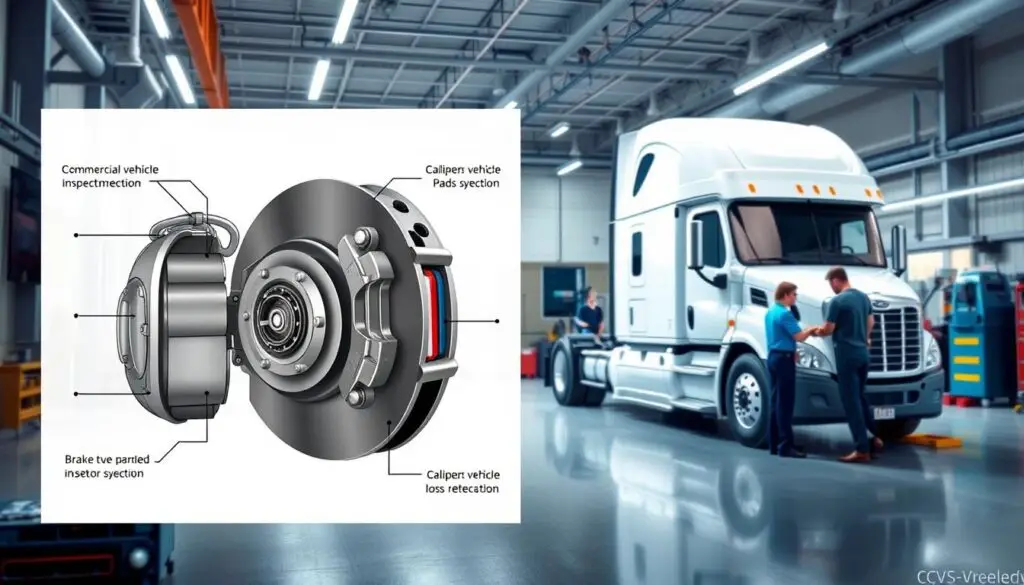
Brake-related violations topped the list during CVSA International Roadcheck 2025, with 18.1% of commercial vehicles receiving out-of-service orders from 56,178 inspections conducted between May 13-15. Each failed inspection means lost revenue, damaged CSA scores, and operational disruptions that ripple through fleet operations for months.
The Level I North American Standard procedure involves 37 detailed steps, with brake systems receiving the most intensive scrutiny of any component. Yet analysis of violation data reveals that most brake failures stem from predictable issues: out-of-adjustment brakes, contaminated linings, excessive air leaks, and damaged components that proper maintenance would have identified weeks before the inspection.
This comprehensive guide provides the essential DOT brake inspection checklist commercial fleets need to maintain compliance in 2025. Fleet managers and diesel technicians will discover specific component requirements, measurement standards, testing procedures, and actionable prevention strategies aligned with Federal Motor Carrier Safety Regulations. More importantly, the systematic approach outlined here transforms reactive compliance into proactive fleet safety management.
Last Updated: November 2025
Key Takeaways
- 18.1% Failure Rate: Nearly one in five vehicles failed CVSA Roadcheck 2025, with brake violations as the primary cause.
- 20% Rule Impact: Two defective brakes on a typical 5-axle combination trigger immediate out-of-service status.
- Prevention Focus: Four violation categories dominate failures—adjustment limits, contamination, air leaks, and structural damage.
- CVSA Decal Value: Passing Level I inspection without violations earns a 3-month decal reducing future inspection likelihood.
- CSA Consequences: Brake violations receive 8-10 severity points, directly impacting Vehicle Maintenance BASIC scores.
Understanding DOT and CVSA Brake Inspection Requirements
Commercial vehicle operators navigate a complex framework of federal brake regulations designed to ensure roadway safety across North America. The Department of Transportation establishes minimum performance standards through 49 CFR Part 393, while the Commercial Vehicle Safety Alliance provides standardized inspection protocols that enforcement officers apply during roadside examinations.
The most thorough examination—the CVSA Level I inspection—represents the gold standard for vehicle safety assessment. This 37-step procedure requires certified inspectors to physically examine critical safety systems, with brake components receiving particularly intensive scrutiny. Understanding these requirements helps fleet managers prepare vehicles appropriately and reduces violation likelihood.
What Is a CVSA Level I Brake Inspection?
A CVSA Level I inspection involves comprehensive examination of both driver credentials and vehicle mechanical fitness. Inspectors must physically get under the vehicle to assess brake components, measure pushrod stroke on air brake systems, and verify that all elements meet federal performance standards. The process includes checking for proper adjustment, contamination or damage, and testing system functionality under controlled conditions.
One critical distinction separates Level I from Level II examinations: if inspectors cannot measure more than 20 percent of exposed pushrods, the inspection automatically defaults to Level II classification. This threshold ensures brake assessments maintain consistent thoroughness across all Level I inspections. The measurement accessibility directly impacts the inspection’s classification and validity.
Vehicles successfully passing without critical violations receive a CVSA decal valid for up to three months. This credential serves as visible evidence of recent compliance and may reduce subsequent detailed inspection frequency. During International Roadcheck 2025, scheduled for May 13-15, thousands of inspectors primarily conducted Level I examinations across North America.
Federal Motor Carrier Safety Regulations for Brakes
The Federal Motor Carrier Safety Administration establishes DOT brake requirements through Title 49 of the Code of Federal Regulations. Part 393.40 addresses service brake systems, requiring every commercial vehicle to stop within specified distances based on weight and configuration. These brakes must develop sufficient forces to control vehicle movement on any operational grade.
Parking brake requirements in Part 393.41 specify that systems must hold vehicles stationary under all loading conditions. The parking brake functions independently of air or hydraulic pressure, maintaining effectiveness even during other system failures. Emergency braking systems covered in Part 393.43 establish automatic application requirements when air pressure drops below safe thresholds.
| Regulation | System Type | Performance Standard |
|---|---|---|
| 49 CFR 393.40 | Service Brakes | Stop within specified distances by weight class |
| 49 CFR 393.41 | Parking Brakes | Hold stationary without air/hydraulic pressure |
| 49 CFR 393.43 | Emergency Brakes | Activate when pressure drops below threshold |
Part 393.45 mandates carriers maintain all brake components in proper working condition. This section prohibits operation with contaminated linings, excessive wear, or improper adjustment. Regular maintenance and inspection become legal requirements rather than best practices, with violations carrying significant penalties.
Critical Brake System Components Subject to DOT Inspection
CVSA-certified inspectors follow standardized procedures to evaluate foundation brakes, air systems, hydraulic components, and adjustment mechanisms against federal standards. During Roadcheck 2025, brake-related issues accounted for the majority of out-of-service violations, highlighting the importance of understanding inspection focus areas.
Inspectors trace each system from source to application point, checking for defects that compromise stopping power. Every connection, mounting point, and wear surface undergoes scrutiny to ensure brake system compliance with Federal Motor Carrier Safety Regulations.
Foundation Brake Components: Drums, Rotors, and Linings
Foundation brakes convert air or hydraulic pressure into mechanical friction. Brake drums must remain free of cracks extending to mounting holes or friction surfaces. External cracks longer than half the drum’s friction length result in immediate out-of-service designation. Inspectors check for drums that are loose on wheel hubs or improperly mounted.
Rotors receive similar scrutiny for cracks, excessive scoring, and warping. Deep grooves or heat damage indicate replacement needs. Any crack extending from the friction surface to the mounting area creates critical safety hazards during high-stress braking situations.
Brake lining and pad thickness represents frequently measured specifications during air brake inspection procedures. Federal regulations establish these minimum requirements:
- Standard brake linings: minimum 1/4 inch at thinnest point
- Extended service linings: minimum 1/8 inch at shoe center
- Disc brake pads: minimum 1/8 inch for bonded, 1/16 inch for riveted
Contamination by oil or grease dramatically reduces friction coefficient and stopping power. Even minor petroleum product seepage onto friction surfaces can trigger out-of-service designation if affecting more than one brake assembly per axle. During Roadcheck 2025, inspectors discovered numerous instances of contaminated brake linings.
Air Brake System Components and Connections
The air brake system consists of multiple components that generate, store, and distribute compressed air to brake chambers. Air compressors must mount securely without excessive vibration or mounting bracket damage. The compressor drive belt requires proper tension and freedom from cracks or fraying.
The governor controls system pressure by regulating compressor operation. Cut-in pressure should activate between 85 and 100 psi, while cut-out should deactivate between 115 and 135 psi. Pressures outside these ranges indicate adjustment problems or component failure affecting system reliability.
Supply reservoirs must remain damage-free with properly mounted, functioning drain valves. Brake chambers convert air pressure into mechanical force, coming in various sizes (Type 20, 24, 30, 36). Inspectors examine chambers for housing cracks, damaged mounting studs, and proper pushrod orientation.
Air lines and fittings connect all system components in a leak-free network. Common inspection points include:
- Cracked, chafed, or damaged air hoses
- Loose or improperly secured fittings
- Lines positioned too close to heat sources
- Missing support brackets allowing excessive movement
- Audible or bubble-test-detectable leaks at connections
Automatic and Manual Slack Adjusters
Slack adjusters maintain proper brake shoe-to-drum clearance in air brake systems. These components connect the brake chamber pushrod to the camshaft that rotates during brake application. Proper slack adjuster function remains absolutely critical for maintaining correct adjustment and preventing violations.
Automatic slack adjusters (ASAs) incorporate internal mechanisms that adjust clearance during normal operation. Federal regulations require ASAs on commercial vehicles manufactured after 1994. Inspectors verify correct type installation at specified angles (typically 90 degrees to pushrod at half stroke).
During inspection, officials check that slack adjusters aren’t cracked, broken, or loose on camshafts. The mounting bolt must be tight with proper locking hardware. Any independent movement from the camshaft creates dangerous conditions where brakes cannot apply properly.
Stay Ahead of Industry Trends
Get expert insights, equipment reviews, and operational strategies delivered weekly.
The Complete DOT Brake Inspection Checklist
Understanding the complete brake inspection checklist empowers fleet operators to identify potential violations before encountering CVSA-certified inspectors. The Level I inspection systematically evaluates every aspect of commercial vehicle braking systems through a comprehensive 37-step procedure.
Service Brake Performance Requirements
Service brakes must activate simultaneously when the pedal or treadle valve is applied. Any lag, delay, or uneven application violates brake performance standards. The brake pedal must operate smoothly without binding or excessive resistance, maintaining adequate reserve after full application.
Commercial vehicles must achieve specific stopping distances from designated speeds. Inspectors may conduct deceleration tests using portable equipment that measures stopping performance under controlled conditions. The system must deliver consistent, predictable stopping force across all axles to prevent vehicle instability.
Parking and Emergency Brake Standards
The parking brake must securely hold fully loaded vehicles stationary on grades. During roadside inspections, examiners test effectiveness by setting the brake and attempting vehicle movement. Any failure to hold position results in immediate out-of-service violation.
Emergency brake systems must activate automatically if air pressure drops below critical thresholds. This fail-safe mechanism prevents runaway vehicles during major air system failures. Testing involves controlled pressure reduction while monitoring brake chamber response.
Warning Systems and Indicators
Federal regulations require functional low air pressure warning devices that activate before pressure drops below 60 psi in dual systems or 55 psi in single systems. Warnings can be audible, visual, or both, but must be clearly perceptible to drivers.
Anti-lock braking system (ABS) warning lamps provide critical electronic brake control information. Vehicles manufactured after March 1998 must have ABS with functional warning lamps that illuminate during bulb checks. While illuminated ABS lamps don’t create out-of-service conditions, inspectors note defects as violations.
Air Brake System Testing and Performance Standards
Testing air brake systems requires following specific protocols measuring pressure loss rates, governor function, and warning device activation. These standardized procedures enable inspectors to evaluate pneumatic brake integrity and identify potential failures before they compromise safety.
Testing air brake systems requires following specific protocols measuring pressure loss rates, governor function, and warning device activation. These standardized procedures enable inspectors to evaluate pneumatic brake integrity and identify potential failures before they compromise safety.
Air system leaks were common violations during Roadcheck 2025. Understanding precise testing methods and performance thresholds helps maintenance teams conduct thorough pre-inspection evaluations. According to CVSA International Roadcheck standards, each test serves specific diagnostic purposes revealing different system deficiencies.
Static and Applied Air Loss Test Procedures
The static air loss test measures pressure loss with brakes not applied, revealing leaks in supply lines, reservoirs, and connections. Maximum allowable static leakage rates are 2 psi per minute for single vehicles and 3 psi per minute for combinations. The test requires building pressure to governor cut-out, shutting off the engine, releasing service brakes, and measuring drop over one minute.
Applied air loss testing evaluates system integrity under brake application conditions. This simulates operational use and reveals leaks appearing only when chambers are pressurized. Acceptable limits are 3 psi per minute for single vehicles and 4 psi per minute for combinations.
| Vehicle Type | Static Loss Limit | Applied Loss Limit |
|---|---|---|
| Single Vehicle | 2 psi/minute | 3 psi/minute |
| Combination Vehicle | 3 psi/minute | 4 psi/minute |
Governor and Warning Device Settings
The air compressor governor maintains adequate pressure while preventing over-pressurization. Typical cut-out ranges from 120-140 psi, with cut-in around 100-120 psi. The 20-25 psi difference prevents rapid cycling. Improperly adjusted governors create operational problems compromising safety.
Low air pressure warning devices must activate before system pressure drops below 60 psi in dual tank systems or 55 psi in single tank configurations. This provides essential time for safe vehicle stopping before brake performance deteriorates. Most systems activate between 60-70 psi for additional safety margin.
Brake Stroke and Adjustment Measurement Specifications
Brake adjustment violations dominate DOT inspection failures. During Roadcheck 2025, out-of-adjustment brakes led violation statistics. When pushrod stroke exceeds legal limits on even one brake, it reduces braking force and forces other brakes to compensate, creating dangerous overheating conditions.
Understanding brake adjustment limits and measurement procedures protects fleets from costly out-of-service orders. One critical rule affects validity: if over 20% of exposed pushrod travel cannot be measured, the inspection won’t qualify as Level I.
Pushrod Stroke Measurement Techniques
Accurate pushrod stroke measurement requires systematic approach. The process begins with marking the pushrod at the brake chamber face while brakes remain released. An assistant applies full service pressure (90-100 psi) while the inspector measures travel distance from released to applied position.
Maximum allowable stroke varies by brake chamber type and design. Fleet maintenance personnel must verify measurements stay below published standards for each specific chamber configuration. The difference between passing and failing often comes down to quarter-inch measurements on single pushrods.
Chamber Type Standards and Specifications
Type 30 and Type 36 chambers represent the most common commercial vehicle configurations. Understanding specific standards for these types prevents inspection confusion. Each features distinct dimensions, effective stroke lengths, and maximum adjustment specifications.
| Chamber Type | Standard Stroke | Long Stroke |
|---|---|---|
| Type 30 | 1.75 inches | 2.0 inches |
| Type 36 | 2.25 inches | 2.5 inches |
Automatic slack adjusters theoretically maintain adjustment without manual intervention. Despite this design, inspection protocols require verification of correct function and installation. Visual evidence of manual adjustment raises immediate red flags, indicating underlying problems requiring diagnosis.
Most Common CVSA Brake Inspection Failures and Prevention
Four distinct brake failure categories dominate violation statistics, each with identifiable causes and proven prevention strategies. Brake-related issues were the primary reason vehicles were placed out-of-service during Roadcheck 2025. These failures rarely occur without warning signs that trained personnel should detect during routine inspections.
Leading Violation: Exceeding Adjustment Limits
Out-of-adjustment brakes represent the single largest violation category. When pushrod stroke exceeds maximum limits, brake chambers cannot generate sufficient clamping force. Brakes fall out of adjustment through normal wear, slack adjuster malfunction, or improper initial installation.
Prevention strategies include weekly brake stroke inspections measuring travel before limits are reached, systematic slack adjuster maintenance verifying proper operation, and timely lining replacement when thickness approaches minimums. Documentation of measurements creates trending data predicting maintenance needs.
Contamination and System Leaks
Brake lining contamination by oil or grease creates unpredictable braking behavior. Petroleum contaminants drastically reduce friction coefficients between lining and drum surfaces. Common sources include leaking wheel seals, overfilled hub assemblies, and hydraulic fluid leaks from wheel cylinders.
Air system leaks exceeding acceptable rates undermine the entire pneumatic system. Even small leaks compound across connections to create pressure loss failing leakage tests. Prevention includes systematic inspection of connections using soap solution or ultrasonic detectors, proper installation techniques avoiding stress concentrations, and regular leak detection during pre-trip inspections.
Structural Failures and Missing Hardware
Cracked, missing, or damaged components create immediate safety hazards and automatic violations. Structural failures in drums or rotors compromise the foundation converting friction into deceleration. Missing mounting hardware allows components to shift or separate completely.
Comprehensive prevention includes visual inspection protocols examining structural conditions, component replacement at manufacturer-recommended intervals, and proper torque specifications on all mounting hardware. Immediate investigation of unusual brake noise, vibration, or performance changes prevents developing problems from becoming violations.
CVSA Out-of-Service Criteria and CSA Impact
Out-of-service violations represent the most serious inspection outcomes, carrying immediate operational restrictions and long-term consequences. When inspectors identify defects, they apply CVSA criteria determining whether violations prohibit further operation until repairs. During Roadcheck 2025, the vehicle out-of-service rate reached 18.1%, with brake issues leading causes.
The 20 Percent Rule and Immediate Conditions
The 20 percent brake defect rule forms the foundation of out-of-service criteria. Commercial vehicles are placed out-of-service when 20% or more brakes meet defective conditions. For typical five-axle combinations with 10 total brakes, two defective brakes trigger restriction.
Certain conditions result in immediate out-of-service regardless of the 20% rule. These include complete absence of braking on any axle, loose components likely to separate, audible chamber air leaks, and cracks extending to friction surfaces. No grace period or temporary operation is permitted.
CSA BASIC Scores and Fleet Consequences
Beyond roadside consequences, violations significantly impact carrier safety ratings through the CSA program. Brake violations affect the Vehicle Maintenance BASIC, with out-of-service violations receiving maximum severity weighting (8-10 points). Recent violations carry more impact than older ones through time-weighted formulas.
Poor BASIC percentiles trigger progressive interventions. Carriers exceeding 80th percentile receive warning letters, while higher percentiles face investigations and compliance reviews. The system targets carriers with elevated scores for increased inspection frequency, creating cycles where poor maintenance leads to more inspections revealing additional violations.
Share Your Expertise
Join Heavy Duty Journal as a guest author and reach thousands of industry decision-makers.
Pre-Inspection Preparation and Fleet Best Practices
Fleet operators consistently passing DOT inspections share common approaches: proactive maintenance and systematic preparation. Rather than treating inspections as unpredictable events, successful carriers build preparation into daily operations. This transforms compliance from reactive scrambling into continuous safety culture.
During Roadcheck 2025, 81.6% of vehicles passed without out-of-service violations. This reflects effective preparation protocols. Vehicles successfully completing Level I inspections without violations may receive CVSA decals valid for three months, demonstrating safety commitment.
Daily Inspections and Preventive Maintenance
Federal regulations require drivers to conduct pre-trip and post-trip inspections, preparing written Driver Vehicle Inspection Reports (DVIRs). These serve as first-line defense identifying emerging problems before escalation. Effective DVIRs include specific brake inspection items with immediate reporting of unusual performance, warning lights, air leaks, or component damage.
Preventive maintenance programs require customization based on operational conditions. Recommended intervals include brake adjustment inspection every 60-90 days, lining thickness measurement at major PM cycles, and air system testing at every service. Proactive replacement based on condition prevents failures.
Documentation and Driver Training
Federal regulations mandate carriers maintain inspection and maintenance records. Required documentation includes service dates, work descriptions, technician identity, measurement data, and replaced components. Digital management systems enable quick retrieval during inspections, demonstrating systematic care.
Comprehensive driver training covers proper inspection procedures, brake warning sign recognition, out-of-service criteria understanding, and DVIR completion protocols. Regular refresher training reinforces habits and introduces standard updates. When drivers understand requirements, they become active safety participants.
Conclusion
The 2025 CVSA International Roadcheck results reveal that 81.6% of inspected vehicles passed without critical violations, proving successful brake inspection outcomes are achievable through proper preparation. Success begins with understanding specific components and standards inspectors evaluate, mastering measurement techniques, and addressing common violation categories proactively.
Implementing comprehensive inspection checklists transforms compliance into systematic processes. Daily DVIRs catch problems early, preventive maintenance maintains system integrity, and detailed documentation demonstrates commitment. Vehicles passing Level I inspections receive CVSA decals reducing inspection frequency for three months.
Fleet managers should conduct internal audits using CVSA criteria, train personnel on current standards, and educate drivers on recognizing irregularities. According to FMCSA’s Pocket Guide to Large Truck and Bus Statistics, systematic brake compliance protects drivers, preserves CSA scores, and safeguards operational reputation in the competitive trucking industry.
Frequently Asked Questions
What percentage of vehicles receive out-of-service orders during CVSA Roadcheck?
According to CVSA International Roadcheck 2025 results, 18.1% of commercial vehicles inspected received out-of-service orders. Brake violations remain the leading cause of mechanical failures. However, over 80% of vehicles successfully passed without critical violations, demonstrating that compliance is achievable through systematic preparation and proactive maintenance programs.
What are the maximum allowable air leakage rates?
During static air loss tests with brakes not applied, maximum allowable pressure loss is 2 psi per minute for single vehicles and 3 psi per minute for combination vehicles. For applied air loss tests with service brakes engaged, limits increase to 3 psi per minute for single vehicles and 4 psi per minute for combinations. Exceeding these thresholds constitutes immediate out-of-service violations requiring repair before operation.
How is the 20 percent brake defect rule calculated?
The 20 percent rule states vehicles are placed out-of-service when 20% or more brakes are defective. For typical five-axle combinations with 10 total brakes, two defective brakes trigger restriction. Defective means violations meeting out-of-service criteria including excessive pushrod stroke, missing components, contaminated linings, or audible chamber leaks.
What are the maximum pushrod stroke limits for Type 30 and 36 chambers?
Type 30 standard stroke chambers allow maximum 1.75 inches pushrod travel, while long stroke versions permit 2.0 inches. Type 36 standard chambers allow 2.25 inches, with long stroke versions permitting 2.5 inches. These measurements represent travel distance from released to fully applied positions at 90-100 psi application pressure.
How do brake violations affect CSA BASIC scores?
Brake violations impact the Vehicle Maintenance BASIC within CSA’s Safety Measurement System. Out-of-service violations receive maximum severity weighting of 8-10 points. Recent violations carry more impact through time-weighted formulas. Poor BASIC scores trigger FMCSA interventions, increase inspection targeting, and ultimately affect safety ratings and operating authority.
What brake conditions cause immediate out-of-service designation?
Certain conditions trigger immediate restriction regardless of other factors: complete absence of braking on any axle, components likely to separate from vehicles, audible brake chamber air leaks, drums or rotors with cracks extending to friction surfaces, and air loss exceeding specified rates. These violations prohibit operation until repairs are completed and verified.
Share This With Your Heavy-Duty Network
Help fleet managers and diesel technicians discover valuable insights by sharing this article.