By Michael Nielsen, Editor & Publisher | 15+ Years in Diesel Repair
Last Updated: January 2026
📖 Estimated reading time: 24 minutes
Digital caliper accuracy determines success or failure in diesel engine work. Diesel technicians measure crankshaft journals, bearing clearances, and fuel injector bores where tolerances of one-thousandth of an inch separate a quality repair from catastrophic engine failure. High-pressure fuel systems operating at 30,000+ PSI demand precision that worn or improperly calibrated calipers simply cannot deliver.
A properly maintained $100 measuring tool prevents thousands in warranty claims and comeback repairs. When you’re checking piston ring gaps or main bearing specifications, every measurement affects engine longevity, customer satisfaction, and shop liability. The tightest tolerances in automotive work exist in diesel systems—making measurement precision non-negotiable for professional technicians.
Key Takeaways
- Tolerance requirements are extreme: Main bearing clearances of 0.0015-0.0025 inches allow only one-thousandth of an inch tolerance window.
- Temperature is the biggest accuracy threat: Steel expands 0.0000063 inches per inch per degree Fahrenheit—a 40°F temperature difference causes measurable error.
- Daily zero-point verification is mandatory: Check calibration before each use and against certified blocks weekly.
- Contamination causes false readings: Oil films just 0.0001 inches thick produce measurements outside diesel engine tolerances.
- Investment pays off quickly: Quality stainless steel calipers ($100-200) prevent costly engine failures and warranty claim denials.
- Documentation protects your shop: Calibration records prove due diligence when warranty disputes arise.
Why Precision Measuring Matters in Diesel Engine Diagnostics
Every diesel technician faces a fundamental truth: measurement precision determines whether an engine runs perfectly or fails catastrophically. Diesel engines operate under significantly higher compression ratios than gasoline engines—typically 14:1 to 25:1 compared to gasoline’s 8:1 to 12:1. These extreme operating conditions leave zero room for measurement error when rebuilding or diagnosing engine components.
The stakes become clear when examining real-world tolerance requirements. A piston ring end gap measured incorrectly by just 0.002 inches can spell disaster. If the gap measures too tight, thermal expansion during operation causes ring ends to butt together, leading to ring breakage and catastrophic engine damage. Conversely, excessive clearance creates blow-by that robs power and increases oil consumption.
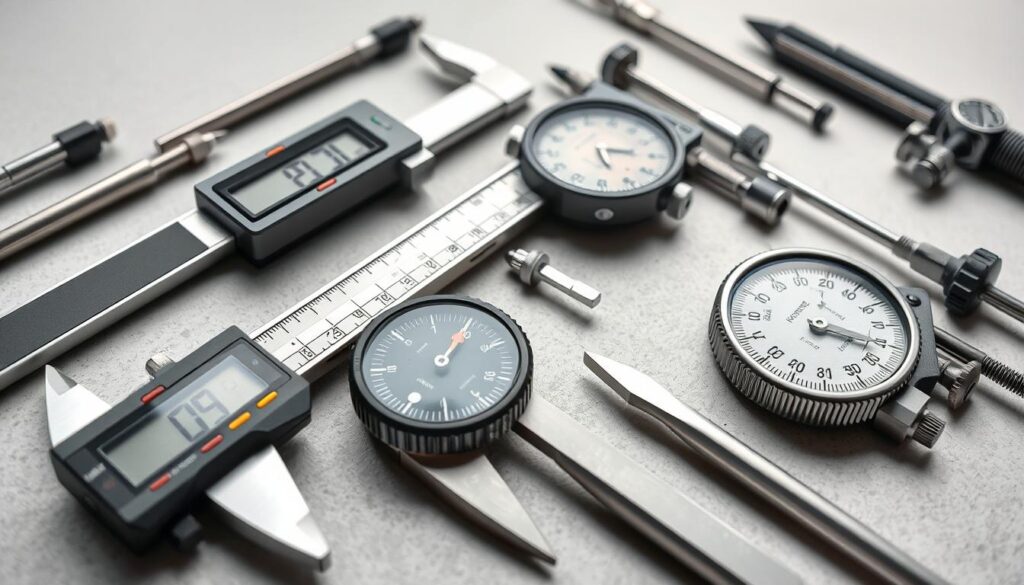
Main bearing clearances present an even more demanding challenge. Most diesel engines specify clearances between 0.0015 and 0.0025 inches—a tolerance window of just one-thousandth of an inch. Measuring these clearances accurately requires tools capable of resolution to 0.0001 inches. Worn or improperly calibrated calipers cannot deliver the accuracy needed. The consequences include premature bearing failure, oil pressure problems, and complete engine seizure.
30,000+ PSI
Operating pressure in modern common rail diesel fuel injection systems, where injector bore tolerances measured in ten-thousandths of an inch become critical to performance.
Modern diesel fuel injection systems raise the bar even higher. Common rail systems operate at pressures exceeding 30,000 PSI, with some heavy-duty applications reaching 40,000 PSI. At these extreme pressures, injector bore tolerances measured in ten-thousandths of an inch become critical to system performance. Even microscopic measurement errors result in fuel leakage past injector sleeves, causing hard starting, rough idle, power loss, excessive smoke, and emissions test failures that violate EPA heavy-duty vehicle standards.
| Component | Typical Tolerance | Accuracy Required | Failure Mode if Incorrect |
|---|---|---|---|
| Piston Ring End Gap | 0.012-0.022 inches | ±0.001 inches | Ring breakage or blow-by |
| Main Bearing Clearance | 0.0015-0.0025 inches | ±0.0001 inches | Bearing failure or seizure |
| Injector Bore Diameter | ±0.0005 inches | ±0.0001 inches | Fuel leakage and performance loss |
| Valve Stem Clearance | 0.001-0.003 inches | ±0.0005 inches | Sticking valves or excessive wear |
The real-world consequences of inadequate measurement accuracy extend beyond immediate mechanical failure. Misdiagnosed component wear leads technicians down expensive rabbit holes, replacing parts that don’t need replacement. Warranty claims get denied when manufacturers discover improper assembly tolerances, leaving shops holding the bag for expensive engine replacements.
Professional diesel facilities understand that maintaining calibrated measurement tools isn’t optional—it’s essential business practice. Insurance carriers increasingly require documented calibration records before approving major warranty claims. Equipment manufacturers specify calibration intervals and traceability to NIST calibration standards in their warranty terms.
Understanding Digital Caliper Components and Measurement Technology
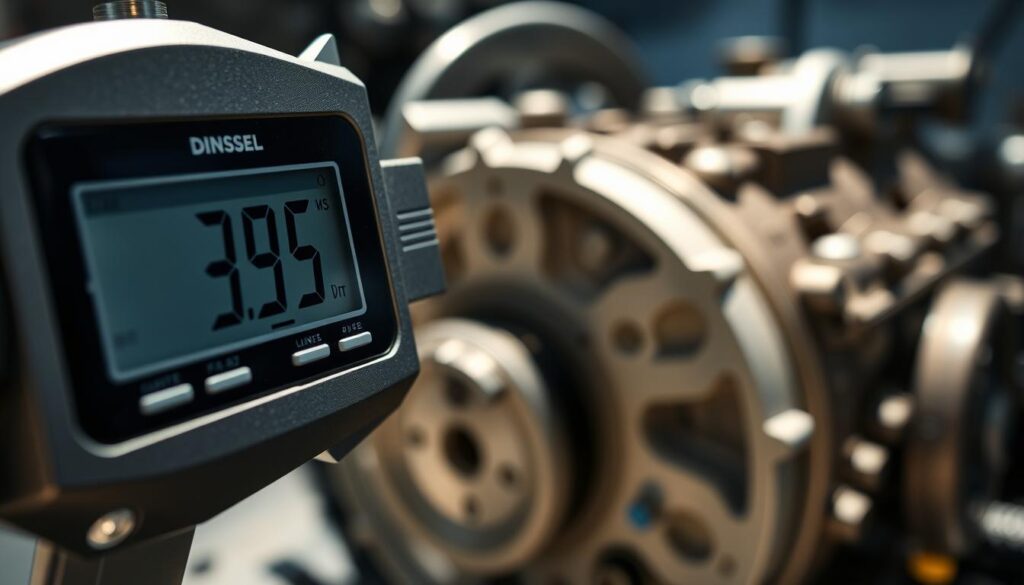
Modern digital calipers incorporate advanced measurement technology through specialized components designed for professional diesel shop environments. The lower jaws measure external dimensions like shaft diameters and component widths. The upper jaws reach into confined spaces to measure internal dimensions such as bore diameters and cylinder openings. The depth gauge extends from the caliper tail to measure hole depths and valve recession.
Digital models include an On/Zero button that powers the device and resets the display to zero. An Inch/Millimeter button allows instant unit conversion between measurement systems. The ABS button provides a temporary reference point reset for comparative measurements. A locking screw secures measurements once captured, preventing accidental jaw movement. The thumb screw or adjustment wheel enables smooth, controlled positioning of the measuring jaws.
Capacitive vs. Inductive Sensing Systems
The internal sensing mechanism determines how digital calipers convert mechanical movement into electronic readings. Two primary technologies dominate professional measurement tools: capacitive and inductive systems.
Capacitive sensing systems measure changes in electrical capacitance between sensing plates as the measuring slide moves along the beam. These systems deliver exceptional accuracy in controlled environments with quick response to position changes and stable readings. However, capacitive systems show susceptibility to contamination from diesel fuel, hydraulic oils, and metallic debris commonly found in diesel repair facilities.
Inductive sensing systems use electromagnetic fields to detect position changes. These rugged systems resist contamination better than capacitive models, maintaining accuracy despite exposure to oils, coolants, and metal particles. The trade-off involves potential interference from strong magnetic fields generated by shop equipment like welders and large power tools.
“Choose sensing technology based on your specific shop environment rather than specification sheets alone.”
— HDJ Technical Guidance
| Feature | Capacitive Sensing | Inductive Sensing |
|---|---|---|
| Accuracy Level | Excellent in clean conditions | Good across varying conditions |
| Contamination Resistance | Low – affected by oils and debris | High – resists shop contaminants |
| Magnetic Interference | Not affected by magnetic fields | May drift near strong magnets |
| Best Application | Diagnostic and precision work | Heavy repair environments |
Resolution and Accuracy Specifications
Technicians often confuse measurement resolution with accuracy, yet these specifications describe fundamentally different performance characteristics. Resolution indicates the smallest increment the caliper can display—most quality digital calipers offer 0.0005-inch resolution in imperial mode or 0.01mm in metric mode.
Accuracy describes how close the displayed measurement comes to the true value being measured. Professional-grade calipers typically specify accuracy of ±0.001 inches or ±0.02mm across the entire measuring range when properly calibrated. High resolution does not guarantee accuracy without proper maintenance. A caliper displaying measurements to 0.0005 inches may still produce inaccurate readings if contaminated, improperly zeroed, or subjected to temperature extremes.
Key Factors That Compromise Digital Caliper Accuracy
Understanding what destroys measurement accuracy helps diesel technicians protect their investment in precision tools. The demanding conditions of diesel repair shops introduce specific challenges that systematically degrade caliper performance.
Temperature Variations and Material Expansion
Temperature differences between calipers and measured components create the most significant source of measurement error in diesel shops. Both metal tools and engine parts expand and contract with temperature changes according to their thermal expansion coefficients.
Steel components expand approximately 0.0000063 inches per inch for every degree Fahrenheit of temperature increase. Consider a six-inch crankshaft journal that warms from 60°F to 100°F during handling. This 40-degree temperature change causes the journal to grow by 0.0015 inches—potentially consuming the entire specification tolerance range for that component.
Aluminum alloys present even greater challenges due to higher expansion coefficients. Pistons and cylinder heads made from aluminum expand roughly twice as fast as steel. Measuring these parts immediately after removal from hot cleaning tanks or cold storage guarantees inaccurate readings.
Temperature Stabilization Best Practice
Allow both measuring instruments and workpieces to stabilize at consistent room temperature for at least 30 minutes before taking critical measurements. Per ASTM calibration standards, most specifications assume measurement at 68°F (20°C), the standard reference temperature for precision work.
Battery Voltage Effects on Measurement Stability
Declining battery voltage creates progressive measurement instability that technicians often fail to recognize until readings become obviously erratic. Electronic sensing circuits require stable voltage for accurate signal processing. As battery voltage drops below optimal levels, the measurement system experiences drift and inconsistent behavior.
Capacitive sensing systems prove particularly sensitive because they rely on precise electrical field measurements. Small voltage variations alter the reference signals used to calculate position. Warning signs include flickering displays, slow response when moving the slide, or measurements that vary when the caliper remains stationary.
Replace batteries at the first sign of display instability rather than waiting for complete failure. Many professional shops implement monthly battery replacement schedules for frequently used calipers to eliminate battery-related accuracy degradation before it affects measurement quality.
Contamination from Oil, Grease, and Metal Particles
The diesel shop environment represents hostile territory for precision instruments. Even microscopic contamination between caliper faces and component surfaces creates false readings that exceed specification tolerances.
Oil films measuring just 0.0001 to 0.0002 inches thick produce measurements outside typical diesel engine tolerances. These invisible layers accumulate on caliper jaws from handling contaminated parts. Metal particles embedded in soft contamination create even more severe problems, generating highly variable readings depending on particle location.
| Contamination Type | Typical Thickness | Measurement Error | Recognition Signs |
|---|---|---|---|
| Oil Film | 0.0001-0.0002 in | 0.0002-0.0004 in | Consistent oversize readings |
| Coolant Residue | 0.0002-0.0005 in | 0.0004-0.0010 in | Sticky feel, variable readings |
| Metal Particles | 0.0005-0.003 in | 0.001-0.006 in | Random variations, scratch marks |
| Carbon Deposits | 0.0003-0.001 in | 0.0006-0.002 in | Black residue, non-repeating measurements |
Wear Patterns on Measuring Surfaces
Repeated contact with hard surfaces and sharp edges gradually damages caliper measuring faces through mechanical wear. The external jaw tips that measure outside diameters experience the most severe wear because they frequently contact hardened journals, sharp keyway edges, and abrasive surfaces.
Microscopic scratches and burrs on measuring surfaces prevent proper contact with components. Technicians should regularly inspect caliper measuring faces under good lighting or magnification. Deep scratches or significant burrs require immediate caliper retirement from precision measurement service.
Step-by-Step Digital Caliper Calibration Procedures
Establishing a comprehensive calibration routine ensures digital calipers deliver trustworthy measurements for every diesel engine repair. Systematic calibration procedures protect against costly errors that could compromise engine performance or lead to premature component failure.
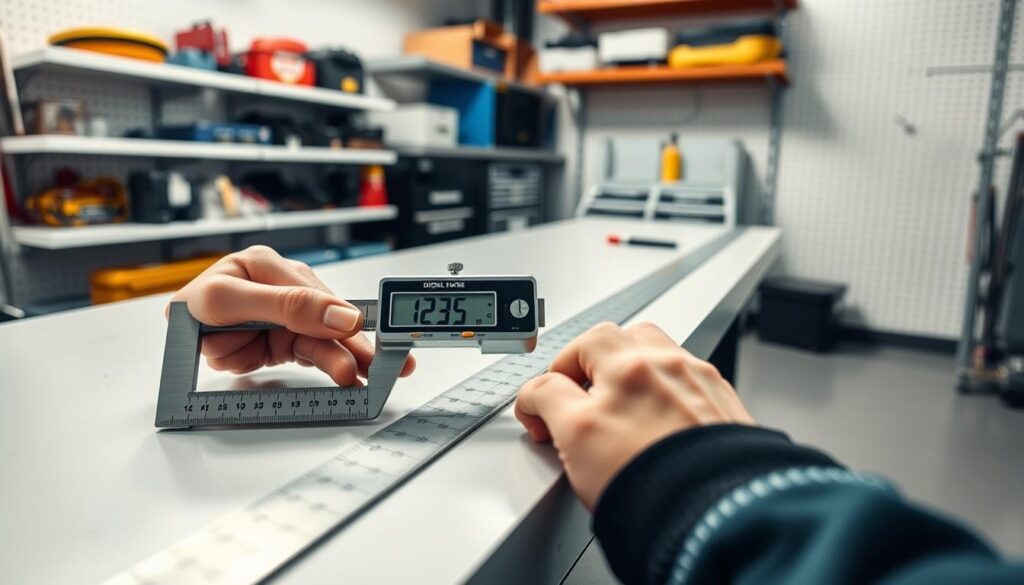
Certified Reference Standards for Accuracy Verification
Precision-ground steel blocks with NIST-traceable dimensions serve as known references that validate caliper accuracy. Professional diesel shops maintain calibration block sets at multiple dimensions including 1.000″, 2.000″, 3.000″, and larger sizes spanning the instrument’s full measuring range.
Handle calibration standards carefully—fingerprint oils contain acids and moisture that compromise surface accuracy. Always handle blocks by insulated grip areas or wear clean cotton gloves. Store blocks in protective cases with desiccant packets to prevent corrosion.
Zero-Point Reset Techniques
Zero-point calibration establishes the baseline reference for all subsequent measurements. Close the caliper jaws completely and inspect contact surfaces under good lighting. Any trapped particles or debris prevent accurate zero setting.
Press the zero button while applying light, consistent pressure between 2-3 pounds of force. The display should read exactly 0.0000 in four-decimal precision mode. If the reading shows any other value, clean the measuring faces and repeat. Perform zero-point calibration before each measurement session without exception.
Multi-Point Accuracy Confirmation
Multi-point verification reveals non-linear errors that single-point checks miss. Begin testing with a 1.000″ calibration block and record the displayed reading. A reading of 1.0003″ indicates a positive error of 0.0003 inches at that dimension.
Continue verification with 2.000″, 3.000″, and blocks near the caliper’s maximum range. Consistent error amounts across all test points suggest simple offset errors correctable through zero calibration. Variable errors at different positions indicate internal damage requiring professional service or replacement.
| Calibration Activity | Frequency | Documentation Required | Acceptance Criteria |
|---|---|---|---|
| Zero-Point Verification | Before each use | Daily checklist notation | Display reads 0.0000″ |
| Single-Point Accuracy Check | Weekly | Calibration log entry | Within ±0.0005″ at 1.000″ |
| Multi-Point Span Verification | Monthly | Detailed measurement record | Within ±0.001″ across range |
| Laboratory Certification | Annually | Traceable certificate | Meets manufacturer specifications |
Professional Measurement Techniques for Diesel Components
Mastering measurement techniques separates competent diesel technicians from exceptional ones. The difference between accurate readings and costly errors often comes down to fundamental handling skills rather than equipment quality.
Proper Grip and Controlled Force Application
Hold the main beam with your dominant hand, positioning fingers along the fixed section while keeping your thumb free to operate the adjustment wheel. This grip provides stability without introducing movement that compromises readings. Your non-dominant hand should support the component being measured or position it securely.
Consistent measuring pressure determines whether readings reflect true dimensions or measurement-induced distortion. Excessive force deflects thin components like piston rings and compresses softer materials. Professional technicians develop a feel for appropriate force—snug without forcing—where the caliper slides over the component with light resistance making full contact without compression.
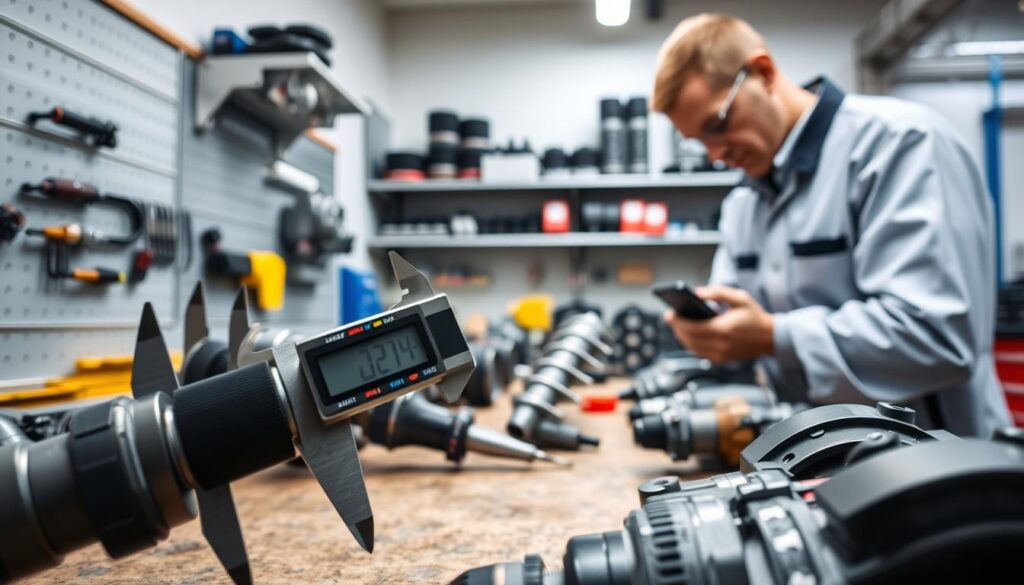
Achieving Perfect Surface Contact
Perpendicular alignment ensures your caliper measures true dimensions rather than angled chord distances. The measuring jaws must contact surfaces at exactly 90 degrees to the measurement axis. Any angular deviation produces readings that appear smaller than actual dimensions.
When measuring crankshaft journals, position caliper jaws perpendicular to the journal axis. Rock the caliper gently from side to side while watching the display. The minimum reading represents true diameter as the caliper passes through the journal center. For bore measurements, the opposite principle applies—the maximum reading indicates true diameter.
Verification Through Repetition
Single measurements never provide sufficient confidence for critical diesel component evaluation. Take three to five measurements of each dimension, recording all readings individually. Measurements that vary significantly indicate problems requiring immediate attention—variation exceeding 0.001 inches suggests inconsistent technique, component damage, or caliper malfunction.
Always re-zero your caliper between measurement series to check for zero drift. Document each measurement with component identification, dimension measured, all readings obtained, and calculated average. This systematic approach creates traceable quality records.
The HDJ Perspective
Twenty years ago, shops could get away with approximate measurements on diesel engines. Today’s common rail systems and emissions-compliant engines have eliminated that margin for error. The technicians building sustainable careers are those who’ve embraced precision measurement as fundamental to their craft—not optional overhead. Invest in quality tools, master proper technique, and document everything. Your reputation depends on measurements your customers never see.
Daily Maintenance Routines for Measurement Precision
Maintaining digital caliper accuracy in demanding diesel environments starts with establishing non-negotiable daily care procedures. Even microscopic contamination affects readings and damages electronic components over time.
Pre-Use and Post-Use Cleaning Protocols
Effective maintenance begins before touching a single component. Inspect measuring faces under bright lighting for contamination, corrosion, or visible damage. Look closely at jaw edges for nicks, burrs, or wear patterns. Wipe all surfaces with clean, lint-free cloths slightly dampened with isopropyl alcohol.
Post-use cleaning matters equally. Immediately after measuring diesel components, wipe measuring surfaces thoroughly to remove contamination before it hardens. Diesel fuel, coolant, and carbon deposits cause corrosion if left on caliper surfaces overnight. Use brass brushes—never steel—to remove stubborn deposits from jaw serrations.
Proper Storage and Lubrication
Never leave calipers loose on workbenches where moisture, temperature extremes, impacts, and airborne debris cause permanent damage. Store calipers in fitted protective cases with foam inserts inside temperature-controlled toolboxes. Position jaws slightly open—not fully closed—to prevent spring tension fatigue.
Apply light precision instrument oil to the sliding beam track monthly or whenever sliding action becomes stiff. Avoid excessive lubrication that attracts contamination. Never apply oil to measuring faces or electronic components. Replace batteries annually regardless of apparent function—declining voltage affects measurement stability long before complete failure.
Free Professional Fleet Tools
Cost calculators, fault code lookup, maintenance planners, and more—built for owner-operators, fleet managers, and diesel techs. No signup required.
Critical Measurement Errors That Diesel Technicians Must Avoid
Understanding common pitfalls is essential for error prevention and maintaining diagnostic reliability. Even expensive digital calipers produce false readings when used incorrectly.
Parallax Error and Display Reading
Parallax error occurs when viewing digital displays from an angle rather than straight-on. LCD screens show different readings depending on viewing position. A measurement reading 2.5035 inches directly may appear as 2.5038 inches from the side—critical when working with tight diesel tolerances.
Over-Tightening and Component Distortion
Excessive measuring force deflects components, compresses materials, and damages caliper mechanisms. Thin-walled components suffer most—piston ring grooves, aluminum piston skirts, and fuel injector copper sealing washers deform under heavy pressure. Warning signs include display readings continuing to change as pressure increases and difficulty removing the caliper from measured components.
⚠️ Safety Warning
Never measure components directly from hot cleaning tanks, ultrasonic cleaners, or immediately following machining operations. Temperature differentials cause dimensional changes that exceed specification tolerances, leading to incorrect diagnostic conclusions and potential safety issues during engine operation.
Temperature Measurement Errors and Zero Drift
Measuring hot or cold parts produces readings that don’t represent normal operating dimensions. Steel components expand approximately 0.0000063 inches per inch per degree Fahrenheit. A crankshaft journal measuring 3.000 inches at 120°F shrinks to 2.9995 inches when cooled to 70°F—often exceeding the acceptable tolerance range.
Zero drift develops throughout measurement sessions from impacts, handling, and general use. Re-check zero calibration regularly during measurement work. Consistent drift in one direction suggests wear on measuring faces or contamination between sliding surfaces requiring immediate attention.
Essential Diesel Engine Parts Requiring Caliper Measurements
Several diesel engine components demand measurement accuracy within thousandths of an inch to function properly. Understanding which parts require caliper measurements and proper techniques ensures reliable engine performance.
Piston Ring End Gap Specifications
Measuring piston ring gap ranks among the most critical measurements technicians perform during engine assembly. Install piston rings in the cylinder bore at the bottom of ring travel to measure accurately. Square the ring using an inverted piston, then measure the gap between ring ends. Typical diesel piston ring end gaps range from 0.012 to 0.024 inches depending on ring type and bore diameter.
Insufficient end gap causes ring butting and breakage under thermal expansion. Excessive gap permits blow-by, increases oil consumption, and creates pressure loss. Measure installed ring groove depths and widths to verify proper ring fit—worn grooves compromise sealing even when ring specifications appear acceptable.
Crankshaft Journal and Main Bearing Dimensions
Crankshaft measurements require exceptional precision because these components operate under extreme loads. Measure journals at multiple locations—front, center, and rear—to detect taper conditions causing uneven bearing wear. Measurements in two perpendicular axes reveal out-of-round conditions accelerating bearing failure.
Compare journal diameters to bearing dimensions to calculate clearances. Per TMC Recommended Practices for heavy-duty engine rebuilding, clearances falling outside specifications require correction before assembly to prevent premature failure under operating loads.
Fuel Injector Bore and Sleeve Measurements
Fuel injector measurements represent some of the most critical dimensions due to extreme operating pressures. Modern common-rail injectors seal against cylinder pressures through precision fits between injector bodies and cylinder head bores. Typical specifications require clearances within 0.0005 to 0.0015 inches.
Use internal caliper jaws with a rocking motion to find true diameter rather than measuring across worn spots. Worn or damaged injector bores allow combustion gases to blow past sealing surfaces, creating carbon buildup and eventual injector failure.
Valve Stem Diameter and Guide Clearance
Valve measurements determine critical clearances affecting sealing, heat transfer, and oil control. Diesel engines typically specify valve stem clearances of 0.0015 to 0.0030 inches for intake valves and 0.0025 to 0.0040 inches for exhaust valves operating at higher temperatures.
Measure valve stem diameters at multiple points along the stem length to detect taper and wear patterns. Guide inside diameters require measurements at top, middle, and bottom to identify bell-mouthing. Excessive clearance allows oil consumption and reduces heat transfer from exhaust valves.
| Component | Measurement Type | Typical Specification | Required Accuracy |
|---|---|---|---|
| Piston Ring Gap | End gap spacing | 0.012-0.024 inches | ±0.001 inches |
| Crankshaft Journals | Diameter, taper, roundness | Per manufacturer spec | ±0.0001-0.0005 inches |
| Injector Bores | Inside diameter clearance | 0.0005-0.0015 inches | ±0.0005 inches |
| Valve Stem Clearance | Stem-to-guide clearance | 0.0015-0.0040 inches | ±0.0001 inches |
Environmental Factors Affecting Measurement Accuracy
Workshop conditions create hidden challenges that compromise precision measurements. Temperature fluctuations, moisture levels, and physical disturbances all impact accuracy in ways that remain invisible until component failures occur.
Optimal Temperature and Humidity Control
Professional calibration laboratories maintain 68°F ±2°F (20°C ±1°C) as the standard reference temperature. While diesel shops cannot maintain laboratory conditions, smart technicians create designated measurement areas away from shop doors, heating equipment, and air conditioning vents where temperature remains relatively stable.
Excessive humidity above 70% relative humidity causes condensation on electronic circuits, corrosion of measuring surfaces, and erratic display behavior. Capacitive sensing systems prove particularly sensitive to surface moisture. Use desiccant packs in caliper cases and replace them when indicator color changes.
| Environmental Parameter | Optimal Range | Warning Threshold | Impact on Accuracy |
|---|---|---|---|
| Workshop Temperature | 68°F ±5°F | Below 50°F or Above 90°F | Thermal expansion errors |
| Relative Humidity | 30-60% | Above 70% or Below 20% | Electronic instability, corrosion |
| Temperature Stability | ±2°F per hour | Changes exceeding 10°F/hour | Prevents thermal equilibrium |
| Vibration Exposure | Isolated storage area | Continuous machinery vibration | Surface wear, loose connections |
Vibration and Shock Protection
Digital calipers contain delicate electronic components, precision sliding mechanisms, and calibrated springs that suffer permanent damage from impacts and vibration. Never place calipers on running engines, operating machinery, or surfaces subject to impact.
Transport calipers in protective cases rather than loose in toolboxes. Mount calipers on foam-padded racks when not in use. Immediately verify calibration after any suspected impact or dropping incident—calipers dropped from workbench height may have suffered internal damage affecting accuracy.
Recording and Converting Measurement Data
Digital calipers generate precise measurements, but technicians must transform raw numbers into quality-controlled repair decisions. Professional shops treat measurement data as legal documentation supporting warranty claims and customer communication.
Interpreting Tolerance Specifications
Manufacturer specifications establish boundaries between acceptable and unacceptable dimensions. A specification listed as “3.5000” +0.0015/-0.0000 inches indicates the dimension can measure between 3.5000 and 3.5015 inches. Any measurement below the minimum fails specification regardless of how close it appears.
Clearance specifications define differences between mating parts such as piston-to-cylinder wall clearance. Understanding that caliper accuracy affects measurement certainty is critical—a caliper with ±0.001 inch accuracy measuring 2.5000 inches means actual dimension falls between 2.4990 and 2.5010 inches.
Imperial and Metric Conversion
Diesel repair requires fluency in both measurement systems. The basic conversion: 25.4mm equals 1.000 inch. Multiply inches by 25.4 to get millimeters; divide millimeters by 25.4 to get inches. Digital calipers eliminate manual calculations through built-in Inch/Millimeter buttons for instant conversion.
Documentation Standards
Professional documentation includes date and technician identification, component identification with engine serial number, specification source citing manual section and page numbers, all readings obtained, pass/fail determination, and action taken based on findings. This documentation proves due diligence when warranty disputes arise and supports continuous quality improvement per CVSA inspection documentation standards.
Troubleshooting Digital Caliper Performance Problems
Performance problems range from simple battery issues to complex electronic malfunctions. Most problems fall into three categories: power and display issues, measurement inconsistencies, and mechanical failures.
Display Problems and Power Solutions
Blank displays, dim numbers, flickering readouts, or missing digit segments typically indicate power supply problems. Open the battery compartment, note orientation, clean contacts using a pencil eraser, and install fresh batteries observing correct polarity. Battery problems account for approximately 70% of all display-related issues.
Resolving Measurement Inconsistencies
When repeated measurements of identical components yield different results, begin by verifying zero calibration and thoroughly cleaning all surfaces. Inspect jaws for mechanical damage and verify measured components remain stationary. Electronic drift—gradual reading changes over time—results from temperature effects, declining battery voltage, or moisture infiltration.
Repair vs. Replacement Decisions
Simple repairs include battery replacement, cleaning, professional recalibration ($50-150), and damaged component replacement. Replace calipers when measuring face damage shows deep gouges or bent jaws, mechanical sliding action has excessive play that cleaning cannot correct, or electronic systems show erratic behavior after battery replacement. When repair costs approach 50% of replacement cost, purchasing new equipment proves more economical.
| Problem Symptom | Common Causes | Solution | Estimated Cost |
|---|---|---|---|
| Blank or dim display | Dead battery, poor contacts | Replace battery, clean contacts | $2-5 |
| Inconsistent readings | Contamination, worn jaws, technique | Clean, verify zero, check standards | $0-150 recalibration |
| Error messages | Range exceeded, calibration loss | Factory reset, professional service | $50-150 |
| Mechanical binding | Dirt accumulation, structural damage | Clean, lubricate, consider replacement | $20-200 replacement |
Professional-grade calipers from manufacturers like Mitutoyo, Starrett, or Brown & Sharpe cost $100-200 but deliver superior accuracy, durability, and longevity that justify the investment for demanding diesel component work.
Frequently Asked Questions
How often should diesel technicians calibrate digital calipers?
Perform zero-point verification before each use by closing the jaws and confirming the display reads exactly 0.0000 inches. Conduct weekly accuracy checks against certified calibration blocks at multiple dimensions (1.000″, 2.000″, 3.000″). Document monthly verification results for quality records. Pursue annual certification through accredited calibration laboratories for shops with OEM certifications or ISO quality management requirements. More frequent verification becomes necessary in harsh environments or after any impact event.
What causes digital caliper measurement errors in diesel shops?
The most common causes include temperature differences between calipers and components causing thermal expansion errors, contamination from oil films and metal particles creating false readings, declining battery voltage affecting electronic stability, and measuring surface wear from repeated contact with hard components. Environmental factors like humidity above 70% and continuous vibration from shop equipment also compromise accuracy over time. Improper technique—such as excessive measuring force or reading displays from angles—introduces additional errors.
What measurement accuracy do diesel engine components require?
Main bearing clearances require accuracy within 0.0001 inches for clearances typically specified between 0.0015-0.0025 inches. Piston ring end gaps need accuracy within 0.001 inches for gaps typically ranging 0.012-0.024 inches. Fuel injector bore tolerances in common rail systems often measure in ten-thousandths of an inch due to operating pressures exceeding 30,000 PSI. Valve stem clearances require 0.0005-inch accuracy for clearances ranging 0.0015-0.0040 inches depending on intake versus exhaust application.
Should diesel shops use capacitive or inductive sensing calipers?
Capacitive sensing delivers exceptional accuracy in cleaner diagnostic environments but shows susceptibility to contamination from diesel fuel, oils, and metallic debris. Inductive sensing resists contamination better and maintains accuracy despite exposure to shop contaminants, though it may drift near strong magnetic fields from welders or power tools. Match sensing technology to your specific environment—capacitive for precision diagnostic work in controlled areas, inductive for heavy repair environments with significant contamination exposure.
When should a digital caliper be replaced rather than repaired?
Replace calipers when measuring face damage shows deep gouges, excessive wear, or bent jaws that cannot be corrected. Mechanical sliding action with excessive play or binding that cleaning cannot resolve indicates structural failure. Electronic systems showing erratic behavior after battery replacement and thorough cleaning signal circuit board damage. When repair costs exceed 50% of replacement cost, new equipment proves more economical. Never continue using questionable calipers for critical measurements—the cost of one comeback repair far exceeds caliper replacement expense.
Build Your Measurement Skills for Career Success
Digital caliper accuracy forms the foundation of professional diesel diagnostics. The measurement best practices covered throughout this guide separate expert technicians from those who rely on guesswork. Every measurement either builds or undermines your professional reputation.
Quality tools deserve quality care. Temperature control, contamination prevention, and regular verification keep your measurements trustworthy year after year. Precision measurement skills open doors to advanced diesel specializations—high-pressure fuel systems, turbocharger diagnostics, and emission controls all demand even tighter tolerances.
Master these digital caliper techniques, maintain your tools properly, and document everything. Your reputation grows with every accurate diagnosis and successful repair. The discipline required for precision measurement becomes the standard that elevates your entire approach to diesel service work.
Share This Guide
Know a diesel technician who could benefit from precision measurement techniques? Pass this guide along to your shop colleagues and industry connections.