
By Michael Nielsen, Editor & Publisher | 15+ Years in Diesel Repair
Last Updated: February 2025
📖 Estimated reading time: 24 minutes
The demand for skilled professionals who maintain and repair heavy-duty vehicles continues to grow across America. Understanding diesel mechanic salary trends helps both aspiring technicians and experienced specialists make informed career decisions. This comprehensive guide examines compensation patterns, regional variations, and earning potential in this essential trade.
According to the U.S. Bureau of Labor Statistics, bus and truck mechanics and diesel engine specialists earned a median annual income of $60,640 in May 2024. That translates to an hourly wage of $29.15. Entry-level technicians typically start between $40,000 and $45,000 annually. Master-level specialists can command over $120,000 when factoring in overtime and union benefits.
The industry offers exceptional job security with more than 25,000 average annual openings nationwide. Employment projections indicate over 28,000 positions will become available each year through 2032. These opportunities span multiple sectors including transportation, construction, agriculture, and maritime industries.
Your earning potential depends on several factors: technical certifications, geographic location, industry specialization, and years of experience. ASE-certified technicians and those with specialized training in emerging technologies often earn premium wages. Union membership and employer-provided benefits packages significantly enhance total compensation.
Key Takeaways
- Median compensation: Qualified diesel technicians earned $60,640 annually ($29.15/hour) in May 2024, with master specialists exceeding $120,000.
- Strong job market: Over 28,000 annual job openings projected through 2032, with above-average growth in Colorado, Connecticut, Indiana, New Jersey, and Tennessee.
- Regional variations matter: Hawaii ($79,010), Washington ($76,940), and Alaska ($73,180) lead in median wages, though cost of living affects real purchasing power.
- Certifications pay off: ASE-certified technicians earn 20-30% more than non-certified counterparts, with each additional certification boosting marketability.
- Benefits add significant value: Total compensation packages including health insurance, retirement plans, and tool allowances add 20-40% beyond base salary.
- Overtime opportunities: Fleet and transportation positions routinely offer overtime at 1.5x regular pay, enabling annual earnings of $89,000-$102,000.
The Current State of Diesel Mechanic Employment in 2025
Diesel technician careers continue to flourish in 2025, supported by consistent industry demand and diverse employment opportunities nationwide. The profession demonstrates remarkable resilience as commercial operations across multiple sectors maintain their dependence on diesel-powered equipment. Unlike passenger vehicle markets experiencing gradual electrification, heavy-duty commercial applications remain predominantly diesel-based, creating sustained opportunities for qualified professionals.
The diesel mechanic job outlook reflects this stability through concrete employment data and industry projections. Modern technicians face an evolving workplace that balances traditional mechanical expertise with cutting-edge diagnostic technology. Understanding the current employment landscape helps both aspiring mechanics and experienced professionals navigate career decisions effectively.

Job Market Demand and Industry Growth
The diesel technician demand continues to demonstrate exceptional strength, with more than 25,000 estimated average annual job openings in the United States. The U.S. Bureau of Labor Statistics projects an annual average of 25,600 job openings between 2023 and 2033 specifically for Bus and Truck Mechanics and Diesel Engine Specialists. These figures represent consistent opportunities rather than temporary market fluctuations.
Several states currently lead in diesel industry employment levels. Texas, California, Ohio, New York, and Pennsylvania maintain the highest concentrations of working diesel mechanics. These states support large transportation networks, extensive agricultural operations, and significant industrial infrastructure that depends on diesel power.
Growth projections reveal particularly strong opportunities in specific regions. States including Colorado, Connecticut, Indiana, New Jersey, and Tennessee expect growth rates well above the national average over the next decade. These projections reflect expanding logistics operations, infrastructure development, and industrial growth within these areas.
Multiple industries drive this sustained demand for qualified technicians: transportation and logistics companies requiring fleet maintenance, construction firms operating heavy equipment, agricultural operations maintaining farm machinery, mining companies servicing extraction equipment, power generation facilities managing backup systems, marine operations maintaining diesel-powered vessels, and railroad companies servicing locomotive engines.
Technicians with specialized expertise in electronics and diagnostics find themselves in especially high demand. Modern diesel engines incorporate sophisticated computer systems that control fuel injection, emissions, and performance parameters. This technological complexity creates premium opportunities for mechanics who combine traditional mechanical skills with advanced diagnostic capabilities.
Essential Skills and Responsibilities
Today’s diesel mechanics must master a comprehensive skill set that extends far beyond basic mechanical repairs. The profession requires both hands-on technical abilities and cognitive problem-solving capabilities. Understanding these essential competencies helps prospective technicians prepare for successful diesel mechanic careers.
Technical skills form the foundation of diesel mechanic expertise. Advanced diagnostic capabilities using computerized equipment have become non-negotiable requirements. Technicians must interpret data from electronic control modules, identify system malfunctions through diagnostic codes, and utilize specialized software to troubleshoot complex issues.
Proficiency in repairing complex fuel injection systems represents another critical competency. Modern diesel engines employ high-pressure common rail injection systems, electronic unit injectors, and precision fuel delivery mechanisms. Mechanics must understand fuel system hydraulics, injection timing, and the relationship between fuel delivery and engine performance.
Key technical competencies include electronic control system expertise for engine management, hydraulic system knowledge for equipment operation, emissions system diagnosis and repair capabilities, electrical troubleshooting for integrated vehicle systems, and preventive maintenance protocol implementation.
Beyond technical abilities, successful diesel technicians develop essential soft skills. Customer service capabilities enable effective communication with vehicle owners and fleet managers. Clear communication with service advisors ensures accurate problem identification and appropriate repair authorization.
Attention to safety protocols protects both the technician and workplace colleagues. Diesel repair involves heavy components, high-pressure systems, and potentially hazardous materials. Following established safety procedures prevents workplace injuries and ensures compliance with occupational health standards.
⚠️ Safety Warning
Diesel repair work involves high-pressure fuel systems, hot exhaust components, heavy lifting, and hazardous chemicals. Always follow proper lockout/tagout procedures, use appropriate PPE, and never work on pressurized systems without proper depressurization protocols.
Employment Settings and Work Environments
Diesel mechanics work across remarkably diverse employment settings, each offering distinct advantages and workplace characteristics. This variety allows technicians to select environments that match their preferences, lifestyle requirements, and career objectives. Understanding these options helps professionals make informed decisions about diesel industry employment opportunities.
Independent repair shops specializing in diesel vehicles provide entrepreneurial environments where technicians often develop broad expertise. These facilities typically service diverse equipment types and customer bases. Mechanics in these settings frequently interact directly with vehicle owners and develop long-term customer relationships.
Dealership service departments for truck and bus manufacturers offer structured employment with manufacturer-specific training opportunities. These positions provide access to proprietary diagnostic tools, technical support networks, and warranty repair work. Dealership mechanics often specialize in particular vehicle brands and model lines.
Fleet maintenance facilities for transportation and logistics companies represent major employment sectors. These operations maintain dozens or hundreds of vehicles for single organizations. Fleet mechanics typically focus on preventive maintenance, minimizing vehicle downtime, and maintaining consistent operational standards across entire vehicle populations.
Additional employment settings include construction and mining companies with heavy equipment operations, marine repair facilities servicing diesel-powered vessels, railroad maintenance yards for locomotive engines, agricultural equipment dealers supporting farming operations, government fleet operations at local, state, and federal levels, and mobile or field service positions traveling to client locations.
Work environments vary considerably based on employment setting. Many technicians work in climate-controlled repair facilities with modern equipment and ergonomic workstations. Others perform field service work at customer locations, adapting to outdoor conditions and variable work settings.
National Average Diesel Mechanic Salary Breakdown
Compensation for diesel mechanics nationwide demonstrates significant variation based on expertise, certifications, and years working in the field. According to the Bureau of Labor Statistics, the median annual income for bus and truck mechanics and diesel engine specialists reached $60,640 in May 2024, with a median diesel mechanic hourly wage of $29.15. This national benchmark provides a foundation for understanding how diesel mechanic wages progress throughout a professional’s career.
The compensation structure rewards continuous skill development and practical experience. Professionals who invest in certifications and specialized training see measurable financial returns. Geographic location, employer type, and industry specialization also influence earnings potential significantly.
Entry-Level Technician Pay Ranges
Technicians beginning their careers with 0-2 years of experience typically earn between $40,000 and $45,000 annually. This translates to diesel technician pay of approximately $19 to $22 per hour. These positions are commonly filled by recent graduates from technical training programs or diesel technology schools.
Entry-level professionals work under supervision while developing practical diagnostic abilities. They handle routine maintenance tasks, assist experienced mechanics with complex repairs, and gradually build their technical knowledge base. This foundational period is critical for establishing strong work habits and mechanical proficiency.
Many employers offer apprenticeship programs that combine on-the-job training with classroom instruction. These structured programs help new technicians develop competencies systematically while earning competitive wages.
Experienced Mechanic Earnings
Mid-career diesel mechanics with 3-7 years of experience see substantial salary increases, earning $48,000 to $60,000 annually. The average diesel mechanic salary at this career stage ranges from $23 to $29 per hour. These professionals have developed proficiency in common repair procedures and work independently on most routine maintenance tasks.
At this level, technicians often begin specializing in particular equipment types or diesel systems. They may focus on transmission repair, fuel injection systems, or emissions control technology. Specialization typically leads to higher compensation as expertise becomes more valuable to employers.
Many mid-career mechanics pursue ASE (Automotive Service Excellence) certifications in specific areas. These credentials demonstrate verified competency and frequently result in pay increases ranging from $2,000 to $5,000 annually.
Master Technician and Senior-Level Compensation
Senior technicians with 8-15 years of experience command salaries ranging from $62,000 to $79,000 annually, equivalent to $30 to $38 per hour. These professionals possess advanced troubleshooting abilities and comprehensive knowledge of multiple diesel systems. They frequently mentor less experienced technicians and handle the most complex diagnostic challenges.
Master technicians and diesel engine specialists represent the highest earning tier. Their compensation reaches $85,000 to $120,000 or more annually, translating to diesel mechanic wages of $40 to $58+ per hour. These elite professionals typically hold multiple ASE certifications and possess expertise in specialized equipment or systems.
Top-tier technicians often work in supervisory capacities, overseeing shop operations or managing fleet maintenance programs. Their extensive experience allows them to diagnose rare problems quickly and implement efficient repair solutions. Union membership further enhances compensation through collective bargaining agreements that secure premium wages and comprehensive benefits packages.
| Experience Level | Years in Field | Annual Salary Range | Hourly Wage Range |
|---|---|---|---|
| Entry-Level Technician | 0-2 years | $40,000 – $45,000 | $19 – $22 |
| Mid-Career Mechanic | 3-7 years | $48,000 – $60,000 | $23 – $29 |
| Senior Technician | 8-15 years | $62,000 – $79,000 | $30 – $38 |
| Master Technician | 15+ years | $85,000 – $120,000+ | $40 – $58+ |
Hourly vs. Annual Salary Structures
Most diesel mechanics receive hourly compensation rather than fixed annual salaries. This payment structure provides flexibility for both employers and employees, allowing earnings to fluctuate based on workload and availability. Hourly wages enable significant earnings increases through overtime work, which is common in this profession.
Overtime rates typically calculate at 1.5 times the regular hourly rate for hours worked beyond 40 per week. During peak seasons or equipment breakdowns, technicians may work 50-60 hours weekly, substantially boosting their total compensation. A mechanic earning $30 per hour can add $11,700 annually by working just 10 overtime hours per week.
Some experienced technicians in management or specialized roles transition to salaried positions with guaranteed annual compensation. These positions offer income stability and often include performance bonuses tied to shop productivity or customer satisfaction metrics. Salaried positions typically require additional administrative responsibilities beyond hands-on repair work.
Northeast Region Diesel Mechanic Salary Data
Diesel mechanics working in the Northeast region enjoy some of the nation’s most competitive compensation packages. This area combines high living costs with strong industrial demand to create premium wage opportunities. Union representation and concentrated transportation hubs further boost Northeast diesel technician pay across multiple states.
The region’s extensive logistics infrastructure requires thousands of skilled technicians. Port operations, construction projects, and commercial transportation create consistent job openings. These factors position the Northeast as a top-earning region for diesel professionals.
Tri-State Area Premium Compensation
The diesel mechanic salary New York professionals earn reflects the state’s robust industrial economy. New York’s median annual salary reaches $66,840, placing it among the top ten states nationally. This figure represents base compensation before overtime and bonuses.
The New York-Newark-Jersey City metropolitan area offers even stronger earnings potential. Technicians in this massive urban market earn between $72,500 and $79,747 annually when overtime hours are included. The Port of New York and New Jersey generates constant demand for diesel expertise to maintain cargo equipment and commercial vehicles.

The diesel mechanic salary New Jersey workers command averages $68,620 per year. The state’s strategic location along major transportation corridors supports this competitive pay scale. Pharmaceutical companies, logistics firms, and manufacturing operations all require fleet maintenance services.
Pennsylvania rounds out the tri-state picture with slightly lower but still competitive wages. The state ranks among those with the highest employment levels for diesel mechanics nationwide. This abundance of job openings provides excellent opportunities across transportation, energy, and manufacturing sectors.
New England States Strong Earnings Profile
Connecticut leads New England with a median annual salary of $70,160 for diesel technicians. The state’s aerospace and defense manufacturing sectors utilize substantial diesel-powered equipment. Growth projections for Connecticut exceed national averages, signaling expanding opportunities.
Massachusetts provides another strong market with a median salary of $67,590. Maritime operations in Boston Harbor and extensive manufacturing facilities drive demand. The state’s trade transportation networks require continuous maintenance support.
New Hampshire completes the top-ten states nationally with a median salary of $65,580. Despite its smaller size, the state offers competitive compensation and lower living costs than neighboring areas. This combination creates attractive purchasing power for diesel professionals.
| State | Median Annual Salary | Key Industries | Employment Outlook |
|---|---|---|---|
| Connecticut | $70,160 | Aerospace, Defense, Manufacturing | Above Average Growth |
| New Jersey | $68,620 | Logistics, Pharmaceuticals, Transport | Steady Demand |
| Massachusetts | $67,590 | Maritime, Manufacturing, Trade | Strong Employment |
| New York | $66,840 | Port Operations, Construction, Fleet | High Volume Hiring |
| New Hampshire | $65,580 | Manufacturing, Transportation | Competitive Market |
Metropolitan Markets Command Premium Rates
Urban diesel mechanic wages reach their highest levels in major metropolitan areas. The Philadelphia-Camden-Wilmington region ranks among top employment markets nationally. Dense population centers create transportation demands that require extensive diesel maintenance operations.
Hartford-West Hartford-East Hartford represents another high-employment metropolitan area. Insurance company fleets, manufacturing operations, and construction projects all need qualified technicians. These urban centers typically offer 10-15% higher wages than rural areas within the same state.
Union membership plays a significant role in Northeast compensation structures. Organized labor negotiates favorable wage scales and scheduled pay increases. Comprehensive benefits packages, job security provisions, and overtime protections add substantial value beyond base salaries.
Southern States Diesel Mechanic Pay Rates
Southern states offer diesel mechanics an attractive value proposition through the combination of competitive wages and affordable cost of living. The region compensates for generally lower nominal Southern states diesel pay with significantly reduced housing costs, lower taxes, and decreased daily expenses. This economic balance often results in comparable or superior purchasing power compared to higher-wage coastal markets.
The South’s diverse industrial base creates steady demand for qualified diesel technicians. Major industries including transportation logistics, agriculture, manufacturing, oil and gas extraction, commercial fishing, timber operations, and mining all rely heavily on diesel-powered equipment. This variety provides mechanics with numerous specialization opportunities and stable employment prospects throughout the region.
Lone Star State and Energy Corridor Compensation
Texas stands as an employment powerhouse for diesel mechanics, ranking among states with the highest current employment levels in this occupation. The diesel mechanic salary Texas market benefits from the state’s massive transportation infrastructure, extensive logistics networks, and robust energy sector operations. These factors combine to create thousands of positions across metropolitan and rural areas alike.
The Gulf Coast region encompassing Texas, Louisiana, Mississippi, and Alabama offers distinctive earning opportunities. Gulf Coast diesel technician wages reflect the specialized nature of marine applications, offshore platform support, and petrochemical industry requirements. Mechanics servicing commercial shipping fleets, fishing vessels, and industrial port equipment often command premium rates for their specialized skills.
Texas mechanics enjoy additional financial advantages beyond base compensation. The state’s lack of income tax increases take-home pay substantially compared to similar wages in states with income taxation. A diesel technician earning $55,000 annually in Texas effectively receives more net income than a counterpart earning $60,000 in a state with 5% income tax.
$0 State Income Tax
Texas, Florida, and several other Southern states charge no state income tax, effectively boosting take-home pay by 5-10% compared to similar wages in high-tax states.
Atlantic Seaboard Regional Earnings
Southeast coastal states including Florida, Georgia, South Carolina, and North Carolina present varied compensation structures. The diesel mechanic salary Florida averages $49,591 annually, translating to approximately $23.00 per hour. Individual earnings typically range from $43,835 for entry-level positions to $56,495 for experienced technicians with specialized certifications.
Florida’s employment market reflects the state’s diverse economic activities. The tourism industry generates substantial demand for mechanics maintaining bus fleets, shuttle services, and transportation systems. Major port operations in Jacksonville, Tampa, and Miami require technicians for cargo handling equipment and commercial vehicle maintenance.
The Sunshine State balances lower wages with significant lifestyle and financial benefits. Florida imposes no state income tax, immediately increasing take-home pay. Housing costs outside major metropolitan areas remain moderate compared to Northeast and West Coast markets. These factors enhance the effective value of Florida compensation packages.
| State | Average Annual Salary | Hourly Rate | Cost of Living Index |
|---|---|---|---|
| Florida | $49,591 | $23.00 | 98.2 |
| Georgia | $51,340 | $24.68 | 91.4 |
| South Carolina | $47,820 | $22.99 | 89.7 |
| North Carolina | $50,280 | $24.17 | 93.8 |
Georgia’s transportation and logistics sector anchors substantial diesel mechanic employment. The state serves as a major distribution hub with extensive warehousing operations and freight corridors. Atlanta’s airport operations and surrounding logistics facilities create consistent demand for qualified technicians.
Interior Regional Compensation Standards
Inland Southern states including Tennessee, Arkansas, Kentucky, and West Virginia typically offer the region’s most affordable living costs alongside lower nominal wages. Tennessee projects above-average employment growth for diesel mechanics, supported by expanding manufacturing operations and central geographic positioning along major transportation routes.
These markets provide valuable entry points for new technicians building experience and credentials. Lower competition for positions and reduced cost pressures allow apprentices and recently certified mechanics to establish careers while developing specialized skills. Many technicians use these opportunities as stepping stones toward higher-wage markets or advanced specializations.
The agricultural equipment maintenance sector thrives throughout inland Southern regions. Rural areas require mechanics servicing tractors, combines, irrigation systems, and harvesting equipment. These specialized positions often include housing allowances or reduced living expenses in small communities, effectively increasing total compensation value.
Midwest and Great Plains Regional Salaries
Across America’s heartland, diesel technicians find competitive wages supported by diverse industries ranging from automotive manufacturing to farm equipment maintenance. The diesel mechanic salary Midwest landscape reflects balanced economic conditions where affordable living costs enhance earning power. This central region combines urban industrial centers with extensive rural agricultural operations, creating varied employment opportunities for skilled technicians.
The Midwest economy supports diesel mechanic positions through manufacturing, logistics, construction, and agriculture. These interconnected industries maintain constant demand for qualified technicians. Geographic diversity means compensation packages vary significantly between metropolitan manufacturing hubs and rural agricultural communities.
Industrial Corridor Compensation Standards
Ohio, Michigan, Indiana, and Illinois form the industrial core where diesel mechanic employment reaches the highest concentration levels nationally. Ohio ranks among the top states for diesel technician employment, with opportunities spanning manufacturing facilities, trucking companies, construction firms, and municipal fleet operations. Major metropolitan areas including Cleveland, Columbus, and Cincinnati support robust demand for skilled mechanics.
The diesel mechanic salary Ohio averages range from $48,000 to $67,000 annually for experienced technicians. Entry-level positions typically start between $38,000 and $44,000, while master technicians in specialized roles command $70,000 or more. Urban centers offer premium wages reflecting higher operational costs, but smaller cities provide competitive compensation with substantially lower living expenses.

Michigan’s automotive heritage extends beyond passenger vehicles into heavy-duty truck manufacturing and commercial fleet maintenance. Detroit, Grand Rapids, and surrounding areas host numerous opportunities in logistics, manufacturing, and government operations. Diesel technicians here earn between $46,000 and $65,000 annually, with specialized certifications pushing earnings higher.
Indiana projects above-average growth rates for diesel mechanic positions through 2025 and beyond. The state’s extensive logistics infrastructure, centered on Indianapolis and Fort Wayne, drives consistent demand. Manufacturing facilities and transportation companies offer annual salaries ranging from $45,000 to $63,000 for qualified mechanics.
Illinois benefits from Chicago’s position as a major transportation and warehousing hub. The metropolitan area supports thousands of diesel technician positions serving commercial fleets, municipal operations, and logistics companies. Compensation in Chicago reaches $50,000 to $72,000 annually, reflecting urban wage premiums and higher costs of living.
Farm Equipment Service Compensation
Iowa, Kansas, Nebraska, Missouri, and the Dakotas present unique opportunities for agricultural diesel technician pay structures. Rural markets may show lower baseline salaries compared to industrial urban centers, but specialized farm equipment expertise commands competitive wages. Agricultural equipment specialists earn $42,000 to $58,000 annually in these regions, with significant overtime potential during critical seasons.
Planting and harvest seasons create urgent demand for equipment repair services. Downtime during these periods directly impacts farm operations and revenue. Diesel mechanics with agricultural specialization can substantially increase earnings through overtime work when farmers need immediate repairs to keep operations running.
Agricultural diesel technician pay reflects the technical complexity of modern farm machinery. Today’s tractors, combines, and irrigation systems incorporate advanced electronic controls and hydraulic systems requiring specialized diagnostic skills. Technicians working for equipment dealerships, independent repair shops, or large farming operations find year-round employment opportunities.
| Midwest Subregion | Entry-Level Annual | Experienced Salary | Primary Industry Focus |
|---|---|---|---|
| Ohio Industrial Centers | $38,000 – $44,000 | $48,000 – $67,000 | Manufacturing, logistics, municipal fleets |
| Agricultural Belt States | $35,000 – $42,000 | $42,000 – $58,000 | Farm equipment, seasonal service |
| Great Lakes Region | $40,000 – $46,000 | $46,000 – $66,000 | Maritime, manufacturing, transportation |
| Chicago Metropolitan | $42,000 – $50,000 | $50,000 – $72,000 | Logistics, warehousing, urban fleets |
Maritime and Manufacturing Markets
Wisconsin, Minnesota, and surrounding Great Lakes states combine multiple employment sectors supporting diesel technician careers. Great Lakes diesel mechanic wages range from $46,000 to $66,000 annually, reflecting diverse industry applications. Commercial shipping operations, recreational vessel maintenance, and manufacturing facilities create varied opportunities for qualified mechanics.
Maritime diesel applications include commercial shipping vessels, fishing boats, and recreational craft operating on the Great Lakes. Technicians with marine diesel specialization service engines, propulsion systems, and auxiliary equipment. These positions often pay premium rates due to specialized knowledge requirements and seasonal demand patterns.
Milwaukee, Minneapolis, Green Bay, and Duluth serve as regional employment centers. Manufacturing operations in these cities produce everything from construction equipment to consumer goods, maintaining fleet operations requiring skilled diesel mechanics. Municipal operations and transit authorities also employ technicians for bus and truck maintenance.
The HDJ Perspective
The diesel mechanic salary landscape in 2025 reveals a profession that rewards strategic career planning. While coastal and urban markets offer the highest nominal wages, the real story lies in purchasing power. A technician earning $55,000 in rural Ohio may enjoy a comparable lifestyle to someone making $75,000 in California—with significantly less financial stress. The smartest approach combines initial skill-building in accessible markets with strategic advancement toward higher-paying specializations or union positions as experience accumulates. Certifications remain the single most controllable factor for boosting earnings at any career stage.
Western United States Diesel Mechanic Earnings
Western states establish the upper tier of diesel mechanic earnings through a combination of strong unions, high living costs, and industrial demand. This region consistently outpaces national averages across multiple metrics. Technicians working in these markets benefit from robust economic activity spanning agriculture, maritime operations, energy production, and transportation infrastructure.
The concentration of high-paying positions reflects both economic prosperity and practical realities. Geographic isolation in states like Alaska and Hawaii creates premium compensation structures. Meanwhile, California’s massive economy generates sustained demand across diverse industrial sectors.
Golden State Compensation Leaders
The diesel mechanic salary California market commands attention with a median annual figure of $70,650. This baseline represents substantial earning potential before factoring in union membership or metropolitan premiums. California’s position as the world’s fifth-largest economy creates exceptional opportunities for skilled technicians.
Union positions elevate compensation to remarkable heights. Organized labor agreements secure rates up to $58.00 per hour, translating to annual earnings exceeding $120,640. These packages include scheduled wage increases, comprehensive benefits, and overtime opportunities that further enhance total compensation.
The San Francisco Bay Area metropolitan region pushes earnings even higher. Technicians in this market command up to $83,370 annually, reflecting the area’s exceptional cost of living and competitive labor dynamics. Similar premiums appear in other major California metros.
California diesel opportunities span Central Valley agricultural equipment maintenance operations, Los Angeles and Long Beach port logistics facilities, statewide construction and development projects, and transportation networks serving 40 million residents. Organizations like the International Association of Machinists and Teamsters negotiate industry-leading contracts establishing California as the benchmark for diesel technician compensation nationwide.
Northwest Regional Standards
The diesel mechanic salary Washington median reaches $76,940 annually, positioning the state among the nation’s highest-paying markets. Washington’s diverse economy drives this compensation level through maritime industries, aerospace manufacturing, and agricultural operations. Military installations and forestry activities add further demand for diesel expertise.
Pacific Northwest diesel wages reflect regional economic strength and quality of life factors. Oregon fleet technicians earn base rates around $31.50 per hour, but total compensation tells a more complete story. Including overtime opportunities, annual earnings reach $89,000 to $102,000 for transportation and government agency positions.
Green technology initiatives throughout the region create specialized opportunities. Food manufacturing and defense contractors require skilled technicians for equipment maintenance. The Pacific Northwest’s commitment to environmental standards often translates to modern equipment and advanced diagnostic systems.
Extreme Market Premium Rates
Alaska diesel technician pay averages $73,180 annually, ranking third nationally for median compensation. This premium reflects multiple challenging factors that justify higher wages. Harsh working conditions, extreme geographic isolation, and elevated living costs all contribute to the compensation structure.
Alaska’s industrial base creates consistent demand for skilled technicians through oil extraction operations requiring 24/7 equipment support, commercial fishing fleet maintenance during intensive seasons, timber industry equipment servicing in remote locations, mining operations with specialized heavy machinery, and agricultural equipment supporting limited growing seasons.
Hawaii tops all states with a median annual salary of $79,010. This distinction reflects the nation’s most extreme cost of living combined with complete geographic isolation. Everything from replacement parts to specialized tools arrives by air or sea, creating unique operational challenges. The islands’ diverse diesel mechanic needs span military installations, agriculture operations, maritime facilities, and tourism transportation infrastructure.
| State | Median Annual Salary | Key Industry Drivers | Special Factors |
|---|---|---|---|
| ✓ Hawaii (Highest) | $79,010 | Military, tourism, maritime | Highest cost of living, complete isolation |
| Washington | $76,940 | Maritime, aerospace, agriculture | Strong union presence, diverse economy |
| Alaska | $73,180 | Oil, fishing, mining | Extreme conditions, geographic isolation |
| California | $70,650 | Agriculture, ports, manufacturing | World’s 5th largest economy, union strength |
Free Professional Fleet Tools
Cost calculators, fault code lookup, maintenance planners, and more—built for owner-operators, fleet managers, and diesel techs. No signup required.
Industry Specialization and Salary Variations
Specializing in particular equipment types or industries creates premium earning opportunities for diesel technicians. The sector you choose to focus on can influence your compensation by $20,000 to $40,000 annually compared to general repair work. Different industries value specialized expertise differently based on equipment criticality, downtime costs, and skill scarcity.
Diesel specialization wages vary significantly across sectors due to distinct technical requirements and operational demands. Natural gas distribution employs the highest-paid diesel mechanics according to Bureau of Labor Statistics data. The complexity of equipment and consequences of failures drive these compensation differences.
Fleet Operations and Transportation Services
Fleet diesel mechanic salary levels represent some of the most stable and lucrative opportunities in the profession. Large transportation companies and government transit agencies offer comprehensive compensation packages that extend beyond base wages. Public transit systems consistently pay mechanics above $75,000 annually with extensive benefits and overtime availability.
Fleet maintenance positions provide employment stability that independent repair shops cannot match. These roles typically involve predictable schedules with regular daytime hours rather than on-call emergency service. Technicians work within preventive maintenance systems that emphasize scheduled service over breakdown repairs.
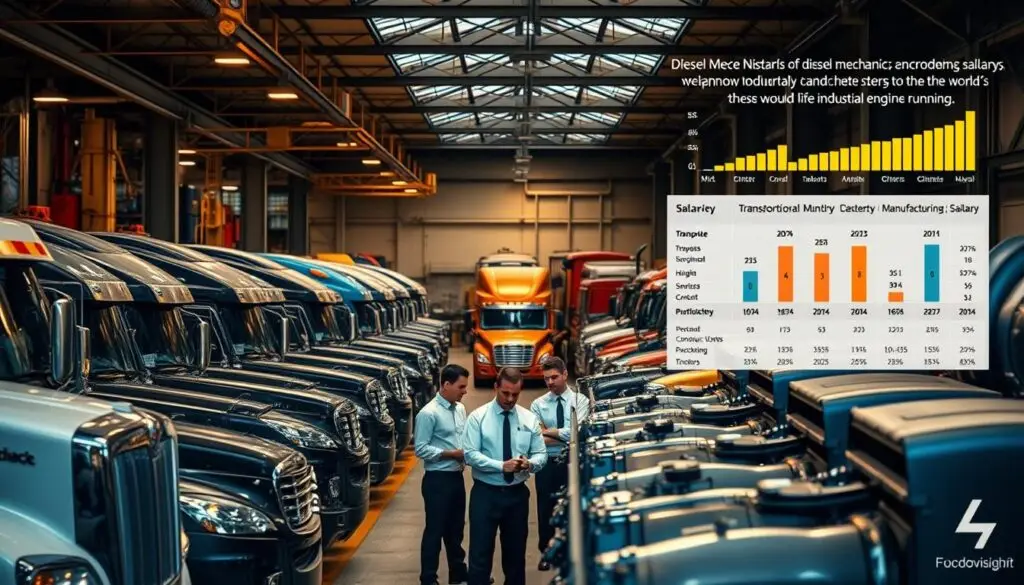
Oregon exemplifies premium fleet compensation markets where technicians earn $89,000 to $102,000 through base wages combined with overtime opportunities. Fleet specialists need expertise in telematics and fleet management software systems, rapid diagnostics to minimize vehicle downtime, preventive maintenance scheduling and documentation, multi-vehicle troubleshooting and efficiency, and compliance with 49 CFR Part 396 inspection and maintenance regulations.
Construction and Mining Equipment Technicians
Heavy equipment mechanic salary packages reach premium levels due to the critical nature of equipment uptime in these sectors. Construction and mining operations lose substantial revenue when excavators, loaders, or haul trucks sit idle. This economic reality drives higher compensation for specialists who maintain this equipment.
High-demand markets pay construction equipment specialists up to $102,000 annually in states like Oregon. Mining industry positions frequently include additional compensation for remote location assignments. These roles often involve rotation schedules with extended on-site periods followed by time off.
Construction equipment specialization requires knowledge beyond standard diesel engine expertise. Technicians must understand hydraulic systems that power multiple functions simultaneously. Undercarriage components experience unique wear patterns from constant ground contact and abrasive materials.
Marine and Agricultural Specialists
Marine diesel technician pay reflects specialized expertise required for vessel engine systems. Coastal states offer enhanced opportunities where commercial fishing, cargo shipping, and tugboat operations create steady demand. Marine mechanics service engines in environments where saltwater corrosion creates unique maintenance challenges.
Agricultural equipment repair creates seasonal demand patterns that influence compensation structures. Diesel mechanics servicing tractors, combines, and irrigation systems experience peak workload periods during planting and harvest seasons. The Technology & Maintenance Council develops recommended practices that fleet and agricultural equipment technicians reference for service procedures.
| Specialization Sector | Average Salary Range | Key Skill Requirements | Work Environment |
|---|---|---|---|
| Fleet Maintenance | $65,000 – $102,000 | Telematics, preventive systems, DOT compliance | Shop-based, regular schedules |
| Construction Equipment | $58,000 – $102,000 | Hydraulics, undercarriage, field diagnostics | Mobile service, job sites |
| Marine Diesel | $52,000 – $88,000 | Corrosion prevention, marine systems, vessel knowledge | Coastal shops, shipyards |
| Agricultural Equipment | $48,000 – $75,000 | Precision agriculture, seasonal demands, PTO systems | Rural dealerships, farm service |
Key Factors That Determine Diesel Mechanic Salary Levels
The financial rewards for diesel mechanics stem from a combination of professional qualifications, work experience, and strategic employment choices. Understanding these compensation factors empowers technicians to make informed career decisions that maximize earning potential throughout their professional journey. Several interconnected elements work together to establish individual pay rates across different employment settings.
Your career path as a diesel technician involves controllable factors that directly impact your income trajectory. Professional development decisions and strategic planning significantly influence long-term compensation outcomes. These determinants range from certifications you can pursue immediately to career advancement opportunities that unfold over years of dedicated service.
Professional Credentials and Specialized Training
The impact of ASE certification diesel mechanic credentials on compensation cannot be overstated. Certified mechanics earn up to 30% more than non-certified counterparts performing identical work functions. This substantial wage premium reflects the value employers place on verified technical competency and professional commitment.
Entry-level technicians without diesel mechanic certifications typically start at $19-$22 per hour. ASE-certified technicians often command starting wages closer to $25 per hour, representing an immediate return on certification investment. This $3-$6 hourly difference translates to $6,240-$12,480 in additional annual income for full-time positions.
The National Institute for Automotive Service Excellence offers more than 50 certification examinations covering specialized domains. These include Medium-Heavy Truck, Truck Equipment, School & Transit Buses, and other diesel-specific areas. Each additional certification expands your marketability and justifies higher compensation requests.
Key Recommendation
Pursue at least one ASE certification within your first two years. The 20-30% pay increase typically covers certification costs within months, making it the highest-ROI investment a diesel technician can make early in their career.
Career Progression and Experience Pay
The relationship between diesel mechanic experience pay and tenure follows a clear upward trajectory throughout your career. Experience level directly correlates with compensation as you accumulate diagnostic expertise and familiarity with diverse equipment types. Your efficiency in repair procedures improves dramatically with each year of hands-on work.
Wage progression follows distinct career stages with measurable income brackets. Entry-level positions typically offer $40,000-$45,000 annually, while mid-career technicians earn $48,000-$60,000. Senior technicians command $62,000-$79,000, and master technicians reach $85,000-$120,000 or higher.
Experience builds the judgment necessary to diagnose intermittent problems and recognize patterns across equipment failures. This expertise extends beyond technical skills to include mentoring junior technicians and leading complex repair projects. Your ability to handle challenging problems that stump less experienced technicians justifies premium compensation.
Union Membership Benefits
Union membership and collective bargaining dramatically transform compensation structures for diesel mechanics in unionized sectors. Union contracts negotiate minimum wage scales, scheduled annual increases, and overtime provisions that typically result in substantially higher total compensation. The union diesel mechanic salary premium can reach 30-40% compared to non-union positions.
California union diesel mechanics earning $58 per hour exemplify the compensation advantage union membership provides. This translates to $120,640 in annual base pay before overtime and benefits. Union contracts also establish comprehensive benefits packages that significantly enhance total compensation value.
Union positions offer greater job security through collective bargaining agreements. These contracts establish termination procedures and seniority systems that protect experienced workers. The combination of higher wages, superior benefits, and employment protections makes union positions highly sought-after among diesel technicians nationwide. The Owner-Operator Independent Drivers Association and other industry organizations provide resources for understanding compensation trends across different employment structures.
Complete Benefits Package Analysis for Diesel Mechanics
Diesel mechanic benefits extend far beyond base salary, creating a complete compensation package that addresses both immediate needs and long-term financial security. These additional forms of compensation often add 20-40% to the value of base earnings, making the total diesel technician compensation package substantially more valuable than salary figures alone suggest. Understanding the full range of benefits available helps technicians evaluate job offers accurately and negotiate effectively for comprehensive coverage.
Benefits packages vary significantly based on employer type, company size, and geographic location. Large corporations, government agencies, and union positions typically offer the most comprehensive benefit programs.
Healthcare and Insurance Coverage
Diesel mechanic insurance forms the foundation of most full-time employment benefits, protecting technicians and their families from substantial medical expenses. Comprehensive health insurance plans cover medical services, hospitalization, emergency care, prescription medications, and preventive health screenings. Employer contributions often reduce or eliminate premium costs that employees would otherwise pay directly from their paychecks.
Dental insurance typically covers preventive care like cleanings and examinations at 100%, basic procedures such as fillings at 80%, and provides partial coverage for major dental work including crowns and root canals. Vision insurance covers annual eye examinations and contributes toward corrective lenses or contact lenses, with typical allowances of $150-$300 for eyewear.
Retirement Plans and Long-Term Security
Diesel mechanic retirement benefits provide crucial long-term financial security that becomes increasingly valuable throughout a career. Traditional defined-benefit pension plans remain available primarily through government employment and some union positions, providing guaranteed monthly payments during retirement based on years of service and final salary levels.
More commonly, employers now offer defined-contribution plans such as 401(k) programs. Employees contribute pre-tax income, reducing current taxable wages while building retirement accounts. Employers frequently provide matching contributions up to specified percentages of salary, typically ranging from 3-6% of annual wages.
Employer matching represents immediate returns on retirement savings. A 50% match on contributions up to 6% of salary effectively provides additional compensation equal to 3% of annual wages. For a technician earning $60,000 annually, this matching contribution adds $1,800 per year to total compensation while building long-term wealth.
Tool Allowances and Professional Support
Tool allowances, uniforms, and equipment support address the significant personal expenses diesel mechanics incur for professional tools and work clothing. Professional diesel technicians often invest $10,000-$50,000 or more in specialized tools, diagnostic equipment, and tool storage throughout their careers. Quality tools represent both a substantial financial commitment and essential assets for performing high-quality work efficiently.
Many employers provide annual tool allowances of $500-$2,000 to offset these costs. Some companies provide complete tool sets to new technicians, eliminating the initial investment barrier that can make entering the profession financially challenging. These tool programs particularly benefit apprentices and entry-level technicians who haven’t yet accumulated comprehensive tool collections.
Maximizing Earnings Through Overtime and Bonuses
The diesel mechanic earnings potential extends far beyond base pay when technicians take advantage of overtime, shift premiums, and bonus structures available in the industry. Strategic approaches to these compensation opportunities can increase annual income by 20-50% or more above standard wages. Mechanics who understand these earning mechanisms position themselves for significantly higher total compensation without necessarily moving into management roles.
Overtime Pay Opportunities
Federal labor law mandates diesel mechanic overtime pay at 1.5 times the regular hourly rate for hours worked beyond 40 in a workweek for non-exempt employees. This requirement covers most hourly diesel mechanics across the United States. Union contracts frequently offer even more favorable terms, including double-time pay for holidays or work exceeding certain daily hour limits.
The financial impact of regular overtime proves substantial for technicians in high-demand positions. A mechanic earning $31.50 per hour who works 20 overtime hours monthly generates an additional $945 monthly in overtime compensation. Over a full year, this adds $11,340 to base earnings.
Combined with regular wages of approximately $65,500, this overtime schedule elevates total annual compensation to over $76,800. Fleet technicians in Oregon earning base rates around $31.50 per hour achieve total annual compensation of $89,000-$102,000 through regular overtime work.
Shift Differentials and Premium Pay
Shift differential diesel mechanic positions provide additional compensation for working less desirable schedules. Evening shifts, overnight shifts, weekends, and on-call rotations typically include premium pay rates added to base hourly wages. These differentials reward mechanics for schedule flexibility while addressing employer staffing needs.
Typical shift differential premiums add $1-$5 per hour to base rates for all hours worked during premium shifts. Overnight differentials generally exceed evening shift premiums due to greater lifestyle disruption. A $3 per hour night shift differential on a standard 40-hour work week adds $6,240 annually to base compensation without requiring overtime hours.
Performance Bonuses
Performance-based compensation creates variable income components that reward productivity, quality, and company success. Individual performance bonuses typically range from $1,000-$5,000 annually in positions with established bonus structures. These payments reward measurable achievements and contributions beyond standard job duties.
Common diesel technician bonus metrics include efficiency ratios comparing hours billed to hours worked. Mechanics who complete repairs faster than standardized labor time guides demonstrate higher productivity levels. Customer satisfaction survey results, warranty claim rates, and safety records also influence bonus calculations in many organizations.
Career Advancement Pathways and Salary Growth
Professional growth in the diesel mechanic field creates opportunities for ambitious technicians to transition from apprentice roles to master-level positions earning over $100,000 annually. The diesel mechanic career path offers multiple advancement trajectories beyond remaining in technician roles throughout one’s working years. Each pathway provides increased compensation, diverse professional challenges, and opportunities aligned with evolving interests and strengths.
Technical Excellence Track
The traditional advancement path focuses on developing supreme technical expertise and diagnostic capabilities through progressive experience levels. This journey typically begins immediately following technical training or high school graduation with apprentice or entry-level positions.
New technicians work under supervision while developing foundational skills in routine maintenance, basic repairs, and proper tool usage. Formal apprenticeships registered with state agencies or informal on-the-job training arrangements typically last 3-4 years, combining practical experience with continued classroom education.
Master technician designation represents the pinnacle of technical achievement. This elite status requires extensive experience, multiple advanced certifications, and proven diagnostic expertise in complex problems. Master technicians earning $100,000-$120,000 or more serve as technical resources for entire shops and work directly with manufacturer support on unusual problems.
Management and Leadership Roles
Shop foreman positions represent the first level of formal management responsibility in the diesel mechanic career advancement ladder. These roles combine hands-on technical work with team leadership, work assignment, quality oversight, and employee development. Shop foremen typically supervise 5-15 technicians while ensuring efficient workflow and maintaining quality standards.
Diesel shop supervisor salary packages typically range from $65,000-$90,000 depending on facility size and geographic region. These positions require both technical credibility and developing leadership skills.
Fleet manager and service director positions represent senior management with primarily administrative and strategic responsibilities. Fleet manager salary ranges typically fall between $75,000-$120,000 or more depending on organization size. The Commercial Vehicle Safety Alliance provides inspection standards and out-of-service criteria that fleet managers must understand for compliance management.
Frequently Asked Questions
What is the average diesel mechanic salary in 2025?
The median annual salary for diesel mechanics is $60,640 according to the Bureau of Labor Statistics (May 2024 data), translating to $29.15 per hour. Entry-level technicians typically earn $40,000-$45,000 annually, while master technicians with extensive certifications can exceed $120,000 when factoring overtime and benefits. Geographic location significantly impacts earnings, with Hawaii ($79,010), Washington ($76,940), and Alaska ($73,180) offering the highest median wages.
Which states pay diesel mechanics the most?
Hawaii leads with a median annual salary of $79,010, followed by Washington at $76,940, Alaska at $73,180, Connecticut at $70,160, and California at $70,650. These premium wages reflect high living costs, strong union presence, and specialized industry demands. Union diesel mechanics in California can earn up to $58 per hour. However, when factoring cost of living, states like Texas and Ohio may offer superior purchasing power despite lower nominal wages.
How much do ASE certifications increase diesel mechanic pay?
ASE-certified diesel mechanics typically earn 20-30% more than non-certified technicians performing identical work. This translates to $3-$6 higher hourly rates, or $6,240-$12,480 in additional annual income. Each additional ASE certification expands marketability and justifies higher pay. The National Institute for Automotive Service Excellence offers over 50 certification examinations covering Medium-Heavy Truck, Truck Equipment, School and Transit Buses, and other diesel-specific specializations.
What benefits do diesel mechanics receive beyond salary?
Comprehensive benefits packages typically add 20-40% to base salary value. Standard benefits include health insurance covering medical, dental, and vision care; retirement plans with 401(k) matching (often 3-6% of salary); paid vacation starting at 1-2 weeks and increasing to 4-5 weeks with tenure; sick leave; and tool allowances of $500-$2,000 annually. Government and union positions often provide superior benefits including defined-benefit pensions and family health coverage with minimal employee contributions.
How much can overtime increase diesel mechanic earnings?
Overtime significantly boosts diesel mechanic income, as federal law requires 1.5 times regular pay for hours exceeding 40 per week. A mechanic earning $31.50 per hour who works 20 overtime hours monthly adds $945 monthly or $11,340 annually to base earnings. Fleet technicians in high-demand positions regularly achieve total compensation of $89,000-$102,000 through consistent overtime. Some union contracts offer double-time pay for holidays, effectively doubling hourly rates for those shifts.
What is the job outlook for diesel mechanics?
The diesel mechanic job outlook remains strong with more than 25,000 estimated average annual job openings nationwide. The Bureau of Labor Statistics projects 25,600 annual openings for Bus and Truck Mechanics and Diesel Engine Specialists through 2033. States including Colorado, Connecticut, Indiana, New Jersey, and Tennessee expect growth rates well above the national average. Commercial trucking, construction, agriculture, and marine industries continue driving sustained demand for qualified technicians.
Building Your Diesel Mechanic Career
The diesel mechanic salary landscape in 2025 presents strong earning potential for skilled technicians willing to invest in their professional development. This profession offers middle-class wages that can reach six figures with the right experience, certifications, and specializations.
The diesel technician career outlook remains positive despite changes in the automotive industry. Commercial trucks, construction equipment, agricultural machinery, and marine vessels will continue running on diesel engines for decades. This sustained demand creates job security that many other trades cannot match.
Your diesel mechanic compensation depends on several controllable factors. Earning ASE certifications boosts your credentials and marketability. Gaining expertise in electronic diagnostics and hybrid systems positions you for higher-paying opportunities. Seeking employment with union shops or government agencies often provides superior wages and benefits.
Diesel industry careers reward technical excellence and continuous learning. Starting positions around $40,000 can grow into master technician roles exceeding $80,000 or management positions reaching $100,000 and beyond. Geographic location plays a significant role, with states like Alaska, Washington, and California offering premium wages.
The path forward requires commitment to skill development and strategic career decisions. Whether you’re entering the field or looking to advance, the diesel technician profession provides clear pathways to financial stability and professional growth. The equipment powering American commerce needs skilled hands to keep it running.
Help Fellow Diesel Professionals Plan Their Careers
This salary guide provides valuable benchmarks for technicians, fleet managers, and shop owners. Share it with colleagues who could benefit from current compensation data.