
By Heavy Duty Journal Editorial Team | Last Updated: February 2026 | 22-Minute Read
ASE certification for diesel mechanics represents the nationally recognized credential that separates qualified heavy-duty technicians from the rest of the industry. Established by the National Institute for Automotive Service Excellence, these professional credentials validate that technicians possess the specialized knowledge required to diagnose, repair, and maintain complex commercial vehicle systems ranging from high-pressure fuel injection to advanced emissions controls.
This comprehensive guide walks you through everything needed to become a certified diesel technician. You’ll discover eligibility requirements, the eight T-Series exam areas, preparation strategies, associated costs, and the path to Master Technician status. Whether you’re entering the field or validating years of hands-on experience, understanding the certification process positions you for better compensation, stronger job security, and long-term career advancement in an industry where qualified professionals remain in high demand.
The heavy-duty vehicle sector continues its steady growth trajectory. The U.S. Bureau of Labor Statistics projects approximately 26,500 annual openings for diesel service technicians over the coming decade, with the majority resulting from technicians retiring or transitioning to other roles. Even during recent economic challenges, diesel techs maintained their essential worker status. This stability, combined with a median annual wage of $60,640 and enhanced earning potential through certification, makes professional credentials an investment worth pursuing.
Key Takeaways
- Industry gold standard: ASE T-Series certifications are the nationally recognized benchmark for medium-heavy truck technicians across all 50 states
- Eight specialized exams: The T-Series program covers diesel engines, drive train, brakes, suspension, electrical systems, HVAC, and preventive maintenance
- Experience required: Two years of hands-on work experience minimum, with accredited education substituting for up to one year
- Accessible investment: Individual exam fees range from $39 to $61, with Master Technician status costing $520 to $988 total including study materials
- Measurable salary impact: Certified technicians earn $8,000 to $15,000 more annually than non-certified peers across all experience levels
- Five-year renewal cycle: Certifications expire every five years, requiring recertification through shorter exams or approved continuing education
What Is ASE Certification for Diesel Mechanics
The National Institute for Automotive Service Excellence establishes the benchmark for diesel mechanic competency across the United States. This certification validates that technicians possess the specialized knowledge required to service complex heavy-duty vehicles. ASE offers more than 50 different credentials across various automotive and diesel specializations, with the T-Series certifications designed specifically for medium and heavy-duty truck technicians.
Diesel mechanics who earn professional credentials demonstrate proven expertise in commercial vehicle systems. The certification process involves rigorous testing that evaluates both theoretical knowledge and practical application. This standardized approach ensures consistent quality across the entire automotive service industry.
Understanding the National Institute for Automotive Service Excellence
The National Institute for Automotive Service Excellence was established in 1972 to address the growing need for standardized competency benchmarks in automotive repair. The organization operates as an independent, non-profit entity dedicated to improving the quality of vehicle service and repair through reliable testing programs that validate technician skills.
ASE developed comprehensive testing protocols that cover every aspect of vehicle maintenance and repair. These assessments evaluate a technician’s understanding of diagnostic procedures, repair techniques, and safety protocols. The organization continuously updates its testing content to reflect emerging technologies and industry developments.
Over five decades, ASE has certified more than 400,000 automotive professionals nationwide. The organization works closely with industry experts, manufacturers, and educational institutions to maintain testing relevance. This collaboration ensures that certification standards align with current workplace demands and technological advancements. You can explore the complete ASE test series catalog on their official website.
Why ASE Certification Matters in the Diesel Industry
Diesel engines operate fundamentally differently from gasoline powerplants, requiring specialized technical knowledge. Commercial diesel systems involve complex fuel injection mechanisms, turbocharging technology, and sophisticated emissions control equipment. These differences make diesel-specific certification essential for technicians working on heavy-duty vehicles.
The diesel sector encompasses commercial trucks, buses, construction equipment, and agricultural machinery. Each application presents unique challenges that demand specific expertise. ASE testing validates proficiency in critical areas including high-pressure fuel injection systems operating at pressures exceeding 30,000 PSI, advanced turbocharging and air intake systems for power optimization, diesel exhaust aftertreatment systems including DEF and DPF technology, heavy-duty drivetrain components designed for commercial applications, and electronic control modules managing complex engine operations.
Certification proves a technician’s ability to diagnose problems accurately and perform repairs correctly the first time. This reliability is crucial in commercial operations where vehicle downtime directly impacts business profitability. Fleet operators specifically seek certified technicians to minimize costly repairs and maximize vehicle uptime.
The complexity of modern diesel emissions systems has further elevated the importance of proper certification. Current EPA emission standards for heavy-duty engines require technicians to understand selective catalytic reduction, diesel particulate filters, and exhaust gas recirculation. Without proper training and validation, mechanics risk causing expensive damage to these sensitive systems.
Industry Recognition and Standards
ASE certification provides universal recognition that transcends geographic boundaries and employer preferences. All 50 states acknowledge ASE credentials as the definitive standard for automotive service excellence. Major trucking companies, equipment manufacturers, and fleet operators specifically require or strongly prefer certified technicians.
The certification serves multiple stakeholders within the automotive ecosystem. Insurance companies often recognize ASE-certified shops with lower liability premiums. Customers gain confidence knowing their vehicles receive service from validated professionals. Employers use certification as a reliable hiring criterion that reduces training costs and liability risks.
Industry organizations and regulatory bodies incorporate ASE certification standards into their professional requirements. The Commercial Vehicle Safety Alliance references ASE credentials in vehicle inspection protocols. Department of Transportation contractors frequently specify certified technicians for maintenance contracts. The standardization that ASE provides creates consistency across the fragmented automotive service landscape, meaning a certified technician in California possesses the same validated competencies as one in New York or Texas.
Professional diesel mechanic credentials differentiate qualified technicians in an increasingly competitive job market. The visible certification patch and wallet card provide immediate recognition of expertise. Many shops prominently display their technicians’ certifications to build customer trust and differentiate their services from uncertified competitors.
Types of ASE Diesel Certifications Available
Diesel mechanics pursuing professional credentials can choose from multiple specialized certifications that cover every major system in medium and heavy-duty trucks. The ASE testing program provides computer-based, multiple-choice examinations across distinct technical areas. Each certification validates your expertise in specific vehicle systems and components.
Understanding which certifications align with your daily work responsibilities helps you build a credential portfolio that reflects your actual technical capabilities. The medium-heavy truck certification pathway offers the most relevant options for professionals working exclusively with commercial diesel vehicles. These specialized tests differ significantly from automotive certifications in both scope and technical depth.
T-Series: Medium-Heavy Truck Certifications
The T-Series represents the specialized certification track designed exclusively for technicians who service commercial vehicles weighing over 14,000 pounds, covering Class 4 through Class 8 trucks. This certification family includes eight distinct examinations that address every major system found in modern commercial trucks. Each test requires passing scores that demonstrate comprehensive knowledge and diagnostic capabilities.
Unlike general automotive certifications, the heavy-duty truck ASE tests focus on commercial-grade components and systems. The testing content reflects the unique challenges technicians face when working on fleet vehicles and long-haul equipment. Earning multiple T-Series credentials demonstrates versatility across different truck systems.
The T1 certification covers gasoline engine diagnosis and repair for commercial vehicles that operate mixed-fuel fleets. This test examines your knowledge of fuel delivery systems, ignition components, and exhaust systems in gas-powered trucks. Content areas include fuel system diagnosis, ignition timing procedures, and emissions control systems. Technicians working for companies with diverse vehicle types find this certification particularly valuable.
T2 Diesel Engines
The ASE T2 diesel engines certification stands as the core credential for diesel specialists. This comprehensive examination covers fuel injection systems, turbochargers, intercoolers, and diesel-specific emissions controls. Questions address both mechanical and electronic diesel engine technologies.
Test content includes advanced topics like common rail fuel systems, diesel particulate filters, and selective catalytic reduction systems. You must demonstrate proficiency in diesel engine performance diagnostics and repair procedures. The T2 test also evaluates knowledge of cylinder head service, engine block repair, and lubrication system maintenance. Electronic control system diagnostics comprise a significant portion of the examination, making this certification essential for anyone specializing in modern diesel powertrains.
T3 Drive Train
The T3 certification validates expertise in heavy-duty drivetrain components including transmissions, clutches, and driveshafts. Manual and automated manual transmissions receive extensive coverage throughout the examination. Test questions cover transmission diagnosis, clutch adjustment procedures, and driveline vibration analysis. You must know differential operation, axle maintenance, and universal joint replacement techniques. This certification proves particularly important for technicians working on linehaul and vocational trucks.
T4 Brakes
The T4 test examines both hydraulic and air brake systems used in medium and heavy-duty trucks. Air brake system components receive the most extensive coverage due to their prevalence in commercial vehicles. Antilock braking system diagnostics also constitute a major testing area. Questions address brake adjustment procedures, air system leak testing, and foundation brake service. DOT compliance requirements and FMCSA inspection procedures also appear throughout the examination.
T5 Suspension and Steering
The T5 certification covers heavy-duty suspension systems, steering mechanisms, and wheel alignment specific to commercial trucks. Air suspension systems and leaf spring configurations receive detailed examination. Test content includes suspension component diagnosis, kingpin replacement, wheel bearing service, and alignment specifications for tandem axle vehicles.
T6 Electrical and Electronic Systems
The T6 test addresses increasingly complex electrical and electronic systems found in modern commercial vehicles. Battery management, starting systems, and charging systems form the foundation knowledge areas. Electronic control modules and multiplexed communications networks receive extensive coverage. This certification grows more valuable as trucks incorporate additional electronic safety and efficiency systems.
T7 Heating, Ventilation, and Air Conditioning
The T7 certification validates competency in cab climate control systems for commercial vehicles. HVAC system diagnosis, refrigerant handling, and component replacement procedures comprise the core content. Environmental regulations regarding refrigerant management receive significant attention, and proper evacuation and charging procedures represent essential skills verified by this examination.
T8 Preventive Maintenance Inspection
The T8 test focuses on preventive maintenance inspection procedures critical for fleet operations and DOT compliance. Systematic inspection methodologies and documentation requirements receive extensive coverage. Content includes fluid sampling procedures, component wear assessment, safety inspection standards, and out-of-service criteria. This certification proves particularly valuable for technicians working in fleet maintenance environments.
Master Technician Status Requirements
Achieving ASE Master Medium-Heavy Truck Technician status requires passing all eight T-Series examinations plus meeting work experience requirements. This credential represents the highest level of certification available in the medium-heavy truck certification program. Master technicians command the greatest respect and compensation throughout the industry.
The master designation demonstrates comprehensive expertise across all major truck systems rather than narrow specialization. Employers actively seek candidates with this credential for lead technician and shop foreman positions. Master certified technicians receive special recognition through distinctive patches and wallet cards, and the comprehensive knowledge required sets you apart from other technicians in competitive job markets.
ASE Certification Eligibility Requirements
Meeting ASE certification prerequisites represents the crucial first step for diesel technicians seeking to validate their professional expertise through industry-standard testing. Unlike many professional credentials, ASE does not mandate specific educational degrees or state licenses as mandatory entry requirements. However, the organization maintains clear standards that ensure only qualified professionals with genuine hands-on experience can earn certification.
The ASE application process focuses primarily on demonstrating practical competency rather than academic credentials alone. While no federal or state laws require formal training for heavy-duty mechanics, ASE has established voluntary standards that the diesel industry widely recognizes as proof of professional excellence.
Basic Prerequisites for Application
ASE eligibility requirements center on work experience rather than educational mandates. Candidates must complete a minimum threshold of hands-on work with diesel engines and heavy-duty vehicle systems before qualifying to take certification exams. This experience-focused approach ensures that only technicians with real-world practical knowledge attempt the rigorous testing process.
No formal licensing or mandatory training exists at the federal level for diesel mechanics. ASE certification remains entirely voluntary, yet it has become the industry benchmark for demonstrating technical competence. Employers across the United States recognize ASE credentials as proof of top-level skills and experience in diesel technology.

Applicants must demonstrate hands-on experience working with specific diesel systems covered by their chosen certification area. The basic prerequisites include two years of relevant work experience in diesel mechanics or related heavy-duty vehicle service, hands-on involvement with diagnostic procedures and repair operations, work performed in a professional shop environment, experience with the specific systems covered by the certification test you plan to take, and the ability to provide employer verification of your work history.
Educational Background Considerations
While ASE does not require formal education to apply for certification, educational background significantly impacts both exam preparation and career opportunities. Technical training from trade schools, community colleges, or vocational institutes provides structured learning that complements hands-on experience. Many diesel technology programs offer curriculum specifically designed to prepare students for ASE certification exams.
Formal education can substitute for a portion of required work experience. An associate’s degree or completion of a diesel technology program may reduce the work experience requirement, allowing graduates to test earlier in their careers. This substitution recognizes that structured technical education provides valuable knowledge equivalent to time spent in the field.
Educational pathways that strengthen certification readiness include associate’s degree programs in diesel technology, certificate programs from technical institutes, manufacturer-specific training courses, apprenticeship programs combining classroom instruction with supervised work, and continuing education courses focused on emerging diesel technologies.
Required Documentation and Proof
The ASE application process includes specific documentation that verifies your work history and qualifications. Applicants must provide detailed records of employment that demonstrate they meet experience thresholds before registering for exams. This verification process maintains the integrity of ASE credentials.
Work experience documentation requires employer verification through official channels. Shop owners, service managers, or supervisors must confirm your employment dates and job responsibilities. Required documentation typically includes completed work experience verification forms, detailed employment history listing job titles and dates, contact information for employers who can confirm your experience, educational transcripts if substituting training for work experience, and government-issued identification for test registration.
The application process timeline requires advance planning. Candidates should gather all necessary documentation several weeks before their intended test date. This preparation ensures smooth registration and allows time to address any verification issues.
Stay Current on Diesel Certification Requirements
ASE testing standards, eligibility rules, and industry requirements evolve regularly. Get the latest certification updates, career insights, and technical guidance delivered to your inbox.
Work Experience Requirements for ASE Diesel Certification
Beyond passing examinations, diesel mechanics must demonstrate substantial hands-on work experience to earn ASE certification. The National Institute for Automotive Service Excellence established these requirements to ensure certified technicians possess both theoretical knowledge and practical skills. Work experience serves as proof that candidates can apply their technical understanding in real-world repair situations.
Two-Year Work Experience Standard
ASE requires a minimum of two years of relevant diesel mechanic work experience before awarding certification. This standard applies across all T-Series diesel certifications, ensuring candidates have adequate exposure to real-world repair scenarios. The two-year requirement translates to approximately 4,000 hours of hands-on work with diesel engines and heavy-duty vehicle systems.
The experience must involve actual diagnostic and repair work, not simply routine maintenance tasks. Technicians need to demonstrate proficiency in troubleshooting complex problems, performing system-level repairs, and working with diagnostic equipment. Basic services like oil changes, tire rotations, or fluid top-offs alone do not satisfy the experience requirements.
Many mechanics start their careers as junior technicians and progressively develop their skills. A dedicated junior tech typically advances to handling most preventive maintenance work within the first year. Within three to five years, experienced technicians can tackle all types of repairs and maintenance on diesel vehicles.
Substituting Formal Education for Experience
ASE recognizes that formal education programs provide valuable training that can partially substitute for on-the-job experience. Candidates who complete a two-year diesel technology program from an accredited institution can substitute one year of the experience requirement. This means graduates need only one additional year of hands-on work experience before applying for certification.
To qualify for this substitution, the educational program must be accredited by organizations like the ASE Education Foundation (formerly NATEF). The curriculum should cover diesel engine theory, fuel systems, electrical diagnostics, and hands-on repair procedures. Trade schools, technical institutes, and apprenticeship programs working under experienced professionals all provide valid pathways.
Qualifying Work Experience Types
ASE accepts qualifying diesel repair experience from various employment settings where technicians perform hands-on diagnostic and repair work. Independent repair shops, dealership service departments, fleet maintenance facilities, equipment rental companies, and construction companies with in-house maintenance operations all count toward the experience requirement.
Military vehicle maintenance experience qualifies when it involves diesel engine systems. Veterans who worked as mechanics on military trucks, generators, or heavy equipment can apply this experience toward ASE certification. The structured training and documentation provided by military service often makes verification straightforward.
| Work Environment | Status | Key Requirements | Documentation |
|---|---|---|---|
| Independent Diesel Repair Shop | Fully Qualifying | Hands-on diagnostics and repairs under supervision | Employer verification letter with dates and duties |
| Dealership Service Department | Fully Qualifying | Factory-trained environment with systematic procedures | HR department confirmation and pay stubs |
| Fleet Maintenance Facility | Fully Qualifying | Regular maintenance and repair of commercial vehicles | Supervisor attestation and employment records |
| Military Vehicle Maintenance | Fully Qualifying | Documented diesel engine repair experience | DD Form 214 and service records |
| Volunteer or Hobbyist Work | Non-Qualifying | Lacks professional oversight and verification | Not accepted for certification purposes |
Documenting and Verifying Your Experience
Proper documentation of diesel mechanic work experience is essential for a successful ASE certification application. Employers or direct supervisors must verify the claimed experience through written attestation confirming the technician performed hands-on diagnostic and repair work on diesel engines and related systems.
Self-employed technicians face additional documentation requirements. They must provide business licenses, tax records, customer invoices, and detailed work logs demonstrating consistent diesel repair activity. ASE may require multiple forms of documentation to establish the legitimacy and scope of self-employment experience.
ASE conducts random audits of certification applications to verify claimed experience. Falsifying experience information results in application denial and potential ban from future certification attempts. Start gathering documentation well before your planned application date to address any gaps, and contact former employers early to request verification letters while supervisors are still accessible.
ASE Diesel Mechanic Test Format and Content
Knowing what to expect on test day transforms ASE certification from an intimidating challenge into a manageable goal. The ASE test format follows a consistent structure across all T-Series certifications, allowing diesel mechanics to prepare strategically. Each examination uses computer-based technology administered at authorized Prometric testing centers nationwide.
Computer-Based Testing Format and Time Management
All ASE diesel certifications use a computer-based testing platform that displays questions on screen with interactive navigation features. Each T-Series exam contains between 40 and 80 questions, depending on the specific certification area. Time limits range from 60 to 90 minutes per individual test, providing approximately one minute per question.
The testing software includes several helpful navigation tools. Candidates can mark questions for later review, allowing them to skip challenging items and return after completing easier ones. Most experienced test-takers recommend a first pass through all questions, answering those that come immediately to mind, followed by a second pass focusing on marked questions requiring deeper analysis.
Question Design and Scoring Methodology
Every question on ASE diesel mechanic exams follows a multiple-choice format with four possible answers. Only one answer is completely correct, though distractors are carefully designed to challenge superficial knowledge. Some incorrect options represent common misconceptions or mistakes technicians make in the field.
Many questions incorporate diagrams, technical illustrations, or specifications that candidates must interpret. These visual elements test practical diagnostic skills beyond simple memorization. The certification exams use a scaled scoring system that adjusts for question difficulty, meaning not all questions carry equal weight in the final score calculation.
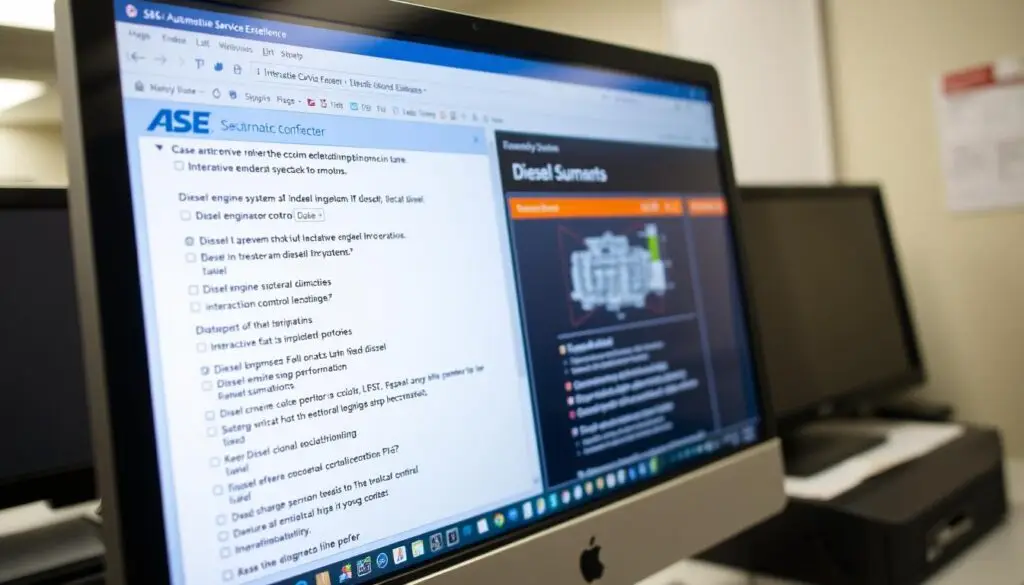
Each exam also includes several experimental questions being evaluated for future tests. These items do not count toward your final score, but test-takers cannot identify which questions are experimental. ASE does not publish specific passing score percentages because question difficulty varies between test versions, making a fixed percentage inappropriate for maintaining consistent standards.
Content Allocation Across T-Series Certifications
Each T-Series certification dedicates specific percentages of questions to defined content areas, providing clear guidance on where to focus study efforts. ASE publishes detailed task lists for every certification outlining specific skills and knowledge areas tested.
| T2 Diesel Engines Content Area | Question Distribution | Emphasis Level |
|---|---|---|
| Fuel Systems and Injection | 30–35% | High Priority |
| Cooling and Lubrication Systems | 25–30% | High Priority |
| Air Induction and Exhaust | 20–25% | Moderate Priority |
| Engine Braking Systems | 15–20% | Standard Priority |
Content distribution reflects real-world diagnostic and repair priorities. Systems that technicians encounter most frequently or that present the greatest safety concerns receive higher question allocations. The test design philosophy balances theoretical knowledge with hands-on expertise, requiring candidates to apply classroom concepts to practical scenarios that mirror the thought process needed when diagnosing complex diesel system failures.
The HDJ Perspective
In our conversations with fleet managers and shop owners across the country, one pattern emerges consistently: the shops investing in ASE certification for their technicians see measurable returns not just in workforce quality, but in customer retention and warranty authorization rates. The technician shortage means that certified professionals hold significant leverage in today’s job market. For technicians debating whether certification is worth the investment, the data speaks clearly — but the real advantage goes beyond salary. Certification creates a framework for continuous learning that keeps you relevant as diesel technology evolves toward increasingly complex emissions systems, hybrid powertrains, and connected vehicle diagnostics.
How to Prepare for ASE Diesel Certification Tests
The difference between passing and failing ASE diesel certification exams often comes down to the quality and consistency of your test preparation. Even experienced diesel technicians with decades of field work can struggle with certification tests without proper study habits. ASE questions may require recall of theories learned in technical school in addition to hands-on field knowledge.
It’s not uncommon for technicians to fail an ASE exam on their first try. Candidates who fail must wait 30 days before retesting and pay registration fees again, making thorough preparation a smart investment of both time and money.
Official ASE Study Guides and Practice Tests
ASE publishes comprehensive study guides for each T-Series certification that should form the foundation of your preparation strategy. These official resources outline all content areas, provide sample questions, and include detailed explanations of correct answers. The materials directly reflect actual test content, making them the most reliable preparation tools available. You can access the official ASE Medium-Heavy Truck Study Guide for detailed task lists and sample questions.
ASE practice tests reveal your weak areas before you sit for the actual exam. Taking multiple practice tests throughout your preparation period helps track your progress and identifies topics that need additional review. These simulation tests also build confidence and reduce test-day anxiety by making the format familiar.
Online Preparation Courses and Digital Resources
Beyond ASE’s official materials, numerous online platforms offer certification exam preparation resources for diesel technicians. Commercial test prep services provide structured courses with video lessons, interactive quizzes, and progress tracking features. These platforms often include updated content that reflects the latest diesel technology and testing standards.

Mobile study tools like Pocket Prep allow studying during downtime away from computers. Online forums and technician communities provide valuable insights from professionals who have recently taken ASE exams. However, verify information quality and avoid outdated materials that may not reflect current test content.
Technical School Programs and Training Centers
Many community colleges and trade schools offer structured diesel technician training programs that specifically prepare students for ASE certification. These programs combine classroom instruction with hands-on lab work, providing comprehensive preparation that addresses both theoretical knowledge and practical skills.
| Preparation Resource | Best For | Time Commitment | Cost Range |
|---|---|---|---|
| Official ASE Study Guides | Self-directed learners with experience | 6–8 weeks | $30–$60 per guide |
| Online Courses and Apps | Flexible scheduling needs | 4–12 weeks | $50–$300 |
| Technical School Programs | Beginners needing comprehensive training | 3–6 months | $2,000–$8,000 |
| Practice Test Bundles | Testing knowledge retention | 2–4 weeks | $20–$100 |
Creating an Effective Study Schedule
A structured study plan significantly increases your chances of passing on the first attempt. Consistency matters more than cramming large amounts of information in short periods. Continuing education remains critical as the diesel industry constantly changes with new technology, so your study approach should emphasize understanding underlying principles rather than memorizing isolated facts.
Experienced diesel technicians should plan for six to eight weeks of regular study when preparing for a single T-Series certification, dedicating at least 8 to 10 hours per week spread across multiple sessions. Technicians newer to diesel work should extend their preparation to three to six months with 10 to 15 hours of weekly study time. When pursuing multiple certifications simultaneously, add three to four weeks of preparation time for each additional test.
Begin your study plan by reviewing the content outline for your chosen certification. Study content areas in order of their test percentage weight, focusing more time on heavily weighted topics. Take regular practice tests every two weeks to track improvement, and review all incorrect answers thoroughly. Supplement your study materials with technical manuals and manufacturers’ service information, and avoid cramming the night before your exam.
Free Professional Fleet Tools
Cost calculators, fault code lookup, maintenance planners, and more — built for owner-operators, fleet managers, and diesel techs. No signup required.
ASE Certification Costs and Testing Locations
Before scheduling your ASE diesel certification exams, you need clear information about costs, testing locations, and available financial support options. The financial commitment varies based on how many tests you plan to take and whether your employer offers assistance. Understanding these expenses upfront helps you budget effectively and maximize your return on this professional investment.
Registration Fees and Payment Options
Each ASE diesel certification exam carries a registration fee ranging from $39 to $61, with most T-Series tests falling in the middle of this pricing spectrum. Payment must be completed at the time of registration through the ASE website. Registration fees are non-refundable, though you can reschedule your test appointment for an additional fee if you submit the request at least two business days before your scheduled date.
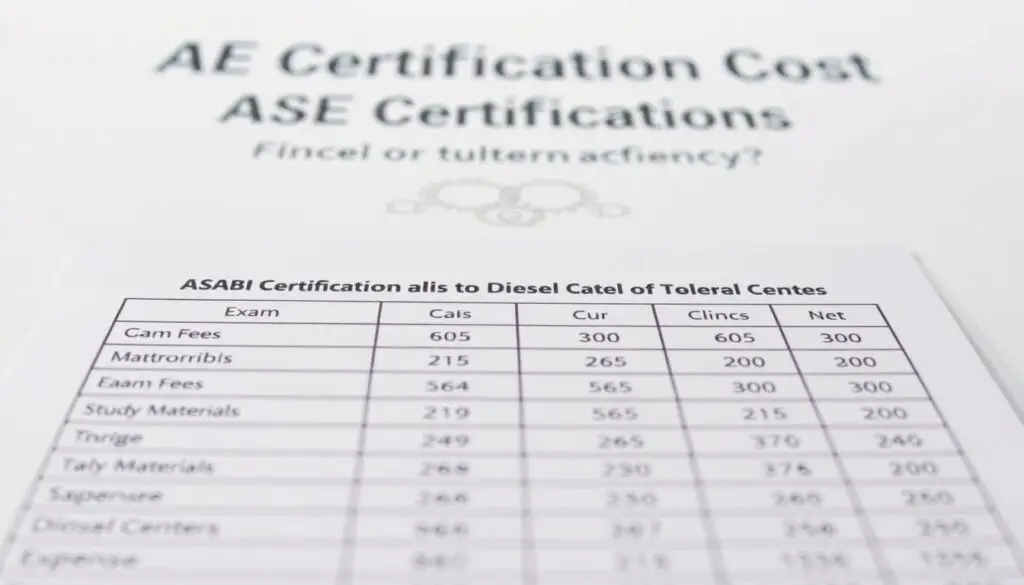
Candidates who fail an ASE exam must pay the full registration fee again to schedule another attempt. ASE also enforces a mandatory 30-day waiting period between test attempts, giving you time to study and prepare more thoroughly before your next try.
Testing Center Locations
ASE partners with Prometric testing centers to administer diesel certification exams throughout all 50 states. The ASE website features an online testing center locator tool where you enter your ZIP code to find available facilities within your area. Prometric centers typically offer testing appointments during regular business hours on weekdays and some Saturdays. Booking your appointment at least two to three weeks in advance ensures you get your preferred testing date.
26,500 Annual Openings
The BLS projects approximately 26,500 openings for diesel service technicians each year through 2034, with the majority from retirements and career transitions — Bureau of Labor Statistics
Total Investment for Multiple Certifications
For diesel technicians aiming to achieve Master Technician status, the financial commitment includes fees for all eight T-Series exams. Based on current pricing structures, testing fees alone range from $320 to $488. When you add study guides, practice tests, and preparation courses, a comprehensive approach adds another $200 to $500 to your total investment.
| Certification Path | Tests | Testing Fees | Study Materials | Total Investment |
|---|---|---|---|---|
| Single T-Series Exam | 1 | $39–$61 | $50–$100 | $89–$161 |
| Three Specializations | 3 | $117–$183 | $100–$200 | $217–$383 |
| Master Technician Status | 8 | $320–$488 | $200–$500 | $520–$988 |
| Recertification (per exam) | 1 | $36–$44 | $25–$50 | $61–$94 |
Many diesel technicians report salary increases of $8,000 to $15,000 annually after achieving ASE certification. The initial investment typically pays for itself within the first year through higher wages and better job prospects.
Employer Reimbursement Programs
Many trucking companies, fleet operators, dealerships, and independent repair shops offer reimbursement programs for ASE certification expenses. These programs recognize that certified technicians bring enhanced credibility to the business and may satisfy manufacturer warranty repair requirements.
Before paying testing fees out of pocket, discuss available support with your employer or HR department. Many companies maintain formal certification assistance policies but don’t actively promote them. Typical reimbursement programs require successful completion of the exam, submission of official score reports and receipts, continued employment for a specified period (often 6 to 12 months), and agreement to display certification credentials professionally.
Employers invest in certified technicians because certification increases shop credibility with customers and manufacturers. Some manufacturers require shops to maintain a minimum number of certified technicians to perform warranty repairs, making your certification directly valuable to your employer’s business operations.
Career Benefits of ASE Certification for Diesel Technicians
ASE certification opens doors to higher-paying positions and creates opportunities that non-certified technicians rarely access. The credential serves as a career accelerator, providing tangible advantages in compensation, employment options, and professional standing. The diesel industry currently faces a significant technician shortage, with demand far exceeding the available workforce, creating exceptional conditions for certified professionals.
Salary Increases and Earning Potential
The financial impact of certification appears immediately in compensation packages. Certified diesel mechanic salary figures consistently exceed non-certified counterparts by $8,000 to $15,000 annually across all experience levels. Entry-level certified diesel technicians typically start between $45,000 and $55,000 per year, while experienced certified professionals with five to ten years earn $55,000 to $75,000 annually. Those who achieve Master Diesel Technician status command salaries ranging from $75,000 to $95,000 or higher, particularly in high-demand regions.
| Experience Level | Certified Salary | Master Technician | Annual Premium |
|---|---|---|---|
| Entry-Level (0–2 years) | $45,000–$55,000 | N/A | $8,000–$12,000 |
| Experienced (5–10 years) | $55,000–$75,000 | $75,000–$85,000 | $10,000–$15,000 |
| Senior (10+ years) | $70,000–$85,000 | $85,000–$95,000+ | $12,000–$18,000 |
Enhanced Job Opportunities and Employer Demand
Certification dramatically expands employment options across the diesel industry. Many fleet operators, trucking companies, equipment dealerships, and municipal maintenance departments require ASE credentials or give strong preference to certified applicants. Major manufacturers mandate ASE certification for warranty repair work authorization, meaning uncertified technicians cannot perform warranty services.
The current technician shortage means certified professionals enjoy extraordinary job security. During economic downturns, including the recent pandemic, diesel technicians remained employed as essential workers maintaining critical transportation infrastructure. Certified technicians can be selective about employers, negotiate favorable compensation packages, and move between positions with minimal unemployment gaps.
Professional Credibility and Career Advancement
ASE certification provides third-party validation of competence that customers, employers, and insurance companies recognize and trust. The credential serves as portable proof of expertise that transcends individual shop reputations or personal references.
ASE-certified diesel technicians frequently advance beyond hands-on repair work into leadership and specialized roles. Common advancement paths include shop foreman, service manager, and fleet maintenance manager positions. Certification also creates opportunities to specialize in high-value areas such as emissions systems, electronic diagnostics, brand-specific expertise, and mobile diagnostic services. Experienced Master Technicians often transition into technical training roles or manufacturer representative positions offering regular business hours and reduced physical demands.
Maintaining and Renewing Your ASE Diesel Certification
Once you’ve earned your ASE diesel certification, understanding the renewal process becomes essential for long-term career success. ASE implements recertification requirements to ensure that certified technicians remain knowledgeable about evolving technologies and industry standards.
The Five-Year Certification Lifecycle
All ASE certifications expire exactly five years from the date they were earned or last renewed. ASE sends renewal reminders beginning 18 months before your certification expiration date, providing ample time to prepare for recertification testing. You can check your certification status and specific expiration dates through your online ASE account at any time.
Allowing your certifications to lapse creates significant complications. If your certification expires, you must start the entire process over, including providing work experience documentation and taking full-length tests. Each certification you hold operates on its own independent five-year cycle, so technicians who earned multiple T-Series certifications at different times will have different expiration dates.
Recertification Testing Process
The primary method for ASE recertification involves taking and passing a recertification exam for each certification area. These specialized tests are shorter than the originals, typically containing 40 to 50 questions instead of 60 to 80. Despite being shorter, recertification exams cover the same content areas and emphasize recently updated technologies including advanced emissions controls, electronic diagnostics, and hybrid powertrains.
Many technicians underestimate recertification exams, assuming their experience makes thorough preparation unnecessary. Reviewing study materials and taking practice tests ensures you’re prepared for questions about recent technological developments you may not encounter daily in your specific work environment.
Alternative Pathways and Ongoing Education
ASE recognizes that continuing education requirements can be met through multiple pathways. Completing approved continuing education programs or manufacturer-specific training courses may substitute for recertification testing in some cases. Many employers provide structured training programs that align with ASE recertification requirements.
| Renewal Method | Time Required | Typical Cost | Best For |
|---|---|---|---|
| Recertification Exam | 2–3 hours per test | $36–$44 | Experienced technicians comfortable with testing |
| Continuing Education Courses | 16–24 hours of instruction | $200–$500 | Those preferring structured learning |
| Manufacturer Training | Variable | Often employer-funded | Dealership technicians with training programs |
| Combination Approach | Varies | $100–$300 | Technicians seeking diverse learning |
Regardless of which formal recertification method you choose, maintaining professional competence requires continuous learning beyond minimum requirements. Advanced emissions systems continue to grow more complex, hybrid powertrains are entering the medium and heavy-duty truck market, and telematics integration is changing how technicians approach troubleshooting and maintenance. The investment in maintaining ASE certification pays dividends throughout your career, proving you’re serious about staying at the forefront of diesel technology.
Your Path to ASE Diesel Certification Starts Now
Becoming an ASE certified diesel mechanic represents a strategic investment in your professional future. The certification journey demands dedication through experience requirements, exam preparation, and ongoing recertification, but the financial and career rewards make this commitment worthwhile.
ASE credentials distinguish you as a recognized expert in diesel technology. These heavy-duty mechanic credentials open doors to better compensation, preferred hiring status, and advancement opportunities that shape your career trajectory. Certified diesel technicians play a vital role keeping commercial trucks delivering goods, construction equipment building infrastructure, and agricultural machinery feeding communities nationwide.
The demand for qualified professionals continues growing as vehicle systems become more complex and experienced technicians retire. ASE certification positions you for long-term job security in an essential industry. Whether you’re entering the field or validating years of hands-on experience, pursuing certification demonstrates your commitment to professional excellence and positions you among the elite diesel professionals who set the standard for quality workmanship.
Frequently Asked Questions
How long does it take to get ASE diesel certification?
The timeline depends on your starting point. ASE requires a minimum of two years of hands-on work experience before awarding certification, though completing an accredited diesel technology program can substitute for one year of that requirement. Once eligible, most experienced technicians need six to eight weeks of focused study to prepare for a single T-Series exam. Pursuing all eight T-Series certifications for Master Technician status typically takes several years of progressive testing. You can schedule exams at Prometric testing centers year-round, with results arriving within approximately four weeks.
How much does ASE diesel certification cost in total?
Individual T-Series exam registration fees range from $39 to $61 per test. Pursuing Master Technician status by passing all eight exams costs between $320 and $488 in testing fees alone. When you factor in study guides, practice tests, and optional preparation courses, the total investment ranges from approximately $520 to $988. Many employers offer partial or full reimbursement for certification expenses, particularly when technicians pass on their first attempt. Recertification every five years carries similar per-exam fees, though the shorter recertification tests cost slightly less at $36 to $44 each.
What is the difference between ASE T-series and A-series certifications?
The T-Series certifications are designed specifically for technicians who service medium and heavy-duty commercial vehicles weighing over 14,000 pounds, covering Class 4 through Class 8 trucks. The A-Series certifications target automobile and light truck technicians working on passenger vehicles. While both series test fundamental mechanical knowledge, T-Series exams address commercial-grade components like air brake systems, heavy-duty drivetrains, and fleet preventive maintenance inspection procedures that differ substantially from passenger vehicle systems. Technicians working exclusively on commercial diesel trucks should pursue the T-Series pathway.
Do you need ASE certification to work as a diesel mechanic?
No federal or state law requires ASE certification to work as a diesel mechanic. The credential is entirely voluntary. However, many employers require or strongly prefer certified technicians because it validates competency and reduces training costs. Major manufacturers mandate ASE certification for warranty repair authorization, meaning uncertified technicians cannot perform manufacturer-backed repairs. Fleet operators and trucking companies increasingly list ASE credentials as hiring prerequisites. While you can work without certification, earning your credentials significantly expands job opportunities and typically commands higher wages.
How many ASE tests do you need for Master Truck Technician status?
Achieving ASE Master Medium-Heavy Truck Technician status requires passing all eight T-Series examinations: T1 Gasoline Engines, T2 Diesel Engines, T3 Drive Train, T4 Brakes, T5 Suspension and Steering, T6 Electrical and Electronic Systems, T7 HVAC, and T8 Preventive Maintenance Inspection. You must also meet the two-year work experience requirement. All eight certifications must remain current simultaneously, meaning you need to manage recertification timelines carefully since each credential expires five years from the date earned. Most technicians pursue Master status progressively over several years rather than attempting all eight exams at once.
Help a Fellow Technician Level Up
Know a diesel tech considering ASE certification? Share this guide to help them understand the process, costs, and career benefits of getting certified.


