
By Michael Nielsen, Publisher | 15+ Years in Diesel Repair
Last Updated: October 2026
⏱ Estimated reading time: 14 minutes
Diesel fuel system cleaning means different things to different people. To one shop it is a bottle of additive, to another it is pulling a tank, and to a fleet manager it is a line item that never quite fixes the truck. The result is a lot of money spent on cleaning that was never going to solve the actual fault.
This guide from Heavy Duty Journal (HDJ), written by publisher Michael Nielsen, puts the work in order: diagnose first, then deal with the tank and water, the filters, the lift pump and lines, and only then the injectors. It relies on federal and laboratory sources and says plainly where they stop.
HDJ rebuilt the earlier version around sources it could check. It removed unsourced pressures, temperatures, mileages, costs, named products and prices, the ranked product table and trade-group links, along with images and advertising prompts.
Key Takeaways
- ✓Diagnose first. Many fuel faults look alike, and cleaning fixes only some of them.
- ✓Start at the tank. Water and sediment feed every later problem.
- ✓Expect filters to load. A tank or blend change can release deposits.
- ✓Additives are a judgment call. Registration is not proof they work.
- ✓Record the result. HDJ found no verified intervals, so your own history decides.
In This Guide
- What Diesel Fuel System Cleaning Covers
- Diagnose Before You Clean
- Tank Cleaning and Water Control
- Filters and Water Separators
- Lift Pump, Lines and Air Leaks
- Injector Deposits and Additives
- A Cleaning Sequence for Fleets
- Verify the Result and Keep Records
- Keeping the System Clean Between Services
- Frequently Asked Questions
- The Bottom Line
What Diesel Fuel System Cleaning Covers
Diesel fuel system cleaning covers four different jobs that are often sold as one. The first is the bulk tank and the vehicle tank, where water and sediment collect. The second is the filters and water separator. The third is the supply side: lift pump, lines and fittings. The fourth is the injectors, where deposits form.
Each job has a different cause, a different fix and a different way to check whether it worked. A bottle of additive poured into the tank can only reach the last job, and then only some kinds of deposit. It does nothing for water in a tank bottom or for air drawn in at a loose fitting.
That is why the order matters. Cleaning in the wrong order wastes effort. A treated injector fed from a dirty tank will be fouled again, and a new filter on a truck with a lift pump fault will starve the engine just as before.
The earlier version leaned on specific pressures, intervals, costs and product names. HDJ could not confirm those from primary sources, so this version uses what government and laboratory sources say and labels the rest as practitioner guidance.
Key Recommendation
Treat diesel fuel system cleaning as a sequence, not a product. Confirm the fault, fix the fuel source, then clean downstream in order and check the result.
Diagnose Before You Clean
Hard starting, rough running, power loss, smoke and poor fuel economy all show up in dirty fuel systems. They also show up in air leaks, weak lift pumps, failing injectors, sensor faults and exhaust problems. Cleaning a system that has none of the deposits you are treating gives you no result and delays the real repair.
The table shows what each stage targets and what HDJ could confirm. It replaces the earlier ranked product table, which HDJ could not source.
| Stage | What it targets | What HDJ found |
|---|---|---|
| Tank and water | Water, sediment, microbial growth | A federal laboratory guide says water bottoms must be removed as much as possible and the best defense is to keep the tank dry |
| Filters and separator | Particles and water | A Department of Energy page says the first tanks of a high-level biodiesel blend can release deposits that clog filters |
| Lift pump, lines, air | Restriction and air entry | No verified pressures or intervals; use the maker's specification and test before replacing parts |
| Injectors | Internal and external deposits | A 2025 journal paper describes internal deposits that disturb needle movement and fuel delivery |
| Additives | Deposits and fuel properties | The Environmental Protection Agency lists registered products but does not say whether any work |
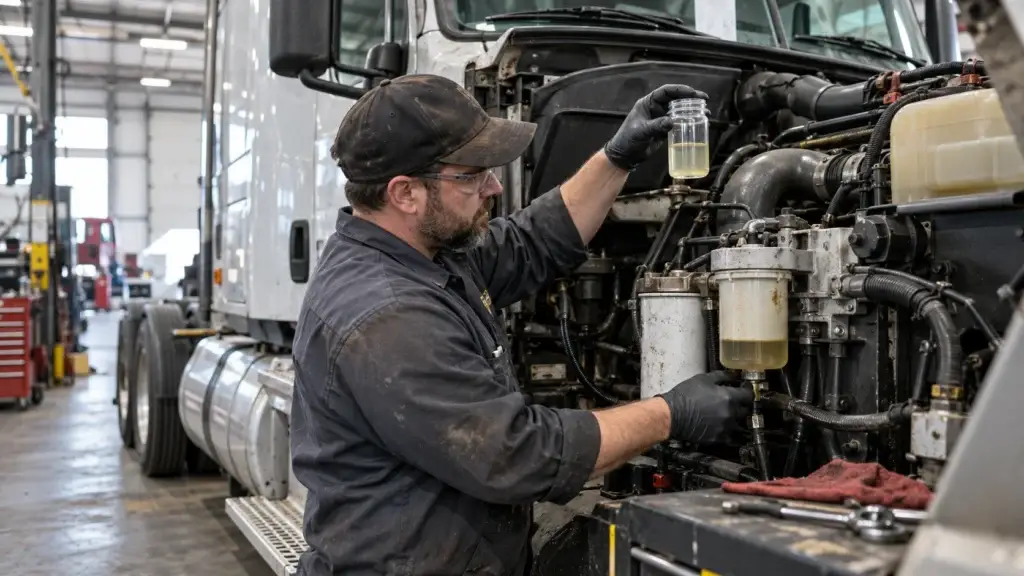
Start with the cheapest and most informative checks. Read the codes, look at the filter, take a fuel sample into a clean glass jar and check the supply side. HDJ's low fuel pressure guide walks through the supply-side tests.
Heavy-duty trucks usually report suspect parameter number (SPN) and failure mode identifier (FMI) pairs, not the light-duty codes some older cleaning guides list. Use your maker's service information to read them. The earlier version's code list and symptom-to-cure chart were removed because HDJ could not source them.
Write down what you see before you touch anything. Note the symptom, when it happens, the last fuel fill and the last filter change. That record shows whether the cleaning changed anything, and without it you will not know whether the fix worked or the fault simply came back.
Tank Cleaning and Water Control
The tank is where most fuel problems start, and it is the easiest place to go wrong with cleaning. Water settles to the bottom. Sediment settles with it. In a stored tank, that layer is also where microbial growth begins.
The National Renewable Energy Laboratory (NREL) Biodiesel Handling and Use Guide says microbial growth requires a layer of free water at the bottom of the storage tank. It says the best defense is to monitor the tank and keep it dry, that water bottoms must be removed as much as possible, and that standing tanks should be sampled and tested for microbial contamination regularly.
The guide also says biocides are recommended where biological growth in fuel tanks has been a problem. HDJ is not recommending a product, and it found no independent test data on any specific biocide. Read the label and the engine maker's guidance before treating a fuel supply.
The Environmental Protection Agency (EPA) notice on diesel tank corrosion calls regularly checking for and removing water from tank bottoms a key preventive step, and says filters may show sludge that looks like coffee grounds. Those filters are telling you what is in the tank.
Fleets with their own tanks have an extra reason to look. EPA inspected 42 underground diesel tanks and found moderate or severe corrosion in 35 of them. Its 2016 EPA news release said microbiologically influenced corrosion was suspected but no cause had been confirmed.
HDJ's guide to preventing diesel fuel contamination covers how water and dirt get in. Fix the entry point first. Cleaning a tank that keeps taking on water from a bad vent or fill cap only resets the clock.
The NREL guide also says that if a system contains sediments, the tanks and fuel system should be cleaned before a high-level biodiesel blend is used. It gives no cleaning procedure, tool list or interval. A tank cleaning vendor can supply the method, and your own records should say when it was last done.
Never enter a fuel tank yourself. Tank interiors can hold flammable vapor and too little oxygen. HDJ found no primary source in this research on entry procedures, so use your safety program and a qualified contractor.
Filters and Water Separators
Filters and water separators are the part of diesel fuel system cleaning that actually removes contamination. Everything else moves it around or dissolves it. When a filter loads early, the fuel is telling you something, and the useful question is what changed.
As of October 2026, the Department of Energy (DOE) Alternative Fuels Data Center (AFDC) page on biodiesel blends says the first few tanks of a high-level biodiesel blend can release deposits that clog filters and require frequent filter replacement. The NREL guide agrees: it says an initial increase in filter plugging is a good sign that biodiesel is cleaning the tank, and that filter change intervals should return to normal over time.
That is a specific, sourced reason to expect extra filter changes after a fleet moves to a higher blend. It is not a reason to ignore a filter that keeps plugging. The NREL guide says that if filters clog more often with a 20 percent biodiesel blend (B20) than with petroleum diesel, the fueling system should be checked.
A filter has limits, too. The 2025 paper in ACS Omega traced one failed heavy-duty injector to coolant in the fuel. It reports that the installed filter could not remove the water, that not every filter removes aqueous contaminants and that droplets smaller than 10 micrometers can pass through.
Do not treat that as proof about your filter. It is one case study from Europe, and the paper does not discuss cleaning. It does show why you should know what your filter and separator are built to stop. Check the maker's specification for water removal.
Inspect every element you remove. Look for water, sludge, metal and unusual color, and keep a note of what you saw. A pattern across several trucks that fuel at the same site points at the fuel source, not the trucks. HDJ's guide to air in the diesel fuel system covers what to do when a new filter does not fix the symptoms.
Lift Pump, Lines and Air Leaks
Between the tank and the injection pump sits the supply side: the lift pump, lines, fittings, check valves and primer. Faults here mimic dirty fuel. A restricted supply starves the engine, and a leak on the suction side lets in air that no additive will remove.
Cleaning here means inspecting, not treating. Look for wet or weeping fittings, collapsed or cracked hoses and kinked lines. Check that the supply side delivers what the engine maker specifies, using the maker's test method. HDJ has no verified pressure values, so it gives none.
When the lift pump itself is suspect, HDJ's guide to diesel fuel pump problems separates lift pump faults from high-pressure pump faults. Cleaning does not repair a weak lift pump, so test it before you spend on anything else.
After any line is opened, prime the system by the maker's procedure. Air in the lines is a common reason for a hard start after service, and it can be mistaken for a failed cleaning job. Do not crank for long periods to bleed air, because that can strain the starter and the pump.
If a line, fitting or tank pickup is found blocked, find out why. Debris in a line usually came from somewhere: a failing component, a dirty tank or a careless service. Removing the debris without finding the source lets it come back.
Check the small parts as well: filter head seals, drain valves, primer pumps and any fitting that has been opened recently. These are common places for a slow air leak. A leak can be intermittent, so inspect with the system running and again after it has sat overnight, and note any dry crust or dampness.
Injector Deposits and Additives
Injector deposits are the reason most people buy cleaning products, and they are the least certain part of the story. The ACS Omega paper describes internal diesel injector deposits (IDIDs) as deposits that interfere with the movement of the injection needle and disrupt the amount and timing of injected fuel. It adds that they can severely affect engine performance and raise fuel consumption.
The same paper cautions that substandard fuel additive packages have been cited as a cause of polymeric deposits linked to polyisobutylene succinimide (PIBSI) chemistry. In plain terms, a poorly made additive can add to the problem it claims to solve.
The paper's own case was a failed injector with a stuck needle, found after coolant contaminated the fuel. Its authors tied one deposit layer to the coolant and described another as a typical layer that likely formed earlier from oil-related contamination. No cleaner would have fixed either cause.
That is the practical lesson for diesel fuel system cleaning. Deposits have sources. Water, coolant, oil, degraded fuel and low-quality additives all leave marks. Find and stop the source, then decide whether a deposit is worth treating.
On additives, the registered fuel and fuel additive products page lists products sold commercially for transportation use. HDJ read nothing on that page saying whether a product works or suits your engine. Registration is not proof of performance, so HDJ names no product and gives no ranking.
If you do use an additive, follow the engine maker's guidance, add it at the rate on the label and do not stack products. Record which truck got which product and when, so you can compare against untreated trucks. HDJ's guide to diesel fuel injector failure covers testing when a cleaner does not help.
A Cleaning Sequence for Fleets
Here is the order HDJ recommends. It is practitioner guidance built from the sources above, not a manufacturer procedure, so check it against your engine maker's service information before you start.
- Confirm the fault. Read codes, record the symptom and rule out air, supply and sensor faults.
- Sample the fuel. Take a sample from the filter housing or tank into a clean glass jar and look for water, particles and color.
- Fix the source. Stop water and dirt entering through vents, caps, fittings or a bad fuel supplier.
- Clean the tank. Remove water bottoms and sediment, or have a qualified contractor do it.
- Replace filters. Install the maker's elements, prime the system and inspect the old ones.
- Check the supply side. Test the lift pump, inspect lines and fittings and rule out air.
- Treat or service injectors last. Only if symptoms and testing still point there.
⚠️ Safety Warning
High-pressure fuel can penetrate skin. Never check a leak with your hand or finger. Relieve pressure by the engine maker's procedure, wear eye protection and fuel-resistant gloves, keep ignition sources away and keep a Class B fire extinguisher within reach. If fuel is injected into the skin, go to a hospital at once.
The StatPearls review of high-pressure injection injuries says these injuries can look like benign puncture wounds and that amputation has been reported in 30 to 40 percent of high-pressure injection injuries. It advises elevating and irrigating the limb and avoiding ice and compressive dressings.
Dispose of drained fuel, sludge and old filters under your local rules. HDJ did not research waste disposal requirements for this guide, so ask your local environmental agency or waste contractor how to handle them.
Free Diesel Maintenance Checklist
Get HDJ's free, field-tested diesel maintenance checklist delivered instantly to your inbox — print it, laminate it, keep it in the shop.
Instant PDF • 100% Free • No Spam

Verify the Result and Keep Records
A cleaning job is finished when the symptom is gone and stays gone, not when the work order is closed. Run the truck under the conditions that showed the fault, compare against your notes and recheck the filter after a short interval. Early filter loading after a service is worth a second look.
Keep the old filter elements and a fuel sample until the repair is proven. If the symptom returns, they show what the fuel looked like before the service. They also support a warranty or supplier claim, where one applies.
Track results by truck, fuel source and product. If trucks that fuel at one site keep loading filters, change the source before you change the cleaning routine. If a single truck keeps returning, look for a fault the cleaning did not touch.
Be careful with before-and-after claims. A truck that feels better after an additive may simply have had a new filter, a bled line or a fresh tank of fuel. Change one thing at a time where you can, and write down what you changed.
The earlier version promised percentage savings and payback periods. HDJ found no primary source for them, so none appear here. Your own fuel economy and repair history are the only numbers worth trusting for your fleet.
Keeping the System Clean Between Services
Most of the value in diesel fuel system cleaning comes from keeping the system clean afterward. Keep tank vents and fill caps sealed. Drain water separators as the maker specifies. Buy fuel from sources that turn over stock, and sample when a supplier changes. As of October 2026, HDJ found no primary source for a fixed interval.
Check bulk tanks for water on a schedule your own records support, and keep a log. The NREL guide says standing tanks should be sampled and tested regularly, and the EPA notice calls water removal a key preventive step. Neither document gives an interval.
Add fuel system checks to your regular service routine so they happen without anyone remembering. Inspect filters at every change, note what you find and flag the trucks that load filters early.
Teach drivers and fuelers to report slow fills, fuel smell, water in the separator or a new hesitation the day it happens. Early reports are cheaper than a roadside call, and they shorten the diagnosis.
Review the log every quarter. If the same truck, tank or supplier keeps appearing, the fix is probably upstream. A short review is cheaper than another round of cleaning that treats the symptom. Share the findings with whoever buys fuel and whoever services the trucks, so both act on the same facts.
Finally, keep the scope honest. HDJ found no verified cost, interval or performance figure for cleaning services or products. Treat any vendor who offers one as a claim to check, not a fact.
Frequently Asked Questions
What is diesel fuel system cleaning?
It covers four jobs: cleaning tanks of water and sediment, replacing filters, inspecting the lift pump and lines, and treating injector deposits. HDJ recommends doing them in that order after confirming the fault, because an additive cannot remove water or fix an air leak.
Should I add an injector cleaner first?
Usually not. Many fuel faults come from air, restriction, water or filters, which an additive does not fix. Diagnose first, fix the fuel source, replace filters and check the supply side. Treat injectors last, and follow your engine maker's guidance on any additive.
Why do filters clog after a switch to biodiesel?
The AFDC says the first few tanks of a high-level biodiesel blend can release deposits that clog filters. NREL says an initial increase in filter plugging is a sign the tank is being cleaned, and intervals should return to normal over time.
How often should I clean my fuel tank?
HDJ found no primary source giving an interval. NREL says standing tanks should be sampled and tested regularly, and EPA calls water removal a key preventive step. Let sampling results and your own filter history set the schedule.
Do EPA-registered additives work?
Not necessarily. EPA lists registered fuel and fuel additive products sold for transportation use, but the page HDJ read says nothing about whether a product works or suits your engine. Registration is not proof of performance, so check the maker's guidance.
Can cleaning fix a failing injector?
Cleaning can address some deposits, but not a stuck needle, worn parts or contamination that is still entering the fuel. The ACS Omega case HDJ read involved coolant in the fuel. Test the injector, find the source and then decide whether to service or replace it.
The Bottom Line
Diesel fuel system cleaning works best as a sequence: confirm the fault, fix where contamination enters, clean the tank, replace filters, check the supply side and treat injectors last. HDJ could not verify costs, intervals or product performance, so it gives none.
Michael Nielsen and the HDJ editorial team publish more diagnostic guidance at heavydutyjournal.com. This month, sample the fuel on your worst-performing truck, inspect its last filter and write the result in a log.
Share This Guide With Your Shop
Know a technician or fleet manager planning a cleaning job? Share this guide with them. Michael Nielsen and Heavy Duty Journal publish it free at heavydutyjournal.com.