
By Michael Nielsen, Editor & Publisher | 15+ Years in Diesel Repair
Last Updated: December 2025
📖 Estimated reading time: 15 minutes
The autonomous trucking timeline has reached a pivotal turning point. What industry experts projected for years is now reality—commercial driverless trucks are hauling freight on American highways in 2025. Aurora Innovation became the first company to launch commercial self-driving trucking service in Texas, while Kodiak Robotics delivered customer-owned driverless trucks to Atlas Energy Solutions in the Permian Basin. Major manufacturers now target 2027 for factory-built autonomous trucks at scale, marking a fundamental shift in how freight moves across America.
The driver shortage continues creating urgency for solutions. With an estimated 60,000 to 82,000 empty seats nationwide and high turnover rates challenging carriers, many view automation as essential rather than experimental. Advanced sensor systems and artificial intelligence now guide trucks safely between distribution hubs, handling long interstate stretches while human drivers manage complex urban deliveries and first-mile/last-mile operations.
Key Takeaways
- Commercial Operations Active: Aurora launched driverless trucking service between Dallas and Houston in May 2025—the first commercial self-driving service with heavy-duty trucks on public roads
- 2027 Factory-Built Target: Major OEMs including Volvo, PACCAR, and Traton are preparing factory-built autonomous trucks for commercial availability by 2027
- Driver Shortage Context: ATA estimates a current shortage of 60,000-82,000 drivers, with projections reaching 160,000 by 2030
- Hub-to-Hub Strategy: Initial deployment focuses on interstate highway corridors rather than complex urban navigation
- Level 4 Automation Focus: Industry prioritizes practical SAE Level 4 systems over full Level 5 autonomy
- Human Roles Evolve: Drivers transition to first-mile and last-mile operations plus technical oversight positions
Commercial Deployment Is Here: 2025 Milestones
The autonomous trucking industry crossed from testing to commercial reality in 2025. Two companies achieved historic firsts that signal the beginning of widespread deployment across American freight corridors.
Aurora Innovation Leads Commercial Launch
Aurora Innovation became the first company to operate a commercial self-driving service with heavy-duty trucks on public roads when it launched operations between Dallas and Houston in May 2025. The company’s Aurora Driver system completed its safety case—a comprehensive body of evidence demonstrating the technology is acceptably safe for deployment—and began regular driverless customer deliveries along Interstate 45.
The company logged more than 20,000 driverless miles by June 2025, equivalent to eight coast-to-coast trips. Aurora now operates three commercial self-driving trucks on the Dallas-Houston corridor and has validated nighttime operations, allowing trucks to travel longer distances past federally mandated service limitations for human drivers.
According to Aurora, their long-range lidar can detect objects in the dark more than 450 meters away. Launch customers include Uber Freight and Hirschbach Motor Lines, both of which participated in supervised testing programs before the commercial launch.
Kodiak Robotics Delivers Customer-Owned Trucks
Kodiak Robotics achieved its own milestone by becoming the first company to deliver customer-owned driverless semi-trucks for commercial operations. Atlas Energy Solutions took delivery of trucks equipped with the Kodiak Driver system in December 2024 and launched driverless operations in West Texas’s Permian Basin.
Atlas now operates a growing fleet of Kodiak-powered trucks that run day and night, delivering frac sand from the Dune Express—a 42-mile autonomous conveyor system—to customer well sites. The trucks have completed over 800 loads and conducted more than 1,600 hours of driverless service across the 75,000-square-mile Permian Basin.
$2.5 Billion
Kodiak AI valuation following Nasdaq listing in September 2025, making it one of the largest de-SPAC transactions of the year
Kodiak went public on Nasdaq in September 2025 through a merger with Ares Acquisition Corporation II, raising over $275 million to scale manufacturing. The company has established a manufacturing partnership with Roush to upfit trucks with its modular, vehicle-agnostic hardware, with plans to scale to hundreds of trucks by the end of 2026.
The 2027 Target: Factory-Built Autonomous Trucks at Scale
While commercial operations have begun, the industry’s next major milestone is factory-built autonomous trucks available at scale. Multiple manufacturers converge on 2027 as the breakthrough year when fleet operators can order autonomous trucks by the thousands rather than through limited pilot programs.
Plus AI and Traton Partnership
Plus Automation (now PlusAI) plans to bring factory-built autonomous trucks to market in 2027. The company is working with Traton Group (which includes International, MAN, and Scania brands), Hyundai, and IVECO to integrate Level 4 autonomous technology directly at the factory rather than retrofitting existing vehicles.
James Cooper, Traton’s director of autonomous business, predicts Level 4 autonomous semis will account for 15% to 20% of Class 8 trucks sold by 2035. Initial production will be in the hundreds rather than thousands, representing about 1% of total output in the first two years.
Aurora-Continental-NVIDIA Manufacturing Alliance
Aurora partnered with Continental and NVIDIA to enable mass production of autonomous driving systems starting in 2027. Continental will develop and supply automotive-grade hardware including sensors, automated driving control units, high-performance computers, and telematics units.
The partnership addresses a critical challenge: commercial vehicle sensors must meet million-mile certification standards, compared to 100,000 miles for passenger cars. This tenfold increase reflects the intense demands of commercial operations where vehicles accumulate hundreds of thousands of miles annually.
| Vehicle Type | Sensor Certification | Testing Duration |
|---|---|---|
| Passenger Cars | 100,000 miles | 12-18 months |
| Commercial Trucks | 1,000,000 miles | 36-48 months |
Torc Robotics and Daimler Truck
Torc Robotics, an independent subsidiary of Daimler Truck, plans to commercialize a Level 4 autonomous Freightliner Cascadia by 2027. The company is integrating Aeva’s Atlas 4D lidar technology to detect objects faster, farther away, and with higher accuracy.
Daimler’s Highway Pilot Connect system enables truck-to-truck communication in just 0.1 seconds, compared to human reaction times of approximately 1.4 seconds. This technology allows safe platooning where trucks follow closely together to reduce wind resistance, with lead trucks saving 4.5% on fuel and following trucks saving up to 10%.
Hub-to-Hub Interstate Operations: The First Wave
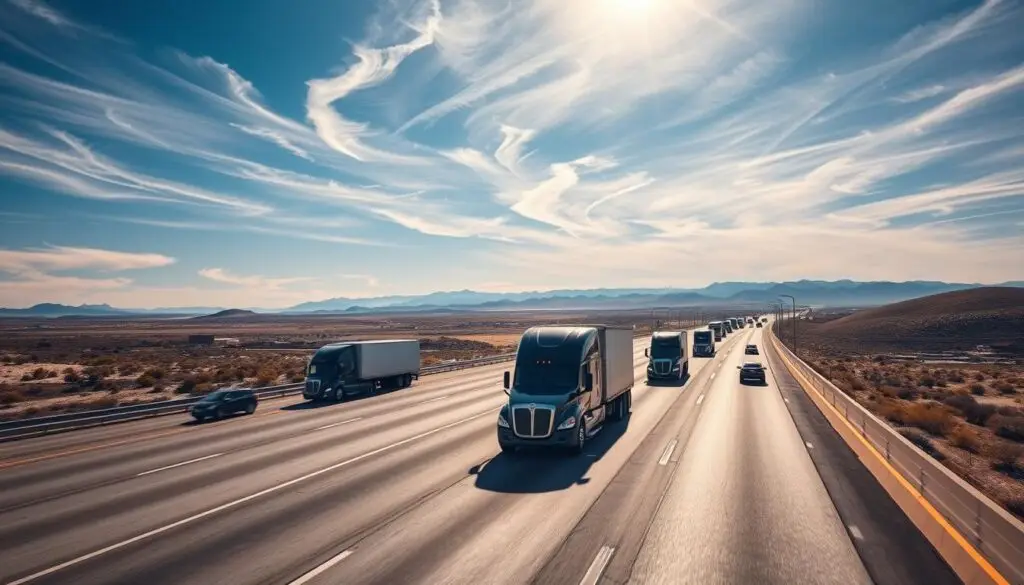
Commercial deployment follows a strategic pattern: hub-to-hub operations on interstate highways represent the ideal starting point for autonomous trucking. These routes feature predictable traffic patterns, minimal construction variables, and conditions that current technology handles reliably.
Current Operating Corridors
Aurora’s Texas operations span the Dallas-Houston corridor along Interstate 45, with expansion planned to Fort Worth, El Paso, and Phoenix by the end of 2025. The company is piloting a 15-hour route from Fort Worth to Phoenix for customers Hirschbach and Werner.
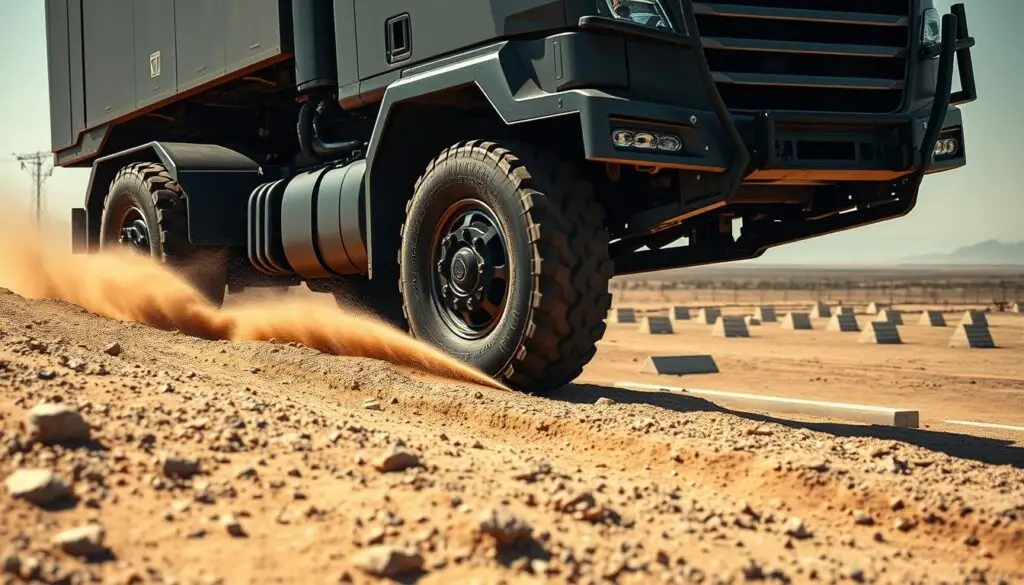
Kodiak operates across the Permian Basin’s rugged terrain, demonstrating autonomous capability in off-highway conditions that include dust, heat, and constantly shifting sand. This industrial application provides a faster path to profitability than long-haul highway trucking because operations run nearly 24/7, requiring three shifts of drivers in traditional operations.
Why Highways Come First
Highway routes offer simpler conditions than city streets, allowing manufacturers to refine Level 4 automation systems. Exit-to-exit automation—where trucks operate autonomously only on highways—maximizes benefits while avoiding complex urban environments. Drivers handle on-ramps and off-ramps, then activate autonomous control during long highway stretches.
Distribution centers and manufacturing facilities present unique challenges requiring human expertise. Facilities often have dozens of trailers creating maze-like conditions. These chaotic environments demand human judgment for safe navigation, making first and last mile operations unsuitable for current autonomous technology.
Stay Ahead of Industry Trends
Get expert insights on autonomous trucking, fleet technology, and operational strategies delivered to your inbox weekly.
Key Players Driving Heavy-Duty Autonomous Technology
Several major companies are racing to bring commercial autonomous trucking to market. Each has developed unique strategies and technologies shaping the deployment timeline.
Aurora Innovation
Aurora’s flagship product, the Aurora Driver, is an SAE Level 4 self-driving system first being deployed in long-haul trucking. The company operates as a carrier initially, owning, maintaining, and insuring its own trucks for customers. Starting in 2027, Aurora expects customers to buy trucks directly from manufacturing partners Volvo Trucks and PACCAR, shifting to a driver-as-a-service model.
Aurora’s technology features their proprietary FirstLight lidar with 450+ meter range for nighttime detection, Verifiable AI framework ensuring traffic law compliance, and redundant systems for braking, steering, computing, and communications. The company aims to achieve positive gross profit by late 2026 or early 2027.
Kodiak AI
Kodiak positions itself as a provider of AI-powered autonomous vehicle technology for tough trucking jobs. The Kodiak Driver combines advanced AI-powered software with modular, vehicle-agnostic hardware that can integrate across different truck platforms. Their SensorPods house LiDAR, radar, and cameras for 360-degree coverage and are field-swappable in minutes.
The company operates a Driver-as-a-Service business model, charging customers either per-truck or per-mile recurring license fees. Kodiak serves both commercial trucking customers and the public sector, having secured contracts with the U.S. Department of Defense for autonomous ground vehicles.
Daimler Truck and Torc Robotics
Daimler Truck, through subsidiary Torc Robotics, is developing Level 4 autonomous capability for the Freightliner Cascadia. Freightliner has positioned its manufacturing facilities to handle varying order sizes, from single units to fleets of 10,000 vehicles.
Tesla Semi
Tesla brings its Autopilot expertise to trucking with the Tesla Semi. The electric truck offers 500-mile range and includes Full Self-Driving hardware. Tesla plans to build solar-powered megacharger stations specifically for long-haul trucking operations.
Economic Impact: Addressing the Driver Workforce Challenge
The autonomous trucking timeline brings both challenges and opportunities for the American workforce. While technology raises concerns about job displacement, the industry faces a labor shortage that autonomous systems could help address. The transformation will reshape rather than eliminate employment in the trucking sector.
The Driver Shortage Reality
The American Trucking Associations estimates a current shortage of approximately 60,000 drivers, with projections reaching 82,000 by year-end and potentially 160,000 by 2030. The industry needs to hire roughly 1.2 million new drivers over the next decade to replace retiring drivers and keep pace with economic growth.
Several factors drive the shortage. The average age of over-the-road drivers is 46, meaning a large proportion are nearing retirement. Annual turnover rates exceed 90% at many carriers due to poor hours, time away from home, and pay concerns. High costs of obtaining and maintaining CDL credentials create barriers to entry, while recent tariff threats could increase new Class 8 truck prices by up to $35,000.
Market Projections
According to McKinsey analysis, autonomous trucks could create an approximately $600 billion market by 2035. The shift to full autonomy will take place gradually from 2027 to 2040, with constrained hub-to-hub operations appearing first, followed by full DC-to-DC operations as autonomous driving software improves.
“2025 is really an inflection point, not only for Kodiak but for the industry of self-driving technology. It’s out there. It’s being deployed. It’s being used.”
— Don Burnette, Founder and CEO, Kodiak AI (2025)
New Job Categories Emerge
As autonomous technology advances, new employment categories are developing. These include pre-trip inspection specialists for autonomous vehicles, remote monitoring operators, sensor calibration technicians, software and hardware maintenance experts, and route planning coordinators.
Current drivers can shift toward higher-value responsibilities, managing complex deliveries and first-mile/last-mile operations while autonomous systems handle repetitive highway routes. This evolution allows experienced operators to focus on challenging tasks requiring human judgment and expertise.
The HDJ Perspective
The autonomous trucking transition isn’t about replacing drivers—it’s about addressing a structural labor problem the industry has struggled with for decades. With annual turnover exceeding 90% at major carriers and an aging workforce, autonomous technology represents a practical solution for long-haul routes that drivers often find undesirable. The real opportunity lies in how fleets integrate these systems alongside human operators. Smart carriers are already developing hybrid approaches where autonomous trucks handle middle-mile highway runs while experienced drivers manage complex local operations, customer relationships, and equipment oversight. This isn’t the end of trucking careers—it’s an evolution toward higher-skill positions with better quality of life.
Safety Advantages of Commercial Autonomous Trucks
Self-driving trucks represent a significant advancement in highway safety. Each year, accidents involving large trucks result in over 4,000 fatalities on American roads. The Federal Motor Carrier Safety Administration tracks these statistics, noting that human factors contribute to the majority of crashes.
Autonomous systems provide 360-degree vision capability, checking surroundings every millisecond—a feat impossible for human drivers who can only focus on what’s directly ahead. Advanced sensors detect potential hazards long before human eyes could spot them, allowing the system to make avoidance decisions well in advance.
| Safety Factor | Human Driver | Autonomous System |
|---|---|---|
| Reaction Time | 1.4-1.5 seconds average | 0.1 seconds or less |
| Field of View | 120-180 degrees | 360 degrees continuous |
| Alertness Level | Varies with fatigue | Constant 24/7 |
| Detection Range (Night) | Limited to headlights | 450+ meters (lidar) |
Autonomous systems eliminate common human-factor risks including driver fatigue from long hours, cell phone distractions, road rage incidents, speeding to meet tight delivery schedules, and improper lane changes during passing maneuvers.
Regulatory Landscape for Autonomous Operations
The regulatory framework for heavy-duty autonomous vehicles varies dramatically across the United States, creating a patchwork system that impacts deployment timelines.
Texas leads the nation with exceptionally progressive regulations, actively collaborating with technology companies at local, state, and federal levels. Governor Greg Abbott praised Aurora’s commercial launch, noting that Texas “welcomes entrepreneurs and encourages innovation.” Florida, Nevada, Arizona, and Michigan have similarly supportive frameworks that enable commercial deployments.
Most U.S. states today allow driverless vehicles, but the lack of unified federal standards creates challenges for companies planning nationwide operations. The U.S. Department of Transportation continues developing standards for connected vehicle infrastructure while federal overlay qualifications are being established.
The International Transport Forum emphasizes that regulatory decisions will dramatically influence adoption speed. Progressive frameworks could enable widespread adoption within the next few years, while restrictive policies might delay implementation for over a decade.
| Regulatory Status | States | Impact |
|---|---|---|
| Full Testing Allowed | 29+ | Open for commercial operations |
| Limited Testing Only | 14 | Restricted to specific routes |
| Pending Legislation | 7 | Uncertain deployment timeline |
Technology Requirements and Infrastructure Needs
Successful implementation requires sophisticated hardware and supporting infrastructure. Advanced sensor systems and artificial intelligence form the backbone of autonomous trucks, while proper road networks and charging stations enable their operation.
Sensor Arrays and AI Systems
Modern autonomous trucks rely on multiple sensor types working together. LiDAR creates detailed 3D maps of surroundings, radar detects objects in fog and rain, and cameras identify road signs, lane markings, and traffic signals. These systems process thousands of data points per second.
Kodiak’s modular SensorPods house all three sensor types for full 360-degree coverage and are designed to be field-swappable in minutes. Aurora’s FirstLight lidar provides long-range detection capability exceeding 450 meters, essential for highway speeds where stopping distances are measured in hundreds of feet.
Communication and Connectivity
Kodiak recently partnered with Verizon Business for connectivity and IoT capabilities to support driverless operations. Low-latency communications enable mission-critical data transport between vehicles and command centers over long distances in remote environments. Use cases include over-the-air software updates, seamless remote fleet management, and skilled remote assistance.
Charging Infrastructure for Electric Autonomous Trucks
Electric autonomous trucks require specialized charging networks. Tesla’s planned megacharger system aims to provide solar-powered charging stations along major freight corridors. The combination of autonomous operation and electric powertrains could significantly reduce both labor and fuel costs for long-haul operations.
Share Your Autonomous Trucking Experience
Are you operating or evaluating autonomous technology for your fleet? Heavy Duty Journal welcomes industry perspectives on this transformative technology.
Challenges and Barriers to Widespread Adoption
While autonomous trucking promises significant benefits, several obstacles stand between current deployments and full-scale nationwide operations.
Public Perception and Trust
Many Americans express concern about sharing roads with autonomous trucks. Building public trust requires consistent safety demonstrations over extended periods. Companies must educate communities about 360-degree monitoring systems and multiple backup safety features. A single high-profile accident could damage years of progress and significantly delay widespread adoption.
Weather and Environmental Challenges
Rain, snow, construction zones, and other challenging conditions remain areas of ongoing development. Aurora has validated nighttime operations but is still working to complete validation for rain operations. As CEO Chris Urmson noted, the company’s development fleet operates in rain well enough that most would wonder why commercial trucks aren’t doing the same—but until validation is complete, those commercial trucks will pull over and wait when adverse weather arises.
Cybersecurity Concerns
Connected autonomous trucks face potential hacking threats that could compromise vehicle data and control systems. Protection against cyber attacks remains a top priority for developers. Insurance companies continue developing coverage approaches while manufacturers prove their systems can handle unexpected situations.
Frequently Asked Questions
When will self-driving trucks be commercially available for trucking companies?
Commercial driverless trucking is available now. Aurora launched commercial service between Dallas and Houston in May 2025, becoming the first company to operate a commercial self-driving service with heavy-duty trucks on public roads. Multiple manufacturers target 2027 for factory-built autonomous trucks available at scale, when fleet operators can order trucks directly from OEMs rather than through limited pilot programs.
What level of automation will commercial self-driving trucks achieve?
The trucking industry focuses primarily on achieving SAE Level 4 automation, where trucks can drive themselves under specific conditions like highway driving without human intervention. Most current autonomous trucks operate at Level 4 with defined operational design domains. Full Level 5 automation, which would work in all conditions without any restrictions, is not the current industry goal.
Where are self-driving trucks currently operating in the United States?
Aurora operates commercial driverless service between Dallas and Houston, with expansion planned to Fort Worth, El Paso, and Phoenix by end of 2025. Kodiak operates driverless trucks across the Permian Basin in West Texas and Eastern New Mexico for Atlas Energy Solutions. Testing continues in Texas, Florida, Nevada, Arizona, and Michigan, which have the most supportive regulatory frameworks.
Will self-driving trucks completely replace human truck drivers?
No. The focus remains on having autonomous systems handle long-haul highway routes while human drivers manage first-mile and last-mile operations, complex deliveries, and technical oversight. Distribution centers, manufacturing facilities, and urban environments present challenges requiring human judgment. New job categories are emerging including remote monitoring, sensor calibration, and fleet coordination.
How will autonomous technology address the driver shortage?
With an estimated 60,000-82,000 driver positions unfilled and projections reaching 160,000 by 2030, autonomous trucks could handle the workload of multiple human drivers by operating nearly 24/7. The technology particularly addresses the least desirable aspects of trucking—long highway runs away from home—that contribute to the industry’s 90%+ turnover rate. This allows human drivers to focus on higher-value local operations with better quality of life.
How safe are autonomous trucks compared to human-driven vehicles?
Autonomous trucks provide 360-degree awareness, checking surroundings every millisecond with reaction times of 0.1 seconds versus 1.4 seconds for humans. They eliminate human factors like fatigue, distraction, and road rage that cause most trucking accidents. Aurora’s lidar can detect objects in darkness at over 450 meters, far exceeding human night vision. With over 4,000 Americans dying annually in large truck accidents, autonomous technology aims to significantly reduce these numbers.
Preparing Your Fleet for the Autonomous Future
The autonomous trucking timeline has accelerated from future possibility to present reality. Commercial driverless trucks now operate on American highways, with Aurora and Kodiak demonstrating the viability of self-driving freight transportation. Major manufacturers are preparing factory-built autonomous trucks for 2027, while the $600 billion market opportunity attracts continued investment and innovation.
For fleet managers and carriers, the question is no longer whether autonomous trucking will arrive—it’s how to prepare for integration. Success will require understanding the technology’s capabilities and limitations, developing hybrid operations that combine autonomous highway running with skilled human drivers for complex operations, and staying current with rapidly evolving regulatory frameworks.
The transformation will unfold gradually from 2025 through 2040, with hub-to-hub operations appearing first and full autonomy expanding as the technology matures. Fleets that begin planning now—evaluating routes, training technical staff, and building relationships with technology providers—will be best positioned to capture the operational efficiencies and competitive advantages that autonomous trucking offers.
Share This Article
Help other fleet managers and industry professionals stay informed about autonomous trucking developments.


