By Michael Nielsen, Editor & Publisher | 15+ Years in Diesel Repair
Last Updated: January 2026
📖 Estimated reading time: 19 minutes
Every year, approximately 26,400 vehicle accidents in the United States occur due to faulty brakes, making air brake system troubleshooting a critical skill for commercial drivers and fleet technicians. Federal CDL regulations mandate routine brake inspections, and understanding commercial vehicle brake diagnosis can prevent catastrophic failures that cost lives and damage equipment worth hundreds of thousands of dollars.
Dirt contamination remains the primary cause of premature air valve failure in truck air brake systems. When following manufacturer specifications for quality heavy-duty parts, technicians must exercise precise care during installation. Overtightening fittings into remanufactured valves can crack castings, while excessive pipe dope contaminates internal components.
Spring brake systems featuring anti-compounding mechanisms and 121 air brake configurations present unique diagnostic challenges. Air escaping from exhaust ports doesn’t automatically indicate valve failure—proper diagnosis requires systematic testing and comprehensive understanding of each component’s function within the pneumatic system.
Key Takeaways
- Safety Impact: Faulty brakes cause 26,400+ accidents annually—regular inspection following DOT procedures is non-negotiable for fleet compliance.
- Primary Failure Cause: Dirt contamination destroys air valves faster than any other factor; clean installation practices extend component life significantly.
- DOT Leakage Standards: Single vehicles allow 4 psi loss in two minutes; combinations permit 6-8 psi depending on configuration.
- Build-Up Requirement: Systems must reach 85-100 psi within 40 seconds—slower build-up indicates compressor or governor problems.
- Diagnostic Accuracy: Exhaust port leaks often indicate problems elsewhere in the system, not at the leaking valve itself.
- CVSA Compliance: Push rod travel exceeding chamber-specific limits results in immediate out-of-service violations during inspections.
Understanding Commercial Air Brake System Components
Commercial vehicles operate sophisticated pneumatic braking systems that differ fundamentally from passenger car hydraulics. According to 49 CFR Part 393 Subpart C, all commercial motor vehicles must maintain adequate braking capability for both service and emergency applications.
The system relies on compressed air flowing through precisely engineered components. Each part converts pneumatic pressure into mechanical force capable of stopping 80,000-pound loads safely. Understanding these components enables accurate commercial vehicle brake diagnosis when problems arise.
Essential Brake System Components and Their Functions
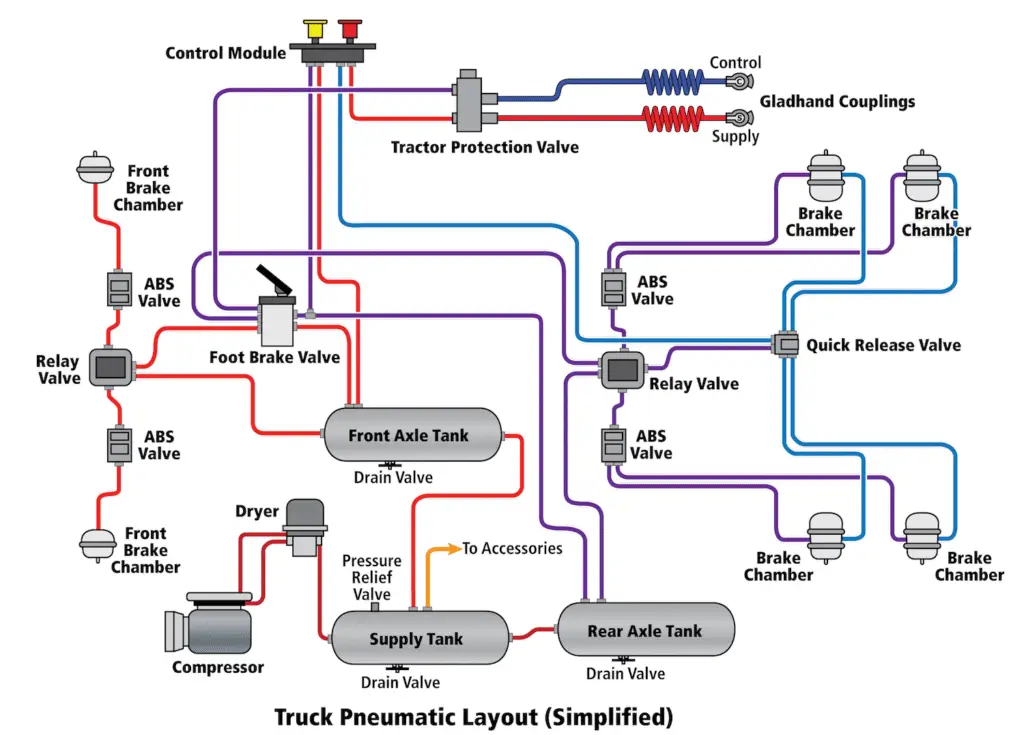
Modern air brake systems integrate multiple components working in synchronized precision. The air compressor generates compressed air while the engine runs, typically maintaining 100-125 psi system pressure. Reservoir tanks store this pressurized air for immediate brake application when needed.
| Component | Primary Function | Failure Indicators | Service Interval |
|---|---|---|---|
| Air Compressor | Generates 100-125 psi | Oil leaks, slow build-up | Every 100,000 miles |
| Governor | Controls cut-in/cut-out | Pressure fluctuations | Annual inspection |
| Brake Chambers | Convert air to force | Diaphragm tears | Every 200,000 miles |
| Slack Adjusters | Maintain adjustment | Excessive travel | Every 30,000 miles |

Brake chambers transform compressed air into mechanical movement through internal diaphragms. This force transmits through push rods to slack adjusters, which rotate S-cams or activate disc brake calipers. Foundation brakes create the actual friction needed to stop the vehicle.
Pneumatic System Operation Fundamentals
When drivers press the brake pedal, the treadle valve releases controlled air pressure from storage tanks. This pressure travels through color-coded airlines—blue for service brakes and red for emergency systems. According to 49 CFR 393.40(d), commercial vehicles must have emergency brake systems that maintain braking capability even with partial system failure.
Air pressure activates relay valves that distribute pressure to individual wheel positions. Quick-release valves accelerate brake release by exhausting air directly at each axle rather than returning through the entire system. This design prevents brake drag and reduces stopping distances.
Modern systems incorporate antilock braking (ABS) modulators that prevent wheel lockup during emergency stops. Electronic control units monitor wheel speed sensors continuously, adjusting brake pressure 15-30 times per second to maintain traction. TMC Recommended Practice RP-136 provides guidelines for proper ABS maintenance procedures.
Recognizing Critical Air Brake Failure Symptoms
Professional drivers encounter various warning signs indicating potential brake problems. Early detection prevents minor issues from escalating into dangerous failures. ASE-certified technicians emphasize that recognizing these symptoms saves both lives and repair costs.
Dashboard Warning Systems and Pressure Gauges
The low air pressure warning activates at 60 psi, providing critical alert time before complete brake failure. Federal Motor Vehicle Safety Standard 121 mandates both visual and audible warnings for commercial vehicles. Drivers must monitor dual pressure gauges showing primary and secondary circuit readings.
Dashboard Indicators Requiring Immediate Attention
- Pressure gauge readings dropping below 90 psi during normal operation
- Inconsistent readings between primary and secondary circuit gauges exceeding 10 psi difference
- Air pressure failing to build from 50 to 90 psi within three minutes at 1,200 RPM
- Governor failing to maintain pressure between 100-125 psi range
- Red brake warning light remaining illuminated during vehicle operation

Physical Symptoms Requiring Immediate Inspection
Unusual sounds provide valuable diagnostic information about brake condition. Squealing indicates worn brake linings approaching replacement limits. Grinding sounds suggest metal-to-metal contact requiring immediate service. Rhythmic clicking often points to cracked drums or loose components.
A burning smell during normal driving indicates dragging brakes that generate excessive heat. This condition destroys brake linings rapidly and can ignite wheel bearing grease. TMC Recommended Practice RP-619B outlines proper inspection procedures when heat damage is suspected.
| Symptom | Likely Cause | Required Action |
|---|---|---|
| Soft/spongy pedal | Air in system | Check for leaks immediately |
| Vehicle pulls left/right | Uneven adjustment | Inspect all brake chambers |
| Brake lockup | Contaminated linings | Replace affected components |
| Pedal vibration | Warped drums/rotors | Machine or replace drums |
Executing the DOT Brake Test Procedure
The Department of Transportation mandates specific testing procedures ensuring commercial vehicle safety. These standardized tests identify truck air brake problems systematically. Following 49 CFR 396.3 inspection requirements, drivers must perform pre-trip inspections including comprehensive brake checks.
The Complete Nine-Step DOT Inspection Process
Professional drivers perform this inspection sequence during every pre-trip inspection. Each step evaluates specific system components for proper operation. Missing any step risks citations during roadside inspections and compromises vehicle safety.
DOT Nine-Step Brake Inspection Procedure
- Static Leakage Test: Engine off, brakes released—monitor pressure drop not exceeding 2 psi per minute
- Applied Leakage Test: Full brake application with engine off—maximum 3 psi per minute loss
- Low Pressure Warning: Verify activation between 55-75 psi through controlled air bleeding
- Emergency Brake Test: Confirm automatic application at 20-45 psi system pressure
- Build-Up Rate: Time pressure increase from 85-100 psi (maximum 40 seconds allowed)
- Governor Function: Verify cut-out at 120-135 psi and cut-in above 100 psi
- Parking Brake Hold: Test against engine power in lowest forward gear
- Service Brake Test: Check for proper stopping without pulling at 5 mph
- Final Walk-Around: Visual inspection of all brake components for damage

CVSA Inspection Standards and Out-of-Service Criteria
The Commercial Vehicle Safety Alliance establishes North American Standard Out-of-Service Criteria used during roadside inspections. Vehicles failing these standards cannot operate until repairs are completed. Understanding these criteria helps prevent costly violations and ensures fleet compliance.
Critical out-of-service conditions include push rod travel exceeding adjustment limits, audible air leaks at brake chambers, missing or non-functional brake components on 20% or more positions, and contaminated brake linings showing evidence of oil or grease. CVSA Level I inspections examine all brake system components thoroughly, requiring minimum 43.5% braking efficiency.
Diagnosing Low Air Pressure and System Leaks
Low air pressure represents the most common cause of brake system failures. When pressure drops below operating specifications, braking force diminishes exponentially. Systematic diagnosis identifies root causes quickly, minimizing vehicle downtime and preventing dangerous situations.
Testing Compressor Output and Governor Settings
Begin diagnosis by connecting calibrated test gauges directly to the wet tank. Start the engine and maintain 1,000-1,200 RPM while monitoring pressure build-up. The compressor should generate 100 psi from completely depleted tanks within two minutes for proper operation.
Governor malfunction causes excessive cycling or continuous compressor operation. Proper cut-out pressure ranges from 125-135 psi, with cut-in occurring no lower than 100 psi. A differential exceeding 25 psi indicates governor replacement is necessary. Bendix recommends checking compressor discharge temperatures—excessive heat indicates continuous loading from governor failure.

Systematic Leak Detection Methods
Federal standards specify maximum allowable leakage rates for commercial vehicles. Single units cannot exceed 4 psi loss in two minutes. Combinations with one trailer allow 6 psi, while doubles permit 8 psi loss. Testing requires system stabilization for one minute before timing begins.
Apply commercial leak detection solution to all connections, valves, and fittings. Bubbles indicate leak locations requiring immediate repair. The SAE J246 standard covers compression fitting specifications for air brake systems, while SAE J1131 provides performance requirements for air brake tubing and fitting assemblies.
4-6-8 Rule
Maximum allowable air loss: 4 psi (single), 6 psi (tractor-trailer), 8 psi (doubles/triples) per 2 minutes
Common leak sources include gladhand seals deteriorating from weather exposure, quick-release valve exhausts contaminated with oil, relay valve crack pressure settings exceeding specifications, and brake chamber diaphragms torn from over-stroking. Addressing leaks promptly prevents compressor damage from excessive cycling and maintains system efficiency.

Solving Brake Application and Release Malfunctions
Brake application problems create immediate safety hazards requiring systematic troubleshooting. Whether experiencing slow response, complete failure, or dangerous lock-up conditions, proper diagnosis prevents accidents and reduces repair costs.
Diagnosing Slow or Non-Responsive Brake Performance
Sluggish brake response typically stems from restricted air flow or mechanical binding. Check service relay valves for proper crack pressure—usually 3-5 psi for immediate response. Higher crack pressure delays brake application dangerously, increasing stopping distances beyond safe parameters.
Examine air lines for kinks, internal collapse, or ice formation during cold weather operations. A collapsed hose may appear normal externally while restricting flow internally. Replace any suspicious lines rather than risking brake failure. FMCSA regulations require immediate replacement of damaged air lines affecting brake performance.
⚠️ Safety Warning
Never attempt to adjust or repair air brake components while the system is pressurized. Sudden air release can cause serious injury. Always drain all reservoirs and verify zero pressure before beginning brake work.

Addressing Dangerous Brake Lock-Up Conditions
Brake lock-up creates loss of vehicle control and rapid tire wear. Begin diagnosis by disconnecting delivery lines at affected wheels. If brakes release, the problem lies in the air delivery system rather than mechanical components.
Quick-release valves sticking closed trap air pressure in brake chambers. Contamination from moisture or oil causes internal corrosion preventing proper exhaust function. Regular system drainage prevents moisture accumulation that leads to valve failure. TMC RP-609C recommends daily reservoir drainage in humid conditions.
Correcting Uneven Braking and Vehicle Pull
Uneven braking forces cause vehicle instability and accelerated component wear. Professional technicians follow systematic procedures to identify and correct imbalanced braking conditions before they cause accidents or jackknife situations.
Foundation Brake Inspection and Adjustment Procedures
Automatic slack adjusters should maintain consistent brake clearance without manual intervention. However, they cannot compensate for mechanical problems like worn bushings or damaged cam tubes. Manual adjustment only masks underlying issues requiring component replacement.
Measure push rod travel at 80-90 psi application pressure. The angle between push rod and slack adjuster arm should approach 90 degrees when properly adjusted. Both sides of an axle must show identical measurements for balanced braking performance.

Identifying Brake Contamination Issues
Oil or grease contamination causes unpredictable brake behavior including grabbing and premature lock-up. Visual inspection reveals dark staining on brake shoes or drums. Contaminated components require immediate replacement—cleaning attempts prove ineffective and dangerous.
Leaking wheel seals represent the primary contamination source. Proper seal installation and hub bearing adjustment prevent lubricant migration onto friction surfaces. TMC Recommended Practice RP-618A provides detailed wheel seal inspection procedures ensuring proper installation.
The HDJ Perspective
In our experience working with fleets across the country, brake-related out-of-service violations remain among the most preventable failures in commercial trucking. The investment in systematic pre-trip inspections and proactive component replacement pays dividends that extend far beyond avoiding CSA points. Fleets that implement disciplined brake maintenance programs consistently report 15-25% lower per-mile operating costs when factoring in reduced roadside delays, extended tire life from proper brake balance, and eliminated emergency repair premiums. The 26,400 annual brake-related accidents represent failures that rigorous inspection protocols could prevent.
Spring Brake and Parking System Diagnostics
Spring brake systems provide both parking and emergency stopping capability through powerful mechanical springs. These dual-function components require specialized diagnostic procedures ensuring reliable operation when primary systems fail.
Testing begins with verifying proper control valve operation. The yellow diamond knob controls spring brake application on all axles simultaneously. Red octagonal valves protect tractor air supply if trailer connections fail. Both must operate smoothly without sticking or delayed response.
| Valve Type | Normal Position | Emergency Function |
|---|---|---|
| PP-1 Park Control | Pushed in (released) | Auto-applies at 20-40 psi |
| TP-3 Tractor Protection | Pushed in (normal) | Seals at 20-45 psi loss |
| SR-7 Spring Relay | Hold-off pressure applied | Modulates spring force |
Spring brake chambers contain powerful springs compressed by air pressure during normal operation. Loss of air pressure releases these springs, applying parking brakes automatically. This fail-safe design ensures vehicles can stop even with complete air loss. The SAE J1729 standard specifies testing procedures for measuring parking brake holding force.
Free Professional Fleet Tools
Cost calculators, fault code lookup, maintenance planners, and more—built for owner-operators, fleet managers, and diesel techs. No signup required.
Advanced Diagnostic Technology and Methods
Modern diagnostic equipment transforms troubleshooting from trial-and-error into precision science. Electronic systems provide real-time data enabling faster, more accurate problem identification. Fleet managers increasingly rely on these tools for predictive maintenance and compliance verification.
Electronic Brake System Diagnostics
ABS and stability control systems use sophisticated electronics monitoring brake performance continuously. Wheel speed sensors detect impending lock-up conditions milliseconds before they occur. The SAE J1939 Digital Annex provides the communication protocols for modern heavy-duty vehicle diagnostics, including ABS and electronic brake systems.
Diagnostic software reads fault codes stored in electronic control units. These codes identify specific component failures using Suspect Parameter Numbers (SPNs) and Failure Mode Indicators (FMIs), enabling precise problem identification. Technicians must understand both mechanical and electronic systems for complete diagnostics, as modern vehicles integrate J1587/J1708 legacy protocols with newer J1939 networks.
Predictive Maintenance Through Data Analysis
Telematics systems monitor brake performance parameters continuously during vehicle operation. Machine learning algorithms analyze this data, identifying wear patterns before failures occur. This proactive approach reduces emergency repairs and improves fleet reliability significantly.
Pressure transducers installed throughout the brake system provide real-time performance data. Comparing actual pressure values against specifications identifies degrading components before complete failure. This technology enables condition-based maintenance replacing time-based service intervals, reducing costs while improving safety.
Key Recommendation
For fleets running 50+ units, investing in telematics-based brake monitoring typically pays for itself within 18 months through reduced roadside failures and optimized component replacement intervals. Start by tracking build-up times and leakage rates across your fleet to establish baselines before implementing predictive algorithms.
Frequently Asked Questions
What are the most common warning signs of air brake failure?
Critical indicators include the low air pressure warning activating below 60 psi, slow pressure build-up exceeding 40 seconds from 85-100 psi, brake pedal feeling soft or spongy, and vehicles pulling during brake application. Additional symptoms include unusual sounds like squealing or grinding, burning odors during normal driving, and visible air gauge fluctuations. Any of these symptoms requires immediate inspection following DOT procedures.
How do I perform a proper DOT air brake inspection?
The nine-step DOT inspection includes static and applied leakage tests with maximum 2-3 psi per minute loss, low pressure warning verification between 55-75 psi, emergency brake activation at 20-45 psi, pressure build rate testing within 40 seconds, governor cut-out at 125-135 psi, parking brake hold test, service brake performance check, and complete visual inspection. Document all readings for compliance verification.
What causes slow air pressure build-up in truck brake systems?
Common causes include worn compressor components reducing output capacity, clogged inlet filters restricting airflow, loose drive belts causing compressor slip, and excessive system leaks overtaxing compressor capacity. Additionally, incorrect governor settings, contaminated discharge lines with carbon buildup, and operating engines below specified RPM contribute to slow pressure recovery.
How much air leakage is acceptable in commercial vehicles?
Federal standards permit maximum pressure drops of 4 psi in two minutes for single vehicles, 6 psi for tractor-trailer combinations, and 8 psi for doubles or triples. Testing requires one minute of pressure stabilization before timing begins. These limits apply with parking brakes released and service brakes applied at full system pressure.
What should I check when brakes pull to one side?
Inspect automatic slack adjusters for equal adjustment on both sides of affected axles, measuring push rod travel at 80-90 psi application pressure. Check for contaminated brake linings from oil or grease leaks, broken return springs preventing proper shoe retraction, and damaged brake chambers with torn diaphragms. Ensure cam bushings aren’t worn and S-cam timing remains synchronized.
How do I diagnose spring brake problems effectively?
Test parking brake control valves for proper hold and release functions, verify emergency application occurs at 20-40 psi system pressure, and check for air leaking between spring and service brake chambers. Inspect control lines for kinks or damage, test modulating valves like the SR-7 for smooth operation, and ensure anti-compounding features prevent dual brake application.
Maintaining Safe, Compliant Brake Systems
Mastering air brake system troubleshooting requires combining systematic inspection procedures with advanced diagnostic technology. The techniques covered—from basic DOT brake test procedures to electronic system analysis—provide comprehensive diagnostic capability for modern commercial vehicles.
Regular maintenance following manufacturer specifications prevents most brake failures before they occur. Understanding pneumatic brake repair fundamentals enables quick problem identification, reducing vehicle downtime and improving fleet safety metrics. Professional technicians emphasize that successful commercial vehicle brake diagnosis starts with thorough knowledge of system components and their interactions. Whether addressing simple air leaks or complex electronic malfunctions, systematic troubleshooting ensures safe, reliable brake performance for the thousands of accidents that proper maintenance could prevent annually.
Share This With Your Fleet Network
Help fleet managers and diesel technicians master air brake diagnostics—share this comprehensive troubleshooting guide.