By Michael Nielsen, Publisher | 15+ Years in Diesel Repair
Last Updated: October 2026
⏱ Estimated reading time: 13 minutes
Steel and aluminum trench boxes are portable shield systems that protect workers inside a trench from a cave-in, and the right box depends on the manufacturer's tabulated data, the soil, the depth and how the box will be moved. A trench box does not prevent a collapse. It keeps the soil from reaching the people working inside it.
Heavy Duty Journal (HDJ), written by publisher Michael Nielsen, checked every rule in this guide against the Occupational Safety and Health Administration (OSHA) excavation standard, 29 Code of Federal Regulations (CFR) Part 1926 Subpart P, as of October 2026. It also read the trench box information published by Iron Lot, a national trench safety equipment supplier.
This guide covers how steel and aluminum trench boxes differ, what OSHA requires of shield systems, how depth ratings work, the site rules around the box, accessories, setting the box with an excavator, buying and inspection. It is written for contractors, public works and utility fleets, and the equipment managers who support them.
Key Takeaways
- ✓Shields protect; they do not prevent. A trench box protects workers inside it when soil moves. OSHA lists sloping, shoring and shielding as the three protective approaches.
- ✓Depth ratings belong to the model. Each box's limits come from its manufacturer's tabulated data, and OSHA requires you to follow that data or get written approval to deviate.
- ✓Nobody rides the box. OSHA bars employees from being inside a shield while it is installed, removed or moved vertically.
- ✓Five feet starts the clock. A protective system is required at 5 feet or deeper unless the excavation is in stable rock, and 4 feet or deeper needs a way out within 25 feet.
- ✓Steel and aluminum suit different jobs. Suppliers describe steel for heavier, repeated-use work and aluminum for lighter, easier-to-handle jobs, but both must match the data.
In This Guide
- What Steel and Aluminum Trench Boxes Do
- Trench Box vs Sloping and Shoring
- Steel vs Aluminum Trench Boxes
- OSHA Rules for Trench Boxes
- Tabulated Data, Depth Ratings and Soil
- Site Rules Around the Trench Box
- Spreaders, Manhole Boxes and Accessories
- Setting and Moving a Trench Box With an Excavator
- Buying a Trench Box: Quotes and Delivery
- Inspecting and Maintaining Trench Boxes
- Frequently Asked Questions
- The Bottom Line
What Steel and Aluminum Trench Boxes Do
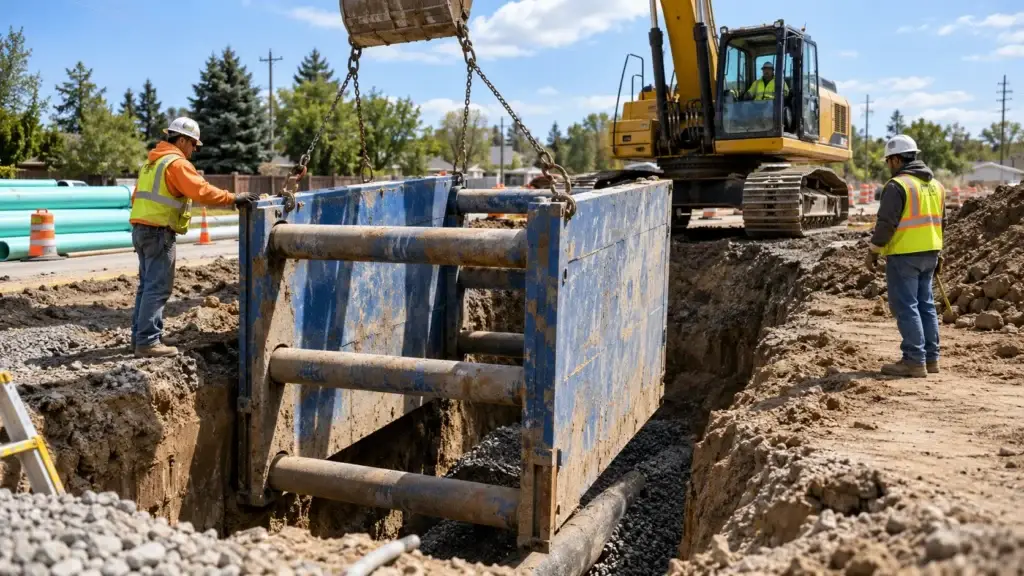
A trench box is a shield, which OSHA defines in 29 CFR 1926.650 as "a structure that is able to withstand the forces imposed on it by a cave-in." The standard adds that shields used in trenches are often called trench boxes or trench shields. Steel and aluminum trench boxes are the two common materials.
OSHA's trenching and excavation page says trench collapses, or cave-ins, pose the greatest risk to workers' lives. Its alert on trench collapses adds that it takes only seconds to become buried in thousands of pounds of soil.
A trench box is one of three approaches OSHA lists to prevent cave-in injuries: slope or bench the walls, shore them with supports, or shield them with trench boxes. Which one fits depends on the site. HDJ covers the shield option, steel and aluminum trench boxes, here because it is the one that depends most on equipment choice.
Trench Box vs Sloping and Shoring
A trench box is the right choice when sloping the walls is impractical and workers need protection inside a narrow trench. Under 29 CFR 1926.652(b), sloping is the first option: slopes may not be steeper than one and one-half horizontal to one vertical (34 degrees) unless the standard's appendices or an engineer's design allow otherwise.
Sloping and benching need open ground, which a utility corridor or a street cut often lacks. Support systems such as timber shoring or aluminum hydraulic shoring brace the walls themselves, while a shield protects the space inside and moves with the work. The trade-off is that a shield does not stop soil from moving behind it.
In HDJ's practical view, crews often choose steel and aluminum trench boxes for repeated, linear work such as pipe and cable runs, because the box can be moved forward as the trench advances. That is a field pattern, not an OSHA preference; the standard lets the employer choose any compliant system.
Steel vs Aluminum Trench Boxes
Steel trench boxes generally suit heavier, repeated-use work, while aluminum trench boxes suit lighter work that needs easier handling. Iron Lot describes steel boxes as the usual choice for heavier utility, sewer, water, road and larger construction work where durability and repeated use matter.
The same supplier describes aluminum boxes as the choice where lighter weight and easier handling matter, such as utility maintenance and smaller trenching jobs. These are supplier descriptions, not OSHA rules. OSHA does not rank materials, and either one is acceptable if it is used within its tabulated data.
| Factor | Steel trench boxes | Aluminum trench boxes |
|---|---|---|
| Typical work (supplier description) | Heavier utility, sewer, water, road and larger construction | Utility maintenance and smaller trenching jobs |
| Handling | Heavier, so the excavator and rigging must be sized to the box | Lighter weight and easier handling |
| Depth and load limits | Set by that model's manufacturer tabulated data | Set by that model's manufacturer tabulated data |
| Sizes listed as of October 2026 | Models from 7.5 by 8 feet to 8 by 20 feet | Models from 3 by 5 feet to 8 by 8 feet |
The sizes in the table come from that supplier's published catalog and show the range, not a recommendation. Within each material, wall design, panel construction and spreader configuration change the rating, which is why the model's own data decides, not the material.
Handling is the practical difference most crews notice. A lighter aluminum box may be set with a smaller machine, while a heavy steel box asks more of the excavator and the rigging. HDJ treats that as a planning question: match the box to the machine you actually have on site before choosing the material.
OSHA Rules for Trench Boxes
OSHA requires each employee in an excavation to be protected from cave-ins by an adequate protective system, with two exceptions. Per 29 CFR 1926.652, those exceptions are excavations made entirely in stable rock, and excavations under 5 feet deep where a competent person finds no indication of a potential cave-in.
For shield systems, the same section sets the core rules in 1926.652(g). Shields may not be loaded beyond their design limits, and they must be installed to restrict lateral or other hazardous movement if sudden lateral loads occur. Employees must also be protected from cave-in hazards when entering or exiting the protected area.
⚠️ Safety Warning
Employees may not be inside a trench box while it is being installed, removed or moved vertically. OSHA states this in 29 CFR 1926.652(g)(1)(iv). Everyone stays out of the box and clear of the lift until it is set and secure.
A trench shield must also be used correctly as the trench is dug. Excavation may go no more than 2 feet below the bottom of a shield, and only if the shield is designed for the full trench depth and there are no signs of soil loss from behind or below it.
Selection has its own rule. Under 1926.652(c), a system must follow the manufacturer's tabulated data, and any deviation needs the manufacturer's specific written approval. Other options are tabulated data approved by a registered professional engineer or a design approved by one. HDJ uses "the data" below to mean whichever of these applies.
Tabulated Data, Depth Ratings and Soil
A trench box's depth rating comes from its manufacturer's tabulated data, not from a universal number. OSHA defines tabulated data in 29 CFR 1926.650 as "tables and charts approved by a registered professional engineer." The data identifies the limits for that specific system.
That supplier's trench box page says ratings vary by box design, size, configuration, soil, surcharge loads and other site factors. In practice, a surcharge load is added weight near the trench edge, such as equipment or spoil. A box that is fine on one site may not be on another with softer ground or heavier nearby loads.
As of October 2026, OSHA's Appendix F to Subpart P says systems for excavations deeper than 20 feet must be designed by a registered professional engineer. The same page says standard tabulated data no longer applies at 20 feet or deeper, and a custom design is required.
Ask the supplier for the data sheet for the exact model, not a family brochure. The supplier says each box comes with manufacturer tabulated data covering depth ratings and use limits, with a registered professional engineer's stamp. Keep a copy at the site so the competent person can check the configuration against it.
Key Recommendation
Before the box is set, confirm the tabulated data on site covers your trench depth, soil, surcharge loads and spreader setup. If it does not, do not use that configuration until the manufacturer or a registered professional engineer approves it in writing.
Site Rules Around the Trench Box
A competent person must inspect the excavation and its protective system, and OSHA's definition requires that person to identify existing and predictable hazards and be authorized to correct them quickly. Under 29 CFR 1926.651, the inspection happens daily, before work starts and as needed through the shift.
The box itself is only part of the control set. Trenches 4 feet or deeper need a stairway, ladder, ramp or other safe means of egress, with no more than 25 feet of lateral travel to reach it. Excavated material and equipment must stay at least 2 feet from the edge or be held back by retaining devices.
Other controls apply around the box. Utility locations must be determined before the excavation opens, and air must be tested before entry where oxygen deficiency or hazardous atmospheres may exist in an excavation deeper than 4 feet. Employees may not work in accumulated water unless adequate precautions protect them.
HDJ's practical view is to treat these as a single pre-entry routine, not separate checks. The competent person walks the egress, edge, utility marks, atmosphere and water each time conditions change, such as after rain or after the box is moved. That is guidance, not a separate OSHA requirement.
Spreaders, Manhole Boxes and Accessories
Spreaders set the working width between a trench box's panels, and suppliers sell them with or without the box. Suppliers note that spreader inclusion varies by box and by quote, so confirm what ships with the model before you compare prices or widths.
Other accessories serve different excavations. Manhole boxes are used for excavation around manholes, structures and utility connections. Bedding boxes help stage backfill, and road plates provide temporary trench coverage or access. Each has its own data and limits.
Shields are not the only protective system. OSHA's standard also covers timber shoring and aluminum hydraulic shoring, and supplier catalogs list hydraulic shoring alongside trench boxes. Which system fits depends on the trench geometry, the depth and what the manufacturer's data permits.
Setting and Moving a Trench Box With an Excavator
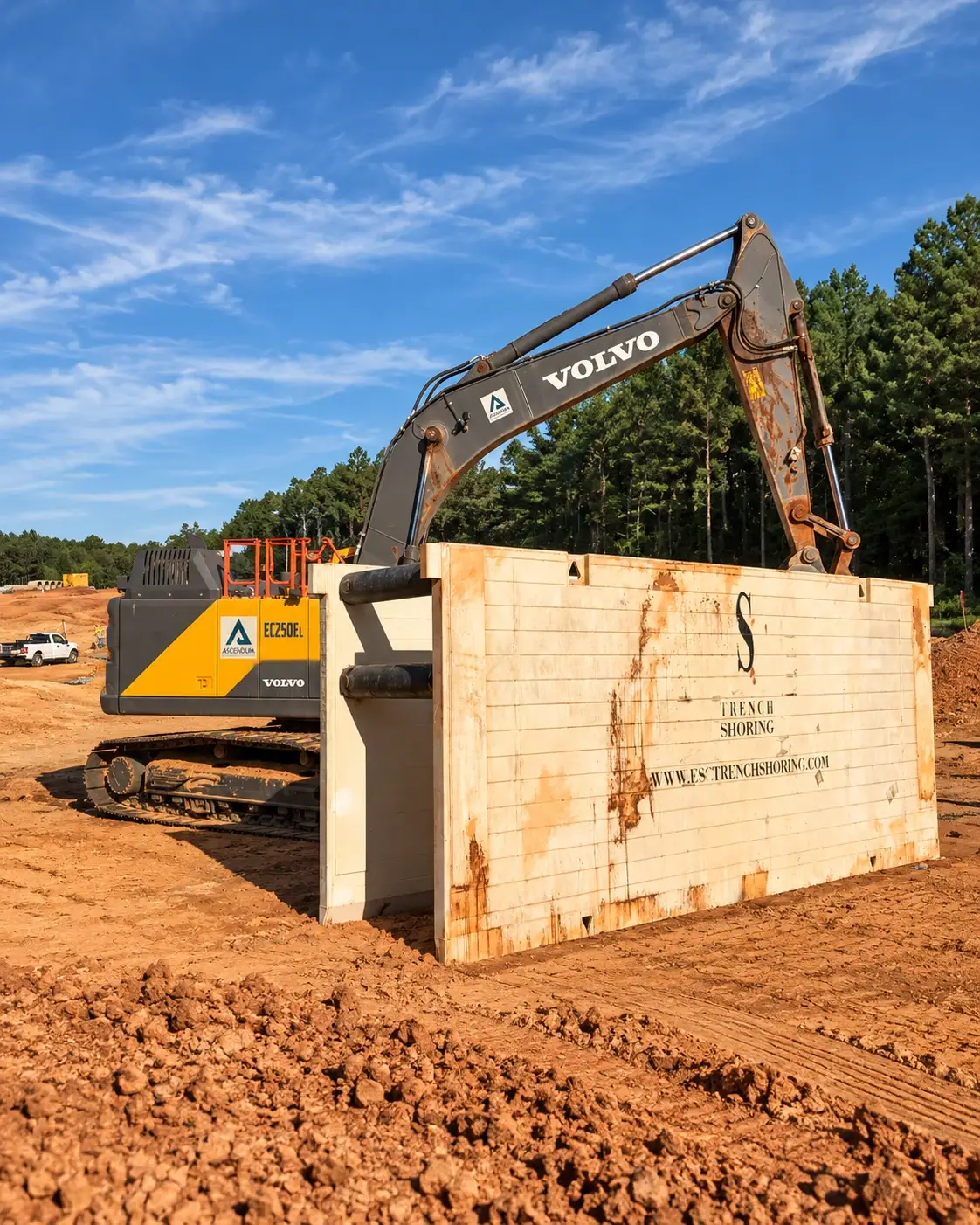
Setting a trench box is an equipment task as much as a safety task, because the excavator and rigging must be sized to the box. HDJ's guide to excavator bucket types and sizes helps match attachments to the machine, and the box's manufacturer instructions govern how it is lifted and set.
A machine that drifts or loses lift while a box is suspended is a hazard. HDJ's guide to excavator hydraulic problems covers the symptoms to fix before the machine handles a suspended load.
In HDJ's practical view, slow boom response, a bucket or hook that creeps down under load, and weeping hydraulic hoses are all reasons to keep the machine off box handling until it is repaired. Check these during the walkaround before the first lift of the day, not after the box is already in the air.
The operator matters too. HDJ's heavy equipment operator certification guide explains the credentials operators carry, though OSHA's trench rules themselves focus on the competent person.
The OSHA rules from earlier apply here. Nobody stands in the box during placement or vertical moves, the box must be installed to resist lateral movement, and digging goes no more than 2 feet below its bottom. Move the box ahead of the excavation only as the data and the competent person allow.
Buying a Trench Box: Quotes and Delivery
Buying a trench box starts with the information a supplier needs to quote it. Iron Lot asks for the trench depth, width and length, the job location or delivery ZIP code, whether you want steel, aluminum or a manhole box, the spreader width if known, and your timeline and shipping needs.
- Trench depth, width and length
- Job location or delivery ZIP code
- Steel, aluminum, manhole box, or unsure
- Spreader width, if known
- Project timeline and shipping needs
- Whether a tabulated data review is needed
Iron Lot lists more than 150 trench box options and serves contractors, municipalities, public works departments and utility crews. As of October 2026, its page says boxes can ship from North Carolina, Ohio, Texas and California, with larger boxes moved by less-than-truckload (LTL) or full truckload (FTL) freight.
The supplier also says financing may be available to qualified buyers and that the buyer remains responsible for final selection and use. That matches OSHA's approach, which puts selection on the employer. Treat any supplier's recommendation as input to the competent person's decision, not a substitute for it.
Cost decisions deserve numbers. Compare the purchase against how often and how long you will use the box, plus freight, spreaders and storage. HDJ's free Fleet Management Calculators can help with the cost-benefit math for equipment that sits on a fleet's books.
Inspecting and Maintaining Trench Boxes
Storage and transport affect condition too. Boxes are heavy steel or aluminum assemblies that move by freight, so protect panels and spreaders from impact during loading, and store them where water and debris do not collect in the frames. Record any damage found on arrival before the box goes to a site.
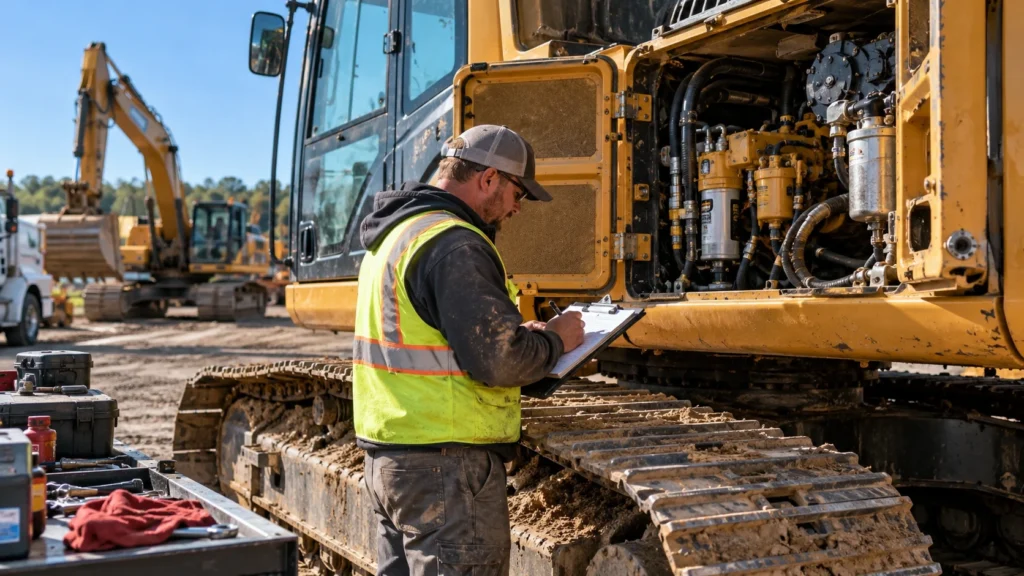
A damaged trench box should stay out of service until it is assured safe. OSHA's rule in 1926.652(d)(3) says damaged equipment that cannot be assured safe must be approved by a registered professional engineer before returning to service. HDJ's practice is to inspect before each use, looking for bent panels, cracked welds, damaged spreaders and missing pins.
A routine helps. HDJ's heavy equipment maintenance checklist shows how inspection routines are structured for the machines that handle the box, and the same discipline suits the box itself.
Used boxes need extra care. Ask for the tabulated data, the inspection history and any repair records before you buy. HDJ's used heavy equipment buying guide lists the red flags to check on secondhand machinery, and several apply to used shielding.
Frequently Asked Questions
What is a trench box?
A trench box is a portable steel or aluminum shield, also called a trench shield, set in a trench to protect workers from a cave-in. OSHA defines a shield as a structure able to withstand the forces imposed on it by a cave-in.
How deep can a trench box go?
The limit comes from the box's manufacturer tabulated data, which varies by model, soil and loads. OSHA requires a protective system at 5 feet or deeper, and systems for excavations deeper than 20 feet must be designed by a registered professional engineer.
Is steel or aluminum better for a trench box?
Neither is better in general. Suppliers describe steel for heavier, repeated-use work and aluminum for lighter, easier-to-handle jobs. OSHA allows either material if it is used within the manufacturer's tabulated data and the site conditions. See the comparison table above for sizes and typical uses.
Can workers be inside a trench box while it is moved?
No. OSHA's rule in 29 CFR 1926.652(g)(1)(iv) bars employees from being inside a shield while it is being installed, removed or moved vertically. Everyone stays out of the box and clear of the lift until the box is set, secure and checked.
How far must spoil and equipment be from a trench edge?
At least 2 feet from the edge, or held back by retaining devices, under 29 CFR 1926.651(j)(2). Trenches 4 feet or deeper also need a stairway, ladder, ramp or other safe means of egress, with no more than 25 feet of lateral travel to reach it.
What does a supplier need to quote a trench box?
Iron Lot asks for trench depth, width and length, the job location or delivery ZIP code, whether you want steel, aluminum or a manhole box, spreader width if known, project timeline and shipping needs, and whether a tabulated data review is needed.
The Bottom Line
Steel and aluminum trench boxes are choices within a system, not just a material decision, and the same OSHA rules apply to both. Start with the trench depth, soil and loads, match them to the model's tabulated data, and keep everyone out of the box while it moves. Then plan egress, edge distance and inspection before the first shovel.
Michael Nielsen and the Heavy Duty Journal editorial team publish more equipment and compliance guides at heavydutyjournal.com. Confirm current OSHA rules and your supplier's data for the exact model before you dig, since selection and use remain the employer's responsibility.
Share This With Your Site Crew
If your crew sets or inspects trench boxes, pass this heavydutyjournal.com guide along so everyone knows the shield rules before the next excavation.