
By Michael Nielsen, Editor & Publisher | 15+ Years in Diesel Repair
Last Updated: June 2026
⏱ Estimated reading time: 14 minutes
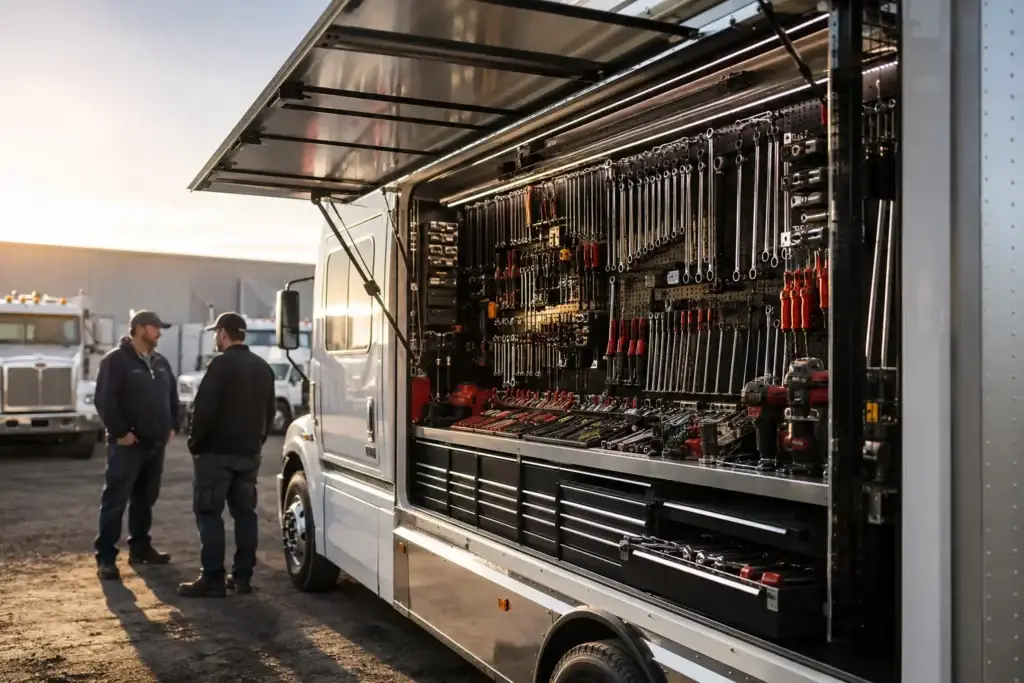
Tool truck brands are the four professional mobile tool companies — Snap-on, Mac Tools, Matco Tools, and Cornwell Quality Tools — that deliver tools directly to diesel technicians, fleet mechanics, and shop owners at their workplace via franchise-operated rolling storefronts. Each brand carries a full line of hand tools, power tools, diagnostic equipment, and tool storage, with a dedicated dealer who services a set route on a weekly or bi-weekly schedule. The mobile sales model, combined with on-the-spot tool replacement under lifetime warranties, is what separates these four from retail alternatives and makes them the dominant purchasing channel for professional mechanics across North America. Whether you're building your first tool set straight out of diesel tech school or evaluating which truck delivers the best value for your shop's specific needs, understanding what makes each brand distinct saves money and prevents frustration over a career that may span decades.
Key Takeaways
- Four brands define professional mobile tool sales: Snap-on (1920), Cornwell (1919), Mac Tools (1938), and Matco Tools (1946) are the only companies operating nationwide franchise tool truck networks serving professional mechanics.
- Ownership matters to quality and pricing: Snap-on and Cornwell remain independent, while Mac Tools is a Stanley Black & Decker division and Matco is a Vontier subsidiary — ownership structures directly affect product development decisions and price positioning.
- Your dealer relationship is as important as the brand: Route reliability, warranty service speed, and financing flexibility are determined largely by the individual franchise dealer, not corporate policy alone.
- All four offer lifetime warranties on hand tools — the distinction is how conveniently those warranties are honored when you need them on a working Tuesday morning.
- Snap-on leads in diagnostics and resale value; Cornwell leads in USA-made hand tool manufacturing; Mac offers Stanley Black & Decker's production scale; Matco provides broad product breadth at competitive price points.
How the Tool Truck Model Works
The mobile tool truck model is a franchise system in which an independent business owner purchases a territory from one of the four major brands, buys inventory from that brand's catalog, and then drives a custom-built rolling showroom to shops, dealerships, and fleet yards on a regular schedule. Each visit functions as a combination sales call, warranty exchange, and product demonstration. Mechanics can handle tools before buying, exchange broken items on the spot, and set up weekly payment accounts — often without a traditional credit check.
The financing component is central to how most technicians build their collections. Rather than paying full price upfront, mechanics make small weekly payments — sometimes as low as $10-$20 per week per item — tied to their existing pay cycle. This payment structure is what made premium tool brands accessible to entry-level technicians in the first place, and it remains one of the core competitive advantages all four companies share over retail outlets and internet sellers.
The American Trucking Associations notes that the commercial vehicle service industry employs hundreds of thousands of technicians across North America, the vast majority of whom rely on some form of direct-to-shop tool purchasing rather than retail channels. That concentrated professional demand has sustained four distinct national brands for over a century.
Snap-on: The Premium Benchmark Since 1920
Snap-on is the tool truck brand most mechanics know by name even before they enter a shop. Founded in 1920 in Milwaukee, Wisconsin by Joseph Johnson and William Seidemann, the company built its earliest reputation on a deceptively simple idea: interchangeable sockets that snapped onto five standardized handles, reducing what a mechanic needed to carry from dozens of one-piece wrenches to a compact, versatile system. The company's original slogan — "5 do the work of 50" — captured the value proposition that still defines the brand's approach to tool engineering a century later.
Snap-on considers itself the originator of the mobile van method of marketing hand tools directly to professional mechanics. Today the company operates over 4,000 franchise dealer vans across the United States, supported by specialized demonstration trucks — the Shop Essentials van for diagnostic equipment and the Rock 'n Roll Cab Express for tool storage — that rotate through regions to showcase products too large for a standard dealer vehicle.
What Snap-on Does Best
Snap-on's diagnostic platform is the most sophisticated available through any tool truck channel. The company's PRO-LINK+ system and its ZEUS, VERUS, and SOLUS scan tool lineup provide OEM-level coverage for heavy-duty commercial vehicle diagnostics, including parameter monitoring, bidirectional system controls, and guided repair workflows for Class 6 through Class 8 trucks. For a diesel shop doing a high volume of engine management and aftertreatment diagnostics, Snap-on's integrated diagnostic and repair information ecosystem is genuinely difficult to match through other channels.
Hand tool quality is the other defining strength. Approximately 85-90% of the tools sold under the Snap-on brand are manufactured by Snap-on or its subsidiaries — a higher proprietary manufacturing ratio than any other tool truck brand. Chrome vanadium steel construction is standard across their socket and wrench lines, with heat treatment processes and surface finishing that consistently exceed ANSI performance standards. Snap-on tools hold their resale value better than any competing brand in the secondary market, a practical indicator of perceived durability and professional confidence.
$4.7B+
Snap-on Incorporated's reported net sales in 2024, reflecting its position as the largest professional tool company in North America. Source: Snap-on Incorporated annual reporting.
Snap-on's Trade-offs
The primary trade-off is price. Snap-on commands a significant premium over the other three tool truck brands on virtually every product category. A 1/4-inch drive socket set that runs $300-$400 at Matco or Cornwell can exceed $1,000 at Snap-on list price. Whether that price difference reflects proportional quality improvement or brand premium depends heavily on the specific tool category and the individual mechanic's usage intensity. For high-wear items like ratchets and sockets in an eight-bay diesel shop, many experienced techs consider the Snap-on premium justified. For items used infrequently, the math rarely works out.
Route consistency is a secondary concern. Snap-on has the widest national coverage, but individual franchise territories are still dealer-dependent. A shop that relies on a reliable Snap-on dealer for weekly warranty service can experience significant disruption when that dealer retires or leaves the territory — dealer transitions sometimes create coverage gaps that last months.
Keep Your Shop Running at Full Capacity
Get HDJ's maintenance guides, compliance updates, and fleet management strategies delivered weekly — built for working diesel professionals.
Cornwell Quality Tools: The Oldest Brand Still Running
Cornwell Quality Tools holds a distinction no other tool truck brand can claim: it is the longest-running mobile tool company continuously selling direct to professional technicians in the United States. Eugene Cornwell, a skilled blacksmith, opened his first shop in 1919 in an old tannery building along the Cuyahoga River in Cuyahoga Falls, Ohio, hammering out chisels, pry bars, punches, and screwdrivers one tool at a time. The company's tagline — "The Choice of Professionals® since 1919" — is factually accurate in a way that the other brands' marketing copy cannot match.
Cornwell remains a privately owned, family and employee-owned company headquartered in Wadsworth, Ohio. That independence — no public shareholders, no private equity timeline, no corporate parent reallocating resources to other divisions — shapes the brand's product philosophy in ways that show up on the truck. Because Cornwell is not answerable to Stanley Black & Decker or Vontier earnings calls, it can maintain manufacturing operations that would be difficult to justify purely on margin: an active foundry in Albion, Pennsylvania, and machining operations in Mogadore, Ohio, both producing hardline tools from USA-sourced steel.
USA Manufacturing as a Differentiator
Cornwell is one of only two remaining tool truck companies that still produce their own hand tools in-house in domestic facilities. Ratchets, sockets, wrenches, pry bars, and chisels manufactured at Cornwell's Pennsylvania and Ohio plants are made from American-sourced steel to tolerances that, in categories like pear-head ratchets and combination wrenches, rival or match Snap-on's own hardline offerings. Cornwell's ratchet designs are particularly well-regarded among long-tenured technicians — the geometry balances throw length, tooth engagement, and handle ergonomics in ways that reflect decades of refinement rather than recent design-by-committee engineering.
The company complements its domestic hardline production with allied tools sourced from Taiwan and China — air tools, cordless electric tools, and diagnostics — following the same sourcing approach used by Snap-on (via its Blue Point line), Mac Tools, and Matco. All hand tools carry a lifetime warranty, honored through the local Cornwell dealer.
Cornwell's Visibility Challenge
The most common complaint about Cornwell is not about tool quality — it is about route availability. Cornwell operates fewer franchise territories than Snap-on or Matco, which means many shops in certain regions rarely or never see a Cornwell truck. In areas where Cornwell coverage is solid, the brand earns fierce loyalty. In areas where coverage is sparse — a truck that comes by once a month rather than weekly — the brand's advantages in hand tool quality become difficult to leverage, because the warranty exchange system and payment plan convenience that define the tool truck model break down when the dealer is hard to reach.
For diesel shops in markets with a reliable Cornwell dealer, the value proposition is strong: USA-made hardline tools at prices that undercut Snap-on, backed by a warranty honored by a local owner-operator who has personal incentive to retain your business.
Mac Tools: Stanley Black & Decker's Professional Line
Mac Tools traces its roots to the Mechanics Tool and Forge Company, incorporated in Sabina, Ohio on July 11, 1938, with the goal of manufacturing high-quality hand tools for professional mechanics. The company changed its name to Mac Tools, Incorporated in 1963, establishing the branding that still appears on tool trucks today. In 1980, Mac Tools was acquired by The Stanley Works, which later merged with Black & Decker in 2010 to form Stanley Black & Decker — one of the largest tool conglomerates in the world. Mac Tools USA hand tools are manufactured at the Proto Dallas facility, with additional production across various Stanley Black & Decker plants worldwide.
Mac Tools operates 1,679 franchise distributors across North America. The company's product line encompasses over 9,000 tools, including screwdrivers, ratchets, wrenches, air tools, and an extensive tool storage lineup manufactured at Mac's Allentown, Pennsylvania facility. Mac's distribution center is in Hilliard, Ohio.
What Mac Tools Offers the Professional Tech
Mac Tools occupies the position immediately below Snap-on in both quality perception and pricing — typically running 10-15% less than equivalent Snap-on items on direct comparisons. Among the four tool truck brands, Mac's USA-made hand tools — particularly knurled extensions, combination wrenches, and sockets — earn consistent praise from experienced mechanics. The knurling depth on Mac's extensions, for example, is a frequently cited ergonomic advantage in greasy-hand conditions that matter on a diesel engine service floor.
Access to Stanley Black & Decker's global manufacturing infrastructure also means Mac can offer certain product categories — particularly cordless power tools and specialty diagnostic equipment — at a scale that the two independent brands struggle to match. Stanley Black & Decker's engineering and production scale provides Mac dealers with a breadth of catalog options that keeps the trucks stocked with a diverse selection.
Mac Tools' Limitations
Mac faces the same route consistency challenge as Cornwell in certain regions, though generally with better national coverage than Cornwell. A more practical concern for heavy-duty diesel shops is the proportion of Mac's catalog that is sourced externally rather than manufactured in-house. While Mac's core USA hardline — wrenches, sockets, ratchets — is genuinely manufactured to professional standards, a meaningful share of the catalog (consumables, specialty tools, accessories) carries the Mac name on imported product. Technicians should distinguish Mac's manufactured items from its sourced items when evaluating value per dollar, as the quality consistency varies across these two categories more than it does at Snap-on.
The HDJ Perspective
After 15+ years in diesel repair, here's the truth about tool truck brands that the marketing doesn't say plainly: you're not just buying a brand — you're buying a dealer relationship. I've seen shops with a mediocre Snap-on line run more efficiently than shops with great Matco or Cornwell inventory, simply because the Snap-on dealer was reliable, showed up every week, and exchanged broken tools without an argument. Conversely, I've watched techs build exceptional Cornwell or Mac collections because their local dealer was exceptional. The brand sets the floor on tool quality and the warranty policy. The dealer determines whether those policies actually function in the real world. Before committing your tool budget to any brand, ask the techs at neighboring shops about their dealer's reliability — that conversation is worth more than any brand comparison chart.
Matco Tools: Broad Selection, Franchise Scale
Matco Tools was founded in 1946 by Bill Mattison and Joe Cornwell — whose combined names formed the company's name — and began selling direct to professional mechanics in 1979. The company's origins are intertwined with Mac Tools: Matco started as the box manufacturing division of Mac before separating in 1979 and establishing its own independent franchise operation. Today Matco is a subsidiary of Vontier Corporation, having passed through Danaher and Fortive through a series of corporate spins before its current ownership structure settled in 2020. Matco is headquartered in Stow, Ohio, with its toolbox manufacturing plant in Lakewood, New York.
Matco operates a franchise network with several thousand distributors across North America and carries one of the largest catalogs in the tool truck channel — over 13,000 different products including wrenches, screwdrivers, gauges, specialty tools, and its own line of USA-made toolboxes. Matco trucks are visually distinctive with their white color and large blue-and-red Matco logo.
What Matco Does Well
Matco's toolbox line is legitimately one of its strongest offerings. The company manufactures its own boxes domestically — an increasingly rare distinction in the tool storage market — and the boxes are well-regarded for their drawer slide quality, lock systems, and construction compared to competing offerings at similar price points. For a diesel shop manager equipping a new bay or replacing a worn-out cabinet, Matco's tool storage is worth evaluating on its own merits independent of hand tool considerations.
Matco also offers competitive pricing relative to Snap-on and Mac on many hand tool categories, typically running 15-25% below comparable Snap-on items. Their ratcheting wrench extensions, spline boxed-end wrenches, and certain socket sets have earned genuine professional endorsements from experienced diesel mechanics who have compared them head-to-head with competing brands. The key is knowing which Matco products are manufactured to their own specification versus which are sourced and rebranded — the quality differential between these two tiers is significant.
Tool Truck Brand Quick Reference
- Snap-on (1920): Founded Milwaukee, WI. Independent public company. Best-in-class diagnostics, highest resale value, premium pricing, widest national dealer coverage.
- Cornwell (1919): Founded Cuyahoga Falls, OH. Privately/employee owned. Only tool truck brand with active domestic foundry and machining. Strongest USA manufacturing story. Limited regional coverage.
- Mac Tools (1938): Founded Sabina, OH. Stanley Black & Decker division. 9,000+ product line, USA hand tools from Proto Dallas. Positions just below Snap-on in quality and price.
- Matco Tools (1946): Founded by Mattison & Cornwell. Vontier subsidiary. 13,000+ products, USA-made toolboxes (Lakewood, NY). Broadest catalog, competitive mid-tier pricing.
Matco's Sourcing Complexity
The most consistent criticism of Matco in professional mechanic communities is the proportion of its catalog that consists of sourced and rebranded product — particularly air tools, cordless electric tools, and accessories. Matco's budget-tier sub-line, Silver Eagle, is imported, which creates confusion among less experienced buyers who may not realize they're purchasing a different product tier than Matco's genuine domestic items. Experienced diesel techs who buy from Matco learn quickly which part numbers represent Matco's own manufactured product and which represent rebranded third-party sourcing — and they buy accordingly.
Route coverage is generally good with Matco, and the brand's franchise system has grown significantly over the past decade. If you're evaluating Matco for your shop, the same principle applies as with the other brands: the quality of your local dealer relationship is the variable that determines day-to-day experience.
| Brand | Founded | Ownership | Best Known For |
|---|---|---|---|
| Snap-on | 1920 | Independent (NYSE: SNA) | Diagnostics, premium hand tools, resale value |
| Cornwell | 1919 | Private (family/employee-owned) | USA manufacturing, hand tool quality, longevity |
| Mac Tools | 1938 | Stanley Black & Decker division | Hand tool ergonomics, catalog breadth, mid-tier pricing |
| Matco | 1946 | Vontier Corporation subsidiary | Toolbox manufacturing, catalog size, competitive pricing |
What Every Tool Truck Brand Has in Common
Despite their differences in ownership, pricing, and manufacturing philosophy, all four tool truck brands share the structural features that define the mobile tool channel:
Lifetime warranties on hand tools. All four brands cover their hardline hand tools — sockets, wrenches, ratchets — under lifetime replacement warranties. The practical distinction is how those warranties are serviced. With a reliable dealer on a consistent route, a broken ratchet is replaced on the next visit without paperwork or argument. With an unreliable dealer, that same warranty becomes a multi-week ordeal. The warranty policy is uniform; the experience is dealer-dependent.
Franchise dealer model. None of the four brands employ salaried sales staff to service individual shop routes. Every dealer is an independent franchise owner-operator who has purchased a territory, owns the truck inventory, and runs their route as a small business. This creates both the model's greatest strength — a dealer with real personal incentive to retain your business — and its greatest vulnerability — a single owner-operator whose departure disrupts service for every shop on that route.
In-shop payment financing. Weekly payment accounts are the tool truck model's most commercially powerful feature. A 2025 ATRI report on diesel technician workforce challenges found that the upfront cost of purchasing tools is the single most-cited barrier for technicians in the early stages of their careers — ahead of pay, mentoring, and training access. The tool truck financing model directly addresses that barrier, and the payment relationship it creates typically persists for years, creating strong brand loyalty that is difficult to break even when competing products offer better value on a straight price comparison.
Tiered product lines. Every brand maintains a core premium line under its main label alongside a value/entry tier under a secondary label: Snap-on's Blue Point, Matco's Silver Eagle, Mac's Expert. These secondary lines are typically sourced rather than manufactured and priced to compete with professional-grade retail brands. Understanding which tier you're purchasing within any brand's catalog is critical to making accurate value comparisons.
Choosing the Right Tool Truck Brand for Your Diesel Shop
For a diesel technician or fleet shop manager evaluating tool truck brands, the decision framework should start with route quality before product quality. No brand's tools are worth their premium pricing if the dealer shows up once a month, has limited truck inventory, or struggles to process warranty exchanges promptly. Before committing substantial tool budget to any brand, talk to technicians at shops within a few miles of yours — their experience with the same dealer over time is the most predictive data available.
Once route quality is established, match brand selection to your specific purchasing priorities. If diagnostics capability is the primary driver and budget is secondary, Snap-on's integrated diagnostic platform is the most comprehensive available through the tool truck channel. The ASE Medium/Heavy Truck certification program recommends that technicians working on electronic engine management systems have access to professional-grade scan tools that can interface with J1939 and J1708 networks — Snap-on's commercial vehicle diagnostic line meets that requirement more completely than competing brands' offerings.
If USA-made hardline tool quality is the priority and pricing discipline is important, Cornwell's manufacturing story and pricing relative to Snap-on makes it the value leader in domestically produced hand tools — provided you have a reliable dealer in your area. The Technology & Maintenance Council (TMC) recommends that fleet maintenance operations standardize on professional-grade tools that meet ANSI/ASME dimensional tolerances — all four tool truck brands' core hand tool lines meet this standard, though the manufacturing origin and consistency varies across brands.
For shops building out toolbox storage capacity, Matco's domestically manufactured tool storage line offers genuine quality at pricing that undercuts Snap-on's equivalent boxes, making it worth evaluating independently of hand tool considerations. If tool storage is a major near-term capital expense for your shop or fleet, ask your Matco dealer about current pricing on their USA-made rollaway and top chest configurations before finalizing any storage purchase decision.
Key Recommendation
Mix strategically across brands based on product category. Buy Snap-on for diagnostic equipment and high-wear ratchets. Buy Cornwell or Mac for combination wrenches and hardline sockets if pricing matters. Buy Matco for tool storage if their box quality fits your needs. No tool truck brand is uniformly best across every category — the professional approach is category-by-category evaluation, not whole-brand loyalty.
The Secondary Market for Tool Truck Brands
All four tool truck brands have active secondary markets through estate sales, pawn shops, online classifieds, and specialized resale platforms. The secondary market is where savvy buyers can acquire professional-grade tools at dramatically reduced prices — and where brand differences in resale value become financially concrete. Snap-on maintains the strongest secondary market values by a significant margin: a used Snap-on 1/2-inch drive impact wrench retains substantially more of its original price than an equivalent Mac or Matco unit, which typically sell at steep discounts in the used market.
The secondary market for tool trucks themselves — the vehicles that carry these products — is also active. Franchisees who exit the business, scale down operations, or upgrade to newer trucks create a regular supply of used mobile tool trucks available for purchase. These vehicles are often purchased by independent mobile tool distributors, service truck operators, or mechanics transitioning into mobile service businesses. Platforms specializing in used tool trucks connect buyers and sellers of used and new tool trucks, making it easier to find the right vehicle for a mobile tool or service business launch.
For mechanics building their collection on a budget — particularly newer technicians working through tech school or first years at a diesel shop — the secondary market for tool truck brand tools represents one of the best value strategies available. Snap-on tools bought used at 40-60 cents on the dollar still represent professional quality at a cost that can fit into an entry-level income. Cornwell and Mac tools sourced through estate sales at those same secondary market discounts deliver professional performance with lifetime warranty limitations since most brands restrict warranty service to the original purchaser.
When evaluating specific used tool trucks available for a mobile service business, exploring listings for used tool trucks and comparable Snap-on and Mac configurations can give a realistic picture of what a configured, route-ready tool truck costs in the current market — data that is useful both for franchise candidates evaluating startup costs and for experienced mechanics thinking about the economics of independent mobile service.
Free Professional Fleet Tools
Cost calculators, fault code lookup, maintenance planners, and more — built for owner-operators, fleet managers, and diesel techs. No signup required.
Frequently Asked Questions
Which tool truck brand is best for heavy-duty diesel mechanics?
For heavy-duty diesel mechanics whose work centers on commercial truck diagnostics and engine management, Snap-on's diagnostic platform — particularly the PRO-LINK+ and ZEUS systems — offers the most comprehensive coverage of Class 6-8 truck systems. For hand tool quality at better pricing, Cornwell and Mac both manufacture USA-sourced hardline tools that hold up in the torque-intensive environment of commercial diesel work. The most practical answer: use Snap-on for diagnostics, Cornwell or Mac for hardline hand tools, and evaluate all four on route quality in your specific area before committing your budget.
Do all tool truck brands offer lifetime warranties?
Yes. All four major tool truck brands — Snap-on, Cornwell, Mac Tools, and Matco — offer lifetime warranties on their hardline hand tools including sockets, wrenches, and ratchets. The scope and service experience of those warranties varies. Snap-on's lifetime warranty on hand tools is backed by their extensive dealer network and has a long industry track record. Cornwell's lifetime warranty is enforced through the local mobile dealer. Mac and Matco warranties are similarly dealer-administered. Secondary market tools purchased used typically do not qualify for warranty service, as most brands limit warranty transfers.
What is the difference between a tool truck brand's main line and their budget line?
Each tool truck brand maintains a premium line under its core brand name and a value sub-line positioned for price-sensitive buyers: Snap-on's Blue Point, Matco's Silver Eagle, and Mac's Expert line are the primary examples. The main-line tools are typically manufactured in-house or to proprietary specifications at a domestic or controlled offshore facility. Budget sub-lines are generally sourced from third-party manufacturers and rebranded. The quality difference is real — main-line Matco and Snap-on items are meaningfully better-engineered than their respective sub-line equivalents. When comparing prices across brands, verify which tier you're comparing.
Which tool truck brand holds its value the best on the secondary market?
Snap-on holds secondary market value significantly better than Mac, Matco, or Cornwell tools in the resale market. A used Snap-on ratchet or socket set typically commands 50-70% of list price in good condition, while equivalent Matco and Mac items may sell at 20-35% of list. This resale premium reflects the market's confidence in Snap-on's durability and the brand's aspirational positioning. For mechanics who rotate tools regularly or upgrade frequently, the Snap-on premium on purchase is partially offset by the higher resale recovery. For mechanics who plan to keep tools for career-long use, the resale advantage matters less than initial cost.
How do tool truck franchise systems work for someone considering starting a mobile tool business?
All four major tool truck brands operate franchise models in which an individual purchases a protected territory, an initial inventory load, and a branded vehicle or builds out their own compliant truck configuration. Franchise costs vary significantly by brand and territory — a new Snap-on franchise startup involves substantially higher initial investment than a Cornwell or Mac franchise, reflecting both the brand premium and the inventory requirements. The franchise owner-operator earns margin on tool sales and is responsible for financing, warranty service, and customer relationship management within their territory. The Federal Trade Commission's franchise disclosure requirements mandate that all four brands provide a Franchise Disclosure Document to serious candidates — reviewing the FDD's Item 19 financial performance representation data gives realistic income expectations.
Conclusion
The four major tool truck brands — Snap-on, Cornwell, Mac Tools, and Matco — collectively represent over a century of professional tool delivery to mechanics who depend on their equipment to earn a living. Each has a distinct identity built on its history, ownership structure, manufacturing approach, and market positioning. Snap-on leads on diagnostics, brand prestige, and resale value. Cornwell leads on domestic manufacturing and hand tool purity as an independently operated company. Mac Tools brings Stanley Black & Decker's manufacturing scale and a strong ergonomic hand tool reputation. Matco offers the broadest catalog, competitive pricing, and domestically produced tool storage.
What no brand comparison chart captures is the human variable: your local dealer. Before making any major tool truck brand commitment, ask the shops near you which dealers actually show up every week, honor warranties without a fight, and have the tools you need on the truck when you need them. The brand sets the product standard. The dealer determines your actual experience. Choose both carefully, and the tool truck system delivers real value across a diesel mechanic's entire career.
Share This With Your Shop Team
If your diesel shop is evaluating tool truck brands or helping newer techs build their first professional collection, this breakdown covers the key decisions they'll face — pass it along to anyone starting out or switching brands.


