
By Michael Nielsen, Publisher | 15+ Years in Diesel Repair & Fleet Operations
Last Updated: September 2026
⏱ Estimated reading time: 9 minutes
Commercial vehicle marketing turns a diesel repair shop from a retail-priced, foot-traffic-dependent operation into a fleet service center with predictable, higher-margin revenue. Fleet managers calculate downtime in dollars per hour, not haggle points — a shop that consistently gets a truck back on the road fast earns premium pricing and long-term loyalty that a one-time retail customer never provides.
This guide focuses on the strategic side of building that book of business: how to position your shop for fleet buyers, which vocational markets to specialize in, and how to structure the sales relationship and account economics. For the digital execution — local SEO, directory listings, website structure, social media — HDJ has dedicated guides linked throughout this piece; this one is about the business decisions those tactics should be serving.
Key Takeaways
- ✓Commercial repair work commands a real margin premium over retail — fleet managers prioritize turnaround time and reliability over price negotiation, which is the opposite of most retail service-writer conversations.
- ✓Specializing in two or three local vocational industries beats trying to serve every fleet type. Deeper expertise in, say, utility contractors or refrigerated delivery builds referral networks a generalist shop can't match.
- ✓B2B fleet sales require sustained relationship-building, not a single pitch. Commercial buyers evaluate reliability and service capability over multiple interactions before committing — treat the first conversation as the start of a relationship, not a close attempt.
- ✓Retaining and expanding existing fleet accounts is cheaper than acquiring new ones. A single fleet account growing its annual spend by even a modest percentage adds revenue with no acquisition cost attached.
The Revenue Case for Commercial Repair Work
Commercial vehicle service events consistently generate higher revenue per visit than passenger vehicle repairs, driven by specialized equipment, larger components, and the expedited turnaround fleet customers pay for. TMC/Decisiv's North American service event benchmark data tracks well over 300,000 monthly commercial maintenance events, and the parts and labor totals on those tickets run substantially above a typical retail repair order precisely because of that equipment scale and urgency.
Fixed operations — service, parts, and body work — also drive a disproportionate share of profit in the broader vehicle retail industry, a pattern that holds even at the largest public dealer groups: in major group financial reporting, service and parts operations routinely generate a share of gross profit well above their share of total revenue, because service margins run far higher than vehicle-sale margins.
The exact ratio shifts by company and by year, but the direction is consistent across the industry — fixed operations, not vehicle transactions, are where the real margin lives. That's the same dynamic an independent diesel shop can capture by building a genuine fleet-service book of business instead of competing purely on one-off retail repair pricing.
| Repair Category | Relative Ticket Size vs. Retail | Why It's Higher |
|---|---|---|
| Class 3 vocational truck repair | Meaningfully higher | Larger components, diesel-specific diagnostics |
| Class 4-5 medium duty repair | Higher still | Heavier duty cycle, specialized upfit components |
| Passenger vehicle (retail baseline) | Baseline | Standard components, price-competitive market |
Downtime cost is the other side of this equation, and it's what actually justifies the premium: a fleet manager isn't paying more because they like your shop better, they're paying for speed because every hour a truck sits is an hour it isn't generating revenue for their business. Lead with that math in your own marketing rather than leading with your labor rate.
Positioning Your Shop for Fleet Buyers
Your commercial positioning starts at the front entrance, before a single word is spoken. A dedicated commercial check-in area, a waiting space with a workstation and reliable Wi-Fi, and visible signage referencing fleet or commercial service all signal to a fleet manager or business owner that your shop takes their kind of work seriously — as opposed to a generic waiting room built around a retail customer killing time.
Train service writers to ask every new customer a single qualifying question — "is this vehicle for business or personal use?" — and route commercial answers to whichever staff member is best equipped to talk fleet operations, maintenance intervals, and turnaround urgency. A retail-trained writer who doesn't know how to talk to a fleet manager loses that account before the truck is even on the lift.
Displaying work-ready vehicles — customer trucks with visible upfits, or your own shop vehicles if you run any — near your entrance reinforces the same signal visually. A business owner deciding where to trust their fleet makes a fast visual judgment before they ever talk to anyone; a lot full of passenger sedans doesn't help you win that judgment call.
None of this matters if a fleet manager can't find your commercial services online in the first place — HDJ's truck repair shop website guide covers exactly how to structure your site so commercial services are impossible to miss, rather than buried behind generic navigation built for retail customers.
Targeting Specific Vocational Markets
Analyze your regional economy for industries with heavy commercial-vehicle dependency — construction, utility contracting, delivery, refrigerated transport — and pick two or three to specialize in rather than trying to be the generalist option for every fleet type in your market. Specialization builds deeper technical expertise and a stronger referral network within a specific sector than a broad, unfocused approach ever produces.
Upfitted vocational vehicles — utility trucks with ladder racks, dump bodies, refrigerated box trucks, service vans with custom shelving — carry component and system complexity a generic repair shop often can't service correctly. That complexity is your opportunity: a shop that genuinely understands a specific vocational upfit becomes the only credible option in its market for that industry, which is a far stronger position than being one of many generalist shops competing on price.
The U.S. Census Bureau's NAICS classification system is a practical starting point for mapping which industries actually operate at scale in your service area, so you're specializing based on real local demand rather than a guess. Training at least one technician as a certified work truck specialist through NTEA gives your shop a credible, third-party-verified claim to that vocational expertise rather than just a marketing slogan.
Stay Current on Fleet Marketing Strategies
Get weekly insights on commercial vehicle marketing, equipment reviews, and operational strategies delivered to diesel shop owners and fleet managers.
Fixed Operations Readiness
Marketing to fleet customers only works if your shop can actually deliver what the marketing promises. That means service bays sized for box trucks, flatbeds, and chassis cabs up to roughly 26 feet, ASE-certified technicians trained on the specific diesel platforms your target fleets run (Cummins, Duramax, Power Stroke), extended or early-morning hours that match a fleet's operating schedule rather than a retail customer's, and a parts inventory weighted toward commercial applications instead of passenger-vehicle stock that happens to overlap.
Build service packages around actual vocational duty cycles rather than a one-size-fits-all maintenance schedule: a landscaping fleet's seasonal wear pattern looks nothing like a delivery fleet's mileage-driven schedule, and a medical transport fleet's priorities skew toward reliability inspections and FMCSA compliance over routine wear items. Matching your service packaging to what a specific vocational customer actually needs is part of the specialization case made in the section above — generic maintenance menus don't win vocational fleet accounts.
Editorial Insight
The HDJ Perspective
Commercial vehicle marketing isn't about flashy advertising — it's about systematically positioning your shop as the reliable partner fleet managers can't afford to lose. Michael Nielsen has seen the shops that succeed treat every fleet relationship as a long-term investment, knowing that one well-served fleet account generates more revenue over years than dozens of one-time retail customers ever will. Start by identifying the two or three industries most prevalent in your service area, then build expertise that makes you genuinely indispensable to those specific operations — not just another shop that happens to also work on trucks.
Building a Relationship-Based Sales Approach
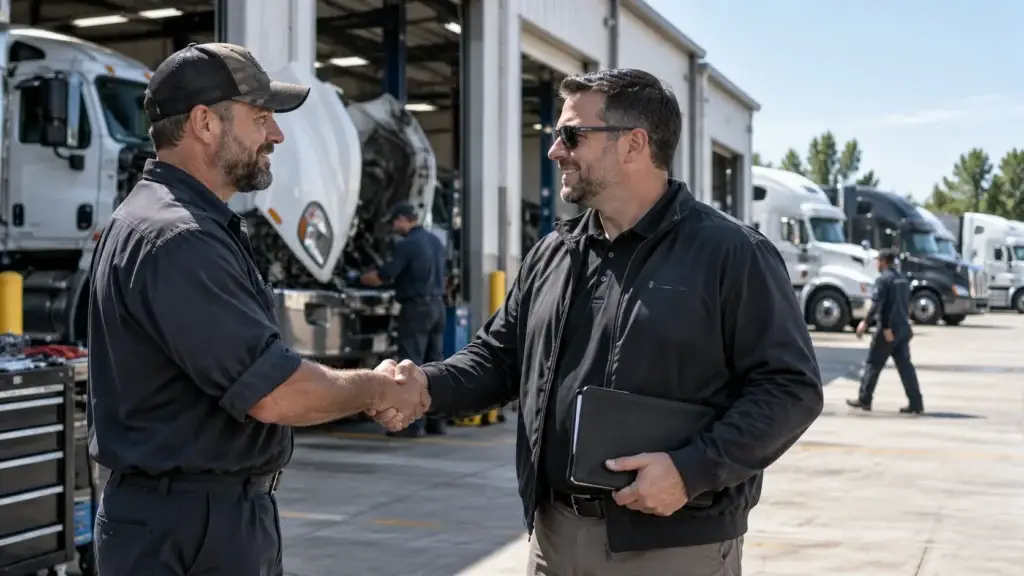
Commercial fleet decisions move slower than retail decisions, and that's not a flaw in your outreach — it's the nature of a B2B buyer evaluating a long-term vendor relationship rather than a one-time repair. A fleet manager choosing a service provider is thinking about reliability over years, not about today's invoice, which means a single pitch or cold call rarely closes anything by itself.
Structure outreach around three sequential priorities: establish a credible relationship first, demonstrate measurable value second — a free fleet inspection, a maintenance-cost comparison, a diagnostic consult — and only then move toward proposing a formal service relationship. This sequence builds the trust that a straight-to-the-pitch approach skips past, and it's the difference between being seen as a vendor trying to close a deal and a partner who understands the account's operation.
Community visibility compounds this relationship-building work: quarterly sponsorships, industry association meetings, and facility open houses put your shop in front of the same decision-makers repeatedly in a low-pressure setting. Local chambers of commerce, construction and trucking associations, and trade groups are where fleet decision-makers already gather — showing up consistently there builds the familiarity that eventually turns into an account.
Account Retention and Lifetime Value Economics
Growing revenue from your existing fleet accounts is consistently cheaper than acquiring new ones, since there's no acquisition cost attached to expanding a relationship you already have. Track service frequency, average repair order value, satisfaction signals, and referral activity per account — these metrics surface at-risk accounts early and reveal genuine expansion opportunities before a competitor gets the chance to win that business away from you.
A structured loyalty approach — priority scheduling for established fleet accounts, volume pricing on frequently needed parts, tiered benefits based on annual spend — gives accounts a concrete reason to consolidate their service spending with your shop instead of splitting it across multiple providers.
Complimentary pickup and delivery, extended workmanship coverage on repairs, and a single point of contact who actually understands that account's fleet are the kinds of perks that make switching providers feel like a real loss to a fleet manager, not just a minor inconvenience.
For the digital tactics that keep this pipeline full in the first place — local SEO, review generation, and paid acquisition — HDJ's diesel shop marketing strategies guide covers the execution side in more depth than this strategic guide has room for.
A few common questions on commercial vehicle marketing, answered directly:
Frequently Asked Questions
What makes commercial vehicle repair more profitable than retail work?
Commercial repairs command a real margin premium because fleet customers prioritize minimal downtime over price negotiation — every day a commercial vehicle is off the road costs the fleet revenue, which shifts the buying decision away from price. Commercial tickets also run higher on average due to specialized equipment, larger components, and more urgent turnaround requirements than typical retail work.
How should a diesel shop choose which vocational markets to target?
Start by mapping which industries with heavy commercial-vehicle dependency actually operate at scale in your service area — NAICS classification data from the Census Bureau is a practical way to do that. Pick two or three sectors rather than trying to serve every fleet type generically; deeper specialization builds stronger referral networks and technical credibility than a broad, unfocused approach.
How long does it typically take to close a new fleet account?
Longer than a retail sale, consistently — B2B fleet buyers evaluate reliability and service capability over multiple interactions before committing to a vendor relationship. Treat early conversations as relationship-building and value demonstration rather than a closing attempt, and expect the sales cycle to run months, not days.
What's the most cost-effective way to grow commercial revenue — new accounts or existing ones?
Expanding existing fleet accounts, in almost every case. There's no acquisition cost attached to growing a relationship you already have, and a loyalty structure with tiered benefits and priority scheduling gives an existing account a concrete reason to consolidate more of its spending with your shop rather than splitting it with a competitor.
Building a genuine commercial vehicle marketing program comes down to a sequence: position your shop visibly for fleet buyers, specialize in the vocational markets your local economy actually supports, make sure your fixed operations can deliver on what the marketing promises, and treat every fleet relationship as a multi-year account rather than a single transaction.
Michael Nielsen's take after 15+ years watching shops make this transition: the ones that succeed pick their specialization deliberately instead of drifting into "we work on everything" — pick two industries this quarter and start building the expertise that makes your shop the obvious call for them.
Help Fellow Diesel Professionals Succeed
Share this commercial vehicle marketing guide with fleet managers and diesel shop owners in your professional network.


