
Commercial Vehicle Marketing: Diesel Shop Growth Guide

Table of Contents
    Add a header to begin generating the table of contents

    By Michael Nielsen, Editor & Publisher | 15+ Years in Diesel Repair

    Last Updated: December 2024

    📖 Estimated reading time: 18 minutes

    Effective commercial vehicle marketing transforms diesel repair shops from struggling retail operations into profitable fleet service centers. With over 8 million commercial vehicles sold annually in the United States and small businesses purchasing half of these units, shops that master targeted marketing to fleet managers and owner-operators gain access to customers who prioritize reliability over price and generate 2-4 times higher profit margins per transaction.

    The commercial vehicle sector operates fundamentally differently than retail automotive markets. Fleet managers calculate downtime costs by the hour, making quick turnaround times worth premium pricing. Business owners need vehicles operational to generate revenue, reducing price sensitivity while increasing loyalty to shops delivering consistent results. Understanding these differences enables diesel repair facilities to build sustainable growth through strategic fleet customer acquisition and retention.

    Key Takeaways

    • Higher margins: Commercial vehicles generate 2-4 times higher margins than retail work, with Class 3 trucks delivering $1,600-$2,000 profit versus $700 for passenger vehicles.
    • Customer priorities: Fleet managers value speed and reliability over price negotiations, creating premium service pricing opportunities.
    • Market size: Over 4 million commercial vehicles purchased annually by small regional companies within local service areas represent untapped potential.
    • Revenue predictability: Fleet maintenance contracts generate $50,000+ in consistent annual service income per major account.
    • Relationship ROI: Success rates increase from 1% at first contact to over 81% by the fifth touchpoint with commercial buyers.
    • Digital research: Commercial buyers spend 9.5 hours researching online before service decisions, making website optimization critical for visibility.

    Understanding the Commercial Vehicle Marketing Opportunity

    The commercial vehicle sector presents substantial revenue opportunities for diesel repair shops willing to shift from retail-focused operations. Business owners who develop targeted commercial vehicle marketing strategies position themselves for sustainable growth with higher margins and more predictable cash flow.

    Commercial vehicle sales reached impressive milestones with over 8 million units sold according to Bureau of Transportation Statistics freight data. Small and medium-sized businesses operating locally or regionally purchased half of these vehicles, creating vast opportunities for shops to capture market share within their service areas through focused fleet maintenance programs.

    Revenue Advantages of Commercial Sales

    Commercial vehicle transactions generate significantly higher revenue per sale compared to retail automotive work. Class 3 truck chassis deliver profits between $1,600 and $2,000, while medium-duty chassis in Classes 4 and 5 reach $2,600 in profit margins. Compare these figures to midsize sedans that typically yield only $700 in profit, and the financial advantage becomes immediately clear.

    Commercial vehicle service events generate significantly higher revenue than passenger vehicle repairs, with TMC/Decisiv benchmark data tracking over 300,000 monthly maintenance events averaging substantially higher parts and labor costs due to specialized equipment, larger components, and expedited service requirements.

    Profit Margins: Commercial vs. Retail Vehicles

    Fixed operations drive overall profitability in commercial fleet sales operations. Major automotive groups demonstrate this pattern consistently across their financial reporting. Lithia Motors reported that used vehicles, finance, insurance, service, body work, and parts accounted for 41.8% of revenue but generated 79.7% of gross profits in recent fiscal analysis.

    Asbury Automotive Group showed even stronger results with service-related operations comprising 87.3% of gross profits despite representing only 44.1% of total revenue. These metrics underscore why successful diesel shop marketing emphasizes service capabilities alongside vehicle sales.

    Vehicle TypeAverage Profit MarginDaily Downtime Cost
    Class 3 Truck Chassis$1,600 – $2,000$2,500 – $5,000
    Class 4-5 Medium Duty$2,600$3,000 – $6,000
    Midsize Sedan (Retail)$700$500 – $1,000

    Building Long-Term Business Relationships

    Commercial customers demonstrate significantly greater loyalty than retail buyers. They purchase multiple vehicles for fleet operations and rely on consistent service support throughout vehicle lifecycles. These businesses value reliability and quick turnaround times since vehicle downtime directly impacts revenue generation and operational efficiency.

    Diesel repair shop service bay with commercial trucks positioned for fleet maintenance work

    Upfitted commercial vehicles offer distinct competitive advantages. Each customized work truck or van becomes unique, preventing customers from price shopping across multiple dealers for identical units. This exclusivity strengthens negotiating positions and protects profit margins better than commodity retail sales.

    Essential Commercial Vehicle Marketing Fundamentals

    Building successful fleet customer acquisition requires more than technical expertise in diesel repair. Effective promotion starts with creating clear visibility for commercial services that immediately communicates your shop’s capabilities to business customers. When fleet managers drive by your location, they need instant recognition that you serve their specific operational needs.

    Differentiating Your Commercial Department

    Your diesel shop marketing begins at the front entrance. Set up dedicated commercial entrances and signage that speak directly to fleet managers and business owners. Create separate waiting areas with business amenities like workstations, conference space, and reliable Wi-Fi that accommodate professionals who work while waiting for service.

    Train service writers to ask each customer a qualifying question: “Will this vehicle be for business or personal use?” This routes commercial clients to specialized staff who understand fleet operations, maintenance schedules, and the urgency business customers require. Proper routing ensures commercial customers receive appropriate attention from their first interaction.

    Fleet manager reviewing diesel shop website on laptop showing service capabilities

    Strategic Display of Work-Ready Vehicles

    Position upfitted trucks, service bodies, and commercial vans prominently at your shop entrance. Business owners make visual assessments first. When they see work-ready vehicles on display, they immediately recognize your shop as a commercial specialist rather than a retail-focused operation.

    Rotate your display inventory weekly to showcase different vocational configurations: utility trucks with ladder racks and organized tool storage systems, dump bodies and flatbeds configured for construction applications, box trucks with lift gates designed for delivery services, and service vans with custom shelving systems for trades contractors.

    Implementing the Two-Click Website Test

    Research shows customers spend nearly 10 hours researching vehicles and service providers online before visiting a shop. Yet only 6% of diesel shops make commercial inventory easy to find through website navigation. Test your website immediately: Can customers reach commercial vehicle services in two clicks or less from your homepage?

    Most shops bury commercial inventory behind 12 or more navigation clicks. Fix this critical issue by adding a prominent “Commercial Vehicles” or “Fleet Services” button on your homepage that leads directly to work truck inventory and fleet maintenance offerings. This simple change dramatically improves user experience for business customers researching your capabilities.

    Leveraging OEM Commercial Programs

    Original Equipment Manufacturer commercial programs offer powerful resources for diesel shops seeking to expand fleet maintenance capabilities. These programs transform participating facilities into preferred destinations for commercial customers by providing specialized support, enhanced service capabilities, and marketing resources designed specifically for vocational vehicle sales.

    Major manufacturers operate distinct commercial programs with varying requirements. General Motors offers Business Elite with dedicated commercial inventory and priority parts access. Ford operates Commercial Vehicle Centers featuring fleet-specific training and expedited service lanes. FCA’s Business Link program provides co-op marketing support and commercial financing options.

    Fleet management software dashboard displaying vehicle maintenance schedules and service alerts

    Participation requirements typically include maintaining specific inventory levels, dedicating service bays with adequate dimensions for larger vehicles, and ensuring next-day service availability for emergency repairs. Staff members must complete specialized training across sales, service, and parts departments to properly support commercial vehicle operations.

    The investment in OEM programs pays dividends through enhanced credibility and manufacturer field support. Dealers gain access to co-op funding for marketing tools while building relationships with commercial fleet managers through manufacturer-backed programs. Before committing, connect with existing participants to understand real-world benefits and challenges.

    Mastering Floor Planning and Inventory Management

    Smart floor planning transforms how diesel shops manage commercial inventory investments. With work trucks averaging $45,000 to $85,000 per unit, strategic financing decisions directly impact profitability and cash flow. Dealers who master floor planning earn additional revenue through interest arbitrage while reducing carrying costs.

    Extended Free Flooring Benefits

    Manufacturers like Ford and GM offer 180 to 270-day free flooring periods on commercial chassis through their financing programs. Each remaining day on free flooring generates $7 to $10 in savings when units sell early. A dealer selling 10 trucks monthly with 30 days remaining on free flooring earns an extra $2,100 to $3,000 through efficient inventory management.

    Commercial vehicle inventory tracking system showing floor plan status and aging metrics

    Upfitted Vehicle Financing Strategies

    When chassis head to upfitters for service bodies or utility beds, financing becomes more complex. Leading floor plan providers now pay upfitters directly and roll customization costs into existing floor plans. This approach keeps working capital intact while offering customers complete work-ready solutions commanding higher margins.

    Using Trade Networks to Reduce Costs

    Regional dealer networks reduce inventory costs through strategic trading agreements. Dealers stock different configurations and trade at invoice pricing while keeping hold-back profits. This cooperative approach expands available selection without increasing floor plan expenses or tying up additional capital in slow-moving inventory.

    Trade Network BenefitsCost ImpactTime Savings
    Direct dealer tradesSave 15-20% flooring costs2-3 days faster delivery
    Shared upfit costsSplit $8,000-12,000 expenses1 week reduced wait time
    Regional inventory accessEliminate transport feesSame-day availability

    Google Analytics reveals exactly how customers search for diesel repair services and commercial vehicles. Track which truck configurations receive the most website views, identify seasonal patterns in service requests, and adjust inventory accordingly. Data-driven ordering reduces aged inventory by 40% while improving turn rates.

    Stay Current on Fleet Marketing Strategies

    Get weekly insights on commercial vehicle marketing, equipment reviews, and operational strategies delivered to diesel shop owners and fleet managers.

    Subscribe to the Newsletter →

    Targeting Specific Vocational Markets

    Smart diesel repair shops focus on specific industries within their local markets to maximize commercial vehicle marketing effectiveness. By understanding which businesses need specialized vehicles and services, shops develop targeted strategies that speak directly to ideal customers’ operational needs and pain points.

    Identifying Local Market Opportunities

    Start by analyzing your regional economy to find industries with strong commercial vehicle dependencies. Construction companies, utility contractors, and delivery services require specialized trucks with custom upfits. These modifications typically range from $7,000 to $15,000 for basic service bodies that electricians and plumbers use daily for tool storage and equipment transport.

    Specialized commercial trucks including service body utility truck and flatbed for construction industry

    Specialty equipment like cranes, lifts, and snowplows push upfit costs significantly higher into the $20,000-$40,000 range. Smart shops add 10-15% markup to these modifications, with unique custom builds generating profits exceeding $5,000 per vehicle through specialized configuration expertise.

    Understanding SIC Codes and Industry Segments

    Standard Industrial Classification codes from the U.S. Census Bureau provide systematic methods to identify and target specific business types. These codes help shops understand which industries operate in their service area, average fleet sizes for different business types, typical vehicle requirements by industry sector, and seasonal demand patterns for repairs and equipment upfits.

    Specialization vs. Diversification Strategies

    Successful fleet maintenance advertising requires choosing between becoming the recognized expert for specific industries or serving a broader market with general capabilities. Specialization builds deeper expertise and stronger referral networks within targeted sectors like HVAC contractors or landscaping companies. Diversification spreads risk across multiple customer types but may dilute marketing effectiveness.

    81%

    Success rate by fifth consecutive touchpoint with commercial buyers, versus just 1% at first contact

    Training at least one team member as a certified work truck specialist through industry associations ensures commercial customers receive specialized attention. These experts understand upfit options, industry-specific requirements, and communicate effectively about customers’ business needs.

    Fixed Operations and Service Excellence

    Service departments drive long-term profitability in diesel shops through repeat business and predictable revenue streams. Commercial customers need vehicles operational to generate income, making reliable service essential for attracting fleet operators who prioritize uptime over initial repair costs.

    Your commercial service department requires specific capabilities: service bays sized for box trucks, flatbeds, and chassis cabs up to 26 feet; ASE-certified technicians trained on Cummins, Duramax, and Power Stroke diesel engines; extended hours including early morning and Saturday availability; priority scheduling systems for fleet customers; and parts inventory focused on commercial applications.

    Commercial diesel service bay with technician performing fleet vehicle maintenance

    Fleet maintenance advertising should emphasize quick turnaround times and specialized diagnostic expertise. Business owners calculate downtime costs by the hour, making next-day service a significant competitive advantage worth promoting. Parts and service revenue now represents over 50% of dealership gross profit according to industry data, highlighting fixed operations’ critical importance.

    Smart diesel shops build service packages tailored to vocational needs. Landscaping companies need different preventive maintenance schedules than delivery fleets. Construction contractors require heavy-duty cooling system service before summer months. Medical transport companies prioritize reliability inspections and FMCSA compliance checks.

    The HDJ Perspective

    Commercial vehicle marketing isn’t about flashy advertising—it’s about systematically positioning your shop as the reliable partner fleet managers can’t afford to lose. The shops we’ve seen succeed treat every fleet relationship as a long-term investment, knowing that one well-served fleet manager generates more revenue over five years than dozens of one-time retail customers. Start by identifying the three industries most prevalent in your service area, then build expertise that makes you indispensable to those specific operations.

    Building an Activity-Based Sales Culture

    Creating an activity-based sales culture transforms diesel shops from passive order-takers into proactive business partners. Successful commercial vehicle marketing requires consistent outreach and strategic engagement with fleet managers. The key lies in understanding that commercial sales happen through persistence and systematic relationship development.

    Relationship-Building Through Multiple Touchpoints

    Industry research reveals a striking pattern in commercial sales effectiveness. First appointments with potential fleet customers yield only a 1% conversion rate. Second appointments improve slightly to 3% success rates. The real breakthrough comes at the fifth consecutive contact, where success rates soar above 81%.

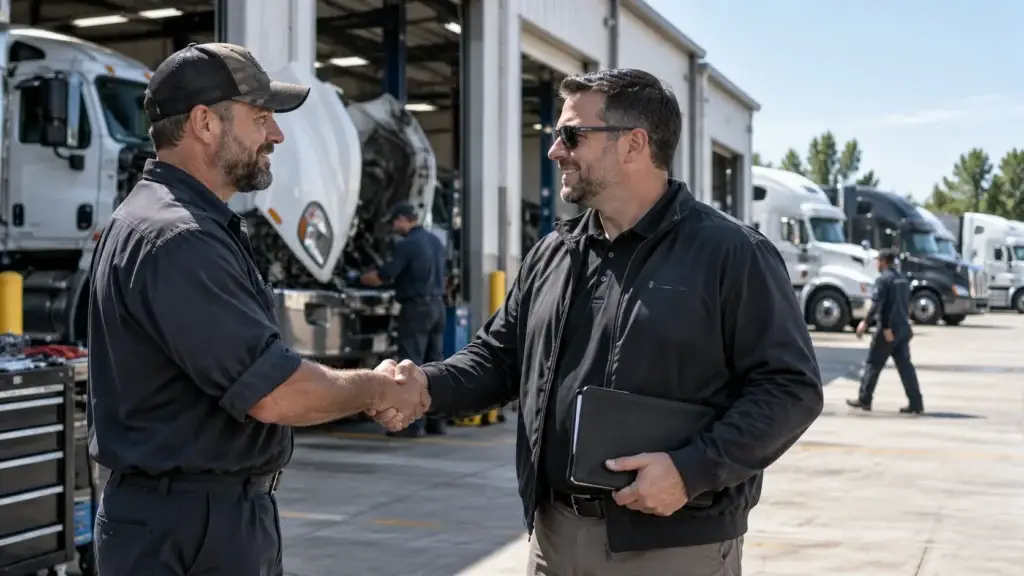
    Sales representative meeting with fleet manager at commercial trucking facility

    This data underscores why business-to-business relationship building demands patience rather than aggressive closing tactics. Commercial customers make significant decisions carefully after evaluating reliability, service capabilities, and long-term partnership potential.

    Effective commercial vehicle marketing strategies follow three sequential priorities: establishing credible relationships first, adding measurable value second, and selling products or services third. This approach builds trust before pitching services, creating sustainable partnerships rather than one-time sales.

    Setting Realistic Sales Targets

    Commercial departments should establish clear, achievable goals based on industry benchmarks. Industry experts recommend targeting 15 vehicles monthly per dedicated sales professional, with an average up-front gross profit of $1,500 per unit. Annual growth models challenge teams to increase performance by 8-10% yearly through improved processes.

    Sponsorship and Community Engagement

    Quarterly sponsorship events amplify visibility and strengthen community ties with potential commercial customers. Successful diesel shops organize industry association meetings and educational workshops, golf tournaments for executive networking, fishing tournaments for informal relationship building, and equipment demonstrations and facility open houses.

    Professional networking groups offer structured environments for business relationship building. Organizations like local chambers of commerce, construction associations, and trucking groups provide regular touchpoints with decision-makers while positioning your shop as an industry leader.

    Share Your Fleet Marketing Experience

    Have you successfully grown your commercial customer base? Join Heavy Duty Journal as a guest author and share your strategies with thousands of fleet managers and shop owners.

    Submit Your Expertise →

    Digital Marketing Strategies for Fleet Customer Acquisition

    Digital marketing opens powerful channels for reaching fleet managers and commercial vehicle owners researching service providers. Your search optimization efforts can transform online visibility into steady business growth when properly executed. Effective promotion combines technical SEO with targeted campaigns speaking directly to ideal customers’ specific needs.

    SEO Optimization for Commercial Keywords

    Start by researching what potential customers actually search for when seeking diesel services. Tools like Google Keyword Planner reveal valuable long-tail phrases such as “fleet maintenance near me,” “commercial truck repair services,” or “diesel mechanic for work trucks.” Natural keyword placement throughout your website helps search engines match your services with relevant searches.

    Focus on creating location-based content targeting commercial buyers within your geographic service area. Write detailed service pages describing specific repairs for popular commercial vehicles like Ford Transit vans, Chevrolet Silverado work trucks, or Ram ProMaster cargo vans. Each page should answer common questions while showcasing your expertise.

    Content Marketing for Fleet Managers

    Fleet managers need reliable information about maintenance schedules, cost-saving strategies, and regulatory compliance requirements. Create helpful guides covering topics like 49 CFR Part 396 inspection requirements, fuel efficiency improvements, or preventive maintenance best practices reducing total cost of ownership.

    Video tutorials demonstrating preventive maintenance procedures build trust while improving search rankings and social media engagement. Case studies showing how you reduced downtime for specific industries demonstrate real-world value and provide compelling social proof for prospective customers.

    Social Media Marketing to Business Owners

    Facebook and Instagram connect diesel shops with local business owners relying on vehicles for daily operations. Share before-and-after repair photos, customer testimonials highlighting uptime improvements, and maintenance tips demonstrating expertise. YouTube videos showing complex diesel repairs demonstrate your team’s technical skills while attracting potential customers.

    Creating Strategic Marketing Budgets

    Building a smart budget for diesel shop marketing starts with answering three fundamental questions: What specific outcomes do you want to achieve? How quickly do you need measurable results? What level of financial risk makes sense for your operations?

    Setting Measurable Goals and KPIs

    Track specific metrics directly impacting your commercial department’s performance. Monitor website traffic from vocational buyers, qualified leads generated per campaign, conversion rates from inquiry to sale, and customer acquisition costs by marketing channel.

    Test different approaches in local markets by targeting specific industries like construction companies, delivery services, or utility contractors. Analytics tools reveal which channels drive the most qualified leads, highest conversion rates, and best return on advertising spend.

    Allocating Resources Across Marketing Channels

    Marketing ChannelBudget AllocationPrimary Target
    Google Ads25%Fleet managers actively searching
    Trade Shows & Events20%Industry decision-makers
    Direct Mail Campaigns15%Local businesses with fleets
    Social Media Advertising15%Small business owners

    Commit to at least one proactive commercial vehicle marketing campaign each quarter to maintain momentum. Regular testing reveals which messages resonate with different customer segments and how seasonal patterns affect commercial buying behavior.

    Maximizing Customer Lifetime Value

    Growing diesel shop revenue depends on more than attracting new commercial customers. Smart shops focus on maximizing each customer’s lifetime value through strategic retention methods and systematic account expansion.

    Understanding the Annual Growth Model

    Successful diesel shops target 8-10% annual growth by focusing on existing customer expansion rather than constantly chasing new accounts. When you retain a fleet customer spending $50,000 annually, a 10% increase generates an extra $5,000 in revenue without incurring customer acquisition costs.

    Commercial customer retention becomes significantly easier when you systematically track metrics like service frequency patterns, average repair order values, customer satisfaction scores, and referral generation rates. These measurements identify at-risk accounts early and reveal expansion opportunities.

    Building Customer Loyalty Programs

    Effective loyalty programs increase commercial customer retention rates by 25% or more according to automotive industry research. Start with simple rewards like priority scheduling for regular fleet customers or volume discounts on frequently needed parts. Create tiered benefits based on annual spending: bronze level for $10,000+, silver for $25,000+, and gold for $50,000+ yearly.

    Include valuable perks like complimentary pickup and delivery service, extended warranty coverage on repairs, and dedicated account managers understanding each customer’s fleet operations. These programs strengthen relationships while encouraging customers to consolidate spending with your facility.

    Frequently Asked Questions

    What makes commercial vehicle repair more profitable than retail automotive work?

    Commercial vehicle repairs generate significantly higher profit margins due to specialized services and fleet contracts reducing price sensitivity. While retail shops compete heavily on price, commercial diesel shops charge premium rates for specialized repairs on Class 3-5 trucks. Commercial customers prioritize minimal vehicle downtime over repair costs since each day off the road directly impacts revenue generation. Fleet customers typically require higher-value services including diagnostics, preventive maintenance programs, and emergency repairs commanding better margins than routine retail work.

    How can diesel shops reach fleet managers effectively?

    The most effective approach combines digital and traditional strategies tailored to commercial buyers. Optimize your website for fleet maintenance keywords and create content addressing fleet management challenges. Establish relationships through local trucking associations, construction industry groups, and business chambers where decision-makers gather. Direct outreach to logistics companies, construction firms, and transportation businesses yields better results than broad consumer advertising.

    What strategies attract owner-operators to diesel repair facilities?

    Owner-operators respond most positively to transparent pricing, quick turnaround times, and demonstrated specialized expertise in diesel systems. Market your emergency repair services, DOT inspection capabilities, and comprehensive preventive maintenance programs through trucking forums and truck stop communications. Highlight your technicians’ experience with specific engine brands like Cummins ISX, Detroit DD15, or Caterpillar engines. Offering flexible payment options and loyalty programs specifically designed for independent operators increases retention and generates word-of-mouth referrals.

    How important is digital marketing for commercial vehicle services?

    Digital presence has become critically important for commercial vehicle marketing success. Research shows commercial buyers spend an average of 9.5 hours researching service providers online before making decisions. Your website should pass the two-click test, allowing fleet managers to find commercial services within two clicks from your homepage. Implement local search optimization focusing on geographic keywords and industry-specific terms. Active presence on Google Business Profile and industry directories significantly increases visibility among potential commercial customers.

    What role does preventive maintenance marketing play in customer retention?

    Preventive maintenance programs serve as the foundation of commercial customer retention strategies, with fleet customers valuing predictable costs and proactive service over reactive repairs. Market comprehensive maintenance contracts including priority scheduling, volume-based discounts, and detailed vehicle tracking. Use customer relationship management platforms to send automated service reminders based on mileage intervals and seasonal needs. Industry studies consistently show commercial customers enrolled in maintenance contracts generate 2.5 times more lifetime value than transactional customers.

    Implementing Your Commercial Vehicle Marketing Strategy

    Successful commercial vehicle marketing requires clear understanding of what differentiates commercial customers from retail buyers. The profit margins in commercial sales consistently exceed standard retail transactions by 30-40% due to higher-volume orders, predictable repeat business, and long-term service contracts. Your diesel repair facility can effectively tap into this lucrative market segment by focusing on relationship-based selling and strategic display of commercial capabilities.

    Digital presence plays an increasingly crucial role in modern fleet maintenance advertising. Fleet managers and business owners conduct extensive online research before making decisions. Your website must pass the two-click test, allowing visitors to quickly find commercial services. Combining search optimization with targeted content creation helps your shop appear prominently when potential customers search within your geographic area.

    Building an activity-based sales culture fundamentally transforms how your team approaches commercial accounts. Regular touchpoints through service reminders, community sponsorships, and strategic industry networking create trust with business owners. By implementing these proven strategies, repair facilities position themselves to capture sustainable growth while building lasting relationships generating referrals and repeat business for years to come.

    Help Fellow Diesel Professionals Succeed

    Share this comprehensive commercial vehicle marketing guide with fleet managers and diesel shop owners in your professional network.

    Leave a Comment

    Your email address will not be published. Required fields are marked *

    Sponsored

    Emergency Breakdown?

    Find Certified Repair Shops Near You

    24/7 Mobile Service
    Verified Facilities
    Nationwide Coverage
    Find Repair Shops Now →

    Trusted by thousands of fleet operators
