
By Michael Nielsen, Publisher | 15+ Years in Diesel Repair
Last Updated: September 2026
⏱ Estimated reading time: 15+ minutes
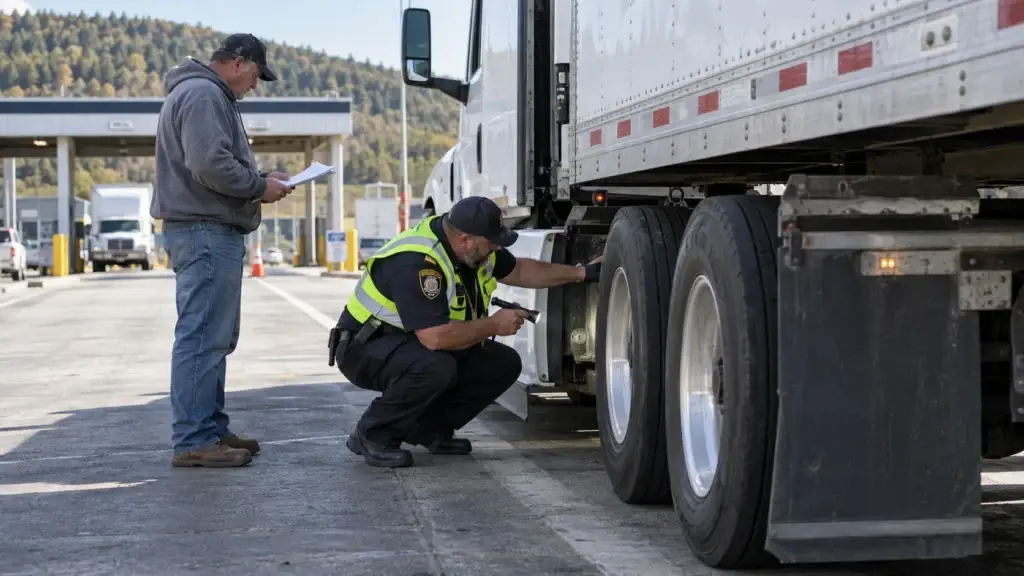
Every commercial motor vehicle operating on American highways faces mandatory annual inspection under federal law — and an unprepared fleet pays the price. A systematic DOT inspection checklist serves as the primary defense against a violation, an out-of-service order, and the damaged CSA score that can affect a business for years. Level I is by far the most common roadside inspection level performed, and its 37-step protocol covers every critical safety system on the vehicle.
The Federal Motor Carrier Safety Administration's 49 CFR Part 396 mandates rigorous vehicle maintenance and inspection standards for every carrier operating a vehicle over 10,001 pounds GVWR. Michael Nielsen and Heavy Duty Journal's editorial team built this guide around exactly what an inspector examines — from brake adjustment measurement to tire tread depth — so a fleet manager or owner-operator can catch a problem during scheduled maintenance rather than at a roadside stop.
Key Takeaways
- ✓Annual inspection mandate: All commercial vehicles must undergo comprehensive safety inspection every 12 months under 49 CFR 396.17, with documentation kept on the vehicle at all times.
- ✓Level 1 dominates enforcement: The 37-point North American Standard Inspection accounts for roughly 60% of all roadside checks — far more common than Level 2 or Level 3 — taking 45-60 minutes to complete.
- ✓Brake violations lead citations: Brake system deficiencies are consistently the single largest category of out-of-service order — proper adjustment and air system maintenance are critical.
- ✓Tire standards differ by position: Steer tires require 4/32" minimum tread depth; drive and trailer positions require 2/32" minimum.
- ✓Documentation prevents violations: A missing annual inspection certificate, expired medical card, or incomplete DVIR triggers a violation independent of vehicle condition.
- ✓Preventive maintenance pays: Catching a defect during scheduled maintenance is reliably cheaper than the emergency repair, towing, and violation cost of the same defect found at roadside.
In This Guide
- Understanding DOT Inspection Requirements and Standards
- The DOT Inspection Checklist: Brake System Requirements
- Lighting, Electrical, and Safety Equipment
- Tires, Wheels, and Suspension Inspection
- Steering and Coupling Devices
- Engine, Fuel System, and Exhaust Inspection
- Documentation and Recordkeeping Requirements
- Common DOT Violations and Prevention Strategies
- Building an Effective Preventive Maintenance Schedule
- Driver Training and Out-of-Service Standards
- Frequently Asked Questions
Understanding DOT Inspection Requirements and Standards
DOT inspections are official examinations of a commercial motor vehicle and its operator conducted by authorized enforcement personnel. A CVSA-certified inspector evaluates whether a vehicle and driver comply with Federal Motor Carrier Safety Regulation, systematically reviewing vehicle components, driver credentials, and operational records to identify a safety violation.
Inspection happens at a fixed weigh station, a mobile inspection site, and during a random roadside stop initiated by law enforcement. The Commercial Vehicle Safety Alliance standardizes these procedures nationwide, ensuring an inspector in any jurisdiction applies consistent criteria. Understanding the different inspection types lets a transportation professional prepare appropriately and respond effectively during an examination.
Free DOT Status Check
Enter a USDOT number and quickly review public carrier status, operating authority and key FMCSA registration data.

The Levels of DOT Inspection
The DOT inspection framework includes up to eight levels, though Levels 1 through 3 make up the overwhelming majority of what happens at roadside. Level I is, by a wide margin, the single most common inspection performed — a recent CVSA International Roadcheck event recorded roughly 60% of all inspections as Level I, with Level II at roughly 21% and Level III at roughly 17%, the remainder spread across the special-study and vehicle-only levels.
| Inspection Level | Focus Area | Duration |
|---|---|---|
| Level I | Comprehensive driver and vehicle including under-vehicle brake inspection | 45–60 minutes |
| Level II | Walk-around driver and vehicle without under-vehicle examination | 30–45 minutes |
| Level III | Driver credentials and hours-of-service only | 15–20 minutes |
| Levels IV–VIII | Special examinations including vehicle-only, terminal, and electronic inspections | Varies |
Level I: North American Standard Inspection
The Level 1 inspection is the most thorough examination a commercial vehicle and driver can undergo — a detailed 37-step protocol examining every critical safety system, standardized uniformly across the United States, Canada, and Mexico.
During Level 1, the officer reviews driver credentials including the commercial driver's license, medical certificate, and endorsements, and examines hours-of-service records and ELD data for compliance with driving time regulation. The vehicle portion includes an under-vehicle examination of brake systems, suspension components, and frame integrity.
The inspector measures brake adjustment, checks for air leaks, and verifies proper function of every safety system. They examine tires for tread depth and damage, inspect lighting, evaluate the steering mechanism, and verify proper cargo securement. A fleet operator should treat Level 1 readiness as the gold standard for a maintenance and compliance program, since Level 1 is overwhelmingly the inspection a truck is most likely to face.
Level II and Level III Inspections
Level 2 provides a comprehensive but less invasive examination — a walk-around covering the same elements as Level 1 without requiring the inspector to physically go underneath the vehicle. The examination focuses on visible components accessible from ground level, making it faster while still thorough.
Level 3 focuses exclusively on the commercial driver, without examining the vehicle — verifying proper credential, current medical certification, and hours-of-service compliance. While it doesn't assess vehicle condition, a violation discovered during a driver-only inspection can still result in an out-of-service order.
The DOT Inspection Checklist: Brake System Requirements
Brake system inspection is the most critical component of DOT compliance verification. Federal regulation mandates specific performance standards for every brake system element, and brake-related violation is consistently the single largest category of out-of-service citation nationwide.
Air Brake System Standards
Air brake system evaluation requires checking multiple components and measuring specific performance parameters. The inspection begins with verifying that air pressure builds from 85 to 100 psi within 45 seconds of engine startup at normal idle speed.
Slack adjusters must be properly set with no excessive travel during brake application. Pushrod stroke must remain within the limit specified for chamber type and size. The low air warning device must activate between 55 and 75 psi, giving both audible and visual alert. Spring brakes must automatically apply when air pressure drops to the 20–40 psi range.
| Air Brake Parameter | Required Standard | Test Condition |
|---|---|---|
| Pressure Buildup Time | 85–100 psi within 45 seconds | From startup at normal idle |
| Low Air Warning Activation | 55–75 psi | Audible and visual warning |
| Spring Brake Activation | 20–40 psi | Automatic application |
| Air Pressure Loss (Single Vehicle) | Less than 2 psi per minute | Brakes applied, engine off |
| Air Pressure Loss (Combination) | Less than 3 psi per minute | Brakes applied, engine off |
⚠️ Safety Warning
Never work on air brake systems without first releasing air pressure and chocking wheels. Spring brakes can release unexpectedly if air pressure is applied to a damaged chamber. Always follow your OEM's lockout/tagout procedures.
Brake Adjustment and Component Inspection
A brake adjustment violation occurs when pushrod travel exceeds manufacturer specification. Different chamber types carry different adjustment limits — a long-stroke chamber allows more travel than a standard chamber. An automatic slack adjuster should maintain proper adjustment continuously, but wear, damage, or improper installation causes adjustment failure.
The inspector examines every brake chamber for leaks and verifies mounting bolts are secure without a crack in the mounting bracket. Air line integrity is verified by checking for leak, kink, or damage throughout the system. A hydraulic brake system on an applicable vehicle needs inspection of brake pad thickness, rotor condition, and master cylinder fluid level. HDJ's air brake maintenance guide covers this inspection procedure in full technical depth.
Lighting, Electrical, and Safety Equipment
Proper lighting ensures vehicle visibility under all operating conditions. Federal regulation specifies exact requirements for placement, color, and operational status — every required light must be visible from roughly 500 feet under normal atmospheric conditions.
Required Lights and Signals
The lighting inspection covers headlights with both high and low beam function. Tail lights must illuminate when headlights are on. Clearance lights mark the overall width and height of a vehicle and combination, while marker lights identify vehicle body sections.
Turn signals must flash between 60 and 120 cycles per minute, amber facing forward and amber or red facing rearward. Brake lights activate when the service brake pedal is pressed, showing red to the rear. The 4-way flasher must operate independently of other lighting circuits. The license plate light must illuminate the rear registration plate sufficiently for identification from 50 feet.
Emergency Equipment Requirements
Federal regulation mandates specific emergency equipment for every commercial motor vehicle. Every commercial vehicle must carry a fire extinguisher with minimum specification — an Underwriters Laboratories rating of at least 5 B:C, fully charged, properly mounted, and readily accessible.
A carrier must provide at least three bidirectional emergency reflective triangles, readily accessible and in good condition. A spare fuse must be carried if the vehicle uses fuses for electrical circuits. Build an equipment inventory checklist to verify every required item is present and accessible.
Tires, Wheels, and Suspension Inspection
Tire Tread Depth Standards
Federal tire tread depth requirement differentiates between steer axle tires and every other position. Steer tires must maintain a minimum of 4/32 inch measured in any two adjacent major tread grooves at three equally spaced points around the tire circumference. Drive axle and trailer tires need a minimum of 2/32 inch using the same method.
Beyond tread depth, tire condition inspection identifies sidewall damage, cuts, bulges, or exposed cord. Any cut deep enough to expose the casing cord creates an out-of-service condition requiring immediate replacement. Mismatched dual tires present a serious safety concern — a dual assembly needs similar tread pattern, matching size designation, and comparable wear level.
4/32" vs 2/32"
Steer tires require twice the minimum tread depth of drive and trailer positions — the extra margin accounts for their critical role in vehicle control.
Wheel and Suspension Components
Wheel assembly inspection includes checking for a damaged rim, a missing lug nut, and proper mounting. Every wheel must be securely attached with the correct number and size of fastener torqued to manufacturer specification — a single loose or missing lug nut on disc wheels places the vehicle out of service.
Suspension inspection examines spring, hanger, and mounting hardware for damage or excessive wear. A leaf spring must be free from cracks, and no leaf should be completely broken or separated from the spring pack. U-bolts securing the axle to springs must be tight with threads extending beyond the nut. Frame rails get a visual inspection for cracks, especially near stress points — any crack in the frame rail is a serious safety defect requiring immediate repair.
Steering and Coupling Devices
The steering system inspection focuses on free play measurement and component security. Steering components must have less than roughly 10 degrees of free play measured at the steering wheel rim before the front wheels begin to turn — the exact allowance scales with steering wheel diameter under the actual CVSA criteria. All steering linkage must be securely fastened with properly torqued bolts and functioning cotter pins or lock nuts.
Fifth Wheel and Kingpin Requirements
The fifth wheel assembly creates the mechanical link between tractor and trailer, bearing tremendous stress during operation. Inspect the fifth wheel plate for a visible crack, particularly around mounting areas and the throat opening — any crack longer than one-quarter inch disqualifies the equipment from service.
Test the locking jaws by attempting to manually open them while coupled — a properly functioning jaw should not release without activating the release handle. Inspect the jaws for excessive wear, a broken spring, or damage. The safety latch must engage fully when the handle returns to the locked position.
Cargo Securement Standards
FMCSA regulation requires cargo be immobilized or secured to prevent shifting in any direction during transport. Load securement must prevent cargo from moving more than one-half inch forward and three inches laterally or rearward. The aggregate working load limit of every tie-down must equal at least one-half the weight of the cargo being secured.
Minimum tie-down quantity depends on cargo length: an article five feet or shorter needs at least one tie-down, an article longer than five but less than ten feet needs at least two, and an article longer than ten feet needs two plus one additional for every additional ten feet. A driver must re-check cargo securement within the first 50 miles of a trip and again after three hours or 150 miles of driving.
Engine, Fuel System, and Exhaust Inspection
Fluid Levels and Exhaust Systems
Systematic fluid check forms the foundation of an effective engine maintenance program. A commercial vehicle operator must verify engine oil, coolant, power steering fluid, transmission fluid, and differential fluid maintain proper level — a low fluid level often signals a leak that constitutes a serious inspection violation.
The exhaust system is a critical inspection area with both safety and environmental implication. DOT regulation mandates secure mounting of every exhaust component with no leak, particularly forward of or directly below the driver and sleeper compartment. A carbon monoxide hazard from an exhaust leak is an immediate out-of-service violation.
A modern diesel engine carries sophisticated emission controls including a diesel particulate filter (DPF) and selective catalytic reduction (SCR) system. A dashboard warning light related to emissions can't be ignored — an illuminated check engine light, DPF regeneration indicator, or SCR system warning needs professional diagnosis before an inspection appointment. HDJ's diesel emission control guide covers DOC, DPF, SCR, and EGR maintenance in full depth.
Fuel System Integrity
Fuel system inspection covers several components directly impacting vehicle safety and fire prevention. DOT standards require secure tank mounting, proper cap function, intact fuel line, and complete absence of leak at any connection point. Even minor seepage is a serious violation — the inspector examines the fuel system with particular attention to visible wetness, fuel odor, and staining.
A fuel tank must mount securely to the frame with properly torqued strap or bracket showing no damage or excessive corrosion. A fuel cap must seal properly to prevent spillage. A connection point where a fuel line attaches to tank, filter, or engine demands particular scrutiny — a fitting must stay tight without seepage or visible fuel residue.
Documentation and Recordkeeping Requirements
Maintaining accurate records is a fundamental requirement that protects both operations and CSA score. Proper recordkeeping creates a verifiable audit trail demonstrating compliance with federal regulation — without comprehensive documentation, even a well-maintained vehicle may fail inspection for inadequate proof of maintenance activity.
Driver Vehicle Inspection Reports
Under 49 CFR 396.11, a driver must inspect their vehicle and prepare a written report at the completion of each day's work when a defect is found. The DVIR process creates a critical communication link between driver and maintenance personnel, ensuring a vehicle defect is identified, documented, and corrected before the vehicle returns to service.
Each DVIR must cover specific components — service brakes and parking brake system, steering mechanism, lighting devices and reflectors, tires and wheel assemblies, horn and windshield wiper, rear-vision mirror, coupling device, and emergency equipment. A motor carrier must retain the original DVIR, certification of repair, and driver's review certification for three months from the initial report date.
Annual Inspection Certification
Federal regulation under 49 CFR 396.17 requires a periodic inspection at intervals not exceeding 12 months, performed by a qualified inspector who understands commercial vehicle systems and federal inspection standards. Documentation must include the inspection date, the inspector's name and signature, and the motor carrier's name and address.
A carrier must retain the periodic inspection report for 14 months from the inspection date, and the vehicle must carry documentation of the most recent periodic inspection at all times during operation. Missing or expired inspection documentation can result in an out-of-service order regardless of actual vehicle condition.
| Document Type | Retention Period | Regulatory Citation |
|---|---|---|
| Driver Vehicle Inspection Reports (DVIR) | 3 months from report date | 49 CFR 396.11 |
| Periodic Inspection Reports | 14 months from inspection | 49 CFR 396.21 |
| Maintenance and Repair Records | Vehicle operational life | 49 CFR 396.3 |
| Roadside Inspection Reports | 12 months from receipt | 49 CFR 396.9 |
| Hours of Service Records | 6 months from receipt | 49 CFR 395.8 |
Common DOT Violations and Prevention Strategies
Top Out-of-Service Violations
Brake system deficiency consistently leads every out-of-service violation category — recent CVSA Roadcheck data puts brake systems as the single largest category on their own, with the combined family of brake-related violations (including the "20% defective brakes" criterion) accounting for well over a third of all vehicle OOS orders. Tire and wheel problems follow, including insufficient tread depth, exposed cord, and a loose lug nut. Lighting failure, cargo securement issue, and fluid leak round out the rest of the top categories.
A brake adjustment violation occurs when pushrod travel exceeds manufacturer specification. An air brake system leak exceeds allowable limit when the pressure loss rate surpasses 2 psi per minute (single vehicle) or 3 psi per minute (combination) with brakes applied. Common leak sources include the glad hand connection, air line fitting, chamber diaphragm, and valve assembly.
Preventing Violations Through Systematic Maintenance
Systematic vehicle inspection identifies a critical defect during a scheduled maintenance window rather than at a roadside enforcement stop. When a maintenance technician checks brake stroke travel during routine service, that prevents the vehicle from being placed out of service miles from the facility.
Regular tread depth measurement and sidewall inspection catch a deteriorating tire before it fails a federal requirement. A tire at 3/32-inch tread identified during preventive maintenance can be replaced on schedule, avoiding a cascading problem when an inspector finds 2/32-inch tread roadside. A pre-trip and post-trip inspection systematically verifies that every required lamp functions properly.
| Violation Category | OOS Criteria | Prevention Strategy |
|---|---|---|
| Brake Adjustment | Pushrod travel exceeds limits for chamber type | Quarterly brake inspections; automatic slack adjuster verification |
| Air System Leaks | Leakage rate exceeds 3 psi/minute (applied) | Soap testing connections; replacing aging air lines during PM |
| Inoperative Stop Lamps | Any required stop lamp not functioning | Daily pre-trip lighting checks; carrying spare bulbs |
| Insufficient Tread Depth | Less than 4/32" on steers or 2/32" on other axles | Monthly tread depth measurements; tire rotation schedules |
| Loose Wheel Fasteners | Any loose or missing lug nuts on disc wheels | Torque verification after tire service; visual inspection |
Building an Effective Preventive Maintenance Schedule
Free Diesel Maintenance Checklist
Get HDJ's free, field-tested diesel maintenance checklist delivered instantly to your inbox — print it, laminate it, keep it in the shop.
Instant PDF • 100% Free • No Spam
Daily Pre-Trip and Post-Trip Requirements
Federal regulation under 49 CFR 396.13 mandates a driver conduct a pre-trip inspection before operating any commercial vehicle and be satisfied the vehicle is in safe operating condition. If the last DVIR noted a deficiency, the driver must review the report and sign to acknowledge the required repair was completed.
A thorough pre-trip inspection follows a systematic walk-around examining brake components, every light and reflective device, steering mechanism, suspension components, tires, coupling device, windshield wiper, mirror, horn function, and fluid leak. A post-trip inspection documents a problem that developed during vehicle use, creating a comprehensive record that lets maintenance personnel address it before the next driver takes the vehicle out.
Weekly, Monthly, and Annual Maintenance Tasks
Weekly tasks include a detailed brake system inspection beyond the driver's daily check, a comprehensive lighting check, tire pressure verification, and battery condition assessment. Monthly maintenance involves more comprehensive procedure including lining thickness measurement, air system leak testing, fluid sample analysis, filter replacement, and a detailed chassis examination with the vehicle on a lift.
Strategic timing of the annual DOT inspection prevents a compliance gap. Schedule inspection 30 to 45 days before the current one expires, allowing adequate time for repair if a deficiency turns up. Perform thorough preventive maintenance two to three weeks before the scheduled inspection to identify an issue that might cause a failure.
Driver Training and Out-of-Service Standards
Understanding Out-of-Service Criteria
Vehicle out-of-service criteria focus on a mechanical defect creating an immediate safety hazard. A critical brake defect includes air pressure below 60 psi, brake chamber pushrod travel exceeding adjustment limit, and a contaminated brake component. A steering system defect including excessive free play beyond manufacturer specification or a loose component also triggers an OOS order.
A driver out-of-service condition focuses on regulatory compliance. An hours-of-service violation — exceeding maximum driving time or failing to take a required rest break — is the most frequent driver OOS condition. A missing or expired credential — an expired CDL, missing medical certificate, or suspended license — immediately disqualifies a driver from operation.
Quick Reference: Driver OOS Conditions
- Hours of Service: Exceeded driving limits, insufficient rest breaks, ELD violations
- Credentials: Expired CDL, missing medical certificate, suspended license
- Substance Violations: Alcohol levels ≥0.04% or any detectable controlled substances
- Medical Issues: Expired or invalid medical certification
Frequently Asked Questions
How long does a Level 1 DOT inspection take?
Typically 45 to 60 minutes, depending on vehicle complexity and any violation discovered. This comprehensive examination includes 37 inspection points covering driver credentials, hours-of-service compliance, and a detailed under-vehicle brake measurement. Level 2 walk-around inspection takes 30 to 45 minutes; driver-only Level 3 takes 15 to 20 minutes.
What are the most common DOT inspection violations?
Brake system violation leads every out-of-service citation. Tire and wheel deficiency follows, including insufficient tread depth, exposed cord, and a loose lug nut. Lighting failure, particularly an inoperative brake light, ranks high too. Other frequent violations include a cargo securement deficiency, an hours-of-service violation, and missing or expired documentation.
What triggers an out-of-service order during a DOT inspection?
A safety-critical defect creating an immediate hazard. Vehicle OOS conditions include air brake pressure below 60 psi, brake pushrod travel exceeding adjustment limit, tire cord exposure, an inoperative headlamp or taillight, and a fuel system leak. Driver OOS conditions include exceeded driving hours, an expired CDL or medical certificate, an ELD violation, and a positive alcohol or drug test.
How often must commercial vehicles undergo DOT inspection?
Federal regulation under 49 CFR 396.17 requires a periodic inspection at intervals not exceeding 12 months, performed by a qualified inspector and documented on the vehicle at all times. Beyond the annual inspection, a driver must conduct a pre-trip inspection before each trip and complete a Driver Vehicle Inspection Report at the end of each workday when a defect is found.
What documents must a driver have during a DOT inspection?
A valid commercial driver's license with appropriate endorsement, a current medical certificate (DOT physical card), and hours-of-service records for the previous seven days via ELD or paper log. Also required: the annual inspection certification, vehicle registration, and proof of insurance. A hazmat carrier must also carry shipping papers and emergency response information.
What are the minimum tire tread depth requirements for DOT compliance?
A steer axle tire needs a minimum of 4/32 inch, measured in any two adjacent major grooves at three equally spaced intervals around the tire. A drive axle or trailer tire needs a minimum of 2/32 inch. A tire with exposed cord or fabric, a sidewall cut deeper than one inch, or a visible bulge fails inspection regardless of remaining tread depth.
Maintaining Year-Round DOT Compliance
Successful DOT compliance starts with systematic inspection preparation and a robust preventive maintenance program. The investment in proper maintenance schedule, driver training, and documentation practice delivers a measurable return through fewer unexpected breakdown, reduced enforcement scrutiny, and lower operating cost.
A fleet manager or owner-operator implementing a comprehensive DOT inspection checklist and treating inspection readiness as a daily discipline consistently outperforms a reactive operation. Understanding the specific measurement, standard, and procedure that an enforcement officer uses during examination lets a fleet identify a problem during scheduled maintenance rather than at a roadside stop — the same discipline Michael Nielsen and Heavy Duty Journal's editorial team hold every guide on heavydutyjournal.com to.
Found This DOT Inspection Guide Helpful?
Share it with other fleet managers and owner-operators who want to stay DOT-ready year-round.


