
By Michael Nielsen, Publisher | 15+ Years in Diesel Repair
Last Updated: September 2026
⏱ Estimated reading time: 15+ minutes
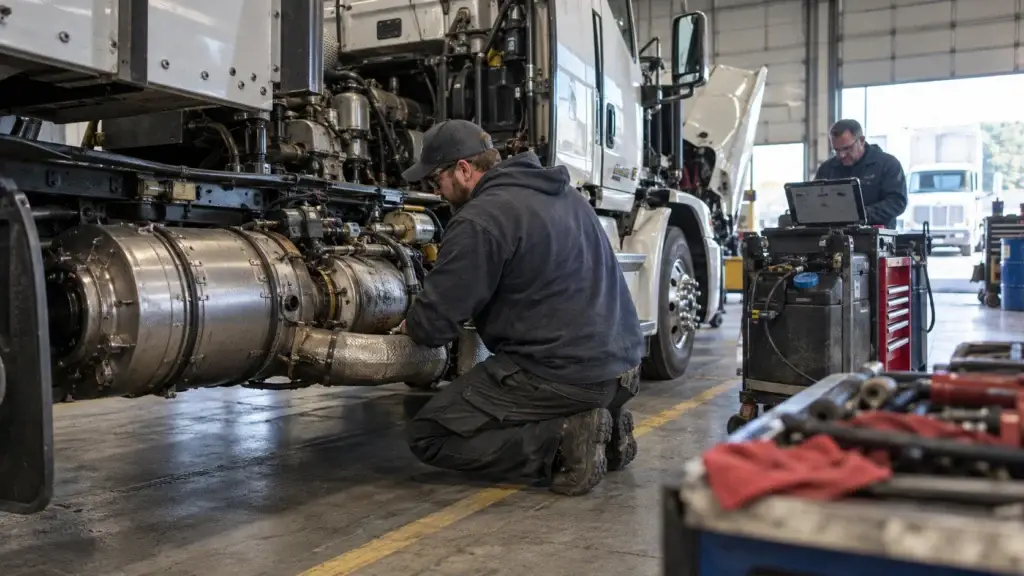
Diesel emission control has become one of the most technically demanding parts of operating a modern truck. Every diesel engine sold since 2010 relies on four integrated aftertreatment components — the Diesel Oxidation Catalyst (DOC), Diesel Particulate Filter (DPF), Selective Catalytic Reduction (SCR) system, and Exhaust Gas Recirculation (EGR) unit — working together to meet federal emission regulations, and understanding how they interact has become essential for anyone managing diesel equipment in the United States.
Neglecting these components leads to engine derates, costly downtime, expensive repair, and potential federal penalties. Michael Nielsen and Heavy Duty Journal's editorial team built this guide as the integrated systems view — how DOC, DPF, SCR, and EGR work together, what happens when one fails, and what the regulation actually requires. For deeper procedural detail on any single component, HDJ's dedicated DPF cleaning and maintenance guide and DEF system maintenance guide go further on those two components specifically.
Key Takeaways
- ✓Four integrated components: DOC, DPF, SCR, and EGR work together to meet EPA's on-highway heavy-duty diesel emission standards.
- ✓DPF regeneration is critical: Regular regeneration prevents soot accumulation — active regeneration occurs at 1000–1200°F, passive at 550–650°F during highway operation.
- ✓DEF quality matters: SCR systems require ISO 22241-compliant DEF with a urea concentration held to a narrow 31.8–33.2% band to prevent catalyst damage.
- ✓Low-ash oil protects aftertreatment: CK-4 and FA-4 oils are designed to sustain emission control system durability and reduce catalyst poisoning and particulate filter blocking.
- ✓Tampering carries serious penalties: Federal civil penalties for defeating an emission control device run into the tens of thousands of dollars per violation.
- ✓Preventive maintenance saves real money: Systematic aftertreatment care meaningfully reduces total ownership cost compared to reactive repair.
In This Guide
- Understanding Modern Diesel Emission Control Systems
- Exhaust Gas Recirculation (EGR) Systems
- Selective Catalytic Reduction (SCR) Technology
- Diesel Particulate Filter (DPF) Systems
- Diesel Oxidation Catalyst (DOC) Function
- Diagnostic Codes and Sensor Monitoring
- Comprehensive Maintenance Best Practices
- Preventing Premature System Failure
- Regulatory Compliance and Legal Requirements
- Frequently Asked Questions
Understanding Modern Diesel Emission Control Systems
The diesel industry has undergone dramatic transformation in response to environmental regulation over the past two decades. What began with simple catalytic converters has evolved into highly sophisticated integrated aftertreatment systems designed to address four primary pollutants: nitrogen oxides (NOx), carbon monoxide (CO), hydrocarbons (HC), and particulate matter.
The journey toward clean diesel began in earnest with 2007 regulations that required dramatic NOx reduction. Manufacturers responded by developing Selective Catalytic Reduction systems that convert NOx into harmless nitrogen and water vapor. By 2010, even stricter standards forced the integration of Diesel Particulate Filters to trap soot particles.
The EPA's on-highway heavy-duty diesel emission standards — the 2007/2010 rule that governs the trucks this guide covers — represent the current pinnacle of on-highway emission requirements. These regulations mandate specific emission limits measured in grams per brake horsepower-hour: NOx limits fell to 0.20 g/bhp-hr and particulate matter to 0.01 g/bhp-hr under the fully phased-in standard, requiring near-complete soot capture and the SCR/DPF technology this guide covers.
It's worth noting this is distinct from EPA's Tier 4 program, which uses similar aftertreatment technology but governs off-highway equipment — construction, agricultural, and industrial machinery — rather than the on-highway trucks HDJ's readers operate.
~98% Reduction
The fully phased-in 2007/2010 on-highway standard cut particulate matter limits from 0.10 g/bhp-hr to 0.01 g/bhp-hr — nearly complete soot capture compared to pre-2007 diesel engines.
How Aftertreatment Components Work Together
Modern aftertreatment configurations consist of components functioning as an interdependent network rather than isolated parts. The Diesel Oxidation Catalyst initiates emission reduction by converting CO and HC into less harmful compounds while generating nitrogen dioxide needed for downstream processes. The DPF captures and stores particulate matter, requiring periodic regeneration to burn off accumulated soot. The SCR catalyst uses Diesel Exhaust Fluid to convert NOx emissions into nitrogen and water.
Understanding this interdependence is critical for maintenance professionals. A failing DOC can prevent proper DPF regeneration, while contaminated DEF can poison the SCR catalyst. This cascading effect means an integrated aftertreatment system needs a comprehensive maintenance strategy, not component-by-component service performed in isolation.
Exhaust Gas Recirculation (EGR) Systems
Nitrogen oxide formation occurs at peak combustion temperature, which is precisely why exhaust gas recirculation became essential in emission control. The EGR system redirects a portion of inert exhaust gas back into the engine's intake stream, diluting oxygen concentration and lowering peak temperature below the threshold where NOx forms.
When temperature exceeds roughly 2,500°F, nitrogen and oxygen molecules combine to form nitrogen oxides. EGR introduces exhaust gas that acts as thermal ballast — absorbing heat energy without contributing to combustion. This lowers peak flame temperature by roughly 200–400°F, dramatically reducing thermal NOx formation while maintaining engine power output.
High-Pressure vs. Low-Pressure EGR Configurations
Modern diesel engines use two distinct architectures. High-pressure EGR routes exhaust from before the turbocharger directly to the intake manifold after the compressor, giving excellent transient response during acceleration. Low-pressure systems take exhaust after the DPF and introduce it before the turbocharger compressor inlet, reducing pumping losses and keeping particulate matter out of the intake system.
| Configuration | Exhaust Source | Introduction Point | Primary Advantage |
|---|---|---|---|
| High-Pressure EGR | Before turbocharger | After compressor | Superior transient response |
| Low-Pressure EGR | After DPF | Before compressor inlet | Reduced pumping losses, cleaner gas |
| Hybrid EGR | Both locations | Both locations | Optimized across operating range |
EGR Valve and Cooler Maintenance
Carbon buildup is the most common EGR maintenance challenge. Exhaust soot combines with oil vapor residue to create hard deposits on valve surfaces and cooler passages. A stuck-open valve allows excessive exhaust gas into the intake manifold, causing engine knock, overheating, and increased particulate emission that can overwhelm the DEF system.
EGR coolers reduce exhaust gas temperature from roughly 900–1,200°F down to 300–400°F using engine coolant as the heat exchange medium. Maintaining proper coolant level and quality directly impacts cooler longevity — neglected coolant maintenance leads to fouling that progressively restricts flow and compromises emission control effectiveness.
Selective Catalytic Reduction (SCR) Technology
Among all emission control technologies, SCR delivers the highest NOx reduction efficiency through a precisely controlled chemical conversion process, achieving conversion rates between roughly 90% and 95%. The system operates within a specific temperature window of roughly 400°F to 850°F for optimal performance.
The Urea Conversion Process
The chemical reaction begins when Diesel Exhaust Fluid enters the hot exhaust stream. DEF meeting ISO 22241 specification consists of 32.5% high-purity urea dissolved in deionized water. When exposed to exhaust temperature, the fluid undergoes thermal decomposition and hydrolysis, generating ammonia that becomes the active reducing agent — which then reacts with nitrogen oxides over the catalyst surface, producing harmless nitrogen gas and water vapor.
Any contamination in DEF — from diesel fuel, engine oil, or mineral deposits — reduces conversion efficiency and can permanently damage the catalyst substrate. HDJ's DEF system maintenance guide covers storage, handling, and contamination prevention in full depth.
DEF Quality Standards
ISO 22241 holds urea concentration to a genuinely narrow tolerance — 31.8% to 33.2%, centered on the 32.5% target — along with strict limits on biuret content, alkalinity, and metal contaminants. Generic or off-brand product may not meet these specifications and can cause irreversible catalyst damage.
Storage conditions demand attention to temperature, light exposure, and container integrity. DEF freezes at 12°F but remains functional after thawing with proper heater operation. Above 86°F, degradation accelerates and shelf life drops significantly — under ideal conditions, expect up to a year of shelf life, but temperature cycling shortens this considerably.
⚠️ Critical Warning
Never add diesel fuel, engine oil, or any fluid other than certified DEF to the DEF tank. Even trace contamination will permanently damage the SCR catalyst, requiring complete system replacement costing thousands of dollars.
Diesel Particulate Filter (DPF) Systems
Diesel particulate filters capture microscopic soot particles through an intricate ceramic filtration system. The DPF uses a wall-flow monolith structure made from silicon carbide or cordierite ceramic containing thousands of parallel channels — alternating channels are plugged at opposite ends, forcing exhaust gas through porous ceramic walls where filtration occurs.
Particulate matter becomes trapped within microscopic pores through diffusion, interception, and inertial impaction. The critical distinction between soot and ash determines maintenance need — soot is combustible carbon that burns off during regeneration, while ash accumulates permanently from engine oil additives and fuel contaminants.
Active and Passive Regeneration
Active DPF regeneration relies on a hydrocarbon dosing injector — commonly called the 7th injector — positioned upstream of the DOC. This introduces diesel fuel directly into the exhaust stream where it oxidizes exothermically, raising exhaust temperature to 1000–1200°F to initiate soot combustion. The engine control module monitors differential pressure sensors and calculates soot load to determine regeneration timing.
Passive regeneration happens naturally when exhaust temperature stays above 550–650°F for extended periods during highway operation. The DOC generates nitrogen dioxide that acts as an oxidizing agent, lowering the temperature threshold needed for continuous soot burnoff. A truck running highway duty cycles benefits most from passive regeneration — fewer active regeneration events and better fuel economy. HDJ's DPF cleaning and maintenance guide covers ash-clean intervals, cleaning method comparisons, and warning signs in full depth.
When regeneration requests go ignored, the engine management system initiates progressive power derates. Eventually the system will shut the engine down completely, requiring a stationary parked regeneration before operation resumes.
Diesel Oxidation Catalyst (DOC) Function
The DOC serves as the first line of defense in the aftertreatment system, sitting directly after the turbocharger to initiate emission reduction. The catalyst contains a ceramic or metallic substrate coated with platinum and palladium that enable chemical transformation without being consumed.
The DOC converts carbon monoxide and unburned hydrocarbons into carbon dioxide and water through exothermic reactions, operating effectively between 250°F and 750°F. Below a light-off temperature of roughly 250–300°F, catalytic activity remains minimal; above 750–800°F, catalyst material can begin to sinter and lose effectiveness over time.
Beyond continuous emission reduction, the DOC performs a vital secondary function converting nitric oxide (NO) to nitrogen dioxide (NO2) — which supports passive DPF regeneration, since NO2 acts as a more effective oxidizing agent than oxygen at lower temperature. During active regeneration, the DOC uses injected fuel to generate the heat needed for soot combustion in the downstream DPF.
Diagnostic Codes and Sensor Monitoring
Diagnostic fault codes are the primary communication method between the exhaust system and technicians, translating complex sensor data into actionable maintenance information. Modern aftertreatment systems use a sophisticated sensor network that continuously monitors performance parameters and alerts the engine control module when conditions deviate from normal operating range.
The heavy-duty diagnostic protocol uses standardized Suspect Parameter Numbers (SPN) and Failure Mode Identifiers (FMI), specified under 40 CFR Part 1065, to classify specific faults. Reviewing both active and historical codes helps a technician identify a pattern indicating a chronic issue rather than an isolated incident.

| Fault Code | Component | Description | Common Causes |
|---|---|---|---|
| SPN 3246 FMI 0/15 | DPF Outlet | Temperature Very High | Excessive regeneration, restricted exhaust |
| SPN 4363 FMI 0 | SCR Outlet | Temperature High | Catalyst damage, uncontrolled regen |
| SPN 3251 FMI 0/16/20 | DPF Pressure | Out of Range | Sensor failure, severe plugging, air leaks |
| SPN 102 FMI 18 | Intake Manifold | Pressure Too Low | Boost leaks, EGR valve problems |
NOx and Temperature Sensor Networks
A diesel truck uses two NOx sensors — one before and one after the SCR catalyst — to monitor nitrogen oxide levels through the emission reduction process. These sensors feed real-time data to the ECM for regulating DEF injection rate, using an electrochemical, zirconia-based dual-chamber design that differentiates between oxygen and nitrogen oxides.
Temperature sensors sit at several points through the aftertreatment system — typically 5–7 locations including before the DOC, between DOC and DPF, after the DPF, and before and after the SCR catalyst. These sensors control regeneration initiation, limit maximum temperature during active regeneration, and detect a fault when temperature rise doesn't match fuel dosing commands.
Comprehensive Maintenance Best Practices
Inspection Schedules by Vehicle Class
Different vehicle classes demand distinct inspection requirements based on operational demand. Class 8 long-haul trucks typically need a comprehensive aftertreatment inspection every 150,000–200,000 miles, while a vocational vehicle in severe-duty conditions needs evaluation at 75,000–100,000-mile intervals. Regional haul applications fall between these extremes at 100,000–150,000 miles.
| Vehicle Class | Duty Cycle | Inspection Interval | Critical Focus Areas |
|---|---|---|---|
| Class 8 Long-Haul | Highway/Extended | 150,000–200,000 miles | DPF, SCR catalyst, sensors |
| Regional Haul | Mixed highway/urban | 100,000–150,000 miles | EGR valve, DPF, DEF system |
| Vocational/Severe | Stop-and-go, idling | 75,000–100,000 miles | EGR cooler, DPF, all sensors |
DPF Ash-Clean Intervals by Engine Platform
Ash buildup sets the real maintenance interval, and it varies meaningfully by engine platform, duty cycle, and fuel economy rather than following one fixed mileage figure. Detroit Diesel's Gen 4 engines (EPA10 to GHG17) carry DPF maintenance intervals reaching 500,000+ miles for line-haul applications, with newer Gen 5 engines (GHG21) extending that to 600,000+ miles.
Cummins reports similar improvement — 2016-and-newer ISX15 engines can reach up to 500,000 miles for conventional line-haul applications achieving fuel economy above 5.5 MPG, with Cummins Single Module aftertreatment extending intervals to 600,000–800,000 miles. An earlier EPA 2013 engine typically needs service at 300,000–400,000 miles depending on build date and duty cycle. HDJ's DPF cleaning and maintenance guide, linked above, breaks this down by platform in full detail, along with a comparison of cleaning methods.
Preventing Premature System Failure
Fuel and Oil Requirements
Using ultra-low sulfur diesel (ULSD) with a maximum 15 ppm sulfur content is legally mandated for 2007-and-newer diesel engines. Sulfur creates sulfate particulate that rapidly loads the DPF and produces sulfur dioxide that permanently poisons catalyst surfaces — even brief exposure to high-sulfur fuel causes irreversible damage.
API CK-4 and FA-4 low-ash engine oil specifications contain reduced levels of sulfated ash, phosphorus, and sulfur, giving enhanced protection against catalyst poisoning, particulate filter blocking, and soot-related viscosity increase. CK-4 oil exceeds the performance of the older CJ-4 formulation and is especially effective at sustaining emission control system durability.
Duty Cycle Optimization
Vehicle duty cycle characteristics determine whether an aftertreatment system stays clean through passive regeneration or progressively loads with soot. Maintaining exhaust temperature above 500–550°F enables natural soot oxidation without active regeneration intervention.
Optimal Duty Cycle Parameters
- Average Vehicle Speed: 40–65 MPH (below 40 MPH is suboptimal)
- Average Drive Load: 30% and above
- Idle Time: Less than 40% of operation
- Engine Load Operation: 50%+ of time above 20% load
- Regeneration Balance: Roughly 75% driving / 25% parked regenerations as a rough target
Fleet managers should analyze operational data to identify a vehicle operating in less-than-optimal conditions. Route modification or equipment reassignment can meaningfully improve duty cycle and reduce maintenance cost.
Regulatory Compliance and Legal Requirements
Compliance with federal emission regulation represents more than a legal obligation — it's a fundamental operational requirement. The Clean Air Act establishes the foundation for all emission regulation, with amendments creating progressively stricter standards for heavy-duty diesel engines. Federal law requires maintaining emission control systems in proper working condition through the engine's useful life — 435,000 miles or 10 years for a heavy-duty diesel engine, whichever comes first.
Federal regulation under 40 CFR 1068.101, implementing Section 203(a)(3) of the Clean Air Act, explicitly prohibits tampering with an emission control system — DPF deletion, EGR blocking, or ECM tuning to disable regeneration all fall under this prohibition. The EPA holds enforcement authority including inspection programs, civil penalties, and the power to compel a recall, and has prioritized tampering enforcement in recent years against both individual violators and the shops that install "delete" hardware and tuning.
| Violation Type | Civil Penalty Range | Additional Consequences |
|---|---|---|
| Per noncompliant vehicle or engine | Up to $45,268 | Loss of warranty coverage |
| Per tampering event or defeat-device sale | Up to $4,527 | Criminal prosecution possible for repeat/egregious cases |
| Per day, reporting/recordkeeping violations | Up to $45,268 | Consent decrees, injunctions for repeat offenders |
These figures are adjusted periodically for inflation under 40 CFR Part 19, so the exact ceiling shifts over time — but the direction has consistently been upward, and EPA has resolved dozens of tampering enforcement cases against repair shops and defeat-device sellers in recent years, some carrying penalties well into six or seven figures for high-volume violators.
Fleet operations must maintain comprehensive maintenance documentation to demonstrate compliance, including maintenance logs, component replacement receipts, and DPF cleaning records. The financial and legal consequence of non-compliance far exceeds the cost of proper maintenance.
Frequently Asked Questions
How often should diesel particulate filters be cleaned?
It depends on engine platform, duty cycle, and fuel economy rather than one fixed mileage for every application. Detroit Diesel's Gen 4 engines (EPA10 to GHG17) reach 500,000+ miles for line-haul use; newer Gen 5 engines (GHG21) extend that to 600,000+ miles. Cummins Single Module aftertreatment can reach 600,000–800,000 miles. An earlier EPA 2013 engine typically needs service at 300,000–400,000 miles depending on build date and whether fuel economy exceeds 5.5 MPG.
What causes SCR system failures and DEF crystallization?
Typically contaminated DEF, thermal damage to the catalyst, or a dosing system malfunction. Crystallization occurs when water evaporates during shutdown or excess fluid is injected, forming solid urea deposits that block lines and injectors. Contamination from diesel fuel, engine oil, or mineral deposits will permanently damage the SCR catalyst. Always use DEF meeting ISO 22241 specification, held to its narrow 31.8–33.2% urea tolerance, and store it away from direct sunlight below 86°F.
What are the symptoms of EGR valve problems?
Typically sticking in either the open or closed position from carbon fouling — exhaust soot mixing with oil vapor residue. A stuck-open valve allows excessive exhaust gas into the intake manifold, causing engine knock, overheating, increased particulate emission, and potential DEF system overload leading to power derate. Diagnostic signs include fault codes indicating EGR flow error, intake manifold temperature deviation, and a gap between commanded versus actual EGR position on scan tool data.
What are the penalties for tampering with diesel emission systems?
Federal regulation under 40 CFR 1068.101 prohibits tampering with an emission control system. Current civil penalties run up to $45,268 per noncompliant vehicle or engine, up to $4,527 per tampering event or defeat-device sale, and up to $45,268 per day for reporting and recordkeeping violations — figures adjusted periodically for inflation under 40 CFR Part 19. Delete-tuning service providers have faced penalties well into six and seven figures in high-volume enforcement cases. Beyond federal penalty, tampering voids manufacturer warranty and may trigger state-level enforcement too.
How do duty cycles affect DPF regeneration and maintenance?
Duty cycle determines whether an aftertreatment system stays clean through passive regeneration or progressively loads with soot requiring active intervention. Optimal conditions include an average vehicle speed of 40–65 MPH, a drive load above 30%, idle time below 40%, and engine load above 20% for at least half the operating time. A vehicle consistently operating below these thresholds sees more frequent active regeneration, increased fuel consumption, accelerated ash accumulation, and shortened component service life.
Protecting Your Fleet Investment Through Strategic Maintenance
Understanding aftertreatment components transforms an operator from a reactive troubleshooter into a proactive fleet manager. The DPF, SCR catalyst, DOC, and EGR system work together as a unified pollution control network, and neglecting any single component creates a cascading failure that compromises the entire system.
Following emission control best practice protects the operational investment while maintaining EPA compliance. Regular inspection catches a minor issue before it escalates into an emergency repair, proper DEF handling prevents catalyst damage, and scheduled regeneration extends system lifespan while maintaining fuel efficiency — the same discipline Michael Nielsen and Heavy Duty Journal's editorial team hold every guide on heavydutyjournal.com to.
Share This Guide With Your Team
Help other fleet managers and diesel technicians maintain emission compliance and reduce downtime — share this comprehensive aftertreatment guide with colleagues who need it.


