By Michael Nielsen, Editor & Publisher | 15+ Years in Diesel Repair
Last Updated: January 2026
📖 Estimated reading time: 22 minutes
The Federal Motor Carrier Safety Administration launched a sweeping overhaul of how carriers register and maintain their operating authority. Starting April 1, 2025, every new motor carrier, broker, and freight forwarder must pass through a rigorous FMCSA identity verification checkpoint that fundamentally changes DOT registration. These aren’t minor paperwork updates—the new rules represent a fundamental shift designed to stop the hundreds of millions of dollars lost annually to freight fraud.
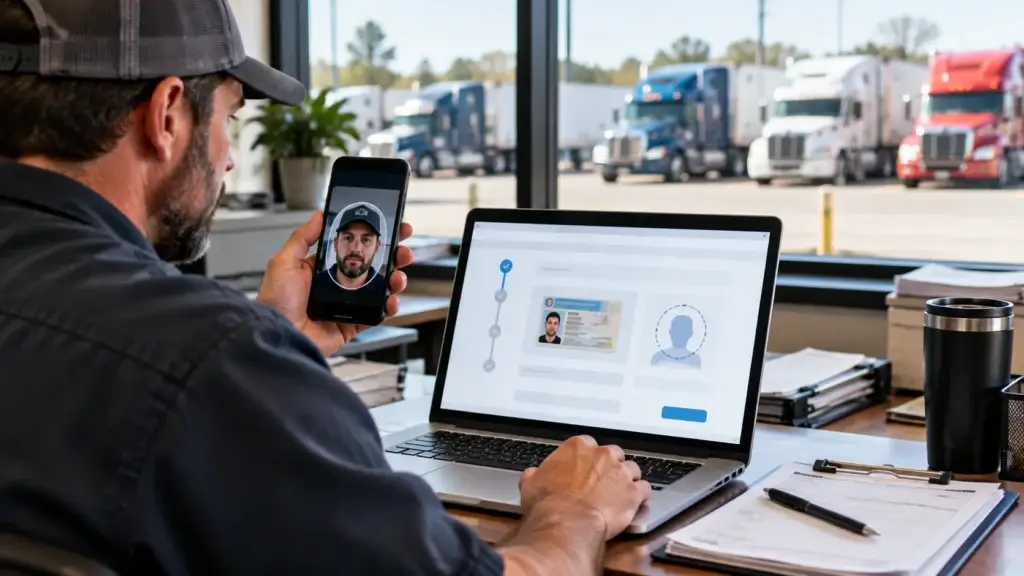
All new applicants must now verify their identity using government-issued photo ID and real-time selfie authentication through IDEMIA security technology. This happens during the Unified Registration System process, where companies submit biometric data and detailed ownership information. The impact has been immediate and dramatic. In April 2025, approval rates plummeted from the typical 60-65% to just 30%. More than half of all applications failed at the first stage as fraudulent submissions got filtered out.
Legitimate carriers benefit from a more level playing field. But everyone must understand these requirements to maintain compliance and avoid operational disruptions.
Key Takeaways
- April 1, 2025 effective date: All new motor carrier, broker, and freight forwarder applicants must complete biometric identity verification through the Unified Registration System.
- IDEMIA technology now required: Government-issued photo ID plus real-time selfie verification authenticates every applicant’s identity before authority is granted.
- Approval rates dropped 50%: First-month data shows approvals fell from 60-65% to just 30% as fraudulent applications were filtered out.
- Existing carriers affected at renewal: Current authority holders must complete verification during renewal cycles or when making ownership changes.
- 99.9% first-attempt success rate: Properly prepared applicants pass verification immediately; most failures result from photo quality issues.
- 300+ enrollment centers available: In-person verification assistance exists nationwide for applicants who prefer or need face-to-face help.
What You Need to Know About FMCSA Identity Verification Changes
Starting April 1, 2025, motor carriers face a new reality: stricter registration requirements that demand verifiable proof of identity before operating authority is granted. These modifications represent the most significant overhaul to the registration process in over a decade. The identity verification process now serves as the first line of defense against fraudulent operators who have historically exploited system weaknesses.
The new framework targets a fundamental problem in the trucking industry. Bad actors previously used fake credentials and shell companies to obtain motor carrier numbers. This practice put unsafe operators on the road and undermined legitimate businesses competing fairly.
Core Components of New Verification Standards
The Unified Registration System now incorporates advanced technology through a partnership with IDEMIA, a global leader in identity security solutions. All new applicants must complete a multi-step verification process that mirrors airport security protocols. This biometric verification ensures the person registering matches government-issued identification documents.
The motor carrier application requirements now include:
- Government-issued photo ID upload: Applicants must submit a clear, current identification document such as a driver’s license or passport
- Real-time selfie matching: A live photograph captures facial biometrics to verify the applicant’s identity matches the submitted ID
- Business operation proof: Documentation demonstrating legitimate business activities and physical location
- Enhanced address validation: Systems verify physical business addresses to prevent fraudulent virtual office registrations
- Company official verification: Each authorized company representative undergoes the same identification process
FMCSA reports that 99.9% of properly prepared applicants pass verification on their first attempt. Minor technical issues like poor lighting, blurry photos, or camera angle problems account for most initial rejections. Applicants who experience difficulties can resubmit corrected documentation or visit one of over 300 enrollment centers nationwide for in-person verification assistance.
Contrasting New Standards with Previous Registration Methods
Previous registration systems relied heavily on document submission without robust identity confirmation. Fraudulent operators exploited these gaps through several sophisticated methods. They submitted fake insurance certificates that appeared legitimate but provided no actual coverage. They cloned motor carrier numbers from legitimate businesses to create shell operations.
The most damaging practice involved rebranding carriers with poor safety records. When a carrier faced suspension or accumulated violations, operators simply shut down and re-registered under a new name. This “reincarnation” scheme allowed unsafe operators to reset their safety scores while continuing dangerous practices.
The identity verification process now prevents these scenarios through several mechanisms:
- Individual accountability: Biometric verification ties each registration to specific, verified individuals who cannot easily create multiple identities
- Cross-reference capabilities: The system checks for previous registrations associated with verified identities, flagging potential rebranding attempts
- Address authentication: Physical location verification eliminates the use of mail drops, virtual offices, and non-existent business addresses
- Document validation: Enhanced verification checks insurance certificates, business licenses, and corporate filings against authoritative databases
These changes create a permanent digital record linking company officials to their motor carrier operations. Bad actors can no longer simply abandon problematic carriers and start fresh with manufactured credentials.
30%
April 2025 application approval rate—down from 60-65% before identity verification requirements took effect
Implementation Scope and Timeline
The URS system rollout follows a phased approach that prioritizes new applicants while planning for comprehensive industry coverage. As of April 1, 2025, all new motor carrier, broker, and freight forwarder applications require completion of the identity verification process. This initial phase establishes the infrastructure and processes that will eventually encompass the entire industry.
FMCSA designed this verification framework as part of a broader modernization initiative. The agency plans to extend registration changes to existing carriers during renewal periods and major account updates. This gradual expansion allows the industry to adapt while ensuring system stability and support resource availability.
For carriers needing immediate verification, the network of 300+ enrollment centers provides in-person alternatives to digital submission. These facilities offer hands-on assistance for applicants who lack reliable internet access, prefer face-to-face verification, experience repeated technical difficulties with online submissions, or require additional guidance navigating application requirements. Most in-person verifications complete within 15-20 minutes, providing immediate confirmation of successful identity authentication.
The Driving Forces Behind FMCSA’s Identity Verification Overhaul
Behind every regulatory change lies a compelling reason, and FMCSA’s identity verification overhaul addresses critical vulnerabilities that threaten the integrity of commercial trucking operations. The agency’s modernization initiative responds to three interconnected challenges that have undermined industry trust and compromised public safety. Understanding these underlying motivations helps carriers recognize that compliance serves their own interests as much as regulatory objectives.

Combating Fraud and Identity Theft in Trucking
Fraudulent activity drains hundreds of millions of dollars annually from carriers, brokers, and shippers who fall victim to sophisticated schemes. Bad actors have systematically exploited weaknesses in the registration and oversight process to masquerade as legitimate businesses. This financial hemorrhaging threatens the stability of honest operators who compete against entities that circumvent proper authorization.
Criminal enterprises employ several specific tactics that the new verification system targets. The most common freight fraud prevention challenges include fake insurance documents (forged or expired certificates that make fraudulent carriers appear properly covered), cloned motor carrier numbers (unauthorized duplication of legitimate MC numbers to create ghost carriers), credential reuse (illegitimate adoption of USDOT numbers from shuttered operations), and rebranding schemes (strategic renaming of unsafe carriers to appear newly compliant).
These fraud schemes create more than financial losses. They pose direct safety risks by allowing unqualified or unsafe operators onto public highways. The verification overhaul directly addresses these vulnerabilities by establishing security standards that make impersonation and credential theft substantially more difficult.
Improving Road Safety Through Verified Credentials
Identity verification serves a dual purpose that extends beyond fraud prevention to encompass fundamental safety improvements. The integration of safety-related data into the new registration process creates a uniform due diligence framework that benefits everyone in the supply chain. Shippers and brokers gain greater confidence in carrier selection when they can verify that partners have legitimate, verified credentials.
The system enhances carrier accountability by tying carrier authorities directly to verified USDOT numbers with clear operational statuses. This linkage allows FMCSA to consolidate its ability to identify and remove unsafe carriers from operation. When registrations connect to real individuals and verified businesses, the agency can prevent the re-entry of fraudulent or unsafe operators into the system.
This approach transforms motor carrier safety oversight from a reactive to a proactive model. Instead of discovering problems after incidents occur, the verification process identifies concerns during the registration phase.
Aligning with Federal Security Standards
FMCSA’s initiative fits within broader federal security frameworks that have proven effective in other transportation sectors. The Transportation Security Administration’s airport security protocols provide one relevant comparison. TSA has successfully implemented layered security measures that verify passenger identities before allowing access to secure areas. Similarly, the Transportation Worker Identification Credential (TWIC) program has applied biometric screening and background checks for maritime and port environments since 2007.
FMCSA is now extending similar verified identity principles to over-the-road trucking operations. This expansion creates consistency across transportation security programs and addresses a gap that left commercial trucking vulnerable to exploitation. Key elements adapted from successful programs include identity verification at multiple touchpoints, database integration connecting safety records with verified credentials, real-time status updates about authority validity, and background screening protocols identifying disqualifying factors.
Stay Ahead of Regulatory Changes
FMCSA requirements continue evolving. Get regulatory updates, compliance guidance, and fleet management insights delivered to your inbox.
Who Is Affected by the New FMCSA Identity Verification Rules
Every segment of the commercial transportation ecosystem faces unique compliance challenges under the new identity verification framework. The reach of these motor carrier regulations extends beyond traditional fleet operators to touch virtually every participant in the freight movement chain. Understanding your specific obligations determines how quickly and effectively you can adapt your business processes.

Interstate and Intrastate Motor Carriers
Motor carriers operating across state lines or within a single state jurisdiction must complete identity verification when applying for new operating authority. This requirement applies regardless of fleet size or operational scope. Whether you manage a hundred-truck operation or a modest regional fleet, the same verification standards apply when establishing or modifying your authority.
Carrier authorities are now tied directly to USDOT numbers with one of three distinct statuses: valid, suspended, or revoked. This classification represents a significant consolidation of FMCSA’s enforcement tools. The three-tier system eliminates ambiguous authorization statuses that previously allowed some carriers to operate in regulatory gray areas.
Existing carriers who obtained authority before these rules took effect are not immediately required to re-verify. However, expect verification requirements during renewal cycles and whenever you make ownership changes or substantial registration updates.
Commercial Drivers and CDL Holders
Individual drivers experience the impact of these regulations through enhanced credential verification that carriers must implement. While drivers themselves don’t directly interface with the IDEMIA verification system, their Commercial Driver’s Licenses and other credentials face more rigorous examination by employers. CDL verification requirements now demand that carriers validate driver credentials through multiple data sources.
The integration of safety data means driver qualification files must meet higher authentication standards. Carriers will scrutinize your employment history, training certificates, and medical qualifications with greater intensity. This heightened verification protects legitimate drivers by making it harder for unqualified individuals to present fraudulent credentials.
Owner-Operators and Independent Contractors
Owner-operators occupy a unique position in this regulatory landscape, operating simultaneously as carriers requiring operating authority and as individual drivers. If you’re an owner-operator obtaining new authority, you must complete the full identity verification process, including biometric verification through approved channels. This dual role means owner-operator compliance involves satisfying requirements that affect both carriers and drivers.
Independent contractors leasing to larger carriers will find their credentials subjected to enhanced verification by the companies they work with. The carriers assuming responsibility for your loads must validate your identity and qualifications with the same rigor they apply to company drivers.
Brokers and Third-Party Administrators
Freight brokers face a dual impact under the new identity verification framework. First, brokers obtaining new broker authority must complete the identity verification process when registering with FMCSA. Second, brokers encounter heightened expectations in vetting the carriers they work with. While brokers have always been expected to exercise due diligence, the new regulatory environment increases potential liability for working with carriers whose identity or authority status hasn’t been properly verified. Third-party carrier verification platforms become increasingly essential for risk management.
Third-party administrators who manage compliance functions for carriers or handle registration on behalf of multiple entities must ensure every client meets the new verification standards. Your role as an intermediary doesn’t exempt clients from compliance—it amplifies your responsibility to guide them through the process correctly.
Required Documentation and Verification Methods
Successful identity verification depends on submitting complete, high-quality documentation that meets FMCSA’s technical and legal standards. The new system combines traditional photo identification with advanced electronic verification methods to combat fraud while ensuring legitimate carriers can complete the process efficiently.

Primary Identification Documents
The foundation of the identity verification process rests on government-issued photo identification that proves both identity and legal status. These primary documents must display clear, current photographs and contain security features that FMCSA systems can authenticate.
State-Issued Driver’s Licenses and CDLs
Government-issued driver’s licenses and Commercial Driver’s Licenses represent the most commonly accepted forms of identification. CDL holders should use their Commercial Driver’s License as their primary identification document since it serves the dual purpose of verifying identity and demonstrating commercial driving qualifications.
Technical requirements for document uploads include specific image quality standards that ensure all security features remain visible and verifiable. The upload system checks for resolution sufficient to read all text clearly (minimum 300 DPI recommended), all four corners of the document visible within the frame, no glare or obstructions covering any portion of the ID, color accuracy allowing verification of security features, and focus sharpness rendering microprinting readable.
Passport and Federal IDs
U.S. passports, passport cards, and federally-issued identification cards serve as alternative acceptable primary identification documents. These documents may be preferable for applicants who don’t possess a driver’s license or for non-citizen permanent residents who hold commercial driving privileges. The biographical data page of a passport must be clearly captured, showing the photograph, personal information, and all security elements.
Secondary Verification Documents
Beyond photo identification, FMCSA requires additional documentation that establishes business legitimacy and physical operational presence. The agency has implemented stricter address validation requirements specifically designed to prevent the use of fake or virtual business locations.
⚠️ Address Verification Warning
P.O. boxes, mail forwarding services, and virtual office addresses will not satisfy verification requirements. FMCSA’s system cross-references submitted addresses against databases of known mail drop locations and virtual office providers. Carriers must provide documentation proving they occupy or own the physical space where business operations are conducted.
Acceptable proof of address includes utility bills, lease agreements, property tax statements, or commercial property documentation demonstrating a genuine physical business location. These documents must be recent—typically dated within the last 60 days—to confirm current occupancy.
Electronic Submission Standards
FMCSA intends to transition from a paper-based registration system to a completely online process, allowing full access from mobile devices as well as desktop browsers. Properly completed online applications process in minutes compared to up to 30 days for paper submissions.
Acceptable file formats for electronic document submission include PDF (preferred for multi-page documents), JPEG (ideal for photographs and scanned identification cards), and PNG (suitable for documents requiring higher quality). Maximum file sizes typically range from 5MB to 10MB per document. Documents should be scanned or photographed at a minimum of 300 DPI to capture fine details and security features accurately.
| Document Type | Accepted Formats | Requirements |
|---|---|---|
| Government Photo ID | JPEG, PNG, PDF | 300+ DPI, all corners visible, no glare |
| Real-Time Selfie | Live capture | Good lighting, face unobstructed, no glasses |
| Address Verification | PDF, JPEG, PNG | Dated within 60 days, physical address only |
| Business Documentation | PDF preferred | Current formation docs, tax filings |
Critical Deadlines and Compliance Timeline
Meeting critical compliance deadlines determines whether your carrier application succeeds or stalls in the new verification environment. FMCSA compliance deadlines represent more than administrative formalities—they define operational readiness and market access for carriers, brokers, and freight forwarders across the transportation industry.

Initial Registration Deadline for Existing Carriers
Existing carriers with valid operating authority obtained before April 1, 2025 are not immediately required to re-verify their identity. This grace period provides breathing room, but it does not eliminate the verification requirement. Your existing authority remains valid until specific triggering events occur.
The renewal requirements activate identity verification when your registration comes up for its standard renewal cycle. Most operating authorities require renewal every two years, meaning all carriers will eventually complete the verification process. Significant ownership changes trigger immediate verification requirements regardless of your renewal schedule. Adding new authorities, changing your business structure, or updating principal officers all require identity verification before FMCSA approves the modifications.
New Carrier and Driver Requirements
All motor carriers, brokers, and freight forwarders applying for new operating authority on or after April 1, 2025 must complete the identity verification process before approval. This requirement is absolute and non-negotiable. The 2025 registration changes eliminated previous workarounds and simplified document pathways that fraudulent applicants exploited.
The April approvals were largely from applications submitted before identity checks went live. The real decline in approval rates appeared in May and June as the new verification rules took full effect. Applicants should expect the verification and approval process to take longer than historical timelines until they become familiar with documentation standards.
| Applicant Type | Effective Date | Expected Processing Time |
|---|---|---|
| New Motor Carriers | April 1, 2025 | 4-8 weeks (extended during transition) |
| Existing Carriers (Renewal) | At standard renewal cycle | 3-6 weeks with proper preparation |
| New Brokers/Forwarders | April 1, 2025 | 4-8 weeks (extended during transition) |
| Individual Commercial Drivers | Immediate for new hires | Determined by carrier processes |
Ongoing Renewal and Update Schedules
The long-term compliance schedule ensures all carriers eventually cycle through identity verification during standard renewal processes. FMCSA’s modernization initiative continues beyond the initial April 2025 rollout, with system refinements and expanded requirements planned through 2026 and beyond.
Carriers should expect to receive renewal notifications through two channels: traditional USPS mail and the new centralized motor carrier portal. The portal makes letters and orders available for download, creating a permanent digital record. This dual-notification system eliminates the excuse of not receiving notifications, as carriers can access their portal accounts at any time to check for pending actions.
Monitoring FMCSA’s official registration resource hub provides critical updates to renewal requirements as the agency refines its processes based on implementation data.
The HDJ Perspective
This regulatory shift represents more than bureaucratic overhead—it’s a fundamental restructuring of how the industry polices itself. Fleet managers who view verification as a one-time checkbox will struggle, while those building systematic compliance processes gain competitive advantages. The carriers who invested in robust documentation systems before April 2025 are now processing applications in days while competitors wait weeks. In a tight capacity market, that difference translates directly to revenue.
Your Compliance Roadmap: Steps to Meet FMCSA Identity Verification Standards
A structured compliance roadmap provides the foundation for successfully meeting FMCSA identity verification standards without overwhelming your operations. Breaking down the verification process into manageable steps helps carriers avoid the common pitfalls that led to high failure rates during the initial implementation period.

Step 1: Assess Your Current Documentation Status
Begin your compliance journey by conducting a thorough inventory of existing documentation. This assessment identifies gaps before you start the formal verification process, preventing delays and rejections.
Gather all company formation documents, including articles of incorporation, partnership agreements, or LLC operating agreements. Create a comprehensive list of all principal officers and owners who will require identity verification. Review your current USDOT and MC/FF number registrations to ensure accuracy. Verify physical business location documentation, including lease agreements or property deeds. Collect existing insurance documentation to confirm coverage meets current requirements.
Document any discrepancies between your current records and federal requirements. Identifying deficiencies during this assessment phase prevents the complications that contributed to the 70% failure rate observed during the initial rollout.
Step 2: Register and Create Your FMCSA Portal Account
FMCSA portal registration serves as your gateway to the new verification system. The agency designed the portal for full mobile and desktop access, allowing you to manage compliance from any location.
Navigate to the official FMCSA registration website to begin account creation. Avoid third-party sites that may charge unnecessary fees for services the government provides free of charge. Establish secure login credentials using strong passwords that meet federal security standards. The system requires multi-factor authentication to protect sensitive business information.
Designate authorized company representatives who will have motor carrier portal access. These individuals should include anyone who handles registration updates, safety compliance, or driver qualification files. The mobile-friendly interface enables you to complete common transactions in minutes from smartphones or tablets.
Step 3: Collect and Verify Driver Credentials
Driver credential verification forms the cornerstone of enhanced safety standards under the new rules. Systematic collection and authentication procedures protect your business from hiring unqualified or fraudulent applicants.
Obtain clear, complete copies of driver’s licenses and CDLs for every driver in your fleet. Request original Social Security cards for in-person verification whenever possible. Collect previous employment history covering at least the past three years. Obtain authenticated driving records directly from issuing states rather than relying on driver-provided copies. Implement systematic processes for collecting proof of address through utility bills, lease agreements, or mortgage statements.
Cross-reference CDL numbers with state databases to confirm validity and detect suspended or revoked licenses. Verify employment history through documented telephone or written inquiries to previous employers. Maintain detailed records of these contacts, including dates, names of individuals contacted, and responses received.
Free Professional Fleet Tools
Cost calculators, fault code lookup, maintenance planners, and more—built for owner-operators, fleet managers, and diesel techs. No signup required.
Step 4: Submit Information Through Official Channels
The actual submission process requires attention to technical details that determine whether verification succeeds on the first attempt. Company officials must temporarily upload a qualifying photo ID and complete a selfie verification to match the submitted identification.
Prepare high-quality photo ID scans that avoid common problems like poor lighting or blurry images. Use a flatbed scanner when possible, or photograph documents against a contrasting background in bright, even lighting. Complete the selfie verification process in a well-lit environment with clear facial visibility. Remove glasses, hats, or other accessories that obscure facial features.
Consider utilizing the 300+ enrollment centers nationwide if you prefer in-person verification or if initial online attempts encounter technical difficulties. These centers provide assistance with the verification process and troubleshoot problems that prevent successful online submission.
Step 5: Implement Ongoing Monitoring Systems
Compliance extends far beyond initial verification into continuous monitoring and maintenance. Sustainable practices ensure your business remains compliant as requirements evolve and your fleet changes.
Establish procedures for monitoring FMCSA communications through both the online portal and traditional USPS mail. Set calendar reminders for renewal deadlines and periodic documentation reviews. Implement new-hire verification protocols that incorporate enhanced identity verification standards from the outset. Conduct quarterly audits of driver qualification files to identify missing documents, expired credentials, or incomplete verification records.
Operational Impact: How Identity Verification Rules Change Your Business
These regulatory changes demand more than paperwork—they alter the fundamental way carriers, brokers, and fleet managers operate their businesses. The new identity verification requirements introduce operational shifts that affect trucking business operations from the hiring desk to the dispatch office.
Adapting Your Hiring and Onboarding Procedures
The carrier onboarding process now requires additional verification steps before drivers can begin hauling loads. You must build extra time into your hiring timeline to accommodate enhanced credential authentication. What once took a few days may now extend to a week or more, depending on documentation availability.
Implement systematic procedures for collecting and authenticating driver documentation before the first dispatch. Train HR and safety personnel on the new verification standards and documentation requirements. Staff members responsible for the carrier onboarding process need thorough knowledge of acceptable identification types, submission procedures, and troubleshooting common verification issues.
While verification adds steps to the onboarding process, it also provides greater assurance of driver legitimacy. You reduce the risk of hiring individuals with falsified credentials, protecting your company from liability and operational disruptions.
Strengthening Record-Keeping and Document Management
The transition from paper-based to electronic systems requires carriers to implement digital document management systems. These systems must securely store identity verification records, driver qualification files, and company registration documentation.
FMCSA now provides centralized access to agency letters and orders through the motor carrier portal. This eliminates the traditional excuse of not receiving critical notifications. You bear responsibility for checking your portal regularly and responding promptly to agency communications. Data security requirements for protecting sensitive personal information have become more stringent. Your systems must safeguard photo IDs, Social Security numbers, and biometric selfie data collected during verification.
Meeting Technology Infrastructure Demands
Compliance technology requirements have expanded significantly under the new verification system. Your business needs devices with adequate cameras for photo ID capture and selfie verification. Internet connectivity sufficient for accessing the online portal and uploading documentation is essential.
Fleet management systems may need integration capabilities to interface with FMCSA verification data. Third-party verification tools offer valuable support for brokers conducting carrier due diligence. Platforms that flag credential discrepancies or ownership history irregularities help identify potential fraud before establishing business relationships.
Planning for Financial Impact and Budget Allocation
While FMCSA’s verification process itself does not carry direct fees beyond standard registration costs, compliance costs emerge from multiple indirect sources. Staff time for documentation preparation and submission represents a significant cost factor. HR personnel, safety managers, and administrative staff will spend additional hours collecting, verifying, and submitting documentation.
Technology investments in document management and verification systems require upfront capital allocation. Budget for hardware purchases, software subscriptions, and system integration services. Balance these costs against the benefits of reduced fraud exposure. The new verification requirements create more equitable competition by eliminating ghost carriers and fraudulent operators.
Consequences of Non-Compliance and Enforcement Procedures
Non-compliance with identity verification requirements carries consequences that can fundamentally threaten your carrier’s ability to operate. FMCSA has consolidated its enforcement tools into a unified system that makes violations immediately visible across the industry.

Monetary Fines and Penalty Structure
Financial penalties for verification failures represent the first level of enforcement action. FMCSA penalties for identity verification violations vary based on the nature and severity of the offense. Operating without proper identity verification when required can result in substantial motor carrier fines.
The penalty structure escalates significantly for intentional violations. Submitting false or fraudulent information during the verification process triggers both civil penalties and potential criminal prosecution. These fines can reach tens of thousands of dollars per violation. Brokers face heightened liability exposure for working with unverified carriers despite due diligence requirements.
Common penalty triggers include failure to submit required identity verification documents within specified timeframes, providing incomplete or inaccurate information during registration, operating with expired or unverified credentials, falsifying identity documents or verification records, and failure to update information following ownership or structural changes.
Suspension or Revocation of Operating Authority
Loss of operating authority represents the most severe consequence of non-compliance. The new three-status system creates clear, immediate ramifications for verification failures. Every carrier authority now holds one of three statuses: valid, suspended, or revoked.
Suspension halts your operations immediately. The suspended status appears throughout FMCSA systems where brokers, shippers, and enforcement personnel can see it. This transparency prevents suspended carriers from obtaining loads or crossing inspection stations. Revocation represents permanent removal of operating authority. This most serious action typically results from fraud, repeated violations, or serious safety concerns.
FMCSA Audit and Investigation Processes
FMCSA employs sophisticated monitoring systems to detect verification violations. Automated checks continuously scan submitted documentation for inconsistencies. These systems flag potential problems that trigger human review and further investigation. Periodic audits verify ongoing compliance with verification and documentation standards.
“Scammers are now targeting dormant or defunct carrier authorities to gain a foothold in the system and exploit existing credentials that lack active monitoring.”
— Industry Fraud Prevention Analysis
Protecting your credentials requires proactive security measures. Implement strong passwords combining letters, numbers, and special characters. Enable multi-factor authentication wherever FMCSA systems support it. Monitor your carrier records regularly for unauthorized changes. Immediately report suspected account compromises to FMCSA.
Impact on Safety Ratings and CSA Scores
Identity verification compliance integrates directly with FMCSA’s broader safety monitoring systems. The new registration process collects safety-related data that informs due diligence and affects carrier safety ratings through the CSA program. Failures to maintain accurate, verified information trigger safety audits.
CSA scores reflect verification violations through the Safety Management Controls BASIC. This category evaluates how well carriers manage their safety responsibilities. Safety ratings determine critical business factors including insurance costs, customer acceptance, and access to certain freight markets.
Proven Strategies for Long-Term Compliance Success
Sustainable compliance with FMCSA identity verification rules depends on comprehensive strategies that integrate technology, training, and continuous improvement. Motor carriers who view verification as a one-time checkbox exercise will face ongoing struggles. Those who build systematic approaches create competitive advantages through reduced risk and operational excellence.

Creating Integrated Verification Frameworks
Building effective compliance management systems starts with treating identity verification as one component of broader regulatory adherence. Carriers need integrated frameworks that connect verification requirements with other safety obligations.
Your compliance system should include written policies clearly defining verification requirements and assigning responsibilities to specific team members, documentation workflows ensuring all required materials are collected and maintained, escalation procedures handling verification failures or discrepancies systematically, and regular review processes incorporating regulatory changes as FMCSA continues its modernization initiative.
Leveraging Technology for Streamlined Verification
Modern fleet compliance software significantly reduces the administrative burden of identity verification while improving accuracy. Technology platforms provide automated verification capabilities that support regulatory requirements and operational security.
Fleet managers can implement technology solutions including face matching features using dashcam technology to verify driver identity, fleet card systems with built-in fraud detection, and camera systems delivering comprehensive visibility and documentation of fleet operations. These private-sector tools complement regulatory verification by providing operational-level identity confirmation.
Developing Personnel Expertise and Accountability
Technology alone cannot ensure compliance. The human element requires comprehensive staff training programs that build organizational competency in verification requirements. Executive leadership must understand compliance obligations and risk implications. HR and recruiting staff require training on enhanced driver verification requirements. Safety and compliance personnel need detailed instruction on verification procedures and integration with driver qualification files.
Clear delegation of verification responsibilities creates accountability. Establish specific compliance tasks for each role. Create backup procedures so compliance doesn’t depend on a single individual.
Implementing Proactive Compliance Reviews
Conducting regular internal audits identifies compliance gaps before FMCSA enforcement actions occur. Your audit program should include quarterly reviews of driver qualification files, semi-annual reviews of company registration status, systematic testing of procedures through mock verification submissions, and security audits reviewing access controls for DOT login credentials.
Internal audits demonstrate good faith compliance efforts. This documentation may mitigate penalties if violations occur during official inspections. Audit findings should drive continuous improvement through prompt corrective actions.
Frequently Asked Questions
What documents are required for FMCSA identity verification?
FMCSA identity verification requires a government-issued photo ID (driver’s license, CDL, or passport) and a real-time selfie for biometric matching through IDEMIA technology. Additionally, applicants must provide business operation proof, physical address documentation such as utility bills or lease agreements dated within 60 days, and detailed ownership information. P.O. boxes and virtual office addresses are not accepted. Each company official with significant ownership or decision-making authority must complete individual verification.
When did FMCSA identity verification requirements take effect?
The new FMCSA identity verification requirements took effect April 1, 2025. All new motor carrier, broker, and freight forwarder applicants must complete biometric identity verification through the Unified Registration System before receiving operating authority. The immediate impact was substantial—approval rates dropped from 60-65% to just 30% in the first month as fraudulent applications were filtered out at the verification stage.
What happens if I fail FMCSA identity verification?
FMCSA reports that 99.9% of properly prepared applicants pass verification on the first attempt. Most failures result from technical issues like poor lighting, blurry photos, or camera angle problems. If you fail initial verification, you can resubmit corrected documentation through the online portal or visit one of over 300 enrollment centers nationwide for in-person assistance. Continued non-compliance can result in application denial, operating authority suspension, or revocation for existing carriers.
Do existing carriers need to complete FMCSA identity verification?
Existing carriers with operating authority obtained before April 1, 2025 are not immediately required to re-verify their identity. However, verification becomes mandatory during standard renewal cycles (typically every two years) or when making significant changes such as ownership transfers, adding new authorities, or updating principal officers. Proactive documentation preparation is recommended to avoid delays when these triggering events occur.
How do I complete FMCSA identity verification online?
Create an account on the official FMCSA registration portal, then upload a high-quality government photo ID and complete a real-time selfie verification. Use adequate lighting, avoid glare, and ensure all document details are clearly visible at 300+ DPI resolution. Online applications process in minutes compared to up to 30 days for paper submissions. If you encounter technical difficulties, over 300 enrollment centers offer in-person verification assistance.
How does FMCSA identity verification affect freight brokers?
Freight brokers face dual impact under the new rules. First, brokers obtaining new broker authority must complete the full identity verification process when registering with FMCSA. Second, brokers encounter heightened carrier vetting expectations and potential liability for working with carriers whose identity or authority status hasn’t been properly verified. Third-party carrier verification platforms and working exclusively with carriers showing valid FMCSA status become increasingly essential for risk management.
Moving Forward with FMCSA Identity Verification Compliance
The FMCSA identity verification requirements that arrived April 1, 2025 address decades of vulnerability in motor carrier registration systems. Fraudulent operators have cost the industry hundreds of millions annually through ghost carriers and cloned MC numbers. These new standards create barriers that protect legitimate businesses and establish accountability throughout the supply chain.
Freight fraud prevention now starts at registration rather than after damage occurs. The verification process filters incomplete and suspicious applications before operating authority gets issued. Early data shows legitimate applicants with proper documentation achieve 99.9% first-attempt success rates. The system works when carriers prepare correctly.
Regulatory compliance transforms from administrative burden to competitive advantage. Verified carriers gain customer confidence and enhanced safety ratings. Shell companies and double brokers that undermined pricing integrity can no longer enter the market easily. Carriers who invested in robust documentation systems before April 2025 are now processing applications in days while competitors wait weeks.
Motor carrier verification requirements will expand during renewal cycles. Carriers currently exempt should prepare documentation now rather than waiting for deadlines. The trucking industry security landscape continues evolving with technology integration and enhanced monitoring capabilities. Success demands treating verification as an ongoing strategic priority rather than a one-time hurdle.
Help Fellow Fleet Professionals Stay Compliant
Know an owner-operator or fleet manager navigating these new requirements? Share this guide to help them avoid costly compliance mistakes.