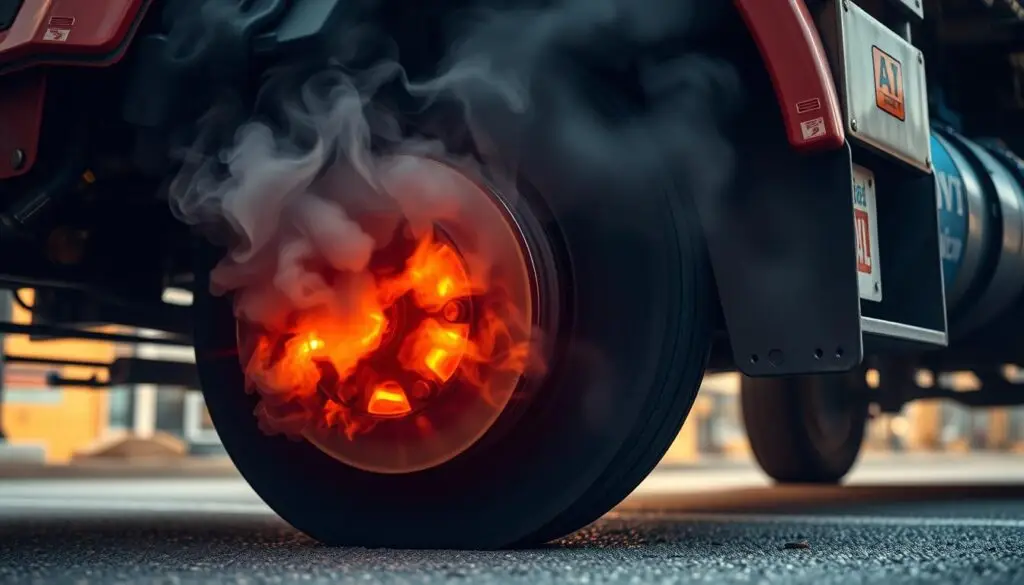
Every day, commercial vehicles traverse highways carrying loads that test their stopping power to the limit. When temperatures rise within braking components, a dangerous condition emerges that threatens driver safety and fleet operations. Brake fade—the heat-induced reduction in braking effectiveness—affects thousands of trucks annually, creating risks that every transportation professional must understand and prevent.
Unlike sudden mechanical failure, brake fade develops progressively as temperatures rise beyond optimal operating ranges. Heavy-duty trucks face this challenge when descending steep grades, navigating stop-and-go traffic, or hauling maximum loads. The friction materials lose their grip as temperatures climb, extending stopping distances precisely when drivers need reliable performance most. With 20-25% of trucks failing inspections during annual Brake Safety Week checks due to braking deficiencies, understanding prevention strategies isn’t optional—it’s essential for protecting drivers, cargo, and fleet investments.
Last Updated: December 2025
Key Takeaways
- Brake fade occurs when excessive heat reduces friction material effectiveness: Temperatures above 550°F produce warning odors; visible smoke at 850°F signals immediate danger.
- Speed management is your most powerful prevention tool: Doubling vehicle speed quadruples the heat energy brakes must dissipate.
- Use snub braking on downgrades: Apply firm pressure to reduce speed 5-10 mph, then release completely to allow cooling between applications.
- Engine braking should be primary, service brakes secondary: Compression release brakes and retarders absorb kinetic energy without heating wheel-end components.
- One in four trucks fails brake inspections: Contaminated fluid, worn linings, and maladjusted components create fade-prone conditions.
- DOT requires specific stopping distances: Loaded trucks must stop from 60 mph within 355 feet—impossible when brake fade compromises performance.
What Causes Brake Fade in Commercial Vehicles
Brake fade refers to the gradual loss of braking effectiveness during operation, occurring when excessive heat accumulation within brake components reduces the system’s capacity to decelerate or stop a vehicle safely. Every braking system functions as an energy conversion device, transforming kinetic energy from a moving vehicle into thermal energy through friction between brake linings and rotors or drums.
The physics behind brake fade follows a critical mathematical relationship: kinetic energy equals one-half mass times velocity squared. This means doubling a vehicle’s weight doubles the heat energy the brakes must dissipate. Even more significant, doubling speed quadruples the thermal load on the brake system. An 80,000-pound truck traveling at 60 mph generates four times the braking heat compared to the same truck at 30 mph.
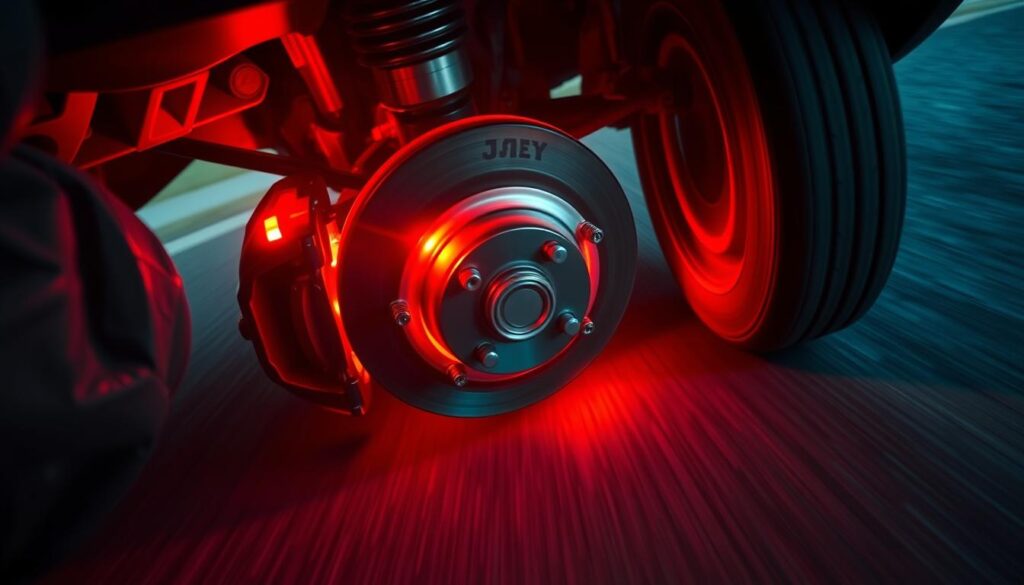
Under normal driving conditions, well-balanced vehicle brakes typically operate between 100 and 200 degrees Fahrenheit. A controlled descent down a mountain grade can push brake temperatures to between 200 and 400 degrees. Understanding these temperature ranges helps drivers recognize when their braking system approaches dangerous thermal thresholds.
20-25% of trucks fail brake inspections
Annual CVSA Brake Safety Week data
How Heat Degrades Brake Materials
Brake linings consist of various materials bound together with specialized resins that provide structural integrity and friction characteristics. As brake temperatures climb, these resins begin to degrade, fundamentally altering how the brake system performs. One phenomenon called glazing occurs when melted resins migrate to the lining surface—upon cooling, they harden into a smooth, glass-like crust that significantly reduces the coefficient of friction.
Specific temperature thresholds mark the progression toward brake fade. At approximately 550 degrees Fahrenheit, drivers may notice a distinctive acrid resin odor emanating from the brakes. This smell serves as an important warning sign that the brake system is approaching dangerous temperature levels. When temperatures reach 850 degrees Fahrenheit, visible smoke begins to appear, representing active decomposition of friction material.
Brake systems dissipate heat through three primary mechanisms: radiation (heat transfers to surrounding air through electromagnetic waves), conduction (heat moves through brake components to other vehicle parts), and convection (moving air carries heat away from brake surfaces). Aggressive or prolonged braking can generate heat energy faster than these mechanisms can remove it, creating thermal saturation where heat accumulates faster than it dissipates.
The Four Types of Brake Fade
Not all brake fade occurs for the same reason—recognizing the four primary categories enables targeted prevention strategies. Each type affects different components within the braking system, producing distinct symptoms and requiring specific corrective actions.
Pad Fade (Friction Fade)
Friction fade occurs when excessive heat reduces the friction coefficient between brake linings and drums or rotors. This thermal degradation represents the most common form of brake failure in commercial vehicles operating under sustained braking conditions. In hydraulic systems, the brake pedal maintains its firm feel, but stopping power diminishes noticeably. Drivers of air-braked vehicles may experience the pedal traveling all the way to the floor.
Fluid Fade
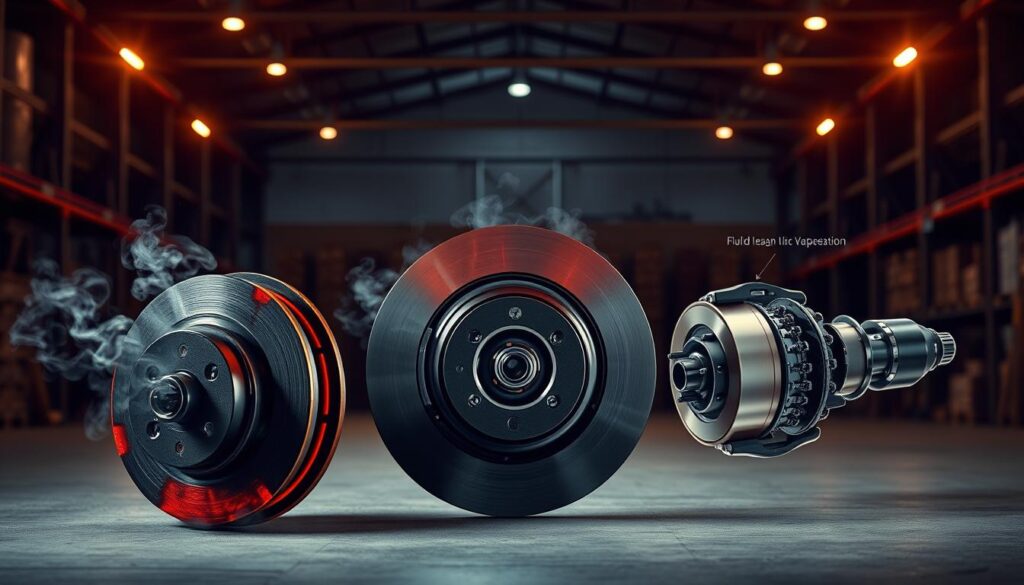
Fluid fade affects hydraulic brake systems when brake fluid reaches its boiling point and vaporizes. This phase change introduces compressibility into a system designed to operate with incompressible liquid, resulting in spongy pedal feel and drastically reduced braking force. Fresh brake fluid maintains a boiling point around 401°F, but when fluid absorbs just 3.5% water content through hygroscopic action, the wet boiling point plummets to approximately 284°F—a 117-degree reduction that makes fade far more likely.
Mechanical Fade
Mechanical fade primarily affects drum brake assemblies through thermal expansion of the brake drum itself. As drum temperatures increase, the metal expands outward, increasing the drum’s internal diameter and moving the friction surface away from the brake lining. Research demonstrates that a brake drum temperature of 400°F can increase required pushrod stroke by as much as 0.5 inches. When automatic slack adjusters reach their maximum adjustment range, the pushrod may bottom out completely, resulting in total brake failure for that wheel position.
Domino Fade
Domino fade represents a cascading failure scenario where uneven brake torque distribution causes certain brakes to work harder than others. These overworked brakes heat up faster and fail first, transferring their load to remaining functional brakes. This creates a progressive failure pattern where each brake loss increases stress on surviving units until complete system failure occurs.
| Fade Type | Primary Cause | Key Symptom |
|---|---|---|
| Pad Fade | Elevated friction surface temperatures | Firm pedal, reduced stopping power |
| Fluid Fade | Brake fluid vaporization | Spongy pedal, increased travel |
| Mechanical Fade | Drum thermal expansion | Pushrod bottoming out |
| Domino Fade | Uneven torque distribution | Progressive loss across wheels |
Primary Causes of Brake Fade in Fleet Operations
Several critical factors combine to create brake fade conditions in commercial vehicle operations. Each cause represents a specific vulnerability that can compromise safety when left unaddressed. Understanding how these factors interact provides the foundation for effective prevention protocols.
Excessive Braking on Steep Grades
Descending steep grades represents the highest-risk scenario for brake fade. Continuous brake application on extended downhill stretches generates sustained heat loads that exceed the system’s ability to dissipate thermal energy. When a loaded truck descends from elevation, the total energy that must be absorbed equals the vehicle weight multiplied by the elevation change. For an 80,000-pound vehicle dropping 3,000 feet, the brakes must absorb approximately 100 million foot-pounds of energy if no auxiliary braking is employed.

Overloaded Vehicles and Poor Weight Distribution
Exceeding gross vehicle weight ratings creates disproportionate thermal stress on brake assemblies. A vehicle operating at 10% overweight requires 10% more braking energy, quickly pushing systems beyond their design parameters. Improper load placement compounds the problem by creating asymmetric brake loading—some brake assemblies work significantly harder than others, causing specific wheels to reach thermal saturation while others remain relatively cool.
Poor Maintenance and Worn Components
Maintenance deficiencies predispose commercial vehicles to brake fade by compromising thermal capacity and friction performance. Worn brake pads and shoes possess reduced thermal mass, reaching critical temperatures faster than components in good condition. Contaminated brake fluid with moisture absorption can experience vapor lock at temperatures as low as 250°F. Glazed brake surfaces from repeated overheating create hard, smooth layers with dramatically reduced friction coefficients.
Stay Current on Brake Safety Regulations
FMCSA brake requirements and DOT inspection standards evolve regularly. Get updates on compliance changes, maintenance best practices, and fleet safety strategies delivered to your inbox.
Recognizing Brake Fade Warning Signs
Brake fade announces itself through distinct symptoms that every commercial vehicle operator must learn to identify immediately. Experienced operators develop an instinct for normal brake performance in their vehicles—any deviation from this baseline demands immediate attention.
Pedal Feel Changes
The brake pedal provides essential feedback about system condition. In hydraulic systems experiencing friction fade, the pedal maintains a firm feel but delivers noticeably reduced braking force. Air-braked vehicles display different symptoms—drivers may report the pedal traveling closer to the floor or reaching floor level with continued application. Increased pedal effort required to achieve normal deceleration, spongy sensation, and delayed brake engagement all indicate developing problems.
Extended Stopping Distances
The most critical symptom of developing brake fade is increased stopping distance. This represents actual loss of braking capability rather than just perceived changes. Extended stopping distances often develop gradually—perhaps an extra vehicle length or two initially. However, as fade progresses, stopping distances can double or triple normal requirements.
Odors, Smoke, and Visual Indicators
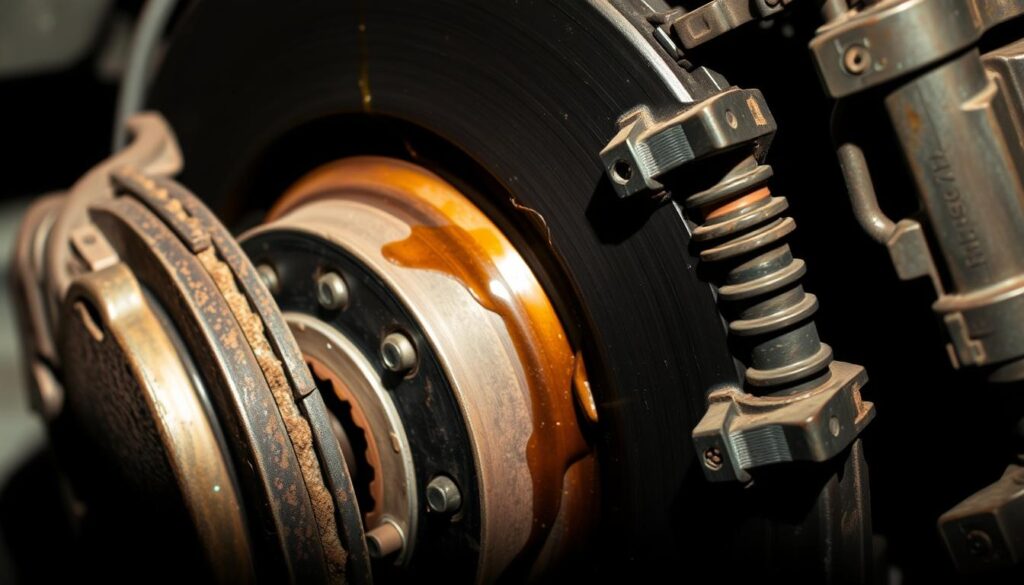
At approximately 550 degrees Fahrenheit, brake resin materials produce a characteristic acrid odor. This sharp, chemical smell penetrates the cab and announces that brake temperatures have exceeded safe operating ranges. When temperatures climb to around 850 degrees Fahrenheit, visible smoke emerges from wheel assemblies—any driver observing brake smoke must find the nearest safe location to stop immediately.
Blue or purple discoloration on rotors or drums indicates localized temperatures exceeding 1,000 degrees Fahrenheit. This bluing results from incomplete friction surface contact and reveals areas where brake components experienced extreme thermal stress.
Driver Techniques to Prevent Brake Fade
Professional operators who master proper braking techniques can dramatically reduce thermal stress on brake components. The techniques recommended by the Federal Motor Carrier Safety Administration and commercial driver licensing programs have proven effective across various terrain types and vehicle configurations.
Gear Selection and Snub Braking
Proper downhill braking begins before the vehicle enters a descent. Drivers must select an appropriately low gear before starting down any grade, choosing a gear low enough to control vehicle speed without excessive service brake application. The Commercial Driver’s License manual recommends the snub braking technique: apply firm brake pressure to reduce speed by 5 to 10 mph, then release the brakes completely to allow cooling before the next application.

This intermittent approach contrasts sharply with continuous light brake application, which creates dangerous conditions. Light, steady applications may not activate all brakes on a heavy truck and can lead to domino fade as individual components overheat.
“The brake pedal should be used as a speed adjustment tool, not a speed control device. The transmission should control your speed on downgrades.”
— National Safety Council Commercial Vehicle Operations Guide
Engine Braking and Auxiliary Systems
Engine braking systems absorb substantial portions of the vehicle’s kinetic energy without generating heat in wheel-end brake assemblies. Compression release engine brakes, exhaust brakes, and hydraulic retarders should serve as the primary speed control method on downgrades, with service brakes reserved for final speed adjustment and emergency stopping.
Compression release brakes work by converting the engine into an air compressor, using the energy required to compress air in the cylinders to slow the vehicle. Drivers should engage compression release brakes before beginning a descent, allowing the system to work continuously while supplementing with service brakes only as needed.
| Braking Method | Heat Location | Recommended Use |
|---|---|---|
| Continuous Light Braking | Wheel-end (concentrated) | Never recommended |
| Snub Braking | Wheel-end (distributed) | With auxiliary systems |
| Engine Braking | Engine (dispersed) | Primary descent control |
| Hydraulic Retarders | Transmission fluid | Supplemental continuous |
Speed Management and Following Distance
Maintaining appropriate speeds and following distances reduces the frequency and severity of brake applications. The standard recommendation of one second per 10 feet of vehicle length provides a baseline, but professional operators should extend this significantly when carrying maximum loads or operating on grades. Anticipatory driving in stop-and-go traffic—maintaining momentum and avoiding sudden stops—reduces cumulative heat input to brake systems during urban operations.
Maintenance Practices for Brake Fade Prevention
Routine inspections and timely component replacement eliminate most brake fade risks before they become safety hazards. Without consistent maintenance protocols, even the most advanced brake systems will eventually develop conditions that lead to fade.
Regular Brake System Inspections
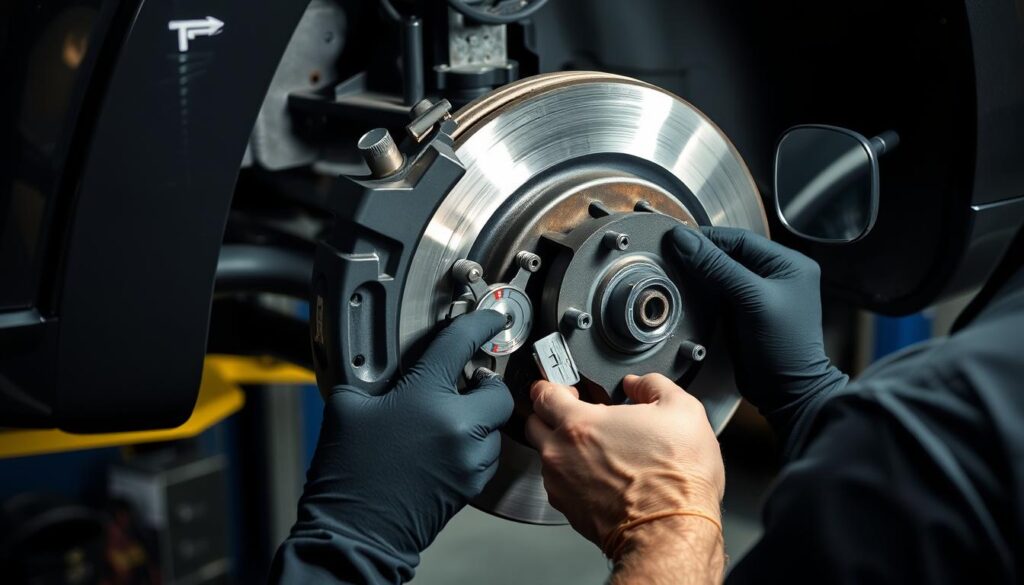
Systematic brake inspection procedures form the foundation of fade prevention. Trained technicians should examine brake systems at predetermined intervals, documenting findings and addressing deficiencies promptly. Visual examination of brake linings reveals remaining thickness and identifies glazing, cracking, or contamination. Proper brake adjustment verification—including pushrod stroke measurements—confirms that automatic slack adjusters function correctly.
Brake Fluid Testing and Replacement
Brake fluid management represents one of the most critical yet frequently neglected maintenance tasks. Testing moisture content or boiling point should occur at regular intervals—typically annually or more frequently for severe service applications. Industry recommendations call for complete brake fluid system flushing approximately every four years to prevent moisture accumulation from compromising boiling point protection.
Component Replacement Standards
Brake linings require replacement when thickness measurements reach minimum specifications. Premium brake linings that meet or exceed original equipment specifications maintain stable friction coefficients across broader temperature ranges, resist glazing, and provide longer service life. Drums and rotors that develop heat checking, scoring, or dimensional changes should be replaced at specified intervals to maintain thermal management essential for fade prevention.
DOT Brake System Requirements and Compliance
The Department of Transportation enforces strict brake system requirements designed to protect public safety on American roads. These federal standards establish the minimum performance levels that all commercial vehicles must achieve before legally transporting goods or passengers.
FMCSA Performance Standards
The Federal Motor Carrier Safety Regulations address multiple aspects of brake system operation, including design requirements, performance standards, maintenance specifications, and inspection criteria. Fleet operators and drivers bear legal responsibility for ensuring their vehicles meet or exceed these requirements.
Required Stopping Distances
DOT regulations specify exact performance metrics that brake systems must achieve during standardized testing. Truck tractors and combination vehicles must stop from 60 mph within 355 feet when loaded to gross vehicle weight rating. Single-unit trucks must achieve the same speed reduction within 310 feet. All commercial vehicles must stop from 20 mph within 32 feet.
| Vehicle Type | 60 mph Distance | 20 mph Distance |
|---|---|---|
| Truck Tractors | 355 feet max | 32 feet max |
| Single-Unit Trucks | 310 feet max | 32 feet max |
| Combination Vehicles | 355 feet max | 32 feet max |
Air Brake System Specifications
Federal Motor Vehicle Safety Standard 121 establishes comprehensive design, performance, and component specifications for commercial vehicles equipped with air brakes. The standard specifies minimum brake force requirements, air system pressure standards, and automatic slack adjuster requirements for vehicles manufactured after specified dates.
Service brake specifications require systems capable of stopping vehicles safely from highway speeds under maximum load conditions. Parking brakes must hold vehicles stationary on a 20% grade in both forward and reverse directions. Spring brake systems must automatically engage when air pressure drops below specified levels, ensuring brake failure results in stopped vehicles rather than runaways.
DOT Inspection Criteria and Out-of-Service Standards
Federal and state enforcement agencies conduct systematic brake inspections using standardized criteria established by the Commercial Vehicle Safety Alliance. These protocols ensure thorough evaluation of all brake system components using consistent measurement techniques throughout the United States, Canada, and Mexico.
Common Out-of-Service Violations
Specific brake defects trigger immediate vehicle removal from service until repairs restore compliance. Brake lining thickness below minimum standards—less than one-quarter inch for shoe brakes or less than one-eighth inch for disc brakes—constitutes one of the most common out-of-service conditions. Missing or inoperative brake components, excessive pushrod stroke, audible air leaks exceeding three pounds per square inch in one minute, and contaminated brake components all result in immediate out-of-service designation.
Cracked or broken structural brake components pose immediate failure risks. Cracked brake drums, broken backing plates, fractured air chambers, and damaged mounting hardware indicate imminent catastrophic brake failure. Blue discoloration of overheated metal surfaces indicates localized temperatures exceeding 1,000 degrees Fahrenheit and classifies as evidence of brake system failure.
Legal Liability and Safety Impact
When braking systems fail to perform as required, the resulting accidents trigger a cascade of legal, financial, and operational consequences for carriers. Brake failure contributes to thousands of commercial vehicle accidents annually, and vehicles with compromised brake systems often perform adequately under normal conditions but fail to deliver required stopping power during emergencies.
Civil litigation following brake-related accidents increasingly focuses on vehicle maintenance records. Evidence of deferred maintenance or inadequate brake servicing can establish negligence, substantially increasing potential damages. Insurance carriers carefully monitor brake-related accident statistics when establishing premium rates—carriers with documented maintenance problems face substantially higher costs that compound over multiple policy periods.
Federal and state regulatory agencies impose significant penalties for brake system violations. Out-of-service orders immediately halt vehicle operations, creating operational disruptions and revenue losses. Repeat violations trigger escalating enforcement actions that can threaten operating authority. The financial impact of inadequate brake maintenance dramatically exceeds the cost of proper preventive maintenance programs.
The HDJ Perspective
Brake fade prevention represents one of those fleet management responsibilities where shortcuts never pay off. The 20-25% inspection failure rate we see year after year during Brake Safety Week isn’t primarily a technology problem—it’s a culture problem. Fleets that build brake maintenance into their operational DNA, train drivers to recognize early warning signs, and invest in quality components consistently outperform those treating brakes as an afterthought. With electronic logging and telematics making operations more transparent, brake system neglect becomes increasingly visible to regulators, insurers, and liability attorneys alike.
Advanced Brake Technologies
Modern commercial vehicles incorporate various fail-safe mechanisms that reduce the likelihood of complete failure. Vehicles typically have two separate braking systems where component failure affects only part of the system. However, advanced technologies should complement, not replace, proper maintenance practices and driver vigilance.
Anti-Lock Braking and Electronic Stability
ABS technology prevents wheel lockup during hard braking, maintaining directional control and reducing stopping distances on most road surfaces. While ABS does not directly prevent brake fade, it helps drivers maintain control even when brake performance is compromised. Electronic stability control systems extend this functionality by using additional sensors to monitor vehicle dynamics and selectively applying individual wheel brakes to correct oversteer or understeer conditions.
Automatic Emergency Braking
Automatic emergency braking systems use radar, lidar, or camera systems to detect collision threats and automatically apply brakes when drivers fail to respond. These collision mitigation systems provide an additional safety layer but cannot overcome the fundamental physical limitations imposed by severe brake fade. If the brake system has experienced significant thermal degradation, even automatic activation cannot generate the stopping power needed to avoid all collisions.
Fleet Management Best Practices
Successful fleet operations require a strategic approach to brake system management that goes beyond basic compliance. This integrated approach addresses driver knowledge, equipment maintenance, and regulatory documentation while reducing accident risk and improving operational efficiency.
Comprehensive Driver Training
Initial driver training must cover brake system fundamentals, fade causes and symptoms, proper braking techniques for various conditions, and inspection procedures. Ongoing education ensures training remains effective throughout a driver’s career. Participation in industry initiatives like Brake Safety Week provides structured opportunities for enhanced safety awareness and demonstrates commitment to regulatory compliance.
Preventive Maintenance Systems
Systematic preventive maintenance represents the most cost-effective approach to brake system reliability. Effective programs use scheduled inspection intervals based on mileage, time, and operational conditions. Technicians require ongoing training to stay current on brake technologies and repair techniques. Quality control processes verify that maintenance meets manufacturer and regulatory standards before vehicles return to service.
Documentation and Compliance Records
Comprehensive documentation serves multiple critical functions: demonstrating regulatory compliance during inspections, providing diagnostic information for identifying recurring problems, and carrying significant legal weight in accident investigations. Required records include periodic inspection dates, specific work performed, components replaced, and technician identification. Federal regulations require retention of inspection and maintenance records for at least one year after vehicles leave the fleet.
Share Your Brake Maintenance Expertise
Fleet managers and diesel technicians with hands-on brake system experience can help shape industry best practices. If you’ve developed effective inspection protocols or driver training programs, the Heavy Duty Journal community wants to learn from you.
Frequently Asked Questions
What is the difference between brake fade and complete brake failure?
Brake fade is a heat-induced reduction in braking effectiveness that develops progressively as temperatures rise—brakes still work but with significantly reduced stopping power. Complete brake failure means brakes become entirely non-functional, which is relatively rare in modern commercial vehicles with properly maintained systems. The critical distinction is that drivers may retain some braking capability during severe fade, but that remaining capacity may be insufficient for emergency situations. Brake fade typically gives warning signs like increased pedal effort, extended stopping distances, and unusual odors before becoming dangerous.
Why does the CDL manual recommend snub braking instead of continuous light brake application?
Snub braking—applying firm pressure to reduce speed 5-10 mph, then releasing completely—distributes thermal load more evenly across all brake assemblies and provides critical cooling intervals that prevent heat saturation. Continuous light brake application concentrates heat without allowing dissipation, steadily driving temperatures into the fade range. Additionally, continuous braking often results in uneven heat distribution, with some brake assemblies working harder than others, leading to progressive domino fade as overheated brakes fail and transfer their load to remaining assemblies.
How often should brake fluid be replaced in commercial vehicles?
Industry recommendations call for complete brake fluid system flushing approximately every four years to prevent moisture accumulation. Brake fluid’s hygroscopic nature causes it to absorb moisture from the atmosphere, which dramatically reduces boiling point—fresh DOT 3 fluid boils at 401°F, but with just 3.5% water content, the boiling point drops to 284°F. Vehicles operating in humid climates or severe service conditions may require more frequent replacement. Annual moisture content testing helps identify when fluid degradation requires earlier intervention.
What are the most common brake defects causing out-of-service violations?
The most common out-of-service brake defects include brake lining thickness below minimum standards (less than 1/4 inch for shoe brakes), excessive pushrod stroke indicating maladjustment, missing or inoperative brake components, audible air leaks exceeding three PSI per minute with brakes applied, contaminated brake components (oil or grease on friction surfaces), and cracked or broken structural components. During annual Brake Safety Week inspections, approximately 20-25% of commercial vehicles receive out-of-service violations for brake defects, indicating widespread maintenance deficiencies across the industry.
How do engine brakes help prevent brake fade on downgrades?
Engine braking systems absorb kinetic energy without generating heat in wheel-end brake assemblies where fade occurs. Compression release brakes convert the engine into an air compressor, using energy required to compress intake air as braking force that dissipates through the exhaust system rather than wheel brakes. This allows service brakes to remain cool and available for final speed adjustment and emergencies. Drivers should engage engine brakes before beginning descent, making them the primary speed control method while supplementing with service brakes only as needed.
Conclusion
Brake fade prevention stands as a shared responsibility across the commercial transportation industry. Every stakeholder plays a vital role in maintaining commercial vehicle safety—drivers must recognize warning signs and practice proper braking techniques, technicians must execute thorough maintenance according to established schedules, and fleet managers must prioritize comprehensive training programs and quality component replacement.
Regular inspections prevent brake fade before it endangers lives. Proper loading procedures protect braking systems from excessive stress. Understanding heat generation and friction material limits helps drivers avoid dangerous situations on steep grades. The knowledge and tools needed for effective brake fade prevention exist today—success requires consistent application of best practices, investment in quality components, and unwavering attention to brake system condition.
Commercial vehicles equipped with well-maintained brakes and operated by trained drivers create safer highways for everyone. Compliance with DOT standards represents the baseline, not the goal. The industry’s collective commitment to brake maintenance and driver education determines whether brake fade remains a preventable challenge rather than an accepted risk that claims lives and livelihoods.
Help Other Fleet Professionals Stay Safe
This brake fade prevention guide could help a fellow fleet manager avoid a serious accident or costly out-of-service violation. Share it with your professional network.