By Michael Nielsen, Editor & Publisher | 15+ Years in Diesel Repair
Last Updated: April 2026
📖 Estimated reading time: 14 minutes
Truck driveshaft maintenance rarely gets the same urgency as engine oil or brake inspections — but a driveshaft failure doesn’t just mean a tow bill. It means a potential roadside out-of-service order, a shaft that drops onto the pavement at highway speed, and downstream damage to the transmission, differential, and yoke assemblies that can run into thousands of dollars. For fleet managers and owner-operators running Class 6 through Class 8 equipment, the driveline deserves a permanent place at the top of every preventive maintenance schedule.
This guide covers everything a working diesel technician, fleet manager, or owner-operator needs to know about commercial truck driveshaft maintenance — from U-joint lubrication intervals and step-by-step inspection procedures to failure diagnostics, repair-versus-replace decisions, DOT compliance obligations, and how to integrate driveline care into a tiered PM program.
Key Takeaways
- Grease at the right interval: Greasable U-joints require lubrication every 40,000–50,000 miles for on-highway applications; severe-duty vocational applications need significantly more frequent service.
- Know the OOS criteria: CVSA out-of-service standards flag driveshaft cracks longer than 1/4 inch, cracked tube-end welds, and twisted shaft tubes — all under 49 CFR 396.3(a)(1).
- Phasing and angle matter: Incorrect U-joint phasing and improper driveshaft operating angles create vibration that mimics other drivetrain issues and accelerates wear on every connected component.
- Vibration is a symptom, not a root cause: Always diagnose all driveline components before replacing any single part — multiple failure modes produce identical symptoms.
- Documentation protects the carrier: 49 CFR 396.3 requires systematic maintenance of all commercial vehicles; records must be available for FMCSA review at any time.
How the Commercial Truck Driveline System Works
The driveshaft — also called the propeller shaft — is the rotating steel tube that transfers torque from the transmission output shaft to the rear differential, enabling the drive wheels to move the truck. On a standard single rear axle tractor, one driveshaft runs from the transmission to the axle. Tandem rear axle configurations use multiple shafts: a primary driveshaft from the transmission to the forward rear axle, and an interaxle shaft connecting the two rear axles through a power divider.
Long-wheelbase trucks — most sleeper cabs and many vocational configurations — use a two-piece driveshaft assembly with a center support bearing that mounts to the frame rail. This design reduces shaft flex and maintains alignment across the greater span between transmission and axle. The center bearing is a sealed unit that can fail quietly, often producing vibration nearly identical to a worn U-joint until a thorough inspection identifies the actual source.
Core Driveshaft Components
Every commercial truck driveshaft contains several interconnected components, each contributing to smooth, reliable power transfer. Understanding each component’s function is the foundation of effective truck driveshaft maintenance:
- Shaft Tube: The hollow steel tube that transmits rotational force between connection points. Must maintain structural integrity — any crack, weld failure, or twist is a safety-critical defect under federal inspection standards.
- Universal Joints (U-Joints): Cross-and-bearing assemblies that allow the shaft to transmit torque while operating at angles. Available in greasable, extended-lubrication, and permanently-lubricated configurations, each with different service requirements.
- Slip Yoke: The splined connection at the transmission end that allows the driveshaft to change length as the suspension cycles. Requires regular lubrication and inspection for spline wear.
- Companion Flanges and Yokes: The hardware that attaches the driveshaft to the transmission output and differential pinion. Must be matched to OEM specifications for spline count and bolt pattern to maintain correct geometry.
- Center Support Bearing: Present on two-piece configurations. A rubber-mounted bearing housing that stabilizes the intermediate shaft and reduces vibration across the full driveline span.
Heavy-duty U-joints are manufactured in standard series designations — 1350, 1410, 1480, 1550, 1710, and larger — each rated for progressively higher torque capacity. Using an undersized U-joint series behind a high-output engine is one of the most common errors on rebuilt driveshafts, and it leads to rapid failure regardless of how well the shaft is maintained. Always verify the correct series for the truck’s engine torque rating before installing any replacement hardware.
Truck Driveshaft Maintenance: Lubrication Schedules and Procedures
Lubrication is the single most critical driveshaft maintenance task. The needle bearings inside U-joint trunnion cups operate under high load at continuously changing angles. Without adequate grease, bearing surfaces wear rapidly, heat builds, and the joint fails — often with little or no warning. Dry joints are the leading cause of premature U-joint failure in commercial trucking, and they are entirely preventable with a consistent lubrication program.
Greasing Greasable U-Joints
For on-highway applications, greasable U-joints should be lubricated every 40,000–50,000 miles, or at the PM-B (intermediate) service interval — whichever comes first. This interval aligns with published driveline manufacturer guidance from suppliers including Dana/Spicer and Meritor. Vocational equipment operating in severe duty cycles — construction, refuse, heavy haul, or frequent stop-and-go — typically requires more frequent service, sometimes as often as every 10,000–15,000 miles at each PM-A service, due to higher torque loading and greater exposure to contamination.
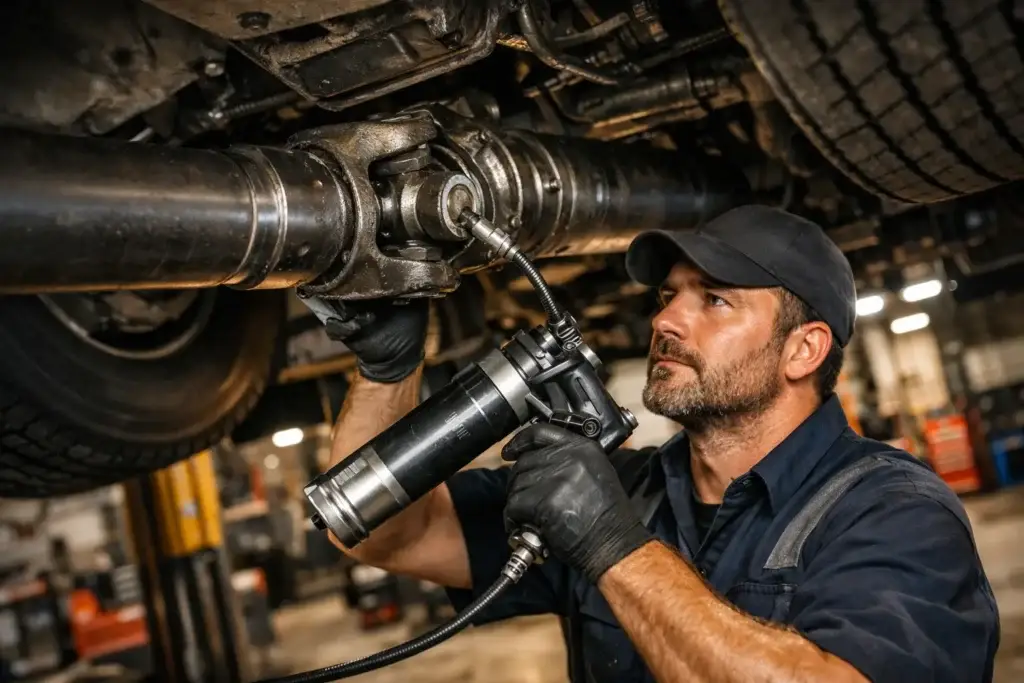
Use a chassis grease meeting NLGI Grade 1 or 2 specification with extreme-pressure (EP) additive packages like Lucas Oil, or the specific grease type called out in your truck’s OEM service documentation. Apply grease through the Zerk fitting at each trunnion cap until fresh lubricant purges from the seals — this confirms old grease has been fully displaced and the bearing surfaces have received complete coverage. Rotating the shaft 90 degrees after the initial application and re-greasing helps ensure all four bearing caps receive adequate lubrication in a single service.
Pay close attention to the color and consistency of the purged grease. Dark brown, black, or metallic-contaminated grease indicates overheating, moisture intrusion, or active bearing wear that warrants a closer physical inspection of that joint — not just a re-grease and return to service.
Slip Yoke and Center Bearing Lubrication
The slip yoke requires lubrication at the same interval as the U-joints and is often overlooked during routine service. A dry slip yoke causes binding and torsional vibration, accelerates spline wear on both the yoke and the mating transmission sleeve, and can produce the clunk-on-shift symptom that technicians frequently misdiagnose as a U-joint problem. Apply grease through the Zerk fitting until it purges from the dust cap or seal — never skip this step.
Center support bearings on two-piece driveshaft systems are typically sealed-for-life units that do not require periodic greasing. However, the rubber mounting bracket and isolator should be inspected at every PM-B service for cracking, deterioration, collapse, and proper alignment. A sagging or misaligned center bearing changes the operating angles of both adjacent U-joints and generates vibration that can be difficult to trace without a geometric inspection of the full driveline system.
⚠️ Safety Warning
Never lubricate U-joints or slip yokes while the driveshaft is spinning. The vehicle must be stationary, wheels chocked, transmission in neutral, and the parking brake applied before any driveline component is serviced. Driveshaft rotation at operating speeds can cause severe injury or death. On air-ride suspension trucks, always block the axles before working beneath the vehicle — air suspension can settle unexpectedly when the engine is off.
Driveshaft Inspection: A Step-by-Step Checklist
Lubrication alone does not constitute a complete maintenance program. Physical inspection at each service interval catches developing problems before they become roadside failures. A thorough driveshaft inspection takes 10–15 minutes and requires no specialized equipment beyond a flashlight, a pry bar, and a torque wrench for fastener verification.
Visual Inspection Points
With the vehicle safely secured and the driveline accessible, inspect the following during every PM service that includes the driveline:
- Shaft Tube Integrity: Look for cracks, dents, bends, or signs of undercarriage contact with road debris or frame components. Any crack exceeding 1/4 inch (6.4 mm) in length is an immediate out-of-service condition under CVSA inspection standards.
- Weld Condition: Inspect the tube-end welds where yokes attach to the shaft tube at both ends. An obvious cracked weld at a shaft tube end is a federally defined out-of-service condition.
- Trunnion Cups and Caps: Check for rust, heat discoloration, or grease blowout around the bearing cap retainers. Rust streaking from a cap indicates a failed seal that has admitted moisture — that joint should be replaced, not simply re-greased.
- Retaining Hardware: Inspect all U-joint retaining straps, snap rings, and bearing cap bolts. Missing or damaged hardware is a citable condition and a serious safety hazard at operating speeds.
- Slip Yoke Seal: Check the dust boot or seal for cracking, collapse, or displacement. A compromised seal allows moisture and abrasive debris to contaminate the splines, dramatically accelerating wear.
- Center Bearing Assembly: Inspect the rubber isolator for cracking and deterioration, and verify that mounting bolts are present and properly torqued on two-piece configurations.
- Balance Weights: Confirm that all factory-applied balance weights are intact. A weight knocked off by a debris strike causes immediate imbalance vibration and is one of the most common causes of sudden driveline vibration onset in otherwise well-maintained equipment.
Manual Play and Movement Tests
Visual inspection alone will not reveal worn needle bearings inside trunnion cups. The physical play tests below should be performed at every PM-B service and any time a driver reports vibration or noise:
U-Joint Radial Play Test: Grasp the driveshaft with both hands near each U-joint and apply firm force up/down and side-to-side. Any visible or felt movement within the joint itself — not in the suspension or transmission — indicates bearing wear requiring replacement. A properly functioning U-joint has zero measurable radial play.
Rotational Smoothness Check: Rotate the shaft by hand through a complete revolution while watching and feeling each U-joint. Movement should be smooth and consistent at all positions. Binding, roughness, or a click at a specific angle indicates internal damage or corrosion that will only worsen under load.
Slip Yoke Radial Play Check: Grasp the slip yoke and attempt to move it radially (side-to-side). Longitudinal movement is normal — radial play is not. Measurable side-to-side looseness indicates spline wear that will produce vibration and handling symptoms as it progresses.
Driveshaft Angle and Phasing Verification
This is the area most frequently overlooked by general maintenance technicians, yet it is among the most important aspects of long-term driveline health. Every U-joint operates at a working angle — the geometric difference in centerline direction between the shaft and the component it connects to. For on-highway applications, each U-joint’s working angle should typically fall between 1 and 3 degrees. Angles that are too steep accelerate needle bearing wear; angles that are too shallow prevent the bearing rollers from rotating through their full contact area, causing flat spots on the trunnion and premature failure.
Driveshaft phasing refers to the rotational alignment of the yokes at each end of the shaft. On a correctly phased shaft, both yokes are aligned in the same plane — what technicians call “in phase.” Proper phasing allows the velocity variations produced by each U-joint to cancel each other out during rotation, resulting in smooth power delivery at all speeds. When a shaft is out of phase, those variations add together rather than canceling, generating a torsional vibration at twice the shaft’s rotational frequency — felt as a shudder or buzz that appears at specific road speeds.
Phasing errors most commonly occur after a driveshaft is removed and reinstalled without marking its original orientation with a paint pen prior to removal, or when a replacement shaft was assembled incorrectly at the rebuilder. Always mark the shaft’s clocking position before disassembly, and verify that replacement shafts are phased to specification before installation.
$4–6
Estimated savings in unplanned repair costs for every $1 invested in preventive maintenance — a ratio consistently cited by the American Trucking Associations, and one that applies directly to the driveline, where a single roadside failure generates towing fees, emergency repair premiums, and cargo delay costs that far exceed a full PM service.
Driveshaft Failure Symptoms Every Driver and Tech Should Recognize
The driveshaft communicates its problems before it fails — if those working with the truck know what to look and listen for. Driver awareness is a critical component of any driveline PM program. Establishing a clear defect reporting process that includes specific driveline symptom categories converts driver observations into actionable shop data, catching problems at the symptom stage rather than the roadside failure stage.
Vibration Under the Cab or Floorboards: The most common driveline symptom. A steady vibration at a specific road speed, or a progressive shudder that worsens as RPM increases, often points to an out-of-balance shaft or a phasing problem. Vibration that appears primarily during acceleration or deceleration — particularly during gear changes under load — more typically indicates U-joint wear or a loose slip yoke. The speed or RPM at which vibration peaks is a useful diagnostic clue: driveshaft-related vibration typically correlates to shaft rotational speed, while transmission-related issues correlate to engine RPM.
Clunking Noise on Shift: A metallic clunk when moving the selector from neutral to drive or reverse is a textbook symptom of U-joint lash — the rotational play that develops as needle bearings wear and the trunnion begins to hammer against the bearing cup walls. This symptom should be acted on immediately. The progression from an intermittent clunk to complete joint separation can be rapid, particularly under high-torque conditions, and a failed joint at highway speed can create a dangerous secondary impact with the road or frame.
Squeaking at Low Speed: A rhythmic squeak from beneath the truck at slow speeds — most noticeable during parking lot maneuvers — typically signals inadequately lubricated U-joints or a dry slip yoke. This symptom is easy to dismiss, but it indicates metal-to-metal contact that accelerates wear significantly. A thorough re-greasing often resolves the squeak temporarily; if it returns within a short mileage period, the joint has degraded beyond the point where lubrication can restore adequate bearing clearance.
Clunking or Grinding From the Driveline at Speed: A rhythmic knock or grinding noise that increases with road speed — distinct from engine or transmission noise — can indicate a center support bearing that has lost its rubber isolation and is transmitting vibration directly into the frame. This symptom is frequently misidentified as a worn U-joint until the bearing is physically examined.
Unexplained Vehicle Pull or Wander: A driveshaft that has developed significant runout — deviation from a true centerline due to a bent tube or impact damage — can produce asymmetric torque inputs that affect vehicle tracking. If a truck develops an unexplained tendency to wander, include the driveline alongside steering and alignment components in the diagnostic sequence.
Keep Your Driveline Knowledge Current
Get maintenance guides, diagnostic procedures, and fleet management insights delivered free to your inbox — written for diesel technicians, fleet managers, and owner-operators who need accurate, actionable information.
Repair vs. Replace: Making the Right Call on Driveshaft Work
Not every driveline problem requires a complete shaft replacement. The repair-versus-replace decision depends on the nature and location of the defect, the mileage and condition of the existing shaft, and the duty cycle the truck operates in. Getting this decision right matters both for cost control and for long-term component reliability — an improperly repaired shaft can create a repeat failure faster and at greater expense than a clean replacement would have.
Repair is typically appropriate when: U-joints require replacement on a shaft with a structurally sound tube, intact welds, and yokes that are within dimensional specifications; slip yoke replacement is needed where spline wear is confined to the yoke itself and the transmission output sleeve is undamaged; a center bearing requires replacement on a shaft with straight tube geometry and correct yoke angles; or a balance correction is needed on a shaft that has lost weight tabs without other structural damage.
Replacement is typically the correct call when: The shaft tube shows any crack, cracked weld, or obvious twist that constitutes a federally defined defect; the tube has sustained impact damage that creates runout exceeding OEM specifications; the yokes show bore wear from failed bearing caps eating into the trunnion saddle; or the shaft has accumulated multiple repairs and is near the end of its practical service life. Using worn yokes to save cost on a rebuild is a common error that creates a repeat failure within a fraction of the original service life.
When ordering a replacement driveshaft, verify the correct U-joint series designation for the truck’s specific engine torque rating. Running a Series 1350 shaft behind a high-output diesel producing 1,800 lb-ft or more — now common across multiple truck platforms — is a prescription for rapid failure regardless of maintenance quality. Freightliner’s Cascadia service documentation and Kenworth’s T680 operator literature both specify minimum driveline series ratings by powertrain configuration. Request this information from your dealer parts department if the specifications are not immediately available.
Have any replacement shaft dynamically balanced before installation. New shafts can arrive with minor imbalance from weld variation and tube straightness tolerances that are imperceptible at low speeds but produce a noticeable vibration at highway speeds. The cost of a pre-installation balance check is minimal compared to the diagnostic time required to identify the source of vibration after the truck is returned to service.
The HDJ Perspective
Driveshaft maintenance is one of those disciplines where small, consistent investments pay outsized returns — and where the fleets that perform best aren’t necessarily using the most expensive components. They’re the fleets with standardized PM intervals, technicians who inspect rather than assume, and drivers who report symptoms promptly instead of driving through them. As engine torque outputs continue to climb across new truck platforms — many production engines now exceeding 1,900 lb-ft — the U-joints, yokes, and shaft tubes in your driveline face progressively higher stress cycles than the prior generation of equipment. Maintenance intervals and component series specifications that were adequate for a 1,450 lb-ft powertrain may not be sufficient for current configurations. If your fleet has taken delivery of newer, higher-torque equipment in the last three to five years, a review of your driveline PM specifications against current powertrain ratings is overdue.
Driveshaft Balance: The Step Most Shops Underestimate
Driveshaft balance is not a one-time factory operation — it is an ongoing maintenance concern that directly affects ride quality, driver fatigue, and the service life of every component connected to the driveline. An out-of-balance shaft generates centrifugal force at every revolution, and that force transmits directly to the transmission output bearing, U-joints, slip yoke, differential pinion, and pinion bearing. The cumulative effect on those components over hundreds of thousands of miles is significant and measurable.
Most shops balance a driveshaft as an isolated single-piece component. For multi-piece driveshaft systems on tandem-axle trucks and sleeper cabs, this approach is insufficient. The correct procedure — assembly balancing — involves balancing all shaft segments simultaneously as a connected system, because the balance characteristics of each segment interact with the others through their shared attachment points. A shaft that balances correctly in isolation can still produce vibration when assembled with its companion segments if the cumulative imbalance vectors are additive rather than self-canceling across the full driveline span.
Any vibration that develops after U-joint replacement, shaft removal and reinstallation, or following an undercarriage impact should trigger a balance verification before the truck is returned to service. Balance weights knocked off by debris strikes are the most common cause of sudden vibration onset in otherwise well-maintained drivelines. A high-speed driveshaft balancer quantifies imbalance in gram-inches and identifies precisely where corrective weights need to be applied, eliminating the diagnostic guesswork that can otherwise consume hours of shop time.
Free Professional Fleet Tools
Cost calculators, fault code lookup, maintenance planners, and more — built for owner-operators, fleet managers, and diesel techs. No signup required.
DOT Compliance and CVSA Out-of-Service Criteria for Driveshafts
Commercial truck driveshaft maintenance is not only a reliability practice — it is a federal compliance obligation. Under 49 CFR 396.3(a)(1), every motor carrier must systematically inspect, repair, and maintain all commercial motor vehicles under its control, with all parts and accessories kept in safe and proper operating condition at all times. The driveshaft system falls squarely within this requirement, and maintenance records must be available for FMCSA review on demand.
49 CFR 396.17 requires that every commercial vehicle undergo a periodic inspection at minimum once every 12 months, conducted by a qualified inspector per 49 CFR 396.19. The annual inspection must cover all items in Appendix G to Subchapter B of the Federal Motor Carrier Safety Regulations, which explicitly includes driveline components. Inspection records must be retained for 14 months and must be produced during any DOT or FMCSA review.
At roadside, CVSA-certified inspectors apply specific out-of-service criteria to driveshaft conditions during Level I and Level V inspections. Per CVSA out-of-service standards applied under 396.3(a)(1), the following driveshaft conditions require an immediate out-of-service order:
- Any crack in the shaft tube greater than 1/4 inch (6.4 mm) in length
- An obvious cracked weld at the shaft tube end
- Any shaft tube exhibiting an obvious twist
- Missing, damaged, or improperly secured retaining straps, snap rings, or bearing cap hardware
These are minimum CVSA threshold criteria — not a comprehensive enumeration of every driveshaft condition that could support an out-of-service order. A driveshaft that clears the specific OOS criteria above but shows severe vibration at inspection, has loose flange bolts, or has a center bearing that allows excessive shaft deflection could still be cited under the broader obligation of 396.3 to maintain vehicles in safe operating condition. The practical standard inspectors apply is whether the condition could likely cause a breakdown or an accident — and a severely worn driveline assembly can meet that threshold without presenting a visible crack or weld failure.
For carriers looking to align their documentation with industry best practices, TMC Recommended Practices — including RP 625 and related driveline service guidance — provide the industry-standard procedures that align with and often exceed federal minimums. Documenting your PM program against TMC RP standards provides a defensible compliance baseline during FMCSA compliance reviews and safety rating audits.
Building Driveshaft Care into Your Fleet PM Program
Driveshaft maintenance should be distributed across tiered PM intervals rather than treated as a standalone event. A well-structured program integrates driveline tasks into existing PM-A, PM-B, and PM-C services, minimizing incremental downtime while ensuring no inspection or lubrication step is missed in the shuffle of higher-profile services.
Driveshaft PM Integration by Service Level
| PM Level | Typical Interval (On-Highway) | Driveshaft Tasks |
|---|---|---|
| PM-A | 10,000–15,000 mi | Visual check; review driver defect reports for vibration or noise |
| PM-B | 25,000–50,000 mi | Full visual inspection; U-joint and slip yoke greasing; radial play tests; center bearing inspection |
| PM-C | 50,000–100,000 mi | All PM-B tasks; driveshaft angle verification; phasing check; flange bolt torque verification; balance inspection |
| Annual (396.17) | 12-month max | Full inspection per Appendix G; complete documentation per 396.21; record retention minimum 14 months |
For vocational fleets operating in construction, refuse, heavy haul, or utility applications, compress these intervals by 30–50% to account for higher torque loading, off-road contamination exposure, and the greater frequency of high-angle driveline operation inherent in those applications. Dana/Spicer and Meritor both publish application-specific interval recommendations in their driveline service documentation for vocational equipment — these should serve as the baseline for severe-duty PM schedules rather than on-highway defaults.
Driver pre-trip inspections are also part of the driveline health equation. While drivers are not expected to physically inspect the driveshaft during a standard pre-trip walk-around, they are the first to detect the vibration, noise, and handling changes that signal developing problems between scheduled PM visits. A formal defect-reporting process — with a dedicated category for driveline symptoms — creates the early-warning system that allows shops to address issues at a PM visit rather than at the roadside.
For owner-operators evaluating the cost of a more rigorous PM program, ATRI’s annual operational cost research consistently identifies unplanned maintenance and repair as one of the largest variable cost components in over-the-road trucking. Driveline failures that require roadside service typically generate towing costs, emergency repair premiums, and cargo delay expenses that substantially exceed the total cost of a properly executed multi-year PM program for those components. The maintenance intervals and driveline servicing guidance published by industry trade media reflect a consistent consensus from component engineers: the cost of lubrication and inspection is always lower than the cost of the failure it prevents.
Frequently Asked Questions
How often should you grease U-joints on a commercial truck?
Greasable U-joints on commercial trucks should be lubricated every 40,000–50,000 miles for on-highway applications, or at each PM-B service interval — whichever comes first. Vocational and severe-duty applications require more frequent service due to higher torque loads and greater environmental contamination exposure; some off-road and construction applications require greasing as often as every 10,000–15,000 miles. Always grease until fresh lubricant purges from all four trunnion cup seals to confirm complete bearing coverage. Extended-lubrication and permanently-lubricated U-joint designs follow separate schedules established by the driveline manufacturer — consult your OEM service documentation for those specifications rather than applying the standard greasable interval.
What are the out-of-service criteria for a driveshaft during a DOT inspection?
Under 49 CFR 396.3(a)(1), CVSA out-of-service criteria for commercial truck driveshafts include: any crack in the shaft tube greater than 1/4 inch (6.4 mm) in length; an obvious cracked weld at the shaft tube end; any shaft tube exhibiting an obvious twist; and missing, damaged, or improperly secured retaining straps, snap rings, or bearing cap fasteners. A truck placed out of service for any of these conditions cannot be operated under its own power until repairs are completed and the defect is cleared. These criteria represent federally defined minimum thresholds — other driveshaft conditions that create a likelihood of breakdown or accident can also support an out-of-service order under the broader systematic maintenance requirement of 49 CFR 396.3.
What causes driveshaft vibration on a semi truck?
Driveshaft vibration on a semi truck most commonly results from worn U-joints, an out-of-balance shaft, a failed center support bearing, or a damaged slip yoke. Incorrect driveshaft phasing — where the yokes at each end of the shaft are not aligned in the same plane — causes a characteristic torsional vibration that typically worsens at highway speeds and appears at predictable RPM thresholds. Vibration can also be produced by a bent shaft tube, loose flange fasteners, a worn differential pinion yoke, or missing balance weights. Because several of these failure modes produce nearly identical driver-perceived symptoms, a systematic diagnostic sequence that evaluates all components is essential before any single part is condemned and replaced.
How do you check U-joints for wear on a commercial truck?
With the vehicle safely chocked and the driveshaft accessible, grasp the shaft near each U-joint with both hands and apply firm force in multiple directions — up/down and side-to-side. Any visible movement within the joint assembly itself (not in the suspension or transmission mount) indicates needle bearing wear that requires replacement. Rotate the shaft by hand through a full revolution while feeling and watching each joint for binding, rough spots, or a click at any position in its range of motion. Inspect trunnion caps for rust streaking or heat discoloration, which signals failed seals or inadequate lubrication. A thorough inspection during replacement involves removing the bearing caps and examining needle bearing and trunnion surfaces for scoring, pitting, or flat spots from inadequate lubrication.
What is driveshaft phasing and why does it matter on a commercial truck?
Driveshaft phasing is the rotational alignment of the U-joint yokes at each end of a driveshaft. When both yokes are aligned in the same plane — “in phase” — the velocity variations inherent in U-joint operation cancel each other out, producing smooth, consistent rotation across all operating speeds. When a shaft is out of phase, those velocity variations compound rather than cancel, generating a torsional vibration at twice the shaft’s rotational frequency — felt as a buzz or shudder that appears at specific road speeds and worsens as highway speeds increase. Phasing errors occur most often after removal and reinstallation without marking the shaft’s original orientation with a paint pen, or when a replacement shaft was assembled out of specification at the rebuilder. On multi-piece driveshafts, phasing requirements apply to each segment independently.
Putting It All Together: A Proactive Approach to Driveline Health
Truck driveshaft maintenance is one of the most straightforward disciplines in commercial fleet operations when approached systematically. The components are accessible, the inspection criteria are clearly defined by federal regulation and industry standards, the failure modes are predictable, and the interventions are neither expensive nor technically complex. What separates fleets with chronic driveline failures from those that run years without an unplanned driveshaft event is rarely a difference in equipment quality — it is a difference in process discipline.
Document your PM intervals and include specific driveshaft tasks at each service tier. Train technicians to perform physical play tests rather than relying on visual inspection alone. Build driver defect reporting into your operations so that vibration and noise symptoms are communicated before they escalate. Match component series specifications to your current powertrain torque ratings — an audit of this alignment is particularly important for fleets that have added high-output equipment in recent years. And maintain the records that 49 CFR Part 396 requires, because documentation is simultaneously a compliance tool and an operational asset that enables pattern recognition across the fleet.
The driveshaft sits at the heart of your truck’s power delivery system. Give it the systematic attention it deserves, and it will deliver the reliability your operation depends on — mile after mile, load after load.
Share This With Your Fleet Team
If this guide helped you build a stronger driveshaft PM program, share it with your shop foreman, fleet manager, or fellow owner-operators. Every truck that avoids a roadside driveline failure is a win for your entire operation.