By Michael Nielsen, Publisher | 15+ Years in Diesel Repair
Last Updated: September 2026
⏱ Estimated reading time: 19 minutes
Automated manual transmission maintenance has become one of the most consequential skill sets in the modern fleet shop. AMTs now account for upward of 80 percent of Class 8 truck sales in the North American line-haul market, with adoption rates at individual OEMs running even higher — Volvo, for instance, reports AMT penetration of 95 to 98 percent across its Class 8 output.
The era of the manual transmission is effectively over for most tractor-trailer fleets. What has replaced it is a fundamentally different kind of gearbox: one that integrates electronically controlled actuation, advanced lubrication systems, and real-time diagnostic capability in a way that no manual transmission ever could. Heavy Duty Journal built this guide to walk through what that shift actually requires.
That sophistication delivers real benefits — extended oil drain intervals, self-adjusting clutch systems, and predictive fault monitoring among them. But it also creates new failure modes that can catch unprepared fleets off guard. Moisture in a pneumatic shift circuit. A degraded battery shortening the shift actuator's operating life. The wrong transmission fluid installed at a routine service.
This guide covers automated manual transmission maintenance from the ground up — how AMTs differ from manual transmissions in their service requirements, the four critical maintenance pillars every fleet needs to address, platform-specific service considerations for the Eaton Endurant, Detroit DT12, Volvo I-Shift, Mack mDrive, and PACCAR 12-speed, and how to build a fleet-level AMT program that maximizes uptime and extends transmission life.
Key Takeaways
- ✓Four maintenance pillars: effective AMT maintenance centers on lubrication, electrical system integrity, air system quality, and clutch/driveline care — each requiring different protocols than manual transmission service.
- ✓Air quality is non-negotiable: for pneumatically shifted AMTs, moisture and oil aerosols in the air supply are the leading cause of harsh shifting and complete loss of gear selection — yet air dryer service remains one of the most commonly deferred maintenance items in the field.
- ✓Battery life is shortened: electrically shifted AMTs draw significantly more electrical current than manual transmissions, compressing battery service life from the typical 12–36 month range down to as few as 18 months in some cases.
- ✓Use OEM-specified fluids: some AMTs require proprietary lubricants not interchangeable with standard gear oil. Using the wrong fluid can void warranty coverage and accelerate internal component wear.
- ✓Extended oil intervals are real — but conditional: Eaton's PS-386-lubricated line-haul AMTs specify up to 500,000-mile drain intervals, but vocational duty cycles require a meaningfully shorter interval.
In This Guide
- What Is an Automated Manual Transmission and How Does It Work?
- The Market Reality: Why Your Fleet Needs AMT-Competent Technicians Now
- The Four Critical Pillars of AMT Maintenance
- AMT Maintenance Schedule: What to Do and When
- Diagnostic Tools and Fault Code Management for AMTs
- Common AMT Problems and How to Prevent Them
- Building a Fleet-Level AMT Maintenance Program
- Frequently Asked Questions
- Conclusion
What Is an Automated Manual Transmission and How Does It Work?
An automated manual transmission is mechanically a standard manual gearbox — countershaft gears, synchronizers, an input shaft, and an output shaft — but with the driver's manual controls replaced by electronic and pneumatic or electric actuators. There is no clutch pedal and no shift lever in the traditional sense.
Instead, the transmission electronic control unit (TECU) manages gear selection and clutch actuation automatically, using sensor inputs that include vehicle speed, engine RPM, load weight, road grade, throttle position, and air pressure to determine the optimal shift point for every operating condition.
This is the fundamental distinction between an AMT and a fully automatic transmission. A fully automatic transmission — like the Allison Series transmissions — uses a torque converter as the launch device, which provides smooth, uninterrupted power delivery through every shift. An AMT uses a mechanical clutch to manage vehicle launch and still experiences a brief torque interrupt during each gear change.
The torque converter is not a wear component and does not require periodic replacement. The AMT's clutch is a wear component — though modern self-adjusting designs have substantially extended its service life compared to earlier generations.
Understanding this mechanical foundation is critical for maintenance planning. Because AMTs retain the core architecture of a manual gearbox, many traditional maintenance practices still apply — fluid changes, clutch inspection, gear synchronizer health monitoring. What changes is the addition of the electronic actuation system, the pneumatic or electric shift circuits, and the software layer that ties everything together. Each of these added elements creates new maintenance requirements that manual transmission service has never had to address.
The Market Reality: Why Your Fleet Needs AMT-Competent Technicians Now
The statistics on AMT adoption make the case for investment in AMT maintenance competency more clearly than any argument could. Market penetration in Class 8 line-haul applications is upward of 80 percent industry-wide, according to representatives from Eaton Cummins, the joint venture that produces the Endurant transmission. Daimler Trucks North America reports that approximately 90 percent of Freightliner Cascadia models leave the factory equipped with the Detroit DT12.
80%+
AMT market penetration in Class 8 line-haul applications, with some OEMs reporting 90–98% adoption rates across their production — per industry data from Eaton Cummins and Volvo Trucks North America.
For independent owner-operators and small fleets, this shift has already happened — most trucks purchased in the last five years came from the factory with an AMT, whether or not the buyer sought one out. For larger fleets, some completed full conversions: NFI Industries transitioned nearly its entire 2,600-vehicle fleet to AMTs starting in 2015, and today operates fewer than ten manuals fleet-wide. HDJ has tracked similar transitions across the fleets it covers on heavydutyjournal.com.
The practical implication for maintenance departments is straightforward. Shops that are not AMT-competent — that lack the diagnostic tools, the correct fluids inventory, and the trained technicians to service these units — are operating at a serious disadvantage. An AMT fault that a competent shop can diagnose and correct in two hours can sit unresolved for days in a shop that doesn't have the platform-specific software to read the transmission's fault hierarchy. In a business where a truck sitting in a bay generates zero revenue, that gap is expensive.
The Four Critical Pillars of AMT Maintenance
Industry sources with hands-on experience maintaining AMT-equipped fleets consistently identify four areas where service requirements diverge most significantly from manual transmission practices: lubrication management, electrical system integrity, air system quality, and clutch/driveline care. Getting these four areas right is the foundation of an effective automated manual transmission maintenance program.
Pillar 1: Lubrication and Fluid Management
AMTs and manual transmissions share a broadly similar lubrication architecture — both require periodic gear oil changes and inspection for leaks. The differences that matter involve oil specification, drain intervals, and the presence of additional lubrication-related components that some AMT platforms add to the baseline gearbox design.
Fluid specification is the most critical variable. Some AMT platforms require proprietary lubricants that are not interchangeable with standard SAE-grade gear oil. Eaton's heavy-duty AMTs require Eaton's PS-386 transmission lube, a proprietary formulation designed to prevent wear patterns specific to AMT gear geometry and improve fuel economy — a different specification than the manual-shift Fuller transmissions Eaton has produced for decades, which HDJ covers separately in its Eaton Fuller transmission problems guide.
Installing a generic gear oil in an Eaton Endurant is not a cost-saving move — it's a warranty-voiding decision that can generate internal wear the extended-interval design was never tested to accommodate.
On drain intervals, modern line-haul AMTs have pushed fluid change schedules well beyond traditional standards. Eaton's own published lubrication specifications set the PS-386 drain interval at up to 500,000 miles (or 10 years) for line-haul automated transmissions under extended warranty, dropping to approximately 180,000 miles for mobile vocational applications — a figure that reflects precision lubrication systems and the reduced mechanical stress that automated shifting places on gear surfaces compared to human-driven shifting. Always confirm the exact figure against current OEM documentation, since these specifications are periodically revised.
These extended intervals are real, but they carry a conditional: they apply to the operating conditions for which they were developed. Vocational fleets — running dump trucks, refuse, concrete mixers, or construction haulers on routes with frequent stops, heavy grades, or off-road exposure — must evaluate whether line-haul drain intervals are appropriate for their duty cycle. When in doubt, more frequent fluid analysis through oil sampling provides an objective data point for interval decisions without the guesswork.
The Volvo I-Shift adds a transmission oil filter to the baseline service checklist — replaceable at drain intervals — along with an integrated oil cooler that maintains optimal operating temperature. Both require inspection and service during fluid changes. Missing either component during scheduled maintenance is a straightforward oversight that can shorten I-Shift service life unnecessarily.
Pillar 2: Electrical System Integrity
Electronically shifted AMTs are far more sensitive to electrical system health than any manual transmission ever was. The shift actuation system draws continuous current to power the TECU, sensors, and electronic actuators that manage every gear change. This sustained electrical demand has a measurable impact on battery life — a factor that catches many fleets unprepared when they transition from manual to AMT-equipped trucks.
On a truck equipped with a manual transmission, battery service life typically runs between 12 and 36 months under normal operating conditions. With an electrically shifted AMT, that upper range compresses — battery service life may top out at 18 months due to the heavier electrical draw from the transmission's actuation system. Fleets that carry over manual-transmission battery replacement intervals without adjustment when they adopt AMTs will find themselves dealing with unexpected electrical faults and shift anomalies that trace back to batteries testing marginally below specification.
⚠️ Safety Warning
Before performing any electrical diagnostics or repairs on AMT shift actuators and wiring harnesses, disconnect and lock out the truck's main battery disconnect. AMT electronic actuators can activate unexpectedly if power is present during servicing, creating pinch and crush hazards in the shift mechanism. Follow OEM lockout/tagout procedures for your specific transmission platform.
Beyond battery testing, electrical system maintenance for AMT-equipped trucks involves regular inspection of the transmission wiring harness for chafing, corrosion at connectors, and loose terminal connections. The TECU communicates with the engine ECM, the ABS module, and other vehicle control units over the J1939 data link.
A corroded or damaged data link connection can produce fault codes that appear to implicate the transmission itself when the root cause is an upstream communication failure — a diagnostic detour that wastes time and creates unnecessary component replacement. According to SAE J1939 vehicle network standards, the data link backbone connecting all heavy-duty truck electronic modules must maintain specified signal integrity for diagnostic communication to function reliably.
Inspect all ground connections at regular intervals — transmission grounds are a commonly overlooked path for electrical faults that manifest as erratic shifting or TECU fault codes.
Stay Current on AMT Service and Fleet Maintenance
Get HDJ's maintenance guides, compliance updates, and fleet management strategies delivered weekly — built for working diesel professionals.
Pillar 3: Air System Quality and Dryer Maintenance
For fleets operating Volvo I-Shift, some Eaton configurations, or other pneumatically shifted AMTs, the air system is not simply a brake system component — it is a critical transmission subsystem. Pneumatic actuators control clutch engagement and gear selection, making the quality of the air supply directly responsible for shift quality, clutch response, and — when the air system fails — the truck's ability to move at all.
Moisture is the primary threat. A desiccant cartridge that has exceeded its service life and reached saturation allows moisture to pass through the air dryer and enter downstream circuits. In cold weather, that moisture can freeze in shift actuator lines, causing delayed or failed gear engagement. In warm weather, it accelerates corrosion in aluminum actuator bodies and contributes to seal degradation. Industry guidance is clear: desiccant cartridges should be replaced proactively on a defined interval — not reactively when the dryer fails.
Oil aerosols from a worn or worn-in air compressor represent the second major air quality threat. Oil-coalescing filters — now standard equipment on most new AMT-equipped trucks — capture oil aerosols before they enter the shift circuit. A new oil-coalescing filter can remove up to 98 percent of oil aerosols from the air supply, providing excellent protection when installed. Performance degrades over time, however, as the filter element accumulates captured material.
Industry guidance recommends a two-year service interval on oil-coalescing filters as a baseline, with condition-based inspection between services accounting for compressor condition, duty cycle, and operating environment. Regular air dryer inspections should include both the desiccant cartridge and the oil-coalescing filter, a check of the purge valve for proper cycling, and an inspection of the supply line between the dryer and the transmission's pneumatic circuits. Refer to FMCSA's vehicle maintenance guidelines for broader inspection requirements that apply to air system components under 49 CFR Part 396.
Pillar 4: Clutch Inspection and Driveline Care
The mechanical clutch in an AMT manages the vehicle's launch from a stop — the highest-stress moment in every shift cycle. Modern AMT clutches are substantially more durable than their manual-transmission predecessors because the TECU controls engagement with precision that no human driver can consistently match. This consistency dramatically extends clutch service life compared to driver-operated systems, where launch quality varies with driver skill and attention.
Current-generation Eaton Endurant transmissions use a 430mm single-plate diaphragm-style organic clutch that is designed to be self-adjusting and maintenance-free during normal service. The PACCAR 12-speed AMT uses a greaseless 430mm self-adjusting clutch with the same maintenance-free design intent. What these clutches do require is condition monitoring — periodic assessment of remaining friction material, wear measurement against OEM wear limits, and replacement when the wear indicator or diagnostic monitoring indicates end-of-life is approaching.
The Detroit DT12 takes this a step further with integrated clutch wear monitoring built into the transmission control unit. The system tracks cumulative clutch wear and generates a fault code alert when the clutch approaches the replacement threshold — giving fleet maintenance managers advance notice to schedule the repair during a planned maintenance window rather than reacting to an unexpected failure in the field.
AMT Maintenance Schedule: What to Do and When
One of the most practical tools a fleet can develop is a consolidated AMT maintenance schedule that integrates platform-specific OEM requirements with the fleet's existing PM intervals. The table below provides a general framework; always verify against the specific service documentation for your transmission model, as intervals differ across platforms and application types.
| Service Item | Line-Haul Interval | Vocational Interval | Notes |
|---|---|---|---|
| Transmission fluid (Eaton PS-386 platforms) | Up to 500,000 miles | ~180,000 miles; oil sampling recommended | Eaton PS-386 required; no substitutions |
| Volvo I-Shift oil filter | At each oil drain | At each oil drain | Oil cooler inspection required at same interval |
| Air dryer desiccant cartridge | Annual or per OEM spec | Annual minimum; inspect more frequently | Critical for pneumatically shifted AMTs |
| Oil-coalescing filter | Every 2 years / inspect annually | Every 2 years or less by compressor condition | Degraded performance before visible failure |
| Battery load test | Every 12–18 months | Every 12 months | AMT electrical draw shortens battery life vs. manual |
| Wiring harness / connector inspection | Semi-annual | Semi-annual; more frequent in corrosive environments | Check for chafing, corrosion, loose terminals |
| Clutch wear check | At major PM intervals; monitor via diagnostics | More frequent — vocational duty accelerates wear | DT12 provides automatic wear monitoring alert |
| Software / firmware update check | At scheduled PM events | At scheduled PM events | Outdated TECU firmware affects shift quality |
This schedule should be used as a starting framework. The governing document for any specific fleet is the OEM service manual for the transmission model installed. Transmissions operating under severe-duty conditions — high ambient temperatures, mountainous terrain, heavy vocational loading, or frequent short-haul cycling — may require interval adjustments that only the OEM service documentation can quantify accurately.
Per 49 CFR Part 396 inspection and maintenance requirements, commercial motor vehicle operators are required to maintain systematic inspection, repair, and maintenance programs covering all vehicle components — transmissions included.
Diagnostic Tools and Fault Code Management for AMTs
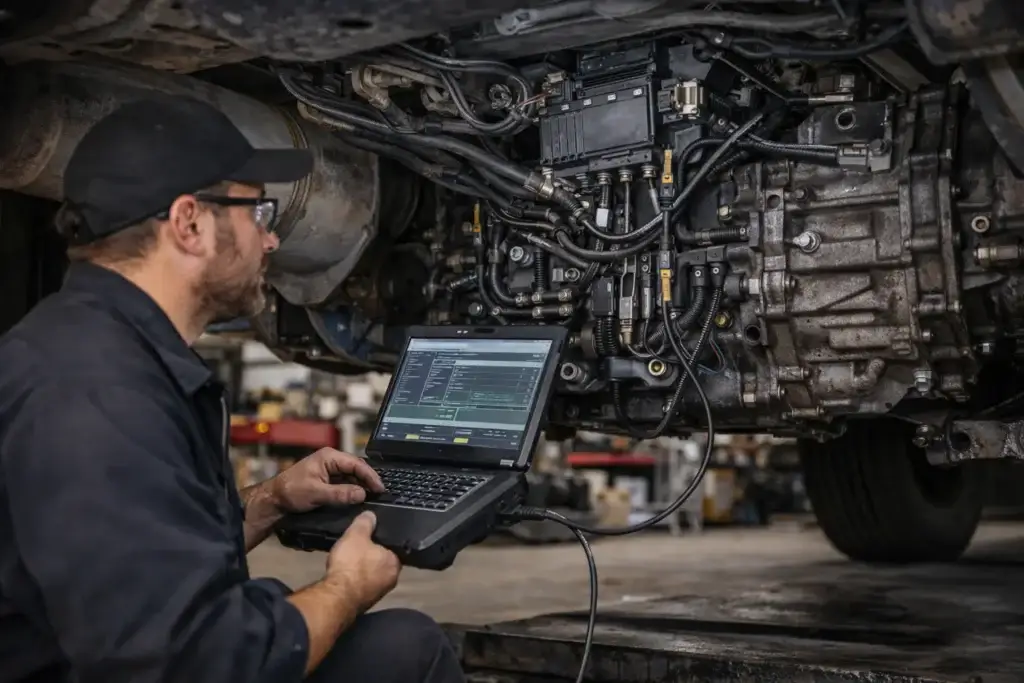
Diagnosing an AMT without platform-specific software is like diagnosing an engine fault without a scan tool — possible in some cases, impossible in others, and always less efficient than it needs to be. Every major AMT platform has a dedicated diagnostic ecosystem, and understanding what each one offers is essential for fleet maintenance managers building their shop tool inventory.
Eaton's ServiceRanger 4 is the primary PC-based diagnostic tool for the Endurant HD, Endurant XD, and UltraShift Plus transmission families. It uses a fault code hierarchy system to help technicians identify the highest-priority fault first, provides guided fault code action plans, clutch calibration procedures, and the ability to read historical fault data. Eaton's IntelliConnect remote diagnostics platform extends this capability beyond the shop by monitoring active fault codes in real time and delivering prioritized action plans before unscheduled failures occur.
Detroit Diesel's DiagnosticLink integrates DT12 transmission diagnostics with the DD13, DD15, and DD16 engine diagnostic systems in a single interface — a significant advantage for Freightliner Cascadia fleets where both the engine and transmission are Detroit products. The DT12's Virtual Technician telematics integration means fault codes are automatically transmitted to Detroit customer support when they occur on-road, enabling proactive scheduling of repairs before the truck returns to the terminal.
Mack's proprietary Tech Tool handles mDrive transmission diagnostics and health checks, with the ability to retrieve fault codes, check clutch health, and perform system calibrations. Volvo's premium diagnostic platform handles I-Shift calibrations, parameter settings, and software updates; per Volvo's own guidance, master technicians are generally required for I-Shift software-level work due to the precision of the calibration procedures involved.
The J1939 data link underpins all of these systems. A faulty data link connection — caused by a damaged J1939 backbone cable, a corroded nine-pin diagnostic connector, or a terminating resistor failure — will generate transmission fault codes that have nothing to do with the transmission itself. A basic J1939 network test using a breakout box and ohmmeter takes minutes and can prevent hours of unnecessary diagnostic work.
Editorial Insight
The HDJ Perspective
Michael Nielsen has watched the AMT transition play out the same way across enough fleets to see the pattern clearly: it hasn't simplified transmission maintenance — it's shifted the complexity from the mechanical domain to the electronic and software domains. Shops that invested in technician training and diagnostic tooling when AMT adoption began are now operating with a genuine competitive advantage: faster fault resolution, fewer diagnostic dead-ends, and the ability to spot clutch wear and fluid degradation trends before they produce failures. The fleets extracting the full value of AMT technology are the ones treating their AMTs not as smarter manual transmissions, but as integrated electromechanical systems that demand a different kind of expertise.
Common AMT Problems and How to Prevent Them
Understanding the failure modes that AMTs are most susceptible to gives fleet maintenance managers the information they need to build preventive measures into their PM schedules before problems develop. The following are the most frequently cited issues in AMT-equipped fleets and the maintenance practices that prevent each one.
Harsh or erratic shifting: the most common driver complaint with AMT-equipped trucks, and one of the most diagnostically ambiguous. Harsh shifting can originate from contaminated air circuits, low or degraded transmission fluid, a worn clutch nearing end-of-life, an out-of-calibration clutch actuator, or degraded TECU software. Maintenance prevention: proactive air dryer service, fluid condition monitoring, regular clutch calibration checks, and firmware updates.
Gear engagement failure: a pneumatically shifted AMT that loses gear engagement is almost always an air system failure — either moisture-frozen actuators, a failed purge valve allowing moisture accumulation, or compressor-contaminated air bypassing a saturated coalescing filter. Maintenance prevention: desiccant cartridge replacement on a proactive interval; coalescing filter service on a defined schedule; purge valve inspection at each PM event.
Clutch slippage and premature wear: more common in vocational applications with frequent heavy starts than in line-haul service, and often exacerbated by driver behavior — lugging the engine at too-low RPM during launch and forcing the TECU to compensate with extended clutch slip. Maintenance prevention: clutch wear monitoring via platform diagnostics, coaching drivers on throttle technique for demanding launch conditions, and not delaying clutch replacement when wear indicators trigger.
TECU fault codes without apparent mechanical cause: electrical faults — particularly corroded connectors and weak batteries — can generate TECU fault codes that appear to implicate transmission internals but clear when the electrical fault is corrected. Maintenance prevention: regular battery load testing, wiring harness inspection on a defined interval, and connector cleaning during scheduled PM events.
Transmission fluid contamination from wrong lubricant: preventable but not rare — occurs most often during fleet expansions when new maintenance personnel aren't familiar with platform-specific fluid requirements, or when a fleet's lubricant inventory isn't clearly labeled and segregated. Maintenance prevention: clear fluid specification labeling in the shop, OEM-specific training for all transmission service personnel, and fluid specification verification built into the PM sign-off checklist.
Building a Fleet-Level AMT Maintenance Program
Individual PM tasks and service intervals are only as effective as the program that coordinates them. Fleet-level AMT maintenance programs that consistently deliver uptime and transmission longevity share several structural characteristics that are worth building explicitly into your operation.
Centralize fluid and parts specifications. Maintain a master document — accessible to every technician in the fleet — that lists the OEM-specified fluid, filter, and desiccant cartridge part numbers for every AMT model in the fleet. When a fleet operates multiple AMT platforms, the risk of cross-platform errors is real. The Technology and Maintenance Council's Recommended Practices include guidance on transmission maintenance documentation standards that fleet programs can reference as a baseline.
Invest in platform-appropriate diagnostic tooling. Every AMT platform your fleet operates should have its corresponding diagnostic software in the shop. This is not optional maintenance infrastructure — it is the difference between a two-hour diagnostic resolution and a multi-day detour. Fleet managers transitioning to AMTs who are building out shop tool inventories should budget for this tooling as part of the AMT adoption cost, not as an afterthought.
Integrate remote diagnostics with your maintenance planning workflow. Remote diagnostic platforms provide fault code alerts in near real time, prioritize critical faults, and in some cases deliver guided action plans that allow fleet maintenance managers to prepare parts and schedule repair windows before the truck returns to the terminal. Fleets that route these alerts into their maintenance management software and act on them proactively reduce unscheduled downtime and the costly cascade of secondary failures that follow ignored fault codes.
Key Recommendation
Create AMT-specific technician training requirements rather than assuming manual-transmission proficiency transfers. OEM technical training provides the foundation; supplement it with in-shop mentoring from your most experienced AMT technicians and periodic competency reviews when platform software updates are released. Per guidance from the Commercial Vehicle Safety Alliance's inspection standards, transmission components are included in out-of-service criteria assessments — technician competency directly affects both uptime and compliance.
For fleets with diverse duty cycles — mixing line-haul, regional, and vocational applications across the same AMT platform — blanket application of a single extended oil interval may not be appropriate for every truck. Oil sampling at interim intervals on vocational units provides an objective basis for interval decisions.
If oil analysis shows fluid in specification well past the vocational baseline, an extended interval may be validated for that specific application. If it shows degradation earlier than expected, the data supports a shorter interval before an internal failure confirms the need.
The American Transportation Research Institute's operational cost studies consistently identify transmission repair and maintenance as a meaningful contributor to per-mile operating costs for Class 8 fleets. Fleets with systematic AMT maintenance programs that prevent premature failures and maximize component life have a direct and quantifiable cost advantage over those reacting to failures after they occur.
Frequently Asked Questions
How often should automated manual transmission fluid be changed?
Intervals vary significantly by manufacturer. Eaton's PS-386-lubricated AMTs specify up to 500,000 miles for line-haul service, dropping to roughly 180,000 miles for vocational applications. The Volvo I-Shift uses an oil filter replaced at drain intervals. Always consult current OEM documentation — specifications are periodically revised.
Does an automated manual transmission still have a clutch that needs to be replaced?
Yes — AMTs retain a mechanical clutch to manage vehicle launch. Modern AMT clutches, like the diaphragm-style organic clutch in current Eaton Endurant transmissions, are self-adjusting and maintenance-free during normal service, but they wear over time and eventually need replacement. The Detroit DT12 includes integrated wear monitoring that alerts the fleet as the clutch approaches end-of-life.
What are the most common AMT maintenance problems fleets experience?
Four categories dominate: air system contamination (moisture or oil aerosols causing harsh shifting or gear loss), electrical faults (corroded connectors or weak batteries causing erratic shifting), the wrong transmission fluid, and deferred TECU software updates affecting shift quality and efficiency.
What diagnostic tools do technicians need to service AMT transmissions?
Each major platform has dedicated software: Eaton's ServiceRanger 4 for Endurant and UltraShift, Detroit's DiagnosticLink for the DT12, and Mack's Tech Tool for mDrive. Remote platforms like Eaton's IntelliConnect complement shop tools. A healthy J1939 data link is a prerequisite for accurate diagnostics on any platform.
How does air system quality affect AMT performance?
For pneumatically shifted AMTs, the air system is a critical transmission subsystem. Moisture from a failing desiccant cartridge can freeze shift cylinders in cold weather or trigger false fault codes. Oil aerosols from a worn compressor contaminate actuators over time. Coalescing filters remove up to 98% of aerosols when new, but performance degrades — proactive replacement matters.
Can an independent shop service AMT transmissions, or is dealer-level tooling required?
Independent shops can perform most AMT preventive maintenance — fluid changes, air system service, electrical inspections — without OEM-proprietary tooling. Clutch calibrations and software updates typically require platform-specific software, most of which is commercially available; deeper mechatronic work generally still calls for OEM-trained technicians.
Conclusion
Automated manual transmission maintenance isn't harder than manual transmission maintenance — it's different. The mechanical fundamentals remain: keep the fluid clean and correct, keep the clutch healthy, keep leaks in check. What AMT maintenance adds is a layer of electronic system care, air quality management, and software stewardship that simply didn't exist in the manual transmission era.
The four pillars — lubrication, electrical integrity, air system quality, and clutch care — are the framework. Platform-specific diagnostic tooling and OEM-trained technicians are the execution mechanism. And a systematic, documented maintenance program is what turns individual service tasks into a consistent, fleet-wide uptime advantage. Heavy Duty Journal covers this same discipline across its other maintenance guides on heavydutyjournal.com, and the AMTs running in today's Class 8 fleet are mature, proven technology — maintaining them well is a choice every fleet maintenance operation can make.
Share This AMT Maintenance Guide with Your Team
If this guide helped you build a better AMT maintenance program, pass it along to the technicians and fleet managers who keep your trucks moving. Every shop that services AMTs correctly is one less breakdown on the road.