
By Michael Nielsen, Editor & Publisher | 15+ Years in Diesel Repair
Last Updated: May 2026
Torque converter problems in heavy-duty trucks follow a predictable pattern: a technician notices shudder at highway cruise, or a fleet manager gets a call about a unit in limp mode on the interstate. The fault codes pull as P0740 or P0741. The transmission fluid is dark. Everyone starts debating whether the converter needs to come out. In most shops, the wrong diagnosis gets made at this point — either the converter gets replaced when a solenoid and fluid change would have solved it, or the converter gets left in when it's contaminating the entire transmission with clutch debris. This guide gives you the diagnostic sequence to get it right the first time, written specifically for Class 6 through Class 8 commercial trucks running Allison automatic transmissions.
Key Takeaways
- Torque converter shudder is the most common complaint in heavy-duty commercial trucks and is frequently misdiagnosed as a transmission clutch pack problem.
- Check the fluid first. Dark, burnt, or metallic-contaminated ATF tells you whether you have a converter problem or a converter that has already caused a transmission problem.
- Fault codes P0740–P0744 define the TCC solenoid circuit — work the electrical circuit before condemning the mechanical converter.
- Stall speed testing is the single most diagnostic procedure for separating a slipping converter from a slipping clutch pack.
- The repair vs. replace decision hinges on fluid contamination — if metallic particles are present, plan for a transmission inspection, not just a converter swap.
- Allison TES 295-compliant fluid and proper change intervals prevent the majority of torque converter lockup clutch failures in vocational applications.
How a Torque Converter Works in a Heavy-Duty Drivetrain
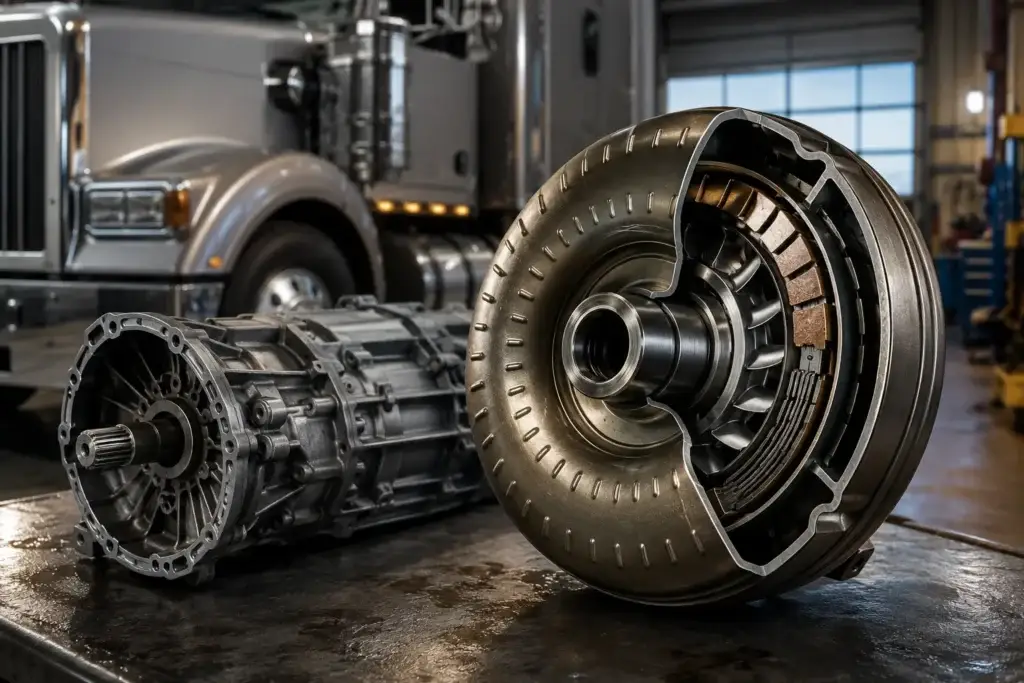
A torque converter is a fluid coupling device positioned between the engine flywheel and the transmission input shaft. In heavy-duty commercial trucks, it performs three functions simultaneously: it transmits engine torque to the transmission through pressurized automatic transmission fluid, it multiplies torque at low speeds to help loaded vehicles launch from a stop, and it allows the engine to idle in gear without stalling by permitting hydraulic slip between its internal components.
Three main components operate inside the converter housing. The impeller — driven by the engine — spins fluid outward. That fluid strikes the turbine, which is connected to the transmission input shaft and transfers rotational force into the drivetrain. Between them, the stator redirects returning fluid to increase impeller efficiency and produce torque multiplication during acceleration. Once the vehicle reaches highway cruise speed, the torque converter clutch (TCC) locks the impeller and turbine together mechanically, eliminating hydraulic slip and improving fuel economy by three to seven percent at steady-state cruise speeds.
In Allison automatic transmissions — the most common automatic configuration in Class 6 through Class 8 vocational trucks — the TCC is commanded by the transmission control module (TCM) through a variable-force solenoid. The TCM monitors turbine speed, output shaft speed, and engine load to determine when conditions are appropriate for lockup engagement and disengagement. When that solenoid circuit or the mechanical clutch inside the converter fails, the symptoms show up quickly in fuel economy, transmission temperature, and drivability.
The 7 Most Common Torque Converter Problems in Heavy Trucks
Understanding which failure mode you're dealing with determines the entire diagnostic and repair path. These are the seven torque converter problems trucks experience most frequently in commercial fleet operations.
1. Torque Converter Shudder (TCC Clutch Wear)
Shudder is the most common torque converter complaint in heavy-duty trucks and the most frequently misdiagnosed. It presents as a rhythmic vibration at highway cruise speeds — typically between 45 and 65 MPH — that feels similar to driving over rumble strips. The cause is partial slippage in the TCC lockup clutch as its friction material wears. Fluid contamination from worn clutch material accelerates the problem. Shudder that appears consistently at the same speed and load condition points directly to TCC clutch wear or deteriorated ATF that can no longer maintain adequate clutch surface lubrication.
2. TCC Failure to Lock Up
When the TCC fails to engage at highway speeds, the converter runs in continuous hydraulic coupling mode. The engine RPM runs higher than expected for a given road speed, fuel economy drops measurably — often two to four percent — and transmission fluid temperature climbs. A scan tool showing turbine speed significantly below engine speed at highway cruise confirms the converter is not locking. This condition logs P0741 (TCC stuck off) or P0740 (TCC circuit malfunction) depending on whether the root cause is mechanical or electrical.
3. TCC Stuck On
A TCC locked in the engaged position causes the truck to lunge forward when selecting drive, stall when coming to a stop, or shudder severely during low-speed operation. The TCM cannot disengage the converter clutch when vehicle speed drops. This logs P0742. In heavy-duty applications, a stuck TCC is a tow-it-in failure — attempting to drive with it engaged at low speed will cause immediate transmission damage.
4. Internal Fluid Leaks and Seal Failure
The torque converter housing maintains pressurized ATF through a combination of seals and bushings at the turbine hub and impeller shaft. When these seals fail, internal fluid pressure drops, reducing both torque multiplication efficiency and TCC apply pressure. Symptoms include sluggish acceleration from a stop, reduced pulling power under load, and erratic TCC engagement. Unlike external transmission seals, internal converter seal failure typically requires converter removal and rebuild or replacement.
5. Stator Clutch Damage
The stator contains a one-way clutch that allows it to freewheel in one direction during coupling phase and lock during torque multiplication. A damaged stator clutch produces one of two failure modes: if it locks in both directions, acceleration becomes sluggish and the converter overheats; if it spins freely in both directions, torque multiplication disappears entirely and the truck struggles to move loads from a stop. Stator damage is often caused by abrupt high-load engagements — common in vocational operations including refuse trucks, concrete mixers, and dump trucks.
6. Overheating and Ballooning
Continuous high-slippage operation — common in stop-and-go refuse routes, vocational applications with heavy grade work, or vehicles with undersized transmission coolers — generates heat that exceeds the converter's design tolerance. Per Allison's operational specifications, sustained transmission sump temperatures above 220°F accelerate seal and clutch degradation, and temperatures above 300°F trigger limp mode to prevent catastrophic internal damage. At extreme temperatures, the converter housing itself can distort — known as ballooning — which destroys internal clearances and typically results in complete converter failure.
7. Contamination-Driven Failure
When a torque converter fails internally — particularly when the TCC clutch material begins disintegrating — debris enters the transmission fluid supply and circulates through the entire transmission. This is the failure mode that turns a converter replacement into a full transmission rebuild. Metallic particles and friction material fragments score valve body bores, contaminate clutch packs, and plug the transmission cooler. Identifying contamination early through fluid inspection is the single most important action a technician or fleet manager can take when torque converter problems are suspected.
3–7%
Fuel economy improvement delivered by torque converter lockup clutch engagement at highway cruise speeds, per Allison Transmission's operational specifications for its commercial automatic transmission series. A failed TCC that won't lock up erases this gain permanently until repaired.
Diagnosing Torque Converter Problems: Step-by-Step Procedure
A systematic diagnostic sequence prevents the most common and costly mistake in converter diagnosis: replacing the converter when the actual fault is electrical, fluid-related, or in the valve body. Work this procedure in order before condemning any hardware.
Step 1 — Pull and Interpret Fault Codes
Connect a heavy-duty scan tool — Allison DOC, Cummins INSITE, or a J1939-capable fleet diagnostic tool — and pull all active and pending codes. Do not clear codes before documenting them. The P0740–P0744 code family specifically targets the TCC circuit. Note whether the code is electrical (P0743 indicates circuit electrical fault) or performance-based (P0741 indicates TCC is commanded on but speed differential indicates it is not engaging). The distinction determines whether you start with wiring or internal inspection.
Step 2 — Inspect the Transmission Fluid
Pull the transmission dipstick or drain a fluid sample and evaluate before any other mechanical work. Healthy Allison TES 295-compliant transmission fluid is amber to light red with no particulate, no burnt odor, and no metallic sheen. Dark brown or black fluid indicates thermal degradation. A burnt smell confirms overheating. Metallic particles — visible on a white rag or confirmed by a fluid analysis lab — indicate internal wear debris in circulation. If metallic particles are present, the diagnostic conversation changes immediately: you are no longer diagnosing just the converter, you are assessing transmission damage scope.
Step 3 — Check the TCC Solenoid Circuit
Before opening the transmission, test the TCC solenoid circuit with a digital multimeter. Disconnect the transmission harness connector and measure solenoid resistance against the manufacturer's specification — Allison TCC solenoids typically fall in the 12–16 ohm range at operating temperature. Out-of-specification resistance indicates solenoid failure. Check the harness for chafing, corrosion at connector pins, and continuity from TCM to solenoid. A solenoid or wiring fault costs a fraction of a converter replacement and resolves the P0740 code family without transmission disassembly in many cases.
Step 4 — Perform a Live Data Scan at Road Speed
With the scan tool connected and the truck at operating temperature, monitor turbine speed, output shaft speed, and TCC apply status at highway cruise. Per Allison's operational documentation, when the TCC is fully engaged, turbine speed and engine speed should be within 50 RPM of each other at steady cruise. A larger differential confirms the TCC is slipping or not engaging. Also monitor transmission sump temperature during the road test — temperatures consistently above 200°F under normal highway load indicate a thermal management problem that will accelerate converter wear regardless of what you replace.
Step 5 — Conduct a Stall Speed Test
The stall speed test is the definitive mechanical assessment of converter condition. With the truck on level ground, wheels chocked, engine at operating temperature, and foot firmly on the service brake, select Drive or a forward gear and apply full throttle briefly — no more than five seconds. Record the peak RPM before releasing throttle and returning to neutral. Compare to the OEM stall speed specification for the engine/transmission combination. Stall speed that is 200–300 RPM above specification indicates converter slippage — the impeller is spinning faster than it should before the turbine engages, confirming internal clutch wear or seal failure. Stall speed below specification typically points to stator clutch damage. Allison does not recommend repeated stall tests in quick succession — allow two minutes of cooling between each test to prevent overheating the ATF.
⚠️ Safety Warning
Stall testing must be performed with wheel chocks on all non-drive axles and the service brake firmly applied throughout the test. Never perform a stall test on a vehicle with a known TCC stuck-on condition (P0742) — the truck will attempt to move immediately against the brakes. Limit stall test duration to five seconds maximum to prevent transmission fluid overheating. Perform this test with an observer present and the shop door clear.
Torque Converter Fault Codes: What Each One Means
The P0740–P0744 code group covers the torque converter clutch circuit across all J1939-equipped heavy-duty vehicles. Understanding what each code specifically targets prevents unnecessary parts replacement.
TCC Diagnostic Trouble Code Reference — Heavy-Duty Trucks
| Code | Description | Start Diagnosis Here |
|---|---|---|
| P0740 | TCC Circuit Malfunction | Solenoid resistance, harness continuity, ATF condition |
| P0741 | TCC Performance / Stuck Off | Live data turbine vs. engine speed, stall test |
| P0742 | TCC Stuck On | Do not drive — tow for inspection; solenoid and valve body |
| P0743 | TCC Circuit Electrical | Wiring harness, connector corrosion, TCM output driver |
| P0744 | TCC Circuit Intermittent | Connector pin tension, harness chafing at flex points |
A P0743 or P0744 code almost never requires converter removal. These are electrical circuit faults — the problem is in the wiring or connector, not the converter itself. A P0741 with confirmed turbine/engine speed differential on live data and elevated stall speed on the stall test is the combination that points to a converter requiring mechanical attention. The SAE J1939 diagnostic protocol that governs how these codes are transmitted across the vehicle databus is standardized — the P0740 code family applies consistently across Allison, Eaton, and all other automatic transmission configurations in Class 6–8 commercial vehicles.
Free Professional Fleet Tools
Cost calculators, fault code lookup, maintenance planners, and more — built for owner-operators, fleet managers, and diesel techs. No signup required.
Transmission Fluid: The Torque Converter's Lifeline
More torque converter problems in commercial trucks trace back to fluid condition than to any mechanical failure. The ATF inside the converter simultaneously serves as the hydraulic medium for torque transfer, the lubricant for all internal surfaces, and the coolant that carries heat to the transmission cooler. When the fluid degrades — through heat, contamination, or extended service intervals — every function it performs degrades with it.
Allison's TES 295 specification defines the fluid performance standard for their automatic transmissions used in Class 6–8 vocational applications. TES 295-compliant fluids provide the specific friction modifier chemistry that the TCC lockup clutch requires to engage and release without shudder. Using a non-approved fluid — or allowing an approved fluid to degrade past its service life — changes the friction characteristics at the clutch interface and is the primary cause of TCC shudder in otherwise mechanically sound converters.
Allison's fluid change intervals for TES 295-compliant fluids specify 50,000-mile or 12-month changes under normal duty, and 25,000-mile or 6-month changes under severe duty — which includes refuse collection, concrete agitator operation, sustained grade work, and high-ambient-temperature environments. Allison Prognostics, available on model year 2009 and later transmissions, monitors actual operating conditions and provides real-time fluid life readings that allow fleets to optimize change intervals based on duty cycle rather than fixed mileage alone. The TMC Recommended Practices for drivetrain maintenance align with these intervals and provide fleet-specific guidance on fluid sampling frequency for early contamination detection.
The HDJ Perspective
In 15 years of diesel repair, the most expensive torque converter jobs I've seen weren't caused by failed converters — they were caused by ignored fluid. A converter that's shuddering on dirty ATF will often recover completely with a fluid and filter change and a fresh TES 295-spec fill. A converter that's been left to shudder on that same dirty fluid for another 30,000 miles will send clutch debris through the valve body and into every clutch pack in the transmission. The parts cost difference between those two outcomes is measured in thousands of dollars. With summer routes, refuse schedules, and construction season loading up your most severe-duty units right now, this is exactly the time to pull fluid samples on any vocational truck that's been running the same ATF since last fall — before the heat turns a $300 service into a $6,000 rebuild. Check the fluid first, every time.
Repair vs. Replace: Making the Right Call for Your Fleet
The repair vs. replace decision for a torque converter in a commercial truck is not primarily a cost-per-unit question — it is a contamination question. The answer to one diagnostic step determines the entire path forward.
If ATF is clean and codes are electrical (P0740, P0743, P0744): Work the electrical circuit. Replace the TCC solenoid if resistance is out of specification. Replace the transmission harness if continuity testing reveals damaged wiring. Perform a fluid and filter service. Clear codes and retest with live data. Converter removal is not indicated at this stage.
If ATF is degraded but no metallic contamination is present and code is P0741: Perform a fluid and filter service with TES 295-compliant fluid. If shudder persists after the fluid change and a 50-mile test drive, proceed to stall speed testing. Confirmed high stall speed with clean new fluid indicates mechanical TCC clutch wear — converter replacement is indicated. The transmission is likely undamaged if fluid contamination was caught before debris entered the circuit.
If ATF contains metallic particles or friction material debris: Converter replacement alone is insufficient. Metallic contamination in the fluid circuit means the valve body, cooler, and clutch packs have all been exposed to wear debris. A transmission inspection is required before the unit returns to service. Flushing without inspection is not a repair — it is a delay before the next failure. Per guidance in 49 CFR Part 396, commercial motor vehicle operators are required to maintain vehicles in safe operating condition, which includes drivetrain systems affecting vehicle control.
Key Recommendation
Send an ATF sample to a fluid analysis lab before making any repair decision on a suspected torque converter problem. A $25 fluid analysis report from a lab accredited to ASTM D7844 standards gives you wear metal data, viscosity, oxidation levels, and contamination markers. That data either confirms the converter as the source or rules it out — and it documents the condition of the transmission before you open it. For fleet operations running Allison-equipped units, fluid analysis at every oil change interval is standard practice among fleets with the lowest drivetrain repair costs.
Preventing Torque Converter Failure in Commercial Trucks
The majority of torque converter problems in heavy-duty commercial trucks are preventable. The failure modes that end in full transmission damage — overheating, contamination-driven debris — all develop slowly and produce warning signs that a structured PM program will catch long before catastrophic failure occurs.
Transmission cooler maintenance is the most overlooked item in preventing converter overheating. The transmission cooler should be blown out with compressed air from the engine side at every PM service — particularly on refuse trucks and vocational units operating in high-ambient environments. A partially blocked cooler raises operating temperature by 20–40°F under sustained load, which is enough to push a marginal converter into the thermal damage range on a hot-weather route. Installing an auxiliary transmission cooler on vocational units that regularly work heavy grades or sustained stop-and-go routes is one of the highest-return upgrades available for fleet drivetrain longevity.
Driver behavior has a measurable impact on torque converter life in vocational operations. Abrupt, high-RPM engagements from a stop create shock loading on the stator clutch and generate heat spikes inside the converter housing. Driver training that emphasizes smooth throttle application from a stop — particularly for vehicles with heavy payloads — reduces stator clutch stress and extends fluid life by reducing peak operating temperatures. The ATRI Operational Costs of Trucking research consistently identifies drivetrain maintenance as one of the top variable cost categories for trucking operations.

Transmission temperature monitoring should be part of every driver's in-route awareness, particularly on severe-duty applications. Allison's operational threshold of 220°F as an elevated-concern temperature and 300°F as the limp-mode trigger gives fleet managers clear benchmarks for driver reporting requirements and dispatch decisions on hot-weather days with heavy loads. Fleets using telematics platforms that capture J1939 transmission temperature data can build automated alerts for units consistently operating near the upper threshold — catching thermal stress before it becomes a failure event. The FMCSA vehicle inspection guidance also supports including transmission condition in scheduled commercial vehicle inspection protocols.
Frequently Asked Questions
What are the first signs of torque converter problems in a heavy-duty truck?
The earliest warning signs are a rhythmic shudder at highway cruise speeds (typically 45–65 MPH), a noticeable drop in fuel economy, and slightly elevated engine RPM for a given road speed. In Allison-equipped commercial trucks, a check engine light with a P0741 code is often the first formal indicator that the torque converter clutch is no longer engaging properly. Catching these symptoms early — before fluid contamination occurs — is the difference between a fluid service and a transmission rebuild.
Can a torque converter be repaired, or does it always need replacement?
Many torque converter problems in heavy trucks are resolved without replacing the converter itself. Electrical faults in the TCC solenoid circuit, degraded ATF that causes shudder, and valve body issues can all produce converter-like symptoms that are corrected through solenoid replacement, fluid service, or valve body work. Replacement is necessary when stall speed testing confirms internal mechanical wear or when fluid contamination with metallic particles indicates the clutch material has already disintegrated.
How long does a torque converter last in a commercial truck?
In well-maintained Allison-equipped Class 6–8 trucks operating on correct TES 295-spec fluid with proper change intervals, torque converter service life routinely exceeds 400,000–500,000 miles in linehaul applications. Vocational operations — refuse, mixer, dump, and construction — experience shorter service life due to sustained high-slip operation and thermal stress. Fleets reporting premature converter failures below 200,000 miles almost always identify deferred fluid changes, incorrect fluid specification, or undersized cooling systems as contributing factors.
What causes torque converter shudder in a diesel truck?
Torque converter shudder in diesel trucks is caused by partial slippage of the lockup clutch during the TCC engagement cycle. The most common cause is degraded ATF that has lost the friction modifier chemistry required to produce smooth clutch engagement — this can often be resolved with a fluid change using fresh TES 295-spec fluid. Worn TCC clutch friction material is the mechanical cause when shudder persists after a fluid change, confirming that the clutch surface itself no longer provides consistent grip during lockup.
Should I replace the transmission when replacing the torque converter?
Not automatically — but always inspect before deciding. If the transmission fluid shows metallic contamination or friction material debris, the converter's failure has already sent damaging material through the transmission's valve body, cooler, and clutch packs. In that case, reinstalling a new converter into a contaminated transmission will result in premature failure of the replacement unit. A transmission inspection — at minimum a valve body inspection and cooler flush — is required before returning the vehicle to service when contamination is confirmed.
Torque converter problems in heavy-duty trucks are diagnosable, predictable, and largely preventable with the right maintenance framework. The diagnostic sequence — codes, fluid inspection, solenoid circuit testing, live data, stall speed — gives technicians and fleet managers a repeatable path from symptom to root cause without guesswork. The most important takeaway for fleet operations is that the fluid tells the story before the failure gets expensive. A converter that's shuddering on degraded ATF is a $300 service call. A converter that has been shuddering for 40,000 miles is a $6,000 transmission job. Heavy Duty Journal covers the full spectrum of commercial truck diagnostic and maintenance topics for diesel professionals who need accurate, field-tested guidance for keeping equipment on the road.
Explore More Heavy-Duty Topics
Browse HDJ's complete library of diesel maintenance guides, fleet management resources, and trucking industry coverage — organized by topic for fast access.


