safety management system implementation

Safety Management Systems for Trucking: Complete Implementation Guide

Table of Contents
    Add a header to begin generating the table of contents

    By Michael Nielsen, Editor & Publisher | 15+ Years in Diesel Repair

    Last Updated: January 2026

    📖 Estimated reading time: 20 minutes

    The trucking industry faces mounting pressure from regulatory agencies, rising accident costs, and increasing insurance premiums. A comprehensive safety management system for trucking operations represents more than checking compliance boxes—it shapes your company’s future competitive position. Motor carriers must navigate complex federal regulations while protecting their drivers and bottom line, making strategic safety implementation essential for operational success.

    The Federal Motor Carrier Safety Administration developed the Safety Management Cycle to help transportation companies address compliance challenges effectively. This framework integrates six core processes that work together to create a structured approach to FMCSA compliance and operational excellence. The cycle provides motor carriers with clear pathways to meet federal requirements while building programs tailored to their specific operational needs.

    Successful implementation delivers measurable returns across your organization. Companies see reduced accident rates, lower insurance costs, improved CSA scores, and enhanced reputation. This guide walks you through every phase—from initial assessment to continuous improvement—showing how commitment at all organizational levels transforms compliance into competitive advantage.

    Key Takeaways

    • Strategic Implementation: Safety management system implementation goes beyond compliance to become a strategic business asset that protects drivers and reduces liability.
    • Proven Framework: The FMCSA Safety Management Cycle provides a six-process framework for addressing regulatory requirements and operational challenges.
    • Integrated Operations: Effective trucking safety programs integrate federal regulations with company-specific policies embedded in daily operations.
    • Measurable Returns: Investment in comprehensive programs yields accident reduction, lower insurance premiums, and better CSA scores.
    • Cultural Commitment: Successful implementation requires organizational commitment from leadership to frontline personnel.
    • Competitive Edge: Motor carriers gain competitive advantages through enhanced reputation and operational efficiency.

    Understanding Trucking Safety Management Systems and Their Impact

    Trucking companies face unique challenges that require structured safety approaches tailored specifically to commercial fleet operations. Unlike traditional workplace safety programs, a safety management system for trucking must account for mobile operations, public roadway involvement, and stringent federal oversight. These frameworks address regulatory compliance while creating a culture that prioritizes driver well-being and operational excellence.

    Safety management systems represent systematic approaches to managing all safety-related activities within a trucking organization. These frameworks include organizational structures, clear accountabilities, documented policies, and operational procedures. For commercial fleets, these systems extend beyond static workplace safety to address the dynamic challenges of highway transportation and interstate commerce.

    The FMCSA’s Safety Management Cycle provides a framework for brainstorming remedies, choosing solutions, and designing plans to improve motor carrier operations. This cycle consists of six core Safety Management Processes that form the foundation of effective commercial fleet safety programs addressing policies, roles, qualifications, training, monitoring, and meaningful action.

    Six interconnected safety management processes diagram showing policies, roles, qualifications, training, monitoring, and meaningful action for FMCSA compliance

    The six interconnected Safety Management Processes create a comprehensive framework for trucking safety compliance.

    The mobile nature of trucking operations creates distinct requirements compared to traditional workplace safety programs. Drivers operate independently across multiple jurisdictions, making consistent policy application and real-time monitoring critical. Fleet safety programs must account for variables like weather conditions, traffic patterns, varying state regulations, and equipment performance across diverse operating environments.

    Measurable Benefits of Strong Safety Programs

    Properly implemented motor carrier safety programs demonstrate measurable impact on accident reduction through systematic hazard identification and risk mitigation. Companies with structured programs experience fewer crashes, injuries, and fatalities compared to carriers with ad-hoc safety approaches. The correlation between comprehensive safety programs and improved outcomes is well-documented across the transportation industry.

    Insurance cost savings represent one of the most tangible benefits for trucking companies. Carriers with demonstrated safety performance improvements can achieve 15-30% reductions in insurance premiums through better CSA scores and claims history. Commercial auto insurance underwriters carefully evaluate safety programs when determining premium rates, rewarding companies that invest in comprehensive risk management.

    Liability protection represents a critical benefit of comprehensive programs. Following an accident, documentation of safety policies, training records, and compliance efforts provides evidence of due diligence. This documentation becomes crucial during litigation, potentially limiting liability exposure by demonstrating reasonable care standards and proactive safety measures.

    Driver retention improves in companies with strong safety cultures, reducing costly turnover expenses. Experienced drivers prefer working for carriers that prioritize their safety and well-being. The average cost to recruit, hire, and train a replacement driver exceeds $8,000 according to industry research, making retention improvements from fleet safety programs financially significant.

    Federal Regulations and Compliance Requirements

    The regulatory framework governing commercial motor vehicles establishes mandatory standards that protect both carriers and the public. Federal motor carrier safety regulations create a comprehensive system that holds trucking companies accountable for their safety performance. Understanding these requirements determines whether your company maintains the right to operate.

    The Federal Motor Carrier Safety Administration developed the Safety Management Cycle to help motor carriers effectively address safety and compliance issues across all seven Behavior Analysis and Safety Improvement Categories. Companies that exceed intervention thresholds may receive warning letters and onsite investigations from safety personnel.

    FMCSA compliance requirements chart displaying DOT safety fitness ratings, BASIC categories, and intervention thresholds

    Understanding FMCSA compliance requirements is essential for maintaining operating authority and avoiding costly violations.

    Safety Fitness Determination Standards

    FMCSA regulations require motor carriers to demonstrate adequate safety management controls through formal evaluations. The agency assigns one of three ratings based on compliance reviews and investigations: Satisfactory, Conditional, or Unsatisfactory. These ratings directly impact your operating authority and business reputation.

    A Satisfactory rating indicates that a carrier has implemented adequate safety management controls and meets or exceeds federal safety requirements. A Conditional rating signals that safety management controls need improvement, with the company remaining operational but facing increased scrutiny. An Unsatisfactory rating represents the most serious determination and can result in the revocation of operating authority if improvements are not made quickly.

    Safety fitness determination evaluates patterns of violations across multiple regulatory areas rather than isolated incidents. Investigators examine compliance across six regulatory areas: driver qualification and licensing requirements, hours of service compliance and recordkeeping, vehicle maintenance programs and inspection records, drug and alcohol testing program implementation, accident history and crash preventability, and hazardous materials safety practices when applicable.

    CSA Scores and BASIC Categories

    The Compliance Safety Accountability program uses roadside inspection data and crash reports to evaluate motor carrier safety performance. The Safety Measurement System calculates percentile rankings across seven BASIC categories: Unsafe Driving, Hours-of-Service Compliance, Driver Fitness, Controlled Substances/Alcohol, Vehicle Maintenance, Hazardous Materials Compliance, and Crash Indicator.

    Each violation receives a severity weight based on its relationship to crash risk. Recent violations count more heavily than older ones through time-weighting factors. FMCSA recalculates your BASIC percentiles monthly using the most recent 24 months of data. Intervention thresholds vary by BASIC category and carrier size, with motor carriers exceeding thresholds triggering warning letters and potential onsite investigations.

    Improving CSA scores requires targeted action in specific BASIC categories. Focus on your highest percentile rankings first. Address driver behaviors through training and coaching. Fix vehicle maintenance issues through enhanced inspection procedures. Challenge incorrect violations through the DataQs system when roadside citations contain errors.

    Record TypeRequired ContentsRetention Period
    Driver Qualification FilesApplication, MVR, medical card, road test, annual review3 years after driver separation
    Vehicle Maintenance RecordsInspection reports, repair orders, preventive maintenance1 year after vehicle disposal
    Hours of Service LogsDaily driving records, supporting documents6 months from date created
    Drug and Alcohol TestingTest results, program documentation, training records5 years minimum

    Core Elements of Effective Trucking Safety Management Systems

    A trucking safety management system functions as the operational backbone of a motor carrier, supporting every decision, procedure, and response through carefully designed core elements. These foundational components work together to create a comprehensive framework that protects drivers, reduces liability, and ensures regulatory compliance. The most successful trucking operations integrate four essential elements: documented policies and procedures, systematic hazard identification, clear accountability structures, and prepared emergency responses.

    Four core safety management components diagram showing policies, hazard assessment, accountability structure, and emergency response procedures

    Four interconnected elements form the foundation of effective trucking safety management systems.

    Comprehensive Safety Policies and Procedures Manual

    A well-structured safety procedures manual serves as the reference guide for all safety-related activities within a trucking operation. This document consolidates mandatory programs from both OSHA and FMCSA into a single accessible resource that employees can reference during daily operations. Common requirements include Emergency Action Plans, Hazard Communication standards, and Lockout-Tagout procedures for maintenance activities.

    Trucking-specific safety policies must address Hours of Service compliance, Pre-Trip Inspection procedures, Distracted Driving prohibitions, and Substance Abuse testing protocols. Each policy should clearly state the requirement, explain the rationale behind it, outline step-by-step procedures, and identify responsible parties.

    Version control and regular review cycles maintain manual relevance as regulations evolve and operations change. Establish a formal review schedule—at minimum annually—that involves stakeholders from operations, maintenance, safety, and administration. Document all revisions with effective dates and ensure updated versions reach all employees promptly.

    Hazard Identification and Risk Assessment Protocols

    Proactive hazard identification prevents incidents before they occur by systematically recognizing workplace and operational dangers. This process extends beyond reactive incident investigation to include regular workplace inspections, Job Hazard Analysis, and near-miss reporting systems. Effective risk assessment prioritizes hazards based on both severity and likelihood, directing resources toward the most critical exposures.

    Facility-based hazards require different identification approaches than road-based risks. Loading dock operations present fall hazards, forklift interaction dangers, and trailer securement concerns. Maintenance facilities involve equipment hazards, chemical exposures, and confined space risks. Road-based hazards encompass driver fatigue, distracted driving, aggressive motorists, adverse weather conditions, and unfamiliar routes.

    Risk matrices provide visual tools for prioritizing hazards and allocating control resources. These matrices plot severity against likelihood, creating risk categories from negligible to critical. Hazards falling into high-risk categories demand immediate attention and substantial control investments, while lower-risk exposures receive proportionate responses.

    Safety Communication and Accountability Structure

    Clear safety accountability ensures everyone understands their safety responsibilities and knows how safety information flows throughout the organization. This structure defines roles from executive leadership down to individual drivers, establishing expectations for safety performance at every level. Written role definitions eliminate confusion about who handles specific safety functions.

    The communication framework should establish regular touchpoints for safety information exchange. Daily pre-shift meetings address immediate concerns and reinforce critical procedures. Weekly safety talks cover specific topics in depth with interactive discussions. Monthly safety committee meetings review performance metrics, investigate trends, and develop improvement initiatives.

    Documentation requirements support safety accountability by creating verifiable records of training completion, inspection performance, incident investigations, and corrective actions. These records demonstrate regulatory compliance during audits and provide evidence of due diligence in legal proceedings.

    Stay Current on Safety Compliance

    Get regulatory updates, safety best practices, and fleet management strategies delivered to your inbox weekly.

    Strategic Roadmap for Safety Management System Implementation

    Transforming trucking safety from a reactive checklist into a proactive management system requires deliberate planning, assessment, and strategic execution. A systematic roadmap ensures your safety assessment identifies genuine gaps rather than surface-level compliance issues. It creates accountability through measurable targets and builds organizational commitment through proper stakeholder engagement.

    Performing a Comprehensive Safety Baseline Assessment

    Every successful implementation begins with understanding where your company currently stands. A thorough baseline assessment reveals the gaps between your existing practices and regulatory requirements. Start by reviewing your company’s Safety Measurement System data on the FMCSA website. Examine violation trends across all BASIC categories, paying particular attention to patterns in unsafe driving, hours-of-service compliance, and vehicle maintenance.

    Analyze your historical accident and violation records for the past three to five years. Look for recurring issues such as specific violation types, common accident causes, or problems with particular vehicle types or routes. This data reveals systemic weaknesses that policies alone cannot address.

    Evaluate six critical areas: Are safety policies documented, current, and aligned with regulatory requirements? Do personnel understand their safety responsibilities? Are hiring standards, training programs, and competency assessments adequate? Is safety training comprehensive and regularly updated? Do oversight mechanisms detect problems early? Does management take corrective action when issues are identified?

    Safety baseline assessment flowchart showing progression from data review through gap analysis to prioritized corrective actions

    A systematic baseline assessment identifies specific gaps and prioritizes improvement initiatives for maximum impact.

    Establishing Measurable Safety Objectives and KPIs

    Clear safety objectives transform abstract goals into concrete targets that drive accountability and measure progress. Develop SMART goals—Specific, Measurable, Achievable, Relevant, and Time-bound. Instead of vague objectives, set targets like reducing preventable accidents by 25% within 12 months or achieving 100% driver participation in quarterly safety training.

    Distinguish between leading indicators that predict future safety performance and lagging indicators that reflect past outcomes. Leading indicators include training completion rates, pre-trip inspection compliance, and preventive maintenance adherence. Lagging indicators include DOT recordable accident rates, CSA BASIC percentile rankings, and roadside inspection violation rates.

    Establish baseline values for each KPI using data from your safety assessment. Set realistic improvement targets based on industry benchmarks, company size, and available resources. Review and adjust these safety objectives quarterly as your system matures.

    Creating a Phased Implementation Timeline

    Attempting to implement every component simultaneously overwhelms organizations and dilutes resources. A phased implementation timeline prioritizes high-impact areas while building organizational capacity for sustained change. Begin by categorizing identified safety gaps into critical, important, and beneficial levels.

    Structure your implementation timeline to build on previous successes. Establish basic safety policies and procedures before launching complex driver behavior monitoring programs. A typical phased implementation spans 12 months: Phase 1 completes baseline assessment and updates critical policies, Phase 2 implements inspection programs and KPI tracking, Phase 3 deploys safety technology solutions, and Phase 4 conducts program audits and plans continuous improvement.

    Building a Proactive Safety Culture

    Transforming safety from a regulatory obligation into a core organizational value creates lasting behavioral change that protects drivers and reduces incidents. A proactive safety approach goes beyond compliance checklists and inspection records. It establishes an environment where employees at all levels genuinely prioritize protection in their daily decisions.

    Leading from the Front: Management Commitment

    Executive leadership accountability starts with visible, consistent actions that demonstrate safety as a genuine priority. When management teams participate actively in safety initiatives, employees recognize that protection matters as much as productivity. Leaders should support, encourage, and recognize workers who operate safely and contribute to making the company safer.

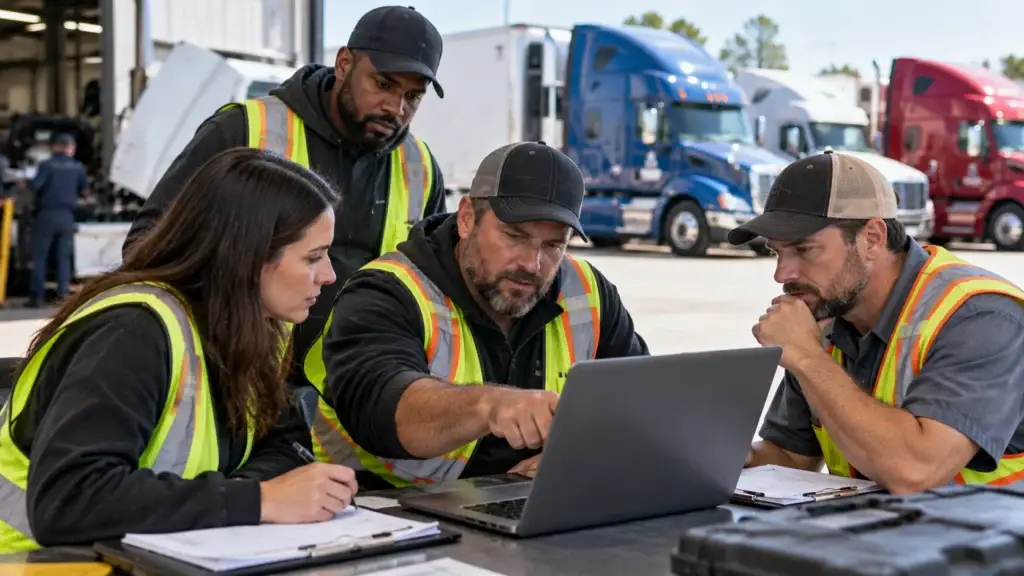
    Fleet leadership team conducting safety meeting with commercial drivers demonstrating visible management commitment to safety culture

    Visible leadership engagement in safety activities demonstrates genuine commitment that shapes organizational culture.

    Resource allocation decisions reveal true priorities more clearly than words. Management must fund safety improvements when hazards are identified, even when budgets face pressure. Personal compliance with safety rules by executives and managers models expectations throughout the organization. Regular safety communications from leadership addressing specific operational concerns and recent learnings reinforce this commitment.

    Harnessing Frontline Knowledge Through Worker Involvement

    Driver participation programs recognize that frontline employees possess invaluable knowledge about operational hazards and practical solutions. Drivers experience road conditions, equipment issues, and customer situations that office personnel never encounter. Tapping this expertise creates more effective safety measures while building employee ownership of safety outcomes.

    Effective safety committees include representation from different terminal locations, shifts, and experience levels to ensure diverse perspectives. Regular meeting schedules with focused agendas address substantive safety issues rather than administrative compliance tasks. Action tracking systems ensure safety suggestions receive timely evaluation and response.

    Creating mechanisms for drivers to submit safety suggestions and hazard reports ensures that valuable insights reach decision-makers promptly. Digital submission systems, suggestion boxes at terminals, and regular safety discussions during dispatch provide multiple reporting channels accommodating different communication preferences.

    Building Trust Through Transparent Communication Systems

    Open reporting systems and non-punitive policies encourage employees to report hazards, near-misses, and concerns without fear of discipline or retaliation. When workers believe that reporting safety issues will result in punishment rather than problem-solving, valuable information remains hidden until incidents occur.

    Implementing Just Culture principles creates frameworks that distinguish between human error, at-risk behavior, and reckless conduct. This approach maintains accountability while fostering the psychological safety needed for honest reporting. Human errors receive coaching and training. At-risk behaviors prompt education about risks and policy clarification. Only reckless conduct warrants disciplinary action appropriate to severity and pattern.

    The HDJ Perspective

    After years of working with fleet operations across the industry, one pattern stands out: carriers that view safety management as a strategic investment rather than a compliance burden consistently outperform their peers. The most successful implementations integrate the FMCSA Safety Management Cycle into daily operations rather than treating it as an annual audit exercise. As insurance costs continue rising and the driver shortage intensifies, your safety program becomes a competitive differentiator—both for attracting quality drivers and securing favorable freight contracts. The carriers investing in comprehensive systems today are positioning themselves for long-term profitability in an increasingly demanding regulatory environment.

    Comprehensive Driver Training and Qualification Standards

    Effective safety training programs transform regulatory requirements into practical competencies that protect drivers, cargo, and the public. While federal regulations establish minimum standards for driver qualification, leading trucking companies recognize that genuine safety excellence requires training programs that go far beyond mere compliance checkboxes.

    Commercial driver receiving behind-the-wheel training instruction from certified instructor for safety certification

    Comprehensive driver training combines classroom instruction with practical behind-the-wheel assessment for complete competency development.

    New Driver Orientation and Safety Onboarding

    The first days and weeks with a new driver create lasting impressions about your company’s safety culture and operational expectations. A comprehensive driver onboarding program must cover essential regulatory topics while avoiding information overload that reduces retention. The orientation should address company-specific safety policies, hours of service regulations with practical logging procedures, and pre-trip and post-trip inspection requirements with hands-on demonstrations.

    Structure your orientation to balance regulatory compliance with practical application. Break complex topics into digestible segments spread across multiple days. Use experienced drivers as mentors during the orientation period to reinforce classroom concepts through real-world context. Documentation serves dual purposes: demonstrating regulatory compliance during DOT audits while providing evidence of due diligence should incidents occur.

    Behind-the-Wheel Training and Skills Assessment

    Classroom knowledge means nothing if drivers cannot execute safe practices when operating commercial vehicles at highway speeds. Behind-the-wheel training bridges the gap between theoretical understanding and practical competency. Effective road training begins with thorough vehicle familiarization covering all controls, gauges, and safety equipment specific to your fleet.

    Backing and maneuvering techniques represent high-risk activities where most property damage occurs. Dedicate substantial training time to various backing scenarios including straight-line backing, alley dock maneuvers, offset backing, and parallel parking. Highway driving assessment must occur in various conditions to reveal how drivers adjust to changing circumstances including urban congestion, rural highways, construction zones, and adverse weather when possible.

    Defensive Driving and Annual Refresher Training

    Commercial vehicles present unique challenges that passenger car defensive driving courses do not adequately address. Defensive driving for professional truck drivers must account for vehicle characteristics, visibility limitations, and the physics of operating heavy equipment. Space management principles form the foundation, with following distance recommendations accounting for vehicle weight, road conditions, and traffic density.

    Initial training establishes baseline competency, but skills and knowledge degrade without reinforcement. Federal regulations mandate annual training on specific topics, but leading companies implement continuous education programs that extend far beyond minimum compliance. Monthly safety meetings, quarterly skills verification, and ongoing coaching create a learning environment where safety improvement becomes part of daily operations.

    Vehicle Maintenance Programs and Inspection Standards

    Well-maintained commercial vehicles reduce breakdowns, prevent violations, and protect lives on the road. Vehicle maintenance programs serve as critical safeguards that directly impact your CSA scores, insurance premiums, and driver safety. A systematic approach to maintenance addresses both regulatory compliance and operational reliability while identifying unsafe conditions before they lead to violations or accidents.

    Diesel technician performing preventive maintenance inspection on commercial truck brake system using proper safety procedures

    Preventive maintenance schedules based on mileage and time intervals prevent equipment failures before they compromise safety.

    Scheduled Service Based on Operating Conditions

    Preventive maintenance schedules establish service intervals that address components before they fail. Developing these schedules requires balancing mileage-based triggers, time-based intervals, and component-specific lifecycles. Most fleets establish primary service intervals at 15,000 to 25,000-mile increments depending on duty cycle and oil specifications.

    Critical safety systems demand specific attention: brake systems require inspection every 25,000 miles with adjustment and lining measurement, tires need pressure checks at every driver inspection with rotation every 25,000 miles, lighting requires monthly comprehensive checks of all lamps and connections, and steering and suspension need quarterly inspections for wear and proper operation.

    Daily Inspection Procedures and Documentation

    Driver vehicle inspection reports create a daily safety checkpoint that identifies defects before vehicles enter service. Federal regulations under 49 CFR Part 396 require commercial drivers to conduct pre-trip inspections and document any defects or deficiencies discovered during operation. The inspection covers service brakes, parking brake, steering mechanism, lighting devices, tires, horn, windshield wipers, rear vision mirrors, and coupling devices.

    ⚠️ Safety Warning

    Never operate a commercial vehicle with known brake defects, steering issues, or tire problems. Out-of-service violations for brake and tire defects carry the highest severity weights in CSA scoring and represent immediate safety hazards that can result in catastrophic accidents.

    Training drivers to conduct thorough vehicle inspections requires structured instruction on what to examine and how to identify defects. Many carriers use standardized inspection sequences that follow a walk-around pattern, ensuring drivers check every required component systematically. Retention requirements mandate keeping driver vehicle inspection reports for three months from the date of inspection.

    Comprehensive Annual Inspection Requirements

    Annual inspections provide a thorough examination of every safety-critical system on commercial vehicles. DOT certification requirements mandate that qualified inspectors perform comprehensive annual inspections and document their findings with detailed reports and certification decals. The annual inspection must occur at intervals not exceeding 12 months, examining brake adjustment, steering component wear, suspension integrity, frame condition, lighting function, tire condition, and coupling device operation.

    Roadside inspection outcomes improve significantly for fleets with rigorous annual inspection programs. Vehicles that receive thorough annual examinations and proper maintenance demonstrate lower out-of-service rates during roadside inspections, directly benefiting CSA scores and reducing the likelihood of enforcement interventions.

    Leveraging Technology for Enhanced Safety Management

    Technology has become an essential pillar of effective safety management systems, providing real-time insights that human oversight alone cannot achieve. Modern safety technology enables fleet managers to monitor driver behavior continuously, verify compliance automatically, and identify potential hazards before they escalate into accidents. Data-driven approaches transform reactive safety programs into proactive prevention strategies.

    Electronic Logging Devices and Hours of Service Compliance

    Electronic logging devices have fundamentally changed how trucking companies track and manage driver hours of service. The federal ELD mandate requires most commercial motor vehicles to use these devices, which automatically record engine hours, vehicle movement, miles driven, and location information. This automation eliminates the manual errors and potential falsifications that plagued paper logbooks for decades.

    ELD systems connect directly to the vehicle’s engine to capture accurate driving time without driver input. The devices automatically switch duty status when the vehicle moves, creating an objective record that satisfies FMCSA inspection requirements. Implementation challenges typically center on driver resistance and technical connectivity issues, addressed through comprehensive training that emphasizes how technology protects drivers from false accusations.

    GPS Tracking and Telematics for Fleet Visibility

    GPS tracking systems provide dispatchers and safety managers with continuous visibility into fleet location and movement patterns. Modern fleet tracking solutions incorporate telematics capabilities that capture vehicle performance data including speed, harsh braking events, rapid acceleration, excessive idling, and engine diagnostics. This information identifies driving behaviors that increase accident risk and vehicle wear.

    Route optimization software uses GPS tracking data to identify the most efficient paths between pickup and delivery points. Advanced systems account for bridge heights, weight restrictions, hazardous material routing requirements, and areas with high accident rates. By steering drivers away from dangerous locations and reducing total miles driven, these systems simultaneously improve safety and reduce operational costs.

    Video Systems and Centralized Safety Documentation

    Forward-facing camera systems have become invaluable tools for protecting drivers and companies from false accident claims. These dashcams continuously record the road ahead, capturing the seconds before, during, and after collisions. Video evidence frequently exonerates professional drivers in rear-end collisions, intersection accidents, and situations where other motorists make dangerous maneuvers.

    Integrated safety management software consolidates multiple compliance functions into single platforms that streamline documentation and reporting. These systems maintain digital driver qualification files, track training completion, schedule vehicle maintenance, document accidents and incidents, and generate compliance reports. Automation features alert managers when driver licenses approach expiration, medical cards need renewal, or annual training becomes due.

    Free Professional Fleet Tools

    Cost calculators, fault code lookup, maintenance planners, and more—built for owner-operators, fleet managers, and diesel techs. No signup required.

    Explore Free Tools →

    Accident Investigation and Preventive Measures

    Thorough accident investigation goes beyond determining fault—it uncovers systemic weaknesses that, when addressed, prevent similar incidents from recurring. Every collision, near-miss, or safety incident provides critical data that can strengthen your entire safety management system. Effective accident investigation determines not just how an event happened, but why it happened.

    Immediate Response and Causal Analysis

    The minutes and hours following an accident are critical for both driver safety and legal protection. Driver responsibilities at the accident scene include ensuring immediate safety by securing the vehicle, rendering aid to injured parties, notifying authorities, documenting conditions through photographs, and collecting witness information. Drivers should avoid making statements that admit fault or speculate about causation.

    Root cause analysis distinguishes effective investigations from superficial reviews. The goal is identifying underlying systemic factors rather than stopping at proximate causes. Simply attributing accidents to driver error misses opportunities to address the conditions that allowed that error to occur. Apply structured techniques like the Five Whys method, fishbone diagrams, or fault tree analysis to identify failure paths.

    Creating Solutions That Prevent Future Incidents

    Implementing corrective actions transforms investigation findings into meaningful safety improvements. The hierarchy of controls provides a framework for selecting the most effective interventions: elimination removes the hazard entirely, substitution replaces with less hazardous alternatives, engineering controls implement physical changes, administrative controls establish policies and procedures, and personal protective equipment serves as the last line of defense.

    Track corrective action completion through your safety management system. Verify effectiveness through follow-up monitoring rather than assuming implemented actions solved the problem. Share investigation findings appropriately throughout your organization through safety meetings, training sessions, and written bulletins focused on systemic issues rather than individual blame.

    Tracking Safety Metrics and Driving Continuous Improvement

    Effective safety management requires more than implementing policies—it demands systematic measurement and continuous improvement. Without clear safety metrics, trucking companies cannot determine whether their safety programs are working or identify areas needing attention. Data-driven decision-making transforms safety from a reactive function into a strategic advantage.

    Key Performance Indicators That Matter Most

    Selecting the right KPIs provides the foundation for measuring safety performance effectively. Successful trucking companies distinguish between leading indicators that predict future performance and lagging indicators that measure past outcomes. Leading indicators include safety observation reports, near-miss reporting rates, training completion percentages, pre-trip inspection compliance, and preventive maintenance adherence.

    Lagging indicators measure results after events have occurred. Critical lagging safety metrics include DOT recordable accident rate, preventable accident rate, crash rate per million miles, CSA BASIC percentile rankings, roadside inspection violation rate, and out-of-service rates. Each metric should be calculated consistently using standardized formulas.

    Benchmarking Against Industry Standards

    Benchmarking against industry standards provides critical context for interpreting your company’s safety performance. Several sources provide valuable benchmarking data including the FMCSA’s Safety Measurement System, industry association reports from the American Transportation Research Institute, insurance industry benchmarks, and safety award program standards. Selecting appropriate comparison groups ensures meaningful benchmarks based on operation type, cargo type, fleet size, and geographic region.

    Pareto analysis reveals that a small number of factors typically contribute to the majority of safety issues. This 80/20 principle applies consistently—often 20% of drivers account for 80% of incidents. Focusing improvement efforts on these high-impact factors delivers maximum results rather than spreading resources thinly across all areas.

    Overcoming Implementation Challenges

    Trucking companies implementing safety management systems inevitably encounter resistance, resource limitations, and competing priorities that demand thoughtful solutions. Understanding common obstacles allows safety managers to develop proactive strategies rather than reactive responses. The FMCSA Safety Management Cycle demonstrates practical problem-solving appropriate for various fleet sizes and resources.

    Building Support Despite Skepticism

    Organizational resistance represents one of the most significant barriers to safety program success. Drivers often view new safety initiatives as burdensome oversight, while operational managers may perceive safety requirements as productivity obstacles. Effective change management starts with clearly communicating the reasoning behind safety changes and involving affected personnel in solution development.

    Celebrating early wins builds momentum for broader implementation. Sharing data about reduced incidents or lower insurance premiums demonstrates tangible value. Pilot programs demonstrate value before full deployment, allowing refinement based on real feedback. Success stories from pilot participants become powerful tools for convincing skeptical colleagues.

    Implementing Systems Within Resource Constraints

    Budget limitations constrain technology purchases, staffing additions, and program development for most carriers. These financial realities require strategic prioritization rather than comprehensive simultaneous deployment. A phased approach addresses highest-risk areas first while building the business case for continued investment.

    Many effective safety improvements require minimal financial investment. Process changes and better use of existing resources often deliver substantial benefits without capital expenditures. Standardizing communication protocols, improving shift handoffs, and establishing clear accountability structures cost little but enhance safety significantly.

    Frequently Asked Questions

    What is a Safety Management System for trucking companies?

    A Safety Management System for trucking companies is a systematic approach to managing safety that includes organizational structures, accountabilities, policies, and procedures specifically designed for commercial fleet operations. The system incorporates six core Safety Management Processes established by FMCSA: Policies and Procedures, Roles and Responsibilities, Qualification and Hiring, Training and Communication, Monitoring and Tracking, and Meaningful Action. An effective system integrates federal and state regulations with company-specific policies, creating a comprehensive framework embedded in daily operations. Unlike general workplace safety programs, trucking systems address unique challenges of mobile operations, public roadway involvement, and DOT regulations while protecting both drivers and company assets.

    How do Safety Management Systems reduce insurance costs?

    Implementing a comprehensive Safety Management System can reduce insurance premiums by 15-30% through demonstrated safety performance improvements. Insurance underwriters specifically evaluate safety programs and CSA scores when determining premium rates. Companies with strong safety records benefit from reduced claims frequency, fewer out-of-service violations, lower workers’ compensation costs, decreased vehicle downtime, and improved driver retention. By systematically addressing hazard identification, driver training, and vehicle maintenance, implementation directly correlates with fewer crashes and injuries. This documented safety improvement provides concrete evidence to underwriters that your fleet presents lower risk, resulting in measurable premium reductions and better coverage terms.

    What are the FMCSA Safety Management Cycle processes?

    The FMCSA Safety Management Cycle consists of six core processes that form the foundation of effective motor carrier safety programs. Policies and Procedures establish written safety standards and operational protocols. Roles and Responsibilities create clear accountability structures with defined duties at all organizational levels. Qualification and Hiring ensure proper driver selection through background screening, license verification, and experience requirements. Training and Communication provide knowledge transfer through onboarding programs and ongoing education. Monitoring and Tracking deliver performance measurement through safety metrics and compliance audits. Meaningful Action addresses identified issues through corrective measures and continuous improvement initiatives. These interconnected processes work together to create systematic approaches to commercial fleet safety management.

    How long must trucking companies retain DOT records?

    Trucking companies must maintain comprehensive DOT records with specific retention requirements. Driver qualification files must be retained for three years after driver separation and include applications, motor vehicle records, medical certificates, road test certifications, and annual reviews. Vehicle maintenance records including inspection reports and repair orders must be retained for one year after vehicle disposal. Hours of service records require six-month retention from the date of receipt. Accident registers documenting all accidents must be maintained for three years from the accident date. Drug and alcohol testing records have varying periods: five years for positive tests, two years for negative tests, and five years for program administrative records. Proper recordkeeping demonstrates compliance during audits and provides critical legal protection.

    Implementing Your Safety Management System

    Safety management implementation success depends on viewing your system as a living framework rather than a completed checklist. The FMCSA Safety Management Cycle provides proven tools that companies can adapt regardless of fleet size or resources. This structured approach helps identify process breakdowns before they result in enforcement actions or serious accidents.

    Your commitment to a comprehensive safety management system for trucking operations must extend beyond regulatory compliance. Companies that embrace the six Safety Management Processes experience measurable benefits including improved CSA scores, fewer accidents, and reduced insurance premiums. These improvements translate directly into competitive advantages through enhanced reputation, better driver retention, and access to premium freight opportunities.

    Start your implementation by conducting a baseline safety assessment. Identify high-priority gaps that pose the greatest risk to your operations. Develop a phased plan that matches your available resources and secures leadership buy-in across all organizational levels. Remember that ongoing safety improvement requires more than technical compliance—it demands cultivating a culture where drivers, dispatchers, and executives take ownership of safety outcomes.

    In today’s regulatory landscape, a comprehensive safety management system represents an essential investment in your company’s future. Organizations that prioritize driver protection, public safety, and operational excellence position themselves for sustainable growth and competitive advantage in an increasingly demanding marketplace.

    Share This With Your Heavy-Duty Network

    Help fleet managers and safety professionals discover this comprehensive safety management guide by sharing it with your network.

    Leave a Comment

    Your email address will not be published. Required fields are marked *

    Sponsored

    Emergency Breakdown?

    Find Certified Repair Shops Near You

    24/7 Mobile Service
    Verified Facilities
    Nationwide Coverage
    Find Repair Shops Now →

    Trusted by thousands of fleet operators