By Michael Nielsen, Editor & Publisher | 15+ Years in Diesel Repair
Last Updated: January 2026
📖 Estimated reading time: 26 minutes
Diesel mechanic ergonomics directly determines whether technicians finish their careers healthy or disabled. Every day, mechanics face punishing physical demands that take a serious toll on their bodies—crawling under heavy trucks, wrestling with massive components, and working in twisted positions for hours puts enormous stress on the spine and joints.
The numbers tell a sobering story. Back injuries account for nearly 40% of all workers’ compensation claims in automotive repair facilities, according to occupational health research. These injuries don’t just cause pain—they end careers, drain shop resources, and cost the industry millions annually in lost productivity.
The good news? Most musculoskeletal disorders are preventable. Strategic ergonomic interventions can cut injury rates by up to 60% while improving work quality and employee morale. This comprehensive guide provides proven strategies to protect your most valuable asset—your skilled workforce.
Key Takeaways
- Back injuries represent 40% of workers’ compensation claims in repair shops, with individual claims ranging from $40,000 to $80,000—making injury prevention a critical business priority
- Proper ergonomic practices can reduce musculoskeletal disorders by up to 60% in diesel repair environments when consistently implemented
- The 50-pound rule provides a baseline for individual lifting limits, but awkward positions, overhead placement, and confined spaces often require mechanical assistance at lower weights
- Workshop layout optimization—including proper bay dimensions, storage heights, and tool placement—creates conditions where safe work practices become the path of least resistance
- Structured warm-up routines, mid-shift stretching breaks, and core strengthening exercises function as preventive maintenance for the mechanic’s body
- Ergonomic equipment investments typically achieve positive ROI within 18-36 months through reduced injury rates, workers’ compensation savings, and improved technician retention
Understanding the Physical Demands of Diesel Repair Work
Every day, diesel mechanics face a demanding combination of heavy lifting, confined spaces, and repetitive tasks that test their physical limits. The nature of diesel repair work creates unique challenges for mechanic health that differ significantly from standard automotive maintenance. Understanding these physical demands provides the foundation for implementing effective injury prevention strategies that protect workers throughout their careers.
Diesel repair environments expose workers to continuous physical strain from multiple sources simultaneously. Mechanics routinely handle massive components, contort their bodies into awkward positions, and perform thousands of repetitive motions each shift. These combined stressors create conditions favorable for developing musculoskeletal disorders that can end careers prematurely if not properly addressed.

Heavy Component Handling Requirements
Diesel engines and their associated components represent some of the heaviest equipment mechanics encounter in any automotive field. A complete diesel engine assembly can weigh anywhere from 500 to over 3,000 pounds depending on the application. Commercial truck engines typically range between 1,200 and 2,500 pounds, while industrial and marine diesel engines exceed these weights substantially.
Individual components also present significant handling challenges. Transmissions designed for heavy-duty diesel applications weigh between 300 and 1,000 pounds. Turbochargers range from 25 to 100 pounds depending on size and configuration. Fuel injection pumps, cylinder heads, and flywheel assemblies each add substantial weight that mechanics must manipulate regularly.
The cumulative trauma from repeatedly handling these masses takes a serious toll on the body. Even when mechanics use proper technique, the sheer frequency of lifting heavy components creates stress on spinal discs, muscle groups, and connective tissues. This repetitive exposure to heavy loads significantly increases the risk of developing musculoskeletal disorders over time.
Many repair tasks require handling components in less-than-ideal circumstances. Mechanics often must support weight at arm’s length, hold parts overhead during installation, or stabilize heavy assemblies while securing fasteners. These scenarios multiply the effective load on the body, creating biomechanical stress far exceeding the component’s actual weight.
Awkward Position Challenges
The design of diesel vehicles and equipment frequently forces mechanics into compromised positions that stress the body unnaturally. Working under vehicles requires extended periods of lying supine with arms raised overhead. This position causes the pelvis to rotate, flattens the natural curve in the lower back, and dramatically increases pressure on spinal discs.
Engine compartments on modern diesel trucks offer limited access despite the size of components housed within them. Mechanics must reach deep into confined spaces, often maintaining awkward arm angles and twisted torso positions for extended periods. These contorted postures prevent proper body mechanics and force muscles to work inefficiently while supporting the body’s weight.
Overhead work presents equally challenging ergonomic obstacles. When servicing lifted vehicles or working on tall equipment, mechanics frequently extend their arms above shoulder height for prolonged periods. This position creates significant strain on shoulder joints, neck muscles, and upper back structures. The sustained elevation reduces blood flow to working muscles, accelerating fatigue and increasing injury risk.
Confined spaces beneath vehicles and inside equipment housings prevent mechanics from maintaining neutral spine alignment. Hours spent hunched over engines or crouched in wheel wells place sustained compressive forces on intervertebral discs. The muscles surrounding the spine become fatigued as they work continuously to maintain these unnatural positions, leaving the spine vulnerable to injury.
Repetitive Motion Patterns
Diesel mechanics perform thousands of repetitive movements throughout each workday, creating micro-trauma that accumulates over months and years. Impact wrench operation alone can involve hundreds of trigger pulls per shift, creating vibration exposure and repetitive gripping motions. Torque wrench application requires sustained forceful exertions repeated across dozens of fasteners during a single assembly job.
Hand tool manipulation contributes substantially to repetitive movements that affect mechanic health. Wrenching motions, screwdriver turns, and hammer strikes all involve similar movement patterns repeated continuously. Each individual motion may seem insignificant, but the cumulative effect on tendons, ligaments, and joint structures becomes substantial over time.
The repetitive nature of diagnostic procedures adds another layer of physical demand. Mechanics repeatedly bend, kneel, and reach during inspection routines performed on multiple vehicles daily. These postural transitions, while necessary for thorough assessments, create additional stress on knee joints, hip flexors, and lower back structures.
Certain repair procedures involve highly repetitive fine motor tasks that stress smaller muscle groups and connective tissues. Wire harness work, connector manipulation, and precise adjustment procedures require sustained awkward hand and wrist positions. These tasks may not seem physically demanding, but they create conditions favorable for developing musculoskeletal disorders in the hands, wrists, and forearms.
40%
Percentage of workers’ compensation claims in repair shops attributed to back injuries—making it the single largest injury category
Common Back Injuries and Musculoskeletal Disorders in Diesel Mechanics
Understanding the medical reality of diesel repair injuries is the first step toward effective back pain prevention. Diesel mechanics experience specific, well-documented musculoskeletal conditions that stem directly from their work environment. These injuries aren’t random accidents but predictable outcomes of repetitive physical stress on the body.
The occupational health data reveals a troubling pattern. Mechanics consistently rank among the highest-risk professions for chronic pain and disability. Recognition of these specific conditions enables shop owners and mechanics to implement targeted prevention strategies.
Lumbar Strain and Disc Herniation
Lower back strain represents the most prevalent injury among diesel mechanics. The lumbar spine endures tremendous force during lifting, twisting, and sustained forward bending. When mechanics lift heavy components while rotating their torso, the pressure on spinal discs can exceed 1,000 pounds per square inch.
Acute lumbar strain begins with muscle and ligament microtears. These small injuries create inflammation, muscle spasms, and that familiar ache or soreness in the back caused by highly fatigued muscles. Without proper recovery time and corrected movement patterns, acute strain progresses to chronic instability.
Herniated discs develop when the outer ring of spinal discs weakens and tears. The soft inner material then pushes through, potentially compressing nearby nerves. Prolonged vibration exposure makes spinal discs more susceptible to injury, particularly after extended periods working on running engines or test-driving vehicles.
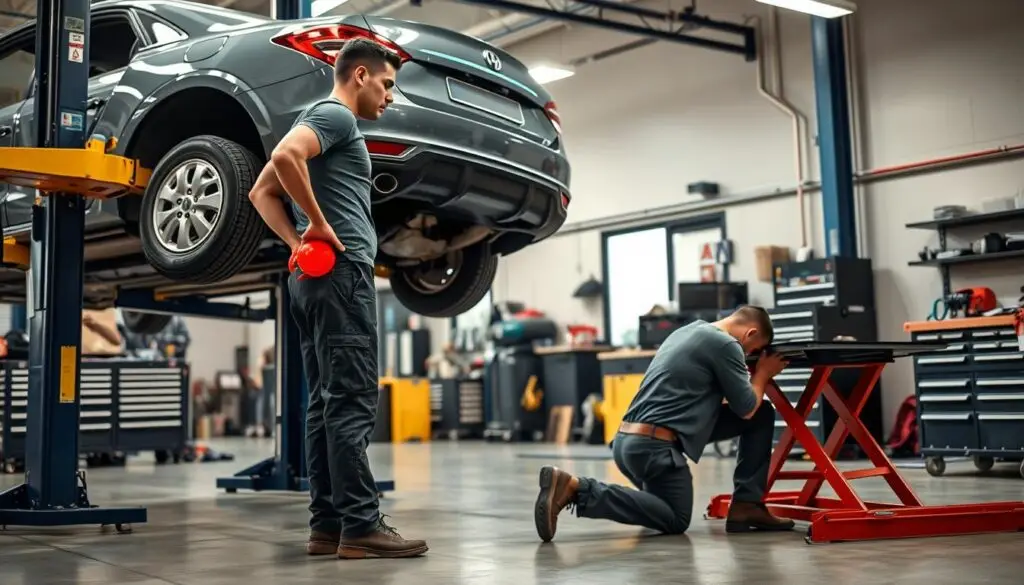
The vulnerability window matters significantly. Immediately after prolonged bending or vibration exposure, muscles are fatigued, tendons and ligaments are stretched, and spinal discs face heightened injury risk. This explains why many mechanics experience injury at seemingly routine moments—their tissues were already compromised.
Rotator Cuff and Cervical Strain
Shoulder and neck injuries create substantial disability in diesel repair work. The rotator cuff—four muscles stabilizing the shoulder joint—sustains damage from overhead work positioning. Reaching above shoulder height to access engine compartments or undercarriage components places extreme stress on these tissues.
Repetitive motion injuries in the shoulder develop gradually. Mechanics performing overhead tasks experience progressive rotator cuff tendon degeneration. Complete tears often occur suddenly during routine movements, but the underlying damage accumulated over months or years.
Cervical strain affects the neck region from sustained awkward head positioning. Working under vehicles requires mechanics to maintain their head tilted backward or rotated sideways for extended periods. This static loading fatigues neck muscles and compresses cervical spine structures.
Thoracic outlet syndrome emerges when prolonged arm elevation compresses nerves and blood vessels. Mechanics working overhead may experience numbness, tingling, or weakness in their hands. These symptoms indicate nerve compression requiring immediate attention and work modification.
Patellofemoral Damage and Cartilage Degradation
Knee and joint problems represent another critical category of diesel mechanic injuries. Patellofemoral syndrome develops from prolonged kneeling on hard shop floors. The constant pressure damages cartilage behind the kneecap, creating pain during squatting or stair climbing.
Meniscal injuries occur when mechanics squat while lifting or rotating. The menisci—cartilage cushions in the knee—tear under combined compression and twisting forces. These injuries often require surgical intervention and lengthy recovery periods that impact joint protection long-term.
Osteoarthritis acceleration occurs when repetitive impact loading breaks down joint cartilage faster than the body can repair it. Mechanics who frequently kneel, squat, or absorb impact through their joints face premature degenerative changes. This condition creates chronic pain and progressive mobility limitations.
The knees aren’t the only joints at risk. Ankles, hips, and wrists all experience accelerated wear from diesel repair work demands. Comprehensive joint protection strategies must address multiple anatomical regions simultaneously.
Accumulated Stress and Chronic Conditions
Cumulative trauma disorders distinguish themselves from acute injuries through their insidious development. Small daily stresses that seem insignificant individually compound over time into debilitating chronic conditions. This category includes tendinitis, bursitis, and degenerative joint disease.
Tendinitis develops when repetitive movements create ongoing inflammation in tendons. Common sites include the elbow (epicondylitis), wrist, and Achilles tendon. Repetitive motion injuries like these respond poorly to treatment if the causative activities continue unchanged.
Bursitis occurs when the small fluid-filled sacs cushioning joints become inflamed. Mechanics who repeatedly lean on hard surfaces or maintain pressure on elbows and knees develop chronic bursa inflammation. This condition creates persistent pain that limits work capacity.
Degenerative joint disease represents the long-term consequence of accumulated microtrauma. Year after year of physical stress accelerates normal aging processes. Mechanics in their 40s and 50s often present with joint degeneration typically seen in much older populations.
| Injury Type | Primary Causes | Common Symptoms | Prevention Priority |
|---|---|---|---|
| Lumbar Strain & Disc Herniation | Lifting while twisting, sustained forward bending, prolonged vibration exposure | Lower back pain, muscle spasms, radiating leg pain, numbness | Proper lifting techniques, mechanical assistance, anti-vibration measures |
| Rotator Cuff & Cervical Strain | Overhead reaching, sustained awkward head positioning, prolonged arm elevation | Shoulder pain with overhead movement, neck stiffness, arm weakness | Work platform optimization, positioning aids, task rotation |
| Patellofemoral & Meniscal Damage | Prolonged kneeling, squatting while lifting, repetitive impact loading | Knee pain during squatting, clicking sensations, swelling, stiffness | Knee pads, creepers, proper footwear, kneeling alternatives |
| Cumulative Trauma Disorders | Repetitive motions, sustained awkward postures, inadequate recovery time | Progressive pain, reduced range of motion, chronic inflammation, joint stiffness | Task variation, micro-breaks, ergonomic tools, conditioning exercises |
These musculoskeletal conditions share a common characteristic—they’re preventable. The biomechanical stresses causing these injuries are well understood. When shop environments prioritize joint protection and implement evidence-based ergonomic practices, injury rates decline dramatically.
The Cost of Poor Ergonomics in Repair Shops
When shop owners calculate the true cost of ergonomic failures, the numbers reveal a stark business reality. The expenses associated with workplace injuries extend far beyond immediate medical bills. They ripple through every aspect of operations, from insurance rates to workforce stability.
Understanding these costs provides compelling motivation for implementing comprehensive shop safety programs. The financial burden of ignoring ergonomic principles can threaten the long-term viability of repair businesses. Smart shop managers recognize that prevention costs significantly less than treatment and recovery.
Direct Financial Impact on Business Operations
Back injuries represent the most expensive category of workers’ compensation claims in the diesel repair industry. A single serious back injury typically generates claims ranging from $40,000 to $80,000 in direct costs. These figures include immediate medical treatment, ongoing physical therapy, and potential surgical interventions.
Insurance premiums respond directly to claim frequency and severity. After just one major injury, small to medium-sized shops can expect annual premium increases between $10,000 and $50,000. The experience modification rate (EMR) adjusts based on three years of claim history, meaning a single incident affects costs for an extended period.
Multiple claims compound these effects exponentially. Shops with poor safety records face difficulty obtaining affordable coverage. Some insurers refuse to renew policies entirely, forcing businesses into high-risk pools with premium costs that can exceed profitability margins.
An ergonomic assessment conducted proactively costs a fraction of reactive injury expenses. Professional evaluations typically range from $2,000 to $5,000, while the return on investment manifests through reduced claims and stable insurance rates.
Operational Disruption and Lost Revenue
Injury-related downtime creates cascading operational problems that affect shop capacity and customer satisfaction. When an experienced mechanic leaves the workforce due to injury, productivity drops immediately. The remaining technicians must absorb additional workload, often at overtime rates.
Training replacement workers requires significant time investment from senior staff. This dual burden reduces overall shop efficiency by 30% to 40% during transition periods. Customer vehicles sit longer in bays, delivery schedules slip, and service quality may decline.
The hidden costs accumulate quickly. Overtime wages for covering absent workers increase labor costs by 50% per hour. Delayed vehicle delivery damages customer relationships and generates complaint handling time. Reduced bay utilization decreases revenue while fixed costs remain constant. Administrative burden of managing claims and replacement hiring diverts management focus. Temporary workers lack facility-specific knowledge, reducing repair quality and speed.
Revenue losses extend beyond direct labor hours. Customers who experience delays take their business to competitors. Rebuilding reputation after service failures requires marketing investments and discount offerings that further erode margins.
Human Capital Degradation Over Time
The long-term health impacts on the workforce represent perhaps the most significant cost, though these consequences are harder to quantify immediately. Chronic pain from poorly managed ergonomics leads to career burnout and early retirement among skilled technicians.
Experienced diesel mechanics possess years of accumulated knowledge that cannot be quickly replaced. When back injuries force these veterans out of the workforce prematurely, shops lose institutional expertise. Problem-solving abilities, customer relationships, and mentorship capacity disappear with them.
| Career Stage | Typical Issues | Impact on Performance | Annual Intervention Cost |
|---|---|---|---|
| Years 1-5 | Minor strains, muscle fatigue | Occasional reduced productivity | $500-$2,000 |
| Years 6-15 | Recurring back pain, joint problems | Frequent limitations on tasks | $5,000-$15,000 |
| Years 16+ | Chronic conditions, mobility restrictions | Severe productivity decline | $20,000+ |
| Early Retirement | Permanent disability | Complete loss of expertise | $100,000+ in separation costs |
Workers’ compensation systems provide financial support for injured mechanics, but they cannot restore lost quality of life. Chronic pain affects every aspect of daily living, from recreational activities to family interactions. These personal costs, while not appearing on shop balance sheets, reflect the ethical dimensions of workplace safety.
Shop owners who prioritize ergonomic assessment and implement recommended changes protect both their workforce and their business interests. The investment in proper equipment, training, and layout optimization generates measurable returns through reduced insurance expenses, maintained productivity levels, and workforce retention.
Proper Lifting Techniques for Heavy Diesel Components
The foundation of back injury prevention in diesel shops starts with biomechanically sound lifting methods. Every day, mechanics face components weighing anywhere from 30 to several hundred pounds. Without proper lifting techniques, these routine tasks quickly transform into injury risks.
Diesel repair work demands more than raw strength. It requires understanding how body mechanics work together to distribute weight safely. Before attempting any lift, mechanics should avoid physically demanding tasks immediately after long drives or extended periods of sitting.
Taking time to stand, stretch, and walk allows the musculoskeletal system to recover and prepare. This preparation phase reduces injury risk significantly. Smart mechanics treat lifting as a skilled technique that deserves the same attention as precision torque specifications.
The Power Lift Method
The power lift represents the gold standard for moving heavy diesel components. This technique engages the strongest muscle groups in your legs and core while protecting the vulnerable lower back. Mastering this method requires attention to specific details that make the difference between safe lifting and potential injury.
This approach keeps your spine in a neutral position throughout the entire movement. Your legs provide the lifting power while your core stabilizes the load. The result is efficient force transfer that minimizes strain on any single body part.
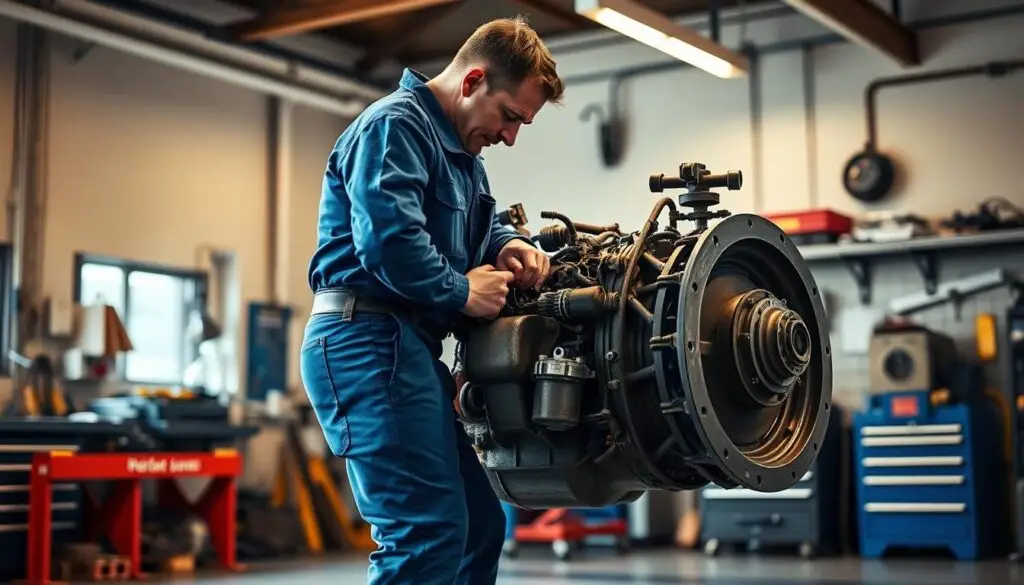
Your feet create the foundation for every successful lift. Position them shoulder-width apart or slightly wider to establish maximum stability. Point your toes slightly outward at about a 15-degree angle.
This stance allows your knees to track naturally over your feet during the lift. One foot should be slightly ahead of the other when possible. This staggered position improves balance and creates a stronger base of support.
Weight distribution matters tremendously. Keep your center of gravity low and centered between both feet. Never lift with your feet too close together or too far apart, as both positions compromise stability and increase injury risk.
Grip Techniques for Secure Holds
Secure grips prevent drops and reduce the need for grip-strength compensation that strains forearms. Use your entire palm to grasp components rather than relying on fingers alone. Palm grips distribute pressure across a larger surface area and provide superior control.
For balanced loads, position your hands at equal distances from the center of gravity. This prevents the component from tilting or rotating during transport. When handling awkwardly shaped parts like cylinder heads or turbochargers, identify natural hand-hold locations before lifting.
Consider using lifting straps or handles for components lacking good grip points. These tools improve control and reduce the grip strength required. Never compromise your lifting posture to accommodate a poor grip, as this defeats the purpose of proper lifting techniques.
Team Lifting Protocols
Some diesel components exceed safe single-person lifting capacity. Team lifting protocols establish clear communication and coordination between mechanics. Always designate one person as the lift coordinator who calls out commands.
The coordinator announces each phase: “Ready to lift,” “Lift on three,” “One, two, three, lift.” This synchronization ensures everyone moves together. Without coordination, uneven lifting forces one person to bear excessive weight.
Load distribution between lifters must remain balanced throughout the movement. Both mechanics should maintain identical body mechanics and lifting posture. The taller person may need to adjust their stance to keep the component level.
Communication continues throughout the entire lift. The coordinator directs placement, announces obstacles, and signals when to lower the component. Never assume your partner knows your intentions, as miscommunication leads to sudden load shifts and injuries.
⚠️ Safety Warning
Never lift components immediately after prolonged sitting, driving, or static positioning. The musculoskeletal system needs 3-5 minutes of movement to restore proper circulation and muscle activation. Lifting with cold, fatigued tissues significantly increases injury risk.
When to Use Mechanical Assistance
Smart mechanics recognize when mechanical assistance becomes necessary rather than optional. The general guideline sets 50 pounds as the maximum individual lift weight. However, other factors often make lighter components candidates for equipment use.
Awkward shapes challenge even experienced mechanics. A 40-pound transmission case with an irregular center of gravity may require a hoist. Overhead placement demands equipment regardless of weight, as lifting above shoulder height dramatically increases injury risk. OSHA’s ergonomics guidance emphasizes that task design—not just weight—determines safe lifting limits.
Confined spaces eliminate proper lifting posture options. When you cannot position yourself correctly, mechanical assistance compensates for these limitations. Distance factors in as well—carrying heavy components more than a few feet justifies using a cart or dolly.
Equipment selection depends on the specific task requirements. Engine hoists handle vertical lifts, while hydraulic jacks assist with horizontal positioning. Transmission jacks specialize in undercarriage work. Choosing appropriate mechanical assistance protects your body and often completes the job faster.
Load Assessment Before Lifting
Every safe lift begins with thorough assessment. Never attempt to lift a component without evaluating its weight first. Test the weight by applying slight upward pressure before committing to the full lift.
Identify proper hand-hold locations during this assessment phase. Look for balanced grip points that allow natural hand positioning. Check for sharp edges, hot surfaces, or slippery residues that could compromise your grip.
Plan your lift path from start to finish. Identify where you will place the component and ensure the path remains clear. Remove obstacles, close cabinet doors, and alert nearby workers. This planning prevents mid-lift adjustments that compromise safety.
Position yourself optimally before initiating the lift. Stand close to the component with your feet properly placed. Ensure you have firm footing without oil, coolant, or other slippery substances. Your body should face the direction you plan to move.
Consider environmental factors during your assessment. Adequate lighting helps you see potential hazards. Good ventilation matters when lifting in confined spaces. Temperature affects both component handling and your physical capacity, so adjust expectations accordingly.
Essential Diesel Mechanic Ergonomics Equipment and Tools
Equipping your diesel repair facility with ergonomic tools represents a critical step toward protecting your workforce from preventable injuries. The right equipment transforms physically demanding tasks into manageable operations that preserve mechanic health while improving productivity. Modern diesel shops that prioritize proper tooling see measurable reductions in injury rates, workers’ compensation claims, and time lost to physical strain.
Smart equipment investments pay dividends through enhanced mechanic longevity and consistent work quality. Shops that view lifting equipment and specialized tools as operational necessities rather than optional expenses create competitive advantages in both safety records and employee retention.
Hydraulic Lifts and Engine Hoists
Vehicle lifts eliminate the need for mechanics to work in cramped, awkward positions under heavy diesel equipment. Two-post lifts provide excellent access to undercarriage components while maintaining clear floor space. Four-post lifts offer superior stability for long-term projects and accommodate heavier commercial vehicles with capacities reaching 80,000 pounds or more.
Scissor lifts bring vehicles to comfortable working heights, reducing the need for prolonged overhead reaching. These lifts distribute weight evenly and provide stable platforms for extended repair sessions. Engine hoists with capacities ranging from one to three tons make removing and installing heavy diesel engines manageable without excessive physical strain.
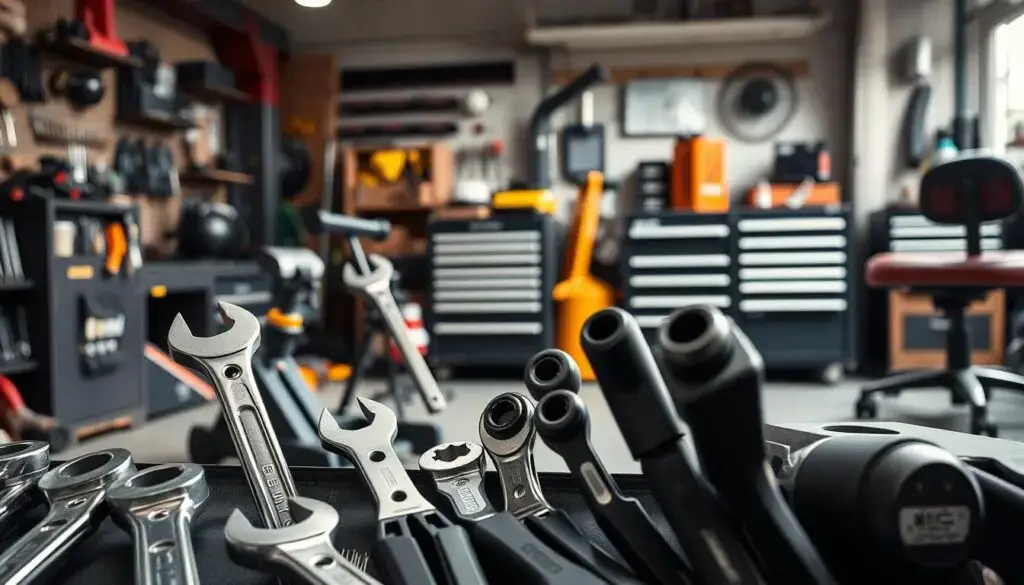
Specialized jacks designed for heavy-component manipulation reduce the physical demands of positioning large assemblies. Transmission jacks with adjustable saddles and hydraulic operation allow single mechanics to safely handle components that would otherwise require multiple workers. These jacks feature tilting mechanisms that align components precisely without requiring mechanics to support weight manually.
Mobile floor jacks with extended reach and high capacity bring lifting equipment directly to the point of need. Models with foot-operated hydraulic pumps free mechanics’ hands for positioning and control. Low-profile designs access tight clearances under lowered vehicles without requiring excessive bending or crawling.
Overhead Crane Systems
Permanent or mobile crane installations provide the ultimate solution for shops handling the heaviest diesel components. Jib cranes with 360-degree rotation cover entire bay areas from fixed mounting points. Bridge cranes spanning multiple bays create flexible material handling systems that eliminate manual lifting of engines, transmissions, and axle assemblies.
Chain hoists and powered lifting systems integrate with overhead track systems for precise load control. These systems incorporate proper suspension systems that reduce vibration impact during component movement and protect both equipment and mechanic safety. Regular maintenance of crane components ensures smooth operation and prevents sudden failures that could create hazardous situations.
Adjustable Work Benches and Platforms
Height-adjustable benches accommodate different mechanics and tasks without forcing workers into awkward postures. Hydraulic workbenches adjust from sitting to standing heights, allowing mechanics to position work at optimal levels that maintain neutral spine alignment. These benches reduce neck strain from looking downward and eliminate excessive reaching for tools and components.
Rotating engine stands bring components to mechanics rather than requiring workers to move around fixed assemblies. These stands lock at multiple angles for access to all sides of engines and transmissions. Mobile platforms with guardrails and non-slip surfaces provide safe elevated access to tall equipment without requiring ladders or unstable improvised solutions.
Tilt tables allow mechanics to position heavy components at comfortable working angles. These specialized platforms reduce the need for mechanics to work in bent or twisted positions when accessing component undersides. Pneumatic or hydraulic controls enable effortless positioning adjustments throughout repair processes.
Ergonomic Hand Tools and Power Equipment
Tool design significantly impacts the cumulative physical stress mechanics experience throughout their careers. Ergonomic tools feature handles shaped to natural hand positions, reducing grip force requirements and minimizing wrist deviation. Lightweight materials like titanium and advanced composites deliver strength without unnecessary weight that contributes to arm fatigue.
Power tools with anti-vibration features protect mechanics from hand-arm vibration syndrome, a cumulative condition that develops from prolonged exposure to tool vibration. Battery-powered options eliminate cord management struggles and allow optimal body positioning without working around power cables. These modern ergonomic tools incorporate brushless motors that reduce vibration while increasing power output.
Reduced-Vibration Impact Wrenches
Modern impact wrenches incorporate damped housings and balanced hammering mechanisms that dramatically reduce vibration transmission to operators’ hands and arms. High-quality impact tools feature rubber isolators between the motor assembly and handle grip. These design elements can reduce vibration exposure by 40-60% compared to standard impact wrenches.
Variable speed controls allow mechanics to match tool power to specific applications, preventing over-tightening that requires excessive removal force later. Electronic torque management systems provide consistent fastener tension without the jarring impacts that contribute to joint stress. Proper suspension systems within tools absorb operational shocks before they reach the mechanic’s body.
Long-Handle Torque Wrenches
Extended handle lengths reduce the force required to achieve specified torque values through improved mechanical leverage. Long-handle designs allow mechanics to engage larger muscle groups in legs and core rather than relying solely on arm and shoulder strength. These tools prove especially valuable for high-torque applications common in diesel repair work.
Torque wrenches with comfortable grip diameters distribute force across larger hand surface areas. This design consideration reduces pressure points that cause hand fatigue and discomfort during extended use. Click-type mechanisms provide clear feedback without requiring mechanics to watch gauge readings while applying force.
Anti-Fatigue Mats and Floor Solutions
Specialized flooring materials significantly reduce standing fatigue during long repair sessions. Anti-fatigue mats with cushioned surfaces encourage subtle muscle movements that promote circulation in legs and feet. These mats reduce the cumulative stress of standing on hard concrete surfaces that contributes to knee, hip, and back problems over time.
Quality mats feature beveled edges that prevent tripping hazards while allowing equipment to roll on and off easily. Oil-resistant materials withstand the harsh shop environment without degrading or becoming slippery. Textured surfaces provide slip resistance even when contaminated with fluids, contributing to overall shop safety.
Fatigue reduction flooring systems integrate seamlessly with shop layouts, covering entire work bays or specific task areas. Modular tile systems allow custom configurations that adapt to changing shop needs. These flooring solutions also provide cushioning for dropped tools and components, protecting both equipment and mechanic safety.
| Equipment Category | Primary Ergonomic Benefit | Typical Capacity | Investment Range |
|---|---|---|---|
| Four-Post Vehicle Lifts | Eliminates under-vehicle crawling and awkward positioning | 40,000-80,000 lbs | $4,000-$12,000 |
| Engine Hoists | Removes heavy lifting requirements for engine work | 1-3 tons | $300-$2,500 |
| Adjustable Workbenches | Maintains neutral spine alignment across task variations | 500-2,000 lbs | $800-$3,000 |
| Reduced-Vibration Impact Wrenches | Prevents hand-arm vibration syndrome development | 400-1,500 ft-lbs torque | $200-$800 |
| Anti-Fatigue Floor Mats | Reduces standing fatigue and lower extremity stress | 3’x5′ to 4’x6′ coverage | $100-$400 |
The equipment selection process should prioritize items that address the most frequent injury mechanisms in your specific shop operations. Analyzing past injury reports reveals patterns that guide strategic equipment investments. Shops handling primarily heavy-duty commercial vehicles benefit most from robust lifting equipment, while facilities focused on precision engine work gain more from adjustable benches and specialized tool holders.
Return on investment calculations must account for both direct costs like workers’ compensation premiums and indirect expenses including productivity losses and replacement worker training. Ergonomic equipment investments typically achieve positive ROI within 18-36 months through reduced injury rates alone. Additional benefits like improved work quality and enhanced mechanic retention accelerate these returns.
Proper equipment maintenance ensures these ergonomic tools continue delivering safety benefits throughout their service lives. Regular inspection of hydraulic systems, suspension components, and structural elements prevents degradation that reduces effectiveness. Manufacturers’ maintenance schedules should be followed rigorously, with particular attention to items like lift cables, jack seals, and crane load-bearing components.
The HDJ Perspective
After decades observing diesel repair operations, we’ve seen the same pattern repeatedly: shops that invest in ergonomic equipment during growth phases build sustainable businesses, while those treating it as optional overhead eventually face crippling workers’ compensation costs or lose their best technicians to competitors with better working conditions. The skilled technician shortage makes this calculus even more stark—you simply cannot replace a 15-year veteran who leaves due to chronic injury. Equipment investments that seem expensive today look like bargains compared to the alternative.
Optimizing Workshop Layout for Injury Prevention
Workshop design represents one of the most powerful injury prevention tools available to shop managers, yet it remains the most overlooked aspect of ergonomic safety. The spatial arrangement of repair bays, storage systems, and tool stations creates the physical framework that either supports proper body mechanics or forces mechanics into injury-producing positions hundreds of times per day. A well-designed facility makes safe work practices the natural choice, while poor layout turns every task into an ergonomic challenge.
The difference between an ergonomically optimized shop and a traditionally designed facility appears in measurable outcomes. Facilities that prioritize workstation setup and spatial organization report 40-60% fewer back injury claims compared to shops with conventional layouts. This reduction occurs because intelligent design eliminates the need for excessive reaching, bending, and awkward positioning that characterize most diesel repair work.
Bay Design and Vehicle Positioning
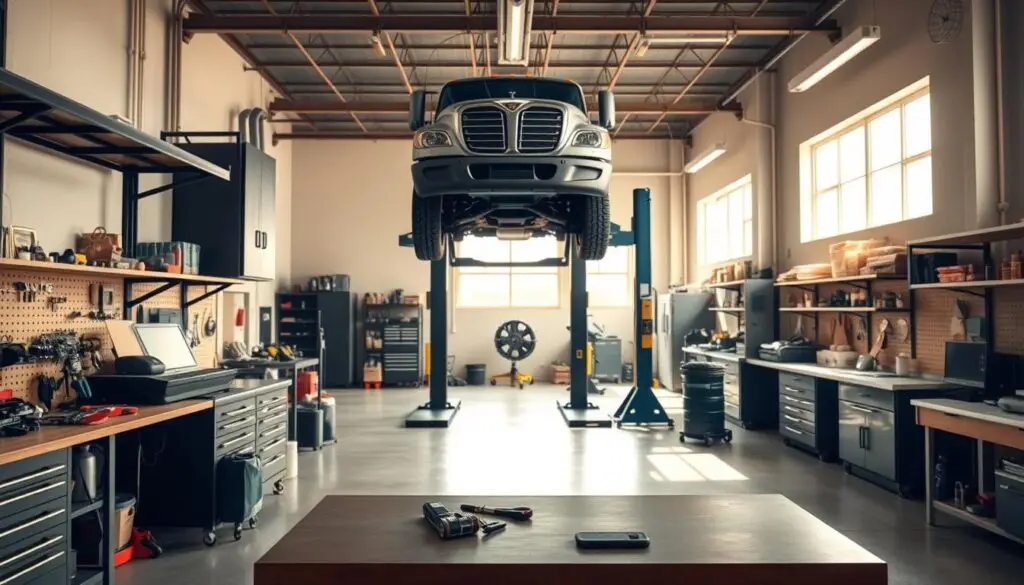
The foundation of effective workshop design begins with proper repair bay dimensions and vehicle placement strategies. Heavy-duty diesel work demands significantly more space than standard automotive repair, yet many shops attempt to maximize bay quantity at the expense of adequate working room.
Optimal bay dimensions for diesel repair require a minimum of 14 feet in width and 40 feet in depth. This configuration provides mechanics with 360-degree access around vehicles without constant repositioning of equipment or contorting bodies to reach components. Narrower bays force technicians into side-angle approaches that strain the back and shoulders during even routine tasks.
Vehicle lift placement determines whether mechanics can maintain neutral spine positioning during under-vehicle work. Lifts should be positioned to allow at least 4 feet of clearance on all sides when vehicles are raised. This spacing enables proper workstation setup with tool carts, parts containers, and lighting equipment without creating trip hazards or forcing awkward reaching.
Overhead clearance represents another critical specification that many facilities underestimate. A minimum of 16 feet from floor to ceiling accommodates fully raised heavy-duty trucks with components extended, preventing the ceiling-induced cramping that forces mechanics to work in bent or twisted positions.
Lighting integration into bay design eliminates the need for mechanics to position themselves awkwardly to see work areas. Overhead LED arrays combined with adjustable task lighting should provide minimum 100 foot-candles of illumination at working height, with shadow-free coverage that follows natural body positioning rather than requiring compensation.
Parts Storage Accessibility
Parts storage organization directly impacts the frequency and severity of bending, reaching, and lifting movements that mechanics perform daily. Traditional storage approaches that prioritize space efficiency over accessibility create thousands of unnecessary ergonomic stressors throughout each shift.
The principle of shop safety through intelligent storage design centers on positioning items based on usage frequency and weight characteristics. This approach transforms storage from a passive space-filling function into an active injury prevention system.
Shelving Height Standards
Frequently accessed parts must be positioned within the optimal ergonomic zone between knee and shoulder height. This range, approximately 24 to 60 inches from floor level, allows mechanics to retrieve items without excessive bending or overhead reaching. Studies demonstrate that parts stored outside this zone increase back strain incidents by 300% compared to properly positioned inventory.
The shelving configuration should follow a frequency-based hierarchy. Daily-use components occupy the prime zone between waist and chest height (36-54 inches), while weekly-use items can extend to the outer boundaries of the ergonomic zone. Rarely accessed parts belong on extreme upper or lower shelves where occasional non-neutral positioning causes minimal cumulative strain.
Heavy Parts at Waist Level
Components exceeding 25 pounds require dedicated storage at waist height, specifically between 36 and 42 inches from the floor. This positioning enables mechanics to maintain proper lifting mechanics with the load close to the body’s center of gravity. Storage below waist level forces deep bending that loads the spine, while storage above waist level requires lifting from extended positions that multiply injury risk.
Heavy parts storage should incorporate slide-out shelving or rotating carousels that bring components to the mechanic rather than requiring reaching into deep shelving. This equipment investment pays for itself through reduced injury claims within the first year of implementation.
| Storage Zone Height | Appropriate Items | Weight Limit | Usage Frequency |
|---|---|---|---|
| 54-72 inches | Light, infrequent parts | Under 10 lbs | Monthly or less |
| 36-54 inches | Daily-use components | 10-25 lbs | Daily to weekly |
| ✓ 36-42 inches (Optimal) | Heavy diesel parts | 25-50 lbs | Any frequency |
| 24-36 inches | Bulk items, fluids | Under 35 lbs | Weekly usage |
| Below 24 inches | Rarely used equipment | Under 15 lbs | Occasional only |
Tool Placement Strategies
Tool accessibility determines whether mechanics maintain efficient workflow or accumulate fatigue through repetitive walking, bending, and reaching. Traditional centralized tool storage creates unnecessary movement patterns that compound physical stress throughout the workday.
Primary tool chests should be positioned within 10 feet of the main work area for each bay. This distance allows mechanics to retrieve tools without leaving the immediate work zone, eliminating hundreds of unnecessary trips per shift. Each 100 feet of daily walking while carrying tools adds measurable fatigue that increases injury susceptibility during afternoon hours.
Shadow boards mounted at arm height (48-60 inches) provide instant visual identification and retrieval of frequently used hand tools. The outline system eliminates searching time while positioning tools at optimal height for grab-and-go access. This arrangement prevents the repetitive bending associated with traditional toolbox drawer access.
Mobile tool carts represent the most significant advancement in tool placement strategy. Carts that travel with mechanics to each task location eliminate the retrieve-and-return cycle entirely. Properly organized mobile units keep essential tools at waist height throughout the workday, supporting neutral spine positioning during tool selection.
Power tool storage requires dedicated holsters or hangers positioned at the point of use rather than in central locations. Pneumatic and electric tools stored near their primary application areas reduce carrying distances and allow immediate return after use, preventing the clutter accumulation that creates tripping hazards and poor ergonomic positioning.
Free Professional Fleet Tools
Cost calculators, fault code lookup, maintenance planners, and more—built for owner-operators, fleet managers, and diesel techs. No signup required.
Body Positioning and Posture During Repair Tasks
How you position your body during repair tasks determines whether you finish your career healthy or injured. Every diesel mechanic faces physically demanding work that challenges the spine, joints, and muscles. Understanding proper body mechanics and implementing posture correction techniques throughout your workday protects your body from cumulative damage.
Correct posture helps distribute the workload evenly, minimizing stress on specific muscle groups. When you maintain a neutral position, keep your spine aligned, and keep your shoulders relaxed, you reduce injury risk significantly. These principles apply to every repair task, from undercarriage work to overhead component replacement.
Learning proper positioning requires conscious practice until it becomes habitual. An ergonomic assessment of your current work positions reveals opportunities for improvement that can prevent years of unnecessary strain.
Working Under Vehicles Safely
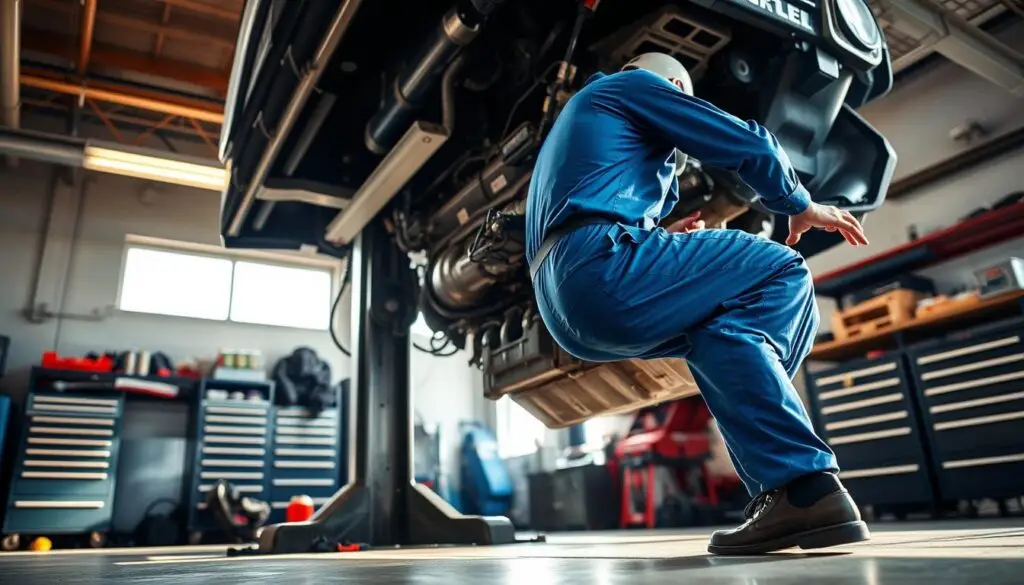
Undercarriage work presents unique body mechanics challenges that many mechanics face daily. The confined space, awkward angles, and sustained positions create conditions for spinal stress and muscle fatigue. Proper techniques minimize these risks while maintaining work efficiency.
Position your entire body in alignment with the task rather than twisting your spine to reach components. Use creeper mobility to reposition your body frequently instead of extending your reach. This simple adjustment dramatically reduces strain on your lower back and neck.
Proper Creeper Use
Select a creeper with adequate padding, smooth-rolling wheels, and proper head support. The head support maintains cervical spine alignment and prevents sustained neck extension. Without this support, your neck muscles work constantly to hold your head up, leading to fatigue and strain.
Adjust the creeper height so your body lies flat rather than twisted. Your spine should maintain its natural curves even while lying on your back. Position the creeper to minimize reaching movements that require shoulder extension beyond comfortable ranges.
Take frequent position changes during extended undercarriage work. Roll out from under the vehicle every 15-20 minutes to restore normal circulation and relieve sustained muscle tension. This practice prevents the stiffness and discomfort that comes from prolonged static positioning.
Avoiding Twisted Postures
Spinal twisting under vehicles represents one of the most common causes of back injuries in diesel repair. Your vertebrae handle compression forces well but resist rotational forces poorly. Combined twisting and reaching movements multiply injury risk.
Reposition your entire body to face the component you’re working on. Move the creeper rather than rotating your torso. If you cannot align your body with the task, exit from under the vehicle and approach from a different angle that allows proper alignment.
Watch for subtle twisting patterns that develop unconsciously. Your lower back may rotate while your upper body remains still, or vice versa. Regular posture correction awareness helps identify these harmful patterns before they cause injury.
Overhead Work Positioning
Tasks above shoulder height create significant strain on neck, shoulder, and upper back muscles. Blood flow to elevated arms decreases, causing rapid fatigue. Extended overhead work without breaks leads to chronic shoulder problems and neck pain.
Use appropriate platforms, step stools, or adjustable work benches to bring your body closer to overhead work. Raising your body position reduces the shoulder angle and decreases muscle fatigue. Your arms should work at or slightly below shoulder height whenever possible.
Take frequent breaks during overhead tasks to lower your arms and restore circulation. Every 10-15 minutes, drop your arms to your sides and perform gentle shoulder rolls. This simple practice prevents the numbness and tingling that signals nerve compression.
Alternate between overhead tasks and ground-level work throughout your day. This variation prevents sustained strain on any single muscle group. Schedule your work to avoid extended periods of overhead positioning that exceed your muscles’ endurance limits.
Maintaining Neutral Spine Alignment
Neutral spine position preserves the natural cervical, thoracic, and lumbar curves your spine developed for optimal load distribution. These curves work together to absorb shock and distribute forces efficiently. Losing neutral alignment during work tasks concentrates stress on specific vertebrae and discs.
Achieve neutral spine by imagining a string pulling the top of your head toward the ceiling. Your ears should align over your shoulders, shoulders over hips, and hips over ankles when standing. The natural curve in your lower back receives support without excessive arching.
Quick Reference: Neutral Spine Self-Assessment
- Chin remains level rather than jutting forward or tilting down
- Shoulders sit back and down rather than hunched forward
- Lower back maintains a slight curve without excessive arching
- Weight distributes evenly across both feet when standing
- Pelvis remains neutral without anterior or posterior tilt
Adjust your seating so that your feet can reach the pedals or floor without lifting your back off the seat. The backrest should recline slightly back from upright while supporting the natural curve in your lower back. This positioning reduces disc pressure by approximately 30% compared to unsupported sitting.
Shift positions regularly throughout the day. Even proper positions become problematic when sustained for extended periods. Movement prevents muscle fatigue and maintains healthy circulation. Avoid placing thick wallets or items in back pockets that change pelvic tilt and disrupt spinal alignment.
Kneeling and Squatting Alternatives
Prolonged kneeling and deep squatting positions place excessive stress on knee joints and limit blood flow to lower legs. Many diesel repair tasks traditionally performed in these positions benefit from equipment alternatives that reduce joint loading.
Mechanics’ stools with wheels provide mobility while reducing knee stress during low-level tasks. These stools support your body weight while allowing position changes without standing up repeatedly. Look for models with adjustable height and adequate padding for extended use.
High-quality knee pads work effectively for short-duration kneeling tasks lasting less than 10 minutes. Choose gel-filled or foam pads that distribute pressure across your kneecap and surrounding tissue. Hard, thin pads concentrate pressure and accelerate joint damage rather than preventing it.
Squat-assist devices and knee savers reduce joint loading during low-level work. These tools provide partial body weight support that decreases the compression forces on your knee cartilage. Using these devices extends the time you can work comfortably in lower positions without joint pain.
Consider body mechanics alternatives to sustained kneeling and squatting: use a rolling mechanics stool for extended low-level work sessions, elevate components to waist height using adjustable work tables when possible, take standing breaks every 15 minutes during kneeling or squatting work, alternate between kneeling on left and right knees to distribute stress, and perform gentle leg stretches after completing low-position tasks.
Regular ergonomic assessment of your work positions identifies opportunities to reduce kneeling and squatting frequency. Small adjustments to component positioning or tool selection often eliminate the need for these high-stress positions entirely. Your knees will thank you after decades of diesel repair work.
Stretching and Conditioning Programs for Mechanics
A mechanic’s body endures the same physical demands as an athlete’s, making structured conditioning programs essential for career longevity. The repetitive motions, heavy lifting, and awkward positions required in diesel repair create cumulative stress on muscles and joints. Without proper preparation and maintenance, these demands lead to chronic injuries that shorten careers and reduce quality of life.
Research shows that mechanics who incorporate stretching exercises and core strengthening into their daily routines experience fewer injuries and less fatigue. These programs don’t require extensive time commitments or expensive equipment. Simple routines performed consistently deliver measurable results in injury prevention and performance enhancement.
Pre-Shift Warm-Up Routines
Starting the workday with a structured warm-up prepares muscles and joints for the physical demands ahead. A 5-10 minute routine increases blood flow, elevates body temperature, and activates the neuromuscular system. This preparation significantly reduces the risk of strains and sprains during the first hours of work when cold muscles are most vulnerable.
The warm-up should occur in the shop before handling tools or components. Mechanics can perform these routines near their workstations without specialized space or equipment. Consistency matters more than intensity during this preparation phase.
Dynamic Stretching Exercises
Dynamic stretching exercises involve controlled movements that take joints and muscles through their full range of motion. These active stretches prepare the body for work better than static stretching, which can temporarily reduce muscle power. The CDC’s workplace health promotion research supports incorporating dynamic movement into pre-shift routines.
Effective pre-shift stretches include arm circles (10 forward and 10 backward circles with each arm to warm shoulder joints and upper back muscles), torso rotations (standing with feet shoulder-width apart and rotating the upper body side to side for 20 repetitions), leg swings (holding a stable surface and swinging each leg forward and backward 10 times, then side to side 10 times), walking lunges (10 steps forward with exaggerated lunges to activate hip flexors and leg muscles), and trunk flexion and extension (gently bending forward and backward 10 times to prepare the spine for varied positions).
These movements take approximately 4-5 minutes to complete. The goal is smooth, controlled motion rather than aggressive stretching.
Joint Mobilization Techniques
Joint mobilization focuses on moving each major joint through its complete range of motion without force or bouncing. This process distributes synovial fluid throughout the joint capsule, providing natural lubrication. Mechanics should mobilize shoulders, hips, knees, ankles, and spine before beginning repair tasks.
Shoulder mobility exercises include arm raises in multiple directions and gentle rotations. Hip mobilization involves slow leg lifts and circular movements. Knee and ankle joints benefit from flexion, extension, and rotation movements performed while standing or seated.
Spinal mobilization requires special attention since back injuries represent the most common mechanic injury. Gentle cat-cow movements, side bends, and careful rotations prepare the spine for the day’s demands. These techniques promote better breathing and circulation, further enhancing overall endurance throughout the shift.
Mid-Day Stretching Breaks
Taking breaks to stand, stretch, and walk helps circulate blood and provides needed rest to stressed muscles. It only takes 5 minutes every hour to significantly reduce fatigue and maintain flexibility. These brief interruptions prevent the muscle tension and joint stiffness that accumulate during sustained work.
Mid-shift stretching exercises should target the specific muscle groups most stressed during morning work. Hip flexor stretches counteract the sustained bending common in diesel repair. Standing quad stretches, lunges, and gentle knee-to-chest movements release lower body tension.
Shoulder and upper back stretches address the overhead work and repetitive arm movements mechanics perform. Doorway chest stretches, shoulder blade squeezes, and neck rolls release accumulated tension. These movements take 3-5 minutes but deliver substantial fatigue reduction benefits.
Spinal extension exercises reverse the forward-flexed postures common throughout repair work. Standing backward bends and supported backbends over a workbench decompress the spine. Before physically demanding tasks, taking a couple of minutes for these stretches allows recovery time for the musculoskeletal system.
Strengthening Exercises for Core Support
Core strengthening exercises build the abdominal and back muscles that stabilize the spine during lifting and awkward positioning. A strong core distributes physical loads more effectively and reduces injury risk. These exercises require no equipment and can be performed in the shop environment or at home.
Plank exercises build overall core stability by engaging multiple muscle groups simultaneously. Mechanics should start with 20-30 second holds and gradually increase duration to 60 seconds. Side planks target the oblique muscles that control lateral spine stability.
Bird-dog exercises develop coordination between core muscles and limb movements, mimicking the body control needed during repair tasks. Starting on hands and knees, extend one arm forward and the opposite leg backward, holding for 5-10 seconds before switching sides. Perform 10 repetitions on each side.
Bridge exercises strengthen the lower back, glutes, and hamstrings that support proper lifting mechanics. Lying on the back with knees bent, lift hips toward the ceiling and hold for 10 seconds. Perform 10-15 repetitions daily.
| Exercise Type | Target Muscles | Frequency | Duration |
|---|---|---|---|
| Plank Hold | Abdominals, lower back, shoulders | Daily | 3 sets of 30-60 seconds |
| Bird-Dog | Core stabilizers, back extensors | Daily | 10 reps each side |
| Bridge | Glutes, hamstrings, lower back | Daily | 3 sets of 10-15 reps |
| Dead Bug | Deep core muscles, hip flexors | 3-4 times weekly | 10 reps each side |
These conditioning programs recognize that mechanics are occupational athletes whose bodies require consistent preparation and maintenance. The routines fit naturally into the repair shop workflow without requiring significant time investment. Shops that implement these stretching and core strengthening programs report fewer injuries, reduced workers’ compensation claims, and improved mechanic performance throughout their careers.
Personal Protective Equipment for Ergonomic Support
Ergonomic protective equipment goes beyond basic safety compliance to actively support body mechanics during demanding repair tasks. While traditional safety gear focuses on preventing immediate injuries from impacts or hazards, ergonomically designed protective equipment addresses the cumulative physical strain that leads to chronic musculoskeletal disorders. This dual-purpose approach makes proper gear selection a critical component of comprehensive workplace safety programs in diesel repair facilities.
The right protective equipment creates a support system that enables mechanics to maintain proper posture and body positioning throughout their shifts. Lightweight, supportive gear improves movement efficiency and reduces the compensatory muscle tension that develops when workers feel restricted or uncomfortable.
Back Support Belts and Braces
Lumbar support devices remain one of the most debated topics in workplace ergonomics. Evidence-based research shows that back support belts do not prevent injury through mechanical reinforcement of the spine. Instead, these devices provide valuable proprioceptive feedback that reminds wearers to engage proper lifting technique during heavy-load handling.
The most effective use of back support belts occurs during known heavy-lift periods rather than continuous all-day wear. Mechanics should apply lumbar support when preparing for engine removal, transmission work, or other tasks involving repeated lifting of components exceeding 50 pounds. This targeted approach maximizes the reminder function without creating dependency on external support.
Key considerations for back support selection include adjustable tension systems that accommodate different body types and task requirements, breathable materials that prevent heat buildup during physical exertion, designs that allow full range of motion without restricting necessary movements, and proper width to distribute pressure across the lower back without digging into ribs or hips.
Critical to understand: back belts supplement but never replace proper lifting mechanics and core strengthening exercises. Mechanics who rely solely on external support without developing internal muscle stability remain at high risk for injury. Shops should emphasize that lumbar support devices work as one component within a comprehensive injury prevention strategy.
Knee Pads and Protective Gear
Knee protection enables mechanics to work at appropriate heights rather than compromising posture to avoid discomfort. When technicians lack proper knee support, they often adopt harmful positions such as excessive bending at the waist or working from unstable squatting positions. Quality knee pads eliminate this compromise by making floor-level work sustainable.
Different knee protection options serve specific applications in diesel repair work. Foam pads work well for occasional kneeling during tire changes or brake inspections. Gel-filled pads provide superior cushioning for extended floor work such as differential repairs or undercarriage welding. Knee pad inserts for work pants offer continuous protection without the need to remember separate gear.
| Knee Pad Type | Best Application | Protection Level | Mobility Rating |
|---|---|---|---|
| Foam Pads | Intermittent kneeling under 15 minutes | Basic cushioning for hard surfaces | High – minimal bulk |
| Gel-Filled Pads | Extended floor work exceeding 30 minutes | Maximum impact absorption | Moderate – thicker profile |
| Hard Cap Pads | Concrete or gravel with sharp debris | Superior puncture resistance | Moderate – rigid structure |
| Integrated Pant Inserts | All-day wear during varied tasks | Consistent moderate protection | High – always positioned |
Proper knee protection serves dual purposes in joint protection strategies. Immediate benefits include preventing acute injuries from kneeling on sharp objects or hard surfaces. Long-term advantages involve reducing cumulative trauma to knee cartilage and supporting structures that leads to chronic pain and arthritis.
Proper Footwear Selection
Footwear creates the critical ergonomic interface between mechanics and shop floors. The wrong boots compromise posture, increase fatigue, and create compensatory movement patterns that strain the entire kinetic chain from ankles to lower back. Proper footwear selection represents one of the most cost-effective ergonomic interventions available to repair facilities.
Safety boots must meet multiple criteria beyond basic toe protection. Mechanics spend 8-10 hours per shift on their feet, walking an average of 4-6 miles around repair bays while carrying tools and parts. This sustained load demands footwear engineered for both protection and comfort. ASTM F2413 establishes the performance requirements for protective footwear, including impact and compression resistance standards.
Steel-Toe Boots with Arch Support
Substantial arch support prevents the foot collapse that triggers a cascade of postural problems throughout the body. When arches flatten under sustained standing, the resulting internal rotation of the lower leg shifts knee alignment and increases stress on hip joints and lower back. Quality safety boots counteract this progression with engineered arch support that maintains proper biomechanics.
Essential features for diesel mechanic footwear include cushioned insoles with memory foam or gel inserts that absorb impact during walking, rigid shanks that provide midfoot support during ladder climbing and equipment operation, ankle stability features that prevent rolling injuries on uneven surfaces, and adequate toe box space that prevents compression during long shifts.
Boots should allow comfortable pedal operation without requiring excessive ankle flexion or leg extension. Proper fit ensures mechanics can reach brake and accelerator pedals while maintaining neutral posture in vehicle operator seats during test drives and positioning tasks.
Slip-Resistant Soles
Traction directly impacts workplace safety and ergonomic positioning. Shop floors contaminated with oil, coolant, and other fluids create slip hazards that force workers into defensive postures. When mechanics unconsciously guard against slipping, they maintain excessive muscle tension and adopt inefficient movement patterns that accelerate fatigue.
Advanced slip-resistant sole designs feature deep tread patterns that channel fluids away from contact surfaces. Materials such as rubber compounds with high coefficient of friction maintain grip even on contaminated floors. This reliable traction allows mechanics to focus on proper body mechanics rather than constantly monitoring foot placement for stability.
The investment in ergonomic protective equipment delivers measurable returns through reduced workers’ compensation claims, decreased absenteeism, and improved productivity. Mechanics equipped with proper support gear work more efficiently because they maintain better positioning and experience less fatigue-related performance decline.
Implementing Shop Safety Policies and Training
Implementing comprehensive safety training programs forms the foundation of effective injury prevention. Without structured policies and education, even the most advanced ergonomic equipment remains underutilized. A systematic approach transforms individual knowledge into consistent workplace practices that protect every member of your team.
Successful implementation requires more than occasional reminders. It demands organized training programs, regular assessments, and leadership commitment. Creating a strong safety culture ensures that ergonomic principles become second nature rather than afterthoughts during busy workdays.
Ergonomic Training Programs
Structured training programs provide the educational framework necessary for lasting behavioral change. These initiatives must address both initial skill development and ongoing knowledge maintenance. Diesel repair shops that invest in comprehensive education see measurable reductions in workplace injuries.
Professional training programs emphasize proper posture and ergonomic techniques as core competencies. This educational foundation prepares mechanics to recognize and avoid physical strain before problems develop. Training should include hands-on demonstrations alongside theoretical instruction for maximum retention.
New Employee Orientation
Every new mechanic must complete mandatory safety training before performing independent work. Orientation programs should cover proper lifting techniques, equipment operation, workstation adjustment, and posture principles specific to diesel repair tasks. This initial education establishes expectations and prevents the formation of harmful habits.
Effective orientation includes practical demonstrations with actual shop equipment. New employees should practice adjusting work benches, operating hydraulic lifts, and positioning themselves correctly for common tasks. Videos and printed materials serve as effective reminders of ergonomic best practices that workers can reference later.
Orientation programs should also address facility-specific layouts and procedures. Trainees need to understand where tools are stored, how to request mechanical assistance, and which tasks require team lifting protocols. This comprehensive approach to injury prevention ensures consistent practices across the workforce.
Ongoing Safety Education
Initial training represents just the starting point of continuous education. Quarterly refresher sessions reinforce proper techniques and address skill degradation over time. These regular touchpoints keep ergonomic principles at the forefront of daily operations.
Training programs must evolve as shops introduce new equipment or modify procedures. Specialized sessions should address emerging injury trends identified through incident analysis. When data reveals knowledge gaps in specific areas, targeted education provides immediate corrective intervention.
Experienced mechanics benefit from advanced training that explores biomechanics and injury mechanisms in greater depth. Understanding why certain techniques prevent strain increases compliance and encourages peer mentoring. Senior staff who grasp underlying principles become valuable resources for less experienced team members.
Safety Audits and Assessments
Systematic evaluation methods identify ergonomic hazards before they cause injuries. Monthly walk-through inspections should examine workstation setups, equipment condition, and observable work practices. These regular reviews catch problems that daily familiarity might otherwise obscure.
Annual comprehensive assessments conducted by qualified safety professionals provide objective external perspectives. These detailed evaluations examine facility layout, procedural compliance, and emerging risk factors. Professional assessors bring specialized knowledge and industry benchmarks that internal reviews might miss.
Task-specific ergonomic analyses focus on high-risk procedures that generate the most strain. Detailed examination of transmission removal, engine installation, and similar demanding operations reveals opportunities for process improvement. Video analysis captures body positioning and movement patterns that workers themselves may not recognize.
| Assessment Type | Frequency | Primary Focus | Responsible Party |
|---|---|---|---|
| Walk-Through Inspection | Monthly | Hazard identification, equipment condition | Shop supervisor or safety committee |
| Comprehensive Evaluation | Annual | Facility layout, policy compliance, injury trends | External safety professional |
| Task-Specific Analysis | As needed | High-risk procedures, post-injury review | Ergonomic specialist or trained supervisor |
| Self-Assessment | Daily | Personal workstation setup, posture awareness | Individual mechanic |
Creating a Culture of Injury Prevention
Transforming shop operations from reactive to proactive requires fundamental cultural change. A strong safety culture emerges when management demonstrates commitment through resource allocation and policy enforcement. Leadership actions speak louder than written policies in establishing workplace priorities.
Peer mentoring systems leverage experienced mechanics who consistently model proper techniques. These informal educators provide real-time guidance and reinforce training concepts during actual work. Recognition programs that reward safe work practices create positive reinforcement for desired behaviors.
Open communication channels allow mechanics to report hazards without fear of blame or repercussion. This psychological safety encourages early identification of ergonomic concerns before they escalate into injuries. When workers feel heard and valued, they become active participants in injury prevention rather than passive policy recipients.
Building this culture requires patience and consistency. Management must visibly prioritize safety over speed when deadlines create pressure. Allowing adequate time for proper lifting techniques and equipment setup demonstrates genuine commitment. These daily decisions shape workplace values more powerfully than any training session.
Incident Reporting and Analysis
Comprehensive reporting systems capture not just injuries but also near-misses and ergonomic concerns. This broader data collection reveals patterns and trends that injury reports alone might miss. Early warning signs enable preventive intervention before serious harm occurs. OSHA recordkeeping requirements provide the regulatory framework for documenting workplace injuries and illnesses.
Root cause analysis identifies systemic issues rather than assigning individual blame. Investigation should examine why unsafe conditions existed or why proper procedures weren’t followed. This analytical approach reveals organizational factors that perpetuate risk rather than simply disciplining workers who get hurt.
Implementing corrective actions with follow-up verification closes the improvement loop. Documented changes demonstrate responsiveness to reported concerns. Verification ensures that implemented solutions actually address identified problems rather than creating new complications.
Tracking metrics over time reveals whether injury prevention initiatives produce measurable results. Compare incident rates, workers’ compensation costs, and lost workday frequency before and after implementing ergonomic programs. Data-driven evaluation justifies continued investment and identifies areas requiring additional attention.
Transparent communication about incidents and corrective actions reinforces the importance of reporting. When workers see that their concerns lead to meaningful changes, participation increases. This feedback loop strengthens the entire safety management system and creates continuous improvement momentum.
Frequently Asked Questions
What percentage of workers’ compensation claims in repair shops are back injuries?
Back injuries account for nearly 40% of all workers’ compensation claims in automotive and diesel repair facilities, making them the single largest injury category. A single serious back injury typically generates claims ranging from $40,000 to $80,000 in direct costs, including immediate medical treatment, ongoing physical therapy, and potential surgical interventions. This high frequency and severity makes ergonomic interventions one of the most cost-effective investments shop owners can make for protecting both their workforce and their bottom line.
What is the maximum weight a diesel mechanic should lift without mechanical assistance?
The general guideline sets 50 pounds as the maximum individual lift weight for diesel mechanics. However, other factors often make lighter components candidates for mechanical assistance, including awkward shapes that shift the center of gravity, overhead placement requirements, and confined spaces that prevent proper lifting posture. When mechanics cannot position themselves correctly for a lift—with feet properly placed, spine neutral, and the load close to the body—mechanical assistance should be used regardless of the component’s actual weight.
How often should diesel mechanics take stretching breaks during their shift?
Diesel mechanics should take 5-minute stretching breaks every hour during their shift to maintain flexibility and reduce fatigue. These brief interruptions prevent the muscle tension and joint stiffness that accumulate during sustained work. Mid-shift stretches should target specific muscle groups stressed during work, including hip flexors to counteract sustained bending, shoulder and upper back muscles for overhead work relief, and spinal extension exercises to reverse forward-flexed postures common in repair tasks.
What is the optimal storage height for heavy diesel parts?
Components exceeding 25 pounds should be stored at waist height, specifically between 36 and 42 inches from the floor. This positioning enables mechanics to maintain proper lifting mechanics with the load close to the body’s center of gravity. Storage below waist level forces deep bending that loads the spine, while storage above waist level requires lifting from extended positions that significantly multiply injury risk. Heavy parts storage should also incorporate slide-out shelving or rotating carousels that bring components to the mechanic.
Do back support belts prevent injuries in diesel repair shops?
Evidence-based research shows that back support belts do not prevent injury through mechanical reinforcement of the spine. Instead, these devices provide valuable proprioceptive feedback that reminds wearers to engage proper lifting technique during heavy-load handling. The most effective use occurs during known heavy-lift periods—such as engine removal or transmission work—rather than continuous all-day wear. Back belts supplement but never replace proper lifting mechanics and core strengthening exercises; mechanics who rely solely on external support remain at high injury risk.
What are the minimum bay dimensions for ergonomic diesel repair work?
Optimal repair bay dimensions for diesel work require a minimum of 14 feet in width and 40 feet in depth. This configuration provides mechanics with 360-degree access around vehicles without constant repositioning or body contortion. Vehicle lifts should be positioned to allow at least 4 feet of clearance on all sides when vehicles are raised, and overhead clearance should be a minimum of 16 feet from floor to ceiling to accommodate fully raised heavy-duty trucks with components extended.
Protecting Your Career Through Smart Ergonomics
Protecting your body through proper diesel mechanic ergonomics ensures you can continue working efficiently for decades to come. The principles outlined throughout this guide form an integrated approach that combines smart lifting techniques, appropriate equipment, intelligent workspace design, and consistent physical conditioning.
Implementing comprehensive injury prevention strategies requires initial investment. Shop owners must allocate resources for ergonomic equipment and training programs. The returns justify these costs through reduced workers’ compensation claims, decreased employee turnover, and improved productivity. Mechanics who maintain their physical health deliver better quality work throughout their careers.
Every diesel repair facility faces a choice. You can accept back injuries and physical strain as inevitable consequences of the profession. Or you can proactively address ergonomic concerns through systematic improvements. The second path supports safer operations, protects your skilled workforce, and maintains the competitive advantage that experienced technicians provide.
Your long-term career depends on the daily choices you make about body mechanics and workspace setup. Start implementing these ergonomic principles today to remain active in this demanding profession for years ahead.
Share This Guide With Your Team
Know a shop owner, fleet manager, or fellow technician who could benefit from these ergonomics strategies? Share this guide to help protect more mechanics from preventable injuries.