
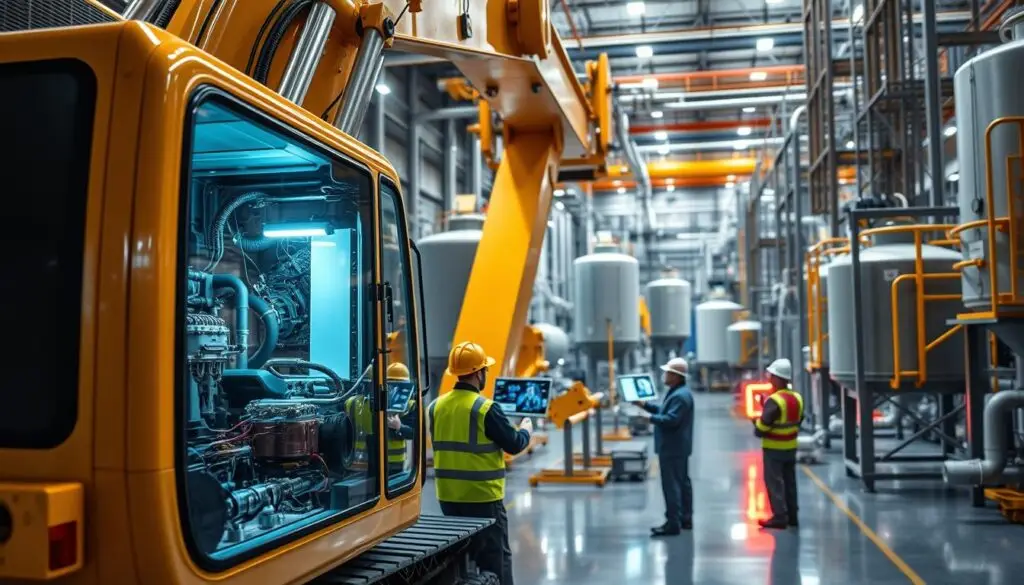
Heavy equipment breaks down at the worst possible times. Mining companies like Rio Tinto and construction giants like Caterpillar face millions in losses when bulldozers fail or haul trucks stop running. Predictive maintenance AI heavy duty systems now change this costly reality through intelligent monitoring and data-driven intervention strategies.
Traditional maintenance costs American manufacturers approximately $50 billion each year in surprise breakdowns, according to U.S. Department of Energy research. Equipment reliability improves dramatically when sensors track every vibration, temperature spike, and pressure change. Smart analytics catch problems before they happen, transforming maintenance from reactive firefighting to proactive management.
Machine learning transforms raw data into actionable insights. Sensors on a Komatsu excavator might detect unusual hydraulic pressure patterns weeks before failure occurs. The AI system recognizes these patterns match failures from thousands of similar machines worldwide. Maintenance teams receive alerts with sufficient lead time to order parts and schedule repairs during planned downtime.
Failure prevention saves more than money. Worker safety improves when equipment runs smoothly without unexpected breakdowns. Production schedules stay on track. Companies can reduce maintenance costs by 18 to 25 percent while increasing equipment availability by 5 to 15 percent, according to McKinsey research on digital maintenance.
Fleet managers at companies like Schneider National now schedule maintenance during planned downtime rather than responding to roadside emergencies. Their trucks stay on the road longer. Repair costs drop significantly. Customer deliveries arrive on time. Smart analytics make this precision possible across entire fleets operating nationwide.
Key Takeaways
- Predictive maintenance AI reduces unplanned downtime by up to 70%: Advanced systems cut maintenance costs 18-25% while increasing equipment availability 5-15%
- Smart sensors detect failures weeks in advance: MEMS sensors monitor temperature, vibration, and pressure with 0.1-degree accuracy and 20,000 Hz frequency capture
- Machine learning achieves 95% prediction accuracy: AI analyzes millions of data points from global fleets to identify failure patterns invisible to human inspection
- ROI achieved within 12-18 months: Companies report $500K-$27M annual savings through prevented failures and optimized scheduling
- Real-world success across industries: Rio Tinto, Werner Enterprises, and Caterpillar demonstrate measurable improvements in equipment availability and cost reduction
Understanding Predictive Maintenance AI Heavy Duty Applications
Modern equipment management has shifted from guesswork to data-driven decisions. Predictive maintenance AI heavy duty systems analyze equipment health in real time, identifying potential failures before they occur. This approach transforms how industries manage their fleets, construction machinery, and manufacturing equipment.
What Makes Predictive Maintenance Different from Traditional Approaches
Traditional maintenance follows fixed schedules regardless of actual equipment condition. A bulldozer might receive service every 500 hours whether it needs it or not. Reactive maintenance waits for breakdowns before taking action, creating expensive emergency repairs and unexpected downtime.
Predictive systems monitor actual wear patterns, vibration levels, and performance metrics continuously. This data-driven approach reduces unnecessary maintenance by 30-50 percent, according to industry research on digital operations. The precision eliminates both over-maintenance and under-maintenance problems.
The difference lies in precision. While preventive maintenance treats all equipment the same, heavy duty machine learning maintenance adapts to each machine’s unique operating conditions. A truck hauling heavy loads through mountains needs different attention than one driving empty on highways. The AI recognizes these distinctions automatically.
Core Components of AI-Driven Maintenance Systems
Four essential elements power modern predictive systems working together as an integrated ecosystem:
- Industrial IoT sensors measuring temperature, vibration, pressure, and acoustic signatures across critical components
- Data preprocessing modules cleaning and organizing incoming information while filtering noise and anomalies
- Machine learning models trained on thousands of failure patterns from similar equipment operating worldwide
- Dashboard interfaces showing equipment health scores, repair recommendations, and predicted failure timelines
These components communicate continuously, creating feedback loops that improve prediction accuracy over time. Each successful prediction and subsequent repair adds data points that refine future forecasts.
Real-Time Data Collection and Analysis Methods
Real-time monitoring happens through wireless sensor networks transmitting readings every few seconds. Modern MEMS sensors capture vibration frequencies up to 20,000 Hz, detecting bearing wear invisible to human inspection. Temperature sensors achieve 0.1-degree accuracy, spotting thermal anomalies indicating electrical problems or mechanical friction.
Edge computing devices process this data locally, reducing delays and bandwidth requirements. These on-site processors filter routine readings while flagging abnormal patterns for immediate attention. Cloud platforms then combine information from entire fleets, spotting patterns across similar equipment types operating in different conditions.
This layered approach ensures both speed and comprehensive analysis. Local processing delivers instant alerts for critical issues, while cloud analytics provide long-term trend analysis and predictive modeling based on massive datasets spanning years of operation.
The Evolution of Heavy Duty Machine Learning Maintenance
The journey of heavy duty machine learning maintenance began with simple threshold alarms in the 1980s. These basic systems would alert operators when equipment readings exceeded preset limits. Technicians received notifications only after problems became severe enough to trigger alarms, offering minimal advance warning.
Modern technology tells a different story. Today’s industrial AI processes billions of data points to predict failures weeks before they occur. The transformation from reactive alerts to predictive intelligence represents one of the most significant advances in equipment management history.
Early maintenance relied primarily on vibration analysis for rotating parts. Technicians would manually check equipment and record readings on paper charts, comparing values to baseline measurements. This labor-intensive process could only sample small portions of operating time, missing critical developments between inspections.
Equipment monitoring accelerated in the 2000s when companies started combining multiple methods:
- Thermal imaging cameras detecting heat anomalies indicating friction, electrical resistance, or insulation breakdown
- Oil analysis revealing microscopic metal particles signaling internal wear before visible damage occurs
- Acoustic sensors identifying unusual sounds from bearings, gears, and hydraulic components
- Pressure sensors monitoring hydraulic systems for leaks, pump wear, and valve degradation
- Current sensors tracking electrical consumption patterns revealing motor problems
Caterpillar and Komatsu led the charge in adopting industrial AI for construction equipment during the 2010s. Their pioneering efforts showed impressive results—maintenance costs dropped by 25 percent within two years of implementation. Equipment availability increased by 15 percent as unplanned downtime decreased significantly.
Current heavy duty machine learning maintenance platforms use deep learning algorithms capable of recognizing complex patterns across multiple variables simultaneously. These systems analyze terabytes of historical data to spot degradation patterns humans would miss. AI achieves over 95 percent accuracy in predicting common failures.
This represents a massive leap from the 60 percent accuracy rates of early warning systems just a decade ago. The improvement stems from larger training datasets, more sophisticated algorithms, and better sensor technology providing higher-quality input data.
Key Technologies Driving AI Fleet Maintenance Technology
The digital transformation of heavy-duty equipment maintenance relies on three critical technological pillars working in harmony. These innovations are reshaping how fleet operators predict failures, schedule repairs, and maximize vehicle uptime across industries from trucking to construction and mining.
Sensor Networks and IoT Integration
Modern AI fleet maintenance technology deploys networks of miniature sensors throughout vehicles and equipment. These MEMS-based devices, often smaller than a thumbnail, monitor everything from engine vibration to hydraulic pressure with remarkable precision. At prices below $50 per unit, fleet operators can affordably instrument entire vehicles with dozens of sensors.
IoT integration platforms like Microsoft Azure IoT and AWS IoT Core serve as the nervous system for these sensor networks. They enable secure, real-time data transmission from thousands of vehicles operating across continents. This infrastructure supports simultaneous monitoring while maintaining data security and system reliability.
These platforms provide several critical capabilities:
- Simultaneous monitoring of multiple equipment parameters across entire fleets
- Encrypted data transmission protecting sensitive operational information from unauthorized access
- Scalable architecture accommodating fleet growth from dozens to thousands of vehicles
- Integration with existing telematics systems eliminating data silos
- Real-time alerting systems notifying relevant personnel of critical conditions
Cloud Computing and Edge Processing Solutions
Raw sensor data creates massive information streams requiring intelligent processing. A single heavy-duty truck generates approximately 25 gigabytes of data daily from all its sensors. Multiply that across a 1,000-vehicle fleet, and data management becomes a significant challenge.
Edge computing devices installed on vehicles perform initial data filtering and analysis, reducing bandwidth requirements by up to 90 percent. This local processing identifies critical events requiring immediate attention while compressing routine data for cloud solutions. Edge devices act as intelligent gatekeepers, ensuring only relevant information travels to central systems.
Cloud platforms provide the computational power needed for deep analysis across entire fleets. They store historical data spanning years of operation, run complex predictive models requiring significant processing resources, and generate maintenance insights accessible from any location worldwide.
The combination creates a responsive system. Local processing delivers sub-second response times for critical alerts, while cloud analytics provide strategic insights based on comprehensive data analysis spanning entire fleets and extended time periods.
Advanced Algorithm Development for Equipment Monitoring
The intelligence behind AI fleet maintenance technology comes from sophisticated machine learning algorithms trained on massive datasets. Random Forests excel at identifying complex failure patterns across multiple variables simultaneously. These ensemble methods combine hundreds of decision trees to achieve robust predictions.
Support Vector Machines classify equipment states with high accuracy, distinguishing between normal operation, early degradation, and imminent failure. Long Short-Term Memory networks analyze time-series data to spot degradation trends before they become critical issues, recognizing patterns that develop over weeks or months.
These algorithms continuously improve through exposure to new data. Each successful prediction and subsequent repair adds training examples that enhance future forecasts. This self-improving capability means system accuracy increases over time, becoming more attuned to specific equipment types and operating conditions within each fleet.
Predictive Analytics Commercial Vehicles Implementation Strategies
Rolling out predictive analytics commercial vehicles systems requires careful planning and phased approaches. Major carriers like UPS and FedEx have demonstrated that starting small yields better results than rushing into full-scale implementations. These companies typically begin with pilot programs covering 10-20 percent of their fleets, allowing them to measure real benefits before expanding investment.
Fleet-Wide Deployment Best Practices
Smart fleet deployment starts with selecting diverse vehicle types for initial testing. This approach helps identify which assets benefit most from predictive analytics while revealing potential integration challenges early. Companies should select vehicles representing different ages, usage patterns, and operating conditions for pilot programs.
Track specific metrics during pilot phases to quantify benefits and build business cases for expansion:
- Reduction in unplanned downtime measured in hours per vehicle per month
- Decrease in emergency repair costs compared to historical averages
- Improvement in vehicle availability rates across the pilot group
- Time savings in maintenance scheduling and coordination
- Fuel efficiency improvements from optimally maintained vehicles
- Driver satisfaction scores related to reduced roadside breakdowns
Successful deployments typically follow a three-phase rollout. Phase one focuses on the pilot program and system validation. Phase two expands coverage to 40-60 percent of the fleet after proving ROI. Phase three completes full deployment with refined processes and trained personnel across the organization.
Integration with Existing Maintenance Management Systems
Successful integration connects new AI tools with current software platforms without disrupting existing workflows. Popular systems like SAP PM, IBM Maximo, and Fleetio can receive data through API connections, creating seamless workflows that enhance rather than replace established processes.
When predictive systems detect potential issues, they automatically generate work orders in existing platforms. This automation eliminates manual data entry, reduces errors, and ensures technicians receive timely alerts through familiar systems. The integration preserves institutional knowledge embedded in current systems while adding predictive capabilities.
Data flow operates bidirectionally. Predictive systems send alerts and recommendations to maintenance platforms. Completed repair data flows back to AI systems, providing feedback that improves future predictions. This closed-loop system ensures continuous learning and accuracy improvement.
Training and Change Management for Maintenance Teams
Employee adoption often determines implementation success more than technology selection. Maintenance teams need clear understanding of how AI tools enhance their daily work rather than threaten their positions. Resistance typically stems from fear of job loss or concern about skill obsolescence.
Hands-on workshops work better than classroom lectures for teaching new systems. Let technicians interact with dashboards, review real alerts, and understand how predictions connect to their expertise. Practical experience builds confidence and reveals workflow improvements that classroom training misses.
Companies report six-month adoption periods when combining technical training with supportive change management. Focus areas include demonstrating reduced emergency calls, improved job satisfaction through predictable schedules, and enhanced career development opportunities as technicians become data-savvy maintenance professionals.
Successful organizations designate “AI champions” among experienced technicians. These early adopters help colleagues understand the technology while providing feedback for system improvements. Champion programs build credibility and accelerate adoption across maintenance teams.
Smart Maintenance Heavy Equipment Benefits and ROI
The financial impact of predictive maintenance on heavy equipment operations reveals compelling opportunities for fleet managers and business owners. Smart maintenance heavy equipment systems deliver measurable returns across multiple operational areas, transforming maintenance from a cost center into a profit driver through improved efficiency and reduced failures.
Major mining operations demonstrate the scale of potential gains. Rio Tinto experienced a 15 percent boost in equipment availability after deploying predictive maintenance across their haul truck fleet operating in Australian mines. This improvement generates approximately $2 million in daily revenue gains through increased operational hours and reduced idle time. Annual benefits exceed $500 million across their global operations.
The cost reduction benefits extend beyond simple uptime improvements. Organizations implementing these systems report maintenance expense reductions of 25-30 percent through better parts inventory management and optimized labor scheduling. Predictive ordering ensures parts arrive exactly when needed, eliminating expensive expedited shipping and reducing inventory carrying costs.
Catastrophic failures drop by 50 percent, preventing expensive secondary damage that often doubles repair costs. When a bearing fails catastrophically, it frequently damages surrounding components including shafts, housings, and seals. Predictive maintenance catches bearing wear early, allowing simple bearing replacement instead of extensive overhauls.
| Benefit Category | Average Improvement | Financial Impact |
|---|---|---|
| Equipment Availability | 15-20% increase | $1.5-2M daily revenue increase |
| Maintenance Costs | 25-30% reduction | $500K-1M annual savings |
| Equipment Lifespan | 20% extension | $2-5M deferred capital costs |
| Insurance Premiums | 10-15% decrease | $100-300K annual savings |
| Parts Inventory | 30-40% reduction | $200-500K working capital freed |
ROI analysis typically shows payback periods of 12-18 months for smart maintenance implementations. Equipment lifespan extends by 20 percent through timely interventions preventing accelerated wear, deferring multi-million dollar replacement costs. A haul truck costing $3 million that operates two additional years represents significant capital preservation.
Insurance companies recognize these benefits, offering 10-15 percent premium reductions for fleets with documented predictive maintenance programs. Insurers understand that proactive maintenance reduces claim frequency and severity. Enhanced resale values create additional returns, as buyers pay premium prices for equipment with comprehensive maintenance histories and reduced wear patterns.
Safety improvements deliver intangible but crucial benefits. Reduced equipment failures mean fewer workplace accidents related to unexpected breakdowns. Equipment failures cause 15 percent of workplace injuries in construction and mining. Predictive maintenance directly addresses this safety concern while improving worker morale and retention.
Common Failure Patterns Detected by Artificial Intelligence Truck Repair Systems
Modern artificial intelligence truck repair systems excel at identifying critical failure patterns before they cause breakdowns. These advanced systems use sophisticated algorithms to analyze data from multiple vehicle components, spotting subtle changes that human mechanics might miss during routine inspections. By recognizing these patterns early, fleet operators can schedule repairs during planned downtime rather than dealing with unexpected roadside emergencies.
Engine and Powertrain Anomaly Detection
Advanced systems track engine performance through multiple data points collected continuously. These systems measure exhaust temperatures, crankcase pressure, fuel consumption rates, and cylinder balance to identify developing problems with precision impossible through manual inspection alone.
When injectors begin to fail, artificial intelligence detects irregular combustion patterns up to 300 operating hours before complete breakdown. Subtle changes in exhaust gas temperature patterns signal injector spray pattern degradation. This early warning gives mechanics time to order parts and schedule repairs without disrupting delivery schedules.
Turbocharger degradation appears in boost pressure inconsistencies and excessive exhaust back-pressure. The AI recognizes these patterns months before turbocharger failure, allowing planned replacement instead of catastrophic failure causing engine damage. Transmission problems manifest through shift point variations and clutch engagement patterns that predictive systems identify weeks in advance.
Brake System Degradation Monitoring
Brake problems appear in approximately 29 percent of commercial truck crashes, making them one of the most frequently coded vehicle factors, according to FMCSA’s Large Truck Crash Causation Study. Smart failure pattern detection analyzes brake pad wear rates, air pressure consistency, and temperature profiles during operation to prevent these dangerous situations. The system alerts drivers and maintenance teams when brake components show signs of excessive wear or uneven performance across axles.
Air brake systems generate distinctive signatures when components begin failing. Compressor wear appears in longer pressure build-up times. Valve leaks show as gradual pressure drops during parking. These subtle patterns alert maintenance teams before complete system failure, preventing dangerous situations and costly emergency repairs.
This proactive approach prevents dangerous situations where brake failures could cause accidents. Beyond safety improvements, early detection saves thousands of dollars in repair costs and prevents cargo damage from inability to safely control loaded vehicles on grade.
Hydraulic and Pneumatic System Analysis
Hydraulic systems power essential truck functions like lifting, steering, and specialized equipment operation. Advanced monitoring tracks pressure oscillations and flow rates to detect contamination or pump degradation before system failure. These systems identify problems like fluid contamination, seal wear, and valve degradation long before complete failure occurs.
Pump cavitation appears as pressure spikes and unusual acoustic signatures. Contaminated fluid shows through filter pressure differential increases and erratic actuator performance. AI systems recognize these patterns while they remain minor issues, preventing catastrophic failures that could damage expensive components throughout the hydraulic system.
Early detection saves thousands of dollars in repair costs. A failed hydraulic pump replacement costs $2,000-4,000. The cascade damage from catastrophic pump failure can easily exceed $15,000 including cylinder repairs, valve replacement, and system cleaning.
Electrical System Fault Prediction
Electrical problems account for 30 percent of heavy-duty vehicle breakdowns according to industry studies. Artificial intelligence analyzes voltage drops, current draw patterns, and charging system performance across the entire electrical system. The technology identifies failing alternators, weak batteries, and damaged wiring harnesses before complete failure occurs.
Battery degradation follows predictable patterns visible to AI systems. Reduced cold cranking amps, longer charge times, and voltage drops under load signal approaching end-of-life. Alternator problems appear through irregular charging patterns and voltage inconsistencies that develop gradually. Early replacement during scheduled maintenance prevents roadside breakdowns and towing expenses.
This predictive capability keeps trucks running and drivers safe on the road. Modern trucks depend on reliable electrical systems for everything from engine controls to safety systems. Preventing electrical failures improves safety, reduces driver frustration, and maintains customer service levels through reliable deliveries.
| System Component | Detection Method | Early Warning Time | Prevention Rate |
|---|---|---|---|
| Engine Injectors | Combustion Pattern Analysis | 200-300 hours | 85% |
| Brake Systems | Wear Rate & Temperature Monitoring | 500-750 miles | 78% |
| Hydraulic Components | Pressure & Flow Analysis | 150-200 hours | 82% |
| Electrical Systems | Voltage & Current Monitoring | 100-150 hours | 76% |
| Turbochargers | Boost Pressure & Temperature | 250-400 hours | 81% |
Real-World Case Studies and Success Stories
Leading companies across different sectors are proving that predictive maintenance AI heavy duty systems deliver measurable results. These case studies demonstrate how organizations achieve significant cost savings and operational improvements by implementing smart maintenance technologies across their operations.
Mining Industry Equipment Optimization
BHP transformed their mining operations by implementing predictive maintenance across 300 haul trucks at Australian sites including Olympic Dam and Mount Arthur. The system monitors engine temperatures, tire pressure, hydraulic systems, and structural stress in real-time, transmitting data to central operations centers for analysis.
This strategy reduced unplanned downtime by 35 percent and saved $27 million annually through prevented failures and better maintenance scheduling. The payback period was just 14 months despite the substantial initial investment in sensors and infrastructure. Equipment availability increased from 78 percent to 89 percent, enabling production increases without purchasing additional vehicles.
BHP’s success extended beyond cost savings. Maintenance technicians reported higher job satisfaction due to predictable schedules and reduced emergency callouts. Safety improved as equipment failures dropped, reducing risks to operators and maintenance personnel.
Transportation Fleet Downtime Reduction
Werner Enterprises deployed AI maintenance systems across 8,000 tractors in their fleet operating throughout North America. The technology analyzes brake wear patterns, engine performance data, transmission health indicators, and tire conditions continuously. Integration with their existing maintenance management system created seamless workflows for scheduling repairs.
This implementation achieved a 23 percent reduction in roadside breakdowns while improving driver satisfaction scores significantly. Drivers appreciated fewer unexpected breakdowns interrupting their schedules. On-time delivery performance improved by 8 percent as vehicles remained in service more reliably.
Annual savings exceeded $12 million through reduced towing costs, lower parts expenses from early intervention, and improved asset utilization. The system paid for itself within 18 months while continuing to deliver benefits. Werner now views predictive maintenance as a competitive advantage in their industry.
Construction Equipment Performance Improvements
Skanska’s construction division utilizes predictive analytics on excavators, cranes, and dozers throughout North American operations spanning dozens of active projects. Their system detects hydraulic system degradation 45 days before failure on average, providing ample time for planned maintenance during off-shifts or between projects.
This early warning capability prevents project delays that could cost $50,000 per day in liquidated damages and schedule extensions. Equipment utilization improved from 65 percent to 78 percent as unplanned maintenance dropped. The company reduced their equipment fleet by 12 percent while maintaining the same production capacity, freeing capital for other investments.
Maintenance costs per operating hour decreased by 28 percent through optimized service intervals and reduced emergency repairs. Parts inventory requirements dropped as predictive ordering replaced just-in-case stocking. The system enabled Skanska to maintain smaller, more efficient fleets operating at higher utilization rates.
| Company | Equipment Type | Key Results | Annual Savings |
|---|---|---|---|
| BHP | 300 Haul Trucks | 35% Less Downtime, 89% Availability | $27 Million |
| Werner Enterprises | 8,000 Tractors | 23% Fewer Breakdowns | $12 Million |
| Skanska | Excavators & Cranes | 65% to 78% Utilization | $8-10 Million |
| Rio Tinto | Global Fleet | 15% Availability Increase | $500+ Million |
Future Trends in Heavy-Duty Maintenance Technology
The maintenance technology landscape continues evolving rapidly with innovations that will reshape how industries manage equipment. These emerging technologies promise to make predictive systems even more accurate, accessible, and valuable for heavy-duty operations across sectors.
Digital twin technology represents one of the most promising developments. Companies like Siemens and GE are creating virtual replicas of physical equipment that allow maintenance teams to simulate years of operation in hours. These digital models incorporate real-time sensor data, creating living representations that evolve alongside actual machinery. When sensors detect unusual patterns, the digital twin runs simulations to identify potential causes and recommend optimal intervention strategies before problems escalate.
Augmented reality is transforming technician training and repair execution. Mechanics wearing AR smart glasses see AI-generated instructions overlaid directly on equipment, reducing repair times by 40 percent while improving first-time fix rates. The technology highlights specific components, displays proper tool selection, and shows torque specifications automatically. This integration with predictive maintenance systems means technicians arrive at jobs fully prepared with complete understanding of required repairs.
The rollout of 5G connectivity addresses a critical limitation in current systems. Mobile equipment operating in remote locations often experiences data transmission delays that affect time-sensitive alerts. Ultra-low latency communication enables instant response to critical situations, improving safety and preventing damage from rapidly developing failures. This advancement particularly benefits mining operations, construction sites, and agricultural equipment operating far from traditional infrastructure.
The global predictive maintenance market demonstrates explosive growth, expanding from $10.93 billion in 2024 to a projected $70.73 billion by 2032, according to Fortune Business Insights. This 26.5 percent annual growth rate reflects widespread adoption across manufacturing, construction, mining, and transportation sectors.
These technologies work together to create more comprehensive maintenance ecosystems. As costs decrease and capabilities expand, even small and mid-sized fleets will access sophisticated predictive tools previously available only to major corporations. The democratization of these technologies will accelerate adoption across industries, making intelligent maintenance the standard rather than the exception.
Overcoming Implementation Challenges and Barriers
Despite proven benefits, many organizations face significant challenges implementing predictive maintenance AI heavy duty systems. Understanding these obstacles and proven solutions helps companies navigate the transformation successfully, avoiding common pitfalls that delay benefits or increase costs unnecessarily.
Data Quality and Integration Issues
Poor data quality represents the most common implementation challenge. Legacy systems often generate inconsistent data formats, missing values, and erroneous readings that undermine AI accuracy. Sensors installed at different times may use incompatible protocols requiring expensive middleware for integration.
Successful companies address this through comprehensive data audits before deployment. They establish data quality standards, implement validation procedures, and upgrade problematic sensors. Investing time in data infrastructure preparation prevents downstream problems that could compromise system effectiveness. Clean, consistent data proves essential for accurate predictions.
Change Management and Cultural Resistance
Maintenance teams sometimes resist AI systems, fearing job loss or skill obsolescence. Experienced technicians may distrust computer predictions contradicting their intuition. This cultural resistance can sabotage implementations through lack of engagement and poor adoption rates affecting system learning.
Effective change management emphasizes how AI augments rather than replaces human expertise. Involve technicians early in implementation, soliciting their input on system design and alert thresholds. Demonstrate how predictive maintenance reduces emergency callouts and improves work-life balance. Recognition programs celebrating successful predictions build enthusiasm and engagement.
Initial Investment and ROI Concerns
High upfront costs deter some organizations despite compelling long-term returns. Sensor networks, integration work, and software licenses require significant capital investment. Management may hesitate without guaranteed returns, especially in industries with thin margins or limited capital availability.
Phased implementations address this concern by demonstrating value incrementally. Start with high-value equipment where failures cause the greatest disruption. Prove ROI on a small scale before expanding investment. Many vendors now offer subscription models reducing upfront costs while providing ongoing support and updates.
Cybersecurity and Data Privacy Risks
Connected equipment creates cybersecurity vulnerabilities that concern IT departments and executives. Equipment sensors represent potential entry points for malicious actors. Data transmission between edge devices and cloud platforms requires robust security preventing unauthorized access or data breaches.
Comprehensive security strategies include encrypted communications, network segmentation, and regular vulnerability assessments. Working with vendors offering security certifications and proven track records reduces risks. Insurance products now cover cyber risks associated with industrial IoT implementations, providing additional protection and peace of mind.
Conclusion
The shift to predictive maintenance AI heavy duty applications marks a turning point in equipment management. Companies moving away from reactive repairs now prevent failures before they happen, fundamentally changing operational economics and competitive positioning. Early adopters like Caterpillar, Rio Tinto, and Werner Enterprises report cutting maintenance costs by 20 to 40 percent while reducing unexpected breakdowns by up to 70 percent through intelligent monitoring systems.
This transformation changes how industries operate their heavy equipment fleets. Equipment availability increases by 15-20 percent as downtime becomes predictable and manageable. Safety improves as catastrophic failures decrease by 50 percent. Workers benefit from reduced emergency callouts and more predictable schedules. Customers receive better service through improved reliability and on-time performance.
Implementation success depends on more than just installing sensors and software. Organizations need the right mix of technology, trained staff, and supportive culture. Smart companies invest in robust data infrastructure and comprehensive training programs. They understand that predictive maintenance AI heavy duty solutions work best when machines and people collaborate effectively. The technology guides decisions, but experienced technicians remain vital for interpreting alerts and executing repairs.
The construction equipment telematics market alone demonstrates the broader industry momentum, with the global installed base expected to reach 12.1 million units by 2028, according to Berg Insight research. Over 60 percent of mining companies plan to adopt predictive maintenance technologies by 2025, reflecting widespread recognition of these systems’ value.
The future belongs to companies that embrace this transformation today. Costs continue dropping while technology capabilities improve each year. What started as a competitive edge will soon become the standard way of doing business across industries. Companies that wait too long risk falling behind as predictive maintenance reshapes the heavy equipment industry worldwide, creating efficiency gaps competitors cannot easily overcome.
Share Your Expertise
Join Heavy Duty Journal as a guest author and reach thousands of industry decision-makers.
Become a Guest AuthorFrequently Asked Questions
What is predictive maintenance AI and how does it differ from traditional maintenance approaches?
Predictive maintenance AI uses machine learning algorithms to analyze real-time equipment data and predict failures before they occur, unlike traditional reactive maintenance that fixes problems after breakdowns or preventive maintenance that follows fixed schedules. This approach reduces unnecessary maintenance by 30-50% and can decrease emergency breakdowns by up to 70%.
How much does implementing AI fleet maintenance technology typically cost?
Initial implementation costs vary based on fleet size, but modern sensor networks now cost under $50 per unit, making comprehensive coverage affordable. Companies report full ROI within 12-18 months through reduced downtime and maintenance savings of 25-30%. Total system costs typically range from $500-2,000 per vehicle depending on complexity.
What types of equipment failures can predictive analytics commercial vehicles detect?
AI systems can detect engine anomalies 200-300 operating hours before failure, brake degradation patterns 500-750 miles in advance, hydraulic contamination 150-200 hours early, and electrical faults that cause 30% of heavy-duty vehicle breakdowns. Systems achieve over 95% accuracy for common failure modes.
How long does it take to implement heavy duty machine learning maintenance across a fleet?
Successful implementation typically follows a phased approach, starting with 10-20% of vehicles in a pilot program lasting 3-6 months. Full fleet deployment usually completes within 12-18 months, with maintenance teams requiring approximately 6 months for training and adoption. Larger fleets may extend timelines to ensure proper integration.
Which industries have seen the most success with predictive maintenance AI?
Mining companies like Rio Tinto and BHP report 15-35% increases in equipment availability and annual savings exceeding $27 million. Transportation fleets including Werner Enterprises achieved 23% reduction in roadside breakdowns. Construction companies like Skanska improved equipment utilization from 65% to 78% while reducing fleet size by 12%.
Can predictive maintenance AI integrate with existing maintenance management systems?
Yes, modern systems integrate through API connections with popular CMMS platforms like SAP PM, IBM Maximo, and Fleetio, enabling automatic work order generation when AI detects potential issues without replacing existing infrastructure. Integration typically requires 2-4 weeks of setup time.
What ROI can companies expect from smart maintenance heavy equipment systems?
Companies typically see 20-40% reduction in maintenance costs, 50% decrease in catastrophic failures, 20% extension in equipment lifespan, and 10-15% reduction in insurance premiums. Rio Tinto reports $2 million daily revenue gains from increased equipment availability. Payback periods average 12-18 months with continued benefits thereafter.
How accurate are artificial intelligence truck repair predictions?
Modern systems achieve prediction accuracy rates exceeding 95% for common failure modes, with advanced algorithms capable of detecting subtle degradation patterns weeks or months before human technicians would notice issues. Accuracy improves over time as systems learn from more data.
What are the biggest challenges in implementing predictive maintenance AI?
Major challenges include ensuring data quality from legacy systems, managing cultural resistance from maintenance teams, justifying initial investment costs, and addressing cybersecurity concerns. Successful implementations address these through phased rollouts, comprehensive training, proven ROI demonstrations, and robust security measures.
Share This Article
Share this post with your network and help other industry professionals stay informed.