By Michael Nielsen, Publisher | 15+ Years in Diesel Repair & Fleet Operations
Last Updated: September 2026
⏱ Estimated reading time: 14 minutes
OBD-II vs J1939 is the first question to settle before you buy a diagnostic tool or plan a training budget, because these two protocols serve fundamentally different purposes: OBD-II monitors emissions in passenger cars and light trucks, while J1939 runs the full communication network across dozens of ECUs in commercial trucks and heavy equipment.
Using the wrong approach on the wrong vehicle wastes time and produces an incomplete diagnosis — this guide is the comparison layer that helps you route the right tool and the right technician to the right vehicle, not a full technical manual on either protocol.
For the complete technical deep dive on J1939 itself — message structure, PGN/SPN breakdown, network architecture — HDJ's J1939 protocol guide covers that in full. This piece stays focused on the side-by-side comparison — what each protocol does, which vehicles use which, and what that means for your tool and training budget — the same practical framing heavydutyjournal.com applies across its diagnostics coverage.
Key Takeaways
- ✓Different purposes entirely. OBD-II monitors emissions in vehicles under 8,500 lbs GVWR; J1939 enables full-network communication across 30+ ECUs in Class 6-8 trucks and heavy equipment.
- ✓Communication architecture differs fundamentally. OBD-II queries and waits for a response; J1939 broadcasts continuously without being asked.
- ✓Fault code formats aren't interchangeable. OBD-II uses alphanumeric DTCs like P0301; J1939 uses SPN-FMI pairs for more granular fault identification.
- ✓Standard OBD-II tools can't read J1939 data. Different connectors, different message formats — mixed fleets need dual-protocol capability, not one tool stretched across both.
- ✓Training paths diverge too. OBD-II competency is standard automotive-program curriculum; J1939 expertise requires heavy-duty-specific training most shops build deliberately.
In This Guide
- How OBD-II and J1939 Evolved From Different Industry Needs
- Technical Architecture Comparison
- Vehicle Applications: Which Protocol Applies to Your Fleet
- ECU Monitoring Capabilities: What Each Protocol Can Access
- Fleet Telematics and Real-Time Data Access
- Diagnostic Tool and Connector Requirements
- Technician Training and Certification Considerations
- Frequently Asked Questions
How OBD-II and J1939 Evolved From Different Industry Needs
The regulatory origins of these protocols explain why they stay fundamentally incompatible. EPA established OBD-II under the Clean Air Act, mandating standardized emissions diagnostics for U.S. passenger vehicles starting in 1996 (California's CARB pioneered the requirement first). Systems must detect malfunctions pushing emissions past 1.5 times the certification standard and illuminate the malfunction lamp within a defined driving cycle — that narrow emissions mandate is what shaped OBD-II's limited diagnostic scope, and also what killed the proprietary connectors and code formats that used to make independent repair genuinely difficult.
J1939 came from an entirely different problem: commercial trucks needed coordination between subsystems that OBD-II's simple query-response model couldn't support, so SAE developed it through industry consensus rather than regulatory mandate. It manages communication between engine controllers, transmission modules, ABS, aftertreatment, and telematics simultaneously — a comprehensive approach that reflects how operationally complex a modern commercial vehicle actually is.
That difference in origin still shapes how the two protocols get updated today. OBD-II changes happen through EPA and CARB rulemaking on a regulatory timeline, while J1939 evolves through SAE's ongoing standards process as manufacturers propose new PGNs and capabilities — which is part of why heavy-duty diagnostics can absorb new sensor types and monitoring capabilities faster than the light-duty emissions framework generally does.
Technical Architecture Comparison
OBD-II runs request-response: a scan tool queries the powertrain module for a specific parameter and waits, at update rates around 1-4 Hz — fine for emissions checks, not fast enough for real-time control.
J1939 runs broadcast-based: the engine controller pushes RPM, torque, and temperature data every 50 milliseconds without being asked, the transmission ECU broadcasts gear position and clutch status at the same time, and every network participant receives it all without generating extra traffic asking for it.
In practice, this is what lets a transmission ECU adjust shift strategy the instant the engine controller reports high torque, or lets an ABS module's wheel-speed broadcast feed traction control, stability control, and the instrument cluster simultaneously — three different systems consuming the same message without any of them requesting it individually.
30+ ECUs
Typical Class 8 truck J1939 network node count, versus 1-3 modules accessible through standard OBD-II.
Both protocols run on Controller Area Network hardware, but the implementations diverge. OBD-II uses 11-bit CAN identifiers through ISO 15765 (2,048 possible message IDs — plenty for emissions-focused work).
J1939 uses 29-bit extended identifiers, over 536 million combinations, encoding message priority, Parameter Group Number, and source address directly in the identifier so a receiver knows what it's looking at without reading the payload. That's what lets J1939 support up to 253 active nodes on one network — a Class 8 truck's engine, transmission, brakes, aftertreatment, and body electronics all sharing the same backbone continuously.
Fault code formats are the most practically important difference. OBD-II uses alphanumeric codes with a system-identifying prefix — P for powertrain, B for body, C for chassis, U for network — so P0301 tells any technician immediately that it's a cylinder 1 misfire.
J1939 pairs a Suspect Parameter Number (which component) with a Failure Mode Identifier (what kind of failure) — SPN 94 FMI 3 means fuel delivery pressure reading voltage above normal. HDJ's SPN and FMI fault code guide covers that lookup system in full if you're translating a heavy-duty code for the first time, and HDJ's CAN bus diagnostics guide covers the physical-layer wiring and termination testing that underlies both protocols' network hardware.
| Technical Aspect | OBD-II Protocol | J1939 Protocol |
|---|---|---|
| Communication Model | Request-response queries | Continuous broadcast |
| CAN Identifier | 11-bit standard | 29-bit extended |
| Data Update Rate | 1-4 Hz typical | 10-50 Hz critical parameters |
| Fault Code Format | Alphanumeric (P0301) | SPN-FMI combination |

Vehicle Applications: Which Protocol Applies to Your Fleet
Every gasoline and diesel vehicle under 8,500 lbs GVWR sold in the U.S. since 1996 carries OBD-II — cars, SUVs, light trucks — and state emissions inspection programs lean on it entirely for compliance verification. Consumer code readers let owners diagnose a check-engine light themselves, and light-duty fleet telematics uses the same port for basic location, mileage, and maintenance tracking.
Freightliner, Kenworth, Peterbilt, Mack, Volvo, and International all run J1939 as their primary standard on Class 6-8 vehicles, and standardization across those brands means a technician can apply consistent diagnostic logic to a Cascadia, a T680, or a VNL even though manufacturer-specific parameters exist beyond the base standard.
The same protocol covers construction and ag equipment too — Caterpillar, John Deere, and Komatsu all standardized on J1939 for excavators, wheel loaders, and precision-farming implement communication — plus marine propulsion, mining equipment, and stationary generation. A technician comfortable with Class 8 truck diagnostics can move into construction or ag equipment with real head-start knowledge, though the application-specific fault patterns still take some getting used to.
ECU Monitoring Capabilities: What Each Protocol Can Access
OBD-II gives reliable, standardized access to emissions-related parameters from the powertrain module — coolant and intake air temperature, MAF data, fuel trims, O2 sensor voltage, catalyst temperature, EVAP status — across every vehicle brand.
Multi-module access is limited, though: ABS, airbag, and body modules have their own diagnostics, but OBD-II doesn't standardize access to them, and manufacturer-enhanced modes vary by brand. A technician chasing a drivability complaint on a light-duty vehicle often has to switch into a manufacturer-specific tool just to see beyond the powertrain data OBD-II guarantees — a limitation J1939 was specifically designed to avoid on the heavy-duty side.
J1939 tools monitor dozens of ECUs at once without any performance hit — engine torque, transmission gear selection, ABS-derived vehicle speed, brake pressure, DPF soot loading, and DEF level, all updating independently on their own broadcast schedule. That holistic view is what makes intermittent drivability complaints diagnosable: watching how engine load, shift pattern, and throttle position interact dynamically reveals problems that single-module diagnostics would miss entirely.
That access is organized through Parameter Group Numbers, each one bundling related data into a single message — PGN 61444 carries engine speed, torque mode, and driver demand torque together in one eight-byte frame, for instance. Individual values inside a PGN are identified by their own SPN, each with a defined byte position, scaling factor, and valid range, which is what lets a diagnostic tool decode the same message consistently across different engine brands.
Michael Nielsen's shorthand for explaining this to a new technician: think of the PGN as the envelope and the SPN as what's written on the page inside it — the J1939 guide linked above walks through that structure PGN by PGN if you want the full reference.
| Monitoring Capability | OBD-II | J1939 |
|---|---|---|
| Accessible ECUs | 1-3 standardized modules | 15-40+ network modules |
| Standardized Parameters | 50-80 emissions-focused PIDs | 300-500+ operational parameters |
| Fleet Telematics Support | Basic location and mileage | Comprehensive performance data |
| Predictive Maintenance | Limited fault trending | Full operational analytics |
Fleet Telematics and Real-Time Data Access
Light-duty telematics through an OBD-II port captures location, RPM, coolant temperature, and basic fuel estimates reliably — the request-response model just can't cycle through parameters fast enough for anything more comprehensive, and for a light-duty service fleet, that's usually enough. Driver scoring on these vehicles leans mostly on GPS-derived acceleration and braking rather than direct vehicle data, since the protocol simply isn't built to stream the kind of continuous behavioral data J1939 provides by default.
J1939's continuous broadcasts change what's possible entirely: engine load, actual fuel consumption, transmission efficiency, brake pressure, and aftertreatment status all stream without polling delay, which is exactly what predictive maintenance algorithms need to spot a developing failure — gradual fuel-efficiency drift or a trending aftertreatment temperature — before it becomes a roadside call.
HDJ's remote diesel diagnostics guide covers how that data actually gets turned into an alert a fleet manager acts on, including the OEM and aftermarket platforms that do the monitoring. Driver coaching gets more granular too — actual engine-braking usage, progressive versus aggressive braking, cruise utilization, and idle time all become measurable rather than estimated.
Diagnostic Tool and Connector Requirements
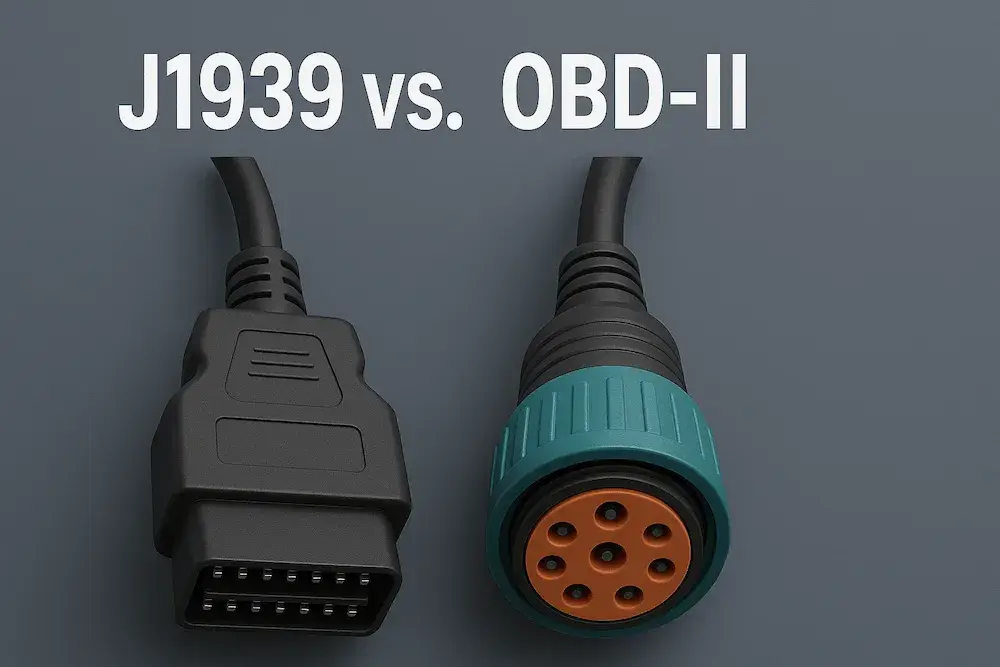
The SAE J1962 standard defines OBD-II's universal 16-pin connector, always within two feet of the steering wheel beneath the dashboard — that consistency is why a sub-$50 consumer code reader works on any compliant vehicle, while professional tools add manufacturer-enhanced access beyond the mandated basics.
J1939 connectors vary more: a 9-pin Deutsch connector is common, but some trucks use 6-pin configurations or integrate the port into the dashboard or instrument cluster. Shops working mixed fleets end up carrying multiple adapter cables as a result.
Professional J1939 equipment needs a comprehensive Parameter Group Number library to decode the message volume correctly, and price runs from several hundred to several thousand dollars depending on capability.
Dual-protocol tools — 16-pin OBD-II and 9-pin J1939 connectivity in one device, with software for both message structures — increasingly bridge the gap for shops and mobile technicians who don't want to carry two separate platforms. When evaluating one, weigh update frequency, brand coverage depth, and whether it supports the bidirectional controls (forced DPF regen, injector coding) that basic code reading doesn't touch.
HDJ's evaluation of Noregon JPRO covers one widely-used professional-tier option in that category — heavydutyjournal.com applies the same evaluation criteria to every diagnostic tool it reviews, dual-protocol or not.
Technician Training and Certification Considerations
OBD-II diagnostics are standard curriculum at community colleges and trade schools, and ASE's Engine Performance certification tests directly on it — that accessibility means an independent shop can hire a technician with foundational OBD-II knowledge and build from there, with generic scan-tool proficiency transferring across brands. Consumer familiarity has grown too: plenty of vehicle owners now arrive having already pulled their own code, which changes the diagnostic conversation before it starts.
J1939 expertise takes real specialized training — air brake networks, electronic engine controls, aftertreatment, transmission communication, and the inter-system dependencies across a multi-ECU network all take deeper study than passenger-car diagnostics ever required. Freightliner, Peterbilt, and Kenworth all run their own certification programs covering proprietary procedures, and that specialization is exactly why heavy-duty technicians command higher pay. Beyond scan-tool operation, real proficiency means understanding J1939's message structure well enough to trace an unfamiliar fault across the network rather than just treating each individual code in isolation.
Regulatory knowledge belongs in the same training bucket: technicians need to understand FMCSA inspection and maintenance regulations alongside CARB's heavy-duty OBD requirements for Class 6-8 vehicles operating in California, including which fault codes create an out-of-service condition and what documentation a fleet needs to prove compliance.
Budget for both sides of this when a shop expands into commercial vehicle service: J1939-capable tools run from several hundred to several thousand dollars depending on capability, and manufacturer certification programs typically require multiple days of initial training plus ongoing recertification as protocols and OEM software evolve. Many shops find the faster path is hiring a technician with existing heavy-duty background and then layering brand-specific certifications on top, rather than training someone up from a pure light-duty background.
Frequently Asked Questions
Can a standard OBD-II scan tool read J1939 data?
No — different connectors, message formats, and addressing schemes. Some professional-grade tools now offer dual-protocol support with both connector types built in, but a basic OBD-II reader has no path into a J1939 network at all.
Why do commercial trucks use J1939 instead of OBD-II?
A Class 8 truck's 30+ ECUs need continuous real-time coordination that OBD-II's request-response model can't support. J1939's broadcast architecture enables that coordination plus the telematics and predictive-maintenance applications commercial operations depend on.
What's the difference between OBD-II and J1939 fault codes?
OBD-II uses alphanumeric codes (P0301 = cylinder 1 misfire); J1939 pairs an SPN (which component) with an FMI (what kind of failure) for more granular identification. See the Technical Architecture section above for a full comparison.
Are heavy-duty trucks required to have OBD-II compliance?
No — commercial trucks follow Heavy-Duty OBD (HD-OBD) requirements from EPA and CARB instead, implemented through J1939-based systems rather than passenger-car OBD-II architecture. California's Clean Truck Check program adds periodic OBD testing for 2013-and-newer diesel engines.
What does this mean for fleet managers running mixed vehicles?
Dual-protocol diagnostic capability, not a single tool stretched across both — separate hardware, likely separate telematics feeds, and technicians trained in both systems. See the Tool Requirements section above for what a dual-protocol setup actually looks like.
Neither protocol will replace the other — OBD-II brought standardized transparency to passenger-vehicle emissions compliance, and J1939 built the comprehensive architecture that makes modern commercial fleet management possible. The equipment purchases, training investments, and maintenance workflows all flow from understanding which one applies to which vehicle in front of you.
Get that decision right on day one, and the rest of the diagnostic process — the tool you reach for, the guide you check, the technician you assign — follows naturally instead of turning into a second round of guesswork.
Help Fellow Fleet Professionals
Share this comparison with a colleague managing a mixed vehicle population — it settles the tool and training question before the wrong purchase gets made.