
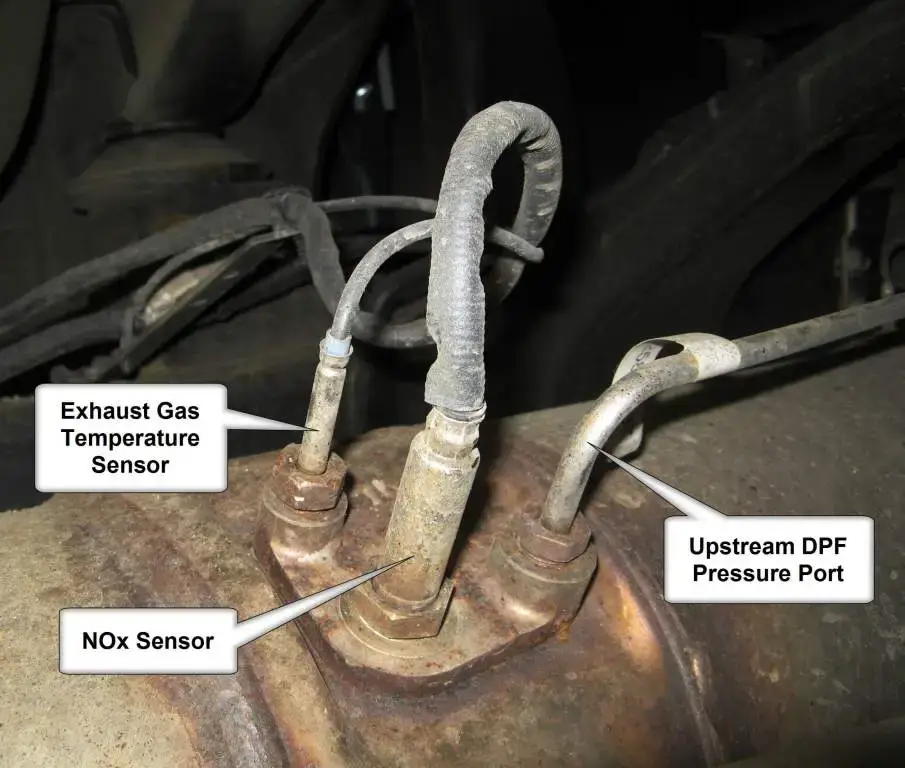
By Michael Nielsen, Editor & Publisher | 15+ Years in Diesel Repair
Last Updated: December 2025
📖 Estimated reading time: 22 minutes
NOx sensor failures rank among the most frustrating emissions system problems facing diesel technicians and fleet managers today. These sophisticated monitoring components serve as the eyes of your Selective Catalytic Reduction system, measuring nitrogen oxide levels in real-time and enabling precise DEF dosing for emissions compliance. When they fail, the consequences hit fast—check engine lights, power derates, and potential limp mode conditions that strand trucks and devastate uptime.
This comprehensive guide covers everything diesel professionals need for successful NOx sensor troubleshooting, from interpreting diagnostic trouble codes to hands-on testing procedures and complete replacement workflows. We focus on the platforms you work with daily: Ford Power Stroke, Dodge Cummins, and GM Duramax engines. Whether you’re diagnosing an intermittent P2200 code or performing a complete sensor replacement, you’ll find the actionable guidance that experienced technicians rely on.
Key Takeaways
- Dual-sensor configuration: Modern diesel engines use upstream and downstream NOx sensors to monitor SCR catalyst efficiency—expect 90-95% NOx reduction between readings.
- Progressive derate system: Unaddressed NOx sensor faults trigger escalating restrictions, from warning lights to 5 mph speed limits and no-restart conditions.
- Root cause matters: Contamination from oil consumption, fuel quality issues, or DEF system malfunctions often destroys replacement sensors—diagnose before replacing.
- Proper relearn is mandatory: New sensors require manufacturer-specific ECU relearn procedures to establish communication and prevent persistent fault codes.
- Torque specifications are critical: Over-tightening cracks exhaust bungs while under-tightening causes leaks—follow OEM specs (typically 48-55 Nm).
How NOx Sensors Work in Modern Diesel Engines
NOx sensors function as precision instruments within the Selective Catalytic Reduction system, continuously measuring nitrogen oxide concentrations in the exhaust stream. The Engine Control Module relies on this data to calculate exact diesel exhaust fluid dosing requirements, optimizing both emissions compliance and fuel economy. When functioning correctly, the SCR system achieves 90-95% NOx reduction in treated exhaust gases.
Modern diesel vehicles employ a dual-sensor configuration positioned at strategic locations in the exhaust path. The upstream sensor (inlet or pre-SCR) measures raw nitrogen oxide levels before treatment, providing baseline data about combustion efficiency and engine operating conditions. The downstream sensor (outlet or post-SCR) monitors treated exhaust gases after they pass through the catalytic converter, enabling the ECU to calculate actual conversion efficiency.
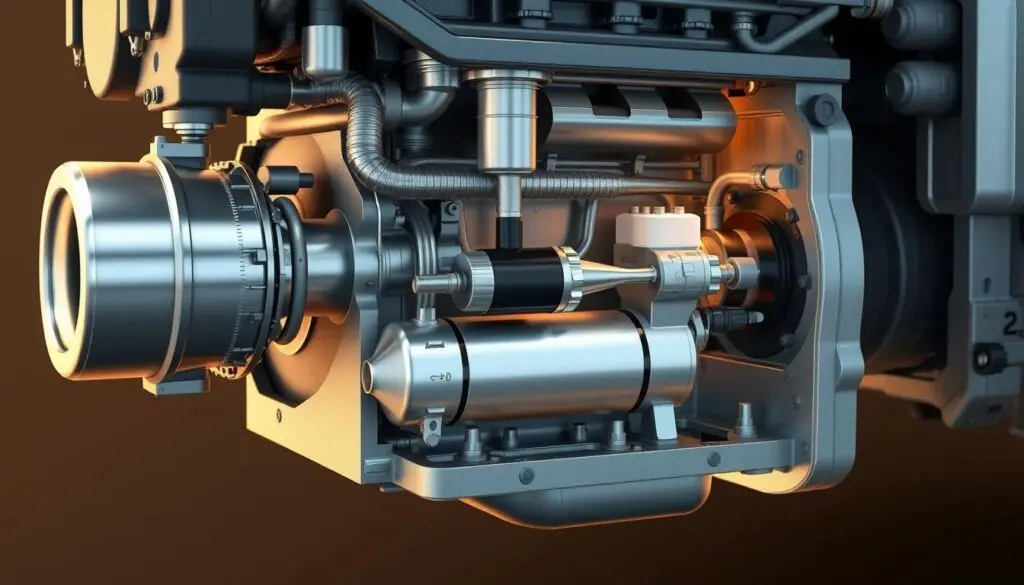
These sensor positions cannot be interchanged randomly. Each sensor contains an embedded control module with a unique CAN identification number corresponding to its specific location. Swapping sensors without proper reprogramming triggers communication errors and inaccurate readings that defeat the purpose of replacement.
Communication Protocols and Operating Requirements
NOx sensors communicate with the ECM through sophisticated digital protocols, typically the DL7 J1939-7 data link standard used in heavy-duty diesel applications. This CAN bus network allows multiple components to share information simultaneously on a single communication line, with each sensor’s unique identifier ensuring correct data interpretation.
Operating conditions significantly affect sensor accuracy. Exhaust temperatures must typically exceed 400°F before sensors activate and provide reliable measurements. The exhaust stream must also be free of moisture that could interfere with the sensing element. These requirements explain delayed sensor response during cold starts and why short-trip driving patterns can trigger temporary error codes.
Recognizing NOx Sensor Failure Symptoms
A failing NOx sensor produces multiple observable symptoms ranging from dashboard warnings to severe operational restrictions. Modern diesel engines depend on these sensors to regulate emissions and maintain performance standards, so malfunctions communicate through various alerts and measurable performance changes.
Dashboard Warnings and Alert Progression
The most immediate indicator appears on the instrument cluster—the check engine light activates when the ECU detects sensor circuit faults or implausible readings. Modern diesel vehicles provide specific text messages alongside illuminated warning lights, including alerts like “Exhaust System Fault,” “NOx Sensor Malfunction,” or “Emissions System Service Required.”
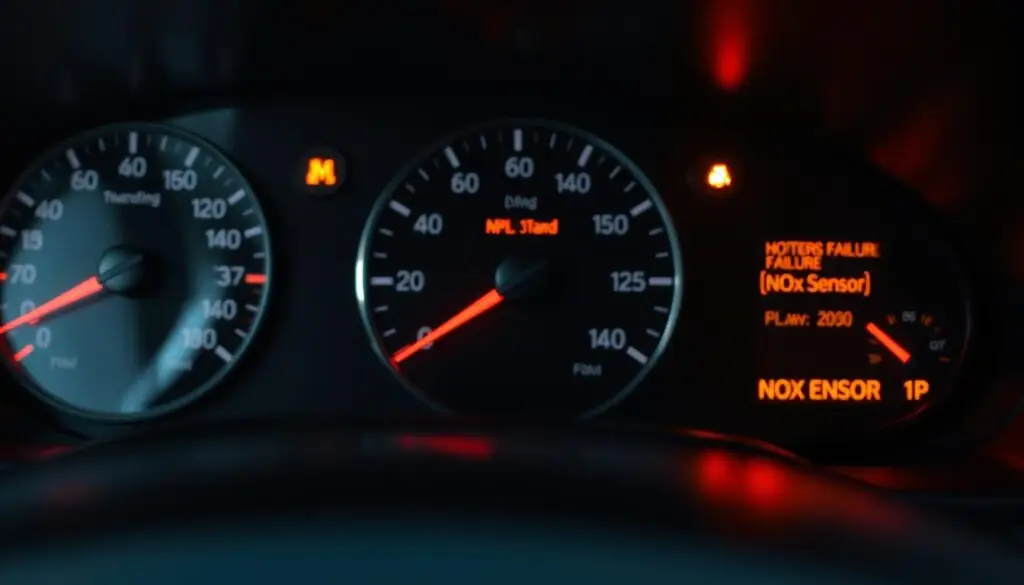
The warning system escalates through multiple stages as problems persist. Initial amber warnings provide advance notice of developing issues. If operators ignore these alerts, the system progresses to red warnings indicating immediate service requirements. Diagnostic trouble codes store in ECU memory even if warning lights temporarily clear.
Performance Degradation and Fuel Economy Impact
Failed NOx sensors trigger protective strategies that directly impact performance. The ECU cannot optimize combustion parameters without accurate exhaust feedback, forcing conservative fuel mapping that sacrifices power for emissions compliance. Throttle response becomes sluggish, vehicles struggle on inclines, and turbocharger boost limits reduce available power across the RPM range.
Fuel economy typically deteriorates by 10-15% above established baseline when NOx sensors fail. The engine management system defaults to richer fuel mixtures that waste fuel, while DEF consumption rises as the SCR system over-injects fluid without sensor guidance. Fleet operators notice these changes quickly through tracking systems, while individual owners observe reduced miles per tank.
DEF System Cascading Failures
The diesel exhaust fluid system relies heavily on NOx sensor feedback to regulate injection rates. When sensors fail, DEF system errors cascade throughout the emissions control network. Common warnings include “DEF Quality Poor” messages even with fresh fluid, incorrect DEF level readings, and excessive consumption leading to crystallization around injector nozzles and potential injector clogging.
Vehicle Entering Limp Mode
The most severe consequence involves limp mode activation—a derate strategy representing the final stage of emissions system protection mandated by EPA regulations. When vehicles enter limp mode, operational capabilities become severely restricted.
Initial derate warnings appear as countdown timers—messages like “Speed Will Be Limited in 50 Miles” provide advance notice. Once engaged, speed restrictions typically limit operation to 5 mph, making highway travel impossible. Some vehicles implement “no restart” conditions that strand trucks until repairs are completed.
⚠️ Safety Warning
Never ignore progressive derate warnings. Limp mode can activate unexpectedly in traffic, creating dangerous situations. Address NOx sensor faults promptly to avoid being stranded with severely restricted vehicle operation.
What Causes NOx Sensor Failures
Understanding what damages NOx sensors enables technicians to identify root causes and implement lasting solutions. These precision instruments face extreme operating conditions daily, with multiple degradation factors working simultaneously to compromise accuracy and shorten service life.
Contamination Sources
NOx sensor contamination represents the leading cause of premature failure in diesel applications. Carbon deposits accumulate on the ceramic sensing element when vehicles operate primarily in short-trip cycles that prevent exhaust systems from reaching temperatures necessary for passive regeneration.
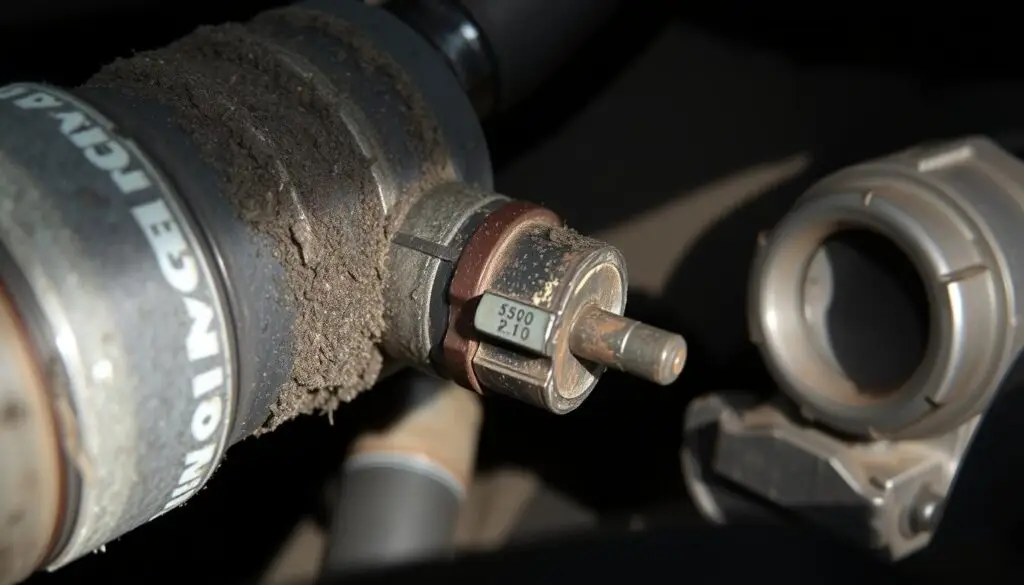
High oil consumption accelerates contamination significantly. Worn piston rings, failing turbocharger seals, and degraded valve guides introduce hydrocarbon contamination into the exhaust stream that coats sensor surfaces and creates insulating barriers. DEF system malfunctions add another contamination layer through urea crystal formation that physically obstructs sensor openings.
Fuel quality issues compound these problems. High sulfur content in off-road diesel or contaminated fuel accelerates sensor poisoning through chemical reactions. Sulfur compounds bind with sensor materials and permanently alter their electrical properties—damage that cannot be reversed through cleaning.
Thermal Stress and Electrical Issues
Extreme temperature exposure creates significant damage over time. Modern sensors routinely face temperatures exceeding 1,200°F during normal operation, causing micro-cracking in ceramic sensing elements. DPF regeneration cycles subject sensors to particularly severe thermal shocks, with temperatures spiking hundreds of degrees within seconds.
Electrical connection failures account for a substantial percentage of reported problems. Connector pins corrode when exposed to moisture and road chemicals, particularly in salt-belt environments. Wiring harness damage occurs when cables route too close to hot exhaust components, degrading insulation and causing short circuits.
Age-Related Degradation
Natural aging affects all NOx sensors regardless of operating conditions or maintenance quality. Typical sensors achieve service lives between 150,000 and 200,000 miles under normal conditions. The zirconia or alumina sensing elements gradually lose measurement sensitivity as their crystalline structure changes through diffusion processes at the molecular level.
Diagnostic Trouble Codes for NOx Sensor Issues
Modern diesel engines generate specific fault codes that pinpoint the exact nature of NOx sensor failures. These codes follow standardized OBD-II protocols while incorporating manufacturer-specific variations, and understanding them enables accurate diagnosis without unnecessary parts replacement.
Bank 1 (Upstream) Sensor Codes
The P2BAE code indicates an open circuit in the Bank 1 NOx sensor heater element, preventing the sensor from reaching optimal operating temperature between 1,400°F and 1,600°F. P2BAF signals a short circuit in the same heater system. Testing requires measuring resistance between specific pins on the sensor connector, with normal values ranging from 2 to 8 ohms depending on temperature.
Additional Bank 1 codes requiring attention include P2200-13 (circuit open), P2203-00 (signal voltage high above 4.8V), P2206-00 (heater control voltage low), P2208-00 (heater sense malfunction), P220E-93 (heater range/performance issue), and P22FB-92 (performance degradation).
Bank 2 (Downstream) Sensor Codes
The P229E trouble code represents an open circuit in the Bank 2 NOx sensor, which monitors emissions after SCR treatment. P229F addresses problems with the sensor’s exhaust gas sampling chamber. Bank 2 codes requiring replacement include P220F-93 (incorrect baseline), P22A1-00 (signal high), P22A3-13 (heater circuit open), P22A4-00 (heater circuit low), P22A6-00 (heater sense failure), and P22FE-00 (sensing element deterioration).
Performance and Communication Codes
The P2200 fault code identifies performance issues distinct from electrical failures—appearing when the sensor communicates properly but provides implausible data. P2201 indicates the sensor signal remains static despite changing engine loads, while P2202 signals insufficient differential between upstream and downstream sensors (should show 90% reduction).
| Manufacturer | Proprietary Code | Standard Equivalent | Specific Meaning |
|---|---|---|---|
| Ford Power Stroke | P20EE | P2200 series | SCR catalyst efficiency low with NOx sensor correlation |
| Dodge Cummins | P2BAD | P2201 | Bank 1 sensor rationality with soot loading calculation |
| GM Duramax | P24B2 | P2206 | Heater performance with cold start compensation |
| Ford Power Stroke | P2BAB | P229E | Bank 2 sensor range with altitude correction |
Communication codes like U029D-00 (lost communication with sensor A) and U029E-00 (sensor B communication loss) indicate wiring or module issues rather than sensor failures. Supply voltage codes like P220A-1C and P220B-1C point to problems in the vehicle’s electrical system—low battery voltage or corroded ground connections.
Pre-Diagnostic Safety Procedures
NOx sensors operate in one of the most hazardous environments within modern diesel powertrains. Only trained, qualified personnel should perform installation and diagnostic procedures, and proper preparation protects both technicians and vehicle systems from preventable damage.

⚠️ Safety Warning
Exhaust systems must cool for at least one hour after engine shutdown before initiating sensor work. Surface temperatures can exceed 300°F even after 30 minutes. Use an infrared thermometer to verify temperatures below 150°F before proceeding.
Essential Protective Equipment
Heat-resistant gloves rated for temperatures up to 500°F are mandatory when handling exhaust components—standard mechanic gloves provide insufficient protection. Safety glasses with side shields protect against falling debris, while half-face respirators with P100 cartridges filter residual soot and particulates during extended exhaust system work.
Additional requirements include jack stands rated for vehicle weight (never rely solely on hydraulic jacks), wheel chocks on both front and rear wheels, high-intensity work lights for confined undercarriage spaces, and a Class B/C fire extinguisher within immediate reach.
Battery Disconnection Protocol
Always disconnect the negative battery terminal first to eliminate ground connections before removing positive cables—this sequence prevents accidental short circuits. Wait at least 10 minutes for capacitor discharge in control modules before proceeding, as this waiting period allows residual electrical charge to dissipate from sensitive components.
Document radio security codes and seat position settings before disconnection. Some diesel platforms require specific battery disconnect durations to clear adaptive parameters—consult manufacturer service information for vehicle-specific requirements.
Stay Current on Emissions System Service
EPA regulations and OEM diagnostic procedures evolve constantly. Get weekly technical updates delivered directly to your inbox.
NOx Sensor Testing Procedures
Successful diagnosis relies on structured testing methods that range from simple visual checks to complex electrical measurements. Professional technicians begin with non-invasive scan tool diagnostics before moving to hands-on inspection and electrical verification.
Scan Tool Diagnostics and Live Data Analysis
Professional-grade diagnostic equipment such as Snap-on Solus, Autel MaxiSys, or manufacturer-specific tools like Ford IDS, Chrysler StarMobile, and GM Tech2 access real-time data streams directly from the ECU. These tools display instantaneous NOx readings in parts per million alongside sensor heating element status and communication integrity indicators.

Upstream sensors typically read between 200-800 ppm during normal operation under moderate load. Downstream sensors should demonstrate 90-95% reduction, displaying readings between 20-80 ppm when the emissions system functions correctly. SCR catalyst temperature readings should stabilize between 400-600°F during active regeneration cycles.
Freeze frame data captured when DTCs set provides invaluable diagnostic context—this snapshot includes engine temperature, vehicle speed, load percentage, and DEF quality status at the precise moment of failure. Analyzing these conditions helps distinguish between sensor malfunctions and temporary irregularities.
Visual and Electrical Inspection
Sensor housing examination begins with checking for physical damage including cracks in the protective stainless steel tube, evidence of impact from road debris, or exhaust system contact marks. Wiring harness inspection requires attention to abrasion damage near frame members, heat damage appearing as discolored or brittle insulation, and connector corrosion indicating moisture intrusion.
For electrical testing, digital multimeters with min/max recording capture voltage fluctuations during engine operation. Most NOx sensors require 12V constant power and a 5V reference signal. Ground circuit resistance between sensor pins and chassis should measure less than 0.5 ohms. Functional sensor heaters draw between 0.8-2.5 amps during warm-up.
| Circuit Type | Test Parameter | Acceptable Range | Test Condition |
|---|---|---|---|
| Power Supply | Battery Voltage | 11.5-14.5V | Ignition On, Engine Off |
| Reference Voltage | ECU Reference | 4.8-5.2V | Ignition On, Engine Off |
| Ground Circuit | Resistance to Ground | Less than 0.5 Ohms | Ignition Off |
| CAN Bus | High/Low Resistance | 55-65 Ohms | Ignition Off, Connectors Attached |
| Heater Element | Resistance (Cold) | 4-8 Ohms | Ambient Temperature |
Interpreting Test Results
When voltage and ground circuits test within specifications but CAN communication fails completely, the sensor module contains internal electronic failures requiring replacement. Conversely, when all electrical testing parameters measure outside acceptable ranges simultaneously, harness damage or connector corrosion represents the most probable cause.
Comparing upstream and downstream sensor readings provides insight into overall SCR system efficiency. When both sensors operate correctly but fail to show expected 90-95% NOx reduction, the SCR catalyst itself may have deteriorated or DEF system problems prevent proper chemical reactions—a diagnostic distinction that prevents misdiagnosis.
The HDJ Perspective
The evolution of NOx sensor technology reflects the broader sophistication of emissions control systems—and the diagnostic complexity that comes with it. In practice, most experienced technicians we speak with emphasize that root cause analysis before sensor replacement pays dividends. The $400-600 cost of a quality OEM sensor stings far worse when contamination from an unaddressed oil leak destroys the new unit within 30,000 miles. Fleet operations running late-model diesel equipment should consider adding NOx sensor data trending to their preventive maintenance protocols. Early detection of drift patterns often catches developing problems before they trigger derates, preserving uptime and avoiding the cascade of emergency repairs that follow limp mode events.
Tools and Equipment for NOx Sensor Replacement
Having the correct tools prevents delays and protects expensive components from damage. NOx sensor work demands specialized equipment designed for the unique challenges these sensors present.

Mechanical Tools
NOx sensors require deep-well sockets ranging from 22mm to 27mm depending on manufacturer and application. Six-point sockets are essential—they provide better grip than twelve-point designs and minimize risk of rounding sensor hexes on corroded components. Offset wrenches and crowfoot-style adapters handle sensors mounted in confined spaces.
Torque wrenches capable of accurate readings between 30-60 Nm are mandatory for proper installation. Most manufacturers specify exactly 50 Nm (37 lb-ft), and following these specifications prevents over-tightening that damages threads or under-tightening that causes exhaust leaks.
Diagnostic and Programming Equipment
Basic code readers fall short for this work. Professional-grade scan tools with bi-directional control capabilities enable technicians to perform sensor activation tests, heater element verification, and adaptation procedures that register new sensor identification numbers to the ECU. Without proper tools, post-installation relearn procedures remain impossible.
OEM vs. Aftermarket Sensor Selection
Original equipment sensors guarantee exact fit, proper calibration, and complete warranty protection at $300-600 each. Quality aftermarket alternatives from Bosch, Delphi, NGK, and Continental offer comparable performance at $150-350, though some require additional programming steps.
| Factor | OEM Sensors | Quality Aftermarket |
|---|---|---|
| Price Range | $300-$600 | $150-$350 |
| Warranty Coverage | Full manufacturer backing | Limited (1-2 years) |
| Programming Needs | Plug-and-play | May need adaptation |
| Expected Lifespan | 100,000+ miles | 80,000-100,000 miles |
Avoid ultra-cheap imported sensors lacking proper certifications—these products may trigger persistent codes or fail within months. Vehicles under factory or emissions warranty coverage require OEM sensors to maintain warranty validity. One critical consideration: never cut sensor wiring harnesses, as sensors must remain complete for return programs and proper disposal.
Step-by-Step NOx Sensor Replacement
Successful replacement begins with correctly identifying sensor locations on your specific platform. Each manufacturer positions sensors differently based on exhaust routing and chassis design.
Locating Sensors by Platform
On Cummins 6.7L ISB engines in Ram trucks, the upstream sensor mounts approximately 18 inches past the turbocharger outlet—access from underneath with the sensor pointing downward. The downstream sensor positions after the SCR catalyst near the rear axle on the passenger side; removing the inner fender liner provides best access.
Duramax 6.6L engines mount both sensors on the driver’s side. The upstream sensor locates between the turbocharger outlet and DPF, approximately 12 inches from the turbo flange. Downstream sensor access sometimes requires raising the transmission crossmember slightly for wrench clearance.
Ford Power Stroke engines position the upstream sensor between turbocharger and DPF on the passenger side in vertical orientation. The downstream sensor locates after the SCR catalyst, also on the passenger side—accessing it often requires removing the DEF tank skid plate (four 15mm bolts).
Removal and Installation Process
Disconnect electrical connectors by pressing or sliding lock mechanisms—never pull on wires. Three common connector types exist: slide locks, push-tab locks, and rotating collar locks. Inspect connector pins during disconnection for corrosion indicating moisture intrusion.
Position your wrench for maximum leverage and apply firm, steady pressure without impact tools that can shatter internal components. Rotate counterclockwise using smooth, continuous motion. For seized sensors, apply penetrating oil 24 hours before removal and consider heat application using an induction heater.
Clean exhaust bung threads thoroughly before installing the new sensor. Use wire brushes and thread chasers rather than taps that remove base metal. New sensors come pre-coated with appropriate thread sealant—do not apply additional anti-seize compounds.
| Engine Platform | Torque Specification | Socket Size |
|---|---|---|
| Cummins 6.7L ISB | 50 Nm (37 lb-ft) | 22mm |
| Duramax 6.6L | 55 Nm (41 lb-ft) | 22mm |
| Ford Power Stroke 6.7L | 48 Nm (35 lb-ft) | 7/8 inch |
Use a calibrated torque wrench—over-tightening cracks exhaust bungs while under-tightening creates exhaust leaks. Route sensor wiring away from heat sources and secure cables using existing clips to prevent chafing.
Share Your Diesel Expertise
Are you a diesel technician or fleet manager with hard-won knowledge about emissions system diagnostics? HDJ readers value practical insights from working professionals.
Post-Replacement Calibration and Verification
Proper post-replacement calibration transforms a parts swap into a complete repair. After sensor installation, adaptation procedures using suitable diagnostic devices are necessary to register the new sensor with the ECU.
ECU Reset and Relearn Procedures
Use the scan tool to clear codes from all related modules simultaneously—engine control module, aftertreatment control module, and body control module. Clearing codes from multiple modules within a 30-second window prevents code migration between modules.
Ford Power Stroke systems require a parameter reset through the scan tool’s special functions menu, selecting “NOx Sensor Replacement” and following prompted steps including key cycling and idle periods. GM Duramax systems often require sensor adaptation plus a separate SCR system reset that reinitializes DEF dosing parameters. Ram Cummins systems may require sensor adaptation and a procedure to reset accumulated NOx mass calculations stored in ECU memory.
Road Testing and Data Verification
Comprehensive testing under real-world conditions verifies proper function. Plan a minimum 20-minute route incorporating low-speed urban driving, steady-state highway cruising at 55-65 mph, moderate acceleration, and loaded operation if applicable.
During the test drive, monitor for warning light activation, power limitations, unusual exhaust sounds indicating leaks, and normal DEF consumption. Post-drive, connect the scan tool and verify upstream sensors reading 200-800 ppm (varying with load), downstream sensors showing 20-80 ppm (90%+ conversion), sensor heater status ready within 2-5 minutes, and SCR catalyst temperature between 400-650°F during operation.
Sensors reading zero or maximum values constantly indicate electrical faults requiring additional repair. Excessive variation during steady-state operation points to contamination or intermittent connections.
Frequently Asked Questions
What is the typical lifespan of a NOx sensor in a diesel engine?
NOx sensors typically last between 150,000-200,000 miles under normal operating conditions, though actual lifespan varies based on driving patterns and maintenance. Fleet vehicles operating primarily on highways often exceed these ranges, while urban delivery vehicles with frequent short trips may require earlier replacement. Factors reducing sensor life include poor fuel quality, oil consumption issues, excessive idling, and incomplete DPF regeneration cycles. Using quality ultra-low sulfur diesel fuel, maintaining proper DEF quality, and ensuring complete regeneration cycles helps maximize longevity.
Can I drive my diesel truck with a failed NOx sensor?
While your truck may initially remain drivable, continuing operation with a failed sensor is not recommended and may become impossible. Initially, you’ll experience reduced performance, decreased fuel economy (typically 10-15% worse), and a check engine light. However, EPA-mandated regulations require progressive derate modes when emissions faults remain unaddressed. After predetermined time or mileage with an active fault, your vehicle may limit speed to 5 mph or completely disable restart capability after shutdown.
Why does my scan tool show NOx sensor codes even after replacement?
Persistent codes typically indicate incomplete relearn procedures, underlying problems beyond the sensor, or improper installation. Modern diesel vehicles require specific relearn procedures where the ECU registers the new sensor’s unique identification number and reinitializes system parameters. If root causes weren’t addressed—such as exhaust leaks, contaminated DEF, failing SCR catalyst, or damaged wiring—codes return even with a new sensor. Always verify proper torque, electrical connections, and complete manufacturer-specific relearn procedures.
How much does professional NOx sensor replacement cost?
Total replacement cost varies significantly based on sensor type, vehicle platform, and labor rates. OEM sensors cost $300-600 each, while quality aftermarket options range from $150-350. Professional labor adds $150-300 depending on sensor accessibility. Total single-sensor replacement typically ranges from $450-900 at professional facilities. Many diesel trucks have two sensors, potentially doubling costs if both require replacement. DIY replacement reduces costs but requires proper diagnostic equipment for post-installation relearn procedures.
Can contaminated DEF cause NOx sensor failure?
Yes, contaminated or degraded diesel exhaust fluid significantly contributes to sensor failure. When DEF quality degrades from age, contamination, or improper storage, the ECU over-injects fluid attempting to compensate, creating urea crystal deposits that physically obstruct sensor surfaces. Contaminated DEF may also contain impurities coating sensor elements. Always use fresh, quality DEF from reputable sources, store properly in sealed containers away from sunlight, and replace DEF stored more than one year. If contamination contributed to failure, flush the entire DEF system before installing new sensors.
Maintaining NOx Sensor Reliability
NOx sensor maintenance plays a vital role in keeping modern diesel engines running efficiently while maintaining emissions compliance. Regular preventive maintenance extends component life significantly—using quality ultra-low sulfur diesel fuel protects sensors from contamination, maintaining fresh DEF prevents crystallization, and addressing oil consumption issues early stops deposits from forming on sensor elements.
Professional technicians benefit from staying current with manufacturer diagnostic procedures as emissions systems evolve with each model year. Fleet operators should monitor DPF regeneration cycles, since complete regeneration prevents excessive soot buildup affecting sensor readings. Following the diagnostic procedures and replacement methods outlined in this guide helps maintain modern diesel technology at peak efficiency while avoiding the costly downtime that NOx sensor failures inevitably cause.
Help Your Network Stay Informed
Know a fleet manager or diesel tech who could use this NOx sensor troubleshooting guide? Share it with your professional network.