By Michael Nielsen, Editor & Publisher | 15+ Years in Diesel Repair
Last Updated: December 2025
📖 Estimated reading time: 18 minutes
Mobile service truck financing represents one of the most significant capital decisions service businesses face. Whether you operate an HVAC company, plumbing service, or mobile repair operation, acquiring a fully equipped work truck requires substantial investment—typically $50,000 to $130,000 for a properly upfitted unit. The choice between equipment loans and leasing arrangements carries implications for your cash flow, tax position, and operational flexibility that persist for years.
According to the Equipment Leasing and Finance Association, eight out of ten U.S. businesses use some form of equipment financing to acquire productive assets. Understanding the structural differences between loans and leases helps you select the financing method that aligns with your business goals, whether that’s building equity through ownership or preserving capital through lower monthly payments.
Key Takeaways
- Equipment loans build ownership equity with higher monthly payments but no restrictions on usage, mileage, or customization—ideal for businesses planning 7-10+ year vehicle lifecycles.
- Leasing offers lower monthly payments and easier equipment upgrades, but you don’t build equity and face potential mileage penalties and end-of-term adjustments.
- Section 179 deductions for 2025 allow businesses to deduct up to $2,500,000 in qualifying equipment costs, with commercial vehicles over 14,000 lbs potentially qualifying for full expensing.
- TRAC leases dominate commercial fleet financing because they offer payment flexibility with predetermined residual values and end-of-term purchase options.
- Qualification requirements vary significantly—traditional banks want 650+ credit scores, while alternative lenders may approve scores as low as 550 with compensating factors.
Understanding Mobile Service Truck Investment Requirements
A mobile service truck functions as a rolling workshop, integrating specialized equipment, organized tool storage, and power generation capabilities that enable technicians to perform professional services anywhere. These aren’t standard commercial vehicles—they require custom shelving systems, reinforced flooring, power generation, and industry-specific equipment that transforms basic transportation into a functional workspace.

The financial commitment extends well beyond the base vehicle purchase price. Base vehicle costs range from $35,000 to $80,000 depending on chassis size and manufacturer. Class 2 trucks under 10,000 lbs GVWR start around $35,000-$45,000, while heavy-duty Class 5 chassis (16,001-19,500 lbs GVWR) reach $65,000-$80,000 for new units.
Specialty vehicle customization adds substantially to total investment. Basic upfitting with shelving systems, partitions, and ladder racks begins at $15,000-$25,000. Intermediate packages incorporating compressors, generators, and specialized equipment storage run $25,000-$40,000. Advanced mobile workshop configurations with comprehensive equipment integration, custom fabrication, and hydraulic systems can exceed $50,000 in customization alone.
| Vehicle Class | Base Cost | Basic Upfit | Advanced Upfit | Total Range |
|---|---|---|---|---|
| Class 2 (Under 10,000 lbs) | $35,000–$45,000 | $15,000–$20,000 | $30,000–$40,000 | $50,000–$85,000 |
| Class 3-4 (10,001–16,000 lbs) | $50,000–$70,000 | $20,000–$30,000 | $35,000–$45,000 | $70,000–$115,000 |
| Class 5 (16,001–19,500 lbs) | $65,000–$80,000 | $25,000–$35,000 | $40,000–$50,000 | $90,000–$130,000 |
These combined costs explain why complete mobile service truck acquisitions frequently exceed $100,000 for fully operational units. Most service businesses cannot allocate this capital from operating reserves without compromising cash flow for payroll, inventory, and marketing—the practical reality that makes equipment financing essential.
Why Financing Makes Sense for Commercial Vehicle Acquisitions
Companies with sufficient capital to purchase mobile service trucks outright frequently choose financing instead. This reflects sophisticated financial management rather than capital scarcity. Working capital preservation enables your business to handle essential expenses without strain while maintaining liquidity for emergency repairs, strategic opportunities, and seasonal revenue fluctuations.
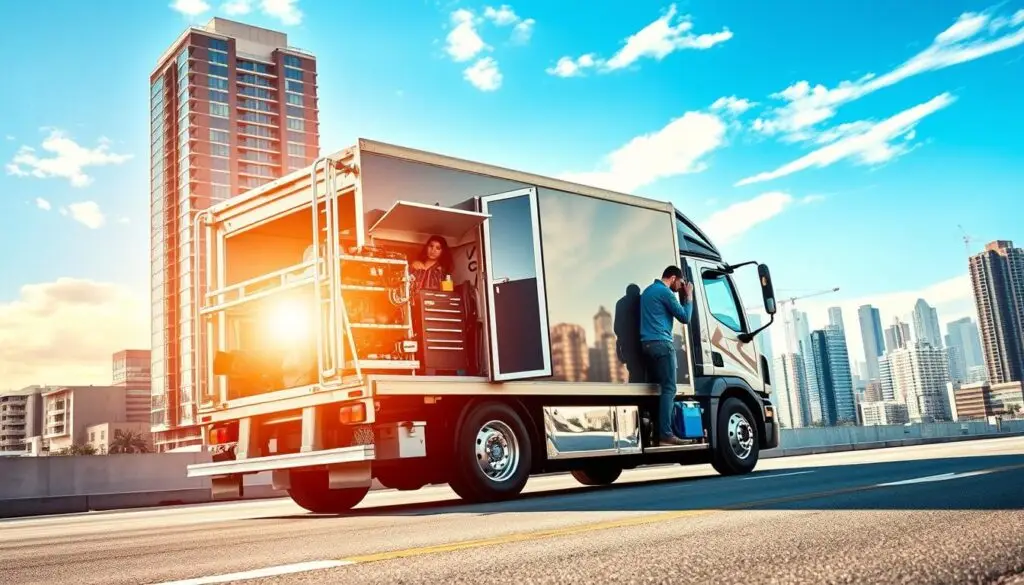
Cash flow management becomes significantly easier when equipment costs align with the revenue that equipment generates. Predictable monthly payments simplify budgeting and financial forecasting. Unlike variable operational costs, financing payments remain constant throughout the agreement term, enabling accurate cash flow projections months or years in advance.
8 out of 10
U.S. businesses use equipment leasing and financing to acquire productive assets, according to ELFA industry research
Tax Benefits of Equipment Financing
The tax advantages associated with mobile service truck financing deliver substantial financial benefits that cash purchases cannot replicate. Federal tax provisions specifically encourage business equipment investments through multiple deduction mechanisms.
Section 179 deductions allow businesses to deduct the full purchase price of qualifying equipment during the tax year of acquisition. For 2025, businesses can deduct up to $2,500,000 in equipment purchases, with the deduction phasing out dollar-for-dollar when total equipment purchases exceed $4,000,000. This immediate expense recognition can dramatically reduce taxable income.
Bonus depreciation provides additional tax advantages. Current provisions under the One Big Beautiful Bill Act (OBBBA) of 2025 allow businesses to claim 100% bonus depreciation on eligible equipment placed in service after January 19, 2025. This applies after Section 179 limits are reached, potentially allowing full first-year expensing of commercial vehicle costs.
The tax treatment differs between equipment loans and leases. With equipment loans, interest payments are fully deductible as business expenses while Section 179 and bonus depreciation apply to the equipment purchase. With operating leases, entire lease payments typically qualify as deductible business expenses, simplifying accounting and providing consistent annual deductions.
Equipment Loans: Building Ownership Equity
An equipment loan provides capital specifically for purchasing a mobile service truck, with your business taking immediate ownership upon acquisition. The loan amount is repaid over a predetermined period—typically three to seven years—with the truck serving as collateral. Once you complete all scheduled payments, you own the vehicle outright with no further financial obligations.
How Equipment Loans Work
The application process requires documentation of your business operations and financial health. Lenders evaluate factors including time in business, annual revenue, credit history, and existing debt obligations. Upon approval, funds typically disburse directly to the vehicle dealer or manufacturer.
Loan terms for mobile service trucks typically range from 36 to 84 months. Shorter terms mean higher monthly payments but less total interest paid over the loan’s life. The loan repayment structure you select should align with the vehicle’s expected useful life—most lenders structure terms to ensure the vehicle retains value throughout repayment.
Interest rates on secured equipment loans typically range from 5% to 25% depending on multiple factors. Your business credit score serves as the primary determinant, with several additional factors influencing your rate: down payment amount, loan term length, business financial strength, and industry risk factors.
Advantages of Equipment Loans
The most significant ownership advantage emerges when you make your final payment—you gain full, unencumbered ownership of the mobile service truck with no additional obligations. This asset remains on your balance sheet as valuable business property you can use indefinitely, sell to recover value, or trade toward upgraded equipment on your preferred timeline.
Complete operational flexibility distinguishes ownership from leasing. Equipment loans impose no restrictions on mileage, operating hours, route patterns, or usage intensity. Your mobile service truck can accumulate unlimited miles responding to customer calls without penalty fees. You can modify, customize, rebrand, or upgrade the vehicle whenever business needs dictate.
Section 179 deductions apply specifically because you’re purchasing the asset. A mobile service truck purchased for $85,000 through an equipment loan can potentially be deducted entirely against your business income for that tax year. At a 25% effective tax rate, this creates approximately $21,250 in tax savings that directly offset financing costs.
Disadvantages to Consider
Equipment loan payments typically run 15-30% higher than comparable lease payments for identical vehicles. This difference reflects the equity-building component and ownership transfer occurring with each payment. For a $75,000 mobile service truck, a loan might require monthly payments of $1,450 versus $1,050 for a lease with similar terms—that $400 monthly difference demands stronger cash flow.
Ownership transfers all maintenance costs, repair expenses, and technological obsolescence risks to your business. A mobile service truck requires regular maintenance, unexpected repairs, and eventual major component replacements. These costs accumulate throughout ownership and can reach $8,000-$15,000 annually for comprehensive service programs on older vehicles.
Stay Current on Fleet Financing Strategies
Equipment financing regulations and tax provisions change annually. Get practical guidance on maximizing your commercial vehicle investments delivered to your inbox.
Equipment Leasing: Preserving Capital and Flexibility
Equipment leasing operates differently from direct purchase financing. A leasing company acquires the mobile service truck and allows your business to use it for a specified period in exchange for regular payments. The leasing company retains legal ownership throughout the lease term, with various end-of-term options available.
TRAC Leases: The Commercial Fleet Standard
A TRAC (Terminal Rental Adjustment Clause) lease has become the primary lease type for commercial vehicles in North America. With a TRAC lease, you and the lessor agree on a residual value at lease origination. You can select the depreciation factor used to amortize the capitalized cost, with various factors available for different vehicles based on specifications and utilization.
At lease end, the vehicle is sold and proceeds are applied to the book value (capitalized cost minus accumulated depreciation). Any resulting gain passes to the lessee. If the vehicle sells for more than the residual, you receive the excess. If it sells for less, you pay the difference—though split TRAC leases can cap your downside exposure.
TRAC leases offer several structural advantages: lease payments are typically lower than loan payments since you’re paying for depreciation rather than full ownership; payments may be fully tax-deductible as operating expenses; and the structure can provide off-balance-sheet treatment for accounting purposes, though recent accounting standards have modified this benefit.
FMV Leases: Walking Away Clean
Fair Market Value (FMV) leases base end-of-term options on the vehicle’s actual market value at lease conclusion rather than a predetermined residual. At termination, you can return the vehicle with no further obligation (assuming you’ve met mileage and condition requirements), purchase at fair market value, or extend the lease.
FMV leases typically offer the lowest monthly payments because they exclude residual value risk from your obligations. However, you have no equity buildup and face potential excess wear and mileage charges at return. These leases work well for businesses that prioritize payment minimization and plan to upgrade equipment regularly.
Advantages of Equipment Leasing
Leasing typically requires minimal or no down payment compared to equipment loans that often demand 10-20% upfront. A $75,000 mobile service truck might require $15,000 down with a traditional loan but could be leased with $2,000 or less at signing. This capital preservation proves valuable for businesses with limited cash reserves or those preferring to deploy capital elsewhere.
Lease structures facilitate regular equipment replacement cycles that keep your fleet modern. When your lease term ends, you can transition to a newer model with updated technology without the complexity of selling used trucks and negotiating new purchases. Maintaining a modern fleet projects a professional image and ensures access to the latest efficiency features.
Disadvantages of Equipment Leasing
Lease payments purchase use rights rather than ownership—your business builds no asset value throughout the lease term. When the lease ends, you must either return the equipment, purchase it separately, or enter a new agreement to maintain access. Over extended periods, businesses that lease continuously may spend significantly more than if they had financed and owned equipment.
Lease agreements include restrictions that can create unexpected costs. Common limitations include mileage caps with excess charges of $0.15-$0.35 per mile, usage restrictions specifying approved business activities, early termination penalties that can cost thousands of dollars, and excessive wear charges assessed at lease end. High-mileage operations accumulating 30,000+ miles annually often find these limitations problematic.
Comparing Loans vs Leasing: Making the Right Choice
The total cost analysis reveals significant differences between purchasing and leasing over extended periods. When businesses plan to use equipment for seven to ten years, purchasing through equipment loans typically costs 20-35% less than serial leasing. A $60,000 mobile service truck purchased with a five-year loan generates ownership of an asset potentially worth $18,000-$24,000 at term end—residual value that leasing customers never capture.
However, the financial picture changes over shorter timeframes. Businesses planning three to five year equipment lifecycles find the cost difference narrows considerably. Monthly payment differences create immediate cash flow implications—a $60,000 truck financed through a five-year loan at 8% interest requires approximately $1,216 monthly, while the same truck leased under an FMV arrangement typically requires $950-$1,050.
| Factor | Equipment Loan | Equipment Lease |
|---|---|---|
| Ownership | Immediate ownership; full title at payoff | Lessor retains ownership; purchase option at end |
| Monthly Payments | 15-30% higher; builds equity | Lower payments; no equity buildup |
| Down Payment | Typically 10-20% required | Often minimal or none required |
| Usage Restrictions | None—unlimited mileage and modifications | Mileage caps; wear standards; modification limits |
| Tax Treatment | Section 179 + bonus depreciation; interest deductible | Full payment deductible as operating expense |
| End-of-Term | Own free and clear; sell or keep using | Return, purchase, or extend; potential adjustments |
| Best For | Long-term use (7-10+ years); high mileage; extensive customization | Regular upgrades (3-5 years); capital preservation; lower mileage |
The HDJ Perspective
In our experience, the loan vs lease debate often gets oversimplified. The right answer depends heavily on your specific operation. Mobile service businesses with extensive customization needs—crane installations, hydraulic systems, specialized tool storage—almost always benefit from ownership because those investments don’t transfer to leased equipment you’ll eventually return. Conversely, operations in rapidly evolving industries where technology obsolescence matters may find leasing’s upgrade flexibility worth the premium. The most successful fleet operators we’ve observed match their financing structure to their actual equipment lifecycle rather than defaulting to familiar patterns.
Qualification Requirements for Commercial Vehicle Financing
Lenders evaluate several key factors when determining approval and terms for mobile service truck financing. Understanding these requirements helps business owners prepare applications effectively and select appropriate lenders.
Credit Score Requirements
Your business and personal credit scores play central roles in financing decisions. Conventional equipment loans generally require personal credit scores of 650-680 or higher for approval with competitive rates. Equipment leases often approve applicants with scores as low as 600, while specialized programs may accommodate scores in the 550-600 range with compensating factors.
Higher credit profiles unlock significantly better terms. Borrowers with scores above 720 typically access interest rates between 5-8%. Mid-range scores (650-720) face moderate rates of 8-15%. Lower scores below 650 encounter rates between 15-25% or may require alternative lenders and larger down payments.
Business History and Documentation
Most conventional lenders require businesses to have operated for at least two years with annual revenues of $250,000 or more. This operational history demonstrates viability and repayment capacity. Established businesses with five or more years of operation and strong revenue typically access the best terms.
Required documentation typically includes business tax returns for the past two years, current profit and loss statements and balance sheets, valid business licenses and registrations, bank statements covering three to six months, equipment specifications and quotes, and personal financial statements for guarantors.
Share Your Fleet Financing Experience
Have you navigated equipment loans or leasing for your service fleet? HDJ readers benefit from real-world perspectives on what worked—and what didn’t.
Navigating the Application and Approval Process
The pathway from application submission to equipment funding requires strategic preparation. Obtaining multiple quotes creates competitive leverage—when lenders know you’re comparing offers, they often improve terms to secure your business.
Choosing Between Lender Types
Traditional banks typically offer the most competitive interest rates, generally ranging from 5-10% for qualified borrowers. However, they maintain stricter qualification requirements and longer approval timelines of 5-10 business days. These institutions conduct thorough financial analysis and may require multiple rounds of documentation.
Alternative lenders and specialized equipment finance companies offer greater flexibility for newer businesses or those with credit challenges. They often approve applications with lower credit scores and shorter business histories, with decisions typically within 24-72 hours. The trade-off involves higher interest rates of 10-20% depending on risk factors.
Manufacturer and dealer financing programs offer convenient point-of-sale financing with streamlined approval processes. These captive finance companies sometimes feature promotional rates during sales events. However, manufacturer financing should be compared against independent sources to ensure competitive terms.
Negotiating Better Terms
Interest rates represent the most obvious negotiation point. Businesses with strong credit profiles, established operating histories, and substantial down payments hold the strongest positions. Even a 1-2% reduction in interest rate creates significant savings over a multi-year term.
Origination fees and administrative charges also deserve attention. Some lenders charge fees of 1-5% of the financed amount—request reductions or elimination, particularly if competing offers include lower fees. Down payment requirements can sometimes be negotiated for strong applicants, preserving more working capital for operations.
Consider requesting flexible payment structures that align with revenue patterns. Service businesses with seasonal fluctuations might benefit from variable payment schedules. Focus on understanding total cost of financing—low monthly payments sometimes result from extended terms that increase total interest paid.
Selecting the Right Financing Approach for Your Operation
Your financing decision should reflect your company’s strategic objectives and financial reality rather than industry generalizations. The following framework helps match financing structure to operational requirements.
Key Decision Framework
Calculate your debt service coverage ratio (DSCR) before committing—divide net operating income by total debt service. A DSCR of 1.25 or higher indicates healthy capacity for equipment loan payments. Businesses below 1.25 should strongly consider leasing options that offer payment flexibility for variable cash flow patterns.
Equipment loans typically favor established businesses with strong credit profiles seeking long-term asset ownership, companies planning to use trucks beyond typical 5-7 year loan terms, operations requiring extensive customization or modifications, and high-mileage businesses that would face significant lease overage penalties.
Equipment leasing typically benefits businesses prioritizing lower monthly payments to preserve working capital, companies needing regular equipment upgrades to maintain competitive capabilities, rapidly growing operations requiring fleet flexibility, and startups with limited capital for substantial down payments.
Your planned equipment lifecycle significantly influences the optimal choice. If you intend to operate vehicles for 7-10 years or longer, ownership through loans typically produces better financial outcomes. If you plan to replace trucks every 3-5 years, leasing aligns better with this strategy and avoids disposition challenges.
Frequently Asked Questions
Should I lease or finance a mobile service truck for my business?
The decision depends on your cash flow, how long you plan to use the vehicle, and whether you prioritize ownership or flexibility. Equipment loans make sense if you plan to use the truck 7-10+ years, have strong cash flow, and want to build equity. Leasing works better for businesses needing lower monthly payments, regular equipment upgrades every 3-5 years, or those preserving capital for other investments. Most fleets with predictable, long-term equipment needs benefit from loan financing, while rapidly growing companies often prefer leasing flexibility.
What credit score do I need to finance a mobile service truck?
Credit requirements vary by lender type. Traditional banks typically require personal credit scores of 650-680 or higher for the best rates. Equipment leases often approve applicants with scores as low as 600. Alternative lenders may work with scores in the 550-600 range if you have compensating factors like a larger down payment or strong business financials. Higher scores above 720 unlock interest rates between 5-8%, while scores below 650 may face rates of 15-25%.
What is a TRAC lease for commercial vehicles?
A TRAC (Terminal Rental Adjustment Clause) lease is a commercial vehicle lease where you and the lessor agree on a residual value at lease origination. At lease end, if the vehicle sells for more than the residual, you receive the excess. If it sells for less, you pay the difference. TRAC leases offer lower monthly payments than loans, flexibility in depreciation factors, and potential off-balance-sheet treatment. They’re the most common lease type for commercial fleets in North America because they balance payment flexibility with end-of-term ownership options.
Can I claim Section 179 deductions on a financed service truck?
Yes. For 2025, businesses can deduct up to $2,500,000 of qualifying equipment costs under Section 179, with the deduction phasing out when total equipment purchases exceed $4,000,000. Commercial vehicles over 14,000 lbs GVWR may qualify for the full deduction without special vehicle caps. Vehicles between 6,000-14,000 lbs have a $31,300 Section 179 limit. You can claim Section 179 on both new and used equipment, and financing doesn’t disqualify you—you take the deduction based on the purchase price, not just what you’ve paid.
How much does a fully equipped mobile service truck cost?
Total investment for a fully operational mobile service truck typically ranges from $50,000 to $130,000 depending on chassis class and customization level. Base Class 2 trucks start at $35,000-$45,000, while Class 5 chassis run $65,000-$80,000. Basic upfitting adds $15,000-$25,000. Advanced customization with compressors, generators, hydraulic systems, and industry-specific equipment can add $40,000-$50,000 or more. Vehicle wraps, specialized insurance, and initial tool inventory increase total acquisition costs further.
What are the typical down payment requirements for commercial vehicle financing?
Equipment loans typically require 10-20% down payment of the total vehicle value. Leases often require only first and last month’s payments plus a security deposit, effectively representing 5-10% of equipment value. Businesses with higher credit risk may face down payment requirements of 25-30%. Some lenders offer application-only programs with minimal down payments for well-qualified borrowers with at least two years in business, strong cash flow, and reasonable credit.
Making Your Mobile Service Truck Financing Decision
Selecting the right financing approach for your mobile service truck shapes your business operations for years. Equipment loans build ownership equity with higher payments but complete operational freedom—ideal for businesses planning extended vehicle lifecycles and extensive customization. Leasing preserves capital with lower payments and upgrade flexibility, though you sacrifice equity and face usage restrictions.
Before committing, request quotes from diverse sources: traditional banks for the most competitive rates if you qualify, alternative lenders for faster approval and flexible terms, and manufacturer programs for convenient processing. Compare interest rates, fees, payment structures, and end-of-term options across providers. Calculate your debt service coverage ratio to ensure payment obligations align with cash flow capacity.
The financing structure you select directly impacts your financial health and operational flexibility. Take time to analyze your specific situation—replacement timeline, customization needs, cash flow patterns, and growth trajectory—before choosing the pathway that positions your service business for sustainable success.
Help Fellow Fleet Operators Navigate Financing
This guide provides the framework for smart equipment financing decisions. Share it with colleagues facing similar commercial vehicle acquisition choices.