By Michael Nielsen, Editor & Publisher | 15+ Years in Diesel Repair
Last Updated: February 2026
📖 Estimated reading time: 22 minutes
The transportation and heavy equipment industries face a critical shortage of skilled diesel technicians, and traditional recruitment methods cannot close the gap. Establishing a diesel technician apprenticeship program gives fleet operations and repair facilities a proven path to building sustainable talent pipelines. Rather than competing for scarce experienced workers, organizations that invest in structured apprenticeship programs develop their own qualified workforce from the ground up.
This guide provides fleet managers and shop owners with actionable frameworks for launching successful diesel technician apprenticeship programs. You will find regulatory requirements, curriculum design strategies, mentorship systems, funding sources, and compensation structures that apply across organizational sizes. Whether you operate a small independent shop or manage a large fleet operation, these principles transform workforce development from a recurring expense into a competitive advantage.
Key Takeaways
- Sustainable talent pipeline: Structured apprenticeship programs address the critical diesel technician shortage while delivering measurable cost savings over external recruitment.
- Regulatory compliance: Successful programs require understanding federal DOL registration standards, state-specific licensing, and OSHA safety mandates before launch.
- Curriculum design: Effective training combines progressive classroom instruction with supervised hands-on experience across engine, electrical, hydraulic, and diagnostic systems.
- Financial incentives: Federal grants, state workforce funds, and tax credits of $1,000-$5,000 per apprentice annually offset program costs significantly.
- Retention advantage: Apprenticeship program graduates demonstrate retention rates exceeding 85%, compared to below 70% for externally hired technicians.
- Scalable framework: Organizations of all sizes can implement programs tailored to their operational capacity using educational partnerships and industry consortium models.
Why Your Business Needs a Diesel Technician Apprenticeship Program
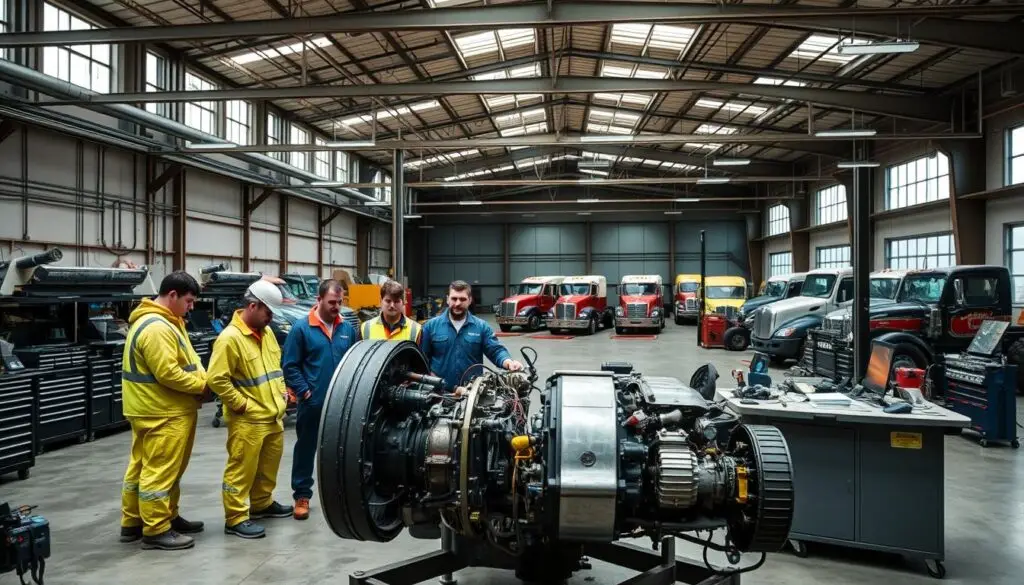
Organizations across the heavy equipment industry are discovering that apprenticeship programs solve multiple business challenges simultaneously. The diesel technician shortage has reached crisis levels, with industry surveys consistently showing that more than 75% of heavy equipment service providers report difficulty finding qualified technicians. This gap between supply and demand creates operational bottlenecks that limit growth, increase customer wait times, and reduce service revenues.
The pipeline of new diesel technician graduates from vocational schools falls far short of replacement needs. Meanwhile, experienced technicians approaching retirement age outnumber those entering the profession by a significant margin. Apprenticeship programs create an independent talent source that bypasses external labor market limitations, giving organizations control over workforce planning and reducing vulnerability to competitive recruiting pressures.
Long-Term Cost Benefits and Return on Investment
The financial case for apprenticeship programs strengthens significantly when analyzed over multiple years. Initial training investments generate returns that compound as apprentices progress through competency levels, with organizations typically reaching break-even within 18 to 24 months of program launch.
| Cost Category | External Hiring | Apprenticeship Program | Difference |
|---|---|---|---|
| Recruitment and onboarding | $8,500 | $3,200 | $5,300 savings |
| First-year compensation premium | $12,000 | $0 | $12,000 savings |
| Training and development (4 years) | $6,000 | $18,000 | $12,000 additional cost |
| Turnover replacement (30% rate) | $15,000 | $4,500 | $10,500 savings |
| Total 4-year investment | $41,500 | $25,700 | $15,800 net savings |
Beyond direct cost savings, apprenticeship programs deliver additional financial returns through improved service quality, higher customer satisfaction scores, and increased retention. Established dealer networks report that apprenticeship graduates demonstrate retention rates exceeding 85% upon program completion, compared to first-year retention rates below 70% for externally hired technicians. This difference compounds over time, with apprentice-trained technicians remaining with employers an average of seven years longer than those recruited externally.
Building Loyalty Through Career Development
The investment organizations make in developing technicians generates reciprocal loyalty that traditional hiring cannot replicate. Leading equipment dealer networks with long-running apprenticeship programs demonstrate this principle clearly. Their multi-year training initiatives have produced not only skilled technicians but also organizational leaders who advanced from apprentice positions into senior management and executive roles.
The most effective programs offer graduates career flexibility across technical paths, training roles, sales positions, and management tracks. This long-term career growth opportunity addresses a critical retention factor while building institutional knowledge that stays within the company. Each retained technician eliminates recruitment costs, prevents knowledge loss, and maintains service continuity for customers.
Understanding Federal and State Apprenticeship Regulations
Before launching your diesel technician apprenticeship program, you must navigate the regulatory landscape that combines federal oversight with state-specific mandates. Understanding these layers of compliance protects your business from legal issues while establishing credible program frameworks that earn recognition across jurisdictions.
Department of Labor Registered Apprenticeship Standards
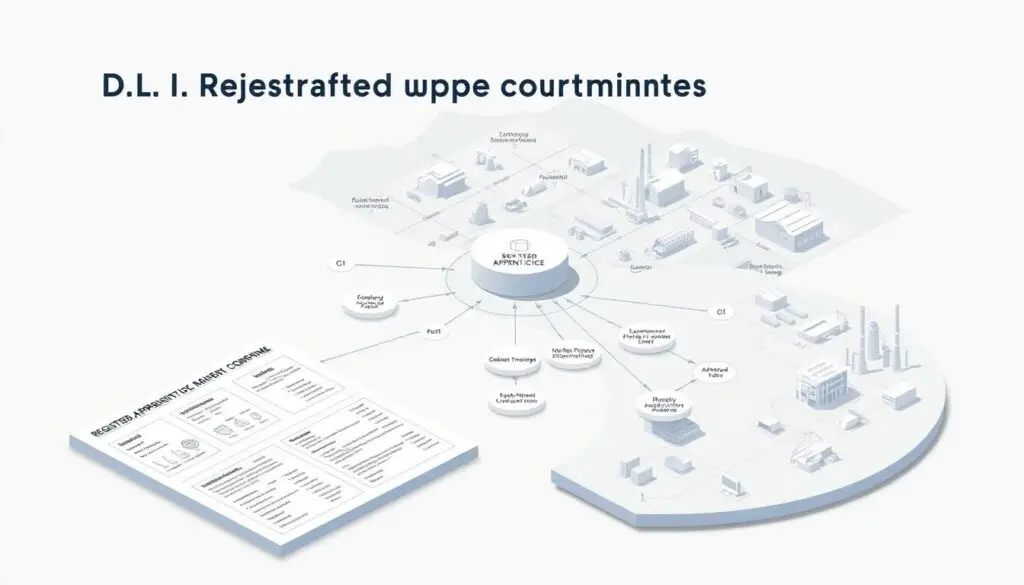
The Department of Labor’s Office of Apprenticeship establishes nationwide standards defining quality training programs. Registration provides federal recognition validating that your curriculum meets established benchmarks. Your apprentices earn nationally recognized credentials, and your program gains access to technical assistance, marketing support, and reserved funding streams.
Core requirements for federal registration include on-the-job learning combined with related technical instruction. Programs must document at least 2,000 hours of supervised work experience annually and include a minimum of 144 hours of classroom instruction each year. Wage progression tied to skill acquisition represents another critical requirement, with clear pay scales rewarding apprentices as they master competencies and advance through program stages.
State Licensing and OSHA Compliance
State regulations add complexity that varies dramatically across jurisdictions. Some states require diesel technicians to obtain specific licenses before performing certain repairs or inspections. California mandates Bureau of Automotive Repair registration for shops performing diesel smog inspections, while Texas requires Motor Vehicle Inspector licenses for state safety inspections. Contact your State Apprenticeship Agency to understand local registration procedures before finalizing program structure.
OSHA regulations establish minimum safety standards protecting apprentices in diesel repair environments. Your program must integrate safety training from day one, covering hazardous materials handling, confined space entry, lockout-tagout procedures, and respiratory protection. General industry standards under 29 CFR 1910 apply to all shop operations regardless of apprenticeship registration status.
⚠️ Safety Warning
Apprentices must never perform hazardous tasks—including confined space entry, lockout-tagout procedures, or hazardous materials handling—until they complete required safety training and demonstrate competency through documented assessments. Non-compliance exposes both apprentices and employers to serious injury risk and OSHA penalties.
| Regulation Type | Governing Body | Key Requirements |
|---|---|---|
| Federal Apprenticeship Standards | Department of Labor | 2,000 OJT hours + 144 classroom hours annually, wage progression |
| State Licensing | State Apprenticeship Agencies | Varies by jurisdiction; may include technician or facility licenses |
| OSHA Safety Training | OSHA (29 CFR 1910) | Hazmat, confined space, lockout-tagout, respiratory protection |
| Industry Certifications | ASE, Manufacturer Programs | System-specific competency verification, progressive throughout program |
Building Your Diesel Technician Apprenticeship Framework
The framework of your apprenticeship program determines how effectively you transform inexperienced candidates into skilled diesel technicians. A well-structured program setup creates clear pathways for skill development while protecting the interests of both apprentices and employers.

Setting Program Duration and Progression Stages
Most diesel technician apprenticeships span three to four years depending on specialization requirements and equipment complexity. This timeframe provides sufficient exposure to diverse repair scenarios while building deep technical competency. Some provincial programs, like those in British Columbia, require apprentices to accumulate 3,000 hours of work-based training alongside progressive technical classroom levels.
Clear progression stages motivate apprentices by demonstrating advancement toward journey-level status. Each level should correspond to measurable skill improvements, increased responsibilities, and higher compensation. Organizations can create accelerated pathways for candidates with prior mechanical experience, though these shortened programs still require rigorous competency assessment to ensure graduates meet industry standards.
| Level | Duration | Primary Competencies | Wage Range |
|---|---|---|---|
| Level 1 (Foundation) | Months 1-12 | Safety protocols, basic diagnostics, tool proficiency, preventive maintenance | 50-55% of journey wage |
| Level 2 (Intermediate) | Months 13-24 | Brake systems, electrical repairs, cooling systems, transmission basics | 60-65% of journey wage |
| Level 3 (Advanced) | Months 25-36 | Engine overhauls, hydraulic systems, emissions controls, computerized diagnostics | 70-75% of journey wage |
| Level 4 (Mastery) | Months 37-48 | Complex diagnostics, system integration, independent repairs, mentoring | 80-90% of journey wage |
Written Program Standards and Agreements
Written program standards document every aspect of the apprenticeship relationship and serve multiple critical purposes. They demonstrate compliance with DOL registered apprenticeship standards, provide reference materials for mentors, and create legal protections for both parties. Comprehensive documentation reduces misunderstandings that could derail promising apprenticeships.
Apprentice contracts should outline attendance requirements, performance standards at each progression stage, tool acquisition timelines, safety protocol adherence, and professional conduct expectations. Include provisions for probationary periods and remediation opportunities. Employer commitments must specify mentor assignments, safe work environments, diverse work experiences, progressive wage increases, and support for classroom attendance without scheduling conflicts.
Pay special attention to contingency provisions covering temporary layoffs, extended illness, or facility closures. These plans protect apprentices from losing progress due to circumstances beyond their control and demonstrate organizational commitment to completing the training program.
Designing the Technical Curriculum
Building technical competence requires a systematic apprenticeship curriculum that transforms inexperienced apprentices into skilled professionals capable of diagnosing and repairing complex diesel equipment. A comprehensive training plan balances classroom theory with hands-on application while advancing through progressive skill levels aligned with industry standards and manufacturer requirements.
Core Diesel Engine and Powertrain Competencies
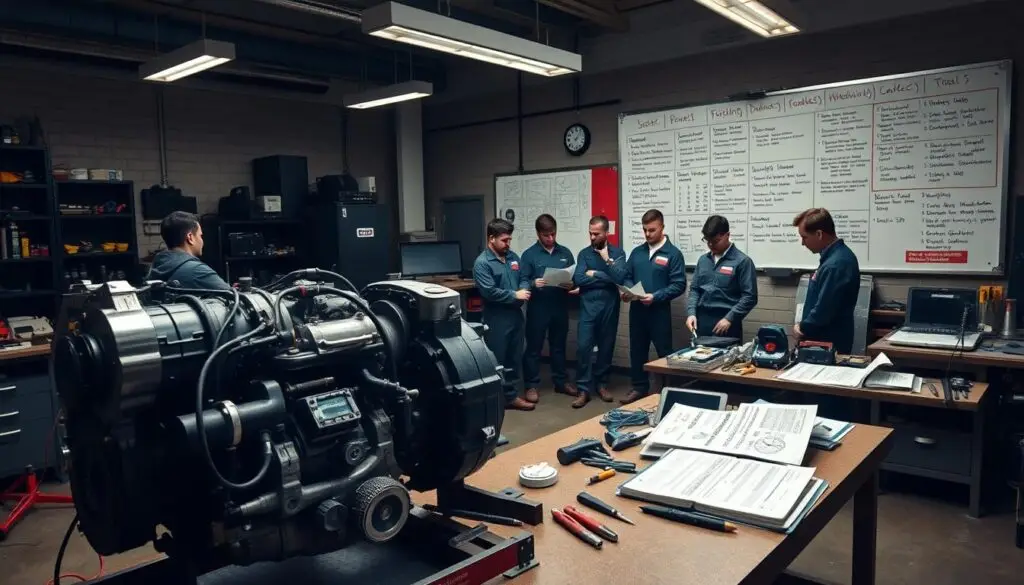
Diesel engine fundamentals form the essential foundation of any diesel mechanic training program. Entry-level instruction covers combustion principles, thermodynamic cycles, and fuel injection timing. Engine component instruction includes cylinder head and valve train construction, engine block assembly with proper bearing installation and crankshaft alignment, and piston ring gap specifications. Technical colleges with established truck and coach technician programs typically allocate 40-50 hours at the introductory level for basic engine systems, expanding to advanced diagnostics at higher levels.
Lubrication system curriculum addresses oil flow patterns, pressure regulation, and filtration technology. Cooling system training covers radiator efficiency, thermostat operation, and coolant chemistry. Advanced instruction expands to turbocharger operation, intercooler systems, and exhaust gas recirculation. Per Cummins and Detroit Diesel service documentation, modern engine diagnostics increasingly require understanding electronic control integration with mechanical systems.
Electrical, Electronic, and Diagnostic Systems
Electrical competency has become increasingly critical as diesel equipment incorporates sophisticated electronic controls. Entry-level instruction typically requires 45-50 hours covering Ohm’s Law, circuit analysis, multimeter usage, battery construction, and charging system regulation. Intermediate training advances to multiplexing, CAN bus networks, and sensor technology, while advanced coursework covers vehicle electronic management systems including emissions controls.
Modern diesel equipment requires technicians who can navigate complex diagnostic platforms and interpret computerized data. Training begins with generic OBD-II protocols and progresses to heavy-duty SAE J1939 diagnostic standards. Apprentices learn fault code interpretation, freeze frame data analysis, and bidirectional control testing. Each major equipment manufacturer provides proprietary diagnostic software—including Caterpillar Electronic Technician, Cummins Insite, and Detroit Diesel Diagnostic Link—requiring specialized training your curriculum should address through hands-on experience with multiple platforms.
Hydraulics, Brakes, and Chassis Systems
Fluid power systems represent a distinct technical discipline within diesel mechanic training. Hydraulic instruction covers pump types, flow control valves, actuator sizing, schematic reading, and contamination control. Air brake system training addresses compressor operation, governor adjustment, slack adjuster mechanisms, and anti-lock braking system technology. Steering and suspension curriculum includes power steering specifications, front axle alignment geometry, air suspension leveling, and shock absorber characteristics.
Technical college programs typically dedicate 25-30 hours at Level 1 for wheel end assemblies and brake systems, expanding to 45-50 hours at Level 2 for steering, suspension, and advanced brake diagnostics. This progression reflects the increasing complexity of modern chassis systems and their integration with electronic stability controls.
The HDJ Perspective
The diesel technician apprenticeship model is evolving alongside the technology it teaches. Programs that treated curriculum as a static document five years ago are now scrambling to incorporate advanced emissions diagnostics, telematics integration, and hybrid powertrain fundamentals. The operations that will thrive are those building adaptability into their apprenticeship DNA—establishing annual curriculum review cycles, maintaining manufacturer training partnerships, and empowering mentors to evolve their instruction as equipment changes.
From what we see across the industry, the biggest risk is not the upfront investment in starting an apprenticeship program. It is the ongoing cost of failing to develop technicians who can service the increasingly complex equipment rolling into your bays every year.
Building Educational Partnerships
Most diesel service businesses lack the resources to deliver all technical training in-house, making strategic partnerships essential for comprehensive diesel mechanic training. Community colleges and technical schools offer established diesel technology programs with certified instructors and equipped laboratories that already meet state and federal educational standards.
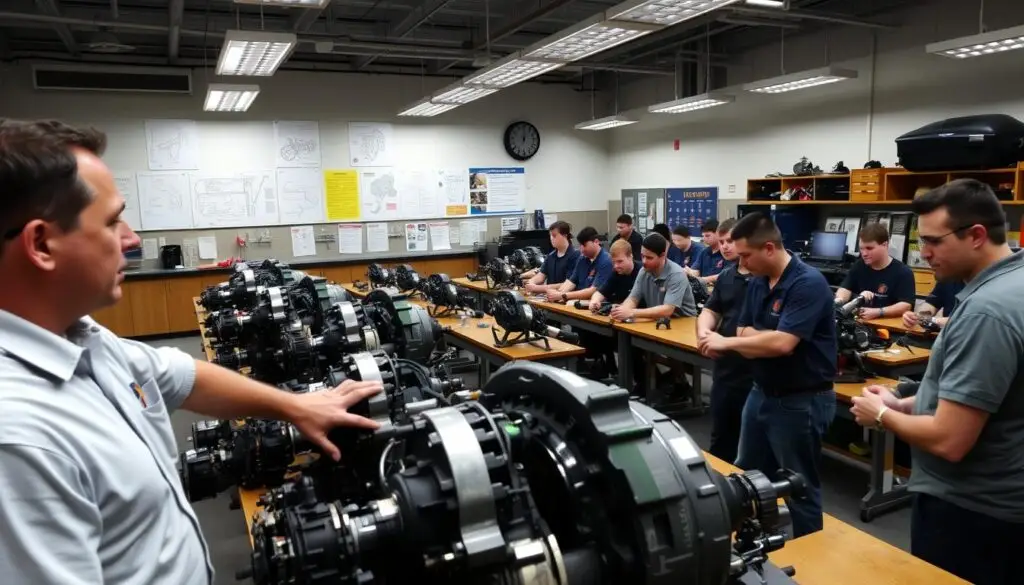
Intensive foundation programs offered by some provincial and state institutions demonstrate how institutional training accelerates apprenticeship pathways. These programs can provide sufficient technical training that graduates enter directly at higher apprenticeship levels without requiring initial employer sponsorship. Establishing formal articulation agreements with educational partners strengthens these relationships by recognizing prior learning and allowing credit for completed coursework.
Manufacturer and Industry Association Resources
Equipment manufacturers provide specialized technical training that generic curricula cannot replicate. Caterpillar offers free online training through Caterpillar University, while Cummins, Detroit Diesel, and Navistar maintain similar training infrastructures for authorized service centers. These programs address proprietary diagnostic software, specialized service procedures, and equipment-specific troubleshooting that community colleges typically do not cover.
Industry associations provide standardized frameworks ensuring programs meet evolving certification requirements. The Technology & Maintenance Council publishes recommended practices and technical bulletins informing curriculum development. ASE certifications provide nationally recognized credentials validating technical competencies beyond internal company standards. State trucking associations often coordinate apprenticeship consortiums allowing smaller businesses to participate in shared training programs that distribute costs across multiple employers.
| Partnership Type | Primary Benefits | Cost Structure |
|---|---|---|
| Community Colleges | Certified instructors, equipped labs, accredited programs | $2,000-$5,000 per year tuition |
| Manufacturer Programs | Brand-specific knowledge, diagnostic software training | Often free or low-cost for authorized dealers |
| Industry Associations | Standardized frameworks, ASE credentials, networking | $500-$2,500 annual membership + $50-$150 per exam |
| Hybrid Approach | Combines academics, brand expertise, and credentials | Variable; consortium models reduce per-company costs |
Recruiting Qualified Apprentice Candidates
The success of your diesel technician apprenticeship depends on identifying individuals who possess both mechanical aptitude and the commitment to complete several years of rigorous training. A systematic approach to apprentice recruitment that balances minimum qualifications with strategic outreach builds a pipeline of skilled technicians for decades.
Minimum Qualifications and Prerequisites
Educational requirements typically include high school completion or equivalent, with Grade 12 strongly preferred by most programs. Specific coursework in English, mathematics, and science at the Grade 10 level provides essential literacy, numeracy, and analytical skills that apprentices apply throughout training. Physical capabilities include lifting 50 to 75 pounds, manual dexterity for precision work, and adequate vision for detailed inspection tasks.
Additional prerequisites often include a valid driver’s license with a clean driving record, passage of background checks and drug screenings, and a minimum age of 18 for legal compliance with workplace safety regulations. Physical stamina to work in demanding environments—including outdoor conditions, noise exposure, and confined spaces—should be assessed during the qualification process.
Strategic Outreach and Candidate Sources
High school career and technical education partnerships represent one of the most productive recruitment channels. Participating in career fairs, providing facility tours, and offering summer internship programs create low-risk opportunities for students to explore diesel technology careers. Scholarship programs supporting students enrolled in heavy equipment mechanics programs at vocational institutions reduce financial barriers while building recruiting pipelines.
Military veterans bring particularly valuable attributes to diesel technician roles. Their technical aptitude, discipline, troubleshooting skills, and experience with heavy equipment maintenance provide strong foundations for civilian training. Creating accelerated pathways that recognize prior military training respects veterans’ experience while streamlining transitions. According to the Bureau of Labor Statistics, diesel technician employment is projected to grow steadily, making career stability a compelling recruitment message for veterans and career-changers alike.
Skills Assessment and Selection
Comprehensive candidate assessment goes beyond reviewing qualifications. Hands-on mechanical aptitude tests measure comfort with tools and understanding of mechanical relationships. Written technical knowledge evaluations assess foundational understanding of mechanical principles and reading comprehension. Problem-solving scenarios presenting realistic workplace situations reveal analytical thinking and troubleshooting orientation—the thought process matters more than reaching the correct answer, as it indicates development potential.
Structured behavioral interviews explore motivation, reliability, learning orientation, and cultural fit. Reference checks with previous employers, teachers, or military supervisors provide external validation. A clear decision framework weighting education, test scores, interview performance, and reference feedback reduces selection bias and ensures choices align with program requirements.
Free Professional Fleet Tools
Cost calculators, fault code lookup, maintenance planners, and more—built for owner-operators, fleet managers, and diesel techs. No signup required.
Structuring Apprentice Compensation and Benefits
Developing effective compensation requires balancing competitive apprenticeship wages against training costs while supporting long-term workforce development. The financial framework directly determines your ability to attract quality candidates and retain them through program completion.

Progressive Wage Scales and Benefits
Most successful programs begin apprentices at 40-50% of journey-level technician wages during the first year, reflecting limited productivity and high supervision requirements. By the final year, apprentices typically earn 85-95% of journey-level pay. Wage increases should occur at specific checkpoints tied to competency demonstrations—completing classroom periods, passing certification exams, or demonstrating proficiency in specific skill areas—rather than simply tracking time served.
Comprehensive benefits packages increasingly differentiate employers in competitive labor markets. Health insurance coverage represents the most valued benefit for most apprentices. Retirement plan contributions, paid time off that increases with progression, tuition reimbursement, ASE certification exam coverage, and flexible scheduling for classroom instruction all strengthen retention. Your compensation structure must remain competitive within your local market while accounting for regional cost-of-living variations.
Tool Allowances and Equipment Support
Professional-grade tool sets costing $5,000 to $15,000 represent a significant financial barrier preventing qualified candidates from entering diesel technician careers. Several approaches address this challenge effectively. Direct tool allowances provide stipends at progression milestones. Interest-free tool loan programs remove upfront cost barriers while allowing immediate access to quality equipment. Some employers maintain company-owned tool cribs with expensive specialized equipment available for checkout.
Quick Reference
- Initial tool investment: $1,000-$2,500 for essential hand tools
- Advanced tool costs: $5,000-$15,000+ for diagnostic and specialty equipment
- Safety equipment: Always employer-provided (glasses, hearing protection, boots, gloves)
- Diagnostic software: Annual subscriptions typically $500-$2,000 per manufacturer platform
Mentorship, Performance Tracking, and Funding
Implementing Effective Mentorship
Journey-level mentors transform theoretical concepts into practical skills through daily guidance that no textbook can replicate. Technical expertise alone does not create effective teachers—successful mentors combine deep technical knowledge with patience, clear communication, and genuine investment in apprentice development. Establish minimum qualifications of five years’ experience as a certified diesel technician, relevant ASE certifications, clean safety records, and demonstrated interpersonal skills.
Mentor training programs should cover adult learning principles, constructive feedback techniques, task decomposition for teaching, and documentation requirements. Maintain ratios no higher than one mentor to two apprentices to ensure adequate supervision time. Ratios above one-to-three compromise training effectiveness regardless of mentor skill level.
Structured communication systems prevent training gaps from becoming serious problems. Daily toolbox talks set expectations and prepare apprentices for upcoming tasks. Weekly progress reviews examine skill development and plan training focus. Monthly formal evaluations document competency achievements using standardized assessment forms. Quarterly meetings involving apprentices, mentors, and program coordinators ensure alignment between on-the-job training and program objectives.
Performance Documentation and Compliance
Documentation serves dual purposes: satisfying external reporting obligations and creating internal resources guiding training decisions. Registered apprenticeship programs must submit quarterly enrollment reports, completion notifications with detailed competency records, equal employment opportunity data, and wage progression documentation. Related technical instruction verification requires maintaining transcripts, attendance records, and course completion certificates with retention periods extending five years beyond program completion.
Internal tracking systems should integrate competency achievement, hours accumulation, classroom performance, and safety training into unified apprentice profiles. Competency tracking matrices mapping progress through required skill areas allow supervisors to quickly identify apprentices ready for advancement or needing additional support. Quarterly performance reviews bring structure to the mentorship relationship, creating formal opportunities for collaborative assessment, challenge identification, and training plan adjustments.
$15,800
Average net savings per technician over four years when comparing apprenticeship development costs to external recruitment and turnover expenses.
Securing Funding and Financial Incentives
Multiple financing mechanisms offset apprenticeship program costs. The Department of Labor administers competitive grants through ApprenticeshipUSA covering curriculum development, equipment purchases, and mentor training. State workforce development boards manage substantial funding including direct training subsidies, equipment grants, and per-apprentice allocations that increase with progression milestones. Some states offer forgivable loans converting to grants when apprentices complete programs and remain employed.
Federal and state tax credits provide direct cost reductions. The Federal Work Opportunity Tax Credit generates credits up to $2,400 per eligible apprentice. State-level credits typically range from $1,000 to $5,000 per apprentice annually, with some jurisdictions offering higher amounts for DOL registered programs. Industry consortium models enable multiple employers to jointly fund training infrastructure while sharing classroom instruction, equipment laboratories, and administrative costs—achieving economies of scale impossible for individual companies.
Overcoming Common Program Challenges
Even well-designed apprenticeship programs face predictable obstacles. Dropout rates typically spike during the first year when apprentices confront physical demands and extended time commitments. Effective retention strategies include comprehensive pre-program orientations setting realistic expectations, early identification systems flagging struggling apprentices through weekly mentor check-ins, financial support mechanisms like tool loans, and cohort-building activities creating peer support networks.
Service departments face constant pressure to maximize billable hours, creating tension with proper training time. Strategic scheduling during lower-volume periods, realistic productivity expectations adjusted by apprentice level, and mentor workload adjustments accounting for teaching responsibilities help balance production demands with skill development. Organizations that protect dedicated training time while acknowledging production realities create sustainable programs.
Multi-location operations face consistency challenges that centralized program management addresses through standardized competency checklists, regular cross-location mentor meetings, standardized assessment rubrics, and rotation programs cycling apprentices through different facilities. Continuous curriculum updates—including annual reviews, ongoing manufacturer training, and advisory committees with fleet managers—keep programs aligned with rapidly evolving diesel technology.
Frequently Asked Questions
How long does a diesel technician apprenticeship program take to complete?
Most diesel technician apprenticeship programs span three to four years depending on specialization requirements and equipment complexity. Programs typically require at least 2,000 hours of supervised on-the-job training annually plus 144 hours of classroom instruction per year under DOL standards. Candidates with prior mechanical experience or military training may qualify for accelerated pathways. Some intensive foundation programs offered through technical colleges allow graduates to enter at higher apprenticeship levels, effectively reducing total time to journey-level certification.
What does it cost to start a diesel technician apprenticeship program?
Total four-year apprenticeship costs average approximately $25,700 per technician, compared to roughly $41,500 for external recruitment over the same period—a net savings of $15,800. Major expenses include recruitment ($3,200), progressive training ($18,000 over four years), and reduced turnover costs ($4,500 versus $15,000 for external hires). Federal grants, state workforce funds, and tax credits ranging from $1,000 to $5,000 per apprentice annually can offset these costs significantly, making programs financially viable even for smaller operations.
What qualifications do diesel technician apprentice candidates need?
Minimum qualifications typically include high school completion (Grade 12 preferred), proficiency in English, math, and science at the Grade 10 level, ability to lift 50-75 pounds, manual dexterity for precision work, and adequate vision for inspection tasks. Most programs require candidates to be 18 or older, hold a valid driver’s license, and pass background checks and drug screenings. Hands-on mechanical aptitude testing during selection often predicts training success more accurately than academic credentials alone.
How do you register an apprenticeship program with the Department of Labor?
DOL registration requires submitting documented structured training plans with qualified instructors, progressive skill development milestones, and wage scales tied to competency advancement. Your program must provide at least 2,000 on-the-job training hours and 144 classroom hours annually. Start by contacting your State Apprenticeship Agency or the DOL Office of Apprenticeship. Registration provides access to federal funding streams, technical assistance, marketing support, and nationally recognized credentials for your graduates that employers across the country respect.
What is the typical wage progression for diesel technician apprentices?
First-year apprentices typically earn 40-50% of journey-level wages, increasing to 55-65% in year two, 70-80% in year three, and 85-95% in the final year. Wage increases should be triggered by demonstrated competency rather than time served—completing classroom periods, passing ASE or manufacturer certification exams, and demonstrating proficiency in specific skill areas. This approach motivates continuous skill acquisition while providing clear financial incentives for apprentices to advance their capabilities throughout the multi-year program.
What funding sources are available for diesel technician apprenticeship programs?
Multiple funding sources reduce out-of-pocket program costs. Federal grants through ApprenticeshipUSA cover curriculum development and equipment. State workforce boards offer training subsidies and per-apprentice allocations. The Federal Work Opportunity Tax Credit provides up to $2,400 per eligible apprentice, while state credits range from $1,000 to $5,000 annually. Industry consortium models distribute costs across multiple employers. Some states offer forgivable loans converting to grants upon apprentice completion and continued employment. Combining these sources transforms workforce development from a cost center into a strategic investment.
Building Your Diesel Technician Workforce for the Long Term
Establishing a diesel technician apprenticeship program delivers strategic advantages that extend far beyond filling immediate job openings. Organizations that commit to comprehensive program frameworks—spanning regulatory compliance, curriculum design, educational partnerships, competitive compensation, quality mentorship, and performance tracking—create sustainable talent pipelines that competitors relying solely on external recruitment cannot match.
The diesel technology sector continues evolving with advanced emissions systems, electronic diagnostics, and alternative fuel technologies. Structured apprenticeship programs provide the development pathway necessary to maintain competitive service capabilities in this changing landscape. Start by contacting your State Apprenticeship Agency, assess your mentorship capacity, and explore federal and state funding sources that make program launch financially accessible regardless of organization size.
Help Fellow Fleet Professionals
Know a fleet manager or shop owner struggling with the technician shortage? Share this apprenticeship guide to help them build their own talent pipeline.