By Michael Nielsen, Editor & Publisher | 15+ Years in Diesel Repair
Last Updated: February 2026
📖 Estimated reading time: 25 minutes
Commercial fleets across America are rapidly adopting electric vehicles, and EV training for diesel technicians has become one of the most urgent workforce development priorities in fleet operations today. Experienced maintenance staff who excel at traditional combustion engines lack the specialized knowledge required for electric vehicle maintenance—a skills gap that threatens operational efficiency, increases downtime, and poses serious safety risks when technicians encounter 400- to 800-volt systems for the first time.
The transition from conventional powertrains to electrified systems demands comprehensive workforce development programs. Effective EV technician training goes beyond learning new procedures. It requires a fundamental rethinking of how maintenance teams approach diagnostics, repair, and safety for a completely different technology platform.
This guide provides fleet operations leaders with a strategic roadmap for implementing successful electric vehicle technician training programs. You’ll find proven methods to upskill your existing diesel workforce, navigate certification requirements, build hands-on training capabilities, and maintain competitive advantage as fleet electrification accelerates.
Key Takeaways
- Safety first: Commercial EVs operate at 400-800 volts DC—untrained technicians face life-threatening electrocution and arc flash hazards that don’t exist in diesel maintenance.
- Structured transition: A phased 6-12 month training program covers high-voltage safety fundamentals, advanced diagnostics, and supporting knowledge without disrupting fleet operations.
- Certifications matter: ASE L3 certification and high-voltage safety Level 2 credentials are becoming industry requirements for warranty compliance and liability protection.
- Diesel skills transfer: Experienced mechanics bring valuable diagnostic problem-solving, suspension/brake knowledge, and HVAC expertise—but electrical theory, battery chemistry, and power electronics require complete retraining.
- Strong ROI: Most fleets achieve training payback within 12-18 months through faster diagnostics, reduced downtime, and 40-60% lower per-repair costs versus dealer outsourcing.
- Retention strategy: EV certification programs double as retention tools in a competitive technician labor market—trained specialists command premium compensation.
Why Electric Vehicle Training Is Critical for Fleet Operations
Investing in electric vehicle safety training delivers measurable returns that extend far beyond regulatory compliance. Fleet operators across the United States are discovering that technician preparation directly impacts operational success, workplace safety, and long-term profitability. Without properly trained personnel, operations face increased safety risks, extended vehicle downtime, and higher maintenance costs that can undermine the entire business case for EV investments.

The Expanding Commercial Electric Vehicle Market
Commercial EV adoption in the United States has accelerated dramatically over the past three years. Fleet managers are transitioning to electric vehicles across multiple classes, from light-duty delivery vans to medium-duty trucks and emerging heavy-duty applications. According to the Department of Energy’s Alternative Fuels Data Center, electric vehicles are projected to comprise a growing share of commercial fleet purchases through the end of the decade.
Several factors drive this transformation: total cost of ownership advantages from lower fuel and maintenance costs, tightening state and federal emissions standards, corporate sustainability commitments, expanding manufacturer options from Ford, GM, Rivian, and others, and rapidly growing charging infrastructure. Major delivery companies have committed to purchasing tens of thousands of electric delivery vehicles. Utility companies are electrifying service fleets. Municipal operations are transitioning to electric buses and maintenance vehicles.
This widespread adoption creates urgent demand for qualified technicians who can maintain these advanced vehicles safely and efficiently.
Critical Safety Hazards for Unprepared Technicians
⚠️ Safety Warning
High-voltage systems in commercial EVs operate between 400 and 800 volts DC. These voltage levels are immediately dangerous to life and require strict safety protocols, proper PPE, and verified de-energization before any maintenance work begins. Never allow untrained personnel to service high-voltage components.
High-voltage electrical systems in commercial electric vehicles are significantly more dangerous than traditional 12-volt automotive systems. Arc flash incidents represent one of the most serious risks—when high-voltage connections are improperly handled, electrical arcs can produce temperatures exceeding 35,000 degrees Fahrenheit, causing severe burns, hearing damage, and potentially fatal injuries. Traditional diesel mechanics have no experience with hazards of this magnitude.
Electrocution risks increase dramatically when technicians bypass safety systems or fail to verify electrical isolation. Battery packs remain energized even when vehicles are powered off, creating hidden dangers throughout the repair process. OSHA electrical safety standards specifically address requirements for workers exposed to voltages above 50 volts, but compliance requires comprehensive training.
Additional hazards include thermal runaway in damaged lithium-ion battery cells leading to fires or explosions, chemical exposure from battery electrolytes during collision repair, silent operation creating workplace hazards, and high-voltage cable damage during routine procedures. Fleet operators bear legal responsibility for technician safety—allowing untrained personnel to work on electric vehicles creates significant liability exposure.
Business Performance Through Technician Expertise
Skilled technicians directly influence fleet maintenance efficiency and overall operational performance. Properly trained EV specialists diagnose problems faster, complete repairs correctly the first time, and minimize vehicle downtime. These capabilities translate into quantifiable business advantages.
| Performance Metric | Untrained Technicians | Certified EV Technicians | Improvement |
|---|---|---|---|
| Average Diagnostic Time | 4.5 hours | 1.8 hours | 60% faster |
| Vehicle Downtime per Incident | 3.2 days | 1.1 days | 66% reduction |
| Warranty Claim Rejection Rate | 23% | 4% | 83% decrease |
| Repeat Repair Rate | 18% | 5% | 72% improvement |
Vehicle availability directly affects fleet revenue generation. Every day an electric vehicle sits idle waiting for diagnosis or repair represents lost productivity. Trained technicians resolve issues quickly, returning vehicles to service faster and maintaining operational schedules.
Warranty compliance provides another critical business advantage. Manufacturers frequently reject warranty claims when improper maintenance causes component failures. Certified technicians understand manufacturer specifications and follow approved procedures, protecting warranty coverage. Employee retention represents an often-overlooked benefit—technicians value professional development opportunities and industry-recognized certifications, creating competitive advantages in recruiting skilled personnel.
Understanding the Diesel to Electric Vehicle Skills Gap
Understanding the competency divide between traditional diesel and electric vehicle maintenance is essential for successful automotive technician upskilling. Fleet managers must recognize that the diesel to electric vehicle transition involves more than learning a few new procedures—it requires fundamentally rethinking how technicians approach vehicle diagnostics and repair.
Traditional Diesel Mechanic Competencies
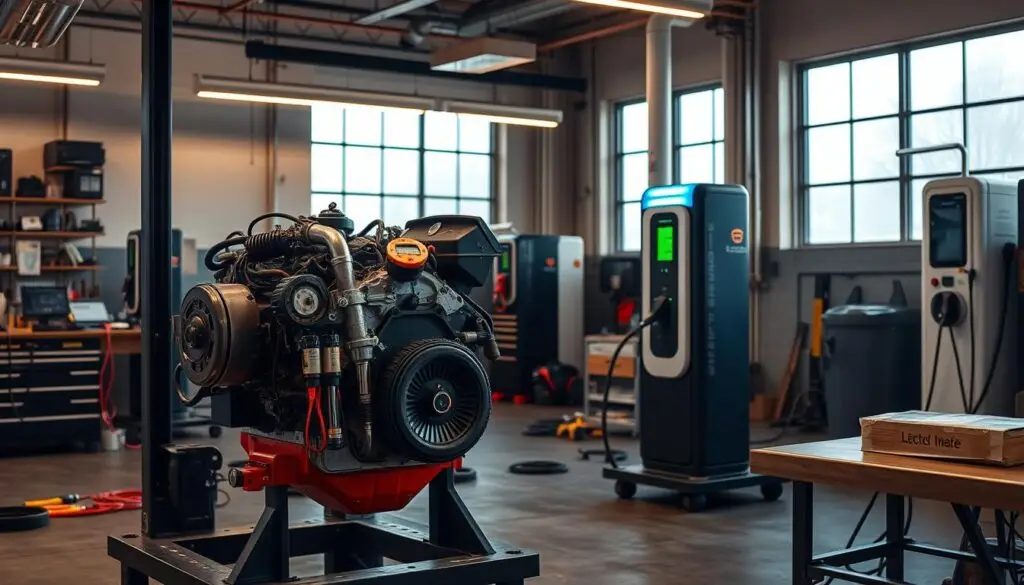
Diesel technicians have developed comprehensive expertise in mechanical systems over years of hands-on work. Their skill set centers on internal combustion engines, with deep knowledge of fuel injection systems, turbochargers, and emission control devices. Beyond engine work, diesel mechanics excel at hydraulic systems, transmission assemblies, differential units, and brake systems that rely on fluid pressure. Their expertise extends to cooling systems, exhaust aftertreatment, and the complex network of sensors monitoring engine performance.
New Technical Skills Required for EV Maintenance
Electric vehicles demand an entirely different technical foundation focused on electrical systems rather than mechanical ones. The most critical new competency involves high-voltage safety protocols—technicians must learn to work safely with battery packs operating at 400 to 800 volts, far exceeding the 12-volt systems in diesel vehicles.
Battery pack diagnostics represent another essential skill area. EV technicians need to understand lithium-ion battery chemistry, cell balancing, and thermal management systems. They must interpret battery management system data to assess pack health and predict remaining capacity. Power electronics knowledge becomes central to maintenance work, including how inverters convert DC battery power to AC for electric motors, onboard chargers, DC-to-DC converters, and the software systems controlling power distribution.
Electric motor service requires understanding electromagnetic principles and regenerative braking systems. Unlike diesel engines with hundreds of moving parts, electric motors have relatively few components but demand precise diagnostic approaches using specialized equipment.
Transferable Skills and Knowledge Gaps
The upskilling process builds on existing competencies that remain valuable in the electric vehicle era. Diesel technicians bring strong diagnostic problem-solving methodologies that apply equally to EVs. Suspension systems, steering assemblies, and friction brake components function similarly across both platforms. HVAC maintenance principles transfer directly, as do vehicle systems integration concepts.
However, certain technical domains have no diesel equivalent and demand comprehensive education. Electrical theory and circuit analysis top this list—diesel technicians may understand basic 12-volt circuits, but EV work requires deep knowledge of Ohm’s law, AC/DC power, and complex electrical calculations. Battery technology, power inverter operation, charging infrastructure protocols, and advanced software diagnostics all require complete retraining from the ground up.
Essential EV Training Curriculum for Fleet Technicians
Fleet managers looking to prepare their diesel technicians for electric vehicle work must implement a training program covering essential electrical, thermal, and diagnostic systems unique to EVs. A well-designed curriculum ensures technicians gain confidence while developing the technical competencies needed for safe, effective service. Experienced instructors with real-world EV maintenance backgrounds should lead these programs to provide practical insights beyond textbook knowledge.
Core Curriculum Components
A complete training program builds upon existing mechanical knowledge while introducing entirely new technical domains. The foundational modules should cover DC and AC electrical principles, Ohm’s law applications, and circuit analysis methods. Technicians need to understand voltage, current, and resistance relationships in ways that go deeper than basic automotive electrical work.
Beyond electrical fundamentals, the curriculum must address battery chemistry and energy storage principles that differ significantly from traditional lead-acid systems. Technicians should learn about lithium-ion cell construction, thermal runaway risks, and state-of-charge indicators. Diagnostic methodology requires systematic instruction in interpreting EV-specific diagnostic trouble codes, using manufacturer scan tools effectively, and applying logical troubleshooting sequences that integrate software diagnostics with physical system inspection.
High-Voltage Safety and Electrical Systems
High-voltage safety training forms the most critical component of any EV technician education program. The training should extensively cover proper de-energization procedures that technicians must follow without exception, including verifying high-voltage disconnection, using appropriate voltage testing equipment to confirm zero energy state, and applying lockout-tagout devices.
Electrical hazard recognition teaches technicians to identify potential risks before beginning work—recognizing high-voltage components, understanding insulation requirements, and identifying damaged cables or connectors. Voltage testing protocols require hands-on practice using digital multimeters rated for high-voltage applications. Safe work practices around energized systems cover scenarios involving minimum approach distances, appropriate PPE requirements, and two-person work rules for high-risk tasks.
Battery Pack Diagnostics and Thermal Management
EV battery maintenance training focuses on the complex battery management systems (BMS) that monitor and control lithium-ion pack performance. The BMS continuously tracks individual cell voltages, temperatures, and current flow. Technicians must understand how to access BMS data, interpret diagnostic information, and identify failing cells or modules.
State of charge and state of health assessments require specialized diagnostic tools beyond simple voltage measurements. Thermal management system operation represents a critical area—EV batteries require precise temperature control through liquid cooling systems with specialized coolants designed for electrical insulation properties. These systems often integrate with cabin climate control, creating diagnostic complexity that requires systematic troubleshooting approaches.
Electric Motor, Power Inverter, and Charging Systems
Understanding the different electric motor types used in commercial vehicles forms the foundation for drivetrain service. Permanent magnet motors offer high efficiency, induction motors provide durability advantages, and AC synchronous motors deliver high torque density for heavy-duty applications. Each requires specific diagnostic approaches.
Power inverter diagnostics represent advanced technical skills—the inverter converts DC battery power to AC current while controlling speed and torque output. Motor controller systems integrate with vehicle control networks through CAN communication protocols, managing acceleration, regenerative braking, and efficiency optimization.
Charging infrastructure training covers DC fast charging systems delivering 50 to 350 kilowatts, Level 2 charging with 240-volt AC equipment and J1772 connectors, and communication protocols including CCS and CHAdeMO standards. Telematics integration and over-the-air update management round out the curriculum, as software management becomes as important as mechanical repair skills.
Types of EV Training Programs for Fleet Technicians
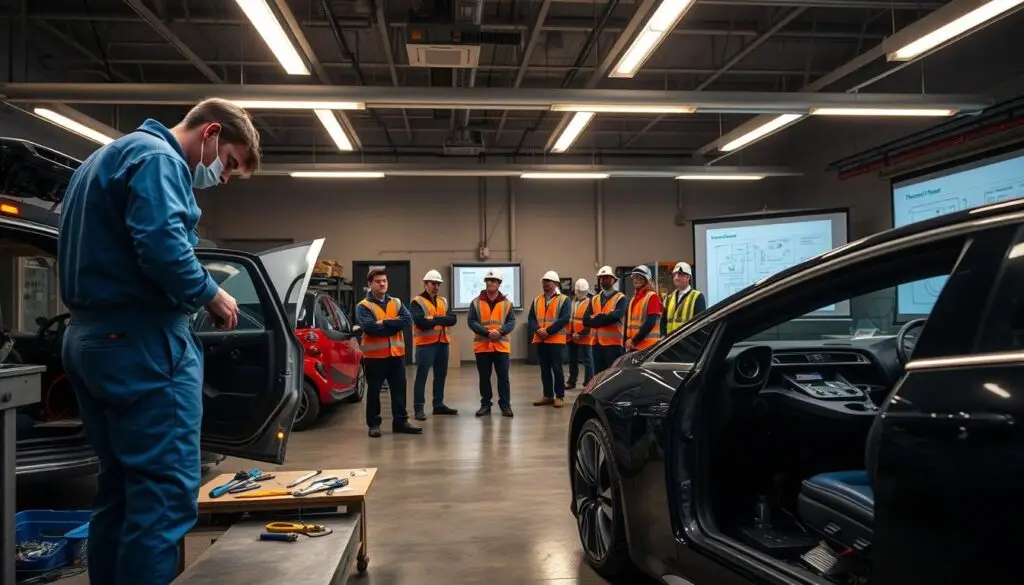
Selecting the right training program requires understanding the diverse educational options available today. The variety of EV technician certification programs ranges from manufacturer-specific courses to comprehensive technical school curricula, each offering unique advantages depending on fleet composition, budget, and operational requirements.
Manufacturer-Specific Training Programs
Major commercial EV manufacturers provide specialized training designed specifically for their vehicle platforms. Ford Pro offers comprehensive training for the E-Transit commercial van and F-150 Lightning. GM’s BrightDrop division provides dedicated training for their delivery van lineup. Other manufacturers including Tesla and Rivian offer fleet vehicle training emphasizing proprietary diagnostic systems.
Benefits of manufacturer programs include access to proprietary diagnostic tools, direct certification credentials, technical support relationships with factory representatives, early access to service bulletins, and model-specific troubleshooting protocols. These programs typically require both online modules and hands-on training and provide authorized service credentials that may be required for warranty work.
Third-Party Training Providers and Industry Organizations
Independent training organizations offer comprehensive programs covering multiple vehicle brands. The National Alternative Fuels Training Consortium (NAFTC) delivers federally supported training programs across the United States. The National Institute for Automotive Service Excellence (ASE) administers standardized certification exams validating technician competency industry-wide.
Third-party providers offer scheduling flexibility and can customize content to specific fleet needs. These organizations maintain vendor-neutral perspectives, teaching universal principles applicable across different EV manufacturers—particularly valuable for mixed fleets containing vehicles from multiple brands.
Online Training vs. In-Person Workshops
Online platforms allow technicians to complete coursework on their own schedule through interactive simulations, video demonstrations, and self-paced assessment tools. In-person workshops deliver hands-on experience with actual vehicle components and high-voltage systems, building tactile familiarity with battery disconnection procedures, thermal management systems, and charging infrastructure.
| Training Format | Primary Advantages | Best Application | Typical Cost |
|---|---|---|---|
| Online Platforms | Flexible scheduling, lower costs, unlimited review | Theory, safety protocols, diagnostic principles | $200-$800/tech |
| In-Person Workshops | Hands-on practice, instructor feedback, networking | Physical procedures, tool operation, component handling | $1,500-$4,000/tech |
| Hybrid Programs | Combines convenience with practical experience | Comprehensive skill development across all areas | $1,000-$3,000/tech |
Many fleet managers find that combining online training for foundational knowledge with in-person sessions for practical skills creates the most effective and cost-efficient learning experience.
Community College and Technical School Programs
Technical school EV programs offer comprehensive curricula spanning one to two years, resulting in certificates or associate degrees in EV technology. Institutions with dedicated EV training bays let students work with decommissioned battery packs, electric motors, and charging systems in controlled settings. Strategic advantages include lower per-student costs, accredited credentials recognized industry-wide, potential partnership opportunities for ongoing workforce development, and recruitment pipelines for adding qualified technicians to your team.
EV Certification Requirements and Industry Standards
Fleet operators must understand certification requirements to build a qualified team capable of maintaining electric vehicles safely. Industry standards protect your business from liability while ensuring technicians possess verified competency in high-voltage systems.

ASE L3 Hybrid/Electric Vehicle Specialist Certification
The ASE L3 certification represents the gold standard for electric vehicle maintenance competency. Candidates need two years of hands-on experience with hybrid or electric vehicles, or one year combined with relevant technical training.
The examination covers five critical content areas: safety procedures for high-voltage systems and lockout-tagout protocols, battery systems including diagnostics and thermal management, electric motors and regenerative braking, power management systems covering inverters and charging, and electrical/electronic systems specific to hybrid and electric vehicles. The certification remains valid for five years, after which technicians must recertify through examination or approved continuing education.
High-Voltage Safety Level 1 and Level 2 Certifications
High-voltage safety certification programs follow a tiered approach based on job responsibilities. Level 1 provides awareness training for personnel who work near electric vehicles but don’t perform service—service advisors, parts specialists, and tow truck operators. This training covers hazard recognition and emergency response without hands-on high-voltage work, typically requiring 4 to 8 hours.
Level 2 qualifies technicians to perform direct maintenance on high-voltage systems, requiring comprehensive training in electrical theory, system diagnostics, and safe service procedures over 16 to 40 hours. Certification validity typically extends two to three years before renewal becomes necessary.
NATEF Accreditation and State Licensing
The National Automotive Technicians Education Foundation establishes quality benchmarks ensuring educational institutions meet rigorous standards for curriculum content, equipment, and instructor qualifications. Fleet managers should prioritize candidates from NATEF-accredited programs when hiring, as the accreditation reduces additional training burden.
Regulatory requirements for EV maintenance vary significantly across states. California maintains the most comprehensive requirements, mandating specific certifications for technicians working on vehicles with systems above 60 volts. Several states require traditional automotive licenses plus additional high-voltage safety credentials. Multi-state fleet operations face additional complexity, though some states offer reciprocity agreements. Contact your state’s automotive repair board for current requirements, as regulations continue evolving with EV adoption.
The HDJ Perspective
The fleet industry is approaching an inflection point with EV technician development. We’re watching the same pattern that played out when electronic engine controls replaced purely mechanical systems in the 1990s—except the stakes are higher because of the voltage levels involved. Fleet operations that invest in structured training programs now will build a competitive moat. Those that wait will find themselves paying premium rates for a shrinking pool of qualified external service providers. The smartest approach we’re seeing from fleet managers is a hybrid model: send two or three top technicians through comprehensive external certification, then build internal knowledge transfer systems that multiply that expertise across the entire team. This keeps training costs manageable while building genuine organizational capability.
Building a Hands-On EV Training Program for Your Fleet
Developing in-house training capabilities provides long-term flexibility tailored to your specific vehicle platforms. While external certification programs deliver essential credentials, building internal hands-on EV training capacity creates operational independence and controls ongoing costs.
Creating a Safe High-Voltage Learning Space
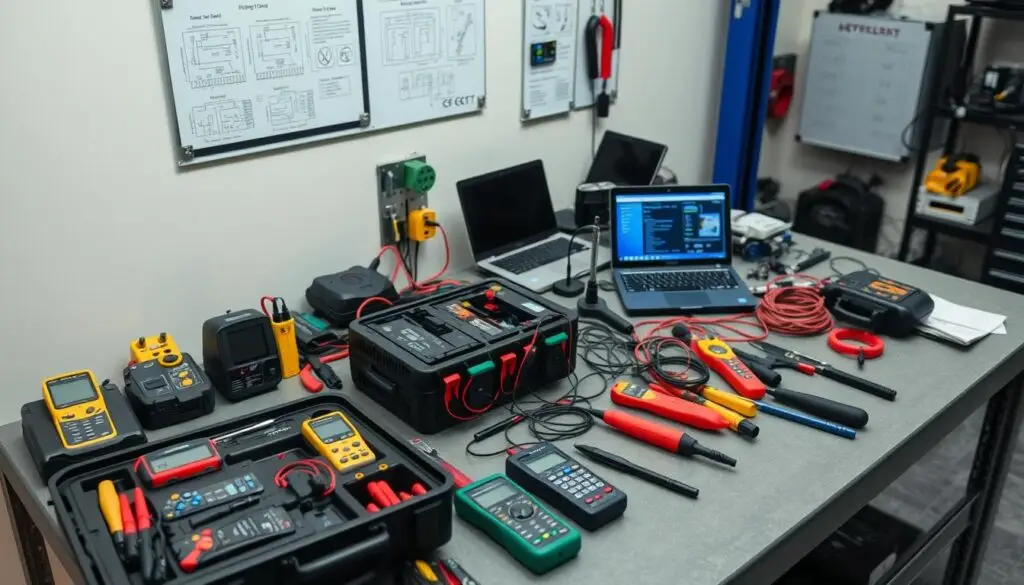
A dedicated training bay must include electrical isolation capabilities that allow technicians to practice procedures without energizing complete vehicle systems. The space requires proper ventilation for potential battery off-gassing, clearly marked emergency power disconnect systems, wall-mounted safety signage displaying voltage ratings and protocols, first aid equipment specific to electrical injuries, non-conductive flooring, and sufficient working space for group training sessions.
Essential Diagnostic Equipment Investments
Effective EV upskilling requires specific diagnostic tools that differ significantly from traditional equipment. High-voltage multimeters rated for systems exceeding 1,000 volts range from $800 to $2,500. Insulation resistance testers for battery packs and motor systems cost $1,200 to $3,000. Manufacturer-specific scan tools require $3,000 to $8,000 in hardware plus $500 to $2,000 in annual subscription fees per manufacturer.
Battery system analyzers assessing cell health and thermal performance run $5,000 to $15,000. Thermal imaging cameras for identifying electrical hotspots cost $2,000 to $8,000. Charging system test equipment ranges from $1,500 for basic testers to $10,000 or more for comprehensive systems simulating various charging standards.
Training Vehicles, Simulation, and Knowledge Transfer
Acquiring dedicated training vehicles provides practical experience without risking active fleet assets. Salvage auction EVs are available for $5,000 to $15,000 depending on damage extent—even vehicles with compromised battery packs serve training purposes when properly de-energized. Battery simulators and cut-away training systems ($15,000 to $50,000) eliminate safety concerns during initial training phases.
Creating realistic maintenance scenarios transforms theoretical knowledge into practical competency, progressing from routine procedures like 12-volt battery service and tire rotation through diagnostic troubleshooting, component replacement simulations, and emergency response scenarios. Building internal knowledge transfer through structured mentorship—pairing experienced EV technicians with trainees—creates a multiplier effect that reduces per-technician costs while building sustainable organizational expertise.
Free Professional Fleet Tools
Cost calculators, fault code lookup, maintenance planners, and more—built for owner-operators, fleet managers, and diesel techs. No signup required.
High-Voltage Safety Protocols and Personal Protective Equipment
Safety training must come first when transitioning fleet technicians to electric vehicle maintenance. The voltage levels in commercial EVs create life-threatening hazards that simply do not exist in diesel vehicle service. Before any technician touches an EV battery system or electric drivetrain component, they must master electrical safety protocols and understand proper protective measures.
Arc Flash and Electrocution Risks
Arc flash events occur when electrical current travels through air between conductors, releasing intense heat, bright light, and pressure waves. Commercial EVs operate at voltage levels that significantly exceed the threshold for lethal electrocution, which can occur at voltages as low as 50 volts under certain conditions. Several conditions increase risk: damaged insulation on high-voltage cables, moisture around electrical components, improper de-energization, corroded connections creating resistance, and tools accidentally bridging high-voltage points.
Required Personal Protective Equipment
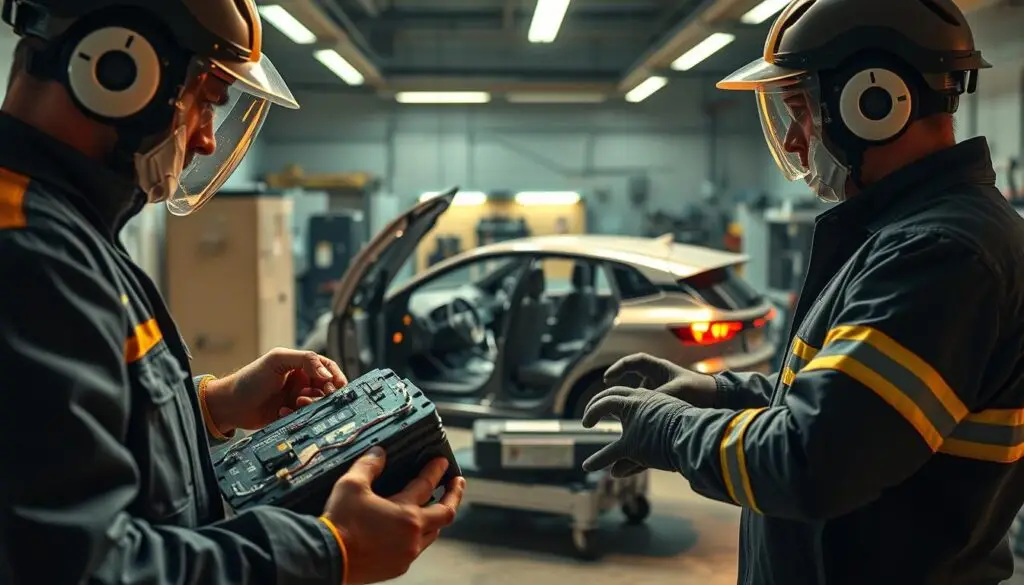
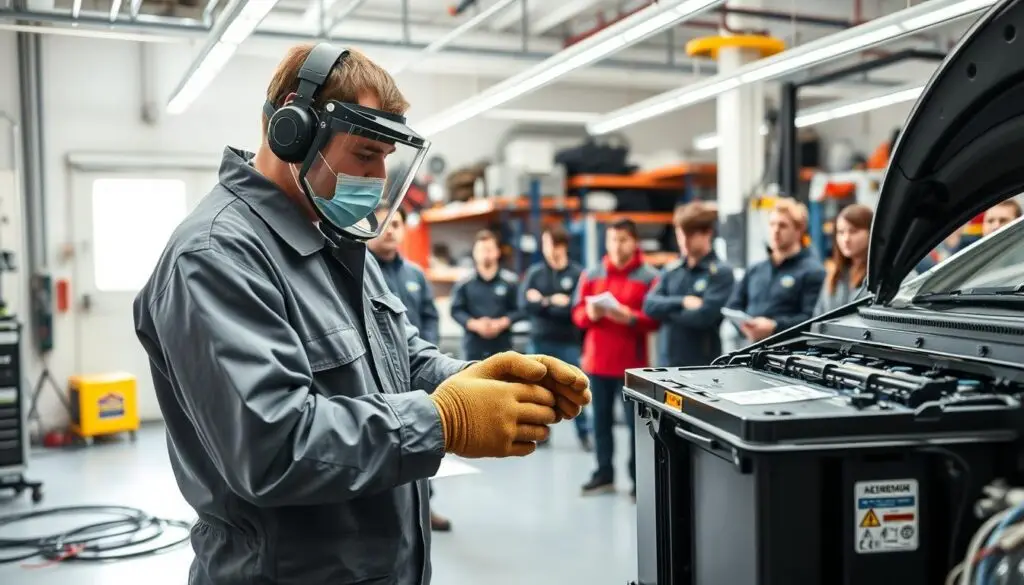
Working safely on high-voltage systems demands specialized PPE designed specifically for electrical hazards. Standard mechanic gloves and shop clothing provide no adequate protection. Every technician performing high-voltage maintenance must use Class 00 or Class 0 insulated gloves rated for 500 to 1,000 volts with leather protector gloves, arc-rated face shields with minimum 8 cal/cm² rating, voltage-rated safety footwear, flame-resistant clothing, and insulated tools rated for the voltage levels being serviced.
Insulated gloves require inspection before each use—technicians must check for tears, punctures, or degradation. Many shops use the air inflation test method. The specific PPE requirements depend on voltage level and work type, and training must teach technicians proper selection for each situation.
Lockout-Tagout and Emergency Response Procedures
Lockout-tagout procedures prevent accidental re-energization during maintenance. The critical sequence includes locating and removing the service disconnect per manufacturer procedures, verifying zero voltage at multiple test points using a properly rated multimeter, applying lockout devices, attaching danger tags, waiting the specified discharge time for high-voltage capacitors, and performing final voltage verification immediately before hands-on work. The technician who applied the lockout must be the person who removes it.
Emergency response preparation covers rescue procedures prioritizing rescuer safety—never touch a person in contact with an energized conductor. Electrical injuries require cardiac monitoring even when victims appear stable, specialized burn treatment, spinal precautions if the victim fell, and immediate medical evaluation for anyone experiencing loss of consciousness. Every facility with EVs should maintain an emergency response plan specific to electrical injuries, including AED devices and designated trained responders.
60% faster diagnostic times
Certified EV technicians resolve issues in 1.8 hours on average compared to 4.5 hours for untrained staff—directly reducing vehicle downtime and improving fleet availability.
Implementing a Training Timeline for Your Fleet
A structured EV training timeline ensures technicians develop essential skills without disrupting critical maintenance operations. Begin EV upskilling as soon as your fleet starts incorporating electric vehicles—waiting until EVs arrive creates unnecessary pressure and safety risks.
Assessing Current Technician Capabilities
Before launching any program, conduct a thorough competency assessment to establish baseline skills. Test basic electrical theory comprehension, evaluate diagnostic troubleshooting abilities, and review safety awareness regarding high-voltage systems. Document each technician’s experience level and specialization areas to shape individualized training paths. Consider using standardized assessment tools from ASE or equipment manufacturers for objective competency measurements.
Creating a Phased Training Schedule
A phased implementation typically spans 6 to 12 months, depending on fleet size and electrification pace.
| Training Phase | Duration | Target Audience | Core Objectives |
|---|---|---|---|
| Phase 1: Safety Fundamentals | 2-3 weeks | All maintenance staff | High-voltage awareness, PPE, emergency procedures, system ID |
| Phase 2: Advanced Technical | 8-12 weeks | Lead EV technicians | Battery diagnostics, motor service, inverter repair, charging systems |
| Phase 3: Supporting Knowledge | 3-4 weeks | Service advisors, assistants | EV intervals, customer communication, parts ID, workflow |
| Phase 4: Ongoing Development | Quarterly updates | All certified technicians | New models, software changes, advanced diagnostics, emerging tech |
Maintaining Operations and Validating Skills
Implement a rotating training participation model—send two or three technicians to training while others maintain normal operations. Schedule intensive blocks during slower maintenance cycles. Online modules allow theoretical coursework during after-hours or between service appointments, reserving in-person sessions for hands-on practice. Consider temporary contract mechanics during intensive training periods to protect service quality.
Effective competency validation ensures training investments produce qualified technicians. Develop detailed skills checklists, conduct supervised practical assessments with immediate feedback, and administer written knowledge testing at key milestones. Create documentation systems tracking certification records and ongoing professional development. Schedule quarterly skills reviews and annual recertification assessments—electric vehicle technology evolves rapidly, making continuous learning essential.
Training Costs and Return on Investment
Understanding the complete cost structure and potential returns helps justify this strategic investment to organizational leadership. While training expenses seem substantial initially, they represent a fraction of what fleets spend on vehicle downtime and outsourced repairs.
Planning Your Training Budget
Per-technician training program fees range from $2,000 to $8,000 depending on depth and certification levels. ASE L3 certification examination fees run approximately $80 per attempt, while high-voltage safety certifications range from $150 to $500. A complete diagnostic tool setup requires $15,000 to $50,000 in capital expenditure. PPE costs run $500 to $1,500 per technician for insulated gloves, arc-rated face shields, voltage-rated safety shoes, and flame-resistant clothing.
Accessing Government Workforce Development Funding
Multiple funding sources exist to offset training expenses. The Workforce Innovation and Opportunity Act (WIOA) provides funding through local workforce development boards for employees transitioning to new technology platforms. Department of Energy Clean Cities coalitions offer grants covering 50% to 75% of training costs for qualifying fleet operations. State-specific programs in California, New York, and 38 other states offer additional reimbursement opportunities. Combined, these programs can reduce net training expenses by 25% to 75%.
Measuring Financial Returns
Trained technicians complete diagnostics and repairs 30% to 50% faster than untrained staff. In-house maintenance eliminates costly dealer visits, with fleets reporting 40% to 60% lower per-repair costs when handling EV work internally.
| Fleet Size | Training Investment | Annual Savings | ROI Breakeven |
|---|---|---|---|
| 10-25 EVs | $35,000-$50,000 | $28,000-$42,000 | 14-18 months |
| 26-50 EVs | $55,000-$75,000 | $52,000-$78,000 | 12-16 months |
| 51-100 EVs | $85,000-$120,000 | $98,000-$145,000 | 10-14 months |
| 100+ EVs | $140,000-$200,000 | $175,000-$265,000 | 9-13 months |
Safety incident prevention and improved warranty claim acceptance rates add further financial benefits. The cumulative effect typically delivers complete return on investment within 12 to 18 months, with savings continuing to accumulate year after year—making EV technician training one of the highest-return workforce investments available to fleet operations.
Overcoming Common EV Training Implementation Challenges
Even carefully designed training programs encounter obstacles that can slow adoption and reduce effectiveness. Fleet managers who address these concerns proactively achieve higher success rates and faster competency development.
Addressing Technician Resistance
Experienced diesel technicians often feel apprehensive about high-voltage systems and worry that their established expertise will become obsolete. Frame EV training as career advancement rather than job replacement. Emphasize that electric vehicle skills increase market value and that transferable competencies form a strong foundation. Gradual exposure through classroom learning before hands-on practice, regular coaching sessions, and celebrating early successes reduce resistance more effectively than management directives.
Keeping Training Current and Managing Workforce Availability
Electric vehicle technology advances quickly, outdating training materials. Establish relationships with multiple training providers, subscribe to manufacturer technical service bulletins, participate in industry conferences through organizations like TMC (Technology & Maintenance Council) and SAE, and build internal knowledge-sharing systems where technicians document solutions and discuss challenging repairs.
Balancing training with daily operations requires staggered training groups maintaining adequate staffing, cross-training for backup capabilities, and coordination with fleet demand cycles. Online modules handle theoretical content during flexible hours while in-person sessions are reserved for hands-on practice requiring supervision.
Retaining Trained EV Technicians
EV-certified technicians command premium compensation in a competitive labor market. Protect training investments through competitive pay adjustments tied to specific credentials, clear career development paths into lead or supervisory positions, ongoing advanced training opportunities, and structured retention bonuses contingent on continued service. Communicating the strategic importance of technicians to the organization’s electrification goals builds intrinsic motivation beyond compensation.
Implementation Challenge Quick Reference
- Technology resistance: Gradual exposure, career framing, celebrate early wins
- Knowledge currency: Multiple providers, TSB subscriptions, industry conferences
- Workforce scheduling: Staggered groups, cross-training, demand cycle coordination
- Talent retention: Certification-tied pay raises, career paths, retention bonuses
Frequently Asked Questions
How long does it take to train a diesel technician on electric vehicle maintenance?
A structured EV training program typically spans 6 to 12 months using a phased approach. Phase one covers high-voltage safety fundamentals for all staff over 2 to 3 weeks. Phase two delivers advanced technical training to primary EV technicians over 8 to 12 weeks, covering battery systems, electric motors, power electronics, and charging infrastructure. Phase three extends supporting knowledge to service advisors and assistants over 3 to 4 weeks. Ongoing quarterly updates keep skills current as technology evolves.
What certifications do fleet EV technicians need?
The ASE L3 Light Duty Hybrid/Electric Vehicle Specialist certification is the industry gold standard, covering high-voltage safety, battery systems, electric motors, power management, and EV-specific electrical systems. Technicians also need high-voltage safety certification at Level 2 for direct service work, plus potentially manufacturer-specific certifications from Ford Pro, GM BrightDrop, or other OEMs for warranty-eligible repairs. State licensing requirements vary—California maintains the most comprehensive mandates for technicians working on systems above 60 volts.
How much does EV technician training cost for a fleet operation?
Per-technician program fees range from $2,000 to $8,000 depending on depth and certification level. Diagnostic equipment investment adds $15,000 to $50,000 for a complete setup. PPE costs $500 to $1,500 per technician. Federal and state workforce development grants through WIOA and DOE Clean Cities programs can offset 25% to 75% of total costs. Most fleet operations achieve positive ROI within 12 to 18 months through reduced downtime and lower per-repair costs.
What are the biggest safety risks when untrained technicians work on electric vehicles?
Commercial EVs operate at 400 to 800 volts DC—far exceeding the 50-volt threshold for lethal electrocution. Arc flash incidents can produce temperatures above 35,000 degrees Fahrenheit. Battery packs remain energized even when vehicles are powered off, creating hidden hazards throughout the repair process. Additional risks include thermal runaway in damaged lithium-ion cells, chemical exposure from battery electrolytes, and high-voltage cable damage during routine maintenance. OSHA regulations specifically address electrical safety for workers exposed to voltages above 50 volts.
Can diesel technicians transfer any existing skills to EV maintenance?
Diesel technicians bring several valuable transferable competencies. Systematic diagnostic problem-solving methodologies apply equally to electrical system troubleshooting. Suspension, steering, and friction brake knowledge remains directly relevant. HVAC maintenance principles transfer well, as do vehicle systems integration concepts. However, high-voltage electrical theory, battery chemistry, power inverter operation, charging protocols, and advanced software diagnostics all require complete retraining with no diesel equivalent.
What is the ROI of EV technician training for commercial fleets?
Trained technicians complete diagnostics 30% to 50% faster, and in-house maintenance reduces per-repair costs by 40% to 60% versus dealer outsourcing. For a mid-size fleet of 26 to 50 EVs, typical investments of $55,000 to $75,000 yield annual savings of $52,000 to $78,000, reaching breakeven in 12 to 16 months. Three-year net benefits range from $96,000 to $159,000. Additional returns include improved warranty acceptance rates and reduced safety incident liability.
Preparing Your Fleet Maintenance Team for the Electric Future
EV training for diesel technicians represents a strategic investment that fleet managers cannot afford to postpone. As commercial fleets transition to electric powertrains, fleet electrification readiness depends on having qualified maintenance personnel in place before vehicles arrive. The fleet operations that invest in structured training programs now—combining comprehensive curriculum, hands-on high-voltage practice, professional certification, and continuous education—will build a competitive advantage through superior technical capabilities, reduced operating costs, and stronger technician retention in an increasingly electric transportation landscape.
Help Fellow Fleet Professionals Prepare for EVs
Know a fleet manager or shop owner navigating the diesel-to-electric transition? Share this guide to help them build a trained, certified maintenance team.