

By Michael Nielsen, Publisher | 15+ Years in Diesel Repair
Last Updated: September 2026
⏱ Estimated reading time: 14 minutes
A truck service provider for fleet operations is a repair partner evaluated and selected specifically for its ability to minimize commercial vehicle downtime — through certified technicians, adequate parts inventory, fast emergency response, and technology that catches problems before they cause a breakdown. The right choice is measurable: fleets that select providers this way typically cut downtime by 20-40% compared to picking a shop on price or proximity alone. The wrong choice compounds daily, since a truck that isn't generating revenue is still generating fixed costs.
Key Takeaways
- ✓Fixed costs don't pause for repairs. With ATRI's 2026 report putting the average non-fuel operating cost at $1.854 per mile, a parked truck keeps accruing payment, insurance, and permit costs while earning nothing.
- ✓Certifications name the technician, not the shop. ASE's T-Series (T1-T8) specifically certifies Class 4-8 truck technicians — a general automotive ASE credential doesn't cover the same systems.
- ✓Fleet service contracts typically run 10-25% below transactional pricing while adding priority scheduling — but only when both sides track performance against real metrics, not goodwill.
- ✓Mobile repair completion rate is the single best proxy for a provider's real capacity — the percentage of roadside calls resolved without a tow reveals more than any marketing claim.
In This Guide
- The Real Cost of Fleet Downtime
- Technical Qualifications and Certifications to Look For
- Infrastructure, Technology, and Parts Access
- Emergency Response and Mobile Repair Capabilities
- Preventive Maintenance Programs and Service Agreements
- Pricing Models and Contract Structures
- Managing the Relationship: Metrics and Vendor Reviews
- Frequently Asked Questions
The Real Cost of Fleet Downtime
Selecting a truck service provider starts with understanding exactly what a bad choice costs. According to the American Transportation Research Institute's 2026 Analysis of the Operational Costs of Trucking, the industry-average non-fuel cost to operate a Class 8 truck reached $1.854 per mile in 2025 — a figure that includes truck and trailer payments, insurance, permits, and driver benefits that continue accruing whether or not the truck is moving.
A parked truck isn't a cost-neutral event; it's a truck that has stopped earning while every fixed line item on that per-mile figure keeps running.
Industry surveys of fleet operators commonly put total downtime cost — combining lost revenue, idle driver pay, and rebalanced loads — in the range of $450 to $1,500 per truck per day, with the wide range reflecting differences in revenue model, contract penalties, and how a fleet accounts for driver wages during a breakdown. As of September 2026, that range has only gotten more expensive to sit inside of, since repair and maintenance costs alone rose 8.6% industry-wide over the prior year.
| Cost Category | What Continues During Downtime | Why It Matters to Provider Choice |
|---|---|---|
| Fixed operating costs | Truck/trailer payments, insurance, permits | Faster turnaround directly shortens the window these costs run with zero revenue offsetting them |
| Driver wages | Standard pay for a driver with no truck to run | Mobile repair that avoids a tow keeps the driver working instead of waiting |
| Contract penalties | Missed delivery windows under shipper agreements | A provider with a guaranteed response window protects commitments a fleet can't control otherwise |
| Emergency repair premium | After-hours labor rates, expedited parts shipping | A provider with deep parts inventory and standard-rate scheduled service avoids the premium entirely |
Fleet operators who calculate only the direct repair invoice routinely underestimate what a breakdown actually costs — the visible parts-and-labor line is frequently the smaller half of the real number once idle driver pay, rebalanced loads, and any contract penalty are added in. According to Michael Nielsen, Heavy Duty Journal's publisher with 15+ years in diesel repair, this is the single most common blind spot fleet managers bring into a provider evaluation.
Contract Penalties and the Customer Relationship
Vehicle unavailability does damage well beyond the repair bill by threatening delivery schedules directly. A missed delivery window can trigger a penalty clause worth thousands of dollars in a shipper contract, and repeated failures put the entire account at risk — a customer who has to explain a late delivery to their own customer rarely gives a second chance quietly.
The safety stakes compound the financial ones: FMCSA research has found that motor carriers flagged for vehicle-maintenance interventions carry a 65% greater future crash rate than the national average — maintenance quality and delivery reliability are measuring the same underlying discipline.
The reputational cost compounds quietly. Fleets known for unreliable service find premium freight harder to secure over time, often getting pushed toward lower-margin loads simply to keep trucks utilized. Heavy Duty Journal has tracked this pattern across the fleets and shops we cover at heavydutyjournal.com: the providers who protect a fleet's on-time performance are protecting something that shows up on the fleet's own bottom line months later, not just the shop's invoice today.
Technical Qualifications and Certifications to Look For
Certifications identify the technician, not the shop, which is a distinction fleet managers frequently miss. Look specifically for technicians holding ASE's T-Series Medium-Heavy Truck certifications (T1-T8), which cover Class 4 through Class 8 systems specifically — engines, drivetrain, brakes, suspension, electrical, and preventive maintenance inspection. A general automotive ASE credential does not test the same material, so asking "are your techs ASE certified?" without asking which series is a common evaluation mistake.
Manufacturer-specific training compounds general certification. Technicians holding current factory training from Cummins, Detroit Diesel, Caterpillar, or Allison bring platform-specific diagnostic knowledge that a generalist shop can't match, particularly on engines still under OEM warranty where non-factory-trained work can complicate a claim.
DOT compliance expertise is non-negotiable rather than a nice-to-have. A provider's inspection and repair work must satisfy 49 CFR Part 396, the federal inspection, repair, and maintenance standard every motor carrier is held to — a provider unfamiliar with its documentation requirements creates compliance exposure that lands on the fleet, not the shop, at the next roadside inspection.
$1.854 Per Mile
ATRI's 2026 report puts the average non-fuel cost of operating a Class 8 truck at this figure for 2025 — the fixed-cost baseline that keeps running on every day a truck sits idle for repair.
Shops that also invest in their own workplace-safety compliance tend to run tighter, more disciplined operations generally. OSHA's General Industry standards (29 CFR 1910) govern hazard communication, lockout/tagout, and machine guarding in a repair shop — a facility that visibly follows these isn't just protecting its own technicians, it's demonstrating the same procedural discipline that shows up in how carefully they document your fleet's repairs. HDJ's OSHA compliance guide for diesel repair shops covers exactly what that safety discipline actually requires.
Service Territory and Location Coverage
Geographic coverage determines whether a technically excellent provider can actually serve a fleet's real operating footprint. A shop with outstanding technicians two states away from where most of your trucks run provides little practical value the day a breakdown happens on a route it doesn't cover. Multi-location networks or authorized service-center partnerships matter most for regional and national fleets specifically, since they guarantee consistent service quality wherever a truck happens to break down rather than forcing a scramble to find an unfamiliar shop in an unfamiliar city.
Map a fleet's primary routes against a candidate provider's actual coverage area before signing anything, not after. A concentrated regional fleet has very different coverage needs than one running trucks across a dozen states, and a provider's marketing materials rarely make that distinction as clearly as a direct question does: which specific routes and states does their mobile and shop coverage genuinely reach, and where does that coverage thin out or stop?
Infrastructure, Technology, and Parts Access
A workshop's physical capacity determines how many of your trucks it can actually touch at once without creating a queue. Fleet-ready bays need higher ceilings, reinforced floors, and lift systems rated for vehicles exceeding 80,000 pounds — a shop built around passenger-vehicle infrastructure simply can't accommodate a Class 8 tractor regardless of how skilled its technicians are.
Beyond raw bay capacity, look for equipment standards that specifically signal fleet readiness: dynamometer testing for engine performance verification, alignment equipment built for commercial axle configurations, and dedicated transmission repair stations with the correct specialized tooling. Climate-controlled work areas let technicians perform precision work regardless of season, and a visibly organized shop — clean workspaces, clearly labeled parts storage, disciplined tool management — correlates strongly with fewer diagnostic errors and faster turnaround, since organizational discipline in the bay tends to show up in the paperwork too.
Parts Inventory Depth
Parts availability is one of the most overlooked predictors of actual turnaround time. A provider with 30-60 days of common-parts inventory on-site — filters, brake components, belts, electrical parts — starts work immediately; one that orders as needed adds one to three days to every repair that isn't a same-day walk-in item. Ask directly about authorized-dealer relationships with major manufacturers, since those relationships determine priority access during parts shortages rather than aftermarket-only sourcing.
Diagnostic Technology and Telematics Integration
Modern commercial engines require manufacturer-current scan tools — a generic code reader misses the depth of data a proprietary diagnostic platform captures, which is how misdiagnosis and repeat repairs happen. Ask when a shop's diagnostic software was last updated; engine control modules, transmission controllers, and emissions systems all receive manufacturer software revisions that require a corresponding scan-tool update to read correctly. HDJ's diesel diagnostic tools comparison guide breaks down what separates a shop running current, professional-grade platforms from one relying on a basic code reader.
Providers that connect their systems to your fleet's telematics platform can receive fault-code alerts before a truck ever arrives, prepare the likely parts in advance, and turn a diagnostic visit into a straight repair. Ask specifically how a candidate provider uses telematics data operationally — whether they review vehicle health trends proactively or only react once a truck is physically on the lift.
| Capability | Fleet-Ready Provider | General Repair Shop |
|---|---|---|
| Common parts stock | 30-60 day supply on-site | Ordered as needed |
| OEM relationships | Authorized dealer status | Aftermarket only |
| Diagnostic software | Manufacturer-current, updated per release | Generic code reader, infrequent updates |
| Telematics integration | Proactive fault-code review, parts pre-staged | Reactive only, truck must be on-site |
Emergency Response and Mobile Repair Capabilities
Response time is where marketing promises and actual capacity diverge fastest. A provider should commit to specific, documented response windows rather than vague "we'll get someone out there" assurances, and those commitments should scale realistically with geography — urban markets typically support 1-2 hour priority response, while rural coverage areas reasonably run 2-4 hours depending on distance from the nearest mobile unit.
The single most revealing number a provider can share is their mobile-repair completion rate — the percentage of roadside calls resolved on-site without a tow. Skilled mobile technicians routinely handle brake adjustments, electrical diagnostics, fuel-system troubleshooting, tire and wheel-end service, DEF system faults, and cooling-system repairs in the field. Providers achieving completion rates above 70% are returning more than two-thirds of emergency calls to the road without ever touching a shop bay, which is the outcome that actually protects a delivery schedule.
| Service Level | Urban Response | Rural Response | Typical Use |
|---|---|---|---|
| Priority emergency | 60-90 minutes | 2-3 hours | Safety hazard or fully blocked operations |
| Standard emergency | 2-3 hours | 3-5 hours | Same-day but not immediately critical |
| Scheduled mobile service | 4-8 hours | Same or next business day | Planned on-site maintenance |
Request documented evidence rather than a verbal claim — average response times by service level, and the percentage of calls that actually met the committed window, are both reasonable things to ask a candidate provider to produce. A truck that sits with an unaddressed defect long enough also risks a roadside out-of-service order under the Commercial Vehicle Safety Alliance's North American Standard Inspection Program — another reason a provider's real response speed matters beyond the immediate delivery schedule.
Preventive Maintenance Programs and Service Agreements
The providers who reduce downtime most reliably are the ones structured around prevention rather than reaction. A generic maintenance schedule doesn't work well across different duty cycles — a stop-and-go urban delivery route stresses brakes and transmission fluid faster than steady highway miles, so a provider worth partnering with adjusts service intervals to how your specific trucks are actually used, not a one-size-fits-all mileage chart.
Tiered service structures are a useful signal of a mature PM program: lighter inspections at shorter intervals (fluid checks, filters, safety items) layered with deeper inspections at longer intervals (brakes, suspension, drivetrain) and major service events (transmission, differential, comprehensive wear assessment) at the longest interval. This structure catches wear early without over-servicing healthy components — replacing a belt during a scheduled visit because a technician spotted early cracking costs a fraction of the emergency tow-and-repair that same belt failure causes on the highway.
Key Recommendation
Ask any candidate provider directly how they document proof of maintenance intervals. Most commercial vehicle warranty claims require it, and a provider who tracks this automatically — rather than relying on the fleet to keep its own paper trail — is protecting a warranty claim you might otherwise lose on a technicality.
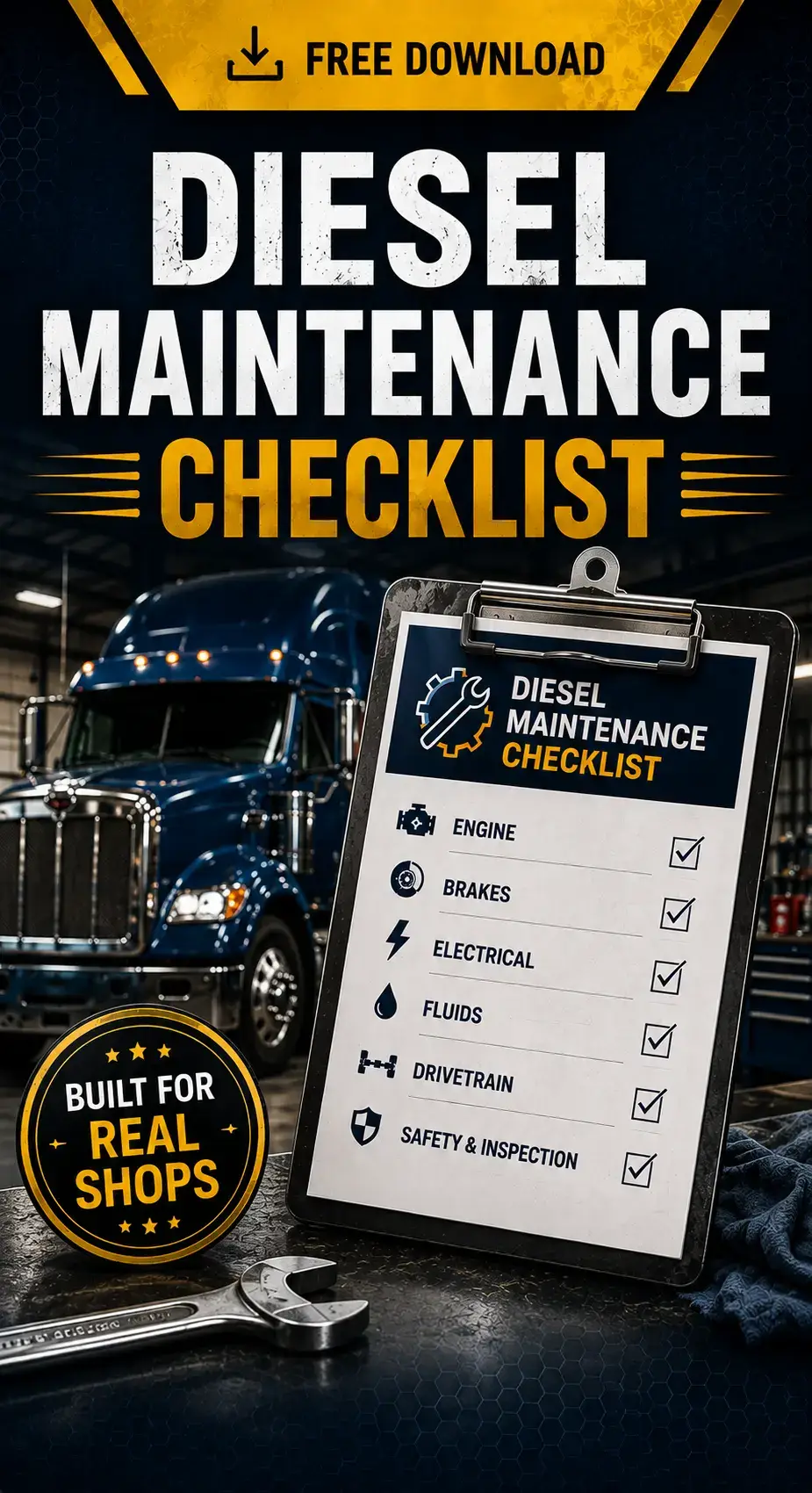
Free Diesel Maintenance Checklist
Get HDJ's free, field-tested diesel maintenance checklist delivered instantly to your inbox — print it, laminate it, keep it in the shop.
Instant PDF • 100% Free • No Spam
Pricing Models and Contract Structures
Two labor-billing models dominate commercial truck repair, and the difference matters for budget predictability. Flat-rate pricing charges a fixed labor amount per repair type from a published labor guide, regardless of how long the job actually takes — a technician who works faster than the guide time still bills the full amount, which rewards efficiency and gives a fleet a known cost before work begins. Hourly billing charges for actual time spent, which suits complex or hard-to-diagnose repairs better but introduces cost uncertainty that complicates budgeting.
Structured fleet service agreements shift the relationship from one-off transactions to an ongoing partnership. A solid agreement typically bundles negotiated labor rates below standard retail (often 15-30% lower), guaranteed priority scheduling, a dedicated service coordinator, consolidated billing across every visit, and defined response-time commitments. For fleets with consistent service volume, these agreements commonly deliver 10-25% total cost savings compared to paying transactional rates at each visit — savings that compound with the operational advantage of not re-explaining your fleet's history to a new shop every time something breaks.
Warranty terms deserve the same scrutiny as the labor rate itself. OEM parts typically carry manufacturer warranties beyond the shop's own guarantee and maintain compliance with any factory warranty still active on the vehicle, at a 30-50% price premium over comparable aftermarket components — a premium that's easiest to justify on newer equipment or mission-critical routes.
Separately, ask what labor warranty covers workmanship itself: reputable providers guarantee their own work for 30 days to a year and correct improper repairs at no charge, a commitment that signals real confidence in their quality control rather than just their marketing copy.
Managing the Relationship: Metrics and Vendor Reviews
Selecting the right provider is the starting point, not the finish line — the value compounds or erodes based on how the relationship is managed afterward. Track a specific, small set of metrics rather than relying on impressions: average repair turnaround from drop-off to return to service, first-time fix rate (repairs that don't require a return visit for the same problem), schedule adherence against promised completion times, and cost per mile trend over time.
| Metric | What It Reveals |
|---|---|
| Average turnaround time | How fast a truck actually returns to revenue service |
| First-time fix rate | Diagnostic accuracy — repeat visits mean the root cause wasn't found |
| Schedule adherence | Reliability and honest capacity management |
| Cost per mile trend | Whether the relationship is trending favorably or needs a conversation |
Quarterly or semi-annual business reviews turn this data into something useful. A good review covers performance trends against the prior period, direct feedback from drivers and dispatchers, and honest discussion of what could improve on both sides — not just a one-way scorecard.
Benchmarking these metrics against the Technology & Maintenance Council's Recommended Practices Manual gives both sides a neutral, industry-standard reference point rather than an internal number with no outside context. Document what's agreed to in these sessions and follow up on it; a provider relationship where commitments are tracked and revisited consistently outperforms one where issues get raised once and never checked again.
Frequently Asked Questions
What is the average cost of fleet downtime per truck per day?
Industry surveys commonly put total downtime cost in the range of $450 to $1,500 per truck per day, combining lost revenue, idle driver wages, and rebalanced loads. ATRI's 2026 report puts the average non-fuel operating cost at $1.854 per mile — the fixed portion of that figure keeps accruing regardless of whether the truck is moving, which is why the visible repair bill is usually the smaller half of what a breakdown actually costs.
What certifications should a fleet truck service provider have?
Look specifically for ASE's T-Series (T1-T8) Medium-Heavy Truck certifications, which cover Class 4 through Class 8 systems — a general automotive ASE credential doesn't test the same material. Manufacturer-specific training and DOT compliance knowledge under 49 CFR Part 396 add further protection against documentation gaps at roadside inspections.
How important is a provider's mobile repair completion rate?
It's one of the most reliable indicators of real capacity. A provider completing more than 70% of emergency calls on-site without a tow is resolving the majority of breakdowns without the added cost and delay of vehicle recovery and shop scheduling. Ask a candidate provider for this number directly and request documented evidence rather than accepting a verbal estimate.
Should I choose flat-rate or hourly billing for fleet maintenance?
Flat-rate pricing gives cost predictability and rewards technician efficiency since the charge is fixed regardless of actual time spent. Hourly billing suits complex diagnostic work better but introduces cost uncertainty. The right choice often depends more on your fleet's repair mix than a fixed preference for one model.
What are the benefits of a fleet maintenance contract versus paying per repair?
Fleet service agreements typically deliver 10-25% cost savings versus transactional pricing, plus priority scheduling, a dedicated coordinator, and consolidated billing across every visit. For fleets with steady service volume, the operational simplicity often matters as much as the direct cost savings.
Choosing a truck service provider for fleet operations is a decision that compounds every day it's in effect — the right partner turns maintenance from an unpredictable expense into a manageable, budgeted line item, while the wrong one quietly erodes margins through extended downtime, repeat repairs, and missed delivery windows insurance never covers.
The framework here — technical certifications matched to your equipment, real infrastructure and parts depth, documented response times, a maintenance program built around your actual duty cycle, transparent pricing, and metrics tracked consistently after the contract is signed — gives fleet managers a concrete way to evaluate a provider beyond an hourly rate on a quote sheet, a pattern heavydutyjournal.com continues to track across the fleets and shops we cover.
Start by assessing your current provider against these criteria, request facility tours and references from other fleet accounts, and put performance expectations in writing before the next contract renewal.
Share This With Your Maintenance Team
If your fleet's next service-provider review is coming up, this is worth forwarding to whoever signs off on that contract.