By Michael Nielsen, Publisher | 15+ Years in Diesel Repair
Last Updated: September 2026
⏱ Estimated reading time: 15+ minutes
The roads are becoming more dangerous for a commercial vehicle operator. As of September 2026, per the National Highway Traffic Safety Administration, an estimated 39,345 people died in traffic crashes in 2024 — the lowest fatality count since 2019, though still well above pre-pandemic norms. These numbers tell a story every fleet manager needs to hear, and AI driver safety monitoring is emerging as one of the more effective responses to the pressure that follows.
Michael Nielsen and Heavy Duty Journal's editorial team built this guide because a traditional approach to managing driver behavior is no longer enough, and manual oversight can't catch a dangerous moment in real time. A truck driver monitoring system powered by artificial intelligence now provides a capability that was impossible just a few years ago — though a fair amount of the specific savings percentages circulating around this technology come from the vendors selling it, not from an independent audit, which is worth keeping in mind throughout this guide.
Key Takeaways
- ✓Traffic fatalities reached 39,345 in 2024 — a real, NHTSA-confirmed figure — and collision-related costs continue rising, making proactive safety technology a genuine fleet priority.
- ✓Automatic emergency braking has reduced heavy truck crashes by more than 40% in academic and IIHS-cited research — a real figure, though it's tied to specific studies rather than a single blanket industry statistic.
- ✓Manual oversight can't catch a dangerous moment in real time — AI monitoring fills a genuine gap that human supervision alone can't cover across a large fleet.
- ✓Vendor-reported ROI figures are common but not independently audited — treat a specific accident-cost or insurance-premium percentage as a company claim to verify against your own data, not a settled industry statistic.
- ✓Driver acceptance improves with proper framing — positioning the technology as protection rather than surveillance is what actually drives adoption.
In This Guide
- The Current Landscape of Truck Driver Safety Challenges
- Understanding AI Driver Safety Monitoring Technology
- Key AI Technologies Transforming Fleet Safety
- Real-Time Driver Behavior Monitoring Capabilities
- AI-Powered Compliance Tracking and Reporting
- Collision Avoidance and Predictive Safety Systems
- Benefits for Fleet Managers and Trucking Companies
- Implementation Challenges and Solutions
- The Future of AI in Trucking Safety and Compliance
- Frequently Asked Questions
The Current Landscape of Truck Driver Safety Challenges
A trucking company confronts an escalating safety challenge with a real consequence for a driver, a business, and the public. Understanding this challenge reveals why a traditional monitoring method no longer provides adequate protection for a commercial vehicle operation.
Accident Statistics Driving Industry Change
The National Highway Traffic Safety Administration's 39,345 estimated 2024 traffic fatalities include a meaningful share of a commercial vehicle involvement, per the National Safety Council's own separate large-truck data, which counted over 5,200 large trucks involved in a fatal crash that same year. The frequency and severity of an accident continues to strain resource across the transportation sector, and each incident generates a ripple effect that impacts an insurance rate, a regulatory scrutiny, and public perception.
The Rising Cost of Non-Compliance
A fleet operator faces mounting expense from a safety failure and an FMCSA regulation violation — a direct cost including an accident repair, a medical expense, a legal fee, and a workers' compensation claim, and an indirect expense encompassing an increased premium, a regulatory fine, a vehicle downtime, and a lost contract with a safety-conscious shipper.
Vendors in this space commonly report a substantial annual reduction in accident-related cost and a meaningful reduction in insurance cost after an AI system's implementation — figures worth requesting directly from a specific platform and verifying against your own fleet's baseline rather than treating as a guaranteed outcome.
Understanding AI Driver Safety Monitoring Technology
The integration of artificial intelligence into trucking safety creates a new paradigm where a vehicle actively prevents an accident rather than merely recording it. This technological shift represents more than an incremental improvement — it fundamentally changes how a fleet manager approaches driver protection and risk mitigation.
What Is AI Driver Safety Monitoring
AI driver safety monitoring is an intelligent system that continuously observes driver behavior, vehicle performance, and environmental condition using an advanced sensor and a machine learning algorithm. Unlike a passive recording device, these systems detect an unsafe situation in a real-time vehicle monitoring scenario and intervene before an accident occurs through an immediate alert and notification.
Core Components of Modern AI Safety Systems
A modern AI safety platform consists of three interconnected layers. A sophisticated sensor array captures every aspect of the driving experience — a high-resolution camera monitors both road conditions and driver attentiveness, a GPS module tracks location and speed, and an accelerometer and gyroscope measure a vehicle dynamic including a hard braking, a rapid acceleration, and a cornering force. An infrared sensor enables a night vision capability, and a vehicle diagnostic port connection provides direct access to engine performance data from the J1939 network.
Powerful edge computing technology at the system's core delivers substantial processing power compared to a basic dashcam, running a complex driver behavior analytics algorithm that identifies a pattern and assesses a risk instantly without cloud latency. When a risk is detected, an in-cab audio and visual warning alerts a driver to a danger requiring instant attention, while the system simultaneously flags an event on a management dashboard for a coaching opportunity and trend analysis.
How AI Differs from Traditional Monitoring Methods
A traditional telematics system laid essential groundwork by transforming a vehicle into a mobile data source, but a legacy platform lacked the intelligence to interpret context or predict an emerging risk before it became a dangerous situation. Third-party benchmarking from an organization like the Virginia Tech Transportation Institute has long studied naturalistic driving behavior and crash risk, and a fleet manager evaluating a specific platform's detection-accuracy claim should ask the vendor for that platform's own third-party validation rather than assume a general industry-wide figure applies.
Key AI Technologies Transforming Fleet Safety
An advanced artificial intelligence platform leverages four core technology categories to transform driver safety monitoring, working together to create comprehensive protection for a driver, vehicle, and cargo.
Computer Vision and Camera Systems
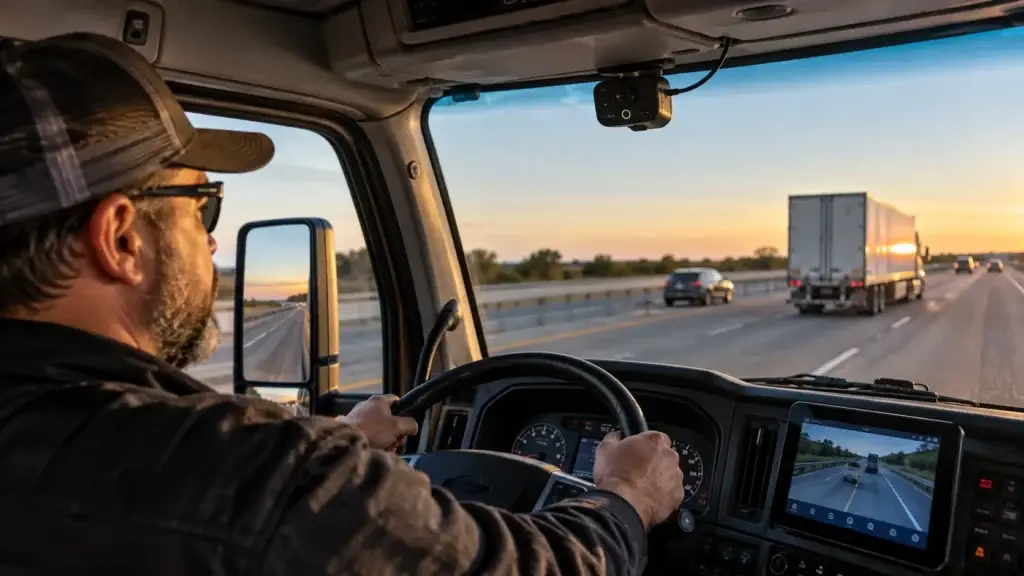
A road-facing camera provides a high-definition recording of traffic conditions and a potential hazard ahead, and a modern dashcam increasingly features a dual road-facing lens that enables a stereo vision for enhanced depth perception, improving accuracy for a forward collision warning and lane departure alert.
A driver-facing camera uses infrared technology to track driver alertness regardless of lighting condition, monitoring eye movement, head position, and facial expression to detect a fatigue or distraction before it becomes dangerous. A 360-degree surround view system eliminates a dangerous blind spot around a commercial vehicle, capturing evidence that protects a driver and company from a fraudulent claim.
Machine Learning for Pattern Recognition
A machine learning application enables a system to learn from millions of driving events across diverse conditions, identifying a subtle risk indicator a human observer often misses — including a microsleep episode lasting just a couple of seconds and a gradual attention drift that precedes a more serious lapse. The pattern recognition capability improves continuously as the system processes more data.
Telematics and IoT Sensor Integration
A modern AI platform synthesizes data from multiple vehicle sensors to create a holistic safety profile, collecting information on engine diagnostics, brake application force, steering angle, acceleration pattern, and geographic location. This sensor integration allows AI to understand the complete context of a driving event and identify a correlation between a different risk factor that would be invisible when examining any single data stream.
Real-Time Driver Behavior Monitoring Capabilities
An AI-powered system continuously watches and analyzes driver action to identify a safety risk instantly, monitoring dozens of behaviors simultaneously to create a comprehensive picture of driver performance throughout every shift.
Fatigue and Drowsiness Detection
An infrared camera measures pupil dilation, gaze direction, and blink frequency with remarkable precision. A drowsiness monitoring algorithm detects a microsleep episode when eyes close for a couple of seconds — enough time for a truck to travel over 200 feet at highway speed — and an abnormal blink rate signals decreasing alertness, triggering an immediate warning before the situation becomes critical.
A camera system also tracks a nodding, tilting, or slumping head position that indicates reduced attention, and an advanced fatigue index system synthesizes a behavioral signal with telematics data and hours-of-service information to identify a fatigue risk before critical degradation occurs.
Distraction and Cell Phone Use Detection
Computer vision technology identifies when a driver looks away from the road or reaches for a mobile device, recognizing a texting behavior, a phone call, and another attention-diverting activity in real time. When a sensor detects a driver reaching for a phone or exhibiting distracted behavior, an automated safety alert triggers an in-cab audio or visual warning immediately, creating a teachable moment a fleet manager can review later for coaching.
Aggressive Driving Pattern Recognition
AI analyzes vehicle dynamics data to identify an aggressive driving pattern that increases accident risk significantly. A deceleration event exceeding a safe threshold indicates a following too closely or an inattentive driving that requires intervention, and a rapid acceleration pattern suggests an aggressive, fuel-wasting behavior that also increases mechanical wear.
A system compares vehicle speed against a posted limit, a safe speed for current conditions, and a company policy in real time, with a hierarchical automated safety alert escalating from a minor notification to a severe violation warning based on the degree and duration of speeding.
Seatbelt and Safety Protocol Compliance
A weight sensor, camera verification, and status monitoring ensure a driver follows a basic safety protocol consistently, detecting an unbuckled seatbelt, a disabled safety feature, or an improper equipment use immediately.
| Monitoring Category | Detection Method | Primary Benefit |
|---|---|---|
| Fatigue Detection | Eye tracking, head position, blink analysis | Prevents drowsy driving accidents |
| Distraction Monitoring | Computer vision, gaze tracking, hand detection | Reduces inattentive driving incidents |
| Aggressive Driving | Telematics, accelerometer, GPS speed | Lowers collision rates and fuel costs |
| Safety Compliance | Weight sensors, camera verification, monitors | Ensures regulatory compliance and injury prevention |
AI-Powered Compliance Tracking and Reporting
Compliance tracking has evolved beyond a manual record-keeping, with an AI platform now handling the complex task of regulatory adherence automatically. HDJ's fleet compliance management software guide covers this category in more depth, including how a leading platform handles DOT reporting specifically.
Automated Hours of Service Management
The system tracks cumulative hours behind the wheel against federal limits under 49 CFR Part 395 — 11 hours driving and 14 hours on-duty. A driver sees a countdown timer showing remaining available time, and a smart system notifies a driver and dispatcher before an HOS limit expires, enabling a proactive route adjustment or driver swap that prevents a violation before it occurs.
DOT and FMCSA Regulation Compliance
An AI platform stays current with an evolving FMCSA regulation including the ELD mandate and a vehicle maintenance requirement under 49 CFR Part 396, automatically generating a required report and flagging a compliance gap before an inspection or audit occurs.
Collision Avoidance and Predictive Safety Systems
The integration of a predictive safety system in a commercial truck has fundamentally transformed how the industry approaches accident prevention. These collision avoidance systems actively intervene to prevent a crash rather than simply documenting an incident after it occurs — and the underlying mechanism has a genuinely strong evidence base behind it.
Automatic emergency braking specifically has been shown to reduce heavy truck crashes by more than 40% in peer-reviewed research cited by the Insurance Institute for Highway Safety, and forward collision warning combined with autobrake has reduced rear-end collisions by roughly 50% in broader vehicle studies. These are real, well-documented figures — worth distinguishing from the many less-traceable vendor percentages that circulate elsewhere in this space.
Forward Collision Warning and Automatic Emergency Braking
A forward collision warning system uses radar and camera technology to continuously calculate a closing rate with a vehicle ahead. When a collision risk is detected, these systems issue an escalating automated safety alert that grows more urgent as danger increases, and if the driver fails to respond in time, an automatic emergency braking engages to prevent or mitigate the impact.
Lane Departure Warning and Prevention
Computer vision technology tracks a lane marking and vehicle position continuously throughout every journey. When an unintentional drift occurs due to inattention or drowsiness, a driver receives an immediate automated safety alert through a visual, auditory, or haptic warning, and an advanced system provides a gentle steering correction that guides the vehicle back to center lane position before a dangerous departure occurs.
Blind Spot Detection and Side Collision Avoidance
A radar sensor and side-mounted camera monitor an adjacent lane, illuminating a warning indicator when a vehicle enters a blind spot. For a large truck with an extensive blind zone along both sides, this technology provides a critical awareness that a mirror alone can't deliver.
Predictive Risk Assessment and Route Analysis
Real-time meteorological data combines with a road surface sensor and historical incident pattern to identify a hazardous segment. When ice, flooding, fog, or a high wind creates an elevated risk, the system automatically suggests a safer alternative route or timing adjustment, preventing an accident by avoiding a dangerous condition altogether rather than relying solely on driver judgment.
Benefits for Fleet Managers and Trucking Companies
A trucking company implementing an AI safety system reports a measurable improvement in accident prevention, insurance cost, driver development, and operational efficiency. As with the earlier caveat, most of the specific percentages a fleet manager will encounter from a specific vendor come from that vendor's own reporting rather than an independent audit — real directional evidence, but worth verifying against your own operation before building a budget case around a headline number.
Lower Insurance Premiums and Claims
A documented safety improvement can qualify a fleet for a preferred rate with an insurer who recognizes AI monitoring as a genuine risk reduction strategy. HDJ's practical guide to fleet insurance costs covers the broader set of strategies a fleet can pair with an AI system to compound that discount. An AI system also accelerates a claim settlement by providing a timestamped video evidence and a comprehensive sensor data, preventing a fraudulent claim against the company while expediting a legitimate claim's resolution.
Enhanced Driver Training and Coaching Programs
A modern driver coaching program leverages AI analytics to transform how a company develops its workforce. Fleets that frame footage as coaching and protection rather than surveillance report meaningfully higher operator approval for an in-cab camera program, which enables a meaningful performance improvement without damaging driver retention in an already tight labor market. An AI system provides each driver with an objective safety rating based on specific behaviors observed over time, replacing a subjective supervisor opinion with a defensible performance data.
Legal Protection and Liability Reduction
A timestamped video evidence and comprehensive sensor data exonerate a driver in a not-at-fault accident while defeating a fraudulent injury claim. The documentation provides a regulatory compliance proof that demonstrates a good-faith safety effort to a court and regulatory agency, reducing a punitive damages exposure in litigation while accelerating a favorable claim resolution.
Implementation Challenges and Solutions
Introducing fleet safety technology into an existing operation presents an obstacle ranging from a driver concern to a technical integration complexity. A company that anticipates these challenges and implements a proven solution achieves faster adoption and a better long-term result.
Driver Acceptance and Privacy Concerns
Many a driver initially views a monitoring system as an intrusive surveillance that erodes trust and autonomy. This resistance represents the single biggest barrier to a successful real-time vehicle monitoring program. Advance notification explaining how a system protects a driver from a false accusation changes the narrative from surveillance to support, and a Driver Privacy Mode that turns a driver-facing camera off when a driver is off-duty or a vehicle is stationary helps protect a driver while reducing an unnecessary alert that creates frustration.
⚠️ Privacy Law Compliance
AI and privacy-related laws differ widely across jurisdictions. California has some of the strictest data privacy laws in the country, while other states have minimal regulation. Ensure your written policy specifies what data is collected, who can access it, how long it's retained, and under what circumstances it may be reviewed. Consult legal counsel familiar with your operating jurisdictions before deployment.
Initial Technology Investment and ROI Considerations
A quality AI system requires a substantial upfront investment in hardware, software licenses, and installation across a fleet. Most an operation achieves a positive ROI within roughly 12-18 months when implementation follows a best practice, and the financial case tends to strengthen as an insurance carrier increasingly offers a premium discount for a verified monitoring system that demonstrates genuine risk reduction.
Data Management, Storage, and Security
A massive video and telematics data stream requires a robust cloud storage infrastructure and sufficient bandwidth for an upload. A retention policy must balance a legal requirement against a storage cost — most a fleet retains standard footage for 30-60 days while preserving an incident recording for an extended period based on a claims timeline and litigation requirement.
System Integration with Existing Fleet Technology
Connecting an AI platform with an existing dispatch system, maintenance software, payroll application, and customer portal presents a technical challenge that requires careful planning. Selecting a vendor with an open API, a proven integration experience, and a dedicated implementation support ensures a smooth deployment without an operational disruption.
The Future of AI in Trucking Safety and Compliance
The next generation of an AI-powered safety system will transform how the trucking industry approaches driver protection and regulatory compliance, building upon a current machine learning application to deliver an unprecedented level of commercial vehicle safety.
Autonomous and Semi-Autonomous Vehicle Integration
While a fully autonomous truck remains in development, a semi-autonomous feature is already enhancing commercial vehicle safety on America's highways. Significant challenges remain unresolved, however — a liability question persists when an accident involves an autonomous vehicle, and determining responsibility among a manufacturer, fleet operator, AI developer, and component supplier requires a new insurance model and regulatory framework that's still evolving.
Vehicle-to-Vehicle Communication Networks
An emerging V2V protocol enables a truck to share real-time information about a road hazard, traffic condition, and emergency braking event, transcending an individual vehicle's awareness to create a collective safety benefit for every equipped vehicle on the road.
Standardization and Regulatory Development
The industry currently faces a fragmentation challenge as a different manufacturer uses an incompatible data format, preventing a comprehensive analysis across a mixed fleet. The American Trucking Associations and another industry group continue advocating for a standard that balances a safety improvement with a practical implementation requirement.
Free DOT Status Check
Enter a USDOT number and quickly review public carrier status, operating authority and key FMCSA registration data.
Frequently Asked Questions
What is AI driver safety monitoring and how does it work?
It uses machine learning, cameras, and sensors to continuously observe driver behavior and road conditions in real time, detecting an unsafe situation and intervening before an accident occurs through in-cab alerts and fleet manager notifications. It combines computer vision, telematics data, and pattern recognition to identify a risk like fatigue, distraction, or aggressive driving that a human observer might miss.
How much can fleets actually save by implementing AI safety monitoring?
Vendors commonly report a substantial reduction in accident-related cost and insurance premium, with most operations reaching positive ROI within 12-18 months. These figures are typically vendor-reported rather than independently audited, so request documentation from a specific platform and measure against your own fleet's baseline before building a budget projection.
What safety events can AI dashcams detect?
Common detections include drowsiness and fatigue through eye tracking, distracted driving and cell phone use, hard braking and rapid acceleration, excessive speeding, lane departure, forward collision risk, and seatbelt non-compliance. Coverage varies meaningfully by platform, so confirm the specific event list with any vendor you're evaluating.
How do AI systems address driver privacy concerns?
Leading platforms include a Driver Privacy Mode that disables driver-facing cameras when off-duty or the vehicle is stationary, sometimes tied to a geofenced location. A written policy should specify what data is collected, who can access it, retention periods, and review circumstances — framing the technology as protection rather than surveillance meaningfully improves acceptance.
What is the typical ROI timeline for AI fleet safety technology?
Most operations achieve positive ROI within 12-18 months when implementation follows best practices. Initial returns come from reduced accident frequency and severity; insurance premium reductions typically follow once a carrier recognizes a documented safety improvement over a longer measurement period.
How does AI safety monitoring integrate with existing fleet systems?
Platforms connect with dispatch systems, maintenance software, electronic logging devices, and payroll applications through APIs, eliminating redundant data entry and creating a unified compliance record. When selecting a vendor, prioritize an open API, proven integration experience with your existing systems, and dedicated implementation support.
The Bottom Line
AI driver safety monitoring has moved beyond experimental technology into a proven category — the same discipline Michael Nielsen and Heavy Duty Journal's editorial team hold every guide on heavydutyjournal.com to. A fleet operator who implements this technology gains a real advantage in safety performance and cost control, but the strongest implementations come from a manager who treats a vendor's specific savings claim as a starting point to verify, not a settled fact to build a budget around.
Smart implementation requires addressing both a technical and human factor. A fleet manager should address a driver concern through transparent communication and a clear privacy policy that demonstrates respect, and should request documented, third-party-verifiable evidence from any vendor rather than relying solely on a marketing figure.
Help Your Network Stay Safe
Know a fleet manager, safety director, or owner-operator who could benefit from this guide? Share it with your professional network to help the industry move toward safer roads.