By Michael Nielsen, Editor & Publisher | 15+ Years in Diesel Repair
Last Updated: December 2025
📖 Estimated reading time: 22 minutes
Understanding truck manufacturing plants and their production capacity has become essential knowledge for fleet managers navigating equipment acquisition decisions in 2025. The commercial vehicle sector faces significant headwinds—Class 8 orders have declined sharply, with preliminary October 2025 figures showing continued weakness well below replacement demand. Original equipment manufacturers have responded with conservative build schedules, creating a market environment where lead times have normalized even as underlying demand fundamentals remain soft.
For fleet operators planning equipment purchases, this environment presents both challenges and opportunities. Regulatory uncertainty surrounding EPA 2027 emissions standards, combined with tariff pressures affecting approximately one-third of North American Class 8 production in Mexico, continues to influence purchasing decisions. The backlog-to-build ratio hovering near 6.1 months reflects OEM discipline rather than strong order activity, meaning build slots remain more accessible than they were during the supply-constrained period of 2021-2022.
This guide examines current production capacity across major manufacturing facilities, analyzes lead time trends, and provides the strategic context fleet managers need for informed equipment procurement planning.
Key Takeaways
- Lead times normalized: Current delivery windows of 3-6 months represent a dramatic improvement from 12-18 month delays during 2021-2022 supply constraints.
- Production cuts outpace orders: The 6.1-month backlog-to-build ratio reflects OEM production discipline rather than strong demand accumulation.
- Tariff exposure matters: Approximately one-third of North American Class 8 builds occur in Mexico, creating cost uncertainty as Section 232 tariffs took effect November 1, 2025.
- EPA 2027 uncertainty persists: Regulatory ambiguity has eliminated traditional pre-buy behavior, complicating fleet replacement timing decisions.
- Capacity utilization down significantly: Most facilities operate at 55-70% of theoretical maximum, down from 85-95% during peak demand periods.
- Build slot availability favorable: Fleet operators now have greater flexibility in timing purchases and customizing specifications than at any point since 2019.
Current State of the Heavy Duty Truck Market
The commercial vehicle sector enters the final weeks of 2025 with mixed signals that complicate strategic planning for manufacturers and fleet operators alike. Class 8 truck orders have contracted substantially throughout the year, with October 2025 recording preliminary net orders well below replacement demand and significantly below typical October peaks—traditionally one of the strongest booking months of the year.
Fleet operators remain hesitant to commit capital for new equipment purchases. Multiple uncertainties cloud the investment horizon, creating a wait-and-see mentality across the industry that has persisted for much of 2025.
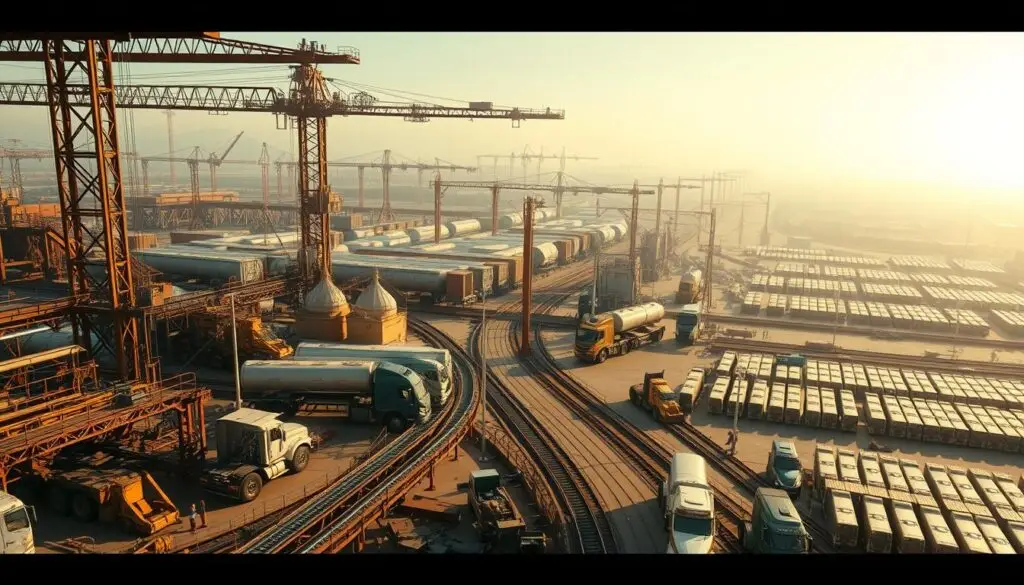
The upcoming EPA 2027 low-NOx emissions standards present particular challenges for planning cycles. These regulations require an 82.5% reduction in nitrogen oxide emissions—from 0.2 g/bhp-hr to 0.035 g/bhp-hr—fundamentally altering engine technology requirements and impacting vehicle pricing structures. The rule also extends useful life requirements to 650,000 miles, up from 435,000 miles, which affects warranty obligations and long-term ownership costs.
This regulatory uncertainty has eliminated the traditional pre-buy behavior that typically precedes major emissions rule changes. Fleet managers lack the cost-benefit data needed to make informed timing decisions, and with less than 14 months until the MY 2027 compliance date, clarity remains elusive.
Trade Policy Complications
Trade policy complications add another dimension to market uncertainty. Section 232 tariffs on imported trucks and components took effect November 1, 2025. These tariffs threaten to raise acquisition costs significantly, particularly because approximately one-third of North American Class 8 production occurs at Mexican facilities operated by multiple major OEMs.
According to ACT Research’s Class 8 order tracking, tariff-driven cost inflation is materially increasing purchase prices for trucks with imported content, including Mexico-sourced units. Combined with high financing and insurance costs, fleets continue to delay multi-unit commitments until tariff litigation and EPA 2027 timelines become clearer.
6.1 Months
Current backlog-to-build ratio, reflecting OEM production discipline — ACT Research, November 2025
OEM production schedules have turned conservative in response to softening demand. Manufacturers have implemented aggressive output reductions to align capacity with current order levels. The backlog-to-build ratio currently stands at approximately 6.1 months—a figure that appears elevated given weak order activity but primarily reflects even deeper production cuts rather than strong demand accumulation.
Factors Constraining Fleet Investment
Several factors converge to constrain fleet investment in the commercial vehicle sector:
- Regulatory uncertainty: EPA 2027 standards remain subject to potential rollback or delay of warranty and useful life extensions, though technology requirements are expected to remain intact
- Trade policy risk: Section 232 tariffs create cost uncertainty for domestically-sold trucks built in Mexico
- Freight market weakness: Soft demand reduces equipment utilization and revenue generation potential
- Financing costs: Interest rates remain elevated compared to historical fleet financing averages
- Insurance expenses: Premium increases continue outpacing general inflation rates
The used truck market remains active as carriers adjust their fleet compositions. Right-sizing initiatives dominate strategic decisions as operators respond to freight market conditions. However, secondary market pricing continues to reflect oversupply, with average retail prices falling month over month and year over year as of October 2025.
Truck Manufacturing Plants: Production Capacity Analysis
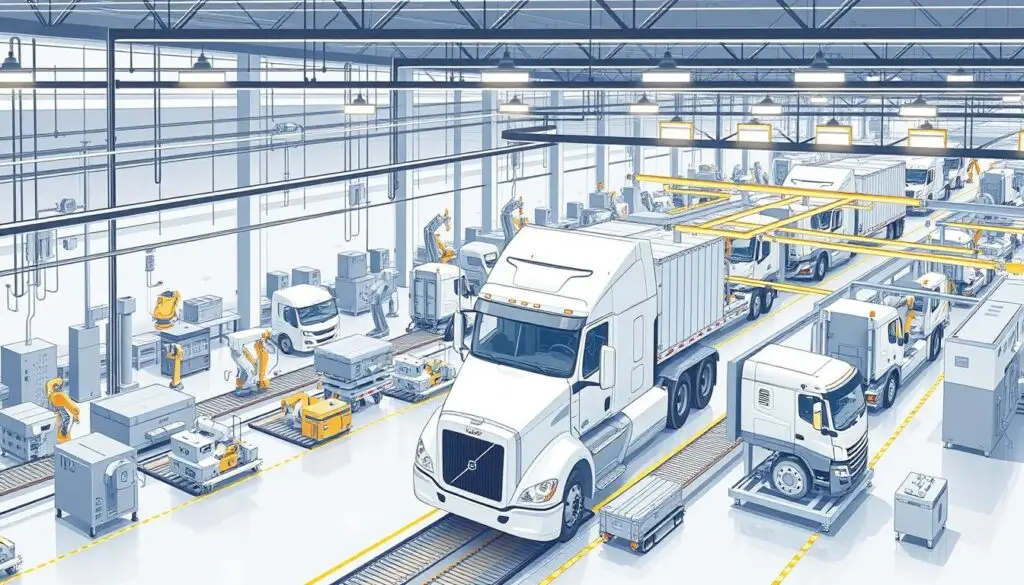
Manufacturing capacity across heavy duty truck assembly facilities demonstrates considerable underutilization as producers adjust output to align with current order volumes. OEMs have implemented conservative build schedules throughout 2025, responding to softening demand signals and elevated inventory levels across the distribution network. The current environment represents a significant shift from the capacity-constrained conditions that characterized 2021 and 2022, when manufacturers struggled to meet order intake.
Class 8 build activity has declined markedly from first-half levels, prompting manufacturers to announce additional reductions for the fourth quarter and into 2026. This strategic pullback aims to better synchronize production output with incoming orders and prevent inventory accumulation.

Regional Manufacturing Footprint
Total annual production capacity varies substantially across North American manufacturing regions, with distinct geographic clusters supporting the industry. The southeastern United States hosts major concentrations of truck assembly plants, particularly in North Carolina and Virginia. These facilities benefit from established automotive supply chains, favorable business climates, and access to transportation infrastructure.
Midwest manufacturing facilities in Ohio and Pennsylvania represent the traditional heart of American truck production. These plants leverage decades of manufacturing expertise, skilled labor pools, and proximity to major freight corridors serving the eastern and central regions.
Mexican facilities have emerged as critical contributors to North American heavy truck production. Operations across northern Mexico provide cost-competitive manufacturing with direct access to the U.S. market through established cross-border logistics networks. However, the implementation of Section 232 tariffs has introduced significant uncertainty regarding long-term cross-border manufacturing economics.
| Manufacturing Region | Est. Annual Capacity | Current Utilization | Primary Manufacturers |
|---|---|---|---|
| Southeastern U.S. | 145,000 – 160,000 units | 60% – 68% | Daimler, Volvo Group |
| Midwest U.S. | 110,000 – 125,000 units | 55% – 64% | PACCAR, Navistar |
| Northern Mexico | 135,000 – 150,000 units | 62% – 70% | Multiple OEMs |
| Texas | 75,000 – 85,000 units | 55% – 62% | PACCAR, Navistar |
Utilization Metrics and Output Levels
Plant operations across the industry reflect substantially reduced utilization rates compared to the elevated levels experienced during the 2021-2022 demand surge. Most facilities currently operate at 55% to 70% of theoretical maximum capacity, representing a significant decline from the 85% to 95% utilization rates common during peak demand periods.
This reduced capacity utilization results from deliberate production cuts rather than operational constraints. Manufacturers have systematically reduced build schedules throughout 2025, with additional cuts announced for Q4 2025 and early 2026 to prevent inventory accumulation and maintain pricing discipline.
Output metrics reveal that absolute production volumes have declined approximately 30% to 35% from 2022 peak levels. Monthly Class 8 production fell sharply in October 2025, according to ACT Research’s Class 8 forecast data, despite October having the highest number of sales days in 2025. This drop aligns with weaker order activity and a strategic shift by OEMs to slow builds in response to excess inventories and carrier margin pressures.
Constraints Preventing Rapid Production Scaling
Several structural constraints limit manufacturers’ ability to rapidly increase production output should demand conditions improve. These factors will shape the industry’s response when market recovery eventually materializes.
Skilled labor shortages represent the most significant challenge, particularly for critical assembly and manufacturing roles requiring specialized training and experience. The complexity of modern heavy duty trucks demands workforce expertise that cannot be quickly developed. Training new workers to full proficiency typically requires 12-18 months for complex assembly operations.
Component availability issues continue to affect production planning, despite improvements from the acute shortages experienced in 2021-2022. Semiconductor chips and electronic control systems remain particular pain points, with lead times for specialized automotive-grade components often exceeding 26-40 weeks.
Capital investment requirements present another significant constraint. Adding production lines or expanding facility footprints requires substantial financial commitments—typically $150-250 million per production line addition—with multi-year payback periods. In the current uncertain demand environment, manufacturers demonstrate reluctance to commit capital to capacity expansions that may prove unnecessary.
Stay Informed on Equipment Trends
Market conditions for fleet equipment are shifting rapidly. Subscribe to Heavy Duty Journal’s newsletter for weekly updates on manufacturing capacity, lead times, and strategic procurement insights.
Lead Time Trends for Heavy Duty Truck Orders
Understanding current heavy truck lead times requires examining how delivery schedules have evolved through successive phases of supply disruption, recovery, and market rebalancing. The landscape for ordering and receiving Class 8 trucks has transformed dramatically from the constraints of recent years. Fleet operators now face a fundamentally different environment when planning equipment acquisitions.

Current Average Lead Times by Manufacturer
Delivery schedules vary across major heavy duty truck manufacturers, though all have seen substantial improvements compared to peak constraint periods. The current environment offers fleet operators more predictability and flexibility than at any point since 2019.
Average lead times now range from 3 to 6 months for most standard configurations, with some variation based on specific powertrain choices and optional equipment packages. Custom specifications requiring specialized components may extend timelines by several weeks. Regional dealers report improved ability to provide accurate delivery estimates—a significant improvement over the uncertain projections that characterized 2021-2022.
Build slots have opened considerably across all manufacturers as consecutive months of year-over-year order declines reduced production queues. Fleet managers can now specify delivery timing more precisely to align with operational needs. This flexibility represents a return to pre-pandemic market conditions where customers drove timing rather than accepting whatever slots manufacturers could offer.
Lead Time Comparison: 2022 Through 2025
The evolution of heavy truck lead times over the past three years tells the story of an industry moving from crisis to normalization. Each year brought distinct market dynamics that shaped delivery schedules and manufacturer capacity utilization.
| Time Period | Average Lead Time | Market Conditions | Primary Constraints |
|---|---|---|---|
| 2022 | 12-18 months | Extreme demand, supply disruption | Semiconductors, component shortages |
| 2023 | 8-12 months | Softening demand, improving supply | Lingering component issues, labor |
| 2024 | 4-6 months | Subdued orders, adequate capacity | Regulatory uncertainty, market caution |
| 2025 (Current) | 3-6 months | Weak orders, disciplined production | Tariffs, EPA 2027, carrier margins |
In 2022, extreme supply chain disruptions created unprecedented order backlogs with lead times frequently exceeding 12-18 months for popular configurations. Semiconductor shortages forced production line stoppages, while surging demand from freight market growth pushed order books to record levels. Many fleets placed orders without firm delivery commitments, contributing to inflated backlog figures.
Throughout 2023, conditions began improving as supply chains gradually recovered and component availability stabilized. Lead times compressed to 8-12 months for most orders as manufacturers increased output. However, demand started softening in the second half as freight rates declined and economic uncertainty grew.
By 2024-2025, lead times normalized substantially to the current 3-6 month range as order activity remained subdued and manufacturers implemented conservative build schedules. The focus shifted from expansion to replacement cycles, with fleets adopting a cautious approach to capital expenditures.
Order-to-Delivery Timeline Breakdown
The order-to-delivery timeline now includes several distinct phases that fleet operators should understand when planning equipment acquisitions:
- Order placement and specification finalization: 1-2 weeks for customers to complete detailed vehicle configuration and secure financing approval
- Production slot assignment: Variable timing based on manufacturer capacity and current backlog status, now more flexible than in recent years
- Component procurement and staging: 2-4 weeks as manufacturers coordinate supplier deliveries and prepare assembly materials
- Vehicle assembly: 1-2 weeks for complete truck construction on production lines
- Quality inspection and compliance verification: 3-5 days for thorough testing and EPA certification confirmation
- Delivery logistics: 1-2 weeks for transportation from manufacturing facility to dealer or customer location
Total timelines typically range from 3-6 months depending on specification complexity and component availability. Rush orders may be accommodated for premium fees when production scheduling allows.
The HDJ Perspective
The current lead time environment represents a rare window of opportunity for fleet operators who’ve been deferring equipment purchases. While the temptation to wait for further regulatory clarity on EPA 2027 is understandable, the combination of available build slots, normalized delivery windows, and pre-tariff pricing for domestic production creates favorable acquisition conditions that may not persist. Fleets with aging equipment approaching trade cycle thresholds should carefully evaluate whether current market conditions warrant accelerating replacement timelines—particularly for units that will require costly maintenance to extend their service life through an uncertain 2026-2027 period.
Major Heavy Duty Truck Manufacturers and Production Status
Major truck manufacturers have adjusted their production strategies significantly in response to changing market conditions and conservative fleet purchasing patterns. The competitive landscape in North America centers on four dominant players who collectively control manufacturing capacity and determine delivery timelines for the vast majority of Class 8 trucks.
Daimler Trucks North America, PACCAR, Volvo Group, and Navistar operate the primary assembly plants that supply commercial transportation fleets across the United States and Canada. Each manufacturer has implemented production reductions to align output with current order intake levels.
Daimler Trucks North America: Freightliner and Western Star
Daimler Trucks North America operates as the largest heavy duty truck manufacturer in North America, producing both Freightliner and Western Star branded vehicles. The company’s manufacturing footprint spans multiple facilities designed to serve different market segments.
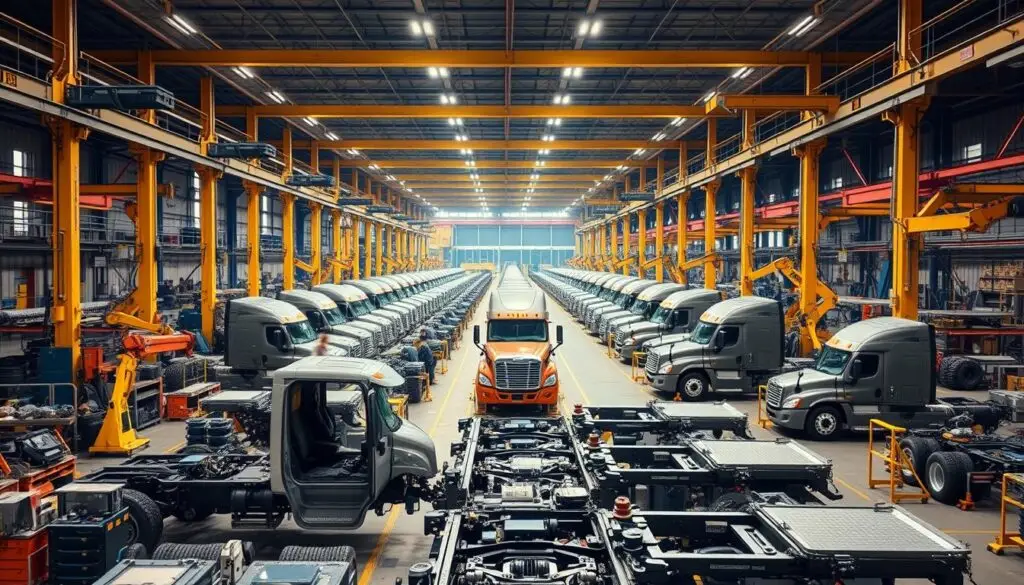
The Cleveland, North Carolina facility is DTNA’s largest heavy-duty truck plant in the U.S., spanning 1.2 million square feet on 178 acres. The facility employs approximately 2,000 people and currently assembles the Fifth Generation Freightliner Cascadia and Western Star 47X and 49X. The Cleveland plant recently celebrated production of its 850,000th truck—a milestone Western Star 47X delivered to Alamo Group in July 2025.
Portland, Oregon houses the specialized Western Star manufacturing facility, concentrating on vocational trucks and severe-duty applications that serve construction, logging, and energy sectors. This operation has demonstrated somewhat more resilience than over-the-road segments due to infrastructure project demand and specialized equipment replacement cycles.
Lead times for standard Freightliner configurations have normalized to typical ranges of 4-6 months. Custom vocational specifications through Western Star may require additional time depending on body upfitter requirements and specialized component availability.
PACCAR: Peterbilt and Kenworth
PACCAR operates as the parent company for both Peterbilt and Kenworth brands, maintaining premium market positioning through advanced engineering and dealer network strength. The company’s manufacturing strategy distributes production across multiple facilities in the United States and Mexico.
Three primary manufacturing locations anchor PACCAR’s domestic production network: Denton, Texas serves as the dedicated Peterbilt manufacturing facility; Chillicothe, Ohio operates as a major Kenworth production site; and Renton, Washington houses the company’s original western regional Kenworth plant.
Production output across PACCAR facilities has declined from 2022 peaks as build schedules adjust to incoming order volumes. The company’s premium market positioning has provided some insulation from market weakness. Larger fleets with stronger balance sheets represent a significant portion of PACCAR’s customer base, contributing to relatively more stable order patterns compared to industry averages.
Delivery schedules have compressed as build slot availability improves. Standard configurations for both Peterbilt and Kenworth now show delivery timelines in the 4-5 month range. Highly customized specifications may extend these timelines depending on proprietary component sourcing requirements.
Volvo Group: Volvo Trucks and Mack Trucks
The Volvo Group manufactures heavy duty trucks under both the Volvo Trucks and Mack Trucks brands from dedicated facilities in traditional industrial regions. Volvo truck production emphasizes fuel efficiency and advanced safety technologies, while Mack focuses on vocational durability and construction market applications.
The New River Valley facility in Dublin, Virginia serves as the world’s largest Volvo truck manufacturing facility. The 2.3-million-square-foot plant sits on 566 acres and produces all Volvo trucks sold in North America, including the recently launched all-new Volvo VNL. The facility employs approximately 3,600 people and represents part of a $400 million investment by Volvo Group in North America.
Macungie, Pennsylvania houses the historic Mack Trucks manufacturing complex. This facility produces the full range of Mack heavy duty models, including the Anthem highway truck and the Granite vocational series. Mack Trucks capacity focuses heavily on construction and refuse applications where brand loyalty remains strong despite broader market softness.
Both Volvo Group facilities have implemented production cuts to align with current order books. Current lead times for standard configurations range from 4-6 months, with improved component availability contributing to more predictable delivery schedules.
Navistar International
Navistar production operates under TRATON Group ownership following the 2021 acquisition by Volkswagen’s commercial vehicle division. The company manufactures International brand trucks from facilities in both the United States and Mexico, providing production flexibility and cost optimization.
Springfield, Ohio serves as Navistar’s primary U.S. assembly complex for International trucks. The facility has undergone modernization investments including updated assembly line equipment and quality systems. Escobedo, Mexico provides additional production capacity for both domestic Mexican market demand and export to the United States.
International truck lead times have normalized alongside competitors as component supply chains stabilize. Standard configurations show delivery windows of approximately 5-6 months—a substantial improvement from the extended backlogs of 2021-2022.
| Manufacturer | Primary U.S. Facilities | Current Lead Time | Capacity Status |
|---|---|---|---|
| Daimler Trucks NA | Cleveland NC, Portland OR | 4-6 months | Below maximum, conservative schedules |
| PACCAR | Denton TX, Chillicothe OH, Renton WA | 4-5 months | Reduced from peak, stable premium segment |
| Volvo Group | New River Valley VA, Macungie PA | 4-6 months | Substantial reduction from peak |
| Navistar | Springfield OH, Escobedo MX | 5-6 months | Adjusted to match order intake |
Manufacturing Challenges and Production Constraints
The heavy duty truck manufacturing sector confronts multiple simultaneous obstacles that significantly constrain production flexibility and strategic planning capabilities. These manufacturing constraints range from workforce availability to regulatory uncertainty, creating a challenging environment for producers attempting to meet market demand.
Workforce Development Challenges
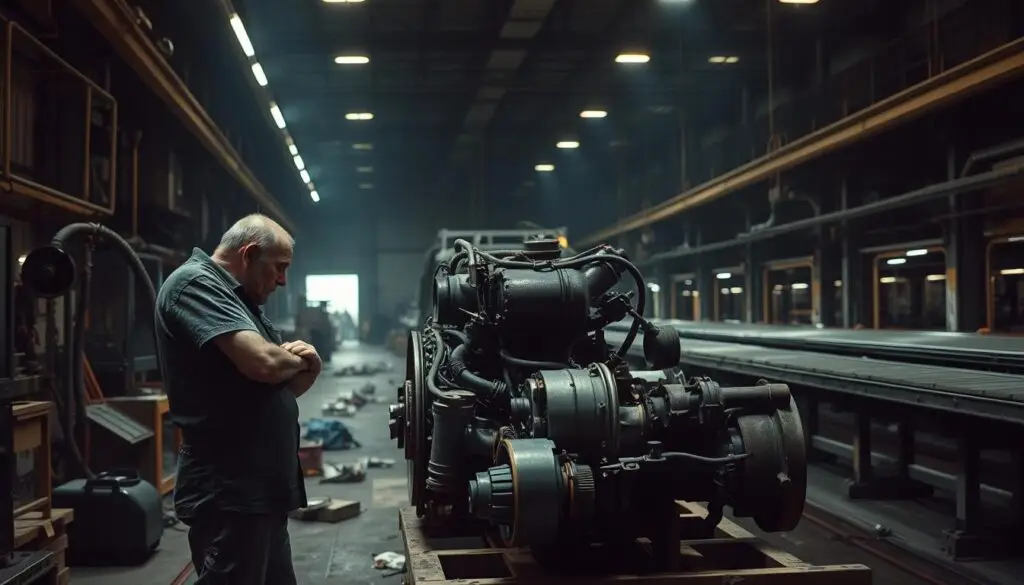
The skilled labor shortage represents one of the most fundamental constraints limiting production capacity across heavy duty truck assembly facilities. Building commercial trucks requires specialized expertise that cannot be quickly developed or easily replaced. Technicians must understand complex electrical systems integration, advanced powertrain installation procedures, precision chassis assembly, and rigorous quality control protocols.
The manufacturing workforce has aged considerably over the past two decades. Many experienced technicians approach retirement age while younger workers show limited interest in manufacturing careers. This demographic shift creates a pipeline problem that extends beyond current market conditions.
Training new workers requires substantial time and investment. Assembly line positions demand months of hands-on experience before technicians achieve full productivity. While current reduced production schedules have temporarily eased immediate labor pressures, manufacturers remain concerned about their ability to scale operations when demand recovers.
Regulatory Uncertainty
EPA regulations and emissions compliance requirements represent perhaps the most significant source of uncertainty affecting manufacturing planning and fleet purchasing decisions. The EPA 2027 low-NOx standards require substantial reductions in nitrogen oxide emissions from diesel engines, but implementation clarity remains incomplete.
Industry groups have petitioned for delays of the EPA 2027 warranty and useful life extensions. Industry consensus is now shifting toward a potential rollback or delay of these provisions, though the technology component requiring 0.035 g/bhp-hr NOx emissions is expected to remain intact. This regulatory uncertainty fundamentally alters traditional market dynamics.
⚠️ Regulatory Planning Alert
With less than 14 months until MY 2027 compliance requirements take effect, fleet managers should factor potential technology cost increases and warranty changes into equipment replacement planning. Consult with your dealer and OEM representatives to understand how pending regulatory developments may impact pricing and availability for your planned acquisitions.
The lack of regulatory clarity has eliminated near-term pre-buy incentives that typically precede major emissions changes. Fleets cannot determine whether accelerating purchases represents sound economic strategy without understanding final compliance requirements and associated cost impacts.
Tariff-Driven Cost Pressures
Section 232 tariffs on imported trucks and components took effect November 1, 2025, creating significant cost pressures across the supply chain. These tariffs particularly impact Mexican production, where multiple OEMs operate significant assembly facilities accounting for approximately one-third of North American Class 8 output.
Additional cost pressures affecting production include elevated raw material costs for steel, aluminum, and specialty alloys; increased energy expenses for manufacturing operations; rising labor costs including wages, benefits, and training investments; and ongoing compliance costs for safety and emissions regulations.
These cost increases translate to higher truck prices at a time when financing costs remain elevated. The combination creates affordability challenges that contribute to demand weakness and extended trade cycles. Fleets face difficult decisions about whether to absorb higher acquisition costs, delay replacements, or reduce order volumes.
Share Your Fleet Equipment Insights
How is your fleet navigating equipment procurement decisions amid regulatory uncertainty and tariff pressures? Heavy Duty Journal welcomes perspectives from fleet managers, maintenance directors, and equipment specialists.
Supply Chain Impact on Production Schedules
The intricate network of suppliers supporting heavy duty truck manufacturing has stabilized significantly, though strategic vulnerabilities continue to affect production planning. Manufacturers have made substantial progress since the severe supply chain disruptions of 2021-2022, yet component availability challenges persist in specific areas that influence delivery timelines.
Semiconductor and Electronics Supply
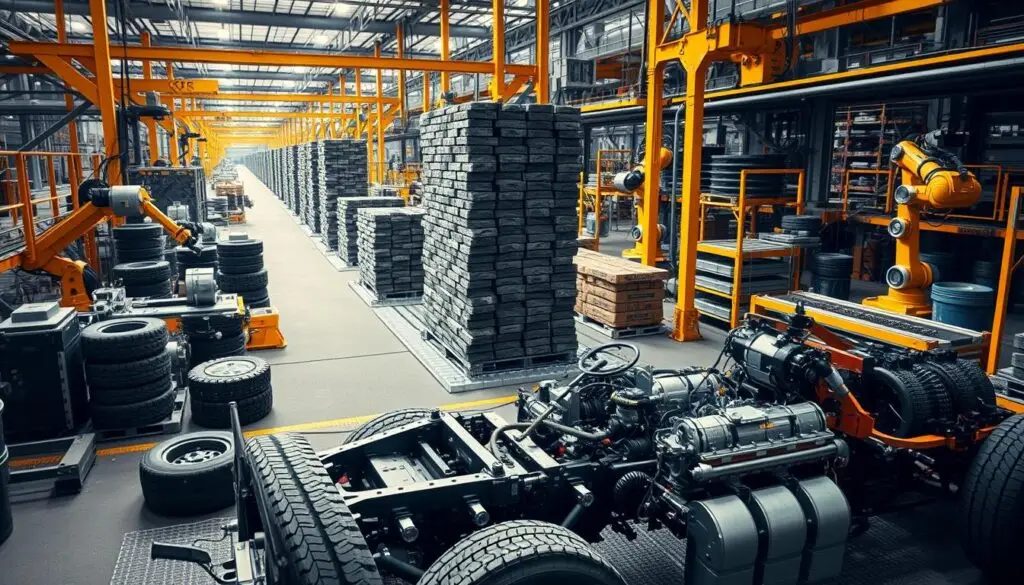
Semiconductor shortages have diminished considerably from peak crisis levels, yet they remain a concern for truck manufacturers. Contemporary heavy duty trucks incorporate dozens of microcontrollers and specialized processors throughout their systems including engine management and emissions control systems, transmission control modules, advanced safety systems, telematics platforms, and digital instrument clusters.
Tier-one automotive chip shortages have largely resolved for passenger vehicle applications. However, specialized components for commercial vehicles face different market dynamics. Lower production volumes mean commercial truck chips receive less supply chain priority than high-volume automotive applications.
Manufacturers have adapted through strategic approaches including redesigning systems to accommodate more readily available components and establishing relationships with multiple chip suppliers. Strategic component inventories provide buffer stock, though this approach increases carrying costs.
Powertrain Component Availability
Powertrain components have seen significant normalization in lead times compared to extended delays during the immediate post-pandemic period. Major engine manufacturers including Cummins, PACCAR, Detroit Diesel, Navistar, and Volvo have aligned production capacity with current truck build schedules, reducing bottlenecks in engine availability.
The upcoming EPA 2027 emissions regulations create uncertainty about future powertrain architectures. Manufacturers face potential substantial re-engineering of emissions control systems. These regulatory changes could temporarily disrupt supply chains as new components enter production and suppliers adapt to revised specifications.
Transmission suppliers including Eaton and Allison have maintained relatively stable supply availability. The industry trend toward automated manual transmissions creates new dependencies on sophisticated electronic controls, adding complexity to the supply chain.
Chassis and Body Component Supply
Chassis components have generally stabilized with major suppliers maintaining production aligned with OEM requirements. Companies like Meritor (now part of Cummins), Dana, and SAF-Holland provide critical chassis systems including axle assemblies, suspension systems, and brake components.
Truck cab manufacturing involves complex assemblies with components from numerous specialized suppliers. Modern cabs integrate stamped metal structures, injection-molded plastic components, glass assemblies, and extensive wiring harnesses. Each component stream represents a potential constraint on final assembly schedules.
Vocational truck applications face unique supply chain considerations for specialized body manufacturing. Dump bodies, tank bodies, and equipment installations typically occur at separate body manufacturers rather than truck assembly plants. This arrangement requires precise coordination between chassis delivery and body installation schedules, which can extend total delivery timelines by several weeks or months depending on body complexity.
Demand Drivers and Market Outlook
Demand drivers pressuring manufacturing capacity remain notably subdued compared to historical patterns, fundamentally altering the relationship between market need and production urgency. The forces that typically create immediate pressure on heavy duty truck manufacturers have moderated considerably throughout 2025.
Fleet Replacement Cycles Extended
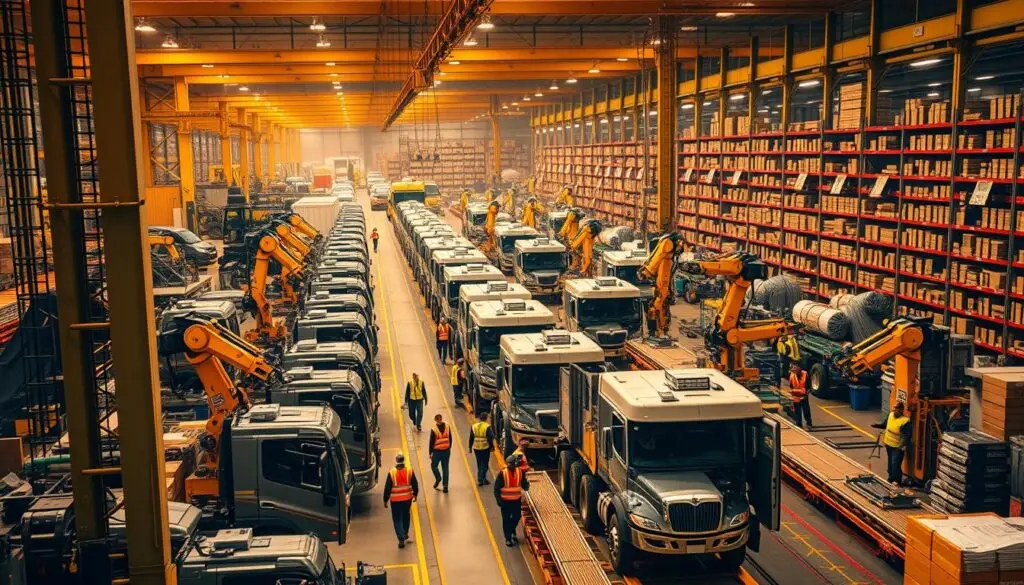
Fleet replacement cycles represent a fundamental demand driver for heavy duty truck manufacturing, yet current market conditions have significantly extended typical replacement timeframes. The average age of Class 8 trucks in operation has increased as fleet operators defer purchases that would normally occur according to established trade cycles.
Elevated vehicle acquisition costs create a primary barrier to fleet replacement. Trucks equipped with modern emissions technology, advanced safety systems, and connectivity features carry substantially higher price tags than previous generations. These increased costs require longer payback periods, making operators hesitant to replace units that remain mechanically sound.
According to ACT Research’s trucking industry forecast, capacity tightening continues, driven primarily by historically weak profitability and sharply reduced Class 8 production. The highway Class 8 tractor fleet is now contracting at an accelerating pace, with monthly declines set to increase further in 2026.
Freight Rate Environment
The relationship between freight rates and equipment investment represents the most critical demand driver affecting manufacturing capacity. Carrier profitability directly determines both the ability and willingness to purchase new equipment. Current freight market conditions show persistent softness that constrains fleet demand across most segments.
Spot market freight rates have stabilized but remain at levels that provide insufficient margins for many carriers given current operating cost structures. Public carriers continue to face recession-level margins, and private fleets remain selective with capital spending. As a result, fleet investment remains focused on essential replacement rather than expansion, keeping Class 8 demand anchored near multi-year lows.
2026 Manufacturing Outlook
Looking ahead to 2026, the North American trucking industry faces a highly uncertain environment shaped by trade policy outcomes, regulatory clarity on EPA 2027 emissions standards, and the trajectory of consumer demand. Key factors such as freight recovery timing, Class 8 production trends, and macroeconomic policy shifts will determine whether the industry stabilizes or remains in a prolonged low-growth phase.
OEMs are holding to reduced build schedules through early 2026, which could eventually help shift demand back toward the for-hire market as capacity continues contracting. Tractor inventories are gradually normalizing as OEMs maintain disciplined build schedules, while vocational inventories remain elevated and slower to correct.
The risk of sudden demand surge meeting constrained supply capacity remains a concern for industry planners. Reduced production infrastructure and workforce limitations could create a new period of extended lead times if orders accelerate rapidly—particularly if regulatory clarity triggers deferred purchasing decisions among fleets that have delayed replacement cycles.
Frequently Asked Questions
What are current lead times for ordering a new Class 8 truck?
Current lead times for Class 8 trucks range from 3-6 months for most standard configurations across major manufacturers including Freightliner, PACCAR brands (Peterbilt and Kenworth), Volvo, Mack, and International. This represents a dramatic improvement from the 12-18 month delays experienced during 2021-2022 supply constraints. Custom specifications with specialized components may extend timelines by several weeks. Build slot availability has improved significantly, giving fleet operators greater flexibility in timing purchases and customizing specifications than at any point since 2019.
How will EPA 2027 emissions standards affect truck pricing and availability?
The EPA 2027 low-NOx standards require an 82.5% reduction in nitrogen oxide emissions to 0.035 g/bhp-hr, along with extended useful life requirements to 650,000 miles. These changes will likely increase vehicle acquisition costs due to advanced emissions control technology requirements and extended warranty obligations. However, implementation clarity remains incomplete, with industry consensus shifting toward potential rollback or delay of warranty and useful life extensions while technology requirements remain intact. Fleet managers should consult with dealers regarding specific pricing impacts as regulatory details become finalized.
Which truck manufacturing plants produce the most Class 8 vehicles in North America?
Daimler Trucks North America’s Cleveland, North Carolina facility is the company’s largest U.S. heavy-duty truck plant, producing Freightliner Cascadia and Western Star models. Volvo Group’s New River Valley plant in Dublin, Virginia is the world’s largest Volvo truck facility at 2.3 million square feet, producing all Volvo trucks for North America. PACCAR operates major facilities in Denton, Texas (Peterbilt), Chillicothe, Ohio (Kenworth), and Renton, Washington. Approximately one-third of North American Class 8 production occurs at Mexican facilities operated by multiple OEMs.
Should fleets buy trucks now or wait for EPA 2027 clarity?
The decision depends on individual fleet circumstances including current equipment age, maintenance costs, and operational requirements. Current market conditions offer favorable lead times of 3-6 months and available build slots that may not persist once demand recovers. However, tariff impacts on Mexico-sourced trucks and regulatory uncertainty create cost uncertainty. Fleets with aging equipment approaching trade cycle thresholds should evaluate whether current acquisition conditions warrant accelerating replacement timelines versus extending service life through a potentially uncertain 2026-2027 period.
How have tariffs affected truck manufacturing and pricing?
Section 232 tariffs on imported trucks and components took effect November 1, 2025, creating significant cost pressures. Approximately one-third of North American Class 8 production occurs at Mexican facilities, making these tariffs particularly impactful. Combined with high financing and insurance costs, tariff-driven cost inflation is materially increasing purchase prices for trucks with imported content. Many fleets are delaying multi-unit commitments until tariff litigation and trade policy outcomes become clearer. Domestically-produced trucks from U.S. facilities may offer more cost certainty for budget-sensitive procurement planning.
Strategic Planning for Equipment Procurement
The heavy duty truck manufacturing sector faces significant uncertainty as it moves toward 2026. Trade policy outcomes, EPA 2027 emissions standards clarity, and consumer demand trajectories will shape the North American trucking landscape. Capacity is tightening gradually, though freight volumes remain soft.
Fleet operators and equipment buyers need strategic flexibility during this transition period. The current production outlook reflects conservative manufacturer scheduling with lead times normalized substantially from pandemic-era disruptions. Understanding manufacturing trends becomes essential for procurement planning as component availability has improved, yet skilled labor shortages and regulatory compliance costs persist.
The industry forecast suggests cautious optimism balanced against real constraints. Aging fleets will eventually require replacement regardless of current market softness. When demand recovers, reduced production capacity developed during this correction cycle could create supply constraints—making current favorable lead times and build slot availability potentially valuable for fleets prepared to act.
Share This Guide With Your Network
Know a fleet manager or procurement specialist navigating equipment acquisition decisions? Share this comprehensive analysis of truck manufacturing capacity, lead times, and market conditions.