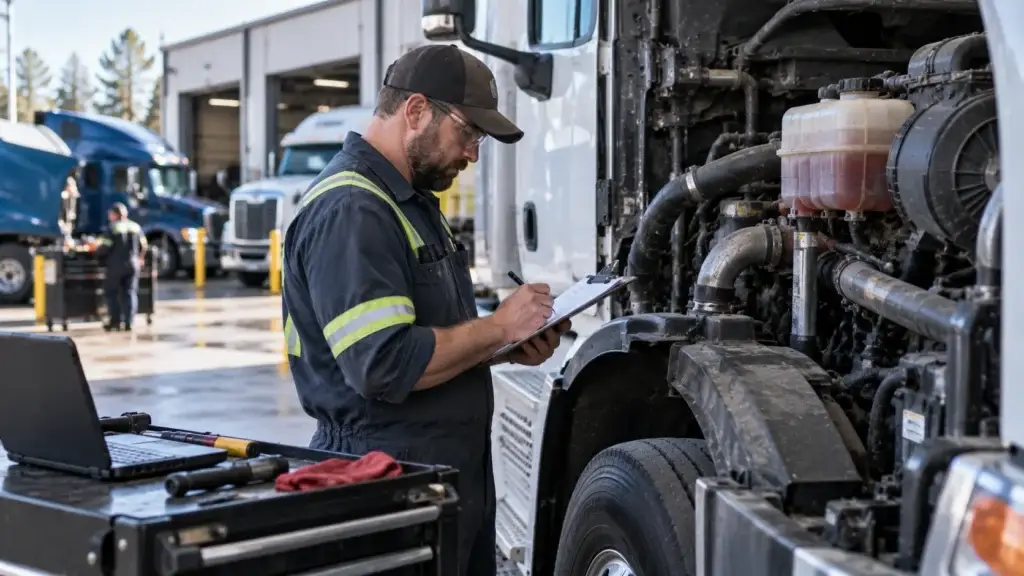
By Michael Nielsen, Publisher | 15+ Years in Diesel Repair
Last Updated: September 2026
⏱ Estimated reading time: 15+ minutes
The Federal Motor Carrier Safety Administration (FMCSA) under 49 CFR 396.3 requires every commercial vehicle maintenance program to systematically inspect, repair, and maintain motor vehicles under its control. This regulatory mandate extends beyond compliance — heavy-duty truck preventive maintenance delivers a measurable business benefit that directly impacts a fleet's bottom line.
Regular servicing of a heavy-duty truck extends vehicle lifespan, reduces an emergency repair cost, and maximizes uptime across an entire operation. A well-structured fleet maintenance program transforms maintenance from an expense into a strategic investment that protects a capital asset while ensuring driver safety.
Michael Nielsen and Heavy Duty Journal's editorial team built this guide to address today's operator challenges head-on — supply chain disruption affecting parts availability, a skilled technician shortage, rising fuel cost, and an increasingly stringent emissions and safety regulation. Preventive maintenance identifies a potential issue before it becomes a costly breakdown.
Key Takeaways
- ✓Regulatory mandate: FMCSA requires a systematic inspection and maintenance protocol for every commercial vehicle under 49 CFR 396.3.
- ✓Inspection hierarchy: a daily driver inspection, a weekly technician check, a monthly service, and a quarterly overhaul create layered protection.
- ✓Documentation requirement: maintain a service record for one year while a vehicle operates, plus six months after decommissioning, per 49 CFR 396.3(c).
- ✓Technology integration: fleet management software automates scheduling, tracks a mileage-based interval, and provides a predictive maintenance alert.
- ✓Cost prevention: a $200 oil change reliably runs far cheaper than a neglected-lubrication engine repair, and scheduled brake service avoids an emergency roadside failure.
In This Guide
- Understanding Heavy-Duty Truck Preventive Maintenance Fundamentals
- Building a Comprehensive Fleet Service Program Framework
- Daily Pre-Trip and Post-Trip Inspection Requirements
- Weekly and Monthly Service Interval Checklists
- Quarterly and Annual Maintenance Schedules
- Mileage-Based Service Milestones
- Critical Heavy-Duty System Maintenance Protocols
- Cost Management and Fleet Service Program Optimization
- Frequently Asked Questions
Understanding Heavy-Duty Truck Preventive Maintenance Fundamentals
Preventive maintenance fundamentals establish a proactive approach that transforms fleet reliability and operational efficiency. This strategic methodology applies to every commercial vehicle requiring regular service to maintain peak performance. The framework encompasses a scheduled intervention that prevents a failure rather than responding to a breakdown after it occurs.
A commercial trucking operation benefits from understanding that preventive maintenance isn't simply about fixing a problem. It represents a comprehensive system designed to identify a potential issue before it escalates into a costly repair. This approach creates a measurable advantage in operational continuity and financial performance.
The scope of preventive maintenance activity extends across multiple service categories. A basic task includes cleaning a component, lubricating a moving part, and checking a fluid level throughout the vehicle. A fleet manager implements a systematic inspection protocol that verifies the condition of a critical system at a predetermined interval.
Regular component replacement forms another essential element. A part expected to wear down over time requires scheduled replacement before failure occurs — common examples include a windshield wiper, a brake lining, a tire, and an air filter that deteriorates through normal operation.
The primary purpose of implementing these protocols is cost reduction through problem prevention. Avoiding a serious mechanical failure generates substantially more savings than a reactive repair approach — a fleet operator who embraces a preventive strategy reduces the likelihood of an unexpected breakdown that disrupts a driver's operation and a delivery schedule.
A practical example demonstrates the financial logic. Regular oil monitoring and a change at a 25,000-mile interval prevents an engine damage that costs significantly more than routine service — a standard oil change typically runs a few hundred dollars for a heavy-duty truck, while an engine repair from neglected lubrication runs into the thousands. The cost differential extends beyond the direct repair expense: an emergency engine repair typically means several days of vehicle downtime compared to a couple of hours for a scheduled oil change.
| Maintenance Approach | Typical Downtime | Reliability Impact |
|---|---|---|
| Preventive Oil Change | 2–3 hours | Maintains optimal engine performance |
| Reactive Engine Repair | 3–5 days | Addresses failure after damage occurs |
| Scheduled Brake Service | 4–6 hours | Ensures stopping system effectiveness |
| Emergency Brake Failure | 2–4 days | Creates a safety risk and a compliance issue |
Vehicle reliability improves substantially when a fleet manager establishes a systematic inspection routine. A predictable maintenance schedule lets an operations team plan service during a non-peak hour or a scheduled downtime window — this contrasts sharply with an emergency breakdown that occurs unpredictably and forces an immediate operational adjustment.
Building a Comprehensive Fleet Service Program Framework
Creating a comprehensive fleet service program framework transforms maintenance from a costly interruption into strategic asset protection. The difference between a fleet operator who maximizes truck uptime and one struggling with a constant breakdown lies in a structured system that prevents a failure before it occurs.
The foundation begins with understanding that no two vehicles in a fleet are identical. Each truck carries a unique maintenance requirement based on its make, model, year, mileage, and operational environment — a fleet manager must catalog a specific detail for every vehicle including a VIN number, tire specification, engine type, and current service history.
Creating Standardized Vehicle Assessment Procedures
A systematic inspection protocol establishes consistency across an entire operation. These procedures create a repeatable process that a technician follows regardless of location or shift timing — standardization eliminates the variability that leads to a missed issue and an unexpected roadside failure.
An effective inspection protocol begins with a comprehensive checklist tailored to a fleet's composition. Each checklist should address a vehicle-specific component while maintaining consistency in inspection methodology, and a documentation requirement extends beyond a simple pass-fail notation.
An inspection protocol must capture an owner name and a complete vehicle identification number, make, model, year, and tire size specification, a fleet identification number for internal tracking, a current and historical maintenance schedule, and a detailed finding from each inspection point.
The FMCSA mandates under 49 CFR Part 396 that a fleet owner maintain an accurate record for each vehicle throughout its service life. These records must remain accessible for at least one year while the vehicle operates and a minimum of six months after decommissioning.
Modern Technology Solutions for Maintenance Documentation
Digital record-keeping has revolutionized how a fleet operation manages maintenance information. A paper-based system creates a bottleneck, increases an error rate, and limits accessibility when a decision needs immediate data support — fleet maintenance tracking software eliminates these limitations while ensuring regulatory compliance.
A contemporary fleet management platform automates a reminder system based on a mileage threshold, engine hour, or calendar interval. This automation significantly reduces administrative burden while preventing a missed service deadline — a technician receives a notification days before scheduled maintenance, allowing proper parts procurement and bay scheduling.
The analytical capability of maintenance tracking software extends far beyond a simple reminder. These systems generate an actionable insight through a key performance indicator including an average cost per mile for repair, a total downtime per truck, a breakdown frequency pattern, a parts inventory turnover rate, and a technician productivity metric.
Building Technical Expertise Through Certification Programs
The skilled labor shortage in heavy-duty truck maintenance challenges every fleet operation. A technician training program addresses this gap by developing internal expertise aligned with a fleet's specific requirement — investment in personnel development creates a competitive advantage that extends beyond immediate repair capability.
ASE (Automotive Service Excellence) certification provides an industry-recognized validation of technician competency. These credentials cover a specific heavy-duty truck system through the T-series tests, including diesel engine (T2), brakes (T4), electrical/electronic systems (T6), and drive train (T3). A certified technician diagnoses a problem faster and implements a correct repair the first time, reducing a comeback and improving overall fleet reliability.
A manufacturer-specific training program complements a foundational certification by addressing proprietary technology. A modern heavy-duty truck incorporates a sophisticated electronic control module, an advanced diesel emissions system, and an integrated telematics platform — factory training ensures a technician understands these complex systems and can leverage a diagnostic tool effectively.
Daily Pre-Trip and Post-Trip Inspection Requirements
A driver-conducted inspection represents the most critical defense against an unexpected breakdown and a safety failure in heavy-duty truck operations. Every pre-trip and post-trip inspection serves as an essential checkpoint that identifies a developing mechanical issue before it escalates into a costly repair or a dangerous road incident.
Federal Motor Carrier Safety Administration regulation mandates that a driver conduct a thorough inspection before operating a commercial vehicle. The driver vehicle inspection report (DVIR) requirement under 49 CFR 396.11 specifies a documentation standard that creates a legal compliance record while establishing a baseline condition assessment.
Critical Safety System Verification
A safety system check forms the core of every daily vehicle inspection program. These systems directly affect vehicle control, visibility, and stopping capability — a compromised safety system creates an immediate hazard that can result in an accident, a citation, and an out-of-service violation.
An air brake system demands meticulous attention during every inspection cycle. A driver should begin verification by checking that air pressure builds from 85 to 100 psi within a manufacturer-specified timeframe, typically around 45 seconds for a single vehicle. Per 49 CFR 570.57, the low-air warning device must activate at a pressure not lower than 50 psi (60 psi for a vehicle built to FMVSS 121) — never lower, though a specific vehicle's actual activation point can sit above that floor.
A brake application test verifies that a service brake engages smoothly without pulling to one side. A driver should apply firm pedal pressure while stationary and listen for an air leak around a chamber, a line, and a connection — any hissing sound indicates a leak requiring immediate maintenance attention.
An additional air brake inspection step includes inspecting an air line for a crack, an abrasion, or evidence of rubbing against a frame component, verifying every air line connection remains tight, checking a slack adjuster for proper clearance, examining a brake chamber for physical damage, and testing a parking brake hold capability. HDJ's brake chamber diagnosis and replacement guide covers this component in full depth.
Tire, Lighting, and Fluid Monitoring
A tire inspection protocol protects against the most common cause of a roadside commercial vehicle failure. Proper tire pressure maintains fuel efficiency, ensures even tread wear, and prevents a catastrophic blowout — a driver should use a calibrated tire pressure gauge rather than a visual inspection alone.
A federal regulation requires a minimum 4/32-inch tread depth on a steering axle tire and 2/32-inch on every other position. A tire and wheel inspection includes examining a sidewall for a cut, a bulge, or an exposed cord, identifying an uneven wear pattern, verifying a valve stem remains straight, and confirming every wheel lug nut shows no sign of looseness.
A comprehensive lighting check requires verification of every lighting and visibility component. Begin electrical system verification by activating headlights and checking both low and high beam operation — walk around the vehicle to confirm every clearance light, identification light, and side marker light illuminates properly.
A daily fluid level check provides an early warning of a leak, a consumption issue, and a developing mechanical problem. Engine oil level verification using the dipstick reveals both quantity and condition. Coolant level inspection requires checking both the overflow reservoir and radiator when cool. Additional monitoring includes windshield washer fluid, power steering fluid, and diesel exhaust fluid (DEF) sufficient for a planned route.
Weekly and Monthly Service Interval Checklists
While a daily inspection catches an immediate concern, a weekly and monthly maintenance procedure addresses a developing issue before it escalates into a major failure. These service intervals require a trained technician with specialized equipment to perform a detailed assessment that goes beyond a basic driver check.
Weekly Maintenance Tasks
A weekly maintenance schedule provides the first line of defense against a component failure that develops between a daily check and a monthly service. These inspections typically take 45–90 minutes per vehicle depending on truck configuration and any identified issue.
A battery load test involves specialized equipment that measures the battery's ability to deliver adequate starting power under a load condition. A healthy battery should maintain at least 9.6 volts during this test, with a reading below that threshold indicating a replacement need. A connection inspection focuses on a terminal, a cable, and a ground connection that affects electrical system performance.
A drive belt tension and condition assessment requires a technician to evaluate both a tension specification and a visual condition indicator. Proper tension ensures efficient power transfer from the engine to a driven component like an alternator, an air compressor, and a water pump — a visual assessment identifies a common failure pattern including glazing, cracking, fraying, and chunk loss.
An air filter restriction indicator monitors filter condition and airflow capacity in real time. Most systems use a color-coded display, with red indicating an immediate replacement need — a modern diesel engine is particularly sensitive to an air restriction level, which causes incomplete combustion, increased emissions, and reduced power output.
Monthly Preventive Maintenance Procedures
A monthly maintenance appointment expands beyond a weekly check to include a more intensive service requirement and component lubrication. These appointments typically require 2–4 hours of technician time depending on truck specification.
Chassis lubrication involves applying appropriate grease to 15–30 fitting locations throughout a truck's undercarriage. These grease points protect a suspension bushing, a steering linkage, and a driveline component from wear and corrosion — a heavy-duty lithium-based grease provides protection under extreme pressure and temperature.
A wheel bearing inspection identifies wear before a catastrophic failure occurs. A technician jacks the wheel and checks for excessive movement by attempting to rock it in multiple directions. A temperature check using an infrared thermometer measures hub temperature after operation, with a normal reading typically between 120–180°F and a reading above 200°F requiring immediate attention.
A suspension component and U-bolt torque inspection verifies that a spring hanger, a shackle, and a U-bolt maintain a proper torque specification. A loose component creates a handling problem and accelerates wear throughout the suspension system.
| Service Category | Weekly Task | Monthly Task | Duration |
|---|---|---|---|
| Electrical Systems | Battery load testing | Complete electrical inspection | 20–30 min |
| Drive Components | Belt tension check | Belt replacement as needed | 15–25 min |
| Chassis Services | Visual inspection | Complete lubrication service | 45–60 min |
| Suspension Systems | Basic visual check | Torque verification and adjustment | 30–45 min |
Quarterly and Annual Maintenance Schedules
Every three months, a fleet operator must implement a deeper service procedure addressing a service interval aligned with a three-month period or a 25,000-mile milestone. Quarterly maintenance requires a vehicle to be removed from service for several hours to complete a comprehensive system evaluation.
Quarterly Service Requirements
Engine oil and filter service, with inspection of used oil for a metal particle and verification of proper oil pressure, forms the foundation of quarterly maintenance. A modern heavy-duty diesel engine with a synthetic lubricant can reach 25,000 to 50,000 miles between an oil change depending on the operating condition.
Fuel filter replacement prevents a contaminated fuel from damaging an injection system. A modern common-rail injection system operates at a high pressure, making it extremely vulnerable to particulate contamination — a single fuel filter replacement costs a modest amount, while an injection system repair runs into the thousands.
Coolant system testing using a refractometer verifies proper freeze protection and corrosion inhibition. Most heavy-duty applications require protection to roughly -34°F. Pressure testing identifies a leak before it causes an overheating emergency, and a hose inspection reveals a deterioration invisible during a routine check — HDJ's coolant flush interval guide covers this system in full depth.
An exhaust system and emissions component review includes a diesel particulate filter inspection for a restriction level, a DEF injection system verification, and an exhaust gas recirculation valve check. These interconnected emissions control systems must function properly to meet EPA emission standards for heavy-duty highway engines and vehicles.
Semi-Annual and Annual Service Requirements
The most intensive maintenance interval occurs at the six-month and twelve-month mark. Semi-annual transmission service protects one of the vehicle's most expensive components from premature failure — this procedure involves draining the transmission pan completely, replacing the internal filter, and inspecting for a metal particle indicating gear wear.
Differential fluid replacement in every drive axle protects a critical drivetrain component that transfers power to the wheels under extreme load. An experienced technician checks a gear tooth contact pattern through an inspection port to identify an alignment issue or an abnormal wear condition.
A complete air brake system teardown and test represents one of the most critical safety procedures. This service involves a complete disassembly of a brake chamber, inspection of a diaphragm and pushrod, and verification of proper stroke length across every wheel position. Air compressor performance testing, governor operation verification, and air dryer cartridge replacement complete the pneumatic system service.
The DOT annual vehicle inspection required under 49 CFR 396.17 covers every safety-related system according to strict regulatory standards. A certified inspector systematically evaluates a brake system, a steering mechanism, a lighting device, a tire, a wheel, a suspension component, an exhaust system, and an emergency equipment. A vehicle passing this comprehensive inspection receives the required safety certification decal — HDJ's DOT inspection checklist guide walks through exactly what an inspector checks.
Mileage-Based Service Milestones
A mileage-based maintenance program tracks a component lifecycle according to the physical demand placed on a heavy-duty truck throughout its operational use. These distance-based service milestones complement a time-based schedule by addressing the direct correlation between miles traveled and component degradation.
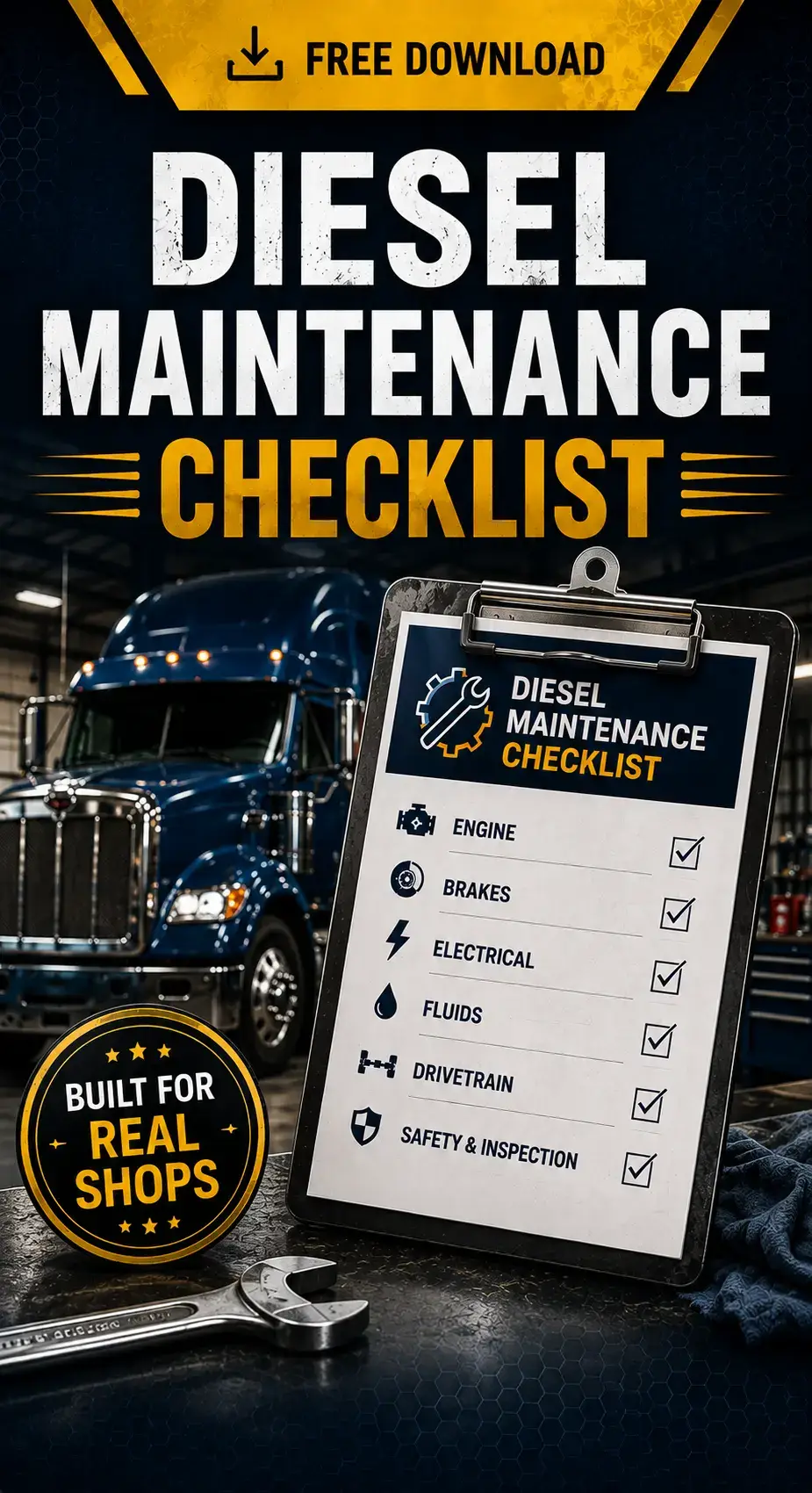
Free Diesel Maintenance Checklist
Get HDJ's free, field-tested diesel maintenance checklist delivered instantly to your inbox — print it, laminate it, keep it in the shop.
Instant PDF • 100% Free • No Spam
The 25,000-mile service represents the first major mileage milestone for most heavy-duty trucks operating in a standard condition. This interval typically includes an engine oil and filter change, a fuel filter replacement, an air filter inspection, a complete brake system inspection, a tire rotation, and chassis lubrication. A fleet operator in a severe service condition — excessive idling, a frequent short trip, an extreme temperature — may need a tighter 15,000-mile interval.
The 50,000-mile service addresses the mid-lifecycle point where multiple systems require detailed attention. This interval often reveals a pattern in component wear that informs future maintenance planning — a critical checkpoint includes a transmission fluid assessment, a differential fluid inspection, a complete brake system inspection with a potential front brake replacement, an alignment verification, and a suspension component evaluation.
The 100,000-mile service represents a major milestone where numerous components reach end-of-lifecycle regardless of apparent condition. This comprehensive service extends operational life significantly and helps a fleet avoid the kind of catastrophic roadside failure that runs tens of thousands of dollars in emergency repair. The investment at this interval includes a complete brake system overhaul, transmission service with filter replacement, differential fluid replacement, shock absorber and bushing replacement, water pump service, drive belt replacement, and a comprehensive fuel system service.
| Service Milestone | Primary Focus Area | Typical Duration |
|---|---|---|
| 25,000 Miles | Fluids, filters, brake inspection, tire rotation | 4–6 hours |
| 50,000 Miles | Mid-life component inspection, brake service, alignment | 6–8 hours |
| 100,000 Miles | Major component replacement, system overhaul | 16–24 hours |
Critical Heavy-Duty System Maintenance Protocols
Critical system maintenance for a heavy-duty truck represents a specialized field requiring deep technical expertise and an advanced diagnostic capability. These complex systems differ substantially from a light-duty vehicle in design, operation, and service requirement.
Diesel Engine Specific Service Requirements
Diesel engine maintenance demands attention to a component and system not found in a gasoline engine. These powerplants operate under a higher compression ratio and temperature, creating a unique service need — proper maintenance extends engine life well beyond what a typical gasoline engine achieves when performed correctly.
Overhead valve adjustment stands as a critical service interval for a diesel engine. A technician must verify a proper clearance to maintain optimal combustion efficiency and valve longevity. The fuel injection system requires meticulous maintenance to ensure proper atomization and combustion, with testing of an injector spray pattern identifying a unit showing poor performance.
Turbocharger inspection protects this vital component from premature failure. A technician examines a turbine and compressor wheel for damage while checking bearing play — excessive play indicates a worn bearing that will fail catastrophically if not replaced promptly.
DEF System and Emissions Component Service
The diesel exhaust fluid system maintains a selective catalytic reduction operation required for emissions compliance. Regular testing of DEF purity using a refractometer ensures the solution maintains a urea concentration in the roughly 32.5% nominal range — DEF tank inspection identifies a contamination that could damage an injection component, and cleaning or replacing a DEF injector addresses a crystallized urea buildup.
Exhaust gas recirculation maintenance addresses a carbon buildup that reduces system effectiveness. Cleaning an EGR valve restores proper flow control and prevents a stuck valve condition — an EGR cooler inspection identifies a leak before it introduces coolant into the intake system.
Diesel particulate filter service includes a forced regeneration when excessive soot accumulation triggers a warning light. A severe case requires removal and a specialized thermal or chemical cleaning when forced regeneration can't restore filter function.
Air Brake System Advanced Maintenance
Air brake maintenance protocol extends beyond a basic inspection to include a complete system component service. Brake chamber disassembly and inspection verifies diaphragm integrity and proper pushrod travel — slack adjuster replacement becomes necessary when an automatic adjustment mechanism no longer maintains proper clearance.
Valve inspection and replacement maintains proper brake application timing and force distribution. A quick release valve, a relay valve, and a proportioning valve control airflow throughout the system. Air dryer cartridge replacement prevents a moisture contamination that damages a brake component.
Cost Management and Fleet Service Program Optimization
The financial performance of a maintenance program directly impacts a fleet's profitability and competitive position. Effective cost optimization requires balancing a preventive maintenance investment against the substantially higher expense of a reactive repair and an unplanned downtime.
Calculating a maintenance ROI provides concrete evidence of program value. A fleet manager should compare the cost of scheduled preventive maintenance against an emergency service call, which carries a real premium for expedited parts and after-hours labor. Treat any specific vendor-published ROI figure the same way you'd treat other sales material — the fleet-software industry publishes a wide range of competing ROI claims that don't reconcile with each other, so build the specific case from a fleet's own before-and-after cost data rather than a marketing number.
A comprehensive ROI analysis should include an extended vehicle lifecycle that defers capital expenditure, an improved fuel efficiency from a properly maintained engine and drivetrain, a reduced insurance premium from a better safety record, and an improved driver retention, since a professional driver generally prefers operating well-maintained equipment.
Technology Platforms and Strategic Sourcing
Fleet management software transforms maintenance operations from manual spreadsheet tracking to an automated system that eliminates an oversight and optimizes service scheduling. A modern platform integrates with vehicle telematics to monitor an actual operating condition including mileage, engine hours, idle time, and a diagnostic trouble code.
An ongoing global supply chain challenge has made strategic parts procurement essential. An effective strategy includes establishing a relationship with multiple suppliers, maintaining a strategic inventory of a critical fast-moving part, negotiating a volume pricing agreement, and utilizing predictive analytics to forecast parts demand based on fleet composition and a maintenance schedule.
Service Delivery Model Selection
Choosing the right service delivery model represents a fundamental strategic decision. An in-house maintenance operation provides maximum control over service quality and scheduling but requires substantial capital investment in a shop facility and equipment — this model tends to be most cost-effective for a larger fleet.
A third-party service arrangement, including a dealer network, a national service chain, and an independent repair facility, offers flexibility without a capital requirement. Many successful programs employ a hybrid model that performs routine preventive maintenance in-house while outsourcing a specialized repair requiring expensive diagnostic equipment or manufacturer-specific training.
Frequently Asked Questions
What is the difference between preventive maintenance and reactive repair for a heavy-duty truck?
Preventive maintenance involves a scheduled inspection and component replacement before a failure occurs, while reactive repair responds to a breakdown after it happens. A preventive oil change protects against a far more expensive engine repair and a few hours of downtime instead of several days. Preventive maintenance creates operational predictability by allowing service during a planned window rather than an emergency that disrupts a delivery schedule.
What records must a fleet operator maintain to satisfy FMCSA compliance requirements?
FMCSA regulation under 49 CFR 396.3 requires a fleet operator to maintain a service record for each vehicle for a minimum of one year while it remains active in the fleet, plus an additional six months after decommissioning. These records must document every inspection, repair, and maintenance event, including the date of service, a description of the work completed, technician identification, and vehicle identification information. A modern fleet maintenance software automates this recordkeeping and keeps an audit trail ready for a DOT inspection.
How frequently should a diesel exhaust fluid system be serviced for emissions compliance?
DEF system maintenance should occur during a quarterly service interval at minimum. This includes testing DEF purity using a refractometer, inspecting a DEF tank for contamination, cleaning or replacing a DEF injector clogged with crystallized urea, verifying a DEF heater functions properly in cold weather, and diagnostic testing to ensure a NOx sensor provides an accurate reading. These maintenance protocols protect an expensive emissions control component while ensuring a vehicle remains compliant with EPA emissions standards.
How should a fleet actually calculate the return on a preventive maintenance program?
Track the fleet's own before-and-after data rather than a published industry figure — compare the direct repair cost, the downtime day, and the roadside emergency call rate for a period before implementing a disciplined PM program against the same period after. A vendor's own marketing material often cites a specific ROI percentage, but these figures vary widely and don't reconcile from source to source, so a fleet's own numbers are the only ones that reliably reflect its actual situation.
What major component requires service at the 100,000-mile interval?
The 100,000-mile service represents a major milestone where numerous components reach end-of-lifecycle regardless of apparent condition. Required service typically includes a complete brake system overhaul with drum or rotor replacement, a transmission service with filter replacement and complete fluid exchange, a differential fluid replacement in every axle, a shock absorber and suspension bushing replacement, a water pump service, a drive belt replacement, a radiator and heater hose replacement, and a comprehensive fuel system service including tank cleaning.
Conclusion
Implementing a comprehensive heavy-duty truck preventive maintenance program delivers a measurable benefit that transforms operational performance. A company following a structured maintenance schedule consistently experiences fewer unexpected breakdowns and meaningful cost savings through early problem detection.
Successful program implementation requires commitment at every organizational level. A fleet manager must establish a clear protocol and track a performance metric. A technician needs proper training and quality tools to execute a service task correctly. A driver plays a vital role by conducting a thorough daily inspection and reporting a developing issue promptly — the same discipline Michael Nielsen and Heavy Duty Journal's editorial team hold every guide on heavydutyjournal.com to.
Creating a maintenance calendar saves time by eliminating a last-minute repair and a surprise failure. An automated reminder keeps a service schedule on track while a digital tracking system provides visibility into a fleet reliability metric — this organized approach replaces reactive chaos with a predictable maintenance cycle. An organization that embraces systematic preventive maintenance as a strategic priority, rather than a discretionary expense, consistently outperforms a competitor through superior reliability, regulatory compliance, and total cost of ownership optimization.
Help Fellow Fleet Professionals Optimize Their Operations
If this preventive maintenance guide helps other fleet managers and diesel technicians reduce downtime and control costs, share it with your professional network.