
By Michael Nielsen, Editor & Publisher | 15+ Years in Diesel Repair
Last Updated: January 2026
📖 Estimated reading time: 24 minutes
Women pursuing heavy-duty tire technician careers face the same fundamental question any prospective technician does: can I develop the skills required for professional commercial tire service? The answer is unequivocally yes. Success in the commercial vehicle service industry depends on proper training, mechanical aptitude, and commitment to safety standards—not gender or physical attributes alone.
The tire service workforce continues to evolve as more women enter technical trades traditionally dominated by men. Industry organizations now actively support this transition through targeted training programs, including the Tire Industry Association’s Women’s Only CTS Instructor certification class. Professional certification pathways provide objective standards that recognize demonstrated expertise, creating clear advancement opportunities for qualified technicians regardless of background.
This comprehensive guide covers everything women need to know about building successful careers in commercial tire service—from required certifications and core competencies to physical considerations, safety protocols, and career advancement pathways.
Key Takeaways
- Capability stems from certification: Gender does not determine success in commercial tire service—proper training and documented competency establish professional credibility.
- Industry support is growing: The Tire Industry Association offers specialized programs, including a Women’s Only CTS Instructor class scheduled for fall 2025.
- Technique beats strength: Modern equipment and proper body mechanics matter more than raw physical strength for sustainable careers.
- Clear career pathways exist: Advancement opportunities include mobile service, fleet management consulting, technical training, and supervisory roles.
- Safety certification is mandatory: OSHA regulations require specific training for multi-piece wheel service—no exceptions regardless of experience level.
- Equal pay for equal work: Certified technicians earn competitive wages based on skills and specialization, not demographics.
The Heavy-Duty Tire Service Industry and Workforce Diversity
Commercial tire operations represent a critical segment of transportation infrastructure that keeps freight moving nationwide. This specialized field encompasses maintenance services for trucks, buses, construction equipment, and agricultural machinery—all vehicles that depend on properly maintained tires for safe operation. The scope of fleet tire service extends far beyond passenger vehicle tire changes, requiring advanced technical knowledge and specialized equipment.
Today’s technicians must understand electronic monitoring systems, complex wheel configurations, and safety protocols that protect workers and ensure vehicle reliability. These professionals work in diverse environments ranging from dealership service bays to mobile service operations that bring expertise directly to fleet locations.
Commercial Fleet Tire Operations Overview
Fleet tire service providers deliver essential maintenance to vehicles that form the backbone of American commerce. A single commercial truck may require service on 10 to 22 tires depending on its configuration, making tire maintenance a substantial operational consideration. Proper tire care directly impacts fuel efficiency, vehicle handling, and overall operational costs for companies managing large fleets.
The Tire Industry Association offers Commercial Tire Service certification that covers critical practices including wheel assembly, proper jacking and lifting techniques, and lock-out/tag-out procedures. This comprehensive training program aligns with U.S. Tire Manufacturers Association guidelines, establishing industry-wide standards for commercial tire operations. TIA’s 2025 schedule demonstrates the breadth of specialization available, with programs ranging from Automotive Tire Service to Commercial, Earthmover, and Farm Tire Service.
Service environments vary significantly based on fleet needs and business models. Independent tire centers handle diverse vehicle types while dedicated fleet maintenance facilities focus on specific equipment categories. Mobile service technicians bring specialized tools and expertise to customer locations, providing convenient solutions for vehicles that cannot easily travel to service centers.
The Growing Presence of Women in Technical Trades
The tire service workforce has experienced significant demographic changes as women in technical trades increasingly pursue careers in traditionally male-dominated fields. According to the Bureau of Labor Statistics, women represent a growing percentage of automotive service technicians, with heavy-duty specializations following similar trends.
Industry organizations, educational institutions, and employers now actively recruit female technicians through targeted outreach and mentorship programs. This shift reflects recognition that workforce diversity strengthens the industry rather than serving as merely a social initiative. The ongoing technician shortage makes expanding the talent pool a business imperative.
Female technicians demonstrate equal capability when provided with proper training and professional development opportunities. Historical barriers to female participation in heavy-duty service work are being systematically addressed through workplace culture improvements and equipment accessibility. Current opportunities extend across all service specializations, from entry-level positions to advanced diagnostic roles.
Core Competencies Required for Commercial Tire Technicians
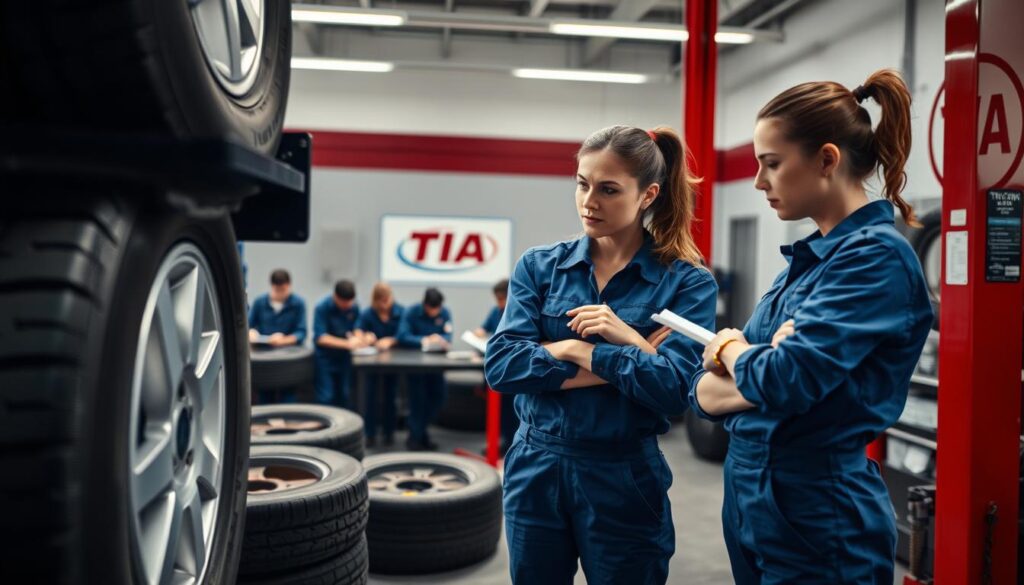
Female technicians entering the commercial tire industry must develop a broad skill set encompassing mechanical knowledge, precision techniques, and safety awareness. These commercial tire skills extend beyond basic automotive service and require specialized training that addresses the unique demands of heavy-duty applications. Professional competency combines theoretical understanding with hands-on experience under expert supervision.
The Commercial Tire Service certification programs provide comprehensive instruction covering tire construction, inspection procedures, and repair techniques specific to commercial truck operations. Training includes both TIA CTS requirements and OSHA Regulation 29 CFR 1910.177 for servicing single and multi-piece wheels. Technicians complete hands-on demonstrations and written examinations that verify their mastery of essential procedures before performing independent service work.
Tire Mounting and Demounting Procedures
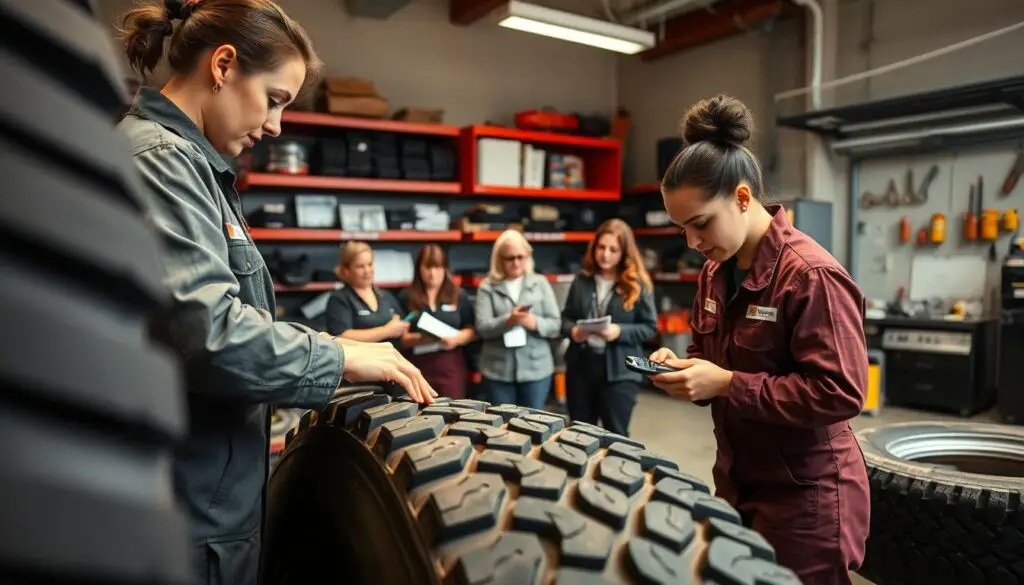
The systematic process of removing tires from wheel assemblies and installing replacement units represents a foundational skill for all heavy-duty tire technicians. Tire mounting procedures differ significantly from passenger vehicle service due to the size and weight of commercial tires. Many heavy-duty tires exceed 40 inches in diameter and weigh more than 100 pounds, requiring specialized equipment and proper technique.
Professional technicians utilize tire machines, bead breakers, and manual techniques designed specifically for commercial applications. The bead breaker separates the tire bead from the wheel rim, allowing safe removal without damaging wheel components. Proper lubrication of the bead area facilitates mounting and prevents damage to both tire and rim during installation.
Thorough inspection of wheel components occurs during every mounting procedure. Technicians examine wheels for cracks, corrosion, and structural damage that could compromise safety. Damaged wheels require immediate replacement rather than continued service, as failure during operation creates severe safety hazards for drivers and surrounding vehicles.
Wheel Assembly and Torque Specifications
Commercial wheel fastening demands precise attention to manufacturer specifications and industry standards for safe operation. Wheel assembly techniques involve specific bolt patterns that vary by manufacturer, vehicle type, and application requirements. Each wheel position uses a designated number of studs or bolts arranged in patterns that distribute clamping force evenly across the mounting surface.
Torque specifications represent critical values that technicians must follow without deviation. Insufficient torque allows wheel movement that can lead to stud fatigue and potential wheel detachment. Excessive torque stretches or breaks studs, creating equally dangerous failure conditions that compromise vehicle safety.
Professional service requires calibrated torque wrenches rather than impact tools for final tightening procedures. Technicians follow specific torque sequence patterns that ensure even pressure distribution across all fasteners. The star pattern or cross pattern typically applies to multi-stud wheels, preventing warping and ensuring proper seating of the wheel against the hub mounting surface.
50-100 miles
Industry standards mandate re-torque verification after initial wheel installation to account for settling during break-in
Tire Pressure Management Systems
Maintaining correct inflation pressure stands as one of the most critical factors affecting tire performance, fuel efficiency, and service life. Tire pressure systems include both manual monitoring procedures and automated tire pressure monitoring systems (TPMS) that provide real-time data to fleet operators. Technicians must understand both approaches to deliver comprehensive service.
Manual pressure monitoring requires accurate gauges and knowledge of proper inflation specifications for each tire position. Steer tires typically operate at different pressures than drive or trailer position tires based on load distribution and handling requirements. Technicians reference manufacturer load and inflation tables that specify correct pressures based on actual vehicle loading conditions.
Modern commercial fleets increasingly utilize TPMS technology that alerts drivers to pressure changes during operation. These systems employ sensors mounted inside the wheel assembly that transmit pressure and temperature data wirelessly. Technicians must understand sensor installation procedures, programming requirements, and diagnostic processes that identify system malfunctions.
Tread Depth Analysis and Measurement
Systematic tread depth evaluation provides essential information about tire condition, remaining service life, and compliance with regulatory requirements. Technicians use precision depth gauges to measure tread grooves at multiple points across the tire surface. This data reveals wear patterns that indicate potential vehicle alignment or suspension problems requiring attention.
Federal regulations establish minimum tread depth requirements that vary by tire position on commercial vehicles. According to 49 CFR 393.75, steer position tires must maintain at least 4/32 inch of tread depth across major grooves, while drive and trailer position tires require minimum depths of 2/32 inch for continued legal operation. Technicians must identify tires approaching these limits and recommend timely replacement.
Visual inspection techniques complement depth measurements by identifying irregular wear patterns that affect performance and safety. Cupping, feathering, and heel-toe wear indicate specific mechanical problems that depth measurements alone cannot diagnose. Recognizing these patterns allows technicians to recommend corrective maintenance that addresses root causes rather than simply replacing worn tires.
Professional Certification Programs and Standards
Industry-recognized certification programs establish measurable standards that validate technical expertise for female technicians entering the commercial tire service field. These credentials demonstrate professional commitment while verifying that technicians possess essential knowledge and practical skills required for safe, efficient service operations. Employers increasingly view commercial tire certification as mandatory rather than optional, particularly for insurance coverage, liability protection, and quality assurance purposes.
Professional certification distinguishes qualified technicians from untrained workers in a field where mistakes can result in serious injury or equipment damage. Structured tire technician training programs provide consistent standards across the industry, ensuring all certified professionals meet identical competency benchmarks. Female technicians benefit from documented credentials that objectively prove their capabilities in a traditionally male-dominated field.
Tire Industry Association Commercial Tire Service Certification
The Tire Industry Association represents the primary credentialing organization for tire service professionals nationwide. TIA certification programs provide structured progression from foundational awareness to advanced instructor-level expertise. The organization offers Commercial Tire Service programs at both 300-level and 400-level designations, with each tier building upon previous knowledge.
The 300-level program establishes foundational competency in tire service fundamentals, covering basic construction principles, service procedures, and safety protocols. Technicians completing this tier demonstrate readiness for entry-level commercial tire service positions under supervision. The curriculum addresses tire types, mounting procedures, inflation standards, and regulatory compliance requirements.
The 400-level instructor program qualifies experienced technicians to train others, requiring deeper technical knowledge and demonstrated teaching ability. Participants must already possess significant field experience and TIA certification at the 300 level before advancing to instructor status. This progression ensures that only thoroughly competent professionals guide the next generation of technicians.
2025 CTS Instructor 400 Level Class Schedule
- April 15-18: Brooksville, Florida
- May 13-16: Youngstown, Ohio
- September 30 – October 2: Women’s Only Class, Youngstown, Ohio
- December 9-12: Brooksville, Florida
The Women’s Only CTS Instructor class represents a significant initiative within the industry, acknowledging that female technicians sometimes benefit from dedicated training environments. This specialized session maintains rigorous technical standards while creating space for women to develop professional relationships and mentorship connections with peers. Participants receive the same credential as mixed-gender classes, with no differentiation in certification documentation.
Written Examination Requirements
Candidates must demonstrate comprehensive understanding through proctored testing that verifies knowledge retention across all program components. The written examination covers tire construction principles, service procedures, safety protocols, and industry regulations. Test questions assess both factual recall and applied problem-solving ability, requiring candidates to analyze scenarios and select appropriate responses.
Examination content aligns with current industry standards and regulatory requirements, including OSHA regulations governing tire service operations. Candidates must achieve minimum passing scores that demonstrate mastery rather than mere familiarity with subject matter.
Practical Skills Assessment
Hands-on evaluation requires candidates to perform actual service procedures under direct observation by certified evaluators. This assessment component validates that technicians can translate theoretical knowledge into proper technique, safety awareness, and problem-solving ability. Practical testing includes tire mounting and demounting, torque application, pressure verification, and safety equipment usage.
Evaluators assess not only final results but also the process candidates follow, including safety precautions, tool selection, and procedural sequence. Technicians must demonstrate proficiency without assistance, proving they can work independently in commercial service environments.
Automotive Lift Institute Safety Certification
Commercial vehicle lifting requires specialized equipment and techniques substantially different from passenger car service procedures. The Automotive Lift Institute provides safety certification specific to heavy-duty applications, addressing the unique challenges of raising trucks, buses, and other large vehicles. Proper lift operation prevents equipment damage, facility damage, and technician injury.
Heavy-duty tire service frequently requires complete vehicle lifting to access wheels and suspension components. Technicians must understand weight distribution, lift point location, capacity limitations, and stabilization requirements. ALI certification verifies that professionals can safely position and operate commercial vehicle lifts without supervision.
OSHA Hazard Communication and Safety Training
Federal workplace safety regulations mandate specific education for employees exposed to hazardous materials and dangerous equipment. OSHA tire safety training addresses chemical hazards from tire materials, sealants, and cleaning agents, as well as physical hazards from pressurized systems and heavy components. The Hazard Communication Standard requires employers to provide comprehensive training before employees begin work with potential hazards.
Training content includes hazardous material identification using Safety Data Sheets, personal protective equipment selection and usage, and emergency response procedures. Technicians learn to recognize warning labels, understand chemical properties, and implement appropriate precautions.
The HDJ Perspective
The commercial tire service industry faces a persistent skilled labor shortage that makes workforce diversification a business imperative, not just a social goal. Women who earn professional certifications enter a field where qualified technicians are genuinely scarce—creating favorable conditions for career advancement and competitive compensation. The TIA’s investment in women-specific programming signals institutional recognition that expanding the talent pipeline benefits everyone in the industry.
Technical Knowledge of Heavy-Duty Tire Categories
The breadth of tire technology in commercial applications demands specialized expertise that distinguishes qualified technicians from general service providers. Female heavy-duty tire technicians must develop comprehensive understanding across multiple tire categories, each engineered for specific performance requirements and operating conditions. This technical knowledge extends far beyond basic installation procedures to encompass the engineering principles that govern tire selection, application, and service life.
Professional competency requires recognition of how commercial tire specifications differ based on vehicle type, axle position, load requirements, and operational environment. Technicians who master these distinctions provide greater value to fleet operations by recommending optimal tire solutions that balance performance, safety, and cost-effectiveness.
Position-Specific Engineering and Performance Requirements
Commercial vehicle tires demonstrate dramatically different characteristics based on their axle position, with each location demanding distinct engineering priorities. Understanding these position-specific requirements forms the foundation of professional tire service and directly impacts vehicle safety, fuel efficiency, and operational costs.
Steer position tires feature specialized tread patterns with circumferential ribs that maintain continuous road contact during steering maneuvers. The rubber compounds used in steer tires prioritize traction in wet conditions while minimizing rolling resistance. Internal construction typically employs steel belts and polyester casing materials that provide the stiffness required for precise steering response without sacrificing ride quality.
Drive position tires face entirely different operational demands focused on traction and power transmission. These tires feature aggressive tread patterns with deep lugs and lateral grooves that bite into road surfaces to convert engine torque into forward motion. The robust construction of drive tires includes multiple steel belt layers and thick undertread compounds that resist chunking and tearing under high torque loads.
Trailer position tires prioritize load capacity and long-term wear resistance over traction characteristics. Since trailer axles neither steer nor drive the vehicle, these tires can utilize construction techniques that maximize durability and fuel economy. Rib-type tread patterns with minimal void areas reduce rolling resistance while providing even wear distribution across the tread surface.
| Axle Position | Primary Focus | Tread Pattern | Typical Service Life |
|---|---|---|---|
| Steer | Directional stability, handling | Circumferential ribs with lateral siping | 150,000-200,000 miles |
| Drive | Traction, power transmission | Deep lug patterns with aggressive voids | 100,000-150,000 miles |
| Trailer | Load capacity, fuel economy | Shallow ribs with minimal voids | 200,000-300,000 miles |
| All Position | Versatility across positions | Moderate depth ribs, balanced voids | 125,000-175,000 miles |
Technicians must recognize that improper position matching leads to premature tire failure and increased operational costs. Installing drive tires in steer positions creates excessive scrubbing wear during turning maneuvers. Conversely, placing steer tires in drive positions results in rapid tread wear due to insufficient lug depth for traction demands.
Construction Equipment and Agricultural Machinery Tires
Off-road and specialty tire applications present dramatically different service requirements compared to highway commercial tires. Construction equipment, mining vehicles, and agricultural machinery operate in environments that demand unique tire engineering solutions. These applications often require bias-ply construction rather than radial designs, providing the sidewall rigidity necessary for operation over rough terrain and resistance to sidewall impacts.
Earthmover tires represent the most extreme examples of specialty tire applications, with individual tires weighing several hundred pounds and requiring specialized equipment for safe handling. Service procedures for these massive tires demand hydraulic tools and techniques covered in dedicated Earthmover Tire Service programs.
Agricultural tires present their own specialized requirements, balancing the need for minimal soil compaction with adequate load-carrying capacity. Farm Tire Service programs offer instruction in demounting, mounting, and inflating agricultural tires that may operate at significantly lower pressures than highway tires. The large air volumes contained in agricultural tires create substantial inflation energy that requires proper safety procedures and equipment.
Safety Protocols and Regulatory Compliance
Professional tire technicians understand that proper safety protocols can mean the difference between routine service and catastrophic injury. The heavy-duty tire service industry operates under stringent federal regulations designed to protect workers from equipment failures that have historically caused serious injuries and fatalities. Female tire technicians receive identical safety training as their male counterparts and must demonstrate equal proficiency in recognizing hazardous conditions and implementing protective measures.
OSHA compliance represents a non-negotiable professional responsibility for all tire service operations. The regulatory framework establishes minimum standards that facilities must follow to maintain safe working environments. Violations can result in substantial fines, operational shutdowns, and potential criminal liability if negligence leads to worker injury.
⚠️ Safety Warning
Multi-piece wheel assemblies present severe explosion hazards when improperly serviced. OSHA regulations mandate specific procedures, and non-compliance has resulted in fatalities. No experience level exempts any technician from following required safety protocols.
Servicing Multi-Piece Wheel Components
Wheel assemblies consisting of multiple components present significant explosion hazards when improperly serviced. OSHA regulation 29 CFR 1910.177 mandates specific procedures for servicing single-piece and multi-piece rim wheels used on large commercial vehicles. This regulation exists because improper handling has resulted in numerous fatalities when pressurized components separated violently during service operations.
Multi-piece rim safety requires technicians to recognize different wheel configurations and understand the specific hazards each type presents. Split rim wheels, which feature a locking ring that secures the tire to the rim, demand particular caution during disassembly and reassembly. The U.S. Tire Manufacturers Association guidelines provide detailed procedures that technicians must follow without deviation.
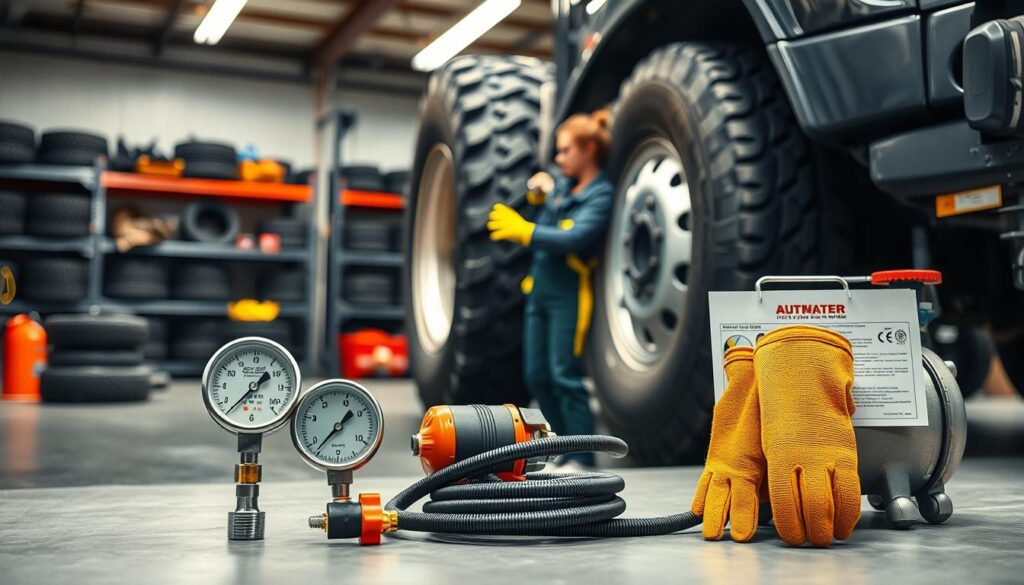
Essential multi-piece wheel service procedures include complete deflation verification before disassembly, visual inspection for damaged or corroded components, proper component alignment during reassembly, use of restraining devices throughout inflation, and adherence to designated pressure limits and sequencing. Technicians must never assume that similar-appearing wheel assemblies follow identical service procedures.
Mandatory Inflation Containment Systems
Tire inflation safety protocols require the use of approved inflation cages or restraining devices for all tire pressurization activities. These cages provide containment barriers that protect technicians if wheel components separate during the inflation process. The explosive force generated by a tire failure at operating pressure can propel components with lethal velocity.
Proper inflation cage usage follows strict operational protocols. Technicians must position the wheel assembly completely within the cage structure before introducing compressed air. The inflation hose must extend from outside the cage to the valve stem, allowing the technician to remain at a safe distance during pressurization.
No exceptions exist to cage requirements regardless of technician experience level or time constraints. Facilities that permit cage bypassing create liability exposure and violate OSHA compliance standards. Every inflation represents a potential hazard event requiring full protective measures.
Required Protective Equipment Standards
Personal protective equipment serves as the final defense against workplace injuries when other safety measures fail. Female tire technicians must select and consistently use PPE appropriate for specific service tasks. Required equipment includes safety glasses with side shields, steel-toed boots rated for impact and compression protection, hearing protection where noise levels exceed OSHA limits, and work gloves designed for specific tasks.
Facilities must provide properly fitting PPE in sizes appropriate for all workers. Generic “one size fits all” approaches often result in female technicians using improperly sized equipment that reduces protection effectiveness or creates additional hazards through poor fit.
Equipment Service Energy Control
Lockout tagout procedures protect technicians servicing tire changing equipment, vehicle lifts, and other powered machinery. These energy isolation protocols ensure that equipment cannot be inadvertently energized while technicians perform maintenance or repairs. Unexpected equipment activation has caused crushing injuries, amputations, and electrocutions in facilities that failed to implement proper control procedures.
Effective lockout tagout procedures require written energy control procedures for each piece of equipment, standardized lockout devices uniquely assigned to individual technicians, verification testing to confirm complete energy isolation, and clear communication protocols when multiple technicians service the same equipment.
Free Professional Fleet Tools
Cost calculators, fault code lookup, maintenance planners, and more—built for owner-operators, fleet managers, and diesel techs. No signup required.
Physical Requirements and Ergonomic Best Practices
Understanding tire technician physical requirements begins with recognizing that proper technique and available tools matter more than raw strength in professional service environments. The commercial tire industry has evolved significantly through investments in equipment and training that prioritize ergonomic tire service principles. Modern facilities equip technicians with resources that reduce physical strain while maintaining productivity standards.
Training programs now include comprehensive instruction on service truck operation, hydraulic tool usage, and specialized equipment designed specifically for handling heavy tires. Professional tire service organizations increasingly recognize that sustainable work practices produce better long-term outcomes than approaches that sacrifice technician health for short-term productivity gains.
Building Sustainable Work Capacity
Commercial tire service involves manipulating heavy components, maintaining challenging postures, and sustaining physical effort throughout work shifts. However, technique and mechanical advantage consistently prove more valuable than raw physical strength in professional settings. Female technicians often demonstrate superior attention to proper body mechanics and greater willingness to utilize available mechanical assistance rather than relying on brute force approaches.
Successful tire service requires sustained energy throughout shifts rather than momentary maximum effort. This reality favors consistent pacing and strategic tool use over exhausting physical exertion. Technicians who develop efficient movement patterns and leverage available equipment typically outperform those who depend primarily on strength.
Female technicians frequently approach physical challenges with enhanced awareness of body positioning and increased attention to technique refinement. These characteristics often translate into fewer acute injuries and better long-term career sustainability compared to approaches that prioritize speed over proper mechanics.

Equipment That Multiplies Capability
Modern tire service facilities provide extensive mechanical assistance tools that dramatically reduce manual handling requirements. This equipment transforms jobs that once demanded exceptional strength into tasks manageable through proper technique and equipment operation. Investment in these tools reflects industry recognition that reducing physical strain decreases injury rates and extends career longevity.
| Equipment | Function | Physical Demand Reduction |
|---|---|---|
| Tire Carts and Dollies | Horizontal transport | Eliminates lifting and carrying across shop floors |
| Overhead Hoist Systems | Vertical positioning | Removes weight-bearing during installation |
| Hydraulic Manipulators | Precise positioning | Controlled movement without manual support |
| Powered Bead Seaters | Rapid inflation for bead seating | Eliminates repetitive pumping |
Ergonomically designed hand tools multiply applied force through leverage principles, enabling technicians to achieve necessary torque specifications without excessive physical effort. Modern impact wrenches, torque multipliers, and specialized pry bars allow precise work that would be impossible through manual force alone.
Protecting Long-Term Physical Health
Injury prevention in tire service depends on understanding proper lifting techniques, weight distribution principles, and postural awareness that prevents both cumulative trauma and acute injuries. Common injury patterns include back strain from improper lifting, knee damage from prolonged kneeling on hard surfaces, and repetitive motion injuries affecting shoulders and wrists. Proper technique and strategic rest intervals effectively mitigate these risks when consistently applied.
Body mechanics training emphasizes that pushing and rolling motions place less stress on the body than lifting and carrying. Technicians who consistently choose the mechanical advantage of wheels and carts over manual transport demonstrate professional judgment that protects their physical capability throughout extended careers.
Diagnostic and Problem-Solving Skills
Beyond mounting and inflating tires, professional technicians must develop advanced diagnostic capabilities that identify underlying vehicle issues affecting tire performance. These tire troubleshooting skills transform basic service providers into valuable fleet maintenance consultants who save customers money through preventive problem identification.
Successful heavy-duty tire technicians function as mechanical detectives who interpret physical evidence to diagnose complex vehicle problems. This analytical capability develops through comprehensive training in tire construction, vehicle systems, and the relationship between component failures and tire behavior.
Recognizing Abnormal Tire Deterioration
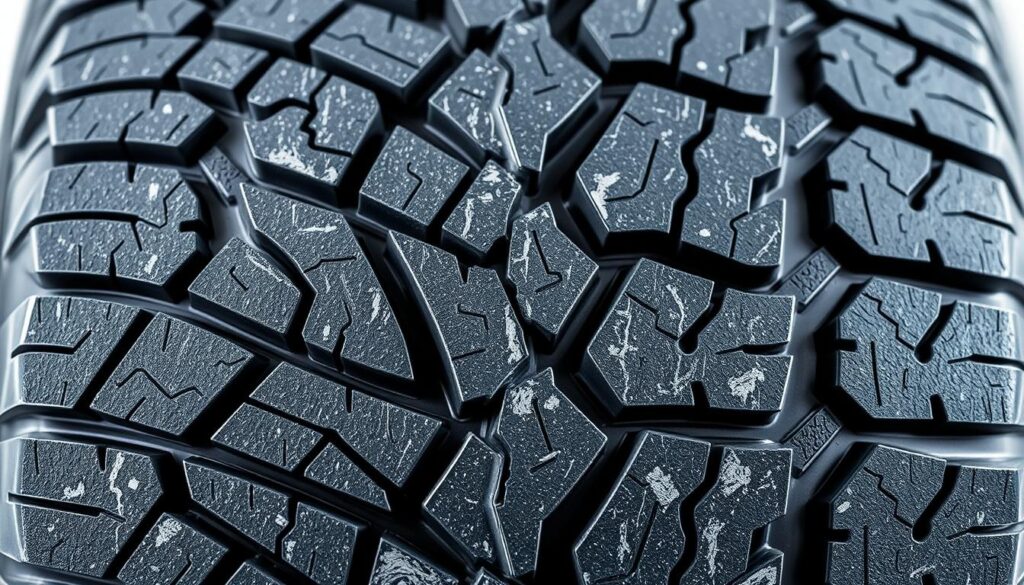
Professional technicians must identify and interpret tire wear patterns that indicate specific mechanical problems affecting vehicle operation. Cupping appears as scalloped depressions around the tire circumference, typically caused by worn shock absorbers or unbalanced wheels. Feathering creates smooth wear on one edge of tread ribs with sharp edges on the opposite side, indicating toe alignment issues that require immediate correction.
Flat spotting occurs when locked wheels slide across pavement during emergency braking, creating distinct flat areas that cause vibration and require tire replacement. Asymmetric wear patterns develop when one shoulder wears significantly faster than the other, pointing to camber misalignment or consistent overloading on one side of the vehicle.
Accurate pattern recognition requires understanding tire construction, vehicle geometry, and operational stresses that affect tire longevity. The ability to explain wear causes and recommend corrective actions distinguishes knowledgeable professionals from parts replacers who simply install new tires without addressing underlying issues.
Connecting Tire Condition to Vehicle Systems
Vehicle alignment diagnosis begins with careful examination of tire wear characteristics that reveal specific mechanical deficiencies. Misaligned axles create distinctive wear signatures that experienced technicians recognize immediately, enabling accurate recommendations for alignment services before excessive tire damage occurs.
Worn suspension components including ball joints, control arm bushings, and spring assemblies allow excessive wheel movement that accelerates irregular tire wear. Technicians must connect tire condition evidence to specific suspension repairs, providing recommendations that address root causes rather than temporary fixes. Improper axle spacing on trailer applications creates tire scrubbing during turns, producing characteristic wear patterns that indicate frame or suspension mounting problems.
This diagnostic capability directly impacts customer retention and service profitability by positioning technicians as trusted advisors rather than transactional service providers.
Decoding Federal Tire Identification Systems
Understanding DOT tire codes enables technicians to verify regulatory compliance, select appropriate replacements, and determine tire age for safety assessments. The Department of Transportation requires standardized tire identification information molded into sidewalls. Size designations indicate tire dimensions, construction type, and rim diameter using standardized formats that technicians must interpret accurately.
Load index ratings specify maximum weight capacity for individual tires, with commercial applications requiring precise matching to vehicle axle loads. The four-digit date code indicates manufacturing week and year, essential information for assessing tire age and replacement urgency. CVSA out-of-service criteria establish specific standards for tire inspection during roadside enforcement.
Advanced Technical Competencies and Specializations
Developing expertise in advanced tire technology creates differentiation opportunities for women pursuing long-term careers in heavy-duty tire service. Specialized technical knowledge separates career professionals from entry-level technicians. Female technicians who master emerging tire systems position themselves for technical specialist roles, training positions, and advancement into fleet consulting careers.
Wide Base Tire Technology and Service Requirements
Wide base tires represent a significant technological shift in commercial vehicle operations. These single tires replace traditional dual tire configurations on trailer and drive axle positions. Fleet operators increasingly adopt this technology for weight reduction that improves fuel efficiency by eliminating one wheel assembly per position, plus simplified maintenance that reduces labor time because technicians service one tire instead of two.
However, this technology presents unique service considerations. Technicians must understand different mounting procedures compared to dual configurations. Pressure requirements differ significantly, with wide base tires typically operating at higher inflation levels. Load distribution calculations change when converting from dual to wide base configurations. Service professionals must verify proper weight ratings and confirm compatibility with vehicle specifications.
Electronic Pressure Monitoring and Diagnostic Procedures
Tire pressure monitoring systems have become standard equipment on modern commercial vehicles. Federal regulations and fleet management practices increasingly mandate automated pressure tracking. This technology integration requires technicians to develop both mechanical and electronic competencies.
TPMS diagnostics involve understanding sensor technology and communication protocols. Each tire position contains a wireless sensor that transmits pressure and temperature data. Technicians must use diagnostic equipment to interrogate sensor information and verify system functionality. Key procedures include reading sensor data through vehicle diagnostic ports, verifying signal strength and battery condition, programming replacement sensors, and troubleshooting communication failures.
Nitrogen Inflation Technology
Nitrogen tire inflation has gained attention in commercial fleet operations. This practice involves filling tires with nitrogen gas instead of compressed air. Theoretical advantages include reduced pressure loss due to larger molecular size, decreased internal oxidation, and improved pressure stability across temperature variations.
Proper nitrogen inflation requires specialized equipment and procedures. Technicians must purge existing air from tires before nitrogen filling. Purity verification ensures nitrogen concentration meets recommended levels, typically above 95 percent. Professional technicians maintain objectivity about performance claims—fleet managers make adoption decisions based on specific operational requirements and cost-benefit analysis.
Career Pathways and Professional Development
Career progression in commercial tire service extends far beyond basic shop floor technician roles for skilled professionals. Female technicians who invest in continuous learning and specialized skill development position themselves for diverse advancement opportunities throughout the industry. These career pathways offer increased compensation, professional work environments, and leadership responsibilities that recognize technical expertise and business acumen.
Mobile Service Specialists
Mobile tire service careers represent a significant advancement opportunity for technicians with proven shop experience and strong problem-solving abilities. These specialists travel directly to customer locations rather than working in fixed facilities. This role requires autonomous decision-making, comprehensive tool management, and exceptional customer service skills.
Mobile technicians typically need three to five years of shop experience before transitioning to independent field operations. The role demands complete technical competence across all tire categories and service procedures. Mobile service technicians often earn premium compensation reflecting the convenience they provide to commercial fleet operators.
Female technicians frequently demonstrate particular strengths in mobile service roles. Strong organizational abilities, professional communication skills, and attention to customer needs create competitive advantages in this field.
Fleet Management and Consulting Roles
Fleet management opportunities allow experienced technicians to transition from hands-on service work into strategic advisory positions. These roles apply deep technical knowledge to optimize commercial tire programs for large fleet operators. Responsibilities include analyzing wear data, recommending tire specifications, developing maintenance protocols, and managing vendor relationships.
Fleet management positions typically offer improved work-life balance compared to shop or mobile technician schedules, along with competitive salaries and professional office environments. The transition generally occurs after 7-10 years of hands-on technical experience combined with demonstrated expertise across multiple tire categories.
Technical Training and Leadership Positions
Technical training positions offer rewarding career paths for experienced technicians who excel at teaching and mentorship. These roles exist within manufacturer training programs, technical schools, and internal corporate training departments. Instructor positions value both technical expertise and communication abilities equally.
The Tire Industry Association partners with MOHR Retail to provide leadership development programs including Commercial Tire Store Leadership, Retail Tire Store Leadership, and Retail Multiunit Leadership courses. These programs prepare technicians for supervisory and management responsibilities through specialized training in leadership styles, effective communication, and performance management techniques.
Store management and district supervisor roles represent natural progressions for technicians who complete leadership training. Female technicians who pursue these opportunities bring diverse perspectives to traditionally male-dominated leadership structures.
Frequently Asked Questions
What qualifications do women need to become commercial tire technicians?
Women need the same qualifications as any commercial tire technician: proper training and certification. The Tire Industry Association Commercial Tire Service certification is the primary industry credential, covering tire construction, mounting procedures, and OSHA safety requirements. Additional certifications include Automotive Lift Institute safety training and OSHA Hazard Communication certification. No prior experience is required to begin training programs, though mechanical aptitude and commitment to safety standards are essential for success. Employers increasingly view professional certification as mandatory for insurance and liability purposes.
Are there training programs specifically for women in the tire industry?
Yes, the Tire Industry Association offers a Women’s Only CTS Instructor 400 Level Class designed to create supportive learning environments while delivering identical technical content and certification standards as mixed-gender classes. The 2025 session is scheduled for September 30 through October 2 in Youngstown, Ohio. Participants receive the same credentials with no differentiation in certification documentation. These programs help build professional networks and mentorship connections among female technicians entering or advancing in the industry.
What physical demands should women expect in heavy-duty tire service?
Commercial tire service involves manipulating heavy components (100-300 pounds for commercial tires), maintaining challenging postures, and sustained physical effort throughout work shifts. However, technique and mechanical advantage prove more valuable than raw physical strength in professional settings. Modern facilities provide tire carts, overhead hoists, hydraulic manipulators, and powered equipment that significantly reduce physical strain. Female technicians often demonstrate superior attention to proper body mechanics and greater willingness to utilize mechanical assistance rather than relying on brute force.
What career advancement opportunities exist for female tire technicians?
Career paths extend well beyond shop floor work. Experienced technicians can advance to mobile service specialist roles that offer premium compensation and work autonomy. Fleet management consulting positions apply technical expertise to optimize tire programs for large fleet operators. Technical training positions allow experienced professionals to educate the next generation of technicians. The TIA partners with MOHR Retail to offer leadership development programs that prepare technicians for store management, district supervisor, and multi-unit leadership responsibilities.
What safety certifications are required for commercial tire service?
OSHA Regulation 29 CFR 1910.177 mandates specific training for servicing single-piece and multi-piece rim wheels—this is non-negotiable due to the catastrophic injury potential of improper tire service. Additionally, technicians need OSHA Hazard Communication training covering chemical hazards, personal protective equipment, and emergency procedures. Automotive Lift Institute certification covers safe operation of heavy-duty vehicle lifts. These certifications protect both the technician and employer while ensuring regulatory compliance and insurance coverage.
How much do female heavy-duty tire technicians earn?
Compensation varies by location, experience, and specialization, but heavy-duty tire technicians typically earn competitive wages in the transportation sector. Mobile service technicians and those with specialized certifications often command premium pay rates. Career progression into fleet management, technical training, or supervisory roles significantly increases earning potential. According to Bureau of Labor Statistics data, median wages for automotive service technicians provide a baseline, with heavy-duty specializations generally paying above the median due to specialized skill requirements.
Building Your Career in Commercial Tire Service
Female tire technician careers continue gaining momentum as the commercial tire industry expands through dedicated training initiatives and workforce diversification efforts. Success in this field requires commitment to professional certification rather than physical attributes alone. Women who complete Commercial Tire Service certification through TIA or accredited training providers position themselves for sustainable careers with clear advancement paths.
The commercial tire service sector offers competitive compensation and genuine skill development. Entry-level technicians can progress toward mobile service positions, fleet management roles, and training responsibilities. This career stability supports critical transportation infrastructure while providing meaningful work.
Women considering this profession should pursue formal training programs and seek employment with organizations that prioritize technical competency. The industry demonstrates institutional commitment to workforce diversity through dedicated programs like the Women’s Only CTS Instructor class and inclusive workplace environments. Female technicians who approach the work with professionalism and pursue continuous learning establish themselves as valued peers who strengthen the overall quality and capability of the commercial tire service workforce.
Know a Woman Considering a Career in Commercial Tire Service?
Share this guide with colleagues, friends, or family members exploring technical career options in the trucking industry. The more qualified technicians we develop, the stronger our industry becomes.


