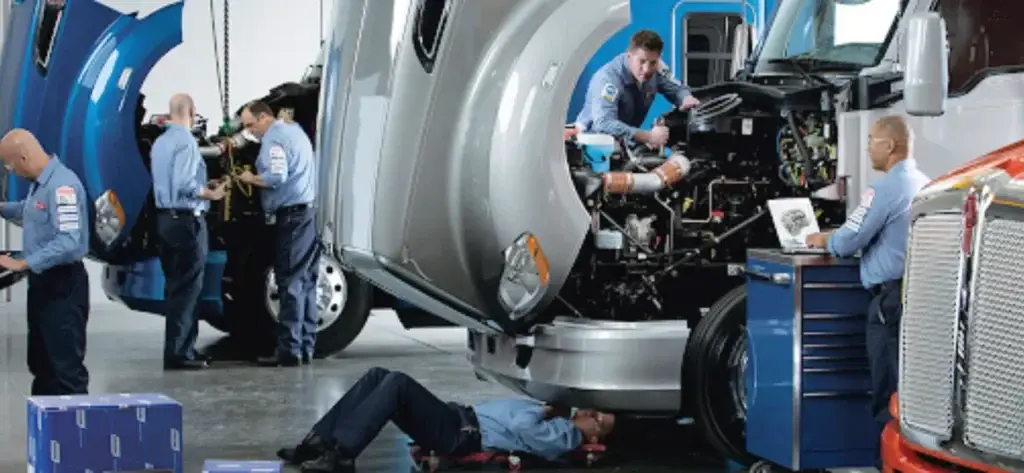
The diesel mechanic benefits landscape has transformed dramatically across North America in 2025. Thousands of companies compete for skilled technicians to maintain commercial vehicles, construction equipment, and transportation fleets, creating unprecedented opportunities for professionals seeking comprehensive compensation packages beyond base salary.
Understanding the full scope of diesel technician compensation goes beyond hourly wages. Today’s employment offerings include health coverage, retirement contributions, professional development programs, and performance bonuses. These comprehensive packages reflect the critical role technicians play in keeping America’s economy moving.
The work demands expertise in complex systems, long hours, and problem-solving under pressure. Weather conditions and physical challenges make this profession uniquely demanding. Smart professionals evaluate employment packages as complete compensation structures, analyzing health insurance value, retirement matching, paid time off, tool allowances, and training opportunities that can add 25-40% to base pay.
This guide explores salary structures, health benefits, retirement options, and professional development opportunities available to diesel mechanics in 2025. You’ll discover how to assess your marketplace value and make informed career decisions based on total compensation analysis.
Last Updated: November 2025
Key Takeaways
- Total Compensation Value: Comprehensive benefit packages add 25-40% to base salary through health insurance, retirement matching, tool allowances, and training programs worth $15,000-$30,000 annually.
- Employment Setting Matters: Government positions offer superior job security and pensions, while transportation companies provide better work-life balance with four-day work weeks and higher base pay.
- Geographic Pay Variations: Coastal regions and Alaska offer 25-40% higher wages, but Midwest and Southern states provide comparable purchasing power due to lower living costs.
- Career Progression Impact: Master technicians with 7+ years experience and multiple certifications earn $35-$60 hourly, with leadership roles reaching $70,000-$100,000 annually.
- Shortage Creates Leverage: The nationwide technician shortage has driven sign-on bonuses to $1,000-$10,000 and enabled skilled mechanics to negotiate comprehensive benefit packages.
The Diesel Mechanic Compensation Landscape in 2025
Compensation for diesel technicians has evolved significantly, with 2025 bringing diverse earning structures that reward efficiency and expertise. The industry offers three primary payment frameworks, each designed to match different work environments and employer needs. These structures create varied earning potential based on individual performance, work volume, and career progression.
Compensation Models and Earning Structures
The hourly-rate system remains the most common compensation method across diesel repair facilities. This structure provides stable, predictable income with substantial overtime pay opportunities when workload increases. Technicians earning an hourly wage typically receive time-and-a-half for hours beyond 40 per week, with some mechanics earning upwards of $100,000 annually through overtime alone when combined with base wages.
The flat-rate pay structure operates on a performance-based model tied to standardized repair times. Mechanics receive payment based on “book time” rather than actual hours worked. An efficient technician who completes 12 hours of book time in 8 actual hours earns compensation for the full 12 hours, maximizing income through speed and skill. However, this system carries inherent risks during slower business periods when fewer repair orders reduce billable hours despite working full days.
Salary-based compensation typically applies to management-level positions and supervisory roles. This structure offers consistent paychecks regardless of workload fluctuations but generally excludes overtime eligibility. Shop foremen, service managers, and fleet supervisors commonly receive this compensation type.
| Pay Structure | How It Works | Advantages | Best Suited For |
|---|---|---|---|
| Hourly Rate | Fixed wage per hour with 1.5x overtime after 40 hours/week | Predictable income, substantial overtime earnings potential, steady pay during slow periods | Technicians seeking income stability with overtime opportunities |
| Flat-Rate | Payment based on standardized “book time” completion | Unlimited earning potential for efficient workers, rewards speed and expertise | Highly skilled mechanics in busy shops with consistent workflow |
| Salary | Fixed annual compensation regardless of hours worked | Consistent income, often includes additional benefits, no hourly tracking | Management positions, supervisors, fleet coordinators |
| Hybrid Models | Combination of guaranteed base plus performance incentives | Income floor protection with upside potential, balances stability and performance rewards | Dealerships and large fleet operations seeking to attract top talent |
Additional compensation enhancements include shift differentials averaging $2 per hour for second and third shifts. Sign-on bonuses range from $1,000 to $10,000 depending on experience level and employer demand. Some facilities also offer profit-sharing programs that distribute quarterly or annual bonuses based on company performance.
Regional Compensation Differences
Geographic location significantly impacts diesel technician earnings across the United States. According to the Bureau of Labor Statistics, coastal metropolitan areas and regions with high living costs typically offer elevated wages to attract qualified professionals. The highest-paying regions include the Pacific Northwest, Northeast Corridor, Alaska, oil and gas regions in Texas and North Dakota, and major distribution hubs like Atlanta and Chicago.
Alaska offers particularly premium pay rates, often 25-40% above national averages due to remote conditions and extreme weather demands. Midwest and Southern states generally feature moderate compensation levels, but lower living costs in these regions often result in comparable or superior purchasing power. Technicians evaluating opportunities should consider total compensation against regional housing, tax, and daily expense variations.
Career Progression and Experience-Based Earnings
Experience levels directly correlate with earning potential throughout a diesel technician’s career. Entry-level apprentices typically start at $15-$20 per hour while developing foundational skills under experienced mentors. As technicians gain certifications and demonstrate competency, they advance to journeyman status with 3-5 years experience, commonly earning $25-$35 per hour depending on location and specialization.
Master technicians with advanced certifications and 7+ years experience command premium compensation, typically earning $35-$50+ per hour, with top performers in high-demand markets exceeding $60 hourly. These experts often specialize in complex systems like electronic engine controls, emissions systems, or transmission rebuilding.
Career advancement pathways extend beyond technician roles into leadership positions including Lead Technician ($45,000-$65,000 annually), Shop Foreman ($55,000-$75,000 annually), Service Manager ($65,000-$90,000+ annually), and Fleet Maintenance Supervisor ($70,000-$100,000+ annually). These leadership roles typically transition from hourly to salaried compensation structures and require both technical expertise and management capabilities.
Comprehensive Health Insurance Benefits for Diesel Technicians
Diesel technicians in 2025 benefit from robust health insurance programs that protect both physical well-being and financial security. Employers across the industry recognize that comprehensive healthcare coverage serves as a critical recruitment and retention tool. Most employers offer benefits that activate within 30 to 90 days of employment, typically including preventive care, emergency services, prescription drug coverage, and specialized treatments relevant to occupational health concerns.

Medical, Dental, and Vision Coverage Options
The standard benefit trio for diesel mechanics consists of medical, dental, and vision insurance. Employers structure these offerings in multiple tiers to accommodate different family situations and healthcare needs. Bronze-level plans provide basic coverage with higher out-of-pocket costs, while platinum-tier options deliver comprehensive protection with minimal employee expense at the point of service.
Medical plans typically feature tiered network structures with preferred provider organizations. In-network care receives higher reimbursement rates compared to out-of-network services. Most plans include prescription drug benefits with tiered copayment structures for generic, preferred brand, and specialty medications. Dental coverage includes preventive services such as cleanings and examinations at little or no cost, with partial coverage for fillings and higher copayments for major work like crowns and bridges.
Vision insurance covers annual eye examinations, prescription eyewear, and contact lenses with specific allowances for frames and lenses. Companies allow employees to customize coverage levels based on family composition, selecting employee-only coverage, employee-plus-spouse, employee-plus-children, or full family plans.
Employer Premium Cost-Sharing Models
Employer contributions toward health insurance premiums represent a significant portion of total compensation value. Industry standards show that employers typically cover 70 to 80 percent of premium costs for employee-only coverage. Family coverage contributions vary more widely, with employers generally paying 50 to 70 percent of the total premium.
The remaining premium amount gets deducted from employee paychecks on a pre-tax basis, reducing the effective cost for technicians. For example, a technician paying $200 monthly for family coverage actually saves approximately $50 to $75 in combined federal and state taxes. Large employers and unionized facilities often provide more generous premium subsidies, with some organizations covering 100 percent of employee-only premiums.
| Coverage Level | Monthly Premium | Employer Contribution | Employee Cost |
|---|---|---|---|
| Employee Only | $650 | $520 (80%) | $130 |
| Employee + Spouse | $1,300 | $845 (65%) | $455 |
| Employee + Children | $1,150 | $748 (65%) | $402 |
| Full Family | $1,800 | $1,080 (60%) | $720 |
Health Savings Accounts and Flexible Spending Arrangements
Consumer-driven healthcare models empower diesel technicians to take control of medical expenses through tax-advantaged savings vehicles. High-deductible health plans paired with Health Savings Accounts provide a compelling alternative to traditional insurance structures. These plans feature lower monthly premiums in exchange for higher initial out-of-pocket costs, with 2025 minimum deductible requirements of $1,650 for individual coverage and $3,300 for family plans.
Employers typically contribute between $500 and $1,500 annually to employee HSA accounts. These contributions represent free money that technicians can use for qualified medical expenses. Unlike flexible spending accounts, HSA balances roll over year after year, creating a powerful long-term savings vehicle. According to IRS Publication 969, individuals may contribute $4,300 while families can save $8,550 in 2025, with workers aged 55 and older receiving an additional $1,000 catch-up contribution allowance.
The triple tax advantage makes HSAs particularly valuable. Contributions reduce taxable income, earnings grow without tax liability, and withdrawals for qualified medical expenses incur no taxation. This structure creates an effective retirement savings supplement that specifically addresses healthcare costs in later years.
Flexible spending account programs provide additional tax-advantaged savings opportunities for diesel mechanics with specific annual expenses. Medical FSAs allow technicians to set aside pre-tax dollars for predictable healthcare costs not covered by insurance, with 2025 contribution limits at $3,200 annually. Dependent care FSAs address childcare expenses, allowing parents to contribute up to $5,000 annually to cover daycare, preschool, and summer programs.
Retirement Plans and Long-Term Financial Security
Smart diesel mechanics recognize that retirement benefits can accumulate more wealth than immediate salary increases over a full career. A technician who starts at age 25 and works until 65 can build substantial financial security through employer-sponsored retirement programs. The most critical factor involves understanding how different benefit structures work together to create lasting financial independence.
401(k) Plans With Matching Contributions
The standard 401(k) matching programs allow technicians to contribute pre-tax dollars from each paycheck into investment accounts, reducing current taxable income while building retirement savings simultaneously. Most employers match employee contributions at rates between 3% and 6% of annual salary. A diesel technician earning $60,000 annually who contributes 5% receives an employer match of $3,000—essentially free money added to retirement savings representing a 5% immediate return on contributed funds before any investment growth.

Understanding vesting schedules proves essential for maximizing benefits. Vesting determines when employer contributions become fully owned by the employee. Most companies use graduated vesting schedules spanning 3-5 years, typically allocating 20% ownership after year one, 40% after year two, and reaching 100% at year five. Technicians who change employers before full vesting forfeit unvested matching contributions.
Defined-Benefit Programs in Union Shops
Traditional pension plans remain available primarily through unionized facilities, offering retirement benefits technicians can depend on regardless of market performance. These defined-benefit programs guarantee specific monthly payments during retirement based on years of service and final salary calculations, providing predictable income that continues throughout retirement.
Union pension plans typically calculate benefits using formulas like: Years of Service × Final Average Salary × Multiplier (usually 1.5-2.5%). A technician with 30 years of service and a final average salary of $70,000 using a 2% multiplier would receive $42,000 annually in pension income. These payments often include cost-of-living adjustments to maintain purchasing power.
The security of pension plans comes from pooled contributions and professional management. Unlike 401(k) accounts where individuals bear investment risk, pension programs guarantee benefits regardless of market conditions, making unionized positions particularly attractive for technicians prioritizing retirement security.
Performance-Based Wealth Building
Profit sharing programs distribute portions of company earnings to eligible employees, creating direct financial alignment between individual success and organizational performance. These distributions often range from 3-8% of annual compensation during profitable years. Eligibility typically requires minimum tenure (often 6-12 months) and active employment status during distribution periods.
Stock ownership plans create additional wealth-building opportunities for technicians working at publicly-traded companies. Employee Stock Ownership Plans (ESOPs) and discounted stock purchase programs allow employees to acquire company shares, aligning employee and shareholder interests. Discounted stock purchase programs typically allow employees to buy company stock at 10-15% below market price through payroll deductions, with an employee purchasing $5,000 in stock annually at a 15% discount immediately gaining $750 in value.
| Retirement Benefit Type | Typical Employer Contribution | Employee Control Level | Primary Advantage |
|---|---|---|---|
| 401(k) With Matching | 3-6% of salary match | High (investment choices) | Portable, immediate tax benefits |
| Union Pension Plans | Fully employer-funded | Low (guaranteed payments) | Predictable lifetime income |
| Profit Sharing Programs | 3-8% in profitable years | Medium (varies by plan) | Direct performance rewards |
| Stock Ownership Plans | 10-15% purchase discount | High (optional participation) | Equity appreciation potential |
Diesel mechanics should prioritize employers offering robust retirement benefits as these programs accumulate substantial wealth over 30-40 year careers. A technician contributing just $200 monthly to a 401(k) with 5% employer match and 7% average annual returns would accumulate approximately $525,000 over 30 years. Combined with pension income and profit sharing, total retirement assets can easily exceed $750,000.
Stay Ahead of Industry Trends
Get expert insights, equipment reviews, and operational strategies delivered weekly.
Paid Time Off and Work-Life Balance Programs
The diesel mechanic profession demands physical stamina and mental focus, making comprehensive paid time off policies essential for preventing burnout and maintaining peak performance. Leading employers recognize that work-life balance directly impacts technician retention, productivity, and job satisfaction. Modern compensation packages extend far beyond hourly wages to include structured time-away benefits that acknowledge the demanding nature of diesel repair work.

Vacation Days and Personal Time Policies
Vacation days technicians receive typically correlate directly with tenure and experience levels. Entry-level diesel mechanics generally start with 5-10 days of annual vacation time, while technicians with 3-5 years of experience commonly receive 10-15 days. Senior technicians with 10+ years of service frequently earn 15-20 vacation days annually, with some employers offering up to four weeks for highly tenured employees.
Accrual systems vary significantly across employment settings. Some facilities provide lump-sum annual allocations at the beginning of each year, while others implement earned-per-pay-period models where technicians accrue approximately 3.08-6.15 hours of vacation time per pay period. Personal time policies have evolved to include flexible PTO that doesn’t require specific justification, with progressive employers allocating 3-5 personal days annually for any purpose.
Sick Leave and Family Medical Leave
Dedicated sick leave policies separate illness-related absences from vacation time, ensuring technicians don’t sacrifice leisure time when facing health issues. Standard sick leave accrual rates range from 1 hour per 30-40 hours worked, translating to approximately 6-10 sick days annually for full-time diesel mechanics. Many employers allow unused sick time to roll over year-to-year, creating banks of up to 40-60 days for catastrophic illness situations.
The Family Medical Leave Act (FMLA) provides eligible employees with up to 12 weeks of unpaid, job-protected leave for qualifying family and medical reasons, including personal serious health conditions, caring for immediate family members, and bonding with newborns. Forward-thinking diesel repair facilities supplement FMLA protections with paid family leave options, with some employers providing 2-6 weeks of paid parental leave.
Paid Holidays and Bereavement Leave
Comprehensive holiday pay packages ensure diesel mechanics receive full compensation when facilities close for national observances. Most employers observe 6-10 paid holidays annually, with nearly universal coverage including New Year’s Day, Memorial Day, Independence Day, Labor Day, Thanksgiving Day, and Christmas Day. When operational requirements demand holiday work, technicians typically receive premium pay rates—either time-and-a-half or double-time compensation depending on employer policies and union agreements.
Bereavement leave policies typically provide 3-5 days of paid time off following the death of immediate family members—spouses, children, parents, or siblings. Some employers extend this benefit to include grandparents, grandchildren, and in-laws. Family emergency leave provisions address urgent situations beyond standard bereavement coverage, incorporating short-term personal leave banks for unforeseen circumstances.
| Experience Level | Annual Vacation Days | Sick Days | Paid Holidays |
|---|---|---|---|
| Entry-Level (0-2 years) | 5-10 days | 6-8 days | 6-8 holidays |
| Mid-Level (3-5 years) | 10-15 days | 8-10 days | 8-10 holidays |
| Senior Level (6-10 years) | 15-20 days | 10-12 days | 8-10 holidays |
| Master Technician (10+ years) | 20-25 days | 12-15 days | 10 holidays |
Professional Development and ASE Certification Support
Leading diesel mechanic employers distinguish themselves through robust professional development initiatives and certification reimbursement programs. Companies offering comprehensive training support recognize that equipment complexity has grown exponentially, with computerized systems requiring specialized knowledge that extends far beyond traditional mechanical repair skills.
ASE Certification Exam Fees and Study Material Reimbursement
Automotive Service Excellence certifications serve as industry-recognized credentials that validate technician expertise across specific diesel repair categories. Top employers provide full ASE certification reimbursement covering examination fees ranging from $36 to $68 per individual test. Beyond examination fees, comprehensive programs include reimbursement for study materials valued between $200 and $500 annually, encompassing official study guides, practice examinations, and preparation courses.
The financial return on ASE certifications justifies employer investment. Certified technicians command $2 to $5 per hour premium wages compared to non-certified counterparts. A technician earning base wages of $28 per hour who obtains four relevant certifications can realistically increase hourly compensation to $33-$36, translating to $10,400 to $16,640 in additional annual earnings from employer-funded certification support.
Manufacturer-Specific Training Programs
Factory training from equipment manufacturers represents the gold standard in diesel mechanic training programs. Leading employers budget $1,500 to $5,000 per technician annually for manufacturer training, including course tuition, travel expenses, lodging, and meals for multi-day training events. The three dominant diesel engine manufacturers—Cummins, Detroit Diesel, and Caterpillar—each maintain comprehensive training infrastructures designed to keep technicians current with evolving technology.
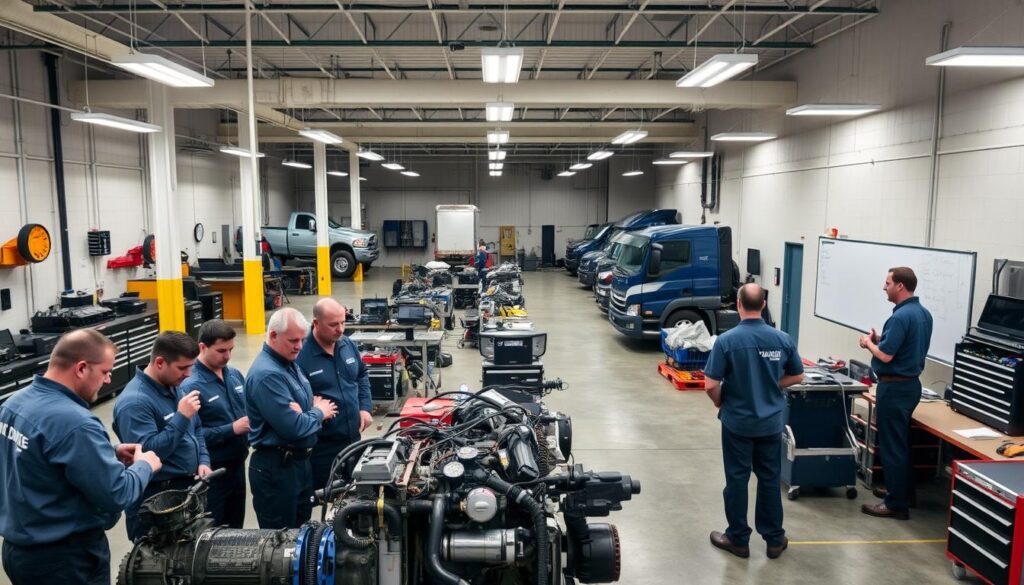
Modern diesel engines feature multiple Engine Control Modules communicating thousands of data points through Controller Area Network bus systems. Understanding these computerized networks requires specialized electronic diagnostics training that traditional mechanical education never addressed. Employers investing in emissions systems education prepare technicians to diagnose Diesel Exhaust Fluid systems, Diesel Particulate Filter regeneration issues, and Selective Catalytic Reduction technology failures.
Tuition Assistance for Advanced Technical Education
Progressive employers extend educational support beyond certification and factory training into degree-granting programs at technical colleges and community colleges. Tuition assistance technicians receive ranges from partial reimbursement to full coverage depending on employer policies, with programs typically requiring technicians to maintain specific grade point averages and remain employed for predetermined periods following degree completion.
Some arrangements cover $5,000 to $20,000 in educational costs dispersed over two to four years for technicians completing diesel technology degrees. A technician receiving $15,000 annually in combined certification support, factory training, and tuition assistance gains skills worth substantially more in increased compensation and career advancement opportunities over a professional lifetime.
Tool Allowances and Equipment Provisions
Beyond traditional salary and health insurance, tool allowance programs deliver tangible value that directly impacts daily work capabilities and long-term financial outcomes. Professional technicians routinely maintain personal tool collections valued between $20,000 and $50,000, representing years of accumulated investment. Progressive employers recognize this financial burden and provide comprehensive support through reimbursement programs, equipment provisions, and financing alternatives.

Annual Tool Budget Allocations
Tool reimbursement programs vary significantly based on employer size, facility type, and technician experience level. Entry-level diesel mechanics typically receive annual allowances ranging from $500 to $1,000 during their first two years of employment. Mid-career professionals with five to seven years of tenure commonly receive $1,500 to $2,000 annually, while senior technicians with ten or more years often qualify for premium allowances of $2,500 to $3,000 or more.
Most reimbursement programs require specific documentation before processing payments. Technicians must submit itemized purchase receipts showing the tool description, purchase date, and amount paid. Understanding allocation cycles helps technicians maximize available benefits by timing significant tool investments strategically.
Employer-Provided Specialty Diagnostic Equipment
High-value specialty tools and diagnostic equipment represent a category where employer provisions deliver exceptional value. Advanced diagnostic equipment creates the most significant cost savings for technicians, with professional-grade scan tools ranging from $3,000 to $8,000 per unit. Leading employers purchase these systems as company property, making them available to all qualified technicians without individual ownership requirements.
Specialty tools provided by employers typically include electronic diagnostic scanners with multi-manufacturer compatibility, hydraulic press equipment, precision measurement tools, heavy-duty lifting equipment, and specialized pullers. This approach ensures all mechanics have access to necessary tools regardless of personal financial circumstances.
“Tools are expensive and take a beating in this trade. Having an employer that understands this reality and provides quality equipment makes a tremendous difference in job satisfaction and long-term career sustainability.”
— Master Diesel Technician, 15 Years Experience
Tool Insurance and Replacement Programs
Protecting substantial tool investments requires comprehensive insurance coverage addressing multiple risk factors. Given that professional collections often exceed $30,000 in value, tool insurance has become a critical benefit consideration. Progressive employers address this through group tool insurance programs negotiated at discounted rates, with annual premiums typically ranging from $150 to $400 depending on collection value.
Traditional tool truck financing through vendors like Snap-on and Mac Tools has historically charged interest rates exceeding 20% APY, creating substantial long-term costs. Forward-thinking employers now offer alternative financing arrangements that eliminate excessive interest charges through interest-free financing programs allowing technicians to purchase necessary tools through payroll deductions at zero interest.
| Financing Method | Interest Rate | Payment Period | Total Cost |
|---|---|---|---|
| Snap-on Financing | 22% APY | 36 months | $6,940 |
| Mac Tools Financing | 20% APY | 36 months | $6,720 |
| Employer Interest-Free Program | 0% APY | 36 months | $5,000 |
| Personal Savings (Cash Purchase) | N/A | Immediate | $5,000 |
Employer-sponsored financing saves technicians between $1,720 and $1,940 on a single $5,000 tool purchase
Comprehensive Diesel Mechanic Benefits Across Employment Settings
Where diesel technicians work matters as much as what they earn, as employment settings deliver vastly different benefit experiences. Major employment categories include dealership positions, independent repair shops, corporate fleet maintenance departments, and government fleet operations. Each setting offers unique advantages alongside specific trade-offs.
Dealership Employment Benefit Packages
Dealership environments provide structured career paths with manufacturer-backed support systems that independent operations cannot match. Heavy-duty truck dealerships at brands like Freightliner, Peterbilt, Kenworth, Volvo, and Mack deliver competitive compensation packages designed to attract ASE-certified professionals, typically offering health insurance with 70-80% employer premium contributions, retirement benefits featuring 401(k) plans with 3-5% employer matching, and tool allowances ranging from $1,000 to $2,000 annually.
Factory training access represents a distinctive advantage of dealership employment, with manufacturers providing technicians certification programs for new engine technologies at no cost. Performance bonuses tied to customer satisfaction scores create additional earning potential, with quarterly bonuses of $500 to $1,500 common at dealerships emphasizing customer experience metrics.

Agricultural equipment dealers including John Deere, Case IH, Caterpillar, and Komatsu franchises offer benefit structures that rival automotive dealerships while providing unique seasonal opportunities. Seasonal workload patterns create significant overtime earning potential during spring planting and fall harvest periods, with technicians often working 50-60 hour weeks during rush seasons, increasing annual earnings by $8,000 to $15,000 through seasonal overtime alone.
Independent Repair Shop Competitive Offerings
Independent repair shops present a diverse employment landscape with benefit structures varying significantly based on shop size. Smaller operations with fewer than 10 employees often compensate for limited formal benefits by offering higher hourly rates ranging from $3 to $8 above dealership pay. Larger independent chains increasingly implement benefit packages that match or exceed dealership offerings to remain competitive in talent acquisition.
Independent shops offer distinctive advantages including varied work exposure across multiple vehicle types and greater scheduling flexibility. Profit-sharing arrangements at some operations provide direct participation in business success, with annual profit-sharing distributions of $2,000 to $5,000 rewarding technicians at successful facilities.
Fleet Maintenance Department Benefits
Fleet maintenance positions offer unique advantages centered on predictable schedules, consistent workloads, and corporate benefit structures. Major transportation and logistics companies including Schneider, J.B. Hunt, Werner, UPS, and FedEx have developed sophisticated benefit packages to attract diesel technicians, typically exceeding small dealership offerings in both scope and value.
Corporate benefit structures at transportation companies include comprehensive health insurance with employer premium contributions of 75-85%, retirement benefits featuring 401(k) plans with 4-6% employer matching alongside profit-sharing contributions, and consistent workloads eliminating income volatility. Some facilities offer four-day work week schedules providing extended time off without reducing annual compensation, with multiple shift options accommodating technician preferences.
Municipal and government fleet benefits represent the gold standard for job security and comprehensive insurance, though often paired with lower base compensation than private sector positions. Defined-benefit pension plans remain the cornerstone, offering guaranteed retirement income based on years of service. A technician retiring after 25 years might receive annual pension payments of $35,000 to $50,000 depending on final salary levels.
Health insurance benefits feature exceptionally low employee premium contributions, often 10-20% of total premium costs compared to 20-30% at private employers. Paid time off structures significantly exceed private sector standards, with starting vacation allowances of 3-4 weeks annually increasing to 5-6 weeks for long-term employees. Job security through civil service protections provides peace of mind unavailable in private employment.
| Employment Setting | Base Pay Range | Key Benefits | Unique Advantages |
|---|---|---|---|
| Heavy Truck Dealership | $24-$32/hour | Health insurance (70-80% employer paid), 401(k) matching (3-5%), tool allowance, factory training | Latest technology exposure, manufacturer certification, performance bonuses |
| Agricultural Equipment Dealer | $23-$30/hour | Health insurance, 401(k) matching, tuition reimbursement, profit-sharing | Seasonal overtime ($8,000-$15,000 annual), precision agriculture technology training |
| Transportation/Logistics Fleet | $26-$34/hour | Health insurance (75-85% employer paid), 401(k) matching (4-6%), profit-sharing, consistent schedule | Four-day work weeks, shift flexibility, no customer pressure, guaranteed hourly pay |
| Municipal/Government Fleet | $22-$28/hour | Defined-benefit pension, health insurance (80-90% employer paid), 3-4 weeks starting vacation, retiree health coverage | Superior job security, exceptional work-life balance, lifetime retirement income |
Performance-Based Incentives and Bonus Structures
The earning potential for diesel mechanics extends far beyond base pay, with sophisticated bonus structures offering opportunities to boost annual income by 10-25%. These performance bonuses create direct financial rewards for efficiency, quality workmanship, and commitment to employers.
Flat-Rate Productivity Bonuses and Efficiency Incentives
Flat-rate compensation structures inherently include built-in efficiency bonuses that reward mechanics who complete repairs faster than allocated “book time.” A mechanic completing 50 hours of billable work in just 40 actual hours achieves 125% efficiency. This efficiency translates directly to increased earnings—consider a technician with a $30 per hour base rate who maintains 120% efficiency throughout the month, with their effective hourly rate becoming $36.
Hourly-paid shops implement different structures but achieve similar results, typically offering monthly or quarterly bonuses ranging from $250 to $1,000 for technicians who exceed efficiency targets. Some employers calculate efficiency bonuses based on departmental profitability, encouraging teamwork and collective productivity improvement.
Sign-On Bonuses and Retention Rewards
The severe shortage of qualified diesel mechanics has driven sign-on bonus programs to unprecedented levels in 2025, ranging from $1,000 for entry-level technicians to $10,000 or more for master technicians. Most employers structure these payments across predetermined distribution dates: 25% at hire, 25% at six months, and 50% at twelve months, improving retention through staggered payments.
Separate from sign-on payments, retention bonuses reward longevity at specific tenure milestones, typically offering $500 to $5,000 payments at one-year, three-year, and five-year anniversaries. The combination creates powerful financial incentives for career stability.
Customer Satisfaction and Quality Performance Bonuses
Customer-facing positions at dealerships increasingly tie compensation to satisfaction metrics, with quarterly bonuses ranging from $300 to $1,500 rewarding technicians who consistently exceed satisfaction benchmarks. Quality performance metrics provide another bonus category focused on technical excellence, with first-time fix rates measuring the percentage of repairs completed correctly without requiring follow-up work.
| Bonus Type | Typical Amount | Payment Frequency | Primary Criteria |
|---|---|---|---|
| Flat-Rate Efficiency | 15-25% above base | Every paycheck | Hours billed vs. actual time |
| Sign-On Bonus | $1,000-$10,000 | Distributed over 6-12 months | Accepting employment and tenure |
| Retention Rewards | $500-$5,000 | Annual milestones | Continued employment at anniversaries |
| Customer Satisfaction | $300-$1,500 | Quarterly | CSI scores above threshold |
Safety Equipment and Workers’ Compensation Coverage
Working underneath heavy vehicles and handling powerful tools creates inherent risks that employers address through safety equipment provisions and comprehensive insurance coverage. The physically demanding nature of diesel repair work makes safety provisions essential rather than optional, directly impacting productivity, retention, and workforce satisfaction.
Personal Protective Equipment and Safety Gear Provisions
PPE provisions form the first line of defense against common workplace hazards. Employers typically supply essential protective equipment at no cost, including safety glasses protecting against metal shavings and chemical splashes, hearing protection against constant noise from air tools, and chemical-resistant gloves addressing different hazard exposures.
Boot allowance programs deliver meaningful financial value, with most employers providing $150 to $200 annually for steel-toed or composite-toe safety boot reimbursement. Quality safety boots range from $70 to $300 per pair and wear out quickly in demanding shop environments. Uniform provisions typically include five to seven complete sets valued at $500 to $800 annually when employer-provided, with regular laundry service saving technicians $15 to $25 weekly.
Comprehensive Workers’ Compensation Insurance
Workers compensation coverage stands as mandatory employer-provided injury protection that safeguards diesel mechanics when accidents occur on the job. According to the U.S. Department of Labor, this essential insurance pays all medical expenses related to work injuries while typically replacing approximately two-thirds of average weekly wages during recovery periods when technicians cannot work. Workplace safety programs complement insurance coverage by actively reducing injury frequency through regular safety meetings, proper lifting technique training, and hazard identification protocols.
Short-Term and Long-Term Disability Coverage
Disability insurance benefits extend protection beyond workers’ compensation to cover both work-related conditions after benefits exhaust and non-work-related illnesses. Short-term disability coverage typically replaces 60% to 70% of salary for three to six months when technicians cannot perform their duties. Long-term disability provides extended income protection, replacing 50% to 60% of salary for durations ranging from two years to age 65.
The distinction between “own occupation” and “any occupation” definitions significantly impacts coverage quality. Premium LTD policies pay benefits when technicians cannot perform diesel mechanic work specifically, proving especially valuable given the physical demands unique to diesel repair work.
| Coverage Type | Income Replacement | Duration | Eligibility |
|---|---|---|---|
| Workers’ Compensation | 66% of weekly wages | Until medical recovery | Work-related injuries only |
| Short-Term Disability | 60-70% of salary | 3-6 months | Work and non-work conditions |
| Long-Term Disability | 50-60% of salary | 2 years to age 65 | Extended inability to work |
Progressive employers implement proactive workplace safety programs that reduce injury frequency while demonstrating genuine concern for technician wellbeing, including ergonomics training, lift-assist equipment, anti-fatigue mats, and incentive programs rewarding injury-free work periods. Facilities with comprehensive injury prevention programs typically experience 30% to 50% fewer workers’ compensation claims compared to shops with minimal safety focus.
Union vs. Non-Union Benefit Package Comparisons
Understanding the fundamental differences between union and non-union benefit structures empowers diesel mechanics to make informed career choices. Both employment paths offer competitive compensation packages in 2025, yet they deliver benefits through distinctly different frameworks that significantly impact long-term financial security, workplace protections, and career advancement opportunities.
Collective Bargaining Advantages and Job Security
Collective bargaining provides union members with negotiating power that individual technicians rarely achieve alone, creating standardized structures that apply equally across the workforce. Job security provisions represent one of the most significant advantages, with union contracts typically requiring just-cause termination standards and seniority-based layoff procedures. Formalized grievance procedures offer structured channels for addressing workplace disputes, ensuring fair treatment and consistent application of workplace rules.
Union Benefit Packages and Guaranteed Wage Increases
Union contracts deliver defined-benefit pension plans that guarantee specific monthly retirement income based on years of service and final salary. A typical formula provides $70 per month for each year of service, yielding $2,100 monthly ($25,200 annually) for a 30-year career. This guaranteed retirement income offers significant advantages over market-dependent 401(k) plans, with employers bearing investment risk rather than transferring it to individual workers.
Union health insurance packages frequently feature lower employee premium contributions than non-union equivalents. Guaranteed wage increases provide predictable income growth throughout careers, with typical union contracts specifying annual raises ranging from 2% to 4% regardless of individual performance. Cost-of-living adjustments protect purchasing power against inflation, automatically adjusting wages when consumer price indices exceed specified thresholds.
Competitive Non-Union Employer Offerings
Leading non-union employers often match or exceed union benefit packages to remain competitive for skilled talent. Merit-based advancement opportunities represent a key advantage in non-union environments, with exceptional performers able to advance more rapidly than seniority systems permit. Non-union employers typically offer 401(k) retirement plans with employer matching contributions rather than defined-benefit pensions, providing complete portability when changing employers.
Schedule flexibility often proves greater in non-union shops, with management able to accommodate individual preferences more easily. Training and certification support frequently matches or exceeds union offerings, with competitive non-union employers investing heavily in employee development.
| Benefit Category | Union Position Example | Non-Union Position Example | Key Difference |
|---|---|---|---|
| Base Hourly Wage | $32.00/hour | $35.00/hour | Non-union offers higher starting rate |
| Retirement Plan | Defined pension: $70/month per service year | 401(k) with 5% employer match | Union provides guaranteed income; non-union offers portability |
| Health Insurance Premium | $150/month employee contribution | $200/month employee contribution | Union premium typically lower |
| Advancement Method | Seniority-based progression | Performance-based merit increases | Non-union rewards individual excellence |
The choice between union and non-union employment ultimately depends on individual circumstances and priorities. Technicians valuing security, standardization, and collective protections often thrive in union environments, while those prioritizing flexibility, individual recognition, and merit-based advancement may prefer non-union settings. Career stage influences optimal choice—early-career technicians might benefit from non-union merit opportunities, while late-career workers approaching retirement may prioritize defined pension plans available primarily through unions.
Share Your Expertise
Join Heavy Duty Journal as a guest author and reach thousands of industry decision-makers.
Additional Perks and Emerging Benefit Trends for 2025
Modern diesel mechanic employers recognize that attracting top talent requires comprehensive support systems extending into housing, wellness, and emerging technology training. The most competitive facilities now offer benefits addressing technicians’ complete life circumstances rather than just workplace compensation.
Relocation Assistance and Housing Support Programs
Technicians willing to move for career advancement find substantial relocation assistance programs at leading employers, typically providing $3,000 to $10,000 in reimbursement for moving expenses. Many facilities offer temporary housing during transition periods, providing 30 to 90 days of lodging while technicians search for permanent residences. Housing support programs extend beyond initial relocation, with some employers offering rental deposit assistance and down payment assistance programs contributing $5,000 to $15,000 toward home purchases.
Wellness Programs and Mental Health Resources
Employers increasingly recognize that diesel mechanic work involves physical demands and occupational stress requiring comprehensive support. Wellness programs address both immediate health needs and long-term wellbeing, with extensive discount programs providing year-round savings from hundreds of companies, reaching $500 to $1,500 annually in extended purchasing power.
Confidential employee assistance program services provide crucial support for personal challenges, typically offering six to eight counseling sessions annually at no cost. Services address substance abuse, family problems, financial stress, and personal crises, with mental health resources including professional counseling, crisis intervention, and referrals to specialized treatment.
Physical fitness programs support the demanding nature of diesel mechanic work, with employers providing paid or subsidized fitness center access valued at $20 to $50 monthly. Wellness challenges with monetary rewards motivate health improvements, targeting smoking cessation, weight management, and cholesterol reduction.
Family Benefits and Dependent Care Support
Family-focused benefits recognize that technician job satisfaction depends partly on support for dependents. Paid parental leave represents a growing trend, with progressive employers offering two to six weeks paid time off for new parents. Adoption assistance programs provide $5,000 to $15,000 reimbursement for adoption expenses. Dependent care benefits include flexible spending accounts allowing pre-tax savings up to $5,000 annually for childcare expenses, reducing actual childcare costs by 20% to 30% depending on tax brackets.
Electric Vehicle and Alternative Fuel Training Incentives
Forward-thinking employers invest in preparing technicians for industry evolution through electric vehicle training programs positioning mechanics for emerging specializations commanding premium compensation. Employer-sponsored training covers EV and hybrid systems, hydrogen fuel cell technology, and compressed natural gas systems, typically costing employers $2,000 to $5,000 per technician. Some facilities offer incentive bonuses for completing advanced certifications, with technicians earning electric vehicle training credentials receiving $500 to $2,000 bonuses.
| Benefit Category | Typical Offering | Annual Value |
|---|---|---|
| Relocation Assistance | Moving reimbursement, temporary housing, travel expenses | $3,000-$10,000 |
| Employee Assistance Program | 6-8 confidential counseling sessions, financial planning, legal services | $600-$1,200 |
| Fitness Programs | Gym membership, wellness challenges, biometric screening | $240-$800 |
| Dependent Care Support | FSA accounts, adoption assistance, backup childcare | $1,000-$5,000 |
| Alternative Fuel Training | EV/hybrid certification, hydrogen systems, CNG technology | $2,000-$5,000 |
Conclusion
Your diesel mechanic career decision shapes your financial future and daily satisfaction. Total compensation extends far beyond hourly rates—health insurance adds $8,000-$15,000 in annual value for family coverage, retirement matching contributes $2,000-$5,000 yearly, paid time off equals $3,000-$6,000 based on vacation weeks offered, tool allowances provide $500-$3,000 annually, and training programs deliver $5,000-$15,000 in employer-paid education. Combined, these benefits represent 25-40% of base compensation.
Employment package comparison requires calculating total value. A position paying $32 per hour with complete benefits often exceeds $35 per hour with minimal coverage. Early-career technicians benefit from prioritizing training and advancement opportunities, while experienced professionals with families gain more from quality health insurance and strong retirement plans.
Ask detailed questions during interviews about insurance providers, premium costs, retirement matching percentages, paid time off policies, and training opportunities. Diesel mechanics remain in critical shortage across the United States, giving you significant negotiating power. Pursue employers demonstrating genuine investment in your wellbeing and professional growth.
According to Bureau of Labor Statistics employment projections, demand for diesel technicians is expected to grow steadily through 2033, maintaining strong leverage for skilled professionals. Armed with this knowledge, you can secure employment packages offering excellent compensation and career growth throughout 2025 and beyond.
Frequently Asked Questions
What is the total value of a diesel mechanic benefits package in 2025?
A comprehensive diesel mechanic benefits package adds 25-40% to base compensation. For a technician earning $60,000 annually, benefits typically include $8,000-$15,000 in health insurance value, $2,000-$5,000 in retirement matching, $3,000-$6,000 in paid time off, $500-$3,000 in tool allowances, and $5,000-$15,000 in training programs. Total compensation can reach $75,000-$85,000 when all benefits are calculated.
Which employment setting offers the best benefits for diesel mechanics?
Government and municipal fleet positions typically offer superior benefits including defined-benefit pensions, 80-90% employer-paid health insurance, 3-4 weeks starting vacation, and exceptional job security. However, base pay runs $22-$28 hourly versus $26-$34 at transportation companies. Large logistics companies like Schneider and UPS provide the best balance of competitive pay, comprehensive benefits, and work-life balance with options like four-day work weeks.
How much do diesel mechanic tool allowances typically cover?
Tool allowances range from $500-$1,000 annually for entry-level technicians to $2,500-$3,000 for senior mechanics with 10+ years experience. Leading employers also provide high-value specialty equipment including diagnostic scanners worth $3,000-$8,000, precision torque wrenches, and hydraulic press equipment. Many facilities now offer interest-free tool financing, saving technicians $1,700-$1,900 compared to traditional tool truck financing at 20-22% interest rates.
Do diesel mechanics receive good health insurance benefits?
Yes, most diesel mechanic positions include comprehensive health insurance with employers covering 70-80% of premiums for employee-only coverage. Family coverage typically sees 50-70% employer contribution. Plans include medical, dental, and vision coverage with prescription drug benefits. Many employers also offer Health Savings Accounts with $500-$1,500 annual employer contributions, creating tax-advantaged medical expense savings that roll over year after year.
What retirement benefits do diesel mechanics typically receive?
Most diesel mechanics receive 401(k) plans with 3-6% employer matching contributions. Union positions often include defined-benefit pension plans guaranteeing lifetime retirement income based on years of service. Some employers add profit-sharing contributions of 3-8% during profitable years. A technician consistently contributing to a 401(k) with 5% employer match can accumulate $525,000 over 30 years, with unionized workers potentially adding substantial pension income.
How much paid time off do diesel mechanics get?
Entry-level diesel mechanics typically start with 5-10 vacation days, 6-8 sick days, 6-8 paid holidays, and 2-3 personal days annually. Mid-level technicians with 3-5 years experience receive 10-15 vacation days, while senior mechanics with 10+ years earn 20-25 vacation days. Government fleet positions offer the most generous PTO, often starting at 3-4 weeks annually and increasing to 5-6 weeks with tenure.
Share This With Your Heavy-Duty Network
Help fleet managers and diesel technicians discover valuable insights by sharing this article.