By Michael Nielsen, Publisher | 15+ Years in Diesel Repair
Last Updated: September 2026
⏱ Estimated reading time: 15+ minutes
AI dashcams for trucking use computer vision and machine learning to detect risky driving behavior in real time — distraction, drowsiness, tailgating — and alert the driver before an incident happens, rather than just recording it afterward. As of September 2026, distracted driving contributed to an estimated 324,819 injuries in 2023 alone, per the National Highway Traffic Safety Administration. Fleet operators struggle with rising collision rates, increasing insurance premiums, and mounting liability concerns — creating urgent demand for a technology that intervenes before the crash, not just after.
Michael Nielsen and Heavy Duty Journal's editorial team built this guide because the shift from passive recording to active intervention represents a genuine change in how fleets approach safety, not just an incremental camera upgrade.
A smart camera system integrates with a telematics system to optimize operations and reduce cost across multiple categories — automating reporting, delivering detailed analytics, and helping a fleet manager make a data-driven decision. The result includes a lower insurance premium, a reduced fuel consumption, an enhanced driver performance, and an improved overall safety outcome for an operation of any size.
Key Takeaways
- ✓Collision prevention, not just documentation: an AI dashcam detects distraction, drowsiness, and a dangerous behavior in real time, alerting the driver before an accident occurs.
- ✓Measurable safety improvements, vendor by vendor: Motive customers report up to 80% fewer accidents within a year of deployment, and Geotab pilot data shows phone-use violations dropping up to 95% with in-cab voice coaching.
- ✓Rapid ROI through multiple savings: a lower insurance premium, a reduced accident cost, an improved fuel efficiency, and a decreased vehicle wear typically deliver payback within 6-18 months.
- ✓Legal protection: an automatic incident recording with a multi-angle video provides an objective evidence that protects a driver from a false claim and expedites an insurance settlement.
- ✓Driver coaching transformation: a real-time feedback and behavioral analytics shift a safety program from punishment-focused to development-oriented.
- ✓Integration capabilities: a modern AI dashcam connects with an existing fleet management system, ELD, and telematics platform for a unified safety oversight.
In This Guide
- Understanding AI Dashcams for Trucking Technology in Commercial Fleets
- How AI Dashcams Work in Commercial Trucking
- Key Safety Features of AI Dashcams
- Driver Behavior Monitoring and Coaching
- Accident Prevention and Risk Reduction
- Evidence Collection and Legal Protection
- Return on Investment for Fleet Operators
- Implementing AI Dashcams in Your Fleet
- Frequently Asked Questions
Understanding AI Dashcams for Trucking Technology in Commercial Fleets
Modern fleet safety depends on understanding the sophisticated technology behind an AI-powered dashcam system. These intelligent devices have transformed how a commercial trucking operation monitors driver behavior and prevents an accident. The technology combines multiple advanced systems to deliver a real-time safety intervention that a traditional recording device simply can't provide.
What Are AI-Powered Dashcams?
An AI-powered dashcam is an advanced camera system that records driving footage while simultaneously analyzing driver behavior and road conditions in real time. Unlike a basic video recorder, these devices use artificial intelligence, computer vision, and edge computing to process information instantly. They function as an intelligent safety partner that watches, analyzes, and responds to a potential hazard as it develops.
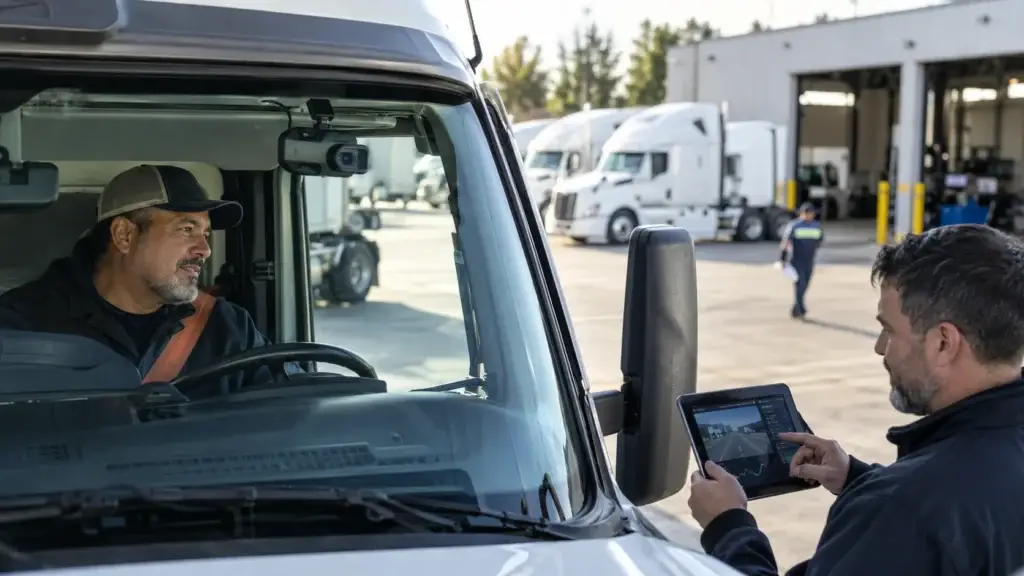
These systems capture video from multiple angles using both a road-facing and driver-facing camera. A driver monitoring system tracks eye movement, head position, and facial expression to detect fatigue or distraction. Meanwhile, a forward-facing camera analyzes traffic pattern, lane position, and following distance to identify an external risk.
The intelligence behind these devices comes from a machine learning algorithm trained on millions of driving scenarios. This training enables the system to recognize a dangerous situation and trigger an immediate alert — an instant notification for harsh braking, a lane departure, and a close following distance that occurs during normal operation.
How AI Technology Differs from Traditional Dashcams
A traditional dashcam operates as a passive recording device that captures video footage for later review. A fleet manager must spend hours reviewing grainy footage after an incident occurs, often without context about what caused the event. This reactive approach provides evidence but does nothing to prevent an accident from happening in the first place.
An AI dashcam takes a fundamentally different approach by actively monitoring every moment of operation. These systems analyze video and telematics data instantly, detecting a risky behavior as it happens. When the system identifies a potential hazard, it triggers an immediate audio or visual alert to help the driver correct behavior before an incident occurs.
| Feature | Traditional Dashcams | AI Dashcams |
|---|---|---|
| Video Analysis | Manual review required after incidents | Automatic real-time processing with instant alerts |
| Driver Behavior Monitoring | No behavioral analysis capability | Continuous monitoring with driver-facing cameras |
| Incident Prevention | Records events but cannot prevent them | Proactive alerts and coaching to avoid collisions |
| Data Processing | Stores video locally with limited context | Cloud connectivity with advanced analytics and reporting |
This technological leap means an AI dashcam functions as an active safety system rather than a simple recording device, providing a fleet operator with an actionable insight that drives continuous safety improvement across the entire operation.
Core Components of AI Dashcam Systems
An AI dashcam system integrates multiple sophisticated components that work together to deliver a comprehensive safety monitoring. The hardware foundation includes a dual-facing camera array that captures both a road and driver perspective simultaneously — a road-facing camera monitors traffic conditions, lane markings, and a potential obstacle, while a driver-facing camera powers the driver monitoring system that tracks attention level and a sign of fatigue or distraction.
An onboard processor handles edge computing tasks, enabling the system to analyze a video feed without relying solely on cloud connectivity. These processors run a machine learning model trained on a diverse driving scenario to recognize a risk pattern instantly, and the model continuously improves as it processes more data.
A sensor array complements the camera system by detecting a vehicle dynamic such as harsh braking, rapid acceleration, and sharp turns, providing context that helps the AI distinguish between a normal driving maneuver and a potentially dangerous behavior. Cloud connectivity enables an automatic upload of incident footage, a remote access to a live camera feed, an advanced analytics that identifies a trend across multiple vehicles and drivers, and integration with an existing telematics and fleet management platform.
This connectivity transforms an isolated safety device into a central component of comprehensive fleet operations. A maintenance management system receives a notification when an AI camera detects a vehicle condition issue such as a cracked windshield or a malfunctioning light, and a preventive maintenance schedule adjusts automatically based on the detected equipment problem.
How AI Dashcams Work in Commercial Trucking
Behind every safety alert and incident recording lies a complex technological ecosystem that processes millions of data points every second. An AI camera system transforms a commercial truck into a mobile safety monitoring center through an advanced computing capability, combining a hardware sensor, an intelligent software, and a cloud infrastructure to deliver a comprehensive protection for a driver and fleet operator.
Computer Vision and Machine Learning Algorithms
Computer vision technology enables an AI dashcam to interpret visual information just as a human eye processes a scene. The system uses a specialized camera that captures a high-definition video from multiple angles simultaneously, and an advanced processor analyzes this visual data to identify an object, read a road sign, detect a lane marking, and recognize a potential hazard.
A machine learning algorithm forms the intelligence behind these visual recognition capabilities, training on millions of driving scenarios to understand what constitutes a safe versus risky behavior. Per manufacturer-published detection benchmarks, a leading system achieves a detection accuracy rate exceeding 99% through continuous learning from real-world data — improving over time without a manual programming update, learning to distinguish between a driver adjusting mirrors and a dangerous distracted behavior.
324,819
Estimated injuries attributed to distracted driving in 2023, per NHTSA — as of September 2026, the most recent full-year figure published.
A training dataset includes a diverse weather condition, a lighting scenario, and a traffic pattern, ensuring reliable performance whether a truck operates on a bright desert highway or through a foggy mountain pass. The algorithm adapts to recognize a region-specific road feature and driving condition.
Real-Time Data Processing and Analysis
Edge computing technology allows an AI dashcam to analyze a video feed instantly without a cloud transmission delay. An onboard processor evaluates multiple data streams simultaneously — video footage, vehicle speed, GPS location, and an acceleration pattern — enabling an immediate driver alert when a dangerous situation develops.
The system monitors dozens of safety parameters continuously throughout each journey, tracking a following distance, a lane position, a speed relative to traffic flow, and a driver attention level. When an algorithm detects a risky pattern such as a harsh braking or a distracted driving, an alert triggers within milliseconds.
A video analytics process footage at 30 frames per second or higher to capture a critical detail, identifying a specific event including a stop sign violation, a failure to wear a seatbelt, and a close following behavior. A sensor fusion combines camera data with a vehicle telematics for a comprehensive situational awareness — an accelerometer detects a sudden movement while a GPS validates speed and location, reducing a false positive and ensuring an accurate event classification.
Cloud Connectivity and Data Storage
A secure cloud platform receives and stores a video clip whenever a safety event occurs. An AI camera system automatically uploads incident footage through a cellular or WiFi connection, and a fleet manager accesses this data through a centralized dashboard from any location with internet connectivity.
A cloud architecture provides a redundant storage to prevent a data loss from device damage or theft, and an encrypted transmission protocol protects sensitive video content during upload. The cloud infrastructure enables a long-term trend analysis across an entire fleet — a safety manager reviews a historical pattern to identify a training opportunity and recognize a top performer, comparing a driver performance metric against an industry benchmark.
A bandwidth optimization technique compresses a video file without sacrificing a critical detail. A smart upload scheduling prioritizes a high-severity incident while managing a data cost, and a system stores weeks or months of footage depending on the subscription plan and storage capacity.
Integration with Fleet Management Systems
A modern AI dashcam seamlessly connects with an existing fleet management platform through a standardized API. A telematics integration creates a unified dashboard displaying a camera footage alongside GPS tracking, fuel consumption, and a maintenance schedule, eliminating the need to switch between multiple software systems.
An electronic logging device platform incorporates a dashcam data to provide a complete driver activity record — the integration links an hours-of-service compliance with a safety performance metric, letting a fleet manager correlate a fatigue-related event with driving time to optimize scheduling.
A safety scoring system automatically incorporates an AI-detected incident into a driver performance evaluation, feeding data into a coaching program that identifies a specific improvement area. A dispatch system incorporates a real-time safety score when assigning a route and load — a high-performing driver receives preference for a premium freight opportunity, creating an accountability loop that rewards a safe driving behavior with a tangible business benefit.
| Technology Component | Primary Function | Integration Benefits |
|---|---|---|
| Computer Vision Sensors | Visual data capture and interpretation | Provides visual context for telematics events |
| Edge Processing Unit | Real-time data analysis | Enables immediate coaching without cloud latency |
| Cloud Platform | Data storage and analytics | Centralizes safety data across distributed operations |
| API Integration Layer | System connectivity | Creates unified fleet management ecosystem |
Keep Your Fleet Running at Full Capacity
Get HDJ's maintenance guides, compliance updates, and fleet management strategies delivered weekly — built for working diesel professionals.
Key Safety Features of AI Dashcams
The safety feature built into an AI dashcam transforms how a fleet operator monitors and prevents a dangerous driving situation. A modern AI dashcam monitors both the road environment and driver behavior simultaneously, addressing the two primary causes of a trucking accident — an external road hazard and an internal driver-related factor — creating a layered safety system that catches a risk a traditional camera would miss.
Forward Collision Warning Systems
A forward collision warning technology represents one of the most critical safety features in an AI dashcam. These systems use a computer vision algorithm to calculate a closing speed with a vehicle or object ahead in real time. When the system detects an imminent collision risk, it triggers an immediate audible and visual alert inside the cab.
The technology measures the distance between the truck and the vehicle ahead, analyzing both a speed differential and a closing rate. This calculation happens dozens of times per second, providing a driver with crucial seconds to respond — for a commercial truck with a longer stopping distance, these extra moments can mean the difference between a near-miss and a devastating accident.
An advanced collision avoidance system also factors in vehicle weight, road condition, and current speed, adjusting sensitivity based on these variables to reduce a false alarm while maintaining a high detection accuracy.
Lane Departure Detection
A lane departure warning system monitors a road marking and vehicle position continuously throughout each trip, tracking the truck's position relative to a lane boundary using a high-resolution camera. When an unintentional lane drift occurs, the system immediately alerts the driver with an audio warning or visual notification.
This feature proves especially valuable on a highway where a driver fatigue and distraction cause a frequent accident. A lane departure detection serves as an early warning system for drowsiness, often catching an attention lapse before it leads to a serious consequence, distinguishing between an intentional lane change with a turn signal and an unintended drift.
Driver Distraction and Drowsiness Monitoring
A driver-facing camera equipped with facial recognition and eye-tracking technology provides a comprehensive monitoring of driver attention and alertness. These systems detect a multiple risk factor including a phone use, an eating, a looking away from the road, and a sign of fatigue, analyzing a facial feature, an eye movement pattern, and a head position to identify a dangerous behavior in real time.
The technology specifically monitors for a critical distraction indicator including a phone handling, an eyes-off-road event, a fatigue marker like a micro-sleep episode and yawning, an extended distraction like eating or smoking, and a seatbelt compliance. An advanced system delivers an in-cab voice coaching, providing an immediate feedback to help a driver correct an unsafe action in the moment. The Commercial Vehicle Safety Alliance emphasizes driver condition as a critical factor in a roadside inspection, making this monitoring capability increasingly important for compliance.
A drowsiness detection algorithm analyzes a pattern of eyelid closure, blink frequency, and head movement. When the system identifies a fatigue indicator, it triggers an escalating alert to rouse a drowsy driver, addressing one of trucking's most persistent safety challenges — driver fatigue on a long haul.
Harsh Braking and Acceleration Detection
An accelerometer sensor and vehicle dynamics monitoring detect a harsh braking event and rapid acceleration pattern automatically, measuring a g-force during a driving maneuver and flagging an event that exceeds a safe threshold. The data reveals an aggressive driving behavior, an emergency situation requiring investigation, and a potential mechanical issue.
A harsh braking often indicates a tailgating, distraction, or a failure to anticipate a traffic condition. The AI system records the event with a video context, allowing a fleet manager to understand what triggered the maneuver — information that supports a targeted driver coaching and identifies a pattern that needs correction.
Following Distance Monitoring
A tailgating detection technology calculates the time gap between a commercial vehicle and traffic ahead continuously, measuring a following distance using computer vision and a depth perception algorithm. When a vehicle follows too closely for a safe stop, especially given the extended braking distance of a loaded truck, the AI triggers an immediate warning.
An advanced collision avoidance system factors in current speed, road condition, and vehicle load when determining a safe following distance, applying a time-based calculation rather than a fixed distance measurement to ensure an appropriate gap at all speeds. Following distance monitoring proves particularly valuable in preventing a rear-end collision, which accounts for a substantial percentage of a commercial vehicle accident.
Driver Behavior Monitoring and Coaching
Driver behavior monitoring has evolved from simple surveillance to a sophisticated coaching platform that helps a trucker become a safer, more efficient operator. An AI dashcam system now serves as a comprehensive development tool that identifies a risk pattern and creates a personalized improvement plan, focusing on education and recognition rather than punishment.
In-Cab Driver Facing Cameras
An in-cab driver-facing camera forms the foundation of a behavioral monitoring system, using infrared technology to track driver action in all lighting conditions, from bright daylight to complete darkness. The camera monitors the driver's face, eyes, and upper body to detect a specific risk behavior.
A leading AI dashcam system identifies a sign of driver fatigue and distraction by recognizing an activity like texting, eating, or talking on the phone. The system also monitors seatbelt compliance, smoking, and drinking while driving, and an advanced algorithm can even detect a medical distress or an unusual driver positioning that might indicate a health emergency.
A privacy concern is addressed through an event-based recording rather than a continuous surveillance — a camera only saves footage when a risky behavior or driving event triggers the system, protecting driver privacy during normal operation while capturing a critical safety information when needed.
Behavioral Analytics and Scoring
An AI system aggregates data from multiple trips to create a comprehensive driver performance profile, revealing a behavioral pattern that emerges over time and assigning a risk score based on the frequency and severity of a detected behavior. Driver behavior analytics enable a fleet manager to identify a high-risk driver requiring immediate intervention, while the same system recognizes a top performer who deserves recognition and reward.
A performance metric tracks dozens of specific behaviors simultaneously — a hard braking incident, an aggressive acceleration, a sharp cornering, and a following distance violation — showing how an individual driver compares to a fleet average and industry benchmark.
| Driver Behavior | Detection Method | Reported Improvement Range |
|---|---|---|
| Cell Phone Use | Facial recognition and hand position | Up to 95% reduction, per Geotab pilot data |
| Drowsiness/Fatigue | Eye closure duration and head position | Meaningful reduction reported industry-wide |
| Eating/Drinking | Hand-to-mouth movement tracking | Meaningful reduction after coaching |
| Seatbelt Compliance | Chest area monitoring | High improvement rate reported |
Real-Time Audio and Visual Alerts
An immediate feedback system provides the most effective behavior modification tool available to a fleet operator. When a risky behavior is detected, a real-time audio and visual alert notifies the driver instantly — a voice warning like "distraction detected" or "following too close" enables a driver to self-correct before an incident occurs.
An in-cab alert creates a continuous learning environment where a driver receives coaching in the moment, proving significantly more effective than a delayed coaching session conducted days or weeks after an event occurs. In pilot deployments of Geotab's GO Focus Plus system, phone use dropped up to 95% following the introduction of in-cab voice coaching — each flagged event tagged with video footage, speed data, and GPS location for comprehensive context.
Coaching Opportunities Based on AI Insights
AI-powered coaching transforms a subjective performance review into an objective, data-driven conversation. The system automatically flags an event requiring manager review and creates a structured coaching workflow, giving a fleet manager a prioritized list showing which driver needs attention and what specific behavior requires correction.
A coaching session becomes more focused and less confrontational when supported by a video evidence and performance data. A driver can see exactly what behavior triggered an alert and understand why a change is necessary, eliminating a dispute about incident details.
The technology tracks a driver improvement over time, documenting the effectiveness of a coaching intervention and helping a manager refine a coaching strategy for maximum effectiveness. Driver behavior analytics also document every coaching session for compliance purposes, protecting a fleet operator during an audit or legal proceeding.
Editorial Insight
The HDJ Perspective
The shift from camera surveillance to driver development represents one of the more significant changes in fleet safety culture in recent years. A fleet that approaches an AI dashcam as a coaching tool — not a punishment system — tends to achieve dramatically better safety outcomes and driver retention. The technology only works when a driver believes it's there to protect them, not catch them. A fleet manager who invests time explaining the "why" behind a camera system and celebrating a safe driving achievement consistently outperforms one who simply installs equipment and expects compliance.
Accident Prevention and Risk Reduction
The greatest value of an AI dashcam lies in preventing a collision, not simply capturing it on video. A traditional dashcam records what already happened; an AI-powered system intervenes while a dangerous situation unfolds. This difference transforms fleet safety from an after-the-fact investigation tool into a real-time protection system that saves a life and reduces a cost.
Proactive Safety Alerts
A leading AI dashcam system leverages machine vision and artificial intelligence to identify a dangerous driving behavior as it occurs, providing a real-time driver alert when a risky pattern appears and allowing the driver to correct action immediately. These warnings interrupt an unsafe behavior in the moment, creating an opportunity to avoid an incident entirely.
The psychology behind an immediate feedback proves remarkably effective. When a driver receives an audible alert during a lane drift or a close following, the brain creates a stronger behavioral association than a post-event coaching ever could, reinforcing a safer decision-making pattern over time.
Near-Miss Detection and Analysis
Not every dangerous situation results in a collision. An AI dashcam identifies and flags a close-call situation that didn't cause an accident but signals an elevated risk, providing a critical early warning indicator a fleet manager can act upon before an actual collision occurs.
An advanced computer vision algorithm detects a situation such as a sudden braking that narrowly avoids a rear-end collision, a lane departure that comes dangerously close to another vehicle, a following distance that shrinks to an unsafe margin, and a pedestrian or obstacle encounter requiring an evasive maneuver.
Analyzing a near-miss pattern reveals a valuable insight about a specific driver, route, or condition associated with a higher incident probability. A driver who experiences a frequent near-miss on a particular route may need additional training or a route reassignment. This intelligence enables a preventive action, fundamentally changing the risk management approach from reactive to predictive.
Predictive Risk Assessment
A machine learning algorithm analyzes a pattern across thousands of trips to build a sophisticated risk profile, identifying a correlation between various factors and incident probability — a driver behavior, a specific route, a weather condition, a time of day, and a traffic pattern.
This predictive capability allows a fleet manager to take a preemptive action. When the system identifies a driver showing an early warning sign of a risky behavior pattern, a manager can provide additional coaching before that pattern results in a collision. A route with a consistently elevated risk score can be modified or assigned to a more experienced driver.
Reduction in Collision Rates
Vendor-reported evidence points to a meaningful result. Motive reports that its own customers achieved up to 80% fewer accidents within one year of deploying its AI dashcam and safety platform, and Geotab's pilot data for its GO Focus Plus system showed phone-use violations dropping up to 95% after introducing in-cab voice coaching — eliminating one of the most dangerous distracted driving behaviors.
These figures come from specific vendor case studies rather than an independent, fleet-agnostic benchmark, so a fleet evaluating a platform should ask any vendor for its own documented results rather than assuming industry-wide figures apply uniformly. Separately, the American Transportation Research Institute has published research finding that dual-facing dashcam footage helps exonerate a driver in a substantial share of insurance claims and litigation cases where footage exists — a distinct and separately documented benefit from the collision-reduction figures above.
ATRI's research on dashcam-assisted driver exoneration is a genuine, separately documented finding — distinct from any single vendor's collision-reduction claims, and worth citing on its own terms rather than folding into a single blended statistic.
A fleet operator deploying these systems reports a consistent improvement within weeks of implementation. The combination of a real-time driver alert, a behavioral coaching, and a predictive analytics creates a comprehensive safety ecosystem that a traditional approach can't match.
Evidence Collection and Legal Protection
Video telematics technology transforms how a fleet handles incident documentation and legal defense. When an accident happens, a clear and objective evidence protects a driver from a false accusation and shields a company from costly litigation. An AI dashcam delivers this protection automatically, creating a digital record that captures a critical moment without requiring manual intervention.
A modern fleet operator faces a growing liability risk from a fraudulent claim and a complex legal dispute. A traditional method of incident investigation relies heavily on driver recollection and witness statements, which can be unreliable or contradictory. An AI-powered camera eliminates this uncertainty by providing a factual, timestamped documentation.
Automatic Incident Recording
An AI dashcam detects a collision event through an advanced G-force sensor that triggers an immediate recording. The system captures footage from before, during, and after the incident, preserving crucial context that shows what led to the event — eliminating the risk of a lost or overlooked footage that could prove a driver's innocence.
The technology saves a video segment ranging from 30 seconds to several minutes, depending on the system configuration. Most systems capture at least 10 seconds of pre-event footage, which often reveals the true cause of an incident — a buffer recording that runs continuously, ensuring nothing important gets missed when an accident occurs suddenly.
A cloud-based automatic upload protects video evidence even if a vehicle sustains damage or a camera becomes disabled — the footage transmits to a secure server within minutes of an incident, creating a tamper-proof documentation that can't be altered. An advanced system stores additional telemetry data alongside a video footage, including vehicle speed, braking force, acceleration pattern, and GPS coordinates.
Multi-Angle Video Evidence
A dual-camera system captures both a road-facing and driver-facing perspective simultaneously, providing a complete context showing what happened outside the vehicle and how the driver responded. A road-facing camera documents traffic conditions, signal lights, road hazards, and action by another driver, capturing a license plate, a street sign, and an environmental factor that contributes to an incident.
A driver-facing camera shows a cab activity and driver response during a critical moment, documenting whether the driver was attentive and responding appropriately to a road condition. The combination of perspectives creates a definitive documentation for a legal proceeding and insurance claim — many a claim that would typically take months to resolve gets settled within days when clear video evidence is available.
Protection Against False Claims
A commercial fleet faces an increasing threat from a staged accident and fraudulent injury claim. A professional scammer targets a truck because they assume a company will settle quickly to avoid litigation cost. An objective video evidence from an AI dashcam exonerates a driver falsely accused of causing an orchestrated incident.
A dashcam footage reveals a suspicious behavior pattern that indicates a fraud attempt — a vehicle that suddenly brakes without cause, a driver who claims an injury inconsistent with impact severity, and a witness whose statement contradicts video evidence. A safety manager can identify these red flags immediately and challenge a fraudulent claim with confidence.
The mere presence of a visible dashcam deters many a fraud attempt before it occurs, as a scammer typically avoids a vehicle with obvious recording equipment. Quick access to a video evidence enables a rapid claim resolution that saves substantial legal cost, and an insurance company appreciates a fleet operator who provides immediate documentation.
Insurance Premium Reductions
An insurance carrier recognizes the risk reduction that an AI dashcam system provides through a lower premium. Many an insurer offers a discount ranging from 5% to 15% or more for a fleet that implements a comprehensive video telematics program — a fleet insurance saving that often offsets the entire cost of the dashcam technology within the first year of operation. HDJ's practical guide to fleet insurance costs covers the broader set of strategies a fleet can pair with dashcam adoption to compound the discount.
A documented safety improvement creates a compelling evidence for a premium negotiation. When a fleet demonstrates a reduced collision rate, fewer claims, and a faster claim resolution, an insurance company responds with a better rate. Some insurance providers now require a dashcam installation for a high-risk fleet category or offer it as a condition for coverage.
The financial benefit extends beyond a direct premium saving to include a reduced legal defense cost, a lower settlement amount when video evidence clearly establishes fault, a decreased fraudulent claim payout, and an improved loss history that qualifies a fleet for a better coverage term over time.
Return on Investment for Fleet Operators
The financial impact of an AI dashcam extends far beyond the initial purchase price, creating value across multiple operational areas. A fleet operator who implements this advanced fleet management solution discovers that the technology pays for itself through a reduced accident cost, a lower insurance rate, an improved fuel consumption, and an optimized vehicle maintenance. HDJ's fleet telematics ROI guide walks through the same payback-period math for the broader telematics category this dashcam investment sits inside.
Cost Savings from Accident Reduction
Preventing even a single serious collision delivers a substantial financial return that justifies the entire AI dashcam investment. A commercial vehicle accident generates a cost across multiple categories that quickly escalate into a six-figure expense — a direct collision repair cost averaging between $15,000 and $75,000 for a major truck accident, a medical expense for an injured party that can reach hundreds of thousands of dollars, and a legal fee and settlement cost that frequently exceeds $100,000 in a disputed claim.
Additional expense categories include a cargo damage requiring replacement and customer compensation, a vehicle downtime cost averaging $500 to $1,200 per day while a truck remains out of service, a driver injury claim and workers' compensation expense, an administrative cost for incident investigation, and an increased insurance premium following an at-fault accident. When an AI dashcam prevents just one moderate collision annually, the cost saving alone typically exceeds the entire system investment.
Lower Insurance Premiums
An insurance carrier recognizes the proven safety benefit of an AI dashcam technology and rewards a fleet operator with a significant premium discount, ranging roughly from 5% to 20% depending on the carrier, fleet size, and safety record documentation provided by the dashcam system. For a fleet spending $500,000 annually on commercial auto insurance, a 10% discount delivers $50,000 in savings each year — a recurring benefit that compounds over time.
An insurer typically requires specific documentation to qualify for a discount, including proof of an active AI dashcam deployment across the fleet and evidence of a driver coaching program based on dashcam data. Beyond the premium discount, a fleet with comprehensive AI dashcam coverage experiences fewer claims and a faster claim resolution.
Fuel Efficiency Improvements
An AI dashcam integrated with a comprehensive fleet management solution monitors a driving behavior that directly impacts fuel consumption, detecting and alerting on a fuel-wasting action including a harsh acceleration, an excessive idling, and an aggressive driving pattern.
A behavior-based fuel management program supported by AI dashcam data can reduce fuel consumption by roughly 10% to 15% according to a range of published industry studies. The technology provides a targeted coaching opportunity by identifying a specific driver who exhibits a fuel-wasting behavior, allowing a fleet manager to focus coaching effort where it delivers maximum impact.
Vehicle Maintenance Optimization
An AI dashcam detects a harsh driving event that accelerates a vehicle wear and component degradation. A hard braking, an aggressive acceleration, and a rough handling stress a brake system, transmission, suspension component, and tire, reducing operational lifespan and increasing maintenance frequency.
By identifying and coaching against these damaging behaviors, a fleet operator extends a vehicle component life and reduces an unscheduled maintenance event. A Technology & Maintenance Council Recommended Practice on condition-based inspection supports exactly this approach — prioritizing an inspection and replacement interval around actual operating severity rather than mileage alone. A reduced component wear translates directly into a lower part and labor cost, and an extended vehicle lifespan increases the return on capital invested in a truck and trailer.
Calculating Total Cost of Ownership
Understanding a complete dashcam ROI requires analyzing all costs against a comprehensive saving across every benefit category — an initial hardware expense, a professional installation, a monthly subscription fee for a cloud service, and an ongoing support cost.
| Cost/Savings Category | Initial Investment | Annual Recurring | Annual Savings |
|---|---|---|---|
| Hardware (dual cameras, 25 trucks) | $37,500 | $0 | — |
| Professional installation | $12,500 | $0 | — |
| Cloud subscriptions | $0 | $15,000 | — |
| Accident prevention | — | — | $125,000 |
| Insurance discounts | — | — | $35,000 |
| Fuel efficiency gains | — | — | $240,000 |
| Maintenance optimization | — | — | $45,000 |
| Total First Year | $50,000 | $15,000 | $445,000 |
This illustrative 25-truck scenario shows a first-year net benefit of $380,000 and a payback period of roughly 1.5 months. Even with a more conservative saving estimate, most a fleet operation achieves a complete cost recovery within 6 to 18 months, and a subsequent year delivers an even stronger return once only the annual subscription fee continues while every saving category compounds.
Implementing AI Dashcams in Your Fleet
Implementing an advanced dashcam technology in a fleet goes beyond simply installing a camera — it requires a strategic selection, a proper setup, and a comprehensive driver engagement. Many a product labeled as a "smart dashcam" offers minimal advancement beyond a traditional camera; the difference between a basic system and a true AI-powered platform becomes apparent in its ability to detect a risk in real time, provide a proactive intervention, and deliver an automated coaching.
Choosing the Right AI Dashcam System
Selecting a commercial fleet dashcam requires evaluating a system against a specific criteria that separates a genuinely intelligent platform from a basic alternative. Look for an AI-powered event detection with a high manufacturer-reported precision, a positive driving recognition to reward safe behavior, a dual-facing camera, a real-time audio and visual alert, a cloud-based video storage with instant retrieval, an automatic incident upload, a driver safety score and coaching tool, an integration capability with a fleet management and ELD system, and a scalability for a fleet of any size.
The evaluation process should include a demonstration of actual AI detection capability. Request evidence of a collision prevention rate, a driver behavior improvement metric, and an integration success story from a similar fleet operation before committing to a vendor.
Leading AI Dashcam Platforms
Several established providers offer an AI dashcam system designed specifically for a commercial trucking application, each bringing a different strength depending on a fleet's specific need. Mobileye Shield Plus delivers a collision avoidance technology using computer vision to monitor road conditions, excelling at detecting a pedestrian, cyclist, and vehicle in a blind spot.
Samsara AI Dash Cams integrate seamlessly with a comprehensive fleet management platform, giving a fleet manager access to video footage, safety events, and driver performance from a single dashboard, with real-time detection covering a cell phone use, drowsiness, and a following distance violation. Lytx DriveCam leverages machine vision plus artificial intelligence to deliver an extensive driver coaching capability built on a proven methodology. Netradyne Driveri identifies both an unsafe behavior and a positive driving action, processing effectively the full driving time rather than just a triggered event.
Installation and Setup Considerations
Proper installation determines how effectively a commercial fleet dashcam performs its safety function. A professional installation ensures a camera mounts securely and connects reliably to a power source — a windshield placement typically centers a forward-facing camera behind the rearview mirror, maximizing road coverage without obstructing driver vision, while a driver-facing camera mounts on the dashboard or A-pillar.
Integration with an existing telematics and ELD system requires a technical coordination — a fleet IT team should verify compatibility before purchasing. A cellular connectivity enables a cloud data transmission for a real-time alert and automatic video upload, and a fleet manager must ensure adequate cellular coverage across the operational route.
Driver Training and Acceptance
Driver buy-in represents the most critical factor in an AI dashcam program's success. Even the most advanced safety equipment fails without driver cooperation. A fleet manager should emphasize a safety goal rather than a surveillance when introducing a camera system — explaining how a dashcam protects a driver from a false accusation changes the perception from monitoring to protection.
Involving a driver in the rollout process creates ownership and reduces anxiety. A pilot program with a volunteer driver generates an internal advocate who shares a positive experience with colleagues, often becoming the most effective champion of the technology.
A comprehensive training session should cover a system feature, an alert meaning, and an expected response. Establishing a transparent policy about footage use addresses a privacy concern directly, and a recognition program that rewards a safe driving score improves acceptance significantly.
Privacy Considerations and Compliance
A legal requirement for video recording in a commercial vehicle varies by jurisdiction, making a compliance research essential before deployment. Federal regulation generally permits a dashcam use in a commercial truck, but a state law adds a specific notification and consent requirement — a fleet operation crossing multiple states must comply with the most restrictive applicable regulation. The Federal Motor Carrier Safety Administration provides guidance on a technology system in a commercial motor vehicle.
HDJ's CSA score improvement strategies guide covers how a documented safety program — including dashcam-supported coaching — factors into the Unsafe Driving BASIC specifically, and HDJ's fleet driver management software guide covers the broader platform category a dashcam program typically plugs into.
A data security and access control protects sensitive footage from an unauthorized viewing — a leading platform implements an encryption, a multi-factor authentication, and a role-based permission. A retention policy balances a legal protection need against a privacy consideration; most a fleet retains footage for 30-90 days unless involved in an incident or investigation.
A union consideration requires additional attention in an organized workplace, since a labor agreement may mandate bargaining over a camera implementation and a discipline procedure. A written privacy policy should address a driver concern explicitly, demonstrating respect for privacy while maintaining a necessary safety oversight.
Frequently Asked Questions
How much do AI dashcams cost for commercial fleets?
Hardware typically runs $300-$800 per unit plus $25-$50 monthly for cloud service, with professional installation adding another $100-$300 per vehicle. A 25-truck fleet should expect $40,000-$65,000 upfront and $7,500-$15,000 annually — see the total-cost-of-ownership table above for the full category-by-category breakdown.
Do AI dashcams actually reduce trucking accidents?
Yes, though the strongest figures come from individual vendors' own case data rather than an independent industry-wide study — Motive reports up to 80% fewer accidents among its customers, and Geotab's pilot data shows phone-use violations dropping up to 95% with in-cab voice coaching.
What is the difference between AI dashcams and regular dashcams?
A regular dashcam passively records footage for review after an incident. An AI dashcam actively analyzes video and telematics data in real time, detecting a dangerous behavior as it happens and alerting the driver to correct it before an accident occurs — shifting safety from reactive documentation to proactive prevention.
Are driver-facing cameras legal in commercial trucks?
Federal regulation generally permits dashcam use, but a state law varies on notification and consent requirements. A fleet crossing multiple states should comply with the most restrictive applicable rule and maintain a written policy explaining what's recorded and who can access it.
How do insurance companies view AI dashcams for trucking fleets?
Insurance carriers increasingly reward AI dashcam adoption with a premium discount of roughly 5% to 20%, plus a faster claim resolution and fewer fraudulent payouts. Some insurers now require dashcam installation for a high-risk fleet category as a condition of coverage.
The Bottom Line
An AI dashcam represents a fundamental shift in commercial fleet safety from reactive incident documentation to proactive collision prevention. These systems deliver a measurable improvement through a real-time detection of distracted driving, fatigue, and dangerous behavior — the same discipline Michael Nielsen and Heavy Duty Journal's editorial team hold every guide on heavydutyjournal.com to.
A fleet consistently achieves a 6-18 month payback period through a reduced accident cost, a lower insurance premium, an improved fuel efficiency, and an optimized maintenance. For a fleet operator still relying on a traditional safety approach, the path forward is clear: evaluate a system against your specific operational need, prioritize a platform with a proven safety outcome, and invest time in driver communication and training. The technology works best when a driver understands it exists to protect them, not surveil them.
Share This Guide With Your Team
If you found this AI dashcam guide valuable, share it with fellow fleet managers, safety directors, and operations leaders who are evaluating fleet safety technology investments.