By Michael Nielsen, Editor & Publisher | 15+ Years in Diesel Repair
Last Updated: January 2025
📖 Estimated reading time: 22 minutes
When a commercial vehicle breaks down unexpectedly, every minute translates directly to lost revenue. Fleet managers and owner-operators know the mounting pressure as disabled trucks sit idle, deliveries get delayed, and operational costs spiral beyond the initial repair bill. Emergency fleet parts sourcing—the ability to locate and receive critical components within hours rather than days—often determines whether a breakdown becomes a minor disruption or a catastrophic loss.
Research from the American Transportation Research Institute indicates that unplanned downtime remains one of the top operational challenges facing motor carriers. With 42% of transportation companies experiencing vehicle breakdowns at least weekly, according to Trimble and FreightWaves data, traditional procurement methods simply cannot address these urgent situations. Round-the-clock parts availability, rapid fulfillment networks, and strategic supplier partnerships have become competitive necessities rather than optional conveniences.
This guide provides fleet managers, maintenance supervisors, and owner-operators with a comprehensive framework for building emergency parts sourcing capabilities that minimize downtime and protect revenue streams.
Key Takeaways
- Downtime costs $448-$760 per vehicle daily in lost revenue alone—emergency towing, premium labor rates, and expedited shipping multiply total breakdown expenses.
- 24/7 supply chain infrastructure requires dedicated operations centers, multi-layered supplier partnerships, and strategic geographic distribution of critical components.
- Technology integration through VIN-based parts identification, real-time inventory tracking, and telematics-driven predictive maintenance transforms reactive sourcing into proactive planning.
- Service level agreements with documented response time guarantees, parts quality verification, and consolidated billing protect fleet operations while providing cost predictability.
- Preventive and predictive maintenance programs using oil analysis, component life cycle tracking, and strategic inventory positioning reduce emergency sourcing dependency by 60% or more.
- Evaluating providers requires verification of national coverage, inventory depth for your vehicle types, supplier network authenticity, and documented performance history.
The High Cost of Fleet Downtime in Modern Operations
When a commercial vehicle breaks down, the financial impact extends far beyond the immediate repair bill. Fleet managers across North America face mounting pressure to minimize vehicle downtime while maintaining operational efficiency. The true scope of fleet downtime costs encompasses direct expenses, cascading operational disruptions, and long-term competitive erosion that significantly affects profitability.
Understanding these multi-layered expenses is essential for making informed decisions about emergency parts sourcing investments. The following analysis breaks down the financial realities of fleet breakdowns and demonstrates why proactive supply chain solutions deliver measurable returns.
Direct Financial Losses from Vehicle Breakdowns
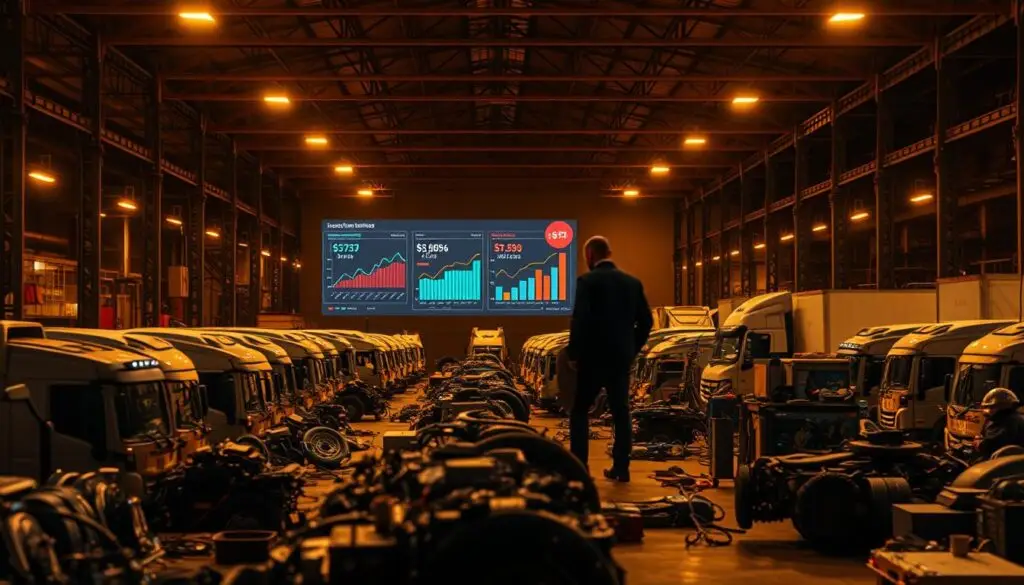
The immediate costs of a vehicle breakdown begin accumulating the moment a driver pulls to the roadside. Emergency towing services for commercial vehicles typically range from $200 to $800 depending on distance and vehicle size. These charges represent just the beginning of expenses that rapidly multiply throughout the repair process.
After-hours repair work commands premium labor rates, often 150% to 200% of standard hourly charges. A routine repair costing $400 during regular business hours can easily exceed $800 when mechanics respond to emergency calls. Expedited parts shipping adds another layer of expense, with overnight delivery fees ranging from $50 to $300 per shipment depending on component size and destination.
$448 – $760
Average daily lost revenue per disabled commercial vehicle — Element Fleet Management industry data
Actual repair costs vary dramatically based on component failure. Engine repairs average $3,500 to $8,000, while transmission replacements can exceed $6,000. These figures don’t account for the lost revenue during repair periods. Each idle vehicle represents deliveries not made, customer commitments broken, and revenue opportunities lost to competitors.
Driver-related costs add another dimension to the financial burden. When vehicles experience frequent breakdowns, driver morale deteriorates significantly. The American Trucking Associations reports that poor vehicle reliability contributes to annual driver turnover rates exceeding 90% in some transportation sectors. Replacing a single commercial driver costs between $8,000 and $12,000 in recruitment, training, and productivity losses.
| Expense Category | Typical Cost Range | Frequency Factor |
|---|---|---|
| Emergency Towing | $200 – $800 | Per breakdown incident |
| After-Hours Labor Premium | $120 – $180/hour | 50% of breakdowns occur outside business hours |
| Expedited Parts Shipping | $50 – $300/shipment | 35% of repairs require immediate sourcing |
| Lost Revenue Per Vehicle | $448 – $760/day | Every breakdown incident |
| Major Component Repair | $3,500 – $8,000 | 20% of breakdown incidents |
Cascading Effects on Delivery Schedules
The ripple effects of transportation delays extend throughout entire supply chains, creating compounding financial consequences. Missed delivery windows trigger service level agreement penalties that typically range from 5% to 25% of shipment value. For high-value cargo, these penalties can reach thousands of dollars per incident.
Customer confidence erodes rapidly when delivery reliability falters. Businesses experiencing repeated delays face contract termination rates 3.5 times higher than competitors with consistent on-time performance. The lifetime value of a single enterprise logistics contract often exceeds $500,000, making customer retention a critical financial consideration.
Rerouting shipments to cover for disabled vehicles generates substantial additional expenses. Alternative carrier arrangements command premium rates of 25% to 40% above standard shipping costs. Administrative teams spend an average of 4-6 hours managing each disrupted delivery schedule, diverting resources from revenue-generating activities.
Fleet operational losses multiply when breakdowns affect time-sensitive cargo. Perishable goods transportation faces particularly severe consequences, with spoilage losses potentially exceeding entire shipment values. Temperature-controlled cargo sitting idle for extended periods can result in total cargo loss ranging from $5,000 to $50,000 depending on load size and commodity type.
Competitive Disadvantage in Time-Sensitive Industries
Industries operating on tight delivery schedules face existential threats from unreliable fleet performance. Just-in-time manufacturing support requires delivery windows measured in hours rather than days. A single late delivery can halt production lines costing manufacturers $22,000 per minute in lost productivity according to automotive industry data.
E-commerce fulfillment has transformed customer expectations for delivery speed. Companies unable to meet promised delivery windows lose customers to competitors at alarming rates. Consumer research indicates that 69% of shoppers are less likely to shop with a retailer again if their order doesn’t arrive within two days of the promised date.
The fleet productivity impact becomes particularly acute during peak demand periods. Holiday shipping seasons, agricultural harvest times, and seasonal retail peaks represent critical revenue opportunities. Breakdowns during these periods create disproportionate financial damage, potentially costing businesses 15% to 25% of annual revenue if service capabilities are compromised.
Competitive positioning suffers when reliability issues become known in the marketplace. Transportation providers with reputation for delays struggle to secure premium contracts offering higher margins. Industry analysis shows companies with documented reliability issues receive bids 12% to 18% lower than competitors with strong performance records.
Emergency Fleet Parts Sourcing Fundamentals
When a vehicle breaks down unexpectedly, standard supply chain rules no longer apply. Emergency parts procurement operates under entirely different principles than routine ordering processes. Fleet managers must understand these unique dynamics to minimize downtime and maintain operational continuity during critical breakdowns.
The ability to source parts immediately can mean the difference between a minor delay and a major operational crisis. Recognizing early warning signs helps prevent some emergencies, but unexpected failures still occur despite best maintenance practices. This reality demands specialized procurement strategies that activate when traditional methods cannot meet urgent timelines.
Defining Emergency Procurement Requirements
Emergency parts procurement begins with understanding what qualifies as a true emergency situation. Mission-critical repairs requiring parts within 2-4 hours represent the most urgent category. These situations involve vehicles stranded on routes, blocking delivery schedules, or preventing essential service completion.
The need for availability outside normal business hours distinguishes emergency procurement from standard ordering. Breakdowns do not respect conventional schedules. A transmission failure at 10 PM on Saturday demands the same urgency as one occurring Tuesday afternoon. Several factors define fleet parts requirements during emergencies: limited time eliminates competitive bidding processes, immediate parts verification becomes essential for compatibility, and premium pricing structures reflect the extraordinary effort required.
Early Warning Signs of Impending Failure
Monitor these indicators to catch problems before they become roadside emergencies: increased engine temperature suggesting cooling system issues, decreasing tire pressure revealing slow leaks, unusual vibrations indicating drivetrain problems, changes in fluid levels pointing to leaks or consumption issues, brake performance degradation through longer stopping distances, increased fuel consumption compared to historical baselines, and warning lights or error codes from onboard diagnostic systems.
Even vigilant monitoring cannot prevent all emergency situations. Sudden component failures from manufacturing defects, road hazards, or extreme operating conditions create genuine emergencies requiring immediate parts sourcing. The goal is reducing emergency frequency while maintaining robust response capabilities when they occur.
Critical Differences from Standard Supply Chain Operations
Emergency operations function fundamentally differently than conventional fleet supply chain management. The contrast becomes apparent when examining response time expectations. Standard procurement operates on timelines measured in days or weeks, while emergency sourcing demands delivery within hours.
Inventory positioning strategies differ dramatically between the two approaches. Traditional supply chains consolidate inventory at central distribution points for cost efficiency. Emergency networks position critical vehicle components at multiple strategic locations to ensure rapid access regardless of breakdown location.
| Operational Aspect | Standard Supply Chain | Emergency Sourcing |
|---|---|---|
| Response Timeline | 3-7 business days | 2-4 hours maximum |
| Operating Hours | Business hours only | 24/7/365 availability |
| Supplier Relationships | Transactional, price-focused | Partnership-based, reliability-focused |
| Quality Verification | Multi-stage inspection | Compressed verification protocols |
| Cost Structure | Competitive bidding | Premium pricing accepted |
Supplier relationship requirements also transform during emergencies. Standard truck parts sourcing relies on transactional relationships focused primarily on cost negotiation. Emergency situations demand partnership arrangements where suppliers commit to extraordinary service levels. Quality verification processes must compress into emergency timeframes without sacrificing safety or reliability.
Frequently Needed Emergency Components by Vehicle Type
Different vehicle classes experience distinct failure patterns that determine which critical components require emergency sourcing most frequently. Understanding these patterns enables better preparation and faster response when breakdowns occur.
Class 8 Truck Critical Parts
Heavy-duty Class 8 trucks demand robust systems to handle extreme workloads. Fuel system components rank among the most frequently needed emergency parts. Injectors, fuel pumps, and filters fail under continuous high-pressure operation. These failures immobilize vehicles immediately, requiring urgent replacement.
Air brake system parts represent another critical category per 49 CFR Part 393 brake system requirements. Valves, brake chambers, and air lines must function flawlessly for safe operation. FMCSA regulations prohibit operating vehicles with compromised brake systems, making these components absolute priorities for emergency sourcing.
Cooling system elements experience high failure rates due to thermal stress. Radiators, water pumps, thermostats, and hoses deteriorate under constant temperature cycling. Overheating can cause catastrophic engine damage, making rapid cooling system repairs essential. Electrical components including alternators, starters, batteries, and sensors also require frequent emergency procurement.
Medium-Duty Vehicle Essential Components
Medium-duty vehicles serve diverse operational profiles influencing their emergency parts requirements. Transmission components experience higher failure rates in vehicles with frequent stop-and-go operation. Delivery trucks making multiple stops daily place extraordinary stress on transmission systems.
Hydraulic system components become critical for vehicles equipped with specialized equipment. Lift gates, dump beds, and other hydraulic systems require pumps, cylinders, and control valves. Equipment failures prevent load handling, effectively immobilizing the vehicle for its intended purpose.
Building a Robust 24/7 Supply Chain Network
The foundation of rapid breakdown response lies in establishing comprehensive supplier partnerships that function seamlessly around the clock. A properly designed parts distribution network combines infrastructure, relationships, and strategic positioning to eliminate barriers that typically delay emergency repairs. Fleet operators who invest in these capabilities gain measurable advantages in uptime and operational continuity.
Creating this level of responsiveness requires deliberate planning across multiple dimensions. Organizations must address operational infrastructure, develop diverse supplier relationships, and implement geographic strategies that bring parts closer to breakdown locations.

Establishing Round-the-Clock Operational Capabilities
True 24/7 parts network functionality extends far beyond simply answering phones after standard business hours. It demands fully staffed operations centers with experienced parts specialists available for real-time consultation at any hour. These professionals must access comprehensive inventory databases and possess technical knowledge to identify correct components under time pressure.
Operational protocols must ensure continuity across shift changes without information loss or delays. Established procedures for after-hours order processing and fulfillment prevent bottlenecks compromising response times. Communication systems with redundancy safeguards maintain uninterrupted connectivity between fleet managers, parts specialists, and field technicians.
Transportation relationships form another critical element of continuous operation. Partnerships with carriers operating around the clock enable immediate shipment once parts are identified and retrieved. The Commercial Vehicle Safety Alliance’s out-of-service criteria underscore why rapid response matters—vehicles with certain safety violations cannot legally operate until repaired, making parts availability a compliance imperative.
Creating Multi-Layered Supplier Partnerships
No single supplier can maintain every component for every vehicle type in immediate stock. Sophisticated fleet operators build redundancy into their parts distribution network through diverse supplier partnerships providing multiple pathways to needed components. This layered approach dramatically increases the probability of rapid parts location regardless of circumstances.
OEM Authorized Distributors
Relationships with OEM parts suppliers provide access to factory-authorized components guaranteeing authenticity and compatibility. These distributors offer technical support for complex diagnostic situations where parts identification proves challenging. Major engine manufacturers like Cummins through their QuickServe Online portal provide comprehensive parts information that supports emergency sourcing decisions.
OEM channels also provide warranty protection that aftermarket alternatives may not offer. For vehicles under manufacturer warranty, using authorized parts prevents warranty disputes. Technical documentation and parts diagrams available through these distributors assist technicians in proper installation.
Aftermarket Parts Specialists
Quality aftermarket parts sources complement OEM relationships by offering cost-effective alternatives for many applications. These specialists maintain inventory depth for older fleet vehicles where OEM parts may be discontinued or expensive. Their cross-reference capabilities prove invaluable when OEM components are temporarily unavailable.
Aftermarket providers often specialize in particular vehicle systems or applications. This specialization creates expertise in niche areas such as heavy-duty transmission components, specialized hydraulic systems, or commercial vehicle electrical parts. Fleet operators benefit from this focused knowledge during complex breakdown situations.
Geographic Distribution Strategy for Maximum Coverage
Even the best supplier partnerships cannot overcome geographical distance when breakdowns occur in remote locations. Strategic positioning of parts inventory creates regional availability that reduces delivery times from hours to minutes in many situations. This geographic strategy considers fleet concentration patterns, common breakdown locations, and transportation infrastructure.
Regional Warehouse Positioning
Strategic warehouse placement in major metropolitan areas and transportation corridors provides coverage for high-density fleet operations. Inventory allocation within these facilities reflects specific vehicle types and applications concentrated in each region. A distribution center serving long-haul trucking routes stocks different components than one supporting urban delivery fleets.
Partnerships with regional distributors who maintain local stock extend coverage without requiring direct warehouse investment. These relationships provide access to established inventory in secondary markets where fleet concentration may not justify dedicated facilities.
Mobile Parts Inventory Solutions
An emerging trend transforms service vehicles into warehouses on wheels, bringing critical components directly to breakdown locations. These mobile units carry carefully selected inventory based on decades of service call data identifying high-failure-rate components. Statistical analysis determines which parts provide the greatest probability of immediate repair completion.
Strategic positioning of mobile resources reduces response times dramatically compared to traditional parts delivery. When deployed to areas with high breakdown frequency or positioned along major transportation routes, they enable same-location repairs that would otherwise require parts shipment delays.
| Distribution Approach | Response Time | Best Application |
|---|---|---|
| Central Warehouse Hub | 4-8 hours | Planned maintenance and common repairs |
| Metropolitan Distribution Centers | 1-3 hours | Urban fleet operations |
| Regional Partner Networks | 2-4 hours | Secondary market coverage |
| ✓ Mobile Inventory Units | 30-90 minutes | Emergency breakdown response |
Technology Systems Powering Emergency Response
Technology systems create the essential framework enabling rapid identification, location, and delivery of emergency components. The difference between hours of downtime and minutes of response often depends on the sophistication of digital infrastructure supporting your supply chain. Modern fleet management technology transforms emergency sourcing into a coordinated operation where every stakeholder has instant access to critical information.
These integrated platforms eliminate guesswork and manual processes that previously slowed emergency response. Instead of technicians making dozens of phone calls to locate parts, digital systems instantly scan thousands of inventory locations simultaneously.

Real-Time Parts Availability and Location Tracking
Advanced parts tracking systems provide immediate visibility into inventory across multiple warehouses, distributors, and mobile service units. These platforms aggregate data from diverse suppliers into a single interface showing current stock levels and precise geographic locations. Fleet managers can see exactly which facility has the needed component and how quickly it can reach the stranded vehicle.
The technology calculates estimated delivery times based on current positioning and available transportation methods. This enables rapid comparison of sourcing options to identify the fastest solution. When a transmission fails in Ohio, the system might reveal Warehouse A in Pittsburgh has the part with 4-hour delivery, while Warehouse B in Columbus offers 2-hour delivery despite being a secondary supplier.
Real-time tracking extends beyond stationary warehouses to include mobile inventory. Many emergency parts providers equip service vehicles with GPS-enabled inventory management updating continuously. A mobile unit already heading toward your breakdown location might carry exactly what you need, turning a potential 6-hour wait into a 45-minute solution.
Automated Diagnostic and Parts Matching Systems
The journey from breakdown to parts identification once required extensive manual research and verification. Today’s automated diagnostics dramatically compress this timeline through intelligent systems that interpret error codes and match them to specific components. When a check engine light illuminates, the system doesn’t just identify the problem—it instantly generates a parts list with supplier availability.
These platforms eliminate human error in parts selection by cross-referencing multiple data points simultaneously. The technology verifies compatibility across vehicle make, model, year, and specific configuration details affecting parts requirements.
VIN-Based Parts Identification
Vehicle Identification Number decoding represents a quantum leap in parts identification accuracy. Modern VIN decoding systems extract comprehensive vehicle specifications from the 17-character code, revealing factory-installed components, engine specifications, transmission types, and axle configurations. This eliminates uncertainty that plagued earlier parts ordering processes.
Fleet maintenance software with integrated VIN decoding can identify the exact part number needed within seconds of entering the vehicle identifier. The system accounts for mid-year production changes, regional variations, and optional equipment affecting component compatibility. For fleets managing hundreds of vehicles with subtle specification differences, this capability prevents costly ordering mistakes.
Cross-Reference Databases for Alternative Parts
Sophisticated cross-reference databases maintain extensive compatibility information across manufacturers and part numbers. When original equipment manufacturer parts are unavailable or prohibitively expensive for emergency situations, these systems identify suitable aftermarket alternatives. The database suggests replacements from different manufacturers while providing compatibility verification.
This capability proves invaluable when dealing with older vehicles or obscure components. The system might reveal an out-of-stock OEM part has three aftermarket equivalents currently available within 50 miles. Each alternative includes specifications, quality ratings, warranty information, and pricing to support informed decision-making during time-sensitive situations.
Integration with Fleet Management Platforms
Comprehensive fleet management platforms serve as the command center coordinating all emergency response activities. These systems connect diagnostic data, parts availability, supplier networks, and technician resources into a unified operational view. When integration functions properly, breakdown notifications trigger automated response sequences beginning parts sourcing before human intervention is required.
Telematics Data for Proactive Sourcing
Telematics integration transforms emergency parts sourcing from purely reactive to increasingly predictive. Systems monitor critical parameters including engine temperature, tire pressure, vibration patterns, and fluid levels continuously. When sensors detect anomalies signaling impending failure, automated alerts trigger proactive parts ordering before breakdowns occur.
Real-time monitoring of engine temperature allows immediate detection of cooling system irregularities. Tire Pressure Monitoring Systems provide continuous readings integrated into fleet maintenance software to track trends predicting failures. Electronic logging devices connect with fluid level sensors providing data on oil consumption patterns indicating developing engine problems.
The HDJ Perspective
The most successful fleets we observe treat emergency parts sourcing as integrated infrastructure rather than crisis management. They’ve moved beyond reactive scrambling to systematic response protocols where technology, supplier relationships, and inventory positioning work together seamlessly. The investment required—in both systems and supplier partnerships—pays dividends not just during emergencies but through reduced overall maintenance costs and improved driver retention. Fleet managers who view this capability as optional overhead rather than operational foundation consistently underperform competitors who’ve made the commitment.
Mobile Apps for Field Technicians
Smartphone and tablet applications extend centralized system power directly to drivers and technicians at breakdown locations. These mobile tools provide immediate access to vehicle service history, allowing technicians to review past maintenance reports before arriving on site. Historical context helps diagnose current problems and avoid repeating ineffective previous repair attempts.
Field personnel use mobile apps to scan VIN barcodes for instant vehicle identification and parts lookup. Applications interpret diagnostic trouble codes in plain language and suggest probable causes with corresponding parts requirements. Technicians can initiate parts orders directly from breakdown locations, selecting from available options and confirming delivery arrangements without returning to base.
Expedited Delivery Methods for Time-Critical Situations
The effectiveness of any emergency parts sourcing strategy ultimately depends on how quickly components reach stranded vehicles. Fleet managers facing breakdowns need more than promises—they require proven delivery systems with guaranteed timeframes and real-time tracking capabilities. The difference between expedited parts delivery and standard shipping lies in infrastructure, partnerships, and specialized protocols designed specifically for time-sensitive situations.

Same-Day and Next-Flight-Out Shipping Options
Commercial air cargo represents the backbone of long-distance same-day shipping for emergency parts. Major carriers maintain space-available booking systems allowing parts suppliers to secure placement on the next departing flight to any major airport. This approach works exceptionally well when parts must travel between metropolitan areas separated by hundreds or thousands of miles.
Professional air freight specialists maintain relationships with multiple carriers to maximize routing options. They coordinate hand-carry services where couriers physically escort components through security, onto aircraft, and directly to receiving parties at destination airports. This eliminates delays associated with baggage handling and cargo processing systems.
Tracking systems integrated with these services provide minute-by-minute location updates. Fleet managers receive notifications when parts reach the airport, board the aircraft, land at destination, and enter final-mile delivery. This transparency allows repair teams to prepare for installation, minimizing idle time once components arrive.
Dedicated Hot Shot Courier Services
Ground-based hot shot courier operations provide unmatched speed for regional deliveries. These specialized services deploy dedicated vehicles traveling direct from parts supplier to breakdown location without intermediate stops or consolidation delays. Unlike traditional freight carriers optimizing routes for multiple deliveries, hot shot services prioritize single-shipment speed.
The economics of expedited parts delivery justify premium pricing when downtime costs exceed transportation expenses. A $500 hot shot fee becomes negligible compared to thousands of dollars in lost productivity from an immobilized vehicle. Professional fleet operations build these services into their emergency response protocols.
Regional Coverage Zones
Professional hot shot courier networks divide territories into defined coverage zones with established response times. Metropolitan areas typically receive 2-4 hour delivery guarantees from the moment parts become available for pickup. Regional zones extending 100-200 miles from major cities offer 4-6 hour commitments.
Longer-distance ground deliveries fill the gap between local courier range and air freight justification. When parts must travel 300-500 miles, dedicated ground vehicles often provide faster service than coordinating air shipments. These vehicles maintain highway speeds without stops, delivering components in 6-10 hours depending on distance.
Guaranteed Delivery Windows
Service level agreements distinguish professional emergency parts transport providers from standard logistics companies. Contractual time guarantees include penalty provisions when deliveries miss committed windows. These financial consequences ensure carriers maintain infrastructure and protocols necessary for consistent performance.
Real-time status updates provide continuous visibility throughout the delivery process. Fleet managers receive estimated arrival notifications with updates every 30-60 minutes as circumstances change. This information flow enables dynamic decision-making about repair sequencing and resource allocation.
Free Professional Fleet Tools
Cost calculators, fault code lookup, maintenance planners, and more—built for owner-operators, fleet managers, and diesel techs. No signup required.
Mobile Service Units and Parts Delivery Vehicles
The most effective mobile service units eliminate separate parts sourcing by arriving fully equipped for common repairs. These warehouse-on-wheels vehicles carry data-driven inventory selections based on failure rate analysis across thousands of service calls. Technicians respond with components most likely needed for specific breakdown scenarios.
Real-world performance demonstrates the time savings this approach delivers. When a fleet vehicle experiences critical failure at 2:17 AM, immediate dispatch alerts technicians within minutes. The fully-stocked service vehicle arrives on-site with correct components already on board, eliminating trips to supply houses or waiting for same-day shipping.
Repairs completing in less than three hours from initial call return vehicles to full operational status rapidly. This response timeline would be impossible with traditional parts sourcing requiring component identification, supplier location, delivery arrangement, and then beginning repairs.
Evaluating and Partnering with Emergency Parts Providers
Building relationships with qualified emergency service providers requires systematic evaluation of capabilities, commitments, and credibility. The decision determines whether your fleet experiences minimal disruption or prolonged downtime during critical breakdowns. A thorough parts supplier evaluation process protects your operations and ensures you receive the support promised when emergencies strike.

Essential Criteria for Provider Selection
The foundation of successful emergency parts partnerships begins with identifying providers meeting your fleet’s specific operational requirements. This evaluation goes far deeper than comparing price quotes. You need partners understanding commercial vehicle operations and maintaining infrastructure to support nationwide fleets.
Leading providers distinguish themselves through comprehensive service networks spanning multiple geographic regions. Networks of 30,000+ independent roadside, tow, and shop service providers represent the scale necessary to serve diverse fleet operations. This extensive coverage ensures that regardless of where your vehicle breaks down, qualified assistance remains within reach.
National Coverage and Local Availability
Geographic reach determines whether an emergency service provider can truly support your fleet across all operating territories. National coverage means maintaining either direct facilities or vetted partnerships in every region where your vehicles operate. The provider must demonstrate presence in major transportation corridors as well as more remote locations where breakdowns still occur.
Evaluate providers based on their ability to handle multiple simultaneous emergencies without resource conflicts. A provider stretched thin across too many clients cannot deliver consistent response times. Ask for specific examples of how they’ve managed peak demand periods and what backup resources exist when primary suppliers face capacity constraints.
Parts Inventory Depth and Breadth
Inventory capabilities separate providers who can truly support commercial fleets from those focused on passenger vehicles. Your evaluation should confirm the provider maintains comprehensive stock of parts for specific vehicle makes and models in your fleet. Generic automotive suppliers often lack specialized components keeping commercial vehicles operating.
The best emergency service providers offer both OEM parts with proper warranties and quality aftermarket alternatives when appropriate. This dual approach balances cost considerations with reliability requirements of commercial operations. Factory-trained technicians with continuous training on latest equipment understand which aftermarket components meet commercial grade standards.
Service Level Agreements and Performance Guarantees
Contractual commitments transform provider promises into enforceable obligations protecting your fleet operations. Service level agreements establish performance standards you can expect and provide recourse when providers fail to deliver. These agreements should address response times, parts quality, warranty coverage, and performance tracking mechanisms.
Well-structured agreements include specific, measurable guarantees rather than vague assurances of “fast service” or “quality parts.” The contract should define exactly what constitutes acceptable performance and what remedies exist when standards are not met.
Response Time Commitments
Response time guarantees form the core of emergency parts service level agreements. Commitments should specify different response windows for various urgency levels. Immediate response might mean parts sourcing begins within 15 minutes of your call, while same-day service guarantees delivery within 8-12 hours depending on location.
Geographic zones with corresponding time commitments acknowledge that rural locations naturally require longer response times than urban areas. The agreement should clearly map which facilities serve which territories and what timeline applies to each zone. Clear escalation procedures must be documented for situations when initial response cannot meet requirements.
Parts Quality and Warranty Terms
Parts quality verification starts with clear specification of whether components are OEM, OEM-equivalent, or aftermarket. Your agreements should define quality standards for each category and specify when each type is appropriate. OEM parts with proper warranties provide highest assurance but may not always be necessary for non-critical components.
Warranty coverage must match or exceed manufacturer specifications to protect your fleet from defective parts. The agreement should clearly state warranty duration, what failures are covered, and how warranty claims are processed. Liability provisions for parts failures protect your operation from losses caused by defective components.
Vetting Supplier Networks and Authenticity Verification
The prevalence of counterfeit parts in commercial vehicle markets makes supplier network vetting essential protection for fleet operations. Counterfeit components may appear identical to genuine parts but often fail prematurely or lack critical safety features. Your emergency parts provider must maintain rigorous standards for verifying supplier authenticity and parts legitimacy.
Verification of supplier authorization and licensing provides the first line of defense. Legitimate suppliers maintain manufacturer authorizations, business licenses, and industry certifications that counterfeit operations cannot obtain. Request documentation of credentials for all suppliers in your provider’s network. The Technology & Maintenance Council’s recommended practices provide benchmarks for evaluating supplier quality standards.
⚠️ Counterfeit Parts Warning
Counterfeit brake components, filters, and emissions system parts pose serious safety and compliance risks. Failed counterfeit brake parts can cause accidents. Non-compliant emissions components can result in EPA violations and out-of-service orders during inspections. Always verify parts authenticity through authorized distribution channels and documented chain of custody.
Traceability systems documenting parts sourcing and chain of custody provide accountability throughout the supply chain. Each part should include documentation showing origin, distribution path, and verification checkpoints. This traceability allows rapid identification of problems if counterfeit parts somehow enter the supply chain.
Financial Planning for Emergency Parts Procurement
The financial framework for emergency parts procurement demands transparency about premium pricing while recognizing substantial return on investment from minimized downtime. Effective fleet budget planning requires understanding both immediate costs of 24/7 services and long-term value they deliver to operations. Fleet managers approaching emergency parts costs strategically can transform what appears as an expense into a competitive advantage.
Understanding Emergency Sourcing Premium Costs
Emergency parts sourcing typically carries premium costs ranging from 25% to 100% above standard pricing. The urgency level and time of service request directly influence these rates. After-hours requests on weekends or holidays command the highest premiums due to increased operational costs for suppliers.
Several factors contribute to elevated emergency service pricing. After-hours labor rates for warehouse personnel and delivery drivers increase substantially outside regular business hours. Expedited shipping charges frequently exceed actual parts costs, particularly for air freight services. Smaller order quantities eliminate volume discounts that larger planned purchases would receive. Time constraints prevent competitive bidding across multiple suppliers.
However, industry data consistently shows emergency parts costs remain significantly lower than downtime expenses. Lost productivity from a single disabled vehicle can reach thousands of dollars per hour. Delayed shipments trigger penalty clauses and damage customer relationships. The premium for emergency sourcing represents insurance against catastrophic operational disruption.
Structuring Service Agreements for Predictable Expenses
Fleet service agreements transform unpredictable emergency costs into manageable budget line items. Structured agreements with parts suppliers provide financial predictability while ensuring rapid response capabilities. These arrangements align vendor incentives with fleet operational requirements through clearly defined terms and pricing structures.
Volume-Based Pricing Models
Annual parts volume commitments yield discounted emergency service rates under volume-based agreements. These pricing models reward fleet operators consolidating emergency sourcing with a single provider or provider network. Discounts typically range from 15% to 40% off standard emergency rates.
Tiered pricing structures recognize that larger fleet relationships generate operational efficiencies for suppliers. As annual volume increases, each tier unlocks additional discounts and enhanced service guarantees. The structure creates mutual benefit by ensuring steady business for suppliers while reducing costs for fleet operators.
Retainer Agreements for Priority Service
Monthly or annual retainer fees guarantee priority response and reduced emergency premiums. These fleet service agreements function similarly to insurance policies, providing peace of mind alongside tangible service benefits. Retainer arrangements prove particularly valuable for fleets operating in competitive time-sensitive markets.
Priority service agreements reserve capacity during peak seasons or in high-demand markets. When parts availability becomes constrained, retainer clients receive preferential treatment over spot-market customers. Comprehensive retainer packages include bundled services beyond basic parts sourcing: dedicated account management, technical support for remote diagnostics, and sometimes delivery and installation services.
Calculating Return on Investment
ROI analysis for emergency parts sourcing requires comprehensive accounting of both direct savings and operational benefits. The calculation extends beyond simple cost comparison to encompass downtime prevention, efficiency gains, and risk mitigation. Fleet managers conducting thorough financial analysis consistently discover that 24/7 sourcing capabilities deliver substantial positive returns.
Downtime cost avoidance represents the most significant ROI component. Revenue preservation from prevented delays directly impacts bottom-line profitability. Each hour of avoided downtime maintains delivery schedules and prevents revenue leakage from idle assets. Penalty avoidance from maintained service levels protects contractual relationships.
| ROI Component | Annual Value Range | Impact Timeline |
|---|---|---|
| Downtime Cost Avoidance | $50,000 – $500,000 | Immediate |
| Penalty Avoidance | $10,000 – $100,000 | Immediate |
| Customer Retention Value | $25,000 – $250,000 | Long-term |
| Operational Efficiency | $5,000 – $50,000 | Ongoing |
| Risk Mitigation | $15,000 – $150,000 | Ongoing |
Complete ROI analysis demonstrates emergency parts sourcing investments generate returns ranging from 300% to 800% annually for actively managed fleets. The comprehensive calculation—factoring downtime prevention, efficiency gains, and risk mitigation—consistently justifies investment for fleet operations prioritizing reliability and customer service.
Proactive Strategies to Reduce Emergency Sourcing Dependency
Reducing reliance on expensive emergency parts sourcing requires a fundamental shift from reactive problem-solving to predictive maintenance optimization. While 24/7 supply chain capabilities remain essential as backup systems, operational excellence comes from minimizing the need to use them. Advanced fleet operations achieve this through data-driven strategies identifying and addressing component issues before they escalate into costly breakdowns.
The most sophisticated preventive maintenance approaches leverage technology and analytics to transform unpredictable failures into scheduled maintenance events. This strategic shift enables fleet managers to order parts through standard supply chains at regular pricing, schedule repairs during low-utilization periods, and avoid operational disruption from emergencies.
Implementing Data-Driven Preventive Maintenance Programs
Modern fleet maintenance programs establish maintenance intervals based on actual vehicle usage data rather than arbitrary time or mileage schedules. This data-driven approach identifies potential problems during routine inspections, allowing maintenance teams to address issues before they cause roadside failures.
Fleet management platforms automate maintenance scheduling based on monitored parameters and usage patterns. These systems generate parts orders for upcoming scheduled services, ensuring components arrive through standard logistics channels. The FMCSA’s hours of service regulations create natural maintenance windows during mandatory rest periods that proactive fleets leverage for preventive work.
Regular brake inspections augmented by sensors monitoring brake wear provide early warnings well before components reach failure points. By scheduling brake service during planned maintenance windows, fleets eliminate emergency parts orders for brake components. This proactive approach applies to all high-wear systems across the vehicle.
Utilizing Predictive Failure Analysis
Beyond monitoring current conditions, predictive maintenance employs advanced diagnostics to forecast component failures before symptoms appear. This sophisticated approach analyzes trends and patterns to identify parts approaching the end of their service life. Fleet operations can then replace components during scheduled maintenance rather than waiting for actual breakdown.
Oil Analysis and Fluid Monitoring
Laboratory testing of engine oil, transmission fluid, and hydraulic fluids detects wear metals, contamination, and fluid degradation indicating impending component failures. Elevated levels of specific metals point to wear in particular engine or transmission components. Iron particles suggest cylinder wear, while copper indicates bearing problems.
Modern trucks increasingly incorporate onboard fluid monitoring sensors providing continuous analysis without laboratory testing. These sensors track fluid condition parameters and alert maintenance teams when intervention is needed. The combination of scheduled oil analysis and continuous monitoring creates a comprehensive early warning system.
Component Life Cycle Tracking
Detailed records of component installation dates, usage hours, and operating conditions enable statistical failure analysis across the fleet. This data reveals typical service life patterns for specific components under various operating conditions. Fleet managers can then predict remaining service life with reasonable accuracy.
Advanced predictive maintenance systems apply machine learning algorithms to historical failure data, identifying patterns preceding component failures. These systems factor in variables like operating environment, load profiles, and maintenance history to generate increasingly accurate predictions.
Optimizing Strategic Parts Inventory
Effective parts inventory management finds balance between self-sufficiency and lean inventory principles. Strategic inventory positioning reduces emergency sourcing needs while avoiding excessive carrying costs. Data analysis determines which components warrant internal stocking based on failure patterns and procurement lead times.
Identifying High-Priority Critical Components
Analysis should identify which parts deserve inventory space based on multiple factors. Failure frequency tops the list—components failing regularly across the fleet warrant stocking. Cost differential between standard and emergency sourcing reveals which parts generate significant savings through inventory availability.
Typical high-priority inventory includes consumables and wear items like filters, belts, and hoses. Components with known failure patterns based on fleet history should be stocked. Parts for older vehicles with limited market availability prevent extended downtime when failures occur.
Balancing Safety Stock with Storage Costs
Economic optimization of inventory levels requires calculating carrying costs versus emergency sourcing costs. Parts inventory management systems track usage patterns and automatically generate reorder points. This data-driven approach maintains optimal stock levels without manual intervention.
| Priority Level | Annual Failure Rate | Emergency Premium | Recommendation |
|---|---|---|---|
| High Priority | >5 per 100 vehicles | >200% of standard | Stock internally |
| Medium Priority | 2-5 per 100 vehicles | 150-200% of standard | Limited stock |
| Low Priority | <2 per 100 vehicles | <150% of standard | No stock needed |
Strategic positioning of inventory across multiple fleet locations benefits distributed operations. Regional warehouses or strategically stocked maintenance facilities reduce both emergency sourcing needs and internal parts delivery times. Modern inventory management systems provide visibility across all locations, enabling parts transfers between facilities when needed.
Frequently Asked Questions
What is emergency fleet parts sourcing?
Emergency fleet parts sourcing is a specialized procurement approach designed to locate and deliver critical vehicle components within hours rather than days. Unlike standard supply chain operations working on 3-7 day timelines, emergency sourcing operates 24/7 with expedited fulfillment networks, priority supplier relationships, and rapid delivery methods. This capability becomes essential when commercial vehicles experience unexpected breakdowns requiring immediate repair to minimize revenue loss and maintain service commitments.
How much does fleet downtime cost per day?
Fleet downtime costs range from $448 to $760 per vehicle per day in lost revenue alone, according to industry data. However, total breakdown costs include emergency towing ($200-$800), after-hours labor premiums (150-200% of standard rates), expedited shipping ($50-$300), and potential customer penalties. Major component repairs like engine overhauls can cost $3,500-$8,000, while transmission replacements often exceed $6,000. The cumulative impact makes rapid parts sourcing a cost-effective investment compared to extended downtime.
What parts fail most often in Class 8 trucks?
Class 8 trucks most frequently require emergency sourcing for fuel system components (injectors, pumps, filters), air brake system parts (valves, brake chambers, air lines), cooling system elements (radiators, water pumps, thermostats), and electrical components (alternators, starters, sensors). Modern trucks with complex emissions systems also commonly need DPF, EGR, and SCR-related parts. Fleet managers should prioritize stocking high-failure-rate components for their specific vehicle configurations.
How can fleets reduce emergency parts sourcing needs?
Fleets reduce emergency sourcing dependency through data-driven preventive maintenance programs, predictive failure analysis using telematics, and strategic parts inventory positioning. Monitor early warning signs including engine temperature changes, tire pressure variations, unusual vibrations, and fluid level fluctuations. Oil analysis programs detect wear metals indicating impending failures. Track component life cycles to schedule replacements during planned maintenance rather than after roadside failures.
What should fleet managers look for in emergency parts providers?
Evaluate emergency parts providers based on national coverage with local availability, parts inventory depth for your specific vehicle types, documented service level agreements with response time guarantees, and verified supplier networks with counterfeit protection. The best providers offer 24/7 operations centers with experienced parts specialists, consolidated billing arrangements, and access to both OEM and quality aftermarket components. Request performance data and customer references before establishing partnerships.
What is the difference between hot shot delivery and standard shipping?
Hot shot courier services deploy dedicated vehicles traveling direct from supplier to breakdown location without intermediate stops, delivering parts in 2-6 hours for regional distances. Standard shipping uses consolidated freight networks with multiple handling points, typically requiring 3-7 business days. Hot shot services command premium pricing ($500+) but become cost-effective when downtime losses exceed $500-$750 per hour. Same-day air freight options bridge longer distances with 6-8 hour delivery for cross-country shipments.
Building Your Emergency Parts Sourcing Capability
Effective fleet parts management transforms vehicle downtime from inevitable disruption into manageable challenge. True 24/7 reliability extends beyond answering phone calls—it requires having trained people, strategically positioned parts, proven processes, and trusted partnerships ready to convert crises into rapid solutions.
Fleet operations optimization demands comprehensive emergency preparedness. The most successful operations combine immediate response capabilities with proactive strategies reducing emergency frequency. Data-driven maintenance programs and predictive analysis address potential failures before breakdowns occur, while robust supplier networks ensure rapid response when unexpected failures still happen.
With 42% of fleets experiencing weekly breakdowns and downtime costs reaching hundreds of dollars per hour, robust supply chain resilience isn’t optional—it’s operational necessity. Evaluate your current emergency sourcing capabilities against the frameworks outlined in this guide. Identify gaps in coverage, technology integration, or supplier relationships. Establish partnerships with qualified 24/7 parts providers demonstrating consistent performance before the next breakdown occurs.
Found This Guide Valuable?
Share it with fellow fleet managers and maintenance supervisors who could benefit from stronger emergency parts sourcing strategies.