By Michael Nielsen, Editor & Publisher | 15+ Years in Diesel Repair
Last Updated: December 2025
📖 Estimated reading time: 22 minutes
Commercial fleet electrification has evolved from experimental pilot programs to a strategic priority reshaping how fleet managers approach vehicle acquisition, infrastructure planning, and long-term capital allocation. The U.S. commercial electric truck market reached $711 million in 2023 and is projected to grow to nearly $14 billion by 2030—a transformation that demands attention from every fleet operator, diesel technician, and equipment dealer serving the heavy-duty industry.
For fleet managers weighing the transition from diesel to battery-electric vehicles, the decision involves far more than comparing sticker prices. EPA Phase 3 greenhouse gas regulations taking effect in model year 2027 will establish the most stringent federal emission standards to date for heavy-duty vehicles. Meanwhile, California’s Advanced Clean Trucks regulation and similar requirements adopted by multiple states are creating de facto national standards that will limit diesel truck availability through the end of the decade.
This guide provides the comprehensive analysis fleet professionals need to navigate electric truck technology, total cost of ownership calculations, charging infrastructure requirements, and incentive programs that can offset transition costs. Whether you’re managing a regional delivery fleet, municipal refuse operation, or long-haul freight business, understanding these developments positions your operation for the competitive landscape emerging through 2030.
Key Takeaways
- Market trajectory: The U.S. commercial EV sector will expand from $711 million (2023) to nearly $14 billion by 2030, representing 36% compound annual growth
- Regulatory deadline: EPA Phase 3 standards take effect for model year 2027, with ZEV adoption requirements reaching 60% for light heavy-duty vocational vehicles by 2032
- TCO advantage: Electric trucks achieve total cost parity with diesel in 3-5 years for high-utilization fleets, with fuel savings of $15,000-$25,000 annually per vehicle
- Incentive stacking: Federal Section 45W credits up to $40,000 combined with California HVIP vouchers up to $420,000 can offset 50-90% of incremental vehicle costs
- Infrastructure investment: Depot charging installations range from $3,000-$8,000 per Level 2 port to $250,000-$500,000+ for ultra-fast DC systems
- Medium-duty priority: Class 4-6 electric trucks offer the strongest near-term ROI with proven technology and favorable duty cycle alignment
Electric Truck Market Size and Growth Projections Through 2030
Financial data reveals a compelling narrative about commercial electric truck adoption: what started as a niche market in 2023 is poised to become a multi-billion dollar industry segment by decade’s end. This explosive trajectory represents more than incremental progress in vehicle electrification—it signals a fundamental restructuring of commercial fleet investment strategies across every industry sector.
The United States electric truck market reached a valuation of $711.42 million in 2023, establishing the baseline from which extraordinary growth will emerge. This figure represents actual vehicle sales, charging infrastructure investments, and associated service revenues across all commercial truck classifications. Industry analysts project the electric truck sector will achieve a compound annual growth rate of 36.16% between 2024 and 2030, reaching $13.92 billion by the end of the decade.

Several interconnected market catalysts are propelling this expansion beyond speculative projections into operational reality. Regulatory drivers lead the transformation, with EPA Phase 3 greenhouse gas regulations requiring substantial emissions reductions starting in 2027. E-commerce expansion serves as a critical demand accelerator, with 14.7% growth in online sales intensifying last-mile delivery requirements. The logistics infrastructure itself is expanding, with small and medium fleet operations growing by approximately 10% annually.
36.16% CAGR
Projected compound annual growth rate for the U.S. commercial electric truck market through 2030
Technology adoption patterns reinforce these trends, with 30% increases in telematics integration providing the data infrastructure necessary to optimize electric vehicle deployment. These monitoring systems enable fleet managers to identify ideal electrification candidates and track performance metrics that justify continued investment. Current market penetration remains relatively modest compared to total commercial truck sales, presenting substantial expansion opportunities for early adopters.
Electric Truck Classifications: Light, Medium, and Heavy-Duty Segments
The electric truck market divides into three primary weight categories, each offering unique advantages and investment considerations for commercial fleet operators. These vehicle classifications directly impact operational capabilities, purchase costs, and suitability for specific commercial applications. Understanding these distinctions enables fleet managers to make strategic electrification decisions aligned with their operational profiles.
Urban Delivery and Service Vehicle Applications (Classes 1-3)
Light-duty electric trucks in Classes 1-3 serve primarily urban and suburban commercial applications with predictable daily routes. These vehicles include electric pickup trucks like the Ford F-150 Lightning Pro, commercial vans such as the Ford E-Transit, and last-mile delivery vehicles like the Rivian EDV deployed by Amazon. The typical range of 150-200 miles per charge aligns well with daily route patterns in service contractor, municipal maintenance, and urban construction support operations.
Lower acquisition costs compared to heavier classes make these vehicles accessible entry points for fleet electrification. The 2025 Chevrolet Silverado EV Work Truck Max offers an impressive 492-mile range and 12,500-pound towing capacity, demonstrating that electric light-duty trucks can match the capabilities of their diesel counterparts for many applications.

Regional Distribution and Municipal Service (Classes 4-6)
Medium-duty electric trucks in Classes 4-6 represent the fastest-growing segment, balancing payload capacity with operational flexibility. This category includes box trucks for regional distribution, refrigerated delivery vehicles, utility service trucks, and municipal refuse collection vehicles. The segment experiences rising demand due to favorable total cost of ownership economics and well-matched duty cycles.
Regional distribution routes typically span 100-250 miles daily, fitting within current battery technology capabilities. Food and beverage distributors, utility companies, and waste management operations find particularly strong value propositions in this segment. According to the International Energy Agency’s Global EV Outlook 2025, medium-duty models comprise approximately half of available commercial electric truck options in the U.S. market, suggesting manufacturers are prioritizing this segment for commercialization.
Long-Haul Transportation Considerations (Classes 7-8)
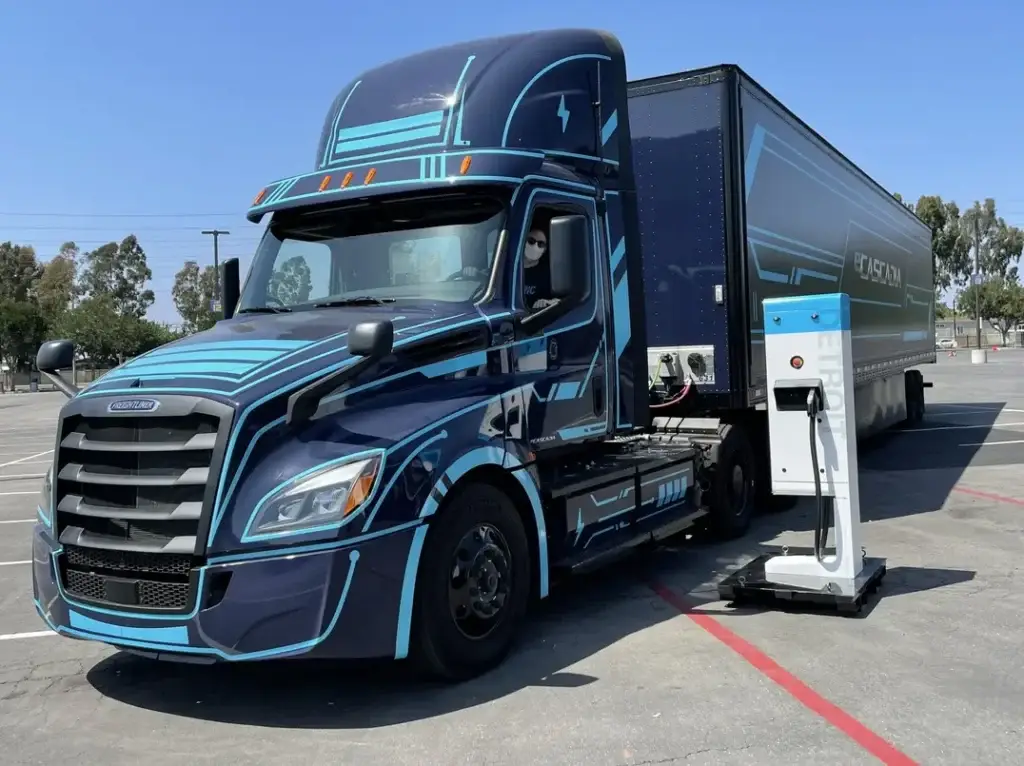
Heavy-duty electric trucks in Classes 7-8 hold the greatest potential for emissions reduction but face technological constraints for widespread long-haul adoption. Current applications focus on regional haul operations, port drayage with defined routes, and dedicated freight corridors. The Tesla Semi, Freightliner eCascadia, and Volvo VNR Electric target specific heavy-duty applications where charging infrastructure exists.
Transportation and logistics companies investing in this segment should focus on routes with reliable charging access and distances under 500 miles. The Volvo FH Electric now offers ranges up to 600 km (approximately 370 miles), and Mack Trucks has announced a battery-electric version of its new Pioneer Class 8 truck featuring a proprietary e-axle delivering 230 kW per axle. Heavy-duty vehicles are projected to capture significant market share during 2025-2030, driven by cross-border trade expansion and infrastructure project investments.
| Vehicle Class | GVWR Range | Typical Range | Primary Applications |
|---|---|---|---|
| Light-Duty (1-3) | 6,001-14,000 lbs | 150-300 miles | Service fleets, urban delivery, contractors |
| Medium-Duty (4-6) | 14,001-26,000 lbs | 100-200 miles | Regional distribution, refuse, utilities |
| Heavy-Duty (7-8) | 26,001+ lbs | 150-500 miles | Regional haul, drayage, dedicated corridors |
Major Manufacturers and Available Electric Truck Models
Fleet operators now have access to diverse electric truck manufacturers offering vehicles across all weight classes. This selection eliminates earlier market constraints and enables strategic procurement decisions based on specific operational requirements. Understanding the competitive landscape helps fleet managers evaluate warranty support, service network depth, and long-term manufacturer viability.
Class 8 Long-Haul Solutions
The Tesla Semi leads heavy-duty offerings with 300-500 mile range configurations and 1MW+ Megacharger compatibility for rapid charging. Tesla plans to expand its charging network significantly, with production priority allocated to select customers including PepsiCo. The Freightliner eCascadia targets regional freight operations with 230-mile range and 475 kW charging capability. The Volvo VNR Electric provides comparable specifications for distribution applications, and both manufacturers leverage established service networks that diesel fleet operators already know and trust.
Emerging players are expanding options. Kenworth and Peterbilt, both PACCAR brands, are rolling out the T680E and 579EV models with ranges of 150-250 miles, gaining traction with existing PACCAR customers who value familiar platforms and dealer support. BYD is making inroads in the U.S. market, particularly in California and urban environments, with competitive pricing for port and urban delivery applications.
Medium and Light-Duty Commercial Vehicles
The Ford E-Transit serves urban delivery routes with 126-162 mile range across multiple cargo configurations. Ford’s F-150 Lightning Pro targets service fleets and contractors with 230-300 mile range starting at $49,995 for commercial buyers. The Rivian EDV delivers purpose-built last-mile capability with 150+ mile range, though Amazon maintains primary access through its partnership.
Specialized manufacturers are addressing specific niches. The Mack LR Electric handles municipal waste collection with 140+ mile range designed specifically for refuse operations. Lion Electric focuses on vocational and municipal fleets, while Xos Trucks specializes in last-mile and medium-duty electrification. Hybrid solutions are also emerging, with Harbinger offering a plug-in medium-duty chassis with approximately 500 miles of range using a gasoline range extender.
Stay Current on Fleet Electrification Developments
EV technology, incentive programs, and regulatory requirements evolve rapidly. HDJ’s newsletter delivers weekly updates to help fleet managers make informed decisions.
Current Adoption Trends and Industry Implementation Rates
Electric truck adoption has emerged as a multispeed transformation, with certain sectors embracing fleet electrification while others remain cautious observers. Understanding these adoption patterns provides essential benchmarking data for fleet operators planning their transition strategies. The variance in implementation rates reflects fundamental differences in operational profiles, financial capabilities, and regulatory pressures facing commercial transportation companies.

Commercial Sector Implementation Rates
Fleet electrification rates vary dramatically across commercial applications, with logistics and parcel delivery companies leading the transformation. These pioneering industry sectors have demonstrated that electric trucks deliver measurable operational advantages in specific duty cycles. Last-mile delivery operations represent the most favorable application for current battery technology and charging infrastructure availability.
Logistics and parcel delivery fleets have achieved 18-22% electric vehicle adoption for new purchases in 2025, driven by predictable routes and centralized operations. Food and beverage distribution companies follow at 12-15% adoption rates, benefiting from refrigeration integration and sustainability mandates from major retailers. Municipal and government fleets show 15-18% implementation, supported by public policy objectives and taxpayer-funded incentive programs. Construction and specialty applications remain at 5-8% adoption, constrained by payload requirements and jobsite charging limitations.
| Industry Sector | 2025 Adoption Rate | Primary Driver | Average Daily Range |
|---|---|---|---|
| Logistics & Parcel Delivery | 18-22% | Route predictability | 120-180 miles |
| Food & Beverage Distribution | 12-15% | Retail sustainability mandates | 140-200 miles |
| Municipal & Government | 15-18% | Policy requirements | 80-150 miles |
| Construction & Specialty | 5-8% | Equipment compatibility | 60-100 miles |
| Long-Haul Freight | <3% | Range limitations | 400+ miles |
Characteristics of Successful Early Implementers
Companies successfully deploying electric trucks share distinctive operational characteristics that enable effective fleet electrification. These early adopters provide valuable templates for organizations evaluating their readiness for transition. Successful operators typically manage centralized facilities that simplify charging infrastructure deployment and overnight vehicle access. Corporate sustainability commitments from leadership or major customers provide strategic motivation beyond pure financial calculations.
Achievement metrics from leading implementations demonstrate compelling results. Operational uptime exceeds 95% for properly managed electric fleets, matching or surpassing diesel equivalents. Total cost of ownership reductions range from 15-30% compared to diesel baselines, driven primarily by fuel and maintenance savings. Driver satisfaction improvements emerge from quieter cabins, smoother acceleration, and reduced vibration during operation.
Regional Implementation Variations
Geographic patterns in electric truck adoption reveal substantial regional disparities across the United States. California maintains the highest electric truck adoption concentration, supported by the HVIP incentive program and Advanced Clean Trucks regulation. Northeast states including New York, Massachusetts, and New Jersey show elevated implementation through coordinated regional policies and utility incentive programs. Pacific Northwest markets benefit from low electricity costs and renewable energy availability that maximize operational savings.
Southern and Mountain states demonstrate slower uptake, constrained by sparse charging infrastructure and less aggressive emissions regulations. However, fleets in the Midwest and Southeast are increasingly running pilots or committing to electrification timelines, recognizing that federal regulations will affect operations regardless of state-level policy environments.
Total Cost of Ownership: Electric vs. Diesel Trucks
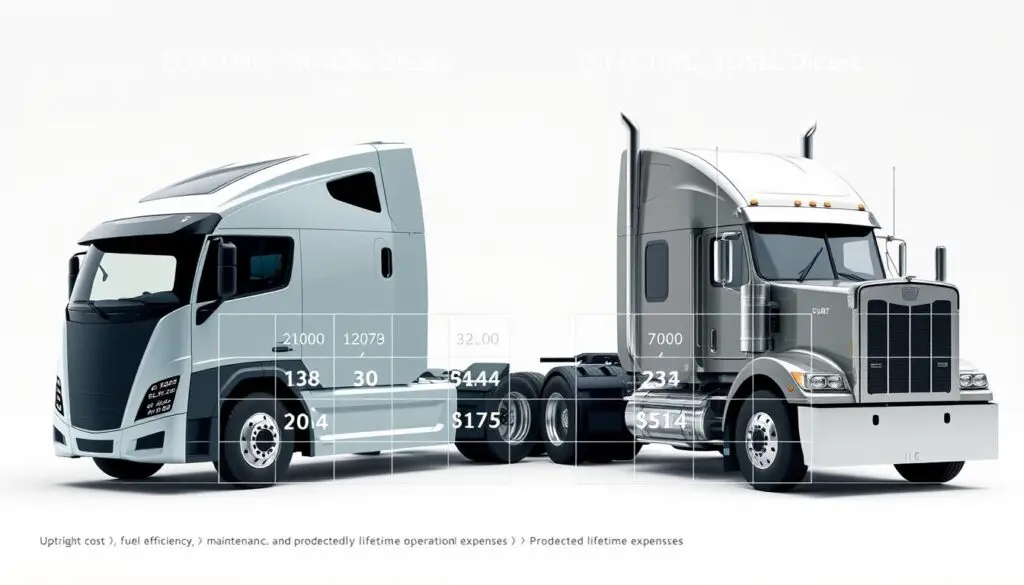
While electric trucks command higher purchase prices, comprehensive TCO analysis reveals compelling financial advantages for high-utilization fleet applications. The economic case for electrification becomes evident when fleet operators examine fuel savings, reduced maintenance costs, and available incentives over typical vehicle lifecycles. This cost comparison demonstrates that upfront price premiums represent only one component of long-term investment returns.
Purchase Price Differential Analysis
Electric trucks currently carry substantial price premiums over diesel equivalents across all vehicle classes. Class 8 electric trucks range from $300,000 to $400,000 compared to $120,000-$180,000 for diesel counterparts, representing a 40-80% differential. Medium-duty electric models show smaller gaps at $180,000-$250,000 versus $100,000-$140,000 for conventional trucks.
Battery cost reductions and manufacturing scale improvements will compress these differentials significantly through 2030. Industry projections indicate price parity for some vehicle classes by 2027-2028 as production volumes increase and battery technology advances. Current lithium-ion battery prices of $120-140 per kilowatt-hour are projected to decline to $60-80 per kWh by 2028-2030.
Fuel Cost Savings Projections
Electricity costs deliver immediate operational savings compared to diesel fuel expenses. Electric trucks typically cost $0.15-$0.25 per mile to operate versus $0.45-$0.65 per mile for diesel vehicles, assuming $3.50 per gallon diesel prices and 6-7 mpg efficiency. Vehicles traveling 50,000 miles annually generate $15,000 to $25,000 in annual fuel savings. The Tesla Semi now delivers a 500-mile range with less than 2 kWh per mile energy consumption, demonstrating the efficiency gains available in heavy-duty applications.
Maintenance and Repair Cost Reductions
Electric powertrains eliminate numerous maintenance requirements inherent to diesel engines. Fleet operators avoid oil changes, transmission services, exhaust system repairs, and diesel particulate filter replacements. These structural advantages translate to maintenance cost reductions of 40-60% compared to conventional trucks.
Regenerative braking systems extend brake component life by 50-70% through reduced mechanical wear. Traditional diesel trucks incur $2,000-$3,000 annually in brake maintenance, while electric vehicles typically spend under $800. Electric trucks also eliminate engine oil, transmission fluid, coolant changes, and air/fuel/oil filter replacements that cost $1,500-$2,500 annually for diesel fleets.
Five-Year TCO Break-Even Scenarios
Despite higher purchase prices, break-even analysis shows electric trucks achieve total cost parity within 3-5 years for high-utilization applications. This timeline depends heavily on annual mileage, local electricity rates, available incentives, and realized maintenance savings. Vehicles exceeding 40,000 annual miles typically reach break-even faster than lower-utilization units.
The electric truck ROI improves substantially when factoring Section 45W tax credits and state incentive programs. Fleets stacking multiple incentives can reduce break-even periods to 2-3 years. According to McKinsey research, the total cost of ownership for battery electric vehicles is projected to outperform internal combustion engine vehicles across all classes for many applications.
Federal Tax Credits and State Incentive Programs
The layered incentive structure for commercial electric vehicles creates substantial opportunities to offset higher upfront purchase costs. Fleet operators who comprehensively pursue available electric vehicle incentives can reduce effective acquisition expenses by $80,000 to $150,000 per vehicle. Understanding this complex financial landscape is essential for accurate total cost of ownership calculations and investment decision-making.

Section 45W Commercial Clean Vehicle Credit
The federal government provides tax credits through Section 45W under the Inflation Reduction Act, offering up to $40,000 per qualifying commercial electric truck. This credit applies to vehicles with gross vehicle weight ratings exceeding 14,000 pounds that meet specific requirements. Eligibility criteria include final assembly in North America, minimum battery capacity thresholds, and incremental cost limitations. Fleet operators planning multi-year purchases should carefully time acquisitions to maximize available federal incentives.
California HVIP and Northeast State Programs
California’s Clean Truck and Bus Voucher Incentive Project leads state programs nationwide. HVIP provides vouchers ranging from $7,500 for Class 2b trucks up to $420,000 for Class 8 fuel cell vehicles, depending on vehicle class, technology type, and fleet size. The program has invested over $1.5 billion helping fleets deploy more than 14,000 clean trucks and buses since 2010. For 2025, small fleet operators—public and nonprofit fleets with 20 or fewer trucks, or private fleets with 20 or fewer trucks and less than $15 million in annual revenue—can access enhanced vouchers of up to $330,000 for Class 8 battery-electric trucks or $420,000 for Class 8 fuel cell trucks.
Northeast states offer equally compelling opportunities. New York’s Truck Voucher Incentive Program delivers up to $185,000 for Class 8 vehicles. Massachusetts, Connecticut, New Jersey, and Rhode Island maintain similar state programs with varying voucher amounts. According to the 2025 Fleet Incentive Roadmap, over $1 billion in fresh funding is currently available across 17 states, with programs offering vouchers that can cover up to 95% of incremental vehicle costs in some cases.
Regional Utility Company Fleet Incentives
Electric utility companies provide often-overlooked incentives to build commercial transportation load. These programs include infrastructure subsidies, discounted electricity rates for fleet charging, and make-ready installations where utilities cover transformer and service upgrade costs. Examples include Southern California Edison’s Charge Ready Transport program and Pacific Gas & Electric’s EV Fleet Program, which now offers incentives covering 80% of infrastructure costs. Similar offerings exist through utilities in New York, Massachusetts, and emerging markets nationwide.
Maximizing Incentive Stacking Strategies
Professional incentive stacking combines multiple funding sources to achieve maximum financial benefit. Fleet operators can layer federal tax credits with state vouchers, utility incentives, and local air quality management district programs simultaneously. Successful stacking scenarios demonstrate combined savings reaching $80,000 to $150,000 per vehicle. For privately owned vehicles, the total voucher amount plus all other eligible public incentives may not exceed 90% of the full vehicle cost. Fleet managers who fail to pursue comprehensive incentive optimization essentially leave substantial capital unclaimed.
The HDJ Perspective
After watching diesel technology evolve for 15+ years, the pace of electric truck development is remarkable—but it doesn’t change the fundamental calculus fleet managers face. The successful operators we’ve observed approach electrification the same way they approach any major capital investment: with rigorous route analysis, realistic payback calculations, and infrastructure planning that matches vehicle acquisition timelines. The technology has proven itself for specific applications. The question for most fleets isn’t whether to electrify, but which vehicles, on which routes, and when. Start with your most predictable duty cycles, stack every available incentive, and build organizational capability before scaling. The fleets treating this as a strategic opportunity rather than a regulatory burden are the ones capturing competitive advantage.
Charging Infrastructure Planning and Capital Requirements
The shift to electric commercial vehicles demands parallel investment in charging capability, often exceeding the cost of the vehicles themselves. Strategic infrastructure planning determines operational success and prevents costly deployment delays. Fleet managers must evaluate depot installations, utility capacity, and network partnerships before vehicle delivery.
As of 2025, over 3,200 heavy-duty charging locations operate across the United States, with geographic coverage concentrated on the West Coast (720 stations) and expanding in other regions. This density now supports regional freight operations that were impossible just two years earlier, though coverage remains uneven across the country.
Depot Charging Station Types and Costs
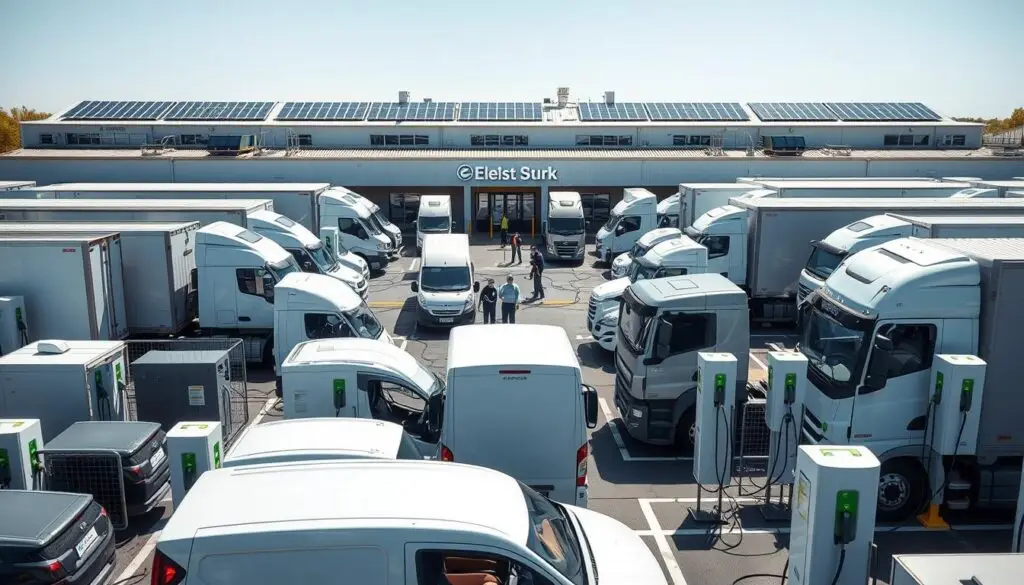
Most commercial fleets rely on depot charging as their primary energy source. Vehicles charge overnight at fleet facilities, eliminating range anxiety for predictable routes. Installation costs vary dramatically based on power requirements and existing electrical infrastructure.
AC charging systems delivering 7-19 kW suit light commercial vans and trucks perfectly, with installation costs ranging from $3,000 to $8,000 per charging port including equipment and basic electrical work. These Level 2 systems fully charge typical light-duty vehicles during an 8-hour overnight period with minimal electrical upgrades for most facilities.
Larger commercial vehicles demand DC fast charging systems to maintain operational efficiency. Power levels from 50-350 kW reduce charging times to 2-4 hours for medium-duty trucks, with installation costs escalating to $75,000-$200,000 per port. Ultra-fast charging systems delivering 500kW to over 1MW serve Class 7-8 heavy-duty applications at $250,000-$500,000 or more per port.
Electrical Service Upgrades and Transformer Capacity
Utility service upgrades often represent the most expensive infrastructure component. Existing electrical services rarely accommodate multiple high-power charging stations without modification. New transformers, upgraded service panels, and utility infrastructure improvements cost $100,000-$500,000 or more for larger depot installations.
Utility interconnection timelines extend 6-18 months in many jurisdictions. This delay catches unprepared fleet operators off guard, stalling vehicle deployments. Early coordination with local utilities prevents schedule disruptions and identifies potential cost-sharing opportunities. Power capacity planning requires detailed load analysis based on fleet size and duty cycles, calculating simultaneous charging demand rather than simple per-vehicle requirements.
| Charging Type | Power Output | Cost Per Port | Typical Charging Time |
|---|---|---|---|
| Level 2 AC | 7-19 kW | $3,000-$8,000 | 6-8 hours (overnight) |
| DC Fast Charging | 50-350 kW | $75,000-$200,000 | 2-4 hours |
| Ultra-Fast DC | 500kW-1MW+ | $250,000-$500,000+ | 45 min-2 hours |
| Utility Upgrades | Varies by site | $100,000-$500,000+ | 6-18 months lead time |
Public Charging Network Access and Partnerships
Strategic relationships with public charging network providers complement depot charging for extended routes. Major network operators have expanded rapidly, with Tesla planning significant Megacharger expansion and Electrify America targeting 1,200 locations. Traditional truck stop operators now compete in the heavy-duty charging market, with Pilot Flying J planning 750 locations and TA-Petro targeting 650 sites.
Network access agreements vary in pricing structure, typically ranging from $0.45-$0.55 per kWh. Fleet operators can negotiate volume discounts and guaranteed uptime service level agreements. Complete depot installations typically require 12-24 months from initial planning through operational commissioning for larger facilities, making early planning essential.
Battery Technology, Range Capabilities, and Performance Standards
Advanced battery systems have transformed electric trucks from experimental concepts into commercially viable transportation solutions. The underlying battery technology directly determines operational range, charging speed, lifecycle costs, and overall vehicle performance. Fleet operators must understand current capabilities and future developments to make informed investment decisions.
Lithium-Ion Chemistry Standards
Modern lithium-ion batteries dominate the commercial electric truck market through two primary chemistries. Lithium Iron Phosphate (LFP) batteries deliver superior thermal stability and cycle longevity, making them ideal for commercial applications where durability outweighs energy density concerns. These systems typically achieve 2,000-4,000 charge cycles before experiencing significant capacity loss.
Nickel Manganese Cobalt (NMC) chemistries provide higher energy density in constrained packaging environments, enabling greater electric truck range without proportionally increasing battery pack size and weight. Current battery performance standards include pack-level energy density of 150-200 Wh/kg and charging capabilities supporting 1C to 2C charge rates.
Operational Range Expectations
Manufacturer specifications typically reflect optimal conditions that rarely occur in real-world operations. Battery performance varies significantly based on payload weight, terrain elevation changes, ambient temperature, and driving behavior patterns. Fleet managers must account for these variables when evaluating vehicle suitability.
Class 2-3 light-duty vehicles achieve 120-200 miles with typical commercial loads. Class 4-6 medium-duty vehicles deliver 100-180 miles with standard payload configurations. Class 7-8 heavy-duty vehicles provide 150-300 miles depending on battery pack size and load characteristics, with some newer models like the Volvo FH Electric offering extended ranges up to 370 miles.
Cold weather conditions reduce battery performance by 20-40% across all vehicle classes, requiring careful route planning and potential range buffer implementation during winter months. Advancements in battery management systems are enhancing safety protocols and prolonging battery life in commercial environments.
Emerging Technology Developments
Solid-state batteries represent the most significant advancement in battery technology for electric trucks, promising 50-80% higher energy density compared to current lithium-ion batteries. These systems could enable 400-500 mile ranges in heavy-duty applications, with commercial availability projected for 2028-2030 based on current development timelines. Additional benefits include faster charging capabilities, improved safety profiles, and potentially lower manufacturing costs at production scale.
Integrated e-axles are becoming increasingly standard for battery-electric commercial vehicles. Volvo’s forthcoming VNL Electric truck will feature an e-axle that integrates motors and transmission in the rear axle, boosting range by freeing up space for additional batteries. This technology represents a shift toward purpose-built electric platforms rather than conversions of diesel truck designs.
Capacity Retention and Manufacturer Warranties
Battery degradation follows predictable patterns under proper thermal and charge management protocols. Typical capacity loss reaches 10-20% over the first 5-8 years of commercial operation. Most manufacturers provide warranty coverage guaranteeing 70-80% capacity retention for 8 years or 100,000-150,000 miles, whichever occurs first.
Battery replacement costs currently range from $15,000 for light-duty vehicles to $150,000+ for heavy-duty long-haul configurations. However, battery costs continue declining approximately 10-15% annually, improving replacement economics for vehicles deployed today.
Fleet Integration and Operational Readiness
Operational readiness determines whether electric truck investments deliver promised returns or become costly implementation failures. The non-hardware aspects of fleet integration frequently separate successful deployments from underperforming assets. Fleet management professionals must address route compatibility, workforce preparation, and system integration before vehicles arrive.
Evaluating Route Compatibility
Route analysis begins with detailed examination of current operational patterns. Fleet managers should document typical route distances, daily mileage averages, load characteristics, terrain profiles, and available charging time at depot facilities. The ideal candidates for initial electrification include routes with predictable daily mileage under 150-200 miles and regular return-to-depot schedules providing eight or more hours for charging.
Pilot programs should target the most favorable routes first. This approach builds organizational confidence and establishes performance benchmarks before expanding to more challenging applications. Experienced fleet operators focus on vehicles with predictable daily mileage under 100 miles to maximize battery efficiency during initial deployments.
Workforce Preparation
Driver training extends beyond basic vehicle operation to encompass new efficiency techniques. Operators must understand regenerative braking systems that maximize energy recovery and extend brake component life significantly. State-of-charge management represents a critical skill set, with drivers needing training on pre-trip charging verification protocols and range planning strategies.
Change management efforts should acknowledge driver concerns about technology reliability while presenting factual performance data. Organizations that invest in comprehensive driver training programs report smoother transitions and higher driver satisfaction with electric vehicle assignments. Addressing range anxiety through education and data-driven performance examples reduces resistance to technology adoption.
Technology Systems Integration
Vehicle telematics integration enhances operational efficiency through data-driven decision-making. Advanced telematics systems provide real-time state-of-charge monitoring and predictive range calculations, accounting for route characteristics, load weight, and weather conditions. Charging schedule optimization minimizes demand charges while leveraging favorable time-of-use electricity rates. Integration with existing fleet management platforms creates unified operations visibility without requiring separate monitoring systems.
Cold Weather and Payload Considerations
Cold weather performance presents significant challenges, with range decreases of 25-40% occurring in freezing temperatures as battery chemistry efficiency declines and cabin heating draws additional power. Mitigation strategies include battery thermal conditioning while vehicles remain connected to charging infrastructure and pre-heating battery packs before departure.
Payload capacity calculations must account for battery weight additions. Current electric trucks carry 2,000-5,000 pounds less payload than diesel equivalents depending on battery pack sizing. Weight-sensitive applications require careful evaluation before electrification commitment, with vehicle specification decisions reflecting actual payload requirements rather than assuming equivalent capabilities.
Investment Risks and Mitigation Strategies
While electric trucks offer substantial benefits, fleet operators must navigate several risk factors to protect their investment and ensure successful deployment. The transition to electric commercial vehicles involves unique challenges that differ significantly from traditional diesel fleet management.
Technology Advancement and Obsolescence
Technology obsolescence represents a significant concern for fleet operators investing in today’s electric trucks. Next-generation battery technologies arriving between 2027 and 2029 could offer substantially improved range, faster charging speeds, and lower costs. This advancement may reduce the competitive value of current-generation vehicles more quickly than traditional diesel trucks.
Effective risk mitigation strategies include leasing vehicles rather than purchasing outright to limit exposure to rapid depreciation, planning shorter asset holding periods than the traditional seven to ten years for diesel fleets, and negotiating manufacturer upgrade programs or trade-in agreements. Fleet managers should recognize that early adoption inherently involves some technology risk but provides valuable operational experience.
Residual Value Uncertainty
Unlike diesel trucks with established depreciation curves, electric truck residual value remains uncertain. Limited transaction history in secondary markets creates challenges for accurate financial forecasting. Battery degradation concerns and questions about parts availability for older models further complicate value projections.
Conservative residual value assumptions prove essential for financial modeling. Fleet operators should expect potentially 40-50% faster depreciation than diesel equivalents. Structuring financing arrangements that include residual value protection transfers this risk to lenders or manufacturers. Certified Pre-Owned programs may eventually provide warranties, inspections, and guarantees that boost secondary market confidence.
Manufacturer Viability and Service Networks
Manufacturer viability concerns center on whether newer electric truck companies will survive long-term and maintain service networks. This uncertainty affects parts availability, warranty support, and vehicle serviceability throughout the ownership period. Diversification across manufacturers reduces concentration risk, combining established manufacturers with extensive service networks alongside specialized electric truck companies.
Evaluating independent service provider capabilities offers additional protection. Third-party maintenance facilities increasingly develop electric vehicle expertise, providing alternatives to manufacturer-authorized service centers.
Share Your Fleet Electrification Experience
HDJ readers benefit from real-world implementation insights. If you’ve deployed electric trucks in your fleet, your experience can help others navigate the transition.
Strategic Investment Framework for Fleet Buyers
Commercial fleet electrification demands a methodical approach that transforms market analysis into actionable investment strategies. An effective investment framework provides structured decision-making protocols that guide operators from initial evaluation through full-scale deployment. Fleet managers must balance capital constraints, operational requirements, and evolving technology capabilities.
Pilot Program Design
Nearly all successful fleet operators begin with limited pilot programs deploying 3-10 vehicles before committing to larger-scale procurement. These initial deployments validate technology performance under real-world conditions while building organizational capability. Pilot testing identifies operational challenges early when adjustments remain cost-effective.
Effective pilot programs establish clear success metrics from the outset, including vehicle uptime targets, driver satisfaction measurements, and total cost of ownership validation. The recommended pilot duration spans 12-18 months to capture sufficient data across diverse operating conditions, encompassing seasonal temperature variations, maintenance cycle completion, and driver adaptation periods.
Phased Deployment Schedules
Strategic roadmaps for multi-year fleet conversion prioritize phased deployment that sequences investments for maximum success probability. Fleet operators should begin with highest-confidence applications—typically medium-duty vehicles operating predictable routes under 150 miles. Early wins build organizational confidence and operational expertise before tackling challenging applications.
Initial deployments during 2025-2026 focus on pilot validation and converting 5-15% of fleet segments with favorable duty cycles. Mid-period expansion from 2027-2028 targets 25-40% penetration as charging infrastructure scales and vehicle availability improves. This graduated approach allows infrastructure investment to pace vehicle acquisition while spreading capital requirements across multiple budget cycles.
Financing Options and Capital Strategies
Higher upfront capital requirements create fleet financing challenges, particularly for smaller operators with limited balance sheet capacity. Direct purchase maximizes long-term value capture and full utilization of available incentives, while leasing reduces upfront capital requirements by 60-80% and limits technology obsolescence risk.
Emerging battery-as-a-service models separate vehicle and battery ownership, reducing acquisition costs by 30-40% while transferring degradation and replacement risk to specialized providers. These structures align particularly well with fleets prioritizing predictable operating expenses over asset ownership.
| Strategic Approach | Timeline | Risk Profile | Competitive Advantage |
|---|---|---|---|
| Aggressive Early Adoption | 2025-2027 | Higher technology risk, maximum incentive capture | First-mover positioning, operational learning |
| Measured Pilot Programs | 2026-2028 | Balanced risk with validation | Data-driven scaling, infrastructure optimization |
| Responsive Fast-Follower | 2028-2030 | Lower technology risk, reduced incentives | Mature technology, proven networks |
| Delayed Compliance-Driven | 2030+ | Regulatory penalty exposure | Minimal advantage, higher conversion costs |
Market Outlook and Regulatory Landscape Through 2030
The next five years will witness fundamental changes in commercial vehicle economics as battery costs decline, regulations tighten, and new technologies emerge. The market outlook through 2030 reveals a rapidly evolving landscape where early strategic positioning delivers measurable competitive advantages.
EPA Phase 3 Implementation Timeline
EPA’s Phase 3 greenhouse gas regulations finalized in March 2024 establish new CO2 emission standards for model years 2027 through 2032. These technology-neutral, performance-based standards allow manufacturers to choose emissions control technologies, meaning compliance can be achieved with advanced internal combustion engines, hybrids, plug-in hybrids, battery electric vehicles, or hydrogen fuel cell vehicles.
For heavy-duty vocational vehicles, Phase 3 standards vary by vehicle type and range up to 60% stronger than previous Phase 2 standards by model year 2032. For tractors, standards range up to 40% stronger than previous requirements. EPA projects ZEV adoption rates reaching 60% for light heavy-duty vocational vehicles, 40% for medium heavy-duty vocational vehicles, and 40% for day cab tractors by model year 2032.
California Advanced Clean Trucks Regulation
California’s Advanced Clean Trucks regulation establishes the most aggressive timeline, mandating zero-emission truck percentages of manufacturer sales. Massachusetts, New York, Oregon, Washington, and other states have adopted similar requirements, creating de facto national standards as manufacturers design products for the largest markets. The California Air Resources Board continues developing implementation guidance as the program phases in.
Price Parity Timeline
Medium-duty electric trucks are expected to reach upfront price parity with diesel equivalents by 2027-2028. Heavy-duty vehicles will follow approximately 18-24 months later, achieving comparable purchase prices by 2029-2030. Once upfront price parity occurs, lower fuel and maintenance costs will make electric trucks the economically optimal choice rather than merely a sustainability investment.
Competitive Landscape Evolution
Traditional manufacturers are responding with electric variants of established platforms. Freightliner’s eCascadia and eM2, Volvo’s VNR Electric, and Mack’s LR Electric leverage existing service networks and dealer relationships that provide risk mitigation for conservative fleet operators. Autonomous commercial vehicles are steadily moving from concept to commercialization, with partnerships between Volvo, Hyundai, and autonomous driving companies advancing toward commercial deployment.
Frequently Asked Questions
What is the typical payback period for electric trucks compared to diesel?
For high-utilization fleets operating vehicles more than 40,000 miles annually with access to federal and state incentives, electric trucks typically achieve total cost parity with diesel within 3-5 years. Fleets stacking multiple incentives—including the federal Section 45W credit up to $40,000, state voucher programs like California HVIP, and utility incentives—can reduce break-even periods to 2-3 years. The primary savings drivers are fuel costs ($15,000-$25,000 annually per vehicle) and maintenance reductions of 40-60% compared to diesel equivalents. Low-utilization fleets or those without access to incentive programs may see longer payback periods of 5-7 years.
How do cold weather conditions affect electric truck range and performance?
Cold weather reduces electric truck range by 20-40% depending on temperature severity and vehicle class. This reduction occurs because battery chemistry efficiency declines in freezing temperatures, and cabin heating draws additional power that would otherwise extend range. Mitigation strategies include battery thermal conditioning while vehicles remain connected to charging infrastructure, pre-heating battery packs before departure, and oversizing battery capacity during vehicle specification for northern climate operations. Fleet managers in cold weather regions should build range buffers into route planning during winter months and consider this factor when selecting pilot routes for initial deployments.
What infrastructure investment is required before deploying electric trucks?
Infrastructure costs vary dramatically based on fleet size and charging requirements. Level 2 AC charging suitable for light-duty overnight charging costs $3,000-$8,000 per port. DC fast charging for medium-duty trucks ranges from $75,000-$200,000 per port, while ultra-fast systems for heavy-duty applications cost $250,000-$500,000+ per port. Often overlooked are utility service upgrades, which can cost $100,000-$500,000+ for larger depot installations requiring new transformers or upgraded service panels. Utility interconnection timelines of 6-18 months frequently catch unprepared fleet operators off guard, making early coordination with local utilities essential for matching infrastructure readiness to vehicle delivery schedules.
Which vehicle classes offer the best return on investment for initial electrification?
Medium-duty electric trucks in Classes 4-6 currently offer the strongest near-term ROI with proven technology and favorable duty cycle alignment. These vehicles balance payload capacity with operational flexibility, and typical regional distribution routes of 100-250 miles daily fit within current battery capabilities. Food and beverage distributors, utility companies, and waste management operations find particularly compelling value propositions in this segment. Light-duty applications warrant strategic testing for urban-focused operations, while heavy-duty investments should focus on pilot programs targeting routes with reliable charging access and distances under 300 miles.
How do I evaluate whether my routes are suitable for electric truck deployment?
Route suitability analysis should document typical route distances, daily mileage averages, load characteristics, terrain profiles, and available charging time at depot facilities. Ideal candidates for initial electrification include routes with predictable daily mileage under 150-200 miles, regular return-to-depot schedules providing eight or more hours for overnight charging, and minimal elevation changes that drain battery capacity. Vehicles with the most predictable duty cycles—fixed routes, consistent loads, and centralized depot operations—should be prioritized for pilot programs. Telematics data from existing diesel fleets can identify which vehicles and routes represent the highest-confidence electrification candidates.
Positioning Your Fleet for the Electric Future
Commercial fleet electrification has evolved from experimental concept to strategic imperative for transportation operators nationwide. The U.S. electric truck market projected to reach nearly $14 billion by 2030 demonstrates the scale of this transformation. With EPA Phase 3 regulations taking effect in model year 2027 and price parity expected for key vehicle segments by 2027-2028, the decision framework has shifted from “whether to electrify” to “how quickly and through what strategy.”
Organizations that approach electrification as strategic opportunity rather than regulatory burden will capture operational and economic advantages first. A comprehensive fleet electrification strategy begins with route suitability analysis and duty cycle matching. Successful operators implement pilot programs to build organizational capability before scaling deployment. Developing detailed total cost of ownership models that capture incentives and operational savings proves essential for accurate financial planning.
The fundamental trajectory toward fleet electrification is now established across all vehicle segments. The EPA SmartWay program provides comprehensive resources for fleets evaluating their transition strategies. Fleet operators who recognize the 2025-2030 period as a critical positioning window will achieve sustainable competitive advantages in an inevitably electrified commercial transportation landscape. Start with your most predictable duty cycles, stack every available incentive, and build organizational capability through measured pilot programs before scaling deployment across your operation.
Help Your Network Navigate Fleet Electrification
This comprehensive guide covers the critical factors fleet managers need to evaluate electric truck investments. Share it with colleagues planning their electrification strategies.