
By Michael Nielsen, Publisher | 15+ Years in Diesel Repair
Last Updated: September 2026
⏱ Estimated reading time: 15+ minutes
A diesel engine maintenance schedule determines whether your fleet runs profitably or hemorrhages money through preventable breakdowns. Every unplanned roadside repair represents not just the repair cost itself, but lost revenue, driver detention, customer dissatisfaction, and potential CSA score impacts that compound over time.
Michael Nielsen and Heavy Duty Journal's editorial team built this guide around the structure that actually protects a fleet: daily pre-trip inspections, monthly PM A service, quarterly PM B oil and filter changes, semi-annual deep service, and annual DOT inspection — the framework that keeps fuel costs down, trucks on the road, and expensive components protected through their full service life.
The difference between a Cummins ISX or Detroit DD15 that reaches 1.2 million miles versus one that requires a major overhaul at 600,000 miles often comes down to maintenance discipline — following the right schedule with the right procedures at the right intervals.
This guide provides the complete diesel engine maintenance schedule framework that fleet managers and owner-operators need to maximize uptime while minimizing total cost of ownership. From daily pre-trip inspections through annual overhauls and long-term component planning, you'll find the specific intervals, procedures, and best practices HDJ's editorial team has verified keep diesel engines running at peak efficiency.
Key Takeaways
- ✓Cost Impact: Preventive maintenance reduces total maintenance costs by 25–40% compared to reactive repair strategies, with unplanned downtime costing $448–$760 per vehicle daily.
- ✓Daily Discipline: 10–15 minute pre-trip inspections catch the large majority of potential failures before they become roadside breakdowns.
- ✓Interval Strategy: PM A (monthly), PM B (quarterly), and PM C (annual) service tiers provide systematic coverage of all critical systems.
- ✓Aftertreatment Focus: DPF, SCR, and DEF system maintenance prevents costly derates and extends emissions equipment life.
- ✓Technology Integration: Telematics-based condition monitoring enables optimized service timing based on actual engine data rather than arbitrary calendar dates.
- ✓OEM Specifications: Following manufacturer-specific intervals for Cummins, Detroit Diesel, PACCAR, and other engines protects warranty coverage and maximizes component life.
In This Guide
- The Economics of Diesel Engine Maintenance Scheduling
- Daily Pre-Trip Inspection Requirements
- Weekly and Monthly Heavy-Duty Maintenance Intervals
- Quarterly PM B Service: Oil Changes and System Inspections
- Semi-Annual Service: Deep System Maintenance
- Annual DOT Inspection and Comprehensive PM C Service
- Long-Term Component Planning and Major Rebuilds
- Technology Integration for Optimized Maintenance Timing
- Customizing Maintenance Schedules by Application
- Frequently Asked Questions
The Economics of Diesel Engine Maintenance Scheduling
Understanding the financial impact of maintenance strategy choices provides the foundation for building an effective diesel engine maintenance schedule. The difference between reactive and preventive approaches isn't just philosophical — it shows up directly on the balance sheet.
Quantifying Reactive Repair Costs
Emergency repairs carry premium costs that extend far beyond the parts and labor involved. When a truck breaks down on the road, the meter starts running on multiple expense categories simultaneously.
Consider what happens when a fleet vehicle experiences an engine failure from deferred oil changes. The direct repair costs for a complete engine replacement run $20,000–$35,000 depending on the platform. Emergency towing from a breakdown location adds $500–$2,000. Driver detention and redeployment creates additional labor costs. Missed delivery penalties and customer relationship damage compound the financial impact.
According to ATRI's Operational Costs of Trucking research, unplanned vehicle downtime costs fleets an average of $448–$760 per vehicle per day as of 2026, accounting for lost revenue opportunity, emergency repair premiums, and operational disruption. A single major breakdown can easily generate $10,000–$15,000 in total costs beyond the repair itself.
$448–$760
Average daily cost per vehicle of unplanned fleet downtime, per ATRI's Operational Costs of Trucking research (as of 2026).
Preventive Maintenance ROI Analysis
The economics of prevention become compelling when compared against reactive repair costs. A comprehensive PM program for a Class 8 truck typically costs $8,000–$12,000 annually in parts and labor. That investment protects against component failures that individually cost multiples of the entire annual PM budget.
Fleets running disciplined preventive maintenance programs consistently report 25–40% lower total maintenance costs than operations relying primarily on reactive repairs. The Technology & Maintenance Council's Recommended Practices document these outcomes across thousands of fleet operations, demonstrating that structured maintenance programs deliver measurable financial returns.
Beyond direct cost savings, preventive maintenance protects uptime — the ultimate driver of fleet profitability. A truck that runs 120,000 miles annually at $2.50 per mile generates $300,000 in revenue. Every day of unplanned downtime represents $800–$1,200 in lost revenue opportunity. Fleets operating PM programs typically achieve 95%+ uptime compared to 85–90% for reactive operations.
DOT Compliance and Safety Implications
Federal regulations require systematic vehicle inspection and maintenance programs for commercial motor vehicles. Under 49 CFR Part 396, motor carriers must maintain vehicles in safe operating condition through regular inspections and timely repairs.
Roadside inspection failures generate immediate costs through out-of-service orders and violation penalties. More significantly, inspection results feed into FMCSA's CSA (Compliance, Safety, Accountability) program, where poor maintenance scores can trigger intervention thresholds that affect operating authority, insurance costs, and shipper relationships. Systematic maintenance documentation also provides legal protection — in the event of an accident, a documented maintenance program can be the difference between a defensible and indefensible legal position.
Daily Pre-Trip Inspection Requirements
Your diesel engine maintenance schedule starts every day with consistent pre-trip checks. These inspections take 10–15 minutes when performed systematically, but they prevent the majority of roadside breakdowns and extend engine life by catching problems while they're still minor.
Engine Fluid Level Verification
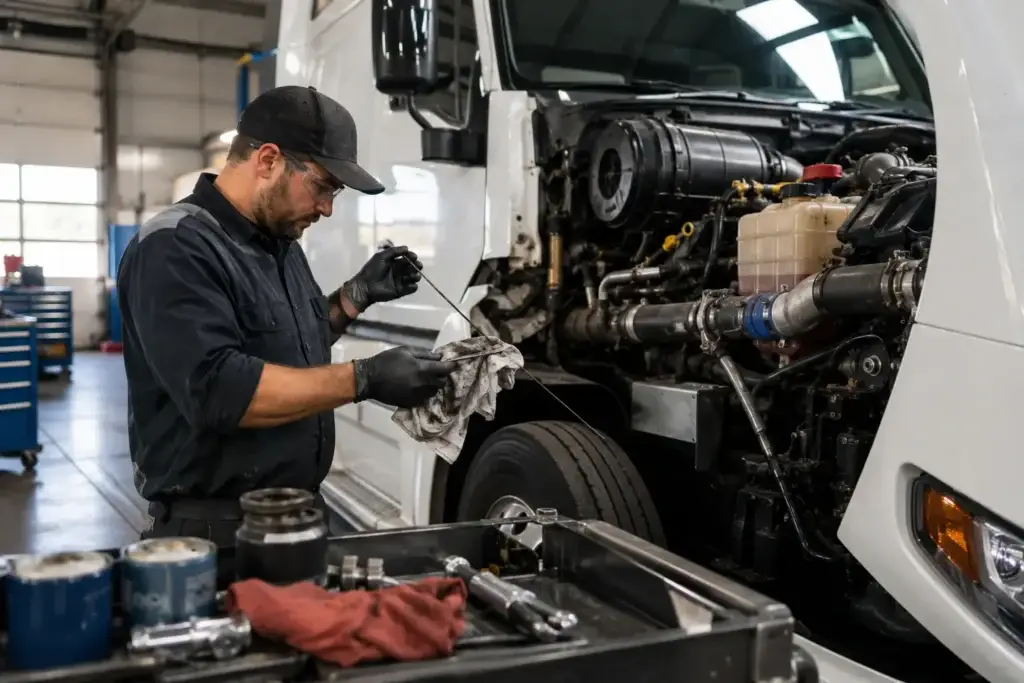
Begin fluid checks with engine oil while the engine is warm but not running — ideally after the truck has sat for 5–10 minutes following operation. Check the dipstick for both level and condition. Oil should sit between minimum and maximum marks. Low levels cause accelerated wear, while overfilling creates foam that reduces lubrication effectiveness.
Examine the oil on the dipstick for contamination indicators. Milky appearance suggests coolant intrusion from a head gasket or EGR cooler failure. Metal flake presence indicates internal wear requiring immediate attention. Fuel dilution — detectable by diesel smell and thin consistency — points to injector or regeneration system issues.
Coolant level inspection covers both the radiator (when cold) and the overflow/degas tank. Proper levels prevent overheating that can crack cylinder heads, blow head gaskets, and cause catastrophic engine damage. Note any color changes or contamination in the coolant that might indicate cooling system problems.
DEF (Diesel Exhaust Fluid) level monitoring has become critical since EPA 2010 emissions standards took effect. Engines will derate — limiting power and eventually speed — when DEF runs low. Check DEF tank level and look for crystallization around tank caps or fittings that might indicate quality issues or leaks. HDJ's SCR system failure troubleshooting guide covers DEF quality and NOx sensor problems in depth if a derate ever does occur.
Visual Leak Detection Protocol
Systematic leak detection prevents small problems from becoming major failures. Walk around the truck looking for fresh wet spots, drips, or accumulated residue at key leak points. Check the oil pan gasket and drain plug area for fresh oil. Inspect fuel system components including supply lines, return lines, filter housings, and injector connections. Examine coolant hoses and clamps at all connection points — radiator, thermostat housing, heater core lines, and EGR cooler connections.
Power steering and transmission leaks often appear at cooler line connections. Exhaust system leaks at manifold gaskets, turbo connections, and DPF clamps can affect performance and create safety hazards. Air system leaks at glad hands, air lines, and tank fittings should be noted for shop attention.
Air Filter Restriction Monitoring
Most commercial diesel engines include air filter restriction indicators that show when the filter needs replacement. Check this gauge or indicator during pre-trip inspection. A restricted air filter reduces engine power, increases fuel consumption, and can cause turbocharger damage from surge conditions. In dusty environments or during seasonal pollen periods, filter restriction can increase rapidly. Drivers operating in construction, mining, or agricultural applications should monitor restriction more frequently than those running primarily highway miles.
Weekly and Monthly Heavy-Duty Maintenance Intervals
Between daily checks and quarterly service, weekly and monthly maintenance intervals catch developing issues before they require major repairs. Establishing consistent heavy-duty maintenance intervals creates the systematic approach that separates high-performing fleets from those constantly fighting equipment problems.
Weekly Inspection Tasks
Weekly inspections take 20–30 minutes and focus on components that can change condition relatively quickly. Battery connections deserve weekly attention — corrosion builds gradually but eventually causes starting problems and charging system stress. Clean terminals with a wire brush and apply protective grease when corrosion appears.
Belt inspection catches wear before failure. Look for cracks, glazing, fraying, or misalignment. Serpentine belt failure disables the cooling system, power steering, and alternator simultaneously — creating an immediate roadside emergency. Tensioner condition affects belt life; note any noise or wobble that indicates tensioner bearing wear.
Tire pressure verification prevents irregular wear patterns and optimizes fuel economy. Underinflated tires increase rolling resistance by 3–5% and create heat buildup that accelerates tire degradation. Check tire condition for cuts, embedded objects, and uneven wear patterns that might indicate alignment or suspension issues. Document all fluid levels during weekly checks to establish baseline consumption patterns — sudden increases in oil or coolant consumption often indicate developing problems that benefit from early attention.
Monthly PM A Service Requirements
Monthly service — sometimes called PM A service — represents the first tier of structured preventive maintenance. This service level addresses safety-critical systems while establishing regular professional inspection of the entire vehicle.
Brake system inspection covers pad and shoe thickness, drum and rotor condition, air system pressure and leak-down rates, and automatic slack adjuster function. Brake issues identified during PM A service can be scheduled for repair before they create safety violations or failure risk. Lubrication of chassis points follows manufacturer specifications for grease type and quantity. King pins, U-joints, fifth wheel, suspension bushings, and steering components all require regular lubrication to prevent accelerated wear.
Electrical system checks verify lighting operation, charging system voltage, and battery condition. Load testing batteries identifies weak cells before they cause starting failures. Alternator output testing confirms proper charging under load. Exhaust system inspection looks for leaks, loose connections, and damage that affects emissions compliance and creates cab fume hazards. DPF mounting and sensor connections deserve particular attention given the complexity and cost of aftertreatment systems.
| PM A Service Component | Inspection Focus | Typical Time |
|---|---|---|
| Brake System | Pad/shoe thickness, air pressure, slack adjusters | 30–45 min |
| Chassis Lubrication | All grease fittings per OEM spec | 20–30 min |
| Electrical Systems | Lights, battery, alternator output | 20–30 min |
| Fluid Levels | Oil, coolant, DEF, power steering, transmission | 15–20 min |
| Exhaust/Aftertreatment | Leaks, mounting, sensor connections | 15–20 min |
Quarterly PM B Service: Oil Changes and System Inspections
Quarterly maintenance — typically designated PM B service — builds on monthly inspections while adding oil and filter service plus more comprehensive system evaluations. For most heavy-duty diesel fleets, this interval falls at 25,000–40,000 miles or 500–750 engine hours, whichever comes first.
Oil and Filter Change Protocols
Oil service intervals vary significantly based on duty cycle, operating conditions, and oil analysis results. Understanding the factors that influence oil life helps optimize intervals for specific applications. Highway operations with consistent loads and speeds stress oil less than stop-and-go urban delivery or severe-service applications. Construction, refuse collection, and other high-idle applications degrade oil faster despite lower mileage accumulation.
Per Cummins service documentation, engine-specific maintenance recommendations are available through the QuickServe Online portal by serial number, including detailed guidance on adjusting intervals for operating conditions and oil analysis results. Modern CK-4 and FA-4 diesel engine oils provide enhanced protection for current emissions-compliant engines. CK-4 oils work in all diesel applications, while FA-4 oils offer fuel economy benefits in specifically designed engines but shouldn't be used in older platforms. Always verify correct oil specification before service.
Oil analysis programs provide data to optimize drain intervals safely. Regular sampling identifies oil condition, contamination sources, and wear metal trends before problems cause failures. Many fleets extend intervals to 50,000+ miles with oil analysis validation, while others discover conditions requiring shorter intervals.
Filter Service Beyond Engine Oil
Quarterly service addresses multiple filter systems beyond the engine oil filter. Fuel filters — both primary and secondary — require replacement to protect injectors from contamination. A single clogged fuel filter restricts flow enough to cause noticeable power loss and can introduce air into the fuel system. HDJ's diesel fuel injector failure guide covers what happens when contamination gets past a degraded filter and reaches the injectors themselves.
Modern common rail fuel systems operate at 30,000+ PSI injection pressure with tolerances measured in microns. Contamination that passes degraded filters destroys injectors costing $300–$500 each. The fuel filter investment of $50–$100 per service protects thousands in injector replacement costs. DEF filter replacement typically occurs during quarterly or semi-annual service depending on DEF consumption rates. Contaminated or restricted DEF filters cause dosing errors that trigger fault codes and potential derates.
Comprehensive System Evaluation
PM B service includes thorough inspection of systems beyond what monthly checks cover. Cooling system evaluation tests for pressure integrity, thermostat operation, and coolant condition. Pressure testing identifies small leaks before they become large problems. Engine and transmission mounts deserve quarterly inspection. Failed mounts allow powertrain movement that damages driveline components and creates vibration that accelerates wear throughout the vehicle.
ECM data download during quarterly service captures fault code history, parameter trends, and performance data that help identify developing issues. Many problems generate stored codes long before they cause drivability symptoms. Proactive attention to code patterns prevents failures.
Semi-Annual Service: Deep System Maintenance
Every six months, comprehensive maintenance addresses systems that require less frequent attention but play critical roles in engine longevity and efficiency. Semi-annual service typically coincides with every other PM B interval, adding deeper inspections and service procedures.
Cooling System Flush and Testing
Cooling system maintenance prevents catastrophic failures that destroy engines. Coolant degrades over time, losing corrosion protection and developing deposits that reduce heat transfer efficiency. Semi-annual service provides opportunity for coolant condition assessment and service as needed. Extended Life Coolant (ELC) formulations used in most modern diesel engines require SCA (Supplemental Coolant Additive) testing and adjustment during service intervals. Proper additive levels maintain corrosion protection for aluminum components, liners, and water pump seals.
Pressure testing the cooling system identifies small leaks and weak points before they fail during operation. Testing at 15 PSI for 10–15 minutes reveals leaks at hoses, clamps, radiator tanks, and core plugs. Radiator and charge air cooler external cleaning maintains heat transfer efficiency. Road debris, bugs, and dust accumulate on cooling surfaces, creating insulation that reduces cooling capacity. Pressure washing from the engine side out removes accumulated material without forcing debris deeper into the cores.
Fuel System Deep Service
Fuel system cleanliness directly affects engine performance, fuel economy, and emissions compliance. Semi-annual service addresses contamination that accumulates despite regular filter changes. Tank cleaning removes water and sediment accumulation that eventually overwhelms filter capacity. Water in diesel fuel promotes microbial growth that creates filter-clogging biofilms and corrosive byproducts. Fuel tank draining and inspection during semi-annual service catches contamination before it causes injector damage.
Injector service varies by engine platform and operating conditions. Some applications benefit from fuel additive treatments that clean injector tips and restore spray patterns. Severely contaminated systems may require professional injector testing and cleaning.
Turbocharger and Exhaust System Inspection
Turbochargers operate under extreme conditions — hot exhaust gases spinning the turbine at 100,000+ RPM while the compressor side pressurizes intake air. Semi-annual inspection catches wear before failure. Check turbo shaft play in both radial and axial directions. Excessive play indicates bearing wear that will progress to failure. Listen for unusual sounds during operation — grinding suggests bearing damage while whistling may indicate seal leaks or compressor wheel damage.
Inspect turbo oil supply and drain lines for restrictions or leaks. Oil supply restrictions cause bearing failures from insufficient lubrication. Drain line restrictions cause oil to leak past seals into the intake or exhaust, creating smoke and potential engine damage. Exhaust system inspection covers manifolds for cracks, connections for leaks, and mounting hardware for security. Exhaust leaks upstream of the turbo reduce turbine efficiency.
Annual DOT Inspection and Comprehensive PM C Service
Annual service represents the most comprehensive maintenance interval, typically combining DOT annual inspection requirements with thorough evaluation of all vehicle systems. PM C service addresses components that require less frequent attention while providing opportunity for major system service.
| Component | Annual Service Required | Typical Indicators |
|---|---|---|
| Fuel Injectors | Clean and test spray pattern, check return flow | Black smoke, rough idle, poor fuel economy |
| Cooling System | Pressure test, coolant analysis, thermostat verification | Temperature variation, coolant loss, overheating |
| Exhaust System | Inspect manifolds, connections, DPF condition | Exhaust smell, ticking sounds, visible leaks |
| Charging System | Load test alternator, verify voltage regulation | Dim lights, battery drain, warning indicators |
| Air Compressor | Check build-up time, governor operation, oil carryover | Slow build-up, oil in air tanks, cycling issues |
Aftertreatment System Annual Service
DPF (Diesel Particulate Filter) maintenance has become a critical component of annual service for all post-2007 diesel engines. The DPF accumulates ash from oil combustion that cannot be removed through regeneration and must be cleaned periodically. Most fleet operations perform DPF ash cleaning every 200,000–400,000 miles depending on duty cycle and oil consumption rates.
High-idle applications and engines consuming more oil accumulate ash faster. Annual inspection determines whether cleaning is needed based on ash loading measurements and back pressure readings. HDJ's complete DPF regeneration troubleshooting guide covers what to do when a truck won't regen between scheduled cleanings.
SCR (Selective Catalytic Reduction) catalyst inspection verifies proper function of the NOx reduction system. Catalyst damage from thermal events, contamination, or physical impact affects emissions compliance and can trigger fault codes. DEF system annual service includes tank cleaning, pump inspection, and injector verification. DEF quality testing confirms concentration meets ISO 22241 specifications for proper SCR function. Contaminated or degraded DEF causes dosing errors and catalyst damage.
Valve Adjustment and Engine Timing
Many diesel engines require periodic valve adjustment to maintain proper clearances as components wear. Valve adjustment intervals vary by engine platform — some require adjustment every 300,000–500,000 miles while others maintain clearance longer. Improper valve clearance affects performance, fuel economy, and engine life. Tight clearances prevent complete valve closure, causing power loss and potential valve damage.
Annual service provides opportunity for compression testing that identifies cylinder condition. Low compression in one or more cylinders indicates ring wear, valve problems, or head gasket issues that benefit from early attention — HDJ's complete diesel engine diagnostics guide walks through compression testing procedure step by step.
Free Diesel Maintenance Checklist
Get HDJ's free, field-tested diesel maintenance checklist delivered instantly to your inbox — print it, laminate it, keep it in the shop.
Instant PDF • 100% Free • No Spam

Long-Term Component Planning and Major Rebuilds
Strategic long-term planning addresses major components that require attention at extended intervals. Planning these services in advance prevents rushed decisions and allows scheduling during low-demand periods that minimize revenue impact.
Engine Component Life Cycles
Understanding typical component life cycles enables proactive planning for major maintenance investments. While actual life varies based on maintenance quality, operating conditions, and manufacturing variations, general guidelines help with budgeting and scheduling. Injectors typically last 300,000–500,000 miles in highway applications with proper fuel filtration. EGR coolers and valves show failure rates increasing after 300,000–400,000 miles, particularly in applications with frequent regeneration events.
Turbochargers generally last 400,000–600,000 miles when oil change intervals are maintained. Water pumps, thermostats, and cooling system components often require replacement between 400,000–600,000 miles. Starter and alternator rebuilds become common after 500,000–700,000 miles.
Transmission and Driveline Intervals
Heavy-duty transmissions require major service between 300,000–500,000 miles for most applications. Fluid changes at 100,000–150,000 mile intervals extend transmission life and identify developing problems through fluid analysis. Driveline components including U-joints, center bearings, and slip yokes require inspection every 100,000 miles with replacement as wear dictates. Differential services at 100,000–150,000 miles maintain gear lubrication and identify bearing wear before failure. Clutch life varies dramatically based on driver behavior and application — some last 500,000+ miles while others require replacement at 200,000 miles.
Major Overhaul Timing
In-frame engine overhauls typically occur between 750,000–1,000,000 miles for properly maintained highway engines. This service addresses wear items including rings, bearings, and seals without removing the engine from the vehicle. Full engine rebuilds or replacements become necessary when wear exceeds in-frame repair capability, typically at 1.2–1.5 million miles for engines that have received proper maintenance throughout their life. Planning major overhauls during slow seasons — typically January through March for many trucking operations — allows extended shop time without peak-season revenue impact.
Technology Integration for Optimized Maintenance Timing
Modern fleet management technology transforms diesel maintenance scheduling from calendar-based guesswork to data-driven precision. Real-time monitoring and predictive analytics enable maintenance exactly when needed — neither too early (wasting money) nor too late (risking breakdown).
Telematics-Based Condition Monitoring
Telematics platforms continuously monitor engine parameters that indicate maintenance needs. Oil life algorithms consider operating conditions, load factors, and idle time to calculate remaining oil life more accurately than simple mileage intervals. DPF soot loading sensors provide data for optimizing regeneration timing and identifying when ash cleaning becomes necessary. Coolant temperature trending reveals thermostat degradation or cooling system restrictions before they cause overheating.
Fault code monitoring through telematics catches stored codes that indicate developing problems. Many issues generate codes long before symptoms appear to drivers. Proactive attention to code patterns prevents roadside failures. Modern fleet management platforms integrate with maintenance software to automatically generate work orders when monitored parameters indicate service is needed. This integration eliminates manual tracking and ensures no service intervals slip through scheduling gaps.
Predictive Maintenance Analytics
Advanced analytics platforms use machine learning to identify patterns that predict component failures before they occur. By analyzing data from thousands of vehicles, these systems recognize parameter combinations that historically precede specific failure modes. Predictive capabilities continue improving as data volumes grow and algorithms learn from outcomes.
Fleets implementing predictive maintenance report 20–35% reductions in unplanned downtime compared to traditional PM programs — HDJ's how AI improves diesel diagnostics guide covers this shift toward predictive, condition-based service in more depth. Integration of parts inventory systems with predictive analytics enables automatic parts ordering before they're needed for predicted repairs — reducing parts-waiting downtime and enabling better cost management through planned procurement.
Digital Documentation and Compliance
Electronic maintenance records eliminate lost paperwork and provide instant access to complete vehicle history during roadside inspections. Digital systems ensure documentation meets FMCSA requirements while simplifying compliance verification. Technician mobile applications enable real-time documentation of completed work, parts used, and issues identified. Photo documentation of component condition provides evidence supporting repair decisions and tracking wear progression. Automated reporting generates maintenance compliance dashboards showing fleet-wide PM completion rates, upcoming service needs, and trend analysis.
Customizing Maintenance Schedules by Application
Generic maintenance schedules provide starting points, but optimized programs account for specific operating conditions that affect component wear rates. A diesel engine maintenance schedule customized for actual application delivers better results than one-size-fits-all intervals.
| Application Type | Interval Adjustment | Key Considerations |
|---|---|---|
| Long-Haul Highway | Standard to extended intervals | Consistent operation, lower idle time, fuel quality |
| Regional/P&D | Standard intervals | Moderate idle, varied speeds, frequent stops |
| Urban Delivery | Reduce intervals 25–30% | High idle time, frequent regen, brake wear |
| Construction/Vocational | Reduce intervals 30–50% | High idle, dust exposure, PTO operation |
| Refuse Collection | Reduce intervals 40–50% | Extreme stop/start, high idle, hydraulic stress |
Severe Service Interval Adjustments
Severe service conditions require compressed maintenance intervals to account for accelerated wear. Dust exposure in construction and mining operations clogs air filters faster and contaminates oil more quickly. Engines operating in dusty environments may require air filter changes at 3–4 times the normal frequency.
High-idle applications accumulate engine hours without proportional mileage. Using engine hours rather than miles for interval tracking ensures adequate service frequency. A refuse truck might accumulate 1,000 engine hours in 20,000 miles while a highway truck covers 100,000 miles in the same hours. Extreme temperatures — both hot and cold — stress cooling and starting systems. Cold climate operations benefit from block heater use and may need different oil viscosity grades seasonally.
OEM-Specific Interval Requirements
Different engine manufacturers specify varying maintenance intervals based on their specific designs and testing. Following OEM recommendations protects warranty coverage and reflects engineering knowledge about each platform's requirements. Cummins, Detroit Diesel, PACCAR, and Navistar each publish detailed maintenance recommendations for their engine families. These specifications account for design differences in filtration systems, lubrication requirements, and component life expectations. Aftermarket extended warranty programs often require specific maintenance documentation to remain valid.
Frequently Asked Questions
How often should you change oil in a diesel engine?
Long-haul highway operations can extend to 25,000–50,000 miles with oil analysis validating condition. Severe service — construction, refuse, urban delivery — needs shorter 10,000–15,000 mile intervals. High-idle applications should track engine hours, not just mileage. Always confirm with OEM recommendations first.
What are the most critical daily diesel maintenance checks?
Engine oil level (warm, not running), coolant level in both radiator and overflow tank, visual leak detection at gaskets and fuel lines, DEF level, and air filter restriction — see the Daily Pre-Trip section above for the full walkthrough. These take 10–15 minutes and catch most roadside breakdowns before they happen.
How much does preventive maintenance save compared to reactive repairs?
Roughly 25–40% lower total maintenance costs than reactive strategies. See the downtime-cost figure above ($448–$760/day per ATRI) for the scale of what's at stake — a blown engine from skipped oil changes costs $20,000–$35,000, against oil changes costing under $500 annually.
What maintenance does the aftertreatment system require?
DPF ash cleaning every 200,000–400,000 miles, DEF filter replacement during scheduled PM intervals, annual SCR catalyst inspection, and DOC monitoring for plugging. Minimize forced regenerations through complete trips rather than repeated short cycles, and use DEF meeting ISO 22241 specifications to protect the catalyst from contamination damage.
How do telematics systems improve diesel maintenance scheduling?
They shift scheduling from calendar-based to condition-based by monitoring engine hours, oil life, DPF soot loading, coolant trends, and fault codes in real time. Fleet platforms can auto-generate work orders when parameters indicate service is due, catching developing problems days or weeks before failure.
What is the difference between PM A, B, and C service levels?
PM A (monthly, ~10,000–15,000 miles) covers safety inspections and fluid checks in 2–3 hours. PM B (quarterly, ~25,000–40,000 miles) adds oil/filter changes, brake inspection, and ECM downloads in 3–4 hours. PM C (annual, ~100,000 miles) is the full DOT inspection plus major component evaluation, taking 6–8 hours.
Building Your Diesel Engine Maintenance Schedule for Maximum Uptime
Effective diesel engine maintenance scheduling protects your investment while maximizing revenue-generating uptime. The structure matters — daily pre-trip inspections catching problems early, monthly PM A service maintaining safety systems, quarterly PM B service addressing oil and filters, semi-annual deep service, and annual comprehensive evaluation all working together as a systematic program.
The most successful fleets combine structured intervals with condition-based monitoring that optimizes timing for their specific operations. Whether running long-haul highway routes or severe-service vocational applications, customizing intervals based on actual operating data delivers better results than generic schedules.
Start with OEM recommendations as your foundation, implement telematics-based monitoring for condition awareness, and use oil analysis to validate interval decisions. Document everything for compliance and trend analysis. The investment in systematic preventive maintenance pays returns through reduced breakdown costs, extended component life, and the uptime that drives fleet profitability — the same discipline Michael Nielsen and Heavy Duty Journal's editorial team apply across every maintenance guide on heavydutyjournal.com.
Pass This Along to Your Fleet Team
Fleet managers and maintenance supervisors who build their PM program around this interval framework consistently outperform fleets running reactive maintenance — share this guide with the people responsible for keeping your trucks on the road, or bookmark heavydutyjournal.com for the next one.


