

By Michael Nielsen, Editor & Publisher | 15+ Years in Diesel Repair
Last Updated: January 2026
📖 Estimated reading time: 22 minutes
Equipment downtime costs fleet operations thousands of dollars every hour. When commercial vehicles sit idle waiting for components, your business loses revenue, misses deadlines, and disappoints customers. Yet excessive stock ties up capital that could fuel business growth. Effective heavy duty parts inventory management balances these competing pressures through strategic frameworks that transform stock control from a reactive cost center into a competitive advantage.
Fleet managers face unique challenges managing specialized components: expensive powertrain assemblies, long procurement lead times, and unpredictable failure patterns that make traditional warehousing approaches inadequate. This guide delivers actionable frameworks for calculating optimal stock levels, implementing classification systems that focus resources where they matter most, and deploying technology solutions that prevent both costly shortages and wasteful overstock situations.
Whether you manage construction equipment, Class 8 trucks, or industrial fleets, the strategies ahead help you reduce emergency purchases, improve asset utilization, and make data-driven decisions about capital allocation. Organizations implementing these approaches typically achieve 15-30% reductions in total inventory value while improving parts availability by 10-20 percentage points.
Key Takeaways
- Downtime costs dwarf inventory investment: Fleet vehicle downtime costs $448-$760 daily per unit, making strategic parts availability far more economical than reactive emergency purchasing.
- Carrying costs consume 20-30% annually: Storage, insurance, obsolescence risk, and capital opportunity costs compound quickly—optimizing stock levels frees significant working capital.
- ABC classification focuses resources: Category A parts (10-20% of SKUs, 70-80% of value) warrant intensive management; Category C consumables need simple automated systems.
- Reorder point formulas eliminate guesswork: Calculate (Average Daily Usage × Lead Time) + Safety Stock to trigger replenishment before stockouts occur.
- Technology enables predictive positioning: CMMS integration with telematics anticipates parts needs based on equipment diagnostics rather than reactive ordering.
- Supplier partnerships extend inventory reach: Vendor-managed inventory and consignment programs provide access to components without capital investment.
The True Cost of Inefficient Heavy Duty Parts Inventory
Understanding the complete financial picture of inventory mismanagement begins with quantifying costs that often remain hidden from standard accounting reports. The price tag extends well beyond invoice amounts for parts themselves. Organizations face a dual threat: excess inventory that drains capital and insufficient stock that halts operations.
Poor inventory practices create financial consequences across three primary dimensions, each representing a significant drain on operational budgets and profitability. Many fleet managers focus exclusively on parts purchase prices while overlooking the substantial secondary costs that accumulate over time. The business case for optimization becomes compelling when these hidden expenses are properly calculated—most operations discover that inefficient fleet parts inventory management costs between 25-40% of their total parts investment annually.
Hidden Storage Expenses and Capital Allocation
Inventory carrying costs typically consume 20-30% of total inventory value each year. For a fleet maintaining $500,000 worth of parts, this translates to $100,000-$150,000 in annual expenses that many organizations fail to track accurately. These costs accumulate across multiple categories extending far beyond simple warehousing rent.
Physical storage expenses include warehouse space, climate control systems, and security measures. Insurance premiums protect against theft, fire, and damage. Handling costs cover labor for receiving, storing, and retrieving parts throughout their shelf life.

The opportunity cost of capital represents perhaps the most significant component. Money tied up in slow-moving inventory cannot be invested in revenue-generating activities or high-return opportunities. When capital sits dormant in parts bins, organizations lose the potential returns from alternative investments. Obsolescence risk increases dramatically with inventory age and fleet composition changes—industry data suggests that 15-25% of heavy equipment parts inventory becomes obsolete within five years without proper management protocols.
20-30%
Annual carrying cost as percentage of total inventory value, according to industry benchmarks
Equipment Unavailability Impact Assessment
Fleet downtime costs dwarf nearly every other operational expense when critical equipment sits idle waiting for parts. According to Element Fleet Management research, downtime costs a fleet an average of $448 to $760 per vehicle per day. For heavy equipment operations where hourly rates exceed $200, daily downtime costs can reach $10,000-$50,000 depending on fleet size and operational scale.
Lost revenue represents the most immediate consequence. Construction equipment that cannot reach job sites, delivery trucks that miss routes, or production machinery that halts operations all generate zero income while fixed costs continue. Idle labor costs accumulate rapidly when technicians and operators remain on payroll without productive work.
Missed delivery commitments damage customer relationships and future business prospects. Late penalties, contract violations, and lost contracts all stem from equipment unavailability. The ripple effects of a single stockout can impact customer satisfaction for months after the immediate crisis resolves. Maintenance cost analysis reveals that reactive approaches driven by parts shortages increase total repair expenses through overtime labor, additional diagnostic time, and temporary workarounds that create future maintenance issues.
Premium Freight and Rush Order Expenses
Expedited shipping expenses represent the most visible symptom of inadequate parts inventory optimization. Organizations forced into reactive procurement face freight costs running 300-500% higher than standard shipping methods. A $200 part requiring overnight delivery can easily incur $150-$300 in transportation charges alone.
Rush order premiums extend beyond shipping to include supplier surcharges for expedited processing. Distributors and manufacturers charge premium prices for parts pulled from stock ahead of regular customers, typically adding 25-75% to standard pricing structures. Emergency purchasing eliminates negotiating leverage and competitive bidding opportunities—suppliers recognize desperation and adjust pricing accordingly.
| Cost Category | Annual Impact Range | Primary Drivers |
|---|---|---|
| Carrying Costs | 20-30% of inventory value | Storage, insurance, obsolescence, capital opportunity cost |
| Downtime Losses | $448-$760+ per equipment day | Lost revenue, idle labor, missed commitments |
| Emergency Procurement | 300-500% premium over standard | Expedited freight, rush fees, supplier premiums |
| Obsolescence Write-Offs | 15-25% of slow-moving inventory | Equipment retirement, manufacturer discontinuations |
Core Principles of Stock Level Optimization
Strategic inventory control begins with understanding the core principles that separate reactive ordering from proactive optimization. Heavy duty parts inventory management demands a systematic approach replacing guesswork with data-driven methodologies. These foundational principles create the framework for balancing availability, cost, and operational continuity across your entire fleet.
Successful inventory strategy relies on three interconnected elements working together. When implemented correctly, these principles reduce carrying costs while simultaneously improving parts availability. Organizations that master these fundamentals consistently outperform competitors relying on outdated ordering habits.

Defining Service Level Targets for Critical Systems
Service level targets represent the probability that parts will be available when your technicians need them. This metric directly influences customer satisfaction, equipment uptime, and inventory investment levels. Most organizations struggle because they apply uniform targets across all parts categories, leading to either excessive stock or frequent shortages.
Critical powertrain components typically require service level targets between 95% and 99.5%. A 95% target accepts a 5% risk of stockouts, while 99% targets substantially increase required inventory investment. Moving from 95% to 99% service levels can increase safety stock requirements by 40-60% for the same part.
Differentiated service levels based on component criticality deliver optimal results. Engine crankshafts and transmission assemblies warrant 98-99% targets due to severe downtime consequences. Cosmetic components and non-essential accessories function effectively at 90-93% service levels. This stratified approach concentrates capital where operational impact is highest.
| Component Category | Service Level Target | Safety Stock Impact |
|---|---|---|
| Mission-Critical Powertrain | 98-99% | High (200-300% of average demand) |
| Safety Systems & Brakes | 96-98% | Medium-High (150-200%) |
| Hydraulic Components | 94-96% | Medium (100-150%) |
| Preventive Maintenance Items | 92-95% | Low-Medium (75-125%) |
| Cosmetic & Non-Essential | 85-90% | Minimal (25-75%) |
Balancing Investment Against Operational Risk
Every inventory decision involves trade-offs between capital investment and operational continuity. Carrying excessive stock ties up working capital that could fund fleet expansion or facility improvements. Insufficient inventory creates downtime costs that far exceed parts purchase prices.
Operational risk assessment quantifies the financial consequences of parts unavailability. Calculate the cost per hour of equipment downtime by considering lost revenue, labor inefficiency, customer penalties, and alternative equipment rental. For many heavy equipment operations, downtime costs range from $500 to $5,000 per hour depending on equipment type and application.
Compare carrying costs against downtime exposure to determine optimal stocking levels. If a $2,000 transmission seal prevents $50,000 in potential downtime losses, the risk-adjusted value justifies maintaining multiple units. Conversely, inexpensive trim pieces with minimal downtime impact warrant just-in-time ordering despite lower unit costs.
Understanding Lead Time Variability
Lead time management represents one of the most challenging aspects of heavy equipment parts inventory. Standard automotive components ship within 24-72 hours, while specialized mining or construction equipment parts may require 8-16 weeks. This variability directly impacts safety stock requirements and reorder point calculations.
Lead time consists of multiple sequential stages introducing variability: order processing, manufacturer production scheduling, transportation, and customs clearance for imported components. Understanding which stages create the most uncertainty enables targeted improvement efforts. Document historical lead times for each critical part number to establish baseline expectations, tracking minimum, average, and maximum delivery times over rolling 12-month periods.
Parts with consistent 7-day lead times require less safety stock than components ranging from 5 to 25 days despite identical average lead times. Seasonal patterns also affect procurement timing—construction equipment parts experience longer lead times during spring building season, while agricultural components face extended delays during planting and harvest periods.
Critical Parts Classification Framework
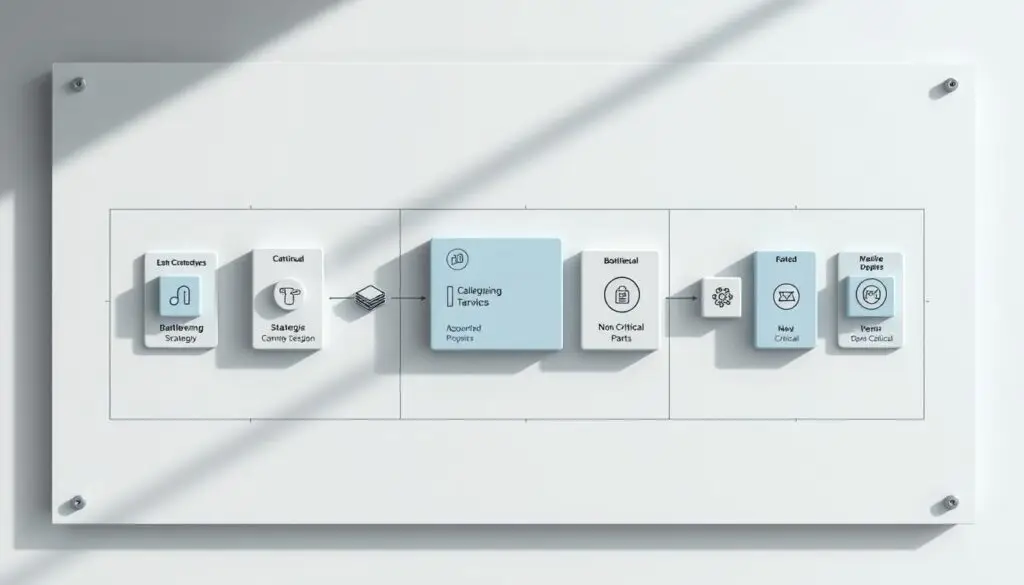
A structured parts classification system separates essential components from routine items, enabling smarter resource allocation. Every fleet operation manages thousands of individual parts with vastly different characteristics, costs, and operational impacts. Without a methodical framework, organizations treat all inventory equally, leading to overstocking low-priority items while critical components remain unavailable.
The classification approach categorizes parts based on three fundamental dimensions: equipment criticality, consumption value, and demand predictability. This multi-factor assessment ensures stocking decisions reflect both financial realities and operational requirements.
Engine and Powertrain Components That Stop Operations
Mission-critical components represent parts whose failure causes immediate equipment shutdown with no operational workaround. These items demand prioritized availability despite typically higher unit costs. The operational cost of their absence far exceeds inventory carrying expenses.
Fuel injectors rank among the highest-priority powertrain components for diesel fleets. A single failed injector can sideline an entire vehicle, and these precision components cannot be field-repaired. Electronic control modules similarly require immediate replacement capability since engine operation depends entirely on their functionality.
Turbochargers present unique stocking challenges due to their high cost and equipment-specific configurations. However, turbocharger failure creates complete power loss, making some inventory investment necessary for high-utilization fleets. Transmission assemblies and major components like torque converters, valve bodies, and clutch packs fall into similar critical identification categories.
Brake Systems, Hydraulics, and Safety-Related Parts
Safety-critical components carry dual importance—they affect both operational capability and regulatory compliance. Brake system failures don’t just create downtime; they generate liability exposure and potential 49 CFR Part 396 violations. This elevated risk profile demands enhanced inventory prioritization compared to components with purely operational impact.
Brake chambers, slack adjusters, and foundation brake components require ready availability across all fleet operations. These items experience predictable wear patterns based on mileage and application, making demand forecasting relatively straightforward. Air system components including compressors, governor valves, and air dryers support the brake system and warrant similar prioritization.
Hydraulic systems present distinct stocking requirements for equipment categories. Hydraulic pumps, control valves, and cylinder assemblies enable core equipment functions in construction and material handling applications. ABS components occupy middle ground in classification hierarchies—while failures don’t prevent vehicle operation, they create regulatory compliance issues and increased accident risk.
Consumables and Preventive Maintenance Items
Routine maintenance components feature the most predictable demand patterns in heavy equipment operations. These items replace at scheduled intervals based on hours, mileage, or calendar time. Their consumption follows calculable patterns derived from maintenance schedules and fleet utilization data.
Oil filters, fuel filters, and air filters represent the highest-volume maintenance parts categorization for virtually all equipment types. These components feature relatively low unit costs, compact storage requirements, and universal application across multiple equipment units. Inventory investment in filters delivers high returns through reduced emergency ordering and improved maintenance efficiency.
Belts and hoses constitute another consumable category with time-based replacement needs. Serpentine belts, coolant hoses, and hydraulic hoses deteriorate predictably and require periodic replacement regardless of visible wear. Maintaining comprehensive belt and hose inventory prevents minor component failures from escalating into major system damage.
Calculating Precise Reorder Points and Safety Stock
Accurate calculations eliminate the uncertainty that leads to both stockouts and excess inventory. Mathematical frameworks transform inventory replenishment from reactive scrambling into systematic planning. These formulas account for usage patterns, lead times, and operational risks to determine exactly when and how much to order.
The foundation of stock optimization rests on two critical calculations: reorder points and safety stock. Together, they create an automated system maintaining availability while controlling capital investment. Fleet managers who master these calculations gain predictable parts availability without tying up excessive funds in inventory.
Applying the Reorder Point Formula to Fleet Components
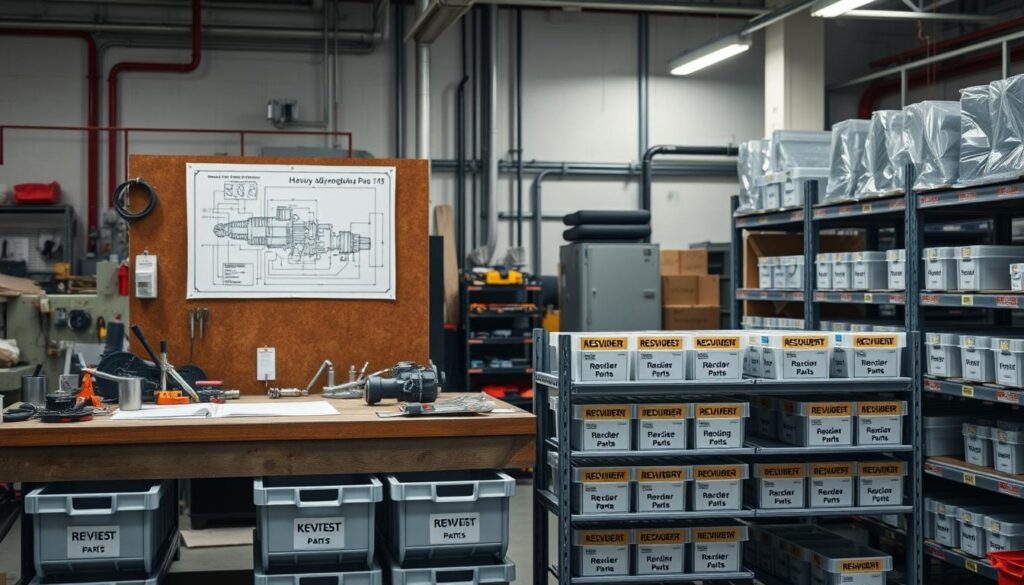
The reorder point calculation determines the exact inventory level triggering a new order. The formula combines average daily usage with lead time: (Average Daily Usage × Lead Time in Days) + Safety Stock. This calculation ensures new stock arrives before existing inventory depletes.
Consider a fuel filter with consistent demand patterns. If your fleet uses an average of 2 filters daily and your supplier has a 10-day lead time, the base reorder point sits at 20 units. This calculation assumes perfect conditions—no delays, no demand spikes, no supply disruptions. Different component types require adapted approaches: high-turnover items like oil filters might use weekly averages to capture demand fluctuations, while slower-moving parts like transmission assemblies benefit from monthly usage calculations.
Lead time accuracy directly impacts reorder point effectiveness. Verify supplier performance data rather than relying on quoted lead times. A distributor might promise 7-day delivery but consistently deliver in 9 days, requiring adjustment to prevent stockouts.
Determining Safety Stock for Unpredictable Demand
Safety stock protects against two fundamental uncertainties: demand variability and supply delays. The calculation uses statistical methods to quantify risk and determine appropriate buffer inventory. Safety stock formulas typically follow this structure: Z-score × Standard Deviation of Lead Time Demand.
The Z-score corresponds to your desired service level—the probability of not stocking out during a replenishment cycle. Common Z-scores include 1.65 for 95% service level and 2.33 for 99% service level. Mission-critical parts warrant higher service levels and larger safety stock buffers.
| Service Level Target | Z-Score | Application |
|---|---|---|
| 90% | 1.28 | Non-critical consumables |
| 95% | 1.65 | Standard maintenance parts |
| 98% | 2.05 | Important drivetrain components |
| 99% | 2.33 | Critical engine and safety parts |
For a brake pad with average lead time demand of 8 units and standard deviation of 2 units, a 95% service level requires: 1.65 × 2 = 3.3 (rounded to 4 units). This means maintaining 4 brake pads as safety stock beyond the basic reorder point. Supply chain reliability influences safety stock significantly—suppliers with inconsistent lead times require larger buffers than reliable partners.
Adapting Stock Levels for Seasonal Operations
Fleet utilization rarely remains constant throughout the year. Construction equipment peaks during summer months, snow removal machinery activates in winter, and agricultural fleets surge during planting and harvest seasons. Annual averages mask these patterns and create either costly excess or critical shortages.
Adjust reorder points and safety stock calculations seasonally to match operational intensity. A paving fleet might require 150% of standard parts inventory from April through October but only 50% during winter months. Lead times also fluctuate seasonally as manufacturers and distributors experience industry-wide demand shifts—anticipate these bottlenecks by increasing safety stock before peak season begins.
Establishing Stock Level Boundaries
Minimum stock levels serve as the automated trigger point for inventory replenishment. When quantity on hand reaches this threshold, the system generates a purchase requisition or order. The minimum typically equals your reorder point: the combination of lead time demand plus safety stock.
Maximum stock levels prevent over-accumulation that ties up capital and consumes warehouse space. Calculate the maximum as: Reorder Point + Order Quantity. This represents the highest inventory level under normal operations—right after a replenishment order arrives. These boundaries create an automated system where stock levels oscillate between maximum (just after delivery) and minimum (just before reordering), with safety stock providing a buffer against uncertainty.
ABC and XYZ Analysis for Heavy Equipment Parts
Not all heavy duty parts deserve equal attention—smart inventory management recognizes these differences through structured classification systems. When managing thousands of individual SKUs across engine components, hydraulic systems, and consumables, a systematic parts categorization strategy becomes essential for operational efficiency.
Value-Based Classification for Economic Prioritization
The ABC analysis method categorizes parts according to their annual consumption value, revealing that inventory worth is rarely distributed evenly across your catalog. This fundamental principle shows a consistent pattern: a small percentage of parts accounts for the majority of your inventory investment.
Category A items represent your highest-value parts, typically comprising only 10-20% of unique part numbers but accounting for 70-80% of total inventory value. For heavy equipment operations, these include complete engine assemblies, transmissions, final drives, torque converters, and major hydraulic pump assemblies.
Category B items occupy the middle ground with moderate values and quantities, making up approximately 30-40% of your SKU count and representing 15-25% of inventory value. Examples include alternators, starter motors, hydraulic cylinders, radiators, and air compressors.
Category C items are low-value components constituting 40-50% of your parts catalog but only 5-10% of total inventory value. This category encompasses filters, belts, hoses, fasteners, seals, lubricants, and other consumables.

Demand Predictability Through XYZ Classification
While ABC analysis addresses economic value, XYZ classification focuses on demand predictability—a characteristic equally important for strategic stocking decisions. This complementary system categorizes parts based on consumption pattern consistency.
X items demonstrate consistent, predictable demand with minimal variation. Preventive maintenance consumables like engine oil filters for a standardized fleet typically fall into this category. Y items exhibit moderate demand variability—brake pads, hydraulic hoses, and wear parts typically fit this classification. Z items experience sporadic, unpredictable demand with high variability, such as specialized sensors or electronic control modules for older equipment.
Building a Combined Matrix for Differentiated Strategies
The real power of inventory segmentation emerges when combining ABC economic analysis with XYZ demand predictability. This integration creates a nine-category matrix enabling truly strategic stocking decisions tailored to each part’s unique characteristics.
| Category | Characteristics | Recommended Strategy |
|---|---|---|
| AX Parts | High-value, predictable demand | Just-in-time delivery agreements; minimal on-hand inventory |
| AY Parts | High-value, moderate variability | Moderate safety stock with close monitoring |
| AZ Parts | High-value, sporadic demand | Consignment arrangements or emergency sourcing protocols |
| BX Parts | Moderate-value, predictable demand | Standard reorder point systems with automated replenishment |
| CX Parts | Low-value, predictable demand | Simple min-max systems with bulk ordering |
The matrix reveals counterintuitive insights. AZ parts—despite their high value—may warrant less inventory investment than CX parts because stocking sporadic, expensive items ties up capital with minimal service improvement. When a $12 hydraulic fitting costs $200 in downtime every hour it’s unavailable, stocking a year’s supply makes perfect economic sense.
The HDJ Perspective
The most common inventory optimization mistake we see in heavy-duty operations isn’t over-stocking or under-stocking—it’s applying uniform management intensity across all parts categories. A fleet manager spending equal time analyzing $8 O-ring safety stock and $18,000 hydraulic pump reorder points has their priorities inverted. The ABC-XYZ matrix exists specifically to prevent this misallocation. Focus your expertise where capital concentration demands it, and let simple automated systems handle the rest.
Technology Infrastructure for Inventory Optimization
Technology infrastructure serves as the backbone of effective heavy duty parts inventory optimization, enabling real-time visibility and automated decision-making. Modern operations demand integrated software systems that eliminate manual processes and connect inventory data with operational workflows.
Selecting the Right Enterprise System
Choosing appropriate inventory management software requires careful evaluation of organizational needs and system capabilities. CMMS systems designed for heavy equipment operations provide serialized component tracking, equipment-specific parts lists, and maintenance history integration that generic inventory systems cannot match.
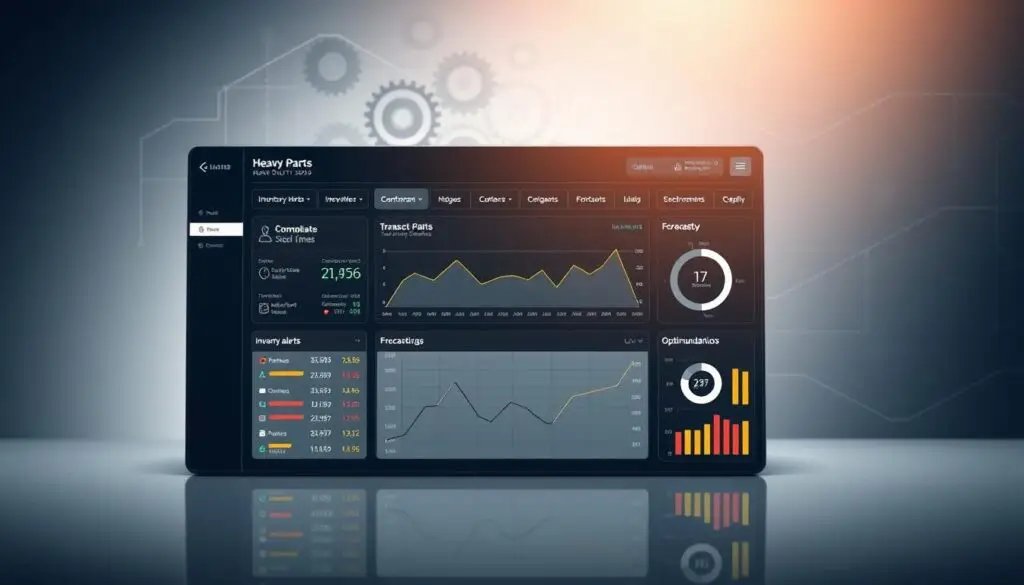
Evaluation criteria should focus on operational requirements rather than feature checklists: parts tracking capabilities with bin-level accuracy, work order integration linking maintenance activities to parts consumption, purchasing workflows with automated requisition generation, multi-location support for distributed warehouses, and comprehensive analytics for turnover rates and forecast accuracy.
Implementing Automated Reordering Systems
Automated reordering transforms inventory replenishment from a daily monitoring task into an exception-based management process. Modern systems generate purchase requisitions automatically when stock levels reach predetermined reorder points, eliminating stockouts caused by human oversight while preventing emotional over-ordering that inflates inventory investment.
Advanced platforms incorporate approved vendor lists and negotiated pricing agreements directly into the ordering workflow. Alert systems complement automated ordering by notifying managers of inventory conditions requiring attention—flagging approaching stockouts, excess inventory accumulation, and parts with unusual consumption patterns.
Enabling Mobile Access for Field Operations
Parts transactions occur in maintenance shops, on service trucks, and at remote job sites—not exclusively at office computers. Mobile inventory access closes the gap between physical parts movements and system records that creates inaccuracy in manual tracking methods. Technicians equipped with mobile applications can check availability, reserve components, and record usage from wherever work occurs.
Connecting Fleet Telematics with Parts Inventory
Telematics integration represents the cutting edge of predictive inventory management for heavy equipment operations. When vehicle diagnostic systems detect fault codes or approaching maintenance intervals, integrated platforms automatically check parts availability. If required components are not in stock, the system triggers procurement before the maintenance appointment.
This proactive approach eliminates delays caused by parts unavailability during scheduled maintenance. Telematics data also enhances demand forecasting accuracy—historical patterns of component failures across the fleet inform safety stock calculations and reorder point adjustments.
Strategic Supplier and OEM Partnership Development
Strategic supplier and OEM partnerships serve as force multipliers for inventory optimization efforts, extending parts availability beyond physical warehouse capacity. External relationships with suppliers, distributors, and equipment manufacturers create flexible inventory solutions that reduce capital investment while maintaining service levels.
Structured Agreements for Supplier-Owned Stock
Consignment inventory arrangements allow suppliers to stock parts at customer facilities while retaining ownership until consumption. This model transfers carrying costs and obsolescence risk to suppliers in exchange for committed stocking levels and preferential pricing. Organizations gain immediate parts access without capital investment or storage cost burden.
Vendor-managed inventory programs extend supplier involvement beyond simple consignment to include replenishment decision-making authority. Suppliers monitor usage patterns, track stock levels, and initiate replenishment orders based on predetermined parameters. VMI implementations succeed when built on robust data sharing and clear performance expectations including fill rates, response times, and inventory turnover targets.
Rapid Response Programs for Specialty Components
Emergency parts programs with distributors provide expedited access to components that don’t justify permanent in-house stocking. Regional distributor warehouses serve as extended inventory for lower-frequency parts, delivering within hours rather than days. Formalized agreements establish service standards and pricing for after-hours emergency situations.
Communication protocols form the backbone of successful emergency programs. Organizations need clear contact procedures for regular hours, after-hours, and weekend situations. Many programs include dedicated account representatives with authority to authorize emergency releases without standard approval delays.
Free Professional Fleet Tools
Cost calculators, fault code lookup, maintenance planners, and more—built for owner-operators, fleet managers, and diesel techs. No signup required.
Performance Metrics and Continuous Monitoring
Without consistent measurement and monitoring, inventory management initiatives lack the visibility needed to demonstrate value and guide strategic improvements. Establishing a comprehensive framework of inventory performance metrics provides the foundation for evaluating system effectiveness and identifying optimization opportunities.
Turnover Rates for Different Parts Categories
The inventory turnover ratio measures how efficiently capital is utilized by comparing annual parts consumption to average inventory value. While general industry targets range from 4-8 turns annually, heavy equipment parts typically achieve 2-4 turns due to lower demand frequency and strategic safety stock requirements. Turnover should be calculated by part category rather than overall—Class A high-value items might turn 3-4 times annually while Class C consumables could achieve 6-8 turns.
Service Level Achievement and Fill Rate Tracking
Service level measurement and fill rate tracking assess inventory system reliability. Service level measures the percentage of time parts are available when requested, while fill rate measures the percentage of total demand quantity satisfied from stock. Organizations should establish target service levels of 95-99% for critical items, 90-95% for important components, and 85-90% for routine consumables.
Stockout Frequency and Impact Assessment
Tracking stockout frequency examines not just how often parts are unavailable but the operational impact of each incident. Organizations should track stockout incidents by part number, recording date, duration, associated equipment downtime, and estimated financial impact. This data reveals patterns indicating whether stockouts result from forecasting errors, supplier reliability issues, or inadequate safety stock.
Return on Inventory Investment Calculations
Return on inventory investment frameworks calculate the financial return generated by inventory optimization initiatives. The calculation compares reduction in downtime costs and emergency procurement expenses against inventory carrying costs. For example, a fleet reducing annual downtime costs by $500,000 and emergency shipping by $150,000 while increasing average inventory value by $200,000 achieves substantial positive returns that justify continued investment.
Implementation Roadmap for Inventory Optimization
Success in inventory optimization implementation depends on following a disciplined approach that addresses systems, procedures, and personnel simultaneously. Organizations attempting piecemeal improvements often fail to achieve lasting results because they overlook critical interdependencies between technology, processes, and people.
Conducting a Comprehensive Inventory Audit
The inventory audit process establishes your starting point by revealing the true state of parts availability, accuracy, and condition. Most organizations discover significant discrepancies between physical inventory and system records during this phase. Research indicates that operations without disciplined inventory practices experience 10-20% record inaccuracy, representing thousands of dollars in misallocated capital.
A complete physical count forms the cornerstone of the audit. Reconciliation follows, comparing actual quantities against system records. Document all variances, categorizing them by type: quantity discrepancies, location errors, obsolete items still recorded as active, and parts physically present but not in the system.
Establishing Standard Operating Procedures
Standard operating procedures create consistency across all inventory transactions, eliminating variability that compromises accuracy. Written procedures ensure that every team member performs tasks identically, regardless of experience level or shift assignment.
Cycle counting represents a fundamental shift from annual physical inventories to continuous accuracy verification. Rather than counting everything once yearly, cycle counting programs count specific items daily or weekly based on classification. High-value A items might be counted monthly while lower-priority C items are verified quarterly. When counts reveal discrepancies exceeding established thresholds, personnel must investigate root causes rather than simply adjusting records.
⚠️ Implementation Warning
Organizations that treat inventory optimization as a project with a defined end date typically experience gradual deterioration as attention shifts elsewhere. Sustained excellence requires ongoing measurement, analysis, and refinement embedded into regular operations—not one-time initiatives.
Frequently Asked Questions
What percentage of inventory value do carrying costs typically represent?
Inventory carrying costs typically consume 20-30% of total inventory value annually for heavy equipment operations. For a fleet maintaining $500,000 in parts inventory, this translates to $100,000-$150,000 in annual expenses including physical storage, insurance premiums, handling labor, capital opportunity costs, and obsolescence risk. Organizations implementing strategic inventory optimization can reduce these carrying costs by 25-35% while maintaining or improving parts availability.
How do you calculate the reorder point for fleet maintenance parts?
Calculate reorder points using this formula: (Average Daily Usage × Lead Time in Days) + Safety Stock. For example, if your fleet uses 2 fuel filters daily and supplier lead time is 10 days, the base calculation yields 20 units. Add safety stock based on your desired service level and demand variability—a 95% service level requires approximately 1.65 times the standard deviation of lead time demand as safety stock. Review and adjust these parameters quarterly based on actual consumption patterns.
What is ABC analysis and how does it apply to fleet parts management?
ABC analysis categorizes parts by annual consumption value to prioritize management attention. Category A items represent 10-20% of part numbers but 70-80% of inventory value—transmissions, engine assemblies, and major hydraulic components requiring close monitoring. Category B items occupy middle ground with 30-40% of SKUs and 15-25% of value. Category C items are high-volume, low-cost consumables like filters and belts. This classification directs resources where they deliver maximum returns.
What is the average cost of equipment downtime due to parts unavailability?
Fleet downtime costs range from $448 to $760 per vehicle per day according to Element Fleet Management research, with heavy-duty trucks often exceeding these figures. These costs include lost revenue, idle labor expenses, missed delivery penalties, and customer relationship damage. For heavy equipment operations where hourly rates exceed $200, daily downtime costs can reach $10,000-$50,000 per unit. This makes strategic parts inventory investment far more economical than reactive emergency procurement.
How can vendor-managed inventory reduce parts investment costs?
Vendor-managed inventory programs transfer carrying costs and obsolescence risk to suppliers while maintaining parts availability. Under these arrangements, suppliers stock parts at your facility while retaining ownership until consumption. The supplier monitors usage, maintains stock levels, and initiates replenishment automatically. VMI works best for expensive powertrain components and specialized assemblies where capital investment would otherwise be significant.
What technology features should fleet managers prioritize in inventory management software?
Prioritize CMMS platforms offering real-time visibility across all storage locations, automated reorder point triggers, work order integration linking parts to repairs, and mobile access for field transactions. Telematics integration enables predictive parts positioning based on equipment diagnostics. Analytics dashboards should track inventory turnover, stockout frequency, and carrying costs. Barcode scanning capabilities improve transaction accuracy and reduce discrepancies.
Optimizing Your Parts Strategy for Fleet Success
Strategic heavy duty parts inventory management transforms operations from reactive firefighting to proactive asset management. The frameworks presented in this guide provide a clear path to measurable results—organizations implementing these approaches typically achieve 15-30% reductions in total inventory value while improving parts availability by 10-20 percentage points.
Success requires commitment across multiple areas: analytical frameworks like ABC classification and reorder point calculations form the foundation, technology infrastructure enables automated replenishment, supplier partnerships extend inventory capabilities beyond physical storage, and performance metrics provide visibility into progress. Excellence in parts management represents a continuous journey rather than a final destination. The strategies outlined here position your fleet for maximum productivity while minimizing operational disruptions and optimizing capital efficiency in demanding operating environments.
Share This Guide With Your Team
Help fleet managers and maintenance professionals optimize their parts inventory strategies—share this comprehensive guide with colleagues who could benefit from these frameworks.