
By Michael Nielsen, Publisher | 15+ Years in Diesel Repair
Last Updated: October 2026
⏱ Estimated reading time: 13 minutes
Diesel filter maintenance protects an engine by removing contaminants from three streams: oil, fuel and intake air. Each filter fails differently and has its own service trigger, so one mileage number for all of them leads to missed changes or wasted ones.
This guide from Heavy Duty Journal (HDJ), written by publisher Michael Nielsen, covers oil, fuel and air filters on Class 6-8 trucks. It explains what primary sources support, how to set intervals from the engine maker's schedule and your duty cycle, and how to keep records for the Federal Motor Carrier Safety Administration (FMCSA).
HDJ rebuilt the earlier version around primary sources. It removed interval, micron, restriction, cost and savings figures that traced to no independent source, along with trade-association links, images and advertising prompts.
Key Takeaways
- ✓Your engine maker sets the interval. HDJ found no independent source for a universal mileage number.
- ✓Three filters, three triggers. Oil, fuel and air filters fail in different ways.
- ✓Soot and fuel show up in the oil. Oil analysis beats a calendar when duty is severe.
- ✓Blend changes can clog fuel filters. A move to a high-level biodiesel blend can load filters early.
- ✓Records are required. The FMCSA requires dated inspection and maintenance records.
In This Guide
- What Diesel Filter Maintenance Covers
- Oil Filters: Soot, Fuel Dilution and Intervals
- Oil Filter Replacement Procedure
- Fuel Filters and Water Separators
- Air Filters and Restriction Indicators
- Count the Cost of a Filter Program
- Severe Duty and Setting Your Own Intervals
- Records, FMCSA Rules and Disposal
- Build a Diesel Filter Maintenance Program
- Frequently Asked Questions
- The Bottom Line
What Diesel Filter Maintenance Covers
Diesel filter maintenance means servicing the oil filter, the fuel filters and water separator, and the air filter on a schedule tied to the engine maker's instructions and to what the filters actually catch. It also means recording each service.
Oil filters trap particles that would otherwise circulate through bearings and the valve train. Fuel filters and separators protect pumps and injectors from particles and water. The air filter keeps dust out of the intake and the turbocharger. Many engines add a second fuel stage or a bypass oil filter, so check your own layout.
The earlier version gave oil intervals three ways in one article: 15,000-25,000, 25,000-50,000 and 15,000-50,000 miles. HDJ found no independent source for any of them. Your engine maker's schedule and your oil analysis are the numbers to use.
A good diesel filter maintenance program answers three questions for every truck: what is the service trigger, who does the work and where is it recorded. The sections below take the filters one at a time, then pull the answers together into a program you can audit.
HDJ's diesel engine maintenance schedule guide places filter service within the wider service calendar.
Oil Filters: Soot, Fuel Dilution and Intervals
A filter traps particles, but oil also carries soot, acid and fuel. A 2007 Argonne National Laboratory paper, sponsored by the U.S. Department of Energy (DOE), found that oil degraded by exhaust gas recirculation raised ball wear about two orders of magnitude in lab tests, mostly through abrasion. Engine crosshead wear tracked soot content.
The study did not test filters, so it cannot tell you how often to change one. What it supports is attention to oil condition, including soot loading, acid number and wear, not only miles.
Fuel can thin the oil too. In an National Renewable Energy Laboratory (NREL) paper on regeneration with late in-cylinder fuel injection, heavy-duty samples showed 1.5 to 1.6 percent fuel dilution for both ultra-low sulfur diesel (ULSD) and B20, a blend of up to 20 percent biodiesel.
In light-duty operation, the authors found 6.7 percent total fuel in B20 oil against 4.1 percent for ULSD after 4,000 miles. They extrapolated 12 percent against about 5 percent at 10,000 miles, which suggests a shorter drain interval for B20. The page gives no date.
Confirm the oil grade and specification your engine maker requires before you choose a filter. HDJ's guide to 15W-40 versus 10W-30 diesel engine oil covers grade selection.
Sample oil at a consistent point in each interval, such as at every change, so results compare cleanly from one service to the next.
Use the engine maker's drain and filter interval as the ceiling. Shorten it for severe duty, or when oil analysis shows soot, fuel dilution or wear metals trending up. Do not go beyond the maker's limit without written approval.
Oil Filter Replacement Procedure
Prepare and Remove
Let the engine cool enough to handle but not so long that the oil settles. Position a drain pan sized for the sump capacity in your service manual, record the odometer or hour meter, and have the correct filter wrench ready.
Note the starting reading in the service record before work begins, so the next due point can be set from it.
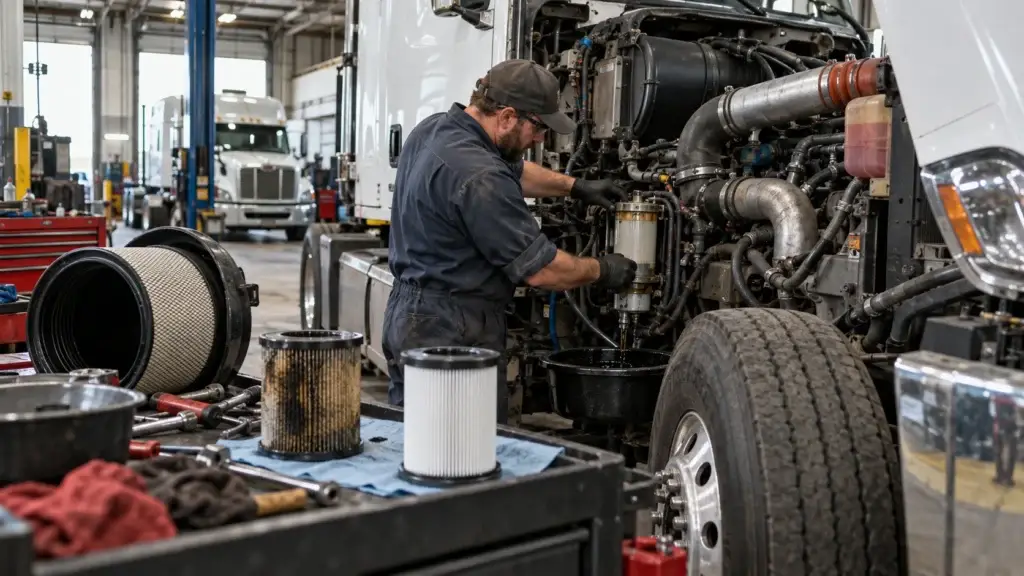
Clean around the filter head, remove the filter and let the housing drain. Inspect the mounting surface for old gasket material and damaged threads. On cartridge filters, check the O-ring surfaces on the housing and cap for scoring.
Wear gloves and eye protection, and keep absorbent material at hand. Used oil and hot components are the main hazards on this job, and a spill is a slip risk. Follow your shop's lockout and safety procedures for the truck before you start.
Install and Verify
Wipe the sealing surface, lightly oil the new gasket and thread the filter on until the gasket touches. Then tighten as the filter label states. Over-tightening damages the gasket and the head, and under-tightening leaks.
Add oil to the level the manual specifies, start the engine and confirm oil pressure builds promptly. Check for leaks while it runs and again at operating temperature, then recheck the level after the filter fills.
Whether to pre-fill a filter depends on its orientation and the maker's instruction, so follow the label instead of habit.
Fuel Filters and Water Separators
Fuel filters and water separators protect pumps and injectors from particles and water. The interval comes from your engine maker, and fuel quality can move it. HDJ found no independent source for a mileage range, so the earlier 15,000-30,000 mile figure was removed.
Fuel changes load filters. As of October 2026, DOE's Alternative Fuels Data Center (AFDC) says the first few tanks of a high-level biodiesel blend can release deposits that clog filters and require frequent filter replacement. Plan extra filter changes when you move a fleet to a higher blend.
Storage matters as well. The Environmental Protection Agency (EPA) inspected 42 underground diesel tanks and found moderate or severe corrosion in 35. Its 2016 news release said microbial corrosion was suspected. EPA did not link this to filters, but fleets with their own tanks should sample the tank bottom and watch filters for early plugging.
Hesitation, power loss under load, hard starting and fuel pressure faults can come from a restricted filter. Many other faults cause the same symptoms, so confirm with a fuel pressure test first. HDJ's low fuel pressure guide covers testing.
When installing, prime the filter or system as the engine maker specifies, because air in the fuel system causes hard starting. Use new seals where supplied, and choose a replacement that meets the maker's filtration and water separation specification. HDJ found no independent test comparing brands.
⚠️ Safety Warning
Diesel fuel is flammable. Work in a ventilated area away from ignition sources, contain spills, and follow the engine maker's procedure for relieving fuel pressure before opening any fuel line. Follow the label and the safety data sheet (SDS) for any cleaner or sealant.
Air Filters and Restriction Indicators
The air filter keeps dust out of the engine and turbocharger. Where the truck has a restriction indicator, service the element by its reading and compare it with the limit your engine maker gives. HDJ could not verify the earlier 20-25 inches of water figure from a primary source, so it was removed.
An Oak Ridge National Laboratory (ORNL) report, sponsored by DOE, tested clogged air filters on three newer fuel-injected gasoline cars and one carbureted car. The fuel-injected cars showed no significant fuel economy change. The carbureted car lost economy, and acceleration improved on all vehicles with a clean filter.
That report covered light-duty gasoline vehicles and gives no year on its page. HDJ found no equivalent heavy-duty test. The earlier claim that clean filters restore fuel economy is unproven for trucks. Replace the filter for protection and power, and track your own mileage if you want to test the claim.
Operating conditions change the interval. Gravel roads, construction, harvest and seasonal debris load a filter faster. Record restriction readings over time, set location-specific service points and use a pre-cleaner or intake cap if your engine maker offers one for your conditions.
To service the element, clean the housing exterior first, remove the element without tapping it, inspect the housing and sealing surfaces for debris or damage, seat the new element by its markings and close every latch. A damaged seal lets unfiltered air in and defeats the filter.
Count the Cost of a Filter Program
A diesel filter maintenance program has costs beyond the part. HDJ has no verified filter, injector or overhaul prices, so this guide gives none. Use your own purchase orders and shop invoices. Count labor, oil, disposal and the hours a truck sits in the bay, not only the part.
The earlier version claimed a program cuts unplanned repairs by up to 50 percent and priced injectors and pumps. HDJ found no independent source for those figures. Count avoided repairs only from your own history, compared across trucks and years.
Compare cost per service across intervals. Suppose a shorter interval adds $100 per service on a truck serviced five times a year. That is $500 a year per truck, which must be earned back in avoided repairs or downtime your records can show. Those numbers are made up.
Multiply by fleet size before you decide, and keep downtime in the calculation. A truck in the bay for filter service is not hauling.
Severe Duty and Setting Your Own Intervals
Severe duty changes diesel filter maintenance. It is anything harder than the engine maker's baseline: long idling, frequent stop-start work, heavy loads, extreme temperatures or dust. Many vocational fleets meet several at once, so check whether your manual names shorter severe-duty intervals.
HDJ found no independent source for the percentage cuts or the per-application mileage table in the earlier version, so both were removed. The table below shows what to use in their place.
| Filter | Service trigger | Where the number comes from |
|---|---|---|
| Oil | Engine maker interval, shortened by duty cycle and oil analysis | Operator manual and lab report |
| Fuel and separator | Engine maker interval, earlier after a blend change or contamination | Operator manual and fuel pressure test |
| Air | Restriction reading at or near the maker limit | Operator manual and indicator |
| Bypass or second stage | Engine maker interval | Service manual |
Use oil analysis to move the interval, not to guess it. Send samples at a consistent mileage, track soot, fuel dilution and wear metals as trends, and change the interval only when the trend supports it.
Records, FMCSA Rules and Disposal
As of October 2026, FMCSA's text of the rule, Title 49 of the Code of Federal Regulations (CFR), section 396.3, says every motor carrier must systematically inspect, repair and maintain its vehicles. Records must identify the vehicle, indicate the nature and due date of each inspection and maintenance operation, and show the date and nature of inspections, repairs and maintenance.
Electronic maintenance systems can store these fields and set due dates. Any system works if it shows the nature and due date of each operation and keeps the record for the required period.
Records must be kept where the vehicle is housed or maintained for one year, and for six months after it leaves the carrier's control. The earlier version described the period differently, so the FMCSA text is the one to follow.
For filters, a useful record shows the date, odometer or hours, filter type and part number, the technician and any finding such as water in a fuel filter or metal in an oil filter. HDJ's maintenance records guide covers the wider system.
For disposal, EPA's used oil guidance for businesses says certain used oil filters are excluded from hazardous waste regulation when they are not terne-plated, are not mixed with listed hazardous waste and are hot-drained by an approved method. States can be stricter. The page does not address used fuel filters.
Free Diesel Maintenance Checklist
Get HDJ's free, field-tested diesel maintenance checklist delivered instantly to your inbox — print it, laminate it, keep it in the shop.
Instant PDF • 100% Free • No Spam
Build a Diesel Filter Maintenance Program
Start with an inventory. For each engine family, list the oil, fuel, separator and air filter part numbers, the engine maker's intervals and the service limits. Keep it in the preventive maintenance (PM) system, not in one technician's head.
Write the installation steps into a checklist so every shop does the same thing: clean the head, check the sealing surface, tighten as labeled, prime where required, verify pressure and look for leaks.
Key Recommendation
Treat the engine maker's schedule as your ceiling. Shorten it for duty cycle or oil analysis, extend it only with written approval, and record every service on the PM form.
Review the results each quarter: unusual restriction readings, water in fuel filters, metal in oil filters and repeat leaks. A finding in a filter is early evidence of a problem elsewhere, so route it to diagnosis. HDJ's fuel system cleaning guide covers what to do when a filter finds contamination.
Pilot your diesel filter maintenance program on one engine family first. Run the checklist and review for a full quarter, fix what the review finds, then roll it out to the rest of the fleet. A small pilot shows where the paperwork breaks down before it becomes a fleet-wide habit.
Ask drivers to report restriction warnings and fuel or oil leaks, and give them an easy way to do it. HDJ's preventive maintenance checklist shows where filter checks usually sit in a service.
Keep the program honest. Compare unplanned filter-related roadside events before and after, using your own records, and drop any step that does not earn its place. Fewer, better-targeted checks are easier to keep doing.
Frequently Asked Questions
How often should I change diesel oil filters on a truck?
Follow your engine maker's drain and filter interval as the ceiling, then shorten it for severe duty or when oil analysis shows rising soot, fuel dilution or wear metals. HDJ found no independent source for a universal mileage number. Do not extend beyond the maker's limit without written approval.
What happens if I run a diesel engine with a clogged fuel filter?
Restriction can cause hesitation, power loss, hard starting or fuel pressure faults, though many other problems cause the same symptoms. Confirm with a fuel pressure test, replace the filter to the engine maker's specification and prime the system. HDJ found no independent source for repair costs, so use your own history.
Can I clean and reuse a heavy-duty air filter?
Follow your engine maker's instructions for the element you have. As a rule, standard disposable elements are replaced, not cleaned, and HDJ found no independent source comparing washable and disposable types. Whatever you choose, inspect the seal and housing, and service the element when the restriction reading reaches the maker's limit.
Are OEM filters worth it over aftermarket filters?
Choose a filter that meets your engine maker's specification for filtration, water separation and bypass pressure, and ask the seller to show that specification in writing. HDJ found no independent test comparing brands, so it does not rank them. Keep the part number in the service record so any problem can be traced.
How do I document filter maintenance for FMCSA inspections?
Under 49 CFR 396.3, records must identify the vehicle, show the nature and due date of inspection and maintenance operations, and record the date and nature of each service. Keep them where the vehicle is housed for one year, and for six months after it leaves your control.
How should I dispose of used oil filters?
EPA says certain used oil filters are excluded from hazardous waste rules when they are not terne-plated, are not mixed with listed hazardous waste and are hot-drained by an approved method. States can be stricter, so check with your state agency. The EPA page does not address used fuel filters.
The Bottom Line
Diesel filter maintenance works when each filter has its own trigger, taken from the engine maker, adjusted for duty cycle and backed by records. The evidence HDJ could verify supports watching oil condition, planning for fuel blend changes and keeping dated records. It does not support universal mileage numbers or savings percentages.
Michael Nielsen and the HDJ editorial team publish more maintenance guidance at heavydutyjournal.com. This month, pull your engine makers' filter intervals into one sheet, check that every service from the last quarter is recorded, and pick one truck to start sampling its oil.
Share This Guide With Your Fleet Team
Know a maintenance manager or technician who could use a clear filter program? Share this guide with them. Michael Nielsen and Heavy Duty Journal publish it free at heavydutyjournal.com.