By Michael Nielsen, Publisher | 15+ Years in Diesel Repair
Last Updated: October 2026
⏱ Estimated reading time: 14 minutes
Common rail diesel troubleshooting works best as a sequence: confirm the complaint, read the codes, check fuel supply, test rail pressure, then look at injectors, sensors and wiring. Skipping steps is how good parts get replaced for the wrong fault, and a common rail system leaves little room for guessing.
This guide from Heavy Duty Journal (HDJ), written by publisher Michael Nielsen, lays out that sequence in plain terms. It draws on government service bulletins and recall records, two engineering papers on diagnosing common rail systems, and the medical literature on high-pressure injuries, and it says where each source stops.
HDJ rebuilt the earlier version around sources it could check. It removed unsourced pressures, flow rates, resistance ranges, failure percentages and service intervals, along with images, trade-group and vendor links and advertising prompts. Where a number matters, your engine maker's service information is the authority.
Key Takeaways
- ✓Codes point to a circuit, not a part. Read them first, then confirm with live data and tests.
- ✓Check fuel supply early. Supply and fuel problems can look like pump or injector faults.
- ✓Use the maker's numbers. HDJ found no verified universal specification for pressures, flows or resistances.
- ✓Code the injectors. Maker bulletins call for trim codes after injector or module replacement.
- ✓Treat fuel injection injuries as emergencies. Fuel under the skin can look minor.
In This Guide
- What Common Rail Diesel Troubleshooting Involves
- How the System Works
- Tools and What They Can Tell You
- Recognizing Symptoms
- Codes and Live Data in Common Rail Diesel Troubleshooting
- Fuel Supply Checks in Common Rail Diesel Troubleshooting
- Testing Rail Pressure and the Pump
- Diagnosing Injectors
- Sensors, Wiring and the Control Module
- Safety and Records
- Frequently Asked Questions
- The Bottom Line
What Common Rail Diesel Troubleshooting Involves
Common rail diesel troubleshooting means finding the faulty part in a system where one pump builds pressure, a shared rail stores it and electronically controlled injectors release it. Most of the work is separating three kinds of fault: fuel supply and quality, high-pressure mechanical wear, and electrical or control faults.
The three overlap. A weak lift pump can look like a failing high-pressure pump, a stuck injector can look like a bad rail pressure sensor, and a damaged wire can mimic any of them. That is why the order of the tests matters more than any single test.
The 2017 paper in the Journal of KONES Powertrain and Transport on diagnosing a common rail system shows the overlap in practice. It describes an engine that idled unevenly because a high-pressure control valve had seized, one with three seized or blocked injectors that was hard to start, and one with an injector jammed open that jerked intermittently. The authors say their analyser found faults the engine controller had not recorded.
The paper does not name the engines, so HDJ treats its cases as examples of method. The earlier version of this article said these systems run at 23,000 to 26,000 psi and spike to 40,000 psi under fault. HDJ found no primary source for those figures across engines and removed them.
Use the maker's service information for the engine in front of you. It gives the pressures, procedures and limits that apply, and a general guide cannot. What a general guide can do is keep the diagnosis in a sound order, which is the aim of the sections below.
How the System Works
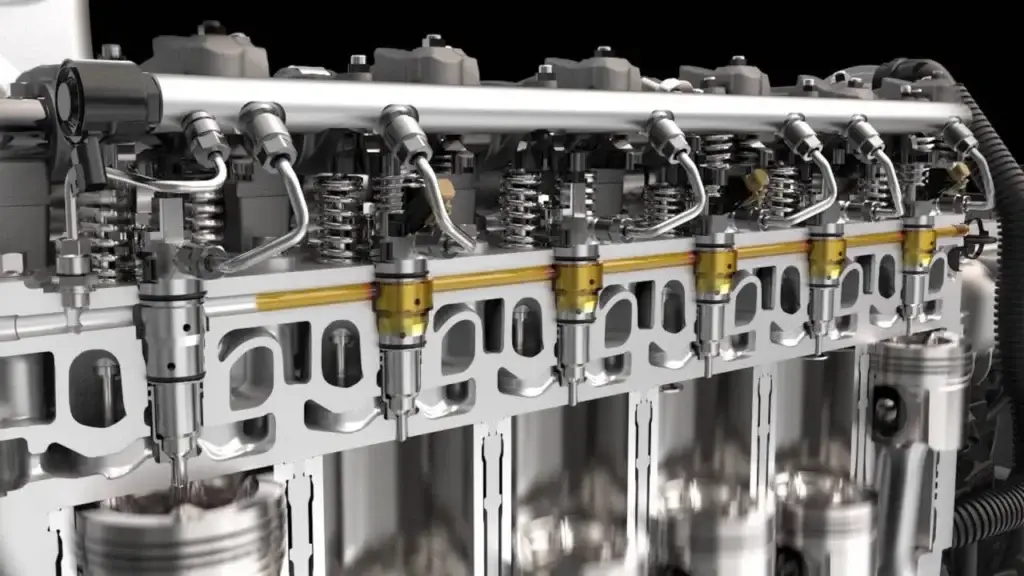
Fuel moves from the tank through a lift pump and filters to the high-pressure pump, which feeds the rail. The rail holds pressure so each injector can fire when the engine control module (ECM) commands it, and a rail pressure sensor reports the result so the ECM can correct it.
Common rail systems separate pressure generation from injection timing. The ECM can change when and how much fuel each injector delivers without changing pump speed, which is why faults so often show up as data first and as noise, smoke or a hard start second.
A pressure control valve, or a metering valve on the pump inlet, lets the ECM hold the rail at the target pressure. A return path carries surplus fuel back to the tank. When any of these misbehave, the rail cannot hold the commanded pressure and the ECM records a deviation.
The 2018 paper in the journal Combustion Engines on diagnosing common rail components from rail pressure uses the factory rail pressure sensor as a diagnostic window. Each injection event shows up as a small drop in the pressure signal, so a seized injector appears as a missing drop. The method is non-invasive, and it works because the sensor that controls the system also reveals the injectors.
The earlier version made claims about tolerances in four decimal places, said multiple injections double wear, and quoted an "Industry Technical Standard" that HDJ could not trace. None had a source, and all three were removed.
Tools and What They Can Tell You
The right tools make common rail diesel troubleshooting faster and safer, but none is needed for every job. The table pairs common tools with what each can show and where each stops. It is practitioner guidance built from the sources cited, not a purchasing list, and HDJ names no brands.
| Tool | What it can show | Where it stops |
|---|---|---|
| Scan tool with maker software | Codes, live data, some commanded tests | Basic readers miss maker-specific data |
| Digital multimeter | Voltage, resistance, continuity, voltage drop | Needs the maker's specification to judge a reading |
| Oscilloscope or injector signal analyser | Injector current and rail pressure waveforms | Takes training; papers used it on unnamed engines |
| Rated pressure gauge or test kit | Pressure at a maker-approved test point | Must be rated for the pressure and used by the maker's procedure |
| Graduated containers and hoses | Return or discharge volume where the maker allows | Limits come from the maker, not from a guide |
The scan tool is the first tool because it shows what the ECM has seen. Software from the engine maker reaches data and tests that generic readers do not. A generic reader can confirm that a fault exists but often cannot say which circuit or which cylinder.
The Wierzbicki paper used a signal analyser that records injector current signals and pressure through five channels. The authors argue it can diagnose faults the controller does not record without taking the system apart, and bench testing of the injectors confirmed what it found.
Electrical tools need care. Some injector designs cannot be judged by a simple resistance reading, and probing the wrong pin can do damage. Check the maker's procedure before you connect a meter, and use a voltage drop test where a connection is suspect.
HDJ found no verified test bench specification and no independent comparison of tool accuracy. As of October 2026, it makes no tool recommendation, and it treats a tool's own documentation and the engine maker's procedures as the basis for use.
Recognizing Symptoms
Symptoms tell you where to start common rail diesel troubleshooting, not what to replace. Hard starting, rough idle, misfires, power loss, smoke, poor economy and warning lights can each come from several parts. Write down the complaint in the driver's words, when it happens and whether it is steady or intermittent.
The two papers show how varied the symptoms are. In the Wierzbicki cases, blocked injectors caused hard starting, a jammed-open injector caused intermittent jerking and vibration, and a seized valve caused uneven idle. In the Karczewski test, a seized injector made the engine louder with more block vibration at idle.
Hard starting deserves a note. Low rail pressure during cranking is one cause, but so are weak batteries, poor connections and fuel problems, and cold weather adds its own causes to rule out.
Smoke is a clue to combustion, not a verdict on one part. The earlier version tied white smoke to coolant or glow plugs and black smoke to stuck-open injectors. HDJ found no source for those pairings and removed them, because smoke color depends on engine, load and conditions.
Codes and Live Data in Common Rail Diesel Troubleshooting
Reading codes comes before any test, and it should be done with the maker's software where possible. Store all codes, including pending and history, and the freeze frame data, before you clear anything. Clearing first throws away the evidence that shows when and under what conditions the fault happened.
A code is a starting point. The California Air Resources Board (CARB) heavy-duty onboard diagnostic data collection report says the suspect parameter number (SPN) and failure mode identifier (FMI) diagnostic is not always a direct indicator of the specific problem and can be a general indication of the malfunction. A rail pressure code points to a circuit, not a part.
For the code structure and how to read the common ones, see HDJ's guide to diesel engine diagnostic trouble codes. HDJ lists no individual code definitions here, because meanings differ by engine maker and the maker's tool is the reliable source.
Live data is the next step. Compare commanded and actual rail pressure, pump control values, engine speed and fuel temperature while the fault is present. The earlier version set a 200 bar mismatch as the limit. HDJ found no verified universal limit and removed it, so use the maker's range.
Key Recommendation
Record the codes and the live data before you touch a part. Compare commanded and actual rail pressure, read the codes as a clue to a circuit, and let the data decide what to test next.

Fuel Supply Checks in Common Rail Diesel Troubleshooting
Check fuel supply early in common rail diesel troubleshooting. A restricted filter, a weak lift pump, air in the line or water in the fuel can leave the high-pressure pump starved, and the symptoms look like a pump or injector fault. Many expensive parts have been replaced before the filter was inspected.
Start with what is cheap to see. Inspect the filters and the water separator, drain any water, look at the fuel in a clear container, and check for air or leaks on the suction side. Record what you find, because it also tells you whether the fuel supply is the real problem.
Measure supply pressure with the maker's procedure. HDJ's guide to diesel low fuel pressure covers the supply-side faults to rule out. The earlier version listed supply pressures for Dodge, GMC and Ford models, and HDJ removed them, since they could not be tied to a primary source.
The earlier version also said over 85 percent of common rail fuel system failures trace to water, and that diesel is hygroscopic. As of October 2026, HDJ found no independent source for the 85 percent figure or any failure share by cause, so it removed both.
Testing Rail Pressure and the Pump
Rail pressure testing in common rail diesel troubleshooting starts with the scan tool. Compare actual and commanded pressure at idle, under load and during cranking. The three views separate faults: a pressure that never reaches target during cranking points one way, while a pressure that reaches target and then wanders points another.
A pressure that cannot reach target suggests starved supply, a weak pump, a stuck-open valve or heavy leakage downstream. A pressure that swings suggests a sensor, a control valve or an injector leaking into the rail. HDJ offers these as practitioner reasoning, not a ranking by frequency.
The Wierzbicki case shows one pattern. An engine idled unevenly because a high-pressure control valve had seized, and the authors flagged a pressure change of more than 5 megapascals (MPa) as too rapid for those conditions. It is a result for one engine, not a limit to apply elsewhere.
The Karczewski test engine, a small Renault diesel, idled at about 35 MPa rail pressure, and the authors' test stand ran at 40 and 80 MPa. Those are examples from a light-duty engine and a bench rig. They are not targets for a heavy-duty truck, whose pressures come from the maker.
Pump tests that open high-pressure lines or measure discharge are maker-specific and hazardous. Follow the maker's procedure, and do not restrict the return line unless that procedure says so. HDJ's guide to high-pressure fuel pump diagnosis covers the pump in more detail.
Diagnosing Injectors
Injector diagnosis in common rail diesel troubleshooting combines scan tool tests, electrical checks and, when needed, a bench test. Start with cylinder contribution and any maker-supplied injector tests. They show which cylinder is off without removing anything, and they guide which injector to test further.
A signal analyser or the pressure signal itself can add detail. In the Karczewski test, a seized injector produced a missing pressure drop, and at 1,200 engine revolutions per minute only three of four expected injections appeared. The authors isolated the faulty injector by comparing its supply current with the pressure signal.
Electrical checks come next. Test the harness and connector for voltage drop and continuity before you suspect the injector, and measure injector resistance only against the maker's specification. The earlier version gave 0.3 to 0.8 ohms for all injectors, which HDJ removed as unsupported.
Return flow, or leak-off, testing is a common method for checking internal leakage. The earlier version gave a limit of 20 cubic centimeters per minute at idle. HDJ found no primary source for a universal limit, so the maker's procedure and specification should set it.
A bench test confirms the result outside the engine. In the Wierzbicki cases, bench testing agreed with the analyser's findings. A bench test is the strongest evidence before a warranty claim or a costly replacement, and it can show what a scan tool cannot.
HDJ's guide to diesel fuel injector failure covers failure signs and repair steps. Treat a failed injector as a prompt to look for the cause, such as fuel quality or a leak, before you fit a new one.
Replacement injectors usually need to be coded to the ECM. The service bulletin on injector trim code calibration for Volvo chassis, filed with the National Highway Traffic Safety Administration (NHTSA) says a hand scanner is the primary way to enter the codes when replacing injectors or switching engine management modules, and the matching Mack chassis bulletin says the same. Skipping coding is a known cause of rough running after injector work.
Sensors, Wiring and the Control Module
Sensors and wiring cause faults that look mechanical. A rail pressure sensor, a crankshaft or camshaft position sensor and the pressure control valve all feed or follow ECM decisions. Test their power, ground and signal circuits by the maker's procedure before you replace them.
A bad connection is a common culprit. Check connectors for corrosion, bent pins and loose terminals, and use a voltage drop test across suspect circuits. HDJ's guide to voltage drop testing shows how to find resistance that a simple continuity check misses.
For testing sensors by type, see HDJ's guide to diesel engine sensor diagnostics. The earlier version gave voltage ranges, resistance ranges and duty cycles for each part. HDJ found no primary source for them and removed them, since the maker's data differs by engine.
Control module faults are less common than wiring and sensor faults, and they should be a late conclusion. Confirm power, ground, communication and software updates first. If a module is replaced, the maker's procedure may require programming and injector coding.
Return custom software to stock before common rail diesel troubleshooting. The Environmental Protection Agency (EPA) enforcement policy on vehicle and engine tampering says products that change an engine control unit, commonly called tuners, might be illegal aftermarket defeat devices, and that software counts. A tuned engine also gives data that does not match the maker's tests.
Safety and Records
Safe common rail diesel troubleshooting respects the pressure, because a leak can injure. The recall record shows leaks are not hypothetical: the NHTSA recall report 21E-099 covers 10,938 Cummins X12 engines whose fuel tubes between the rail and the injectors for cylinders 4, 5 and 6 may crack, causing a high-pressure fuel leak.
⚠️ Safety Warning
Never check for a leak with your hand or finger. High-pressure fuel can penetrate skin. Wear eye protection and fuel-resistant gloves, relieve pressure by the maker's procedure before opening any line, and keep a Class B fire extinguisher within reach. If fuel is injected into the skin, go to a hospital at once.
The StatPearls review of high-pressure injection injuries says these injuries can look like benign puncture wounds, and that amputation has been reported in 30 to 40 percent of high-pressure injection injuries. It advises going to a hospital with a surgeon, elevating and irrigating the limb, and avoiding ice and compressive dressings.
The earlier version told readers to wait 10 minutes after shutdown. HDJ found no verified wait time that applies to all engines, so follow the maker's depressurization procedure. Keep the work area clean, cap open lines, and catch spilled fuel.
Records protect the next repair. Write down the complaint, codes, live data, tests, parts, coding steps and the result of the road test. Keep the old parts when a warranty claim is possible, and note the fuel source and filter condition.
Frequently Asked Questions
What causes common rail problems?
The sources HDJ found point to fuel supply and quality problems, worn or seized injectors, a seized control valve, sensor and wiring faults, and leaks in the high-pressure lines. HDJ found no independent source that ranks the causes by how often they occur, so diagnose in order and let the data decide.
Can a basic scanner diagnose common rail faults?
A basic reader can show that a fault exists, but it often misses maker-specific data and tests. CARB staff say a fault code can be a general indication of a malfunction, not a direct indicator of the part. Use the maker's software where you can, and confirm with live data and tests.
How do I test common rail pressure?
Compare actual and commanded pressure on the scan tool during cranking, idle and load, and use a rated gauge only at a test point the maker approves. HDJ found no verified universal pressure targets, so use the maker's specification and procedure for your engine.
What is a normal injector return flow?
HDJ found no primary source for a universal figure. The earlier version gave one, and HDJ removed it. The correct limit depends on the engine and injector design, so use the maker's specification and procedure. A leak-off result is stronger evidence when you compare it across cylinders.
Do new injectors need to be coded?
Usually yes. A Volvo bulletin filed with NHTSA says a hand scanner is the primary way to enter injector codes when replacing injectors or switching engine management modules, and a matching Mack bulletin says the same. Follow the maker's procedure for your engine and record the result.
What should I do if diesel fuel is injected under my skin?
Treat it as an emergency even if the wound looks minor. StatPearls advises going to the nearest hospital with a surgeon on staff, elevating and irrigating the limb, and avoiding ice and compressive dressings. Do not wait for symptoms to develop.
The Bottom Line
Common rail diesel troubleshooting is a matter of order: complaint, codes, live data, fuel supply, rail pressure, injectors, then sensors, wiring and the module. Use the maker's numbers, code the injectors after replacement and treat high-pressure fuel with respect. HDJ could not verify the figures it removed.
Michael Nielsen and the HDJ editorial team publish more diagnostic guidance at heavydutyjournal.com. On your next common rail job, write the complaint down first and record the codes before you touch a part, then follow the same order every time.
Share This Guide With Your Shop
Know a technician chasing a common rail fault? Share this guide with them. Michael Nielsen and Heavy Duty Journal publish it free at heavydutyjournal.com.